
Leonard Buckley in Translations
As Brian Friel’s pluralised title suggests, Translations is a play that holds multiple perspectives in constant tension, a play that examines the porousness of language and the way that it can hold entire cultures in miniature. Of course, all of the characters (who are mostly Irish) themselves speak in translated words of sorts. On stage, Irish is English, and English is also English, as we hear it. A hedge school in 1830s Donegal is translated onto the stage before us. The setting is not romanticised, but its characters are full of romance, richly drawn figures whose relationships are worn lightly while casting long shadows – performed in the Abbey Theatre’s fantastic new production by a wonderful cast.
The play is richly political, but political with a subtle small ‘p’. Caitríona McLaughlin’s production is engaged with the play’s contemporary significances, proving the play’s fundamental adaptability. First performed in Derry in 1980, the performance context is significantly different in present-day Dublin. Yet Friel’s words remain a potent comment on history and the present, forging an almost mythic tale out of the Ordnance Survey mapping of Ireland and the chilling spectre of famine. Friel contends that this story, with all its particularity, could be as fundamental as the Greek myths so beloved of the plays older – though oddly child-like – characters Jimmy and Hugh. Time is only proving this contention to be all the truer.
Translations startlingly enduring timelessness is located not only in the ever-relevant political context of the United Kingdom’s relationship to Ireland, but perhaps in an essence even more fundamental. Famously, Friel claimed that it is ‘a play about language and only about language’, a statement that seems easy to counter until you see that everything else it is about (history, myth, culture, identity, love, and the relationships forged between people) is built from the blocks of language and communication. The underlying philosophy is almost Wittgensteinian; the world is shaped by, understood with, and even made from language. Thus, the act of translation can never be neutral, for it is in the language, Friel suggests, that cultures flourish. To lose the language is an ‘eviction’ of their culture and identity.
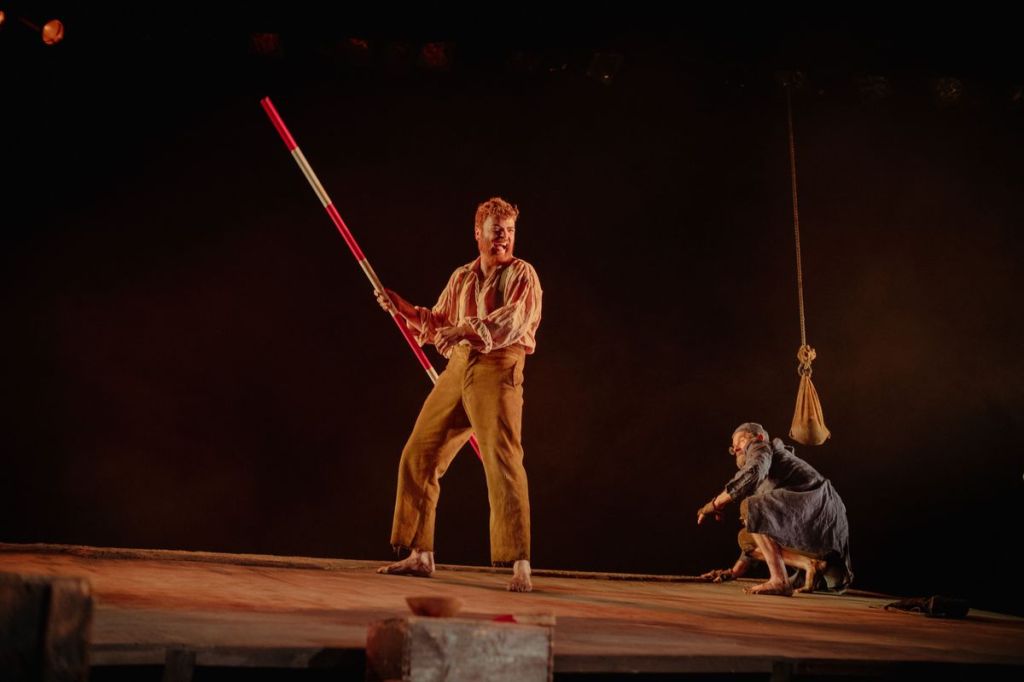
At the heart of the play is Owen, the ambiguous prodigal son returning home at last, acting as a bridge between cultures. He is at once the successful and outgoing wunderkind, quietly resented by his brother Manus for having the life he could not, and deeply compromised by his affiliation with the British Army. He is slick and shiny, as played by Leonard Buckley, bubbling with energetic enthusiasm. Beneath this bravado, there is the powerful sense that his career has entailed a cost to his soul – one that also saps away at his British fellow mapmaker, Lieutenant Yolland. Their task is to Anglicise – or as the British see it, standardise – the sound and spelling of Irish place names, measuring the land partly to levy more accurate (presumably higher) taxation and to imprint British authority on yet another overseas country.
Some of Friel’s most brilliantly intelligent writing is located in the scenes where Owen translates between military leader Captain Lancey and the hedge school’s occupants. Lancey is a perfectly ridiculous symbol of British imperialism in his assumption that the Irish characters will understand him if he talks loudly and slowly enough. Eventually, Owen steps into translate, his fraught collaboration laid bare in his attempts to smooth diplomatic relations through creative translation. He obfuscates the military’s more dominating demands while trying to protect his people, censoring their harsher responses. Yet miscommunication, Friel suggests, is likely to lead to disaster. At the end of the play, Owen’s efforts are hopeless in preventing the levelling of Baile Beag and the surrounding area in a series of increasingly vicious reprisals. Owen seems to realise too late that, quite the opposite of protecting his family and community, he has inadvertently led the wolf to the door.
McLaughlin’s production is filled with perfectly chosen touches. In one exquisite moment, late in the play, Zara Devlin’s Maire tries to explain where Yolland lives and finds herself turning to an impromptu map. Typical of Friel, mapping can be a dangerous, militarised and politically oppressive, but also tender, embodying a quest for knowledge and understanding – to reach out beyond one’s own boundaries and borders. Unlike in the stage directions, in which Maire’s ‘finger traces out an outline map’ on the ground, McLaughlin has Maire build an improvised three-dimensional model from the detritus of the hedge school. Stools and buckets denote small Norfolk villages, and Maire even scrunches up the map Owen has been making to signify an English landmark – with a place name she has learned and remembered in its original language. This is a map that seeks to understand and learn, rather than alter, homogenise or impose external authority.

Marty Rea is particularly compelling as a sometimes-ferocious, sometimes-gentle, heart-breaking Manus, a man whose life seems limited by others: the alcoholic father who fell across his cradle as an infant, leaving him with a lifelong limp; the brother who went on to brighter if not better things. He represents another way in which language can be weaponised as resistance; he refuses to speak English to Yolland, despite knowing it. Meanwhile, his beautifully ambiguous ache of a romance with Maire feels tenderly realistic. There is mutual affection, though both dream of a better life for each other and themselves. As the play develops, it is an inner flaw that comes to the fore however – his relative lack of ambition and unwillingness to stand up for himself against his father. It stymies the promise of happy, romantic resolution that the play’s first act offers. Manus does go on to find some of that ambition, but it is too late, when Maire has found someone else. All the while, Manus barely notices the affection Sarah, the woman who he is helping learn to speak, has for him – one of the play’s quiet tragedies, as Sarah stares at Manus, who stares at Maire, neither quite knowing how to express themselves.
In stark contrast, Yolland and Maire invent a breathtakingly beautiful love language of their own in the tender scene that opens the second half. Having been at a local dance together, elated by the atmosphere and each other’s company, they hazard a stumbling effort at a conversation, even though neither speaks the other’s language. Maire only has one sentence of English – the innuendo-laden ‘in Norfolk we besport ourselves around the maypoll’ – and Yolland’s laughter at the words leads her to panic hilariously that she has been tricked, having been taught something dirty. Yolland tries to extend a linguistic hand out to Maire in return but finds he only knows the place names – names that he has been working to replace, to eradicate. Yet Yolland is entranced by their beauty, increasingly certain that he is ill-suited to a life working for the Army or British Empire. Instead, he wants to learn Irish and attempt to integrate, Aidan Moriarty capturing the intense earnestness of his conviction with a beautiful solemnity. As they talk, a miraculous synergy builds between the two of them. Their uncertain ‘What-what?’ and ‘Sorry-sorry’ dialogue transforms into a stunning concordance of purpose: ‘Don’t stop – I know what you’re saying.’ Another potential romantic ending seems possible as they kiss in the moonlight – if only it could last.

It is Yolland’s disappearance after the events of this scene that drives the final act of the play, a largely quiet, meditative conclusion, even as violence is meted out offstage. Jimmy’s rambling, romantic entreaties to Athene, the Greek goddess he considers to be the finest woman of all, have a desperate, somewhat apocalyptic feel, reminiscent almost of Beckett. The eerie sweet smell – a harbinger of famine that ‘dooms [them] all’ – hangs over the stage, inexorably wafting like the dry ice. What remains though, even as the sappers destroy their homes and the potatoes rot in the ground, is language. McLaughlin follows Friel’s suggestion to end on a slow fade to black, the concluding ellipsis fading into silence, as Hugh describes events from the Trojan War. The play ends with his stories still ongoing. The stories will endure. The rich poetry of Friel’s writing seems perfect evidence that the Irish voice has not and be silenced, albeit with one vast caveat; the play is written and performed in English.
Translations
Written by Brian Friel, Directed by Caitríona McLaughlin, Set Design by Joanna Parker, Costume Design by Catherine Fay, LX Design by Paul Keogan, Sound Design by Carl Kennedy, Movement Direction by Sue Mythen, Casting Direction by Sarah Jones, Voice Direction by Andrea Ainsworth, Assistant Direction by Laura Sheeran, Starring Leonard Buckley, Ruby Campbell, Zara Devlin, Andy Doherty, Brian Doherty, Ronan Leahy, Aidan Moriarty, Marty Rea, Suzie Seweify, Howard Teale
Reviewed 26th July 2022
 Joshua Robey