Categories
theatre

Much Ado About Nothing – National Theatre, Lyttleton

Katherine Parkinson in Much Ado About Nothing

Much Ado About Nothing, Shakespeare’s early entry into the now-perennial genre of the rom-com, is a knockabout comedy driven in both drama and humour almost entirely by rich character motivation rather than coincidence or contrivance. It contains perhaps Shakespeare’s greatest pair of lovers as leads and has more sophisticated wit than most of the other happy comedies. In A Midsummer Night’s Dream, Shakespeare celebrated marriage in the joining of couples who seemed desperate to marry but were prevented by strict laws. Much Ado internalises these restrictions, making it unusually psychological for a comedy, as Beatrice and Benedick insist on their lack of interest in – and even opposition to – the institution of marriage, only to be undone by love. Yet beneath Shakespeare’s idealising of marriage as an expression of romantic love, there simmers a darkness that can be hard to overlook in the way men treat women.

It makes perfect sense to stage Much Ado as a light-hearted show as a tentpole of a summer season, and the National Theatre have done so in their Lyttleton auditorium this year with Simon Godwin’s delightful production. The Sicilian setting of Messina is now the Hotel Messina, a glamorous resort for the rich and famous (this Beatrice is a starry actor), which invests the production with a sense of holiday detachment. The shadow of the war from which Benedick, Don Pedro and Claudio have returned is rather faint here, bar the umber combat fatigues they wear in the first act and Benedick’s soon-trimmed stubble. By contrast, Christopher Luscombe’s pair of 2014 RSC productions, Love’s Labour’s Lost and Much Ado About Nothing (there titled Love’s Labour’s Won), were set in a melancholy Edwardian England, either side of the First World War. Here, the 1930s is treated as an aesthetic, rather than a time of particular political significance. The conflict is an unspecific one used as little more than set dressing. Instead, Godwin focuses on the ‘merry war’ of words in the waspish relations of Beatrice and Benedick. All of the drama is simply interpersonal.

But what interpersonal drama it is. John Heffernan and Katherine Parkinson are brilliantly cast as the play’s famous lovers in denial. Neither of whom can summon the courage to make the first move, shielding their interest in the armour of mutual dislike. They tie themselves in Gordian knots, philosophically opposing marriage in the strongest terms. Benedick in particular disavows the notion of marriage as anathema to his fiercely independent spirit; to marry would be to submit to state of perpetual boredom that means you ‘sigh away Sundays’ in lieu of meaningful entertainment. Yet his obsession with not marrying is apophatic, pointing to the deep desires he is not yet ready to admit. He would only ever countenance marriage if a woman managed to have ‘all graces’ – ‘fair’, ‘wise’, ‘virtuous’, ‘noble’, ‘of good discourse’. (Here, Heffernan’s reading of ‘and her hair shall be of what colour it please God’ alters the original meaning that it may not be dyed to make Benedick seem more endearing; as long as she has all such qualities, he says, her hair colour is irrelevant.) Benedick constructs an elaborately reasoned logical house of cards for why no woman would ever be fit to marry him, yet it comes tumbling down with the play’s most touching romantic cadence, as Benedick realises that there is one woman who fulfils, even transcends, his criteria after all.

Getting Beatrice and Benedick, ostensibly the play’s main characters, to confess their latent feelings is debatably the A-plot, though it is Hero’s story which has the most plot significance and drama. Benedick and Don Pedro’s young soldier friend Claudio wants to marry the hotel-managing Leonato’s daughter Hero, though he is too shy. Therefore, Don Pedro sets out to woo her on Claudio’s behalf. Yet a rift between Don Pedro (Ashley Zhangazha) and his brother Don John (David Judge) threatens to break everything apart. Don John initially lies to Claudio, that Don Pedro is secretly wooing her for himself, yet this is lie is resolved with relative ease – though the trustworthiness of Don John remains undisputed. Thus, Don John confects a new rumour: that Hero is having an affair. Don John is a forerunner of Iago, albeit without the charm. He does not recruit our sympathies like Shakespeare’s tragic villain, and nor is he successful in steering the course of the play towards his intended tragedy – though for a time it seems like tragedy has occurred, for some of the characters. Yet Don John unleashes the play’s other great psychodrama (alongside Beatrice and Benedick’s mental prisons that restrain their love) – a fear of infidelity. To be married is to risk being cheated on. The horn imagery of cuckoldry is frequent in dialogue, even in Benedick’s celebratory lines at the very end: ‘there is no staff more reverend than one tipped with horn’.

The play is proof that tragedy and comedy is all about perspective, the final acts playing like a perspective trick in which most characters believe Hero has died from the shock of false accusation (a similar fate as befalls Hermione in The Winter’s Tale, and from which she also appears resurrected). Meanwhile, the audience share the knowledge of Beatrice, Benedick and Leonato – that Hero’s death is faked, while Don John’s lies are investigated. The restoration of Hermione in The Winter’s Tale could be viewed as a second go at the Hero resolution, with more artful stagecraft. Here, there is the business of marrying a suddenly remembered sister, a messier series of events that leaves Hero as a largely speechless bride.

John Heffernan and Eben Figueiredo in Much Ado About Nothing

For the most part, the production’s tone is utterly blissful, the verse delivered lightly (especially well by John Heffernan, who seems in his element here). It takes a lot of skill, on the part of actors and crew, to make Shakespeare look this easy. The more challenging or outdated pockets of Shakespeare’s language are never allowed to get in the way of the entertainment, any unfamiliar phrasing smoothed over by the brisk pace. As a result, a relatively low percentage of the laughs come from the original wordplay, yet this Much Ado has a somewhat more sophisticated take on Shakespearean comedy than simply padding out the play with anachronistic ad libs. Instead, almost every scene is invested with a potent sense of situation. Anna Fleischle’s wonderfully revolving set evokes the bustle of a busy hotel during peak holiday season, while also helping to place every scene in a specific location, inside or out, rendering the comic flights of fancy far more particular than just zany interludes to spice up the script.

At times, scenes are composed of two elements, relatively simplistically juxtaposed: Shakespeare’s original words and unrelated physical comedy. This is particularly notable in the scene where Dogberry, now the hotel’s security guard rather than the Constable of Messina, delivers pompous instructions to his juniors before sitting (as we know he inevitably will) onto a piled-high plate of spaghetti bolognese that has been inexplicably present on stage since the beginning of the scene. The scene progresses hilariously as his assistants try to clean the residue of Chekhov’s pasta off his trousers while he remains continues to speak obliviously. The original script here is conspicuously, deliberately secondary in importance. In the Dogberry scenes in particular, entertainment is the highest priority.

Other moments utilise random comic business to heighten not only the humour but the characterisation of the play, such as the mirrored scenes in which Beatrice and Benedick overhear that the other has confessed love for them in secret (in rumours set about by the matchmaking Don Pedro). Benedick’s is a particularly funny sequence; he cocoons himself in a hammock to eavesdrop but falls painfully onto the ground below on hearing of Beatrice’s alleged affections. He then clambers across the set to listen, before secreting himself in an ice cream cart to overhear more closely. In a sequence of pure farce, Don Pedro, Claudio and Balthasar help themselves to ice cream – in the full knowledge that Benedick is hidden inside the compartment now revealed to be the cart’s built-in rubbish bin. They gleefully spoon ice cream and shower sprinkles onto Benedick, while remarking on how strong Beatrice’s love is. At the end, Benedick emerges through the bin’s hole, streaked with residue and trying to remain composed – an extremely effective comic sequence, even if Shakespeare’s hand is nowhere near it.

Godwin directs something similar for Beatrice in the following scene. However, the ice cream routine is understandably hard to top, and he is hamstrung a little bit the order of the play. Comic logic would dictate then that the funnier Benedick scene goes second. The enjoyable clowning of the Beatrice scene is entertaining (she ends up entangled in a beach changing tent, adopting the uniform of a passing porter), but it is not quite as viscerally amusing, lending it a slightly repetitious sense of anti-climax. It is unfortunate, but largely the case, that in this production the men are allowed to get the biggest laughs – both from their wit and their humiliation.

Ioanna Kimbook, Celeste Dodwell, Katherine Parkinson and Phoebe Horn in Much Ado About Nothing

The thinness of the female roles is felt noticeably in Ioanna Kimbook’s performance of Hero, which exposes the writing’s limitations, as many strong actors’ interpretations of Shakespeare’s female parts do. Kimbook wrings as much emotion and nuance as she can from a part that asks only that Hero is charmed into silence and then victimised. Particularly good are the scenes where Hero is enlisted into misleading Beatrice. Hero coolly intones about Benedick’s apparent affection for Beatrice, while getting hugely and hilariously frustrated at her companion’s unconvincing woodenness.


This production struggles to sell the romance with Claudio though. Eben Figueiredo plays him as fairly meek at first, which is pretty much as Claudio is written, youthful and shy, but this makes Hero seem even meeker in her silent delight at the match. The intention seems to be for a sweetly dorky union of two shy people, Beatrice’s meta-joke ‘Speak, count, ’tis your cue’ followed here by a comically protracted silence. Neither can find the words, at least in public, and the silence can only be broken by a kiss. Yet the result makes both characters seem a little too dramatically inert, Hero so unknown to us at this point that her silence is hard to read as either being overwhelmed with love or full of uncertainty and reservation. The first act is the production’s weakest (and possibly the play’s too). The substitution of Don Pedro’s villainy (in the mistaken belief that he is wooing Hero for himself) for the real cruel intentions of his brother Don John later on could be a highly dramatic tale of the psychology of betrayal – central to the play’s themes of misbelieved rumours, for good and ill, and adultery. Yet it plays out here as an unfortunate longueur in this otherwise snappy take, delivered with not quite enough dramatic intensity.

The other point at which the production comes a little unstuck is at the dramatic peak – the apparent revelation that Hero let in a gentleman at her window during the night before her wedding, revealed only during the ceremony itself. Claudio has been cruelly tricked by Don John and his associates (he mistook Margaret and her lover for Hero), but that cannot excuse the ferocity of his response – nor that of every male character in the play, bar Benedick and the good-natured friar, who discovers he will not be marrying anyone that day after all. It is, of course, in the original play, but the lightness of Godwin’s interpretation elsewhere cannot be easily squared with the torrent of pure misogyny unleashed into the play, which would feel unnecessarily cruel even were the accusations true.

The convivial Leonato has until then proved to be a warm and gentle father, blunting any of suggestions that the match of Claudio and Hero was arranged against her will. Yet now he turns into a toxic combination of Egeus (Hermia’s cruel father from A Midsummer Night’s Dream) and Leontes (the jealous king who flies into a rage, wrongly suspecting his wife Hermione of adultery in The Winter’s Tale). Leonato wishes his daughter dead, Rufus Wright playing the anger in a serious, violent register: ‘Death is the fairest cover for her shame that may be wished for.’ Patriarchal anger is certainly a valid tone to strike when staging Shakespearean comedy – which is often filled with dark, violent and threatening moments. However, it seems fundamentally jarring with the earlier tone of playfulness and even more so with the relative ease with which the play’s tensions are resolved. It is hard to feel that all can be simply and immediately forgiven – with either father or fiancé – especially as Hero has so little agency in the play’s ending, treated like a prop who can be summoned at will to complete the marriage as if nothing has changed.

The text itself gives only scant acknowledgement to the mountain that must be climbed to resolve the animosity of Claudio in particular. Claudio strikes a tone of attempted amity, but he misdirects the apologies towards a father who has just condemned Hero as strongly (believing Hero to be dead). Figueiredo impressively delivers the speech where Claudio asks him for forgiveness, diverging from Shakespeare, who has Claudio plead his innocence – saying ‘sinned I not, But in mistaking’. Figueiredo’s phrasing instead emphasises contrition over his technical (and extremely dubious) innocence. Godwin tries to enrich Hero’s meagre portion of lines by amending the script with lines from Shakespeare’s Sonnet 29, which she intones from under a veil at the funeral procession being held for her. The line ‘Like to the lark at break of day arising from sullen earth’ takes on the spinetingling register of resurrection, as she will seemingly rise from the grave in the next scene. Yet its deployment is largely to paper over the text’s utter silence on whether or not she still loves Claudio. Godwin’s answer is that she does, even if we can barely see why.

It is also curious that Shakespeare presents such an unusually brisk resolution. The final scene runs to only 120 lines and contains the unions of Hero and Claudio, Beatrice and Benedick, and the entreaty that Don Pedro ‘get thee a wife’. The equivalent scene in Twelfth Night runs to 400 lines, Measure for Measure almost 550, while Love’s Labour’s Lost closes with the longest single scene in Shakespeare – a notorious 900 lines (over a third of the entire play). While Much Ado has somewhat less ado to remedy in the final scene (in terms of pure plot mechanics at least) than any of these plays, there is perhaps a greater deal of emotional complexity to deal with. Shakespeare seems to sidestep the difficulty of emotionally rehabilitating Claudio and Hero’s marriage; instead, he makes it work only practically, in securing Leonato’s consent. Hero’s willingness to marry and her forgiveness will always be an issue for a director of the play to negotiate, and Godwin’s decision to play it relatively straight (bar the added sonnet) does not fully assuage our potential concerns.

The show closes with a joyous musical number, performed by the entire cast and the jazz band who pop up charmingly throughout. No notes of melancholy remain; all is forgotten by the characters on stage, but whether we can forget is quite another matter. The tone is so fantastically calibrated for the most part – Heffernan’s attention-seeking impishness mixing particularly well with Parkinson’s blend of ice and acid. Yet the limits are exposes in the Hero plot. The recurring issue of whether Shakespearean men deserve forgiveness is hardly improved by going so unacknowledged. Despite this, Godwin’s production channels its actors’ brilliant chemistry into one of the most entertaining and watchable Shakespearean comedies I have ever seen, even if this comes at the cost of the overlooking play’s more challenging darker depths.

Much Ado About Nothing

Written by William Shakespeare, Directed by Simon Godwin, Set Design by Anna Fleischle, Costume Design by Evie Gurney, Lighting Design by Lucy Carter, Movement Direction by Coral Messam, Composition by Michael Bruce, Sound Design by Christopher Shutt, Fight Direction by Kate Waters, Associate Set Designer Cat Fuller, Music Associate Lindsey Miller, Company Voice Work by Jeannette Nelson, Staff Director Hannah Joss, Dramaturg Emily Burns, Music Direction and Guitars played by Dario Rossetti-Bonell, Drum Kit played by Shane Forbes, Upright Bass played by Nicki Davenport, Woodwind played by Jessamy Holder, Trumpet played by Steve Pretty, Starring Katherine Parkinson, John Heffernan, Ioanna Kimbook, Eben Figueiredo, Rufus Wright, Ashley Zhangazha, David Judge, Phoebe Horn, Wendy Kweh, David Fynn, Al Coppola, Celeste Dodwell, Olivia Forrest, Ashley Gillard, Brandon Grace, Nick Harris, Kiren Kebaili-Dwyer, Marcia Lecky, Ewan Miller, Mateo Oxley
Production Photographs by Manuel Harlan
Reviewed 23rd August 2022
Categories
theatre

Henry V – Donmar Warehouse

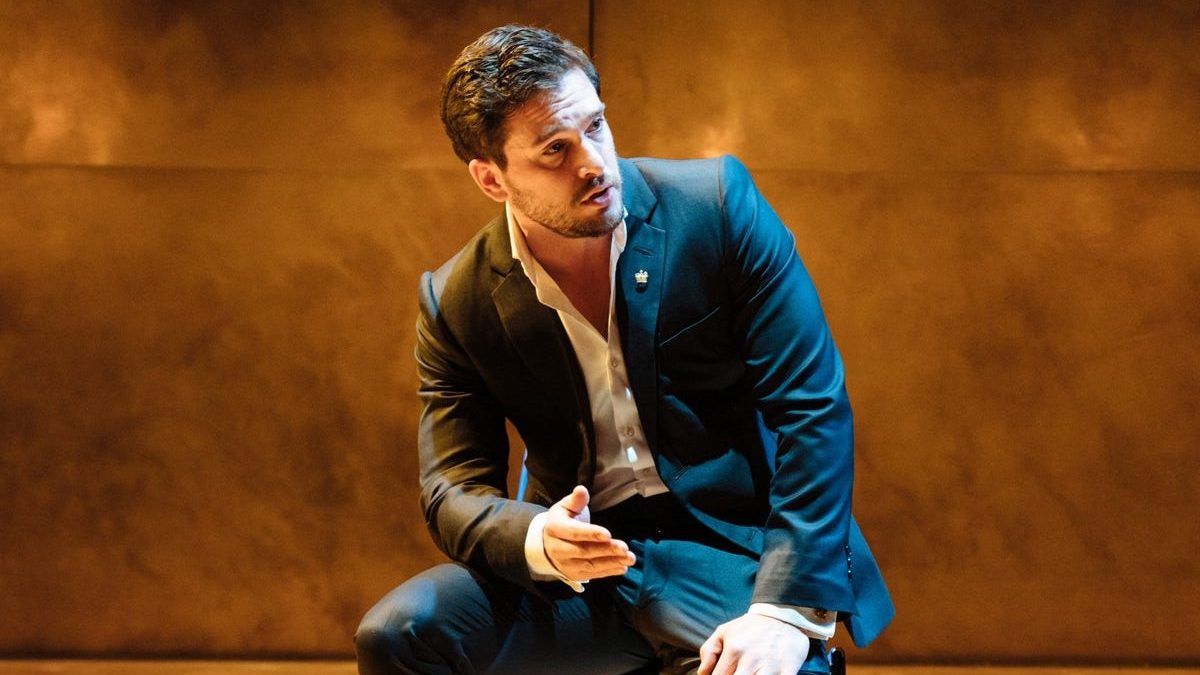
Kit Harington in Henry V

Shakespeare’s war drama Henry V has on various occasions been programmed, staged and filmed with a calculated and deliberate geopolitical message. In 1944, late in the Second World War, Laurence Olivier’s patriotism-drenched film version cast Henry as a brilliant military leader enjoying a deserved triumph over the French. That the French had become allies did not stop the sentiment, and the film was even dedicated to British soldiers ‘whose ancestors it has been humbly attempted to recapture’. More recently, the National Theatre’s 2003 production was received largely as a strong, satirical critique of the UK’s involvement in the Iraq War, treating Henry’s invasion as largely unjustifiable, paralleling British and American military action. Yet in this new, just as timely production, the resonances are shockingly coincidental, yet startling to watch.

Max Webster’s stirring staging echoes the combat fatigues and gritty violence of Nicholas Hytner’s Iraq War critique, yet Webster leans far more into the play’s notorious ambiguity, rather than espousing the clearly ‘pacifist leanings’ Michael Billington identified in 2003. This is not to say that Webster presents war as anything less than a nightmarish horror, which is intensified by Fly Davis, Carolyn Downing and Lee Curran’s terrific design (of set, sound and lighting respectively). Yet Webster’s nuance is slightly, and unavoidably, blunted by the shadow of world events which hangs across the play – obvious long before Kit Harington’s curtain call address, in which he notes that Henry V is a play about invasion, before asking the audience to spare some change for the humanitarian relief effort in Ukraine.

Shakespeare’s depiction of the cost and violence of conquest grimly mirrors Russia’s ongoing attempt to invade Ukraine. This run was announced in mid-2021 and the invasion began a fortnight into its run – though the growing prospect of conflict surely hung over the rehearsal period – so its staging is only a tragically apt coincidence. Thus, there are not direct references made in the play itself. Instead, this already electric staging flickers with a palpable unease, that while the stage is filled with impressive military choreography (from fight director Kate Waters, movement director Benoit Swan Pouffer, and with additional guidance from former Royal Marine Commando Tom Leigh), this is happening for real elsewhere. This is merely a ‘wooden O’, in which war is simulated.

Millicent Wong is terrific as the Chorus, implicitly justifying the role’s presence in the play. (Such a persistent narrator is unusual for Shakespeare.) Yet the infamous apology for the limitations of the stage that opens Henry V seems less necessary than usual. The production inclines to bombast (incredibly effectively), with guns, military manoeuvres and the ever-present sound of circling helicopters. There is no need of ‘imaginary forces’ – Shakespeare’s pun describing mental faculties and pretend armies – when the production depicts semi-realistic modern warfare before our eyes. And yet, scenes of war are now so present on the news, it also seems obvious to suggest that theatre is inadequate in depicting it.

Norman Rabkin famously compared Henry V to drawing of an animal, variously seen as either a rabbit or a duck. Most people can see both at will, mentally switching between the right-facing rabbit and the left-facing duck. However, no matter how hard you try, you cannot see both at once. In Rabkin’s reading, the character of Henry and the moral justifications for the war are like the rabbit-duck. Henry is either a heroic leader of one of England’s crowning military triumphs, or he is barbarous example of the brutality and folly of war. (As the Chorus reminds us at the play’s conclusion, Agincourt’s gains will be lost under Henry VI.) For Rabkin, this ambiguity is to be relished rather than resolved. ‘Mystery is their mode’, he writes, of Shakespeare’s ‘great plays’; ‘the questions aroused by them seem unanswerable’. Thus, to direct Henry V is to either decide on a reading or attempt to embody this tension – leaving the play functioning as a moral challenge for its audience to decode.

Webster strikingly leans into the latter, though it is even more difficult to harbour sympathy for a violent invader now than usual. In this production, the play seems deliberately structured as a series of moral tests. Is Henry admirably ruthless in his determination or a perpetrator of undue, merciless cruelty? In an attempt to bolster the presentation of Henry as a person in his own right, rather than the politician or war leader he appears as in most versions of the play, Webster lifts from Henry IV Part 2 to craft a new opening sequence, in which he is decadent and wayward figure. The Chorus’s Prologue ends with the onset of pounding music, Henry staggering onstage in a stained office shirt, enjoying Bullingdon Club-esque hedonism, and vomiting in the middle of the stage. It is swiftly cleared up, but the smeary remnants glisten under the lights for the next eighty minutes until the interval. Soon he is thrust into power by the death of his father (Henry IV). Yet though he suits up into a suddenly more respectable, disciplined leader, the loutish behaviour lingers in the mind.

Kit Harington in Henry V

The first true test comes in Act 1 Scene 2 of the original Henry V, beginning a trend in Webster’s drama to retain and spruce up the more intractable monologues, rather than simply cutting them. This does make for a long show (over three hours in all), especially given the addition of the opening, yet Webster’s directorial innovations and interventions are compelling and hugely effective. Here, in one such flourish, the Archbishop of Canterbury’s rather turgid explanation of Henry’s claim to the French throne is delivered via PowerPoint presentation. In a neat inversion of the usual audience slump, the characters on stage are visibly bored – yawning, sighing and even swearing when he adds reason after tenuous reason for Henry to stake his claim. Instead, we laugh at the tortuous logic and spider web of a spider web of a family tree, shown in Andrzej Goulding’s superb video projections. That Henry can be convinced by this seems surprising though, and it even grimly evokes Putin’s thin justifications for supposedly ‘liberating’ Ukraine. Henry’s actions are, of course, predicated on an argument about monarchical legitimacy that ignores how the French would self-determine their own nationality.

Henry sits quietly in this scene, epitomising that much-coveted, but nebulous quality of statesmanlike-ness. He has gained authority from his sudden promotion, though perhaps his rigid, silent demeanour is also that of a man still trying to sober up. For all the production’s tendency to overwhelm, Webster plays these subtler moments well; Henry’s power is demonstrated by the simple fact that he is the only one with a chair. After surviving the archbishop’s presentation, Henry is persuaded – calling on ‘God’s help’ to speed their victory, though really it is the vast pledge of church money in support of military action that has tipped the scales for the King. At the end of Act One, Henry is presented with a provocative gift of tennis balls from the Dauphin, an insult to Henry’s ‘youth and vanity.’ Yet you feel the ethical cogs whirring in Webster’s drama; they are derogatory, yes, but are they really an acceptable justification for violent incursion? Yet, Harington explodes with rage, and you feel that ‘chid[ing] this Dauphin at his father’s door’ is hugely understating his aims.

The first half proceeds with a measured pace, next testing Henry with the revelation of the Earl of Cambridge’s plot to assassinate him. The dramatic irony hangs thickly in the air as he tricks them into signing their own death warrants. He tells them of a man who, in drunken excess, ‘railed against our person’. Yet he proposes merciful treatment and allows the plotters to argue against leniency. Accomplice Scroop insists ‘Let him be punished, sovereign, lest example / Breed by his sufferance more of such a kind.’ All three betrayers are in agreement; a King must be feared as well as loved, cruel and kind. Thus, Henry presents them with papers, detailing their own treasonous crimes. When they make their inevitable pleas for mercy, Henry simply gestures to their own hypocrisy. Harington plays Henry here as a clever schemer, his lines half-test, half-trick – playing on the public loyalty everyone must show to him in making them argue against clemency. Shakespeare implicitly questions Henry’s actions; are they start of a slippery slope towards the cruel and dictatorial, or the actions of a just King, only hanging them with their own rope?

This question is, horrifyingly posed again before the interval, when Bardolph is hanged for alleged stealing from a church. While Henry is theoretically upholding a moral standard, in staking a dubiously rightful claim without unnecessary violence or larceny, Webster plays the moment as a grimly mechanised public spectacle – displaying Henry’s swollen power for all to see. Henry watches remorselessly as her body twitches above Donmar’s stage, even though Webster’s additions from Henry IV Part 2 show his youthful friendship with Bardolph, suggesting perhaps that they might have been lovers. There is a potent sense, by this point, that Henry might have gone too far – the killing sapping the morale of Henry’s old Eastcheap friends, Pistol and Nym, and even threatening the customary comic subplot’s mirth.

Kit Harington in Henry V

John Sutherland and Cedric Watts famously place Shakespeare’s Henry on trial in Henry V, War Criminal?, ascribing him that anachronistic moniker, though it has an important partial echo in the original text. After Henry has decided to execute the French prisoners of war, Welsh soldier Llewellyn objects as it is ‘expressly against the law of arms’. Webster slightly updates the phrase to the ‘rules of battle’ – a deliberate shift away from codes of chivalry, respect and fairness, towards modern concepts of human rights and conventions of war. This decision to contravene these rules is the clinching piece of evidence for Sutherland and Watts – as it was in a 2010 mock trial Washington, D.C., which included Supreme Courts justices Samuel Alito and Ruth Bader Ginsburg, where they unanimously found against Henry in the matter of executing prisoners. It is the darkest moment of moral testing in the play, and Webster makes it look for a brief moment like Henry has caught himself in the midst of his tyrannical violence and might retreat from it. Yet instead, defiant of his soldiers’ reluctance, the king graphically slits the throat of one of the prisoners before restating his order. Webster places blood firmly on Henry’s hands.

Yet even amid this horror, there is the rabbit-duck of admirability in amongst the violence. As much as the throat-slitting is a horrifying signifier of just how far Henry has gone, it also, rather perversely, shows him to be a man who leads from the front. He never expects his soldiers to do something he would not be willing to do himself. Henry even skulks covertly around the camp the night before battle, attempting to boost morale. By contrast, the Dauphin avoids the actual fighting, but is still rewarded. Despite the scepticism towards many of Henry’s actions in Shakespeare’s text, Henry’s victory comes through effort, while the French are far from sympathetic victims.

A crucial point after Henry’s victory is his confrontation with Michael Williams (here, one of many gender-swapped roles, like Bardolph). During his night incognito, Henry ends up embroiled in a rather contrived dispute, which leads to the promise of a delayed ‘box on the ear’, if he were ever to come up to her and say, ‘This is my glove’. Of course, Henry eventually does so, prompting immediate terror from Williams as she realises her jest of a threat is now treasonous. Yet Henry pardons the soldier, despite an ominous sense that he might turn against his own army into a completely tyrannical autocrat, more in the vein of Richard III. Instead, Harington’s features crease with warmth and he good-humouredly demands that her glove be filled with money. The stage devolves into a wild party, with drinking, dancing and the blasting underscore of Darude’s ‘Sandstorm’.

Millicent Wong in Henry V

In Shakespeare’s text, this could be read as a pivotal moment of transformation in Henry – the point at which he looks over the precipice, but without falling (as many others have done in the rise-and-fall de causibus tragic form, found variously in history plays such as Richard II and Richard III). A structural reading would align Henry V’s conclusion with the genre of comedy – ending as it does with the wooing of the King of France’s daughter, Katherine, and the promise of their marriage. Yet, typically, Shakespeare infuses a rich ambiguity in these final scenes, a gift to directors (like Webster) who wish to take a more sinister interpretation.

This production treats the awkwardness of the play’s comic resolution as the last of the play’s moral tests, one which – for me – Henry completely fails. Though attempting to be amorous across the language divide, Harington soon turns off Henry’s charm. He is brokering a military deal, as the victor, and as a result his requests are actually demands suffused with a threat of violence and destruction. There is no way that he could straightforwardly court Katherine’s affection. Anoushka Lucas is a standout as Katherine, playing her with a steely determination and wringing as much pathos as possible from her character’s hopeless situation – despite the limitations of the relatively small role. In this staging, the fairly early play Henry V seems to foreshadow the dark undertones of The Winter’s Tale’s resolution (and those of the other late plays), in which the (seemingly) resurrected Hermione does not directly forgive or even address her husband Leontes, whose groundless accusations of adultery led to her apparent death. Leontes hurries everyone offstage before the potential powder keg of unspoken feelings can detonate – and perhaps lead to further tyrannical violence. As with Henry V, Shakespeare’s language denies us the happiness we might expect from the marriage plot’s structural comedy.

Henry V is the third biggest role in Shakespeare – both by raw line count and percentage of the play’s dialogue (32%) – yet I was struck by how small the role felt here, especially in the first half. Kit Harington is cannily cast; of course, his presence will sell tickets, yet he also exudes a quiet celebrity, which fits this interpretation of Henry as a slick-suited, potentially populist monarch. Though Andzrej Łukowski contends in his Time Out review that this production ‘approach[es the play] as a great character study’, I was left with the quite contrasting sense that the play was asking us to judge – as the public, perhaps even as voters – whether we found the King and his actions justifiable, ethical and moral. The frequent projections of Harington’s face on the back wall serve a powerful sense that he is a national leader whose inner thoughts remain largely inaccessible to us. Henry here almost seems like a new take on the Chorus’ invocation ‘Into a thousand parts divide one man’ – not only an entreaty to imagine the stage much wider in scope, but a comment on Henry’s fractured self. He is many things to many people – more of an idea than a psychological presence, and more of a motivational speaker than a soliloquist. We judge him from a distance, rather than suffer with him – as we might with Lear, Macbeth and Lady Macbeth, or Prospero.

Kit Harington in Henry V

Much of the production plays like a glossy modern miniseries, combining stylised stage imagery with realistic verisimilitude. The funeral of Henry’s father (Henry IV) is an operatic, epic scene of stately slow-motion, the Donmar’s medium-sized stage filled with black coats and wet umbrellas. Later, Webster chooses to translate the French scenes back into their original language (with surtitles), a cleverly disruptive choice which elevates the French characters from comic ciphers by giving them their own voice. It forces the audience to engage with the words and lean in, rather than let the drama simply wash over them. Yet it also signifies the French characters’ own defined, different culture – equally real on stage, avoiding the sense that the play is being performed as a history told by the English victors. Even the ostensibly comic scenes crackle with a violent danger. The rather unwieldly comedy of the only originally French scene, in which Katherine learns the English words for body parts (‘de fingres’, ‘de hand’, ‘de bilbow’ and so on) is energised by being set to boxing session. Katherine sharpens her defences, physical and linguistic, knowing that she will likely be part of the peace settlement with Henry.

It is a marvel how well the production’s chaotic clash of imagery works. War is rendered as a baroque spectacle, underscored with live choral music from a quartet of actor-musicians, yet it is also hi tech, with sonar pings, helicopter blades and automatic weaponry. As the army goes ‘Once more unto the breach’, the gold back wall of Fly Davis’ set splits apart into four parts, with red lights blazing through the gaps – a vast St George’s Cross, underlining the pungency of nationalism in this Henry V. England are loutish victors, the flag in the set design literally setting alight as the stage fills with a debauched carnival of celebration, giving a new meaning the Chorus’ earlier statement that ‘all the youth of England are on fire’. Now they are on fire with antisocial raving.

Before the play begins, a quotation is projected on the back wall of the stage: ‘There is no document of civilisation that is not also a document of barbarism.’ Walter Benjamin’s statement chimes with Rabkin’s polysemy, inviting the audience to judge – weighing the evidence, as well as potentially condemning Henry. It is a testament to the intentional ambiguity of Webster’s production, though this neutrality is crushed by the weight of real-world events. Strangely, the actions of Putin make this production seem like a far more definite critique of English nationalism than was perhaps originally intended. For all the play acts as a literary optical illusion, flattering Henry with good qualities of bravery, leadership and determination as well as bad, in Webster’s ambitious take, rhetoric can only distract from Henry’s moral outrages – in no way excusing them.

Henry V

Written by William Shakespeare, Directed by Max Webster, Design by Fly Davis, Lighting Design by Lee Curran, Sound Design by Carolyn Downing, Video Design by Andrzej Goulding, Movement Direction by Benoit Swan Pouffer, Fight Direction by Kate Waters, Casting by Anna Cooper, Composition by Andrew T Mackay, Starring Kit Harington, Jude Akuwudike, Gethin Alderman, Seumas Begg, Claire-Louise Cordwell, Kate Duchêne, Olivier Huband, David Judge, Melissa Johns, Danny Kirrane, Anoushka Lucas, Adam Maxey, Steven Meo, Joanna Songi, Marienella Phillips, Millicent Wong
Production Photographs by Helen Murray
Reviewed 12th March 2022
Categories
theatre

The Comedy of Errors – Barbican (RSC)

Guy Lewis and Toyin Ayedun-Alase in The Comedy of Errors

Most directorial takes on Shakespearean comedy (in Britain, at least) tend to conform to one of three approaches. The first is simply to do the play, trying to milk laughs where they are to be found but largely treating the play as fixed and sacrosanct. The whole thing is much a ritual as a performance. Another option is to mine in the psychological hinterland of the play on stage, as critics and scholars have done to the text. Jan Kott notoriously and violently reads A Midsummer Night’s Dream as a vehicle for characters’ repressed instincts towards sado-masochism and bestiality. On stage, this darkness, earthiness and (quite literal) animal passion have been mined in Robert Lepage’s mud-spattered National Theatre production in 1992, and Joe Hill-Gibbins’ similarly boggy Young Vic version in 2017. In the same vein, Tasmin Greig’s Malvolia (in Simon Godwin’s gender-swapped National Theatre Twelfth Night in 2017) was no mere comic dupe; instead she was perhaps the play’s main character, heartbroken and victimised by notionally comic cruelty.

The final approach, however, is to approach the play as an existing structure onto which all manner of contemporary gags can be added. It is fair to say that Breen largely opts for this, to terrific effect – though the occasional Shakespearean rough edge remains unsmoothed. Yet also, to this heady mix, he adds just a splash of psychological richness and, while the results leave the heartstrings largely un-tugged, the production at least provides a warm glow of satisfaction at its resolution. It is hardly surprising that The Arts Desk aptly branded it a ‘Shakespearean Christmas panto’.

Nicholas Prasad, Avita Jay and Rowan Polonski in The Comedy of Errors

Breen stuffs the show full of all manner of props, beginning at the very start, with its exceptional quartet of singers (Alex Saunders, Dunja Botic, Dale Harris and David Jones) testing out their microphones. ‘1, 2’, ‘1, 2’, they say, in the first of many clever touches, foregrounding the play’s distinctive doubles from the outset. Paddy Cunneen’s music is truly extraordinary. Its riotous energy perfectly evokes the chaotic, yet intricately interweaved narratives of the central characters. The a cappella singing somehow brings to mind hip hop beats and Medieval plainchant all at once. This genre-blending vibrancy is matched by a Max Jones’ majestic set, which mirrors the play’s almost mathematical structure in its checkerboard and isometric designs. The colour scheme is unusually vivid, with the golden browns typical of ancient world sets (of stuffier, more traditional Shakespeare productions) offset by bright pinks and the azure-blue of the Mediterranean Sea.

Into this well-conceived space, the production places many comic routines, which often take little more than a minor cues from the original text. Yet Breen generally manages to serve side-splitting laughs while still serving his characters well. While at dinner, Antipholus of Syracuse (Guy Lewis) is propositioned by Adriana (Naomi Sheldon, who gives perhaps the most complex performance of the play). She confuses him for her husband Antipholus of Ephesus and expects him to come home with her. Antipholus of Syracuse’s initial discomfort at her physicality is signalled by his getting out a bottle of hand sanitiser, to sterilise him of the bodily contact. The audience laugh at Lewis’ characterisation of Antipholus as a bumbling, out-of-his-depth Englishman abroad, as well as the meta-irony of the prop and the new significance it has acquired the last two years. (Similarly, the abbess who appears at the end wears a face mask; she is the doctor who will heal the play of its madness.) Yet as Adriana steps up her seduction attempts, a sudden spasm sends a (rather ejaculative) spurt of hand sanitiser high above the stage, towards the audience. It is a magnificent physical gag, but one that speaks to Antipholus’ sordid delight at his circumstances – deciding to play along with the strange events that befalls him due to his misidentification in Ephesus.

Later on, the Syracusan Dromio and Antipholus discuss Dromio’s comparative experience of female attention in Ephesus, from a very large women who works in the kitchen. This leads to a section of the text which most directors would surely cut before even beginning with the play, in which parts of her body are compared to various nations of Europe in an overwrought inversion of a poetic blazon. Caroline McGinn’s relatively critical review in Time Out singles out this moment as part of why the play is ‘unmodernisable’, given how it relies on crude jokes about fatness to pad out its scanty plot. Certainly, Breen’s addition of a fourth-wall breaking interjection from Dromio that ‘these jokes are 400 years old’, telling us that we should try a bit harder to laugh, is likely to be divisive. Perhaps the 400-year-old excuse does legitimise it a little, or at least somewhat neutralise critical dissent – especially when compared to the pure, artless gratuity of the fat jokes included in the National Theatre’s disastrous Manor.

Yet Breen is decidedly not putting this play on stage for the sake of faithfulness alone. His take is (often brilliantly) filled with directorial liberties, so amending or excising the crasser moments of the text would have been entirely possible and in keeping with the production. Instead, it feels like half an attempt was made to rescue the poorly aged material. Adopting an ironic distance from the text, Antipholus and Dromio posture as bawdy club comics, tapping invisible microphones (their voices amplified despite the lack of mics) and delivering the material with knowing eye-rolls. As a result, the audience go for it merrily. Indeed, on the night I saw it, it led to a fantastic moment of (I think) off-the-cuff audience interaction, when a heckler in the stalls was put down with the quip: ‘I thought I was the one with the imaginary microphone.’ I can see why Breen decided not to lose this section, but perhaps he would have been right to.

Otherwise, it is a terrifically considered and exquisitely detailed production. Breen ensures there’s never a dull moment and fills the stage with all kinds of business. Even the extras are given miniature narratives. A bored film crew, hired to document some kind of grand opening, come alive with gonzo journalistic excitement when violence erupts. In the second half, a man slowly walks back and forth upstage, carrying a comically increasing number of shopping bags from the RSC gift shop. At the heart of the production’s detail is the decision that almost everyone on stage should be angry with each other – apart from the Dromios, and Antipholus of Syracuse. The incidental characters become quietly incensed. A diner in a restaurant scene is visibly irate when his chair is purloined so that Antipholus and Dromio can sit down – peppering in extra laughs while also subtly increasing the play’s intensity. Later, one of the singers is rendered livid when Dromio steals her microphone. It is entirely in keeping with the original play that the main characters’ unwitting presences in Ephesus are an irritation, even causing material harm, to the people that live there.

As brilliant as the production is, it would be fair to say that Shakespeare provides an organising structure to which comedy can be added, rather than being the true source of the comedy. Unlike in The Wife of Willesden, say –Zadie Smith’s reworking of Chaucer to contemporary Kilburn – the jokes are largely additions here, rather than finding the humour in the original. Perhaps The Comedy of Errors is simply less fertile material than The Canterbury Tales. Indeed, placing an early work from Shakespeare next to Chaucer in his prime arguably makes for an unfair comparison. Shakespeare’s comedy here comes not from exposing fundamental truths about the world than from wordplay – and comic language in The Comedy of Errors is fundamentally obscuring, rather than revealing. In Ephesus, speaking is an invitation to be misunderstood.

The farce plot certainly creates the right conditions for comedy, but Breen brings it to life by envisioning new jokes. One such triumphant comic routine recontextualises Shakespeare’s leaden series of puns on the baldness of Father Time in Act 2. The punning now begins after the obsequious waiter bends down to pour wine, when his hair flips over – revealed as a toupee. The references to ‘bald pate[s]’, ‘periwig[s]’, and ‘bald conclusion[s]’ now function as an extended mockery of the waiter – hardly sophisticated, but virtuosic in its delivery and transcending the fundamental aimlessness that often pervades The Comedy of Errors. Yet what truly delights is not the puns themselves, but the waiter’s visible anger at the socially inferior Dromio being juxtaposed with toadying sycophancy towards Antipholus.

Naomi Sheldon and Jonathan Broadbent in The Comedy of Errors

One criticism that could be levelled at The Comedy of Errors is its sheer redundancy. Its plot is perhaps too mechanical. It ticks like a clock (and indeed, the text is liberally scattered with time imagery). Arguably its characters all have a similar problem as those in Chekhov; if people just listened to each other, then maybe everything could be sorted out. Yet their inability to express themselves and communicate is no great tragedy, only intensely irksome to all involved. The overarching threat to the life of Egeon is purely structural and legal. The Duke wants to let him off, but the law will not let him. Only by the end of the play, does he decide to pardon Egeon, and refuses to accept the ransom required for such a stay of execution. Two and a half hours, revealing the chaotic, maddening excesses of bureaucracy, is seemingly enough to change the Duke’s mind.

A darker version of the play would likely emphasise the toll on Antipholus of Ephesus, a pillar of the community plunged into a Kafkaesque nightmare, locked out of his home by over-zealous instructions to a guard and payment demanded of him for a chain he has not received. I also wondered about the political implications of the text. As a story of misidentification, assumptions and a refusal to engage and listen to what is actually being said, the play is arguably a proleptic satire on the effects of echo chambers.

Though Breen’s production is certainly not angling for a weighty political message – and nor should it – he does address some of the other ‘unmodernisable’ aspects surprisingly well. The groan-worthy misunderstandings that grate on the page are played with such wildly comic energy that they are sold remarkably well. The play’s darker aspects are well-handled too. While keeping the overall effect light as a feather, Breen imbues the violence with some heft. The lighting darkens and the music loses all vestiges of irony, the production seemingly withdrawing its support for these moments – or at least mounting a critique of its characters – without losing its otherwise tightly wound structure. It refuses to trivialise the master-servant violence, compared to the overt slapstick meted out to Antipholus of Ephesus. When the Ephesian Antipholus and Dromio are captured and tied together as punishment, Breen even uses this to make a smart connection to the shipwreck they survived as children, lashed to the mast together. The production suggests just a whiff of trauma, finally resolved by the play’s remarkable resolution (which almost resembles those of the late plays, especially Pericles).

The play ends with the two Dromios on stage. They will ‘draw cuts’ (or lots) for which twin gets to be the senior, but only after the play has finished. For now, they will ‘go hand in hand, not one before the other.’ As the singers’ refrain ‘one, two’ is heard for a final time, these comic figures finally attain a seriousness which spells the play’s end. It is fitting that the happy ending is as much theirs as it is the others’.

The Comedy of Errors

Written by William Shakespeare, Directed by Phillip Breen, Design by Max Jones, Music by Paddy Cunneen, Lighting by Tina MacHugh, Sound by Dyfan Jones, Movement Direction by Charlotte Broom, Fight Direction by Renny Krupinski, Starring Toyin Ayedun-Alase, Jonathan Broadbent, Antony Bunsee, Alfred Clay, William Grint, Greg Haiste, Avita Jay, Zoe Lambert, Guy Lewis, Dyfrig Morris, Baker Mukasa, Patrick Osborne, Rowan Polonski, Nicholas Prasad, Riad Richie, Sarah Seggari, Naomi Sheldon
Reviewed 27th November 2021
Categories
theatre

Hamlet – Young Vic

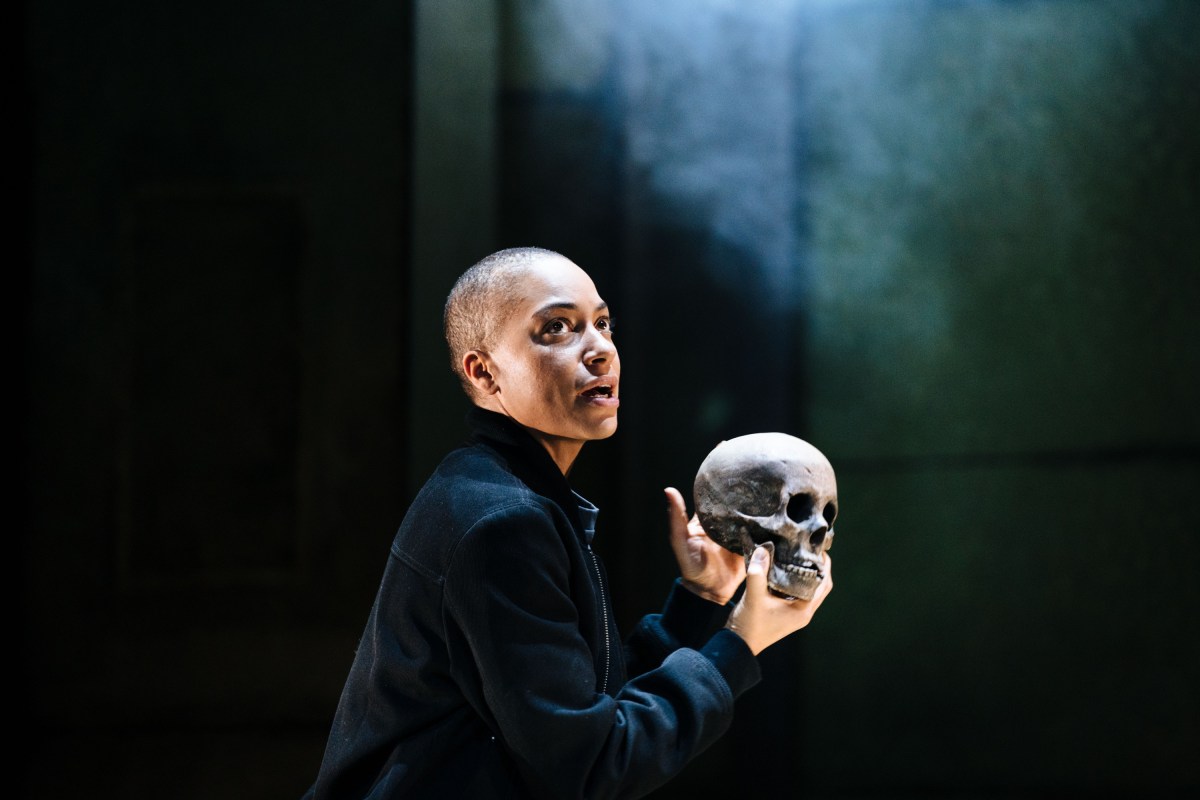
Cush Jumbo in Hamlet

The Young Vic’s audience has waited almost a year and a half to see Cush Jumbo perform the title role, and Jumbo herself lives up to expectations, even if the production she is in does not. She excels in comic moments and brings a freshness to Hamlet’s madness, through a bravura mixture of wry wit and ebullient clowning. Hamlet here is most compelling when interacting with the younger characters, who teem with vivacity. There is such warmth between Hamlet and Horatio especially, and Jonathan Livingstone makes Horatio a memorable presence from the play’s opening scene to its final soliloquy.

One reading of the play could suggest that Hamlet, and his fellow younger characters, are trapped in the world of the play, repressed by courtly strictures and Claudius’ kingly ambitions. Yet here, the younger actors almost seem trapped themselves, their lively energy blending oddly with the other very different acting styles on display. Hersov’s sprawling production has great moments, from the characters’ terror at the ghost of Hamlet’s father in the opening scene to the dumbshow, but there is an utter lack of cohesion. This manifests in the costuming – a modern dress melee of outfits which vary from practical, to chic, to formal, and somewhat inexplicably to spy-like dark suits and sunglasses – as well as the music choices. The singing of Norah Lopez Holden’s Ophelia is moving, yet it feels like it belongs to a very different production.

Jonathan Livingstone in Hamlet

Yet most of all, what jars is the clash in style between the traditional Shakespearean delivery of Claudius, Polonius and Gertrude’s roles and the looser naturalism of the younger characters. Perhaps this was intentional, but the effect ends up grating. Adrian Dunbar’s approach to Claudius is initially promising, projecting a kingly authority with overtures of friendship and just a hint of menace. Yet as the play goes on, he lacks interiority, behaving in private almost identically to his public performances. Everything is pronounced rather than spoken, his words those of a patrician and patriarch. Such a choice makes sense when he addresses Hamlet, yet it makes his marriage to Gertrude seem entirely functional – perhaps a consolidation of power.

Tara Fitzgerald’s Gertrude is even more thinly sketched. It makes sense that Claudius would marry the previous queen to maintain a grip on the throne, but Hersov, Dunbar and Fitzgerald’s cold approach makes the text feels flattened – with no sense of (even private) passion between the pair. This seems especially strange given the tenor of Hamlet’s disgust at his mother; he is horrified not so much by the usurpation and abuse of power than the ‘incest’ the remarriage constitutes. Yet Claudius and Gertrude barely touch, sharing one kiss in the play which feels motivated only by a regard for their public perception. In this version, they are not that into each other. It is a valid interpretation, but you cannot help but feel this production often chooses the duller option at each of these narrative crossroads. In this version of the script, the decision does bump up against textual problems too, such as Hamlet’s insistence that his mother begin practising abstinence, and that with time it will grow easier. Here, there does not seem to be the need.

In many ways, the narrative of Claudius and Gertrude plays as an anti-tragedy, particularly a rejoinder to Macbeth (though Shakespeare wrote that later). The pursuit of monarchical supremacy through murder is pure tedium, according to Hamlet, especially Hersov’s version. The murder is an offstage event before the play begins and there is no passion or power-lust. Claudius simply seems to have thought that killing his brother would be a good career move. Again, this seems representative of the production’s frequent decision to leave psychological richness un-mined. Sometimes it feels like the play is only ‘doing Hamlet’, rather than examining the emotional realities of the play’s world.

Adrian Dunbar in Hamlet

Anna Fleischle’s set design is strangely monolithic – containing giant rectangular blocks which fill up the back half of the stage. The grimy gold colour scheme conveys the gilded cage Hamlet finds himself in. As he remarks to Rosencrantz and Guildenstern, ‘Denmark’s a prison’ – though he fails to notice how he himself imprisons Ophelia. Yet the design limits the stage space and hampers the action. Polonius standing behind a curtain is replaced by him standing behind a block, the effect of Jumbo stabbing behind it cumbersome and bathetic, making the scene dramatically inert. At other times, the production cannot decide how it wants to represent action in the design. The ghost of King Hamlet is initially an offstage presence, machine guns trained on the audience with palpable fear. Yet the effect is diluted by having the ghost later appear in strange (often indecipherable) projections behind the characters, as well as given physical form in one scene by Adrian Dunbar. The production tries a bit of everything, but the result seems unfocused and indecisive – less than the sum of its parts.

There is one textual idea here which borders on brilliant though. The existence of Hamlet in three versions – the much shorter First Quarto, thought by some to be a pirated copy or poor imitation, the Second Quarto and the Folio – forces directors to select the text they want to perform in far more detail than simply where to make cuts. Hersov, like many other directors before him, has found the ‘To be or not to be’ speech to be particularly pliant, and he moves the iconic lines (Act 3 Scene 1 in the Cambridge edition) to the middle of Act 2 Scene 2, after Hamlet has played the fool in conversation with Polonius.

Hamlet implicitly mocks Polonius for being old as he paraphrases the ‘Words, words, words’ he has just been reading. He describes how ‘old men have grey beards, that their faces are wrinkled, their eyes purging thick amber and plumtree gum, and that they have a plentiful lack of wit, together with most weak hams.’ These sentences could be dismissed as incoherent rambles in service of Hamlet’s pretended madness, yet in their juxtaposition with Hamlet’s renowned words, they seem much more important.

Hamlet’s ironic mockery of ageing forces him to acknowledge his own mortality – but even worse, the cruelty of a life which keeps going on. Hersov and Jumbo thus deliver the well-worn soliloquy with a resonance that feels genuinely unusual. Instead of contemplating mortality and suicide, the speech is recast as a meditation on ageing. ‘These tedious old fools!’ Hamlet proclaims, in Act 2 Scene 2, immediately before ‘To be or no to be’. He is a young man tyrannised by the ambitions of the old, yet, when left alone, he reconsiders. Is this a fate that awaits him one day too – the ‘calamity of so long life’?

Norah Lopez Holden and Cush Jumbo in Hamlet

If Hersov’s tonally inconsistent production has a unifying gesture it is a trend for sudden reversal, specifically from Jumbo’s hilariously energetic physical comedy to haunting, horrified introspection. Another such contrast comes in Act 5’s grave scenes. Though the production’s music choices are generally odd and eclectic, ‘Three Little Birds’ is an inspired choice for the gravedigger’s entry. He is a ‘fellow [with] no feeling of his business’, who ‘sings in grave-making’, and his cheer perfectly contrasts his solemn task. The scene continues as riotous comic routine, shot through with sickening dramatic irony: we know Ophelia is dead, while Hamlet does not. Jumbo reads ‘Alas, poor Yorick’ with impish sarcasm and bubbles with chaotic mirth as she shares the gravedigger’s detachment – a detachment Hamlet will soon struggle to maintain. In isolation, the scene is a triumph of acting and, unlike in most of the play, the tone is perfectly judged.

It makes for a strong contrast with the solemn funeral that follows. Jonathan Ajayi is particularly impressive as Laertes – his resolve after his father’s death (in his attempts to comfort Ophelia) now shattered by the devastating further loss of Ophelia. Yet the restrictiveness of the set – and the resultingly poor blocking – pushes Hamlet off the main stage, crouched in the shadows. Why has this moment, which should be a whiplash realisation for Hamlet, been hidden? Hamlet’s anagnorisis should surely not be invisible.

This moment is emblematic of the problems of the production as a whole – particularly as Hersov and Jumbo interpret Hamlet as fundamentally bored by life, rather than exercised by injustice or plagued by suicidal ideation. Death registers as a shrug for him, but though seeing a man so worn down by life’s ‘slings and arrows’ that he will go quietly to his death can be deeply moving, in this version Hamlet has already been in this state for most of the play. The final deaths play out as a formality – though the swordfight (here using knives) is deftly choreographed by Kev McCurdy in the limited stage space. As a result, I felt little of the tragic weight that should accompany the ending. The play only stops, rather than ends.

Hamlet

Written by William Shakespeare, Directed by Greg Hersov, Design by Anna Fleischle, Lighting Design by Aideen Malone, Sound Design by Emma Laxton, Video Design by Nina Dunn, Movement Direction by Lucy Hind, Starring Cush Jumbo, Jonathan Ajayi, Joana Borja, Adrian Dunbar, Tara Fitzgerald, Norah Lopez Holden, Jonathan Livingstone, Joseph Marcell, Adesuwa Oni, Taz Skylar, and Leo Wringer
Reviewed 12th November 2021
Categories
theatre

The Tragedy of Macbeth – Almeida

Saoirse Ronan in The Tragedy of Macbeth

Stars, hide your fires; let not light see my black and deep desires.

These words, used throughout the promotion for the Almeida’s exquisite play The Tragedy of Macbeth, are typically held up as signs of Macbeth’s simultaneous ambition and guilt. Yet here it comes across far more literally; this Macbeth is all about desire. The play presents a central relationship which feels distinctively modern in its toxic consequences and the sublime Saoirse Ronan and James McArdle convey a tragedy caused by a fatal mixture of ambition, insecurity and mutual lust.

Director Yaël Farber has said that ‘People tend to think of this as a couple who have transcended morality but in many ways it’s one of the most functional marriages Shakespeare has written.’ Here, the Macbeths are deeply loving, yet capable of cruelty to each other as well others. Lady Macbeth goads her husband with taunts of inadequacy when his qualms over the morality of regicide threaten to halt their murderous plans. The marriage is truly alive and in the opening act the couple are incandescent with sexual attraction; they seem aroused by the power that seems within reach and hatch their plan in a fit of passion on their marital bed.

One of the reasons the theme of sexual potency seems so present here is perhaps because Farber uses it to examine the issue of childlessness – or, more specifically, child loss – in far more detail than many recent productions. ‘I have given suck’, Lady Macbeth famously says in Act 1, begging the question of where these children are in the play itself. Perhaps they are dead, or have come from a previous marriage, but the extent to which they constitute a significant offstage presence is one of the main decisions a director of Macbeth must make.

This production was announced as a ‘feminist’ version of Shakespeare’s tragedy, yet many recent productions’ feminism has made them uncomfortable in tying a woman’s identity to her (lack of) motherhood. Thus, they often simply eschew the psychological possibilities of the absent children. Yet without it, Lady Macbeth’s character becomes unfortunately thin – un-feminist in a different way.

Here, Farber seems to have made a definite decision about the status of Lady Macbeth’s children. The three suited wyrd sisters, ethereal and spirit-like, function as intermediaries between the worlds of the living and the dead. They beckon Lady Macduff (a compelling Akiya Henry), her children and eventually Lady Macbeth as they die. Throughout the play, they hold three blankets. The trio cradled the sheets as if they were the swaddling clothes of new-borns. I wondered if they represented dead children, three losses that haunt the Macbeths, as much as they attempt to avoid confronting their grief. Heartbreakingly, the blankets are routinely spread out to form the bed in which these three dead children were likely conceived.

As a result, Lady Macbeth’s notorious pronouncement ‘unsex me here’ seems like a response to the trauma of child loss, attempting to dissociate from her bodily relationship to them and suppress all maternal instincts. She swears off children in favour of power – just as Macbeth starts saying that her offspring should ‘compose nothing but males’. As a royal wife, she is expected to stifle her trauma in service of a doomed line of succession.

The vocal refrain ‘Come Away’ – lyrics taken from Thomas Middleton’s The Witch (c.1615) – is sung plaintively by the character of Lady Macduff, accompanied by Aoife Burke’s melancholy cello. (Tom Lane’s score is stunning throughout.) The words of this recurring tune ultimately seem to beckon Lady Macbeth to join her children in the grave.

Maureen Hibbert, Diane Fletcher and Valerie Lilley as the Wyrd Sisters

However, Lady Macbeth is not simply trapped by the patriarchal demands of her husband. Farber makes small emendations to the play in order to ensure what is the case at the beginning remains true throughout: this is equally the tragedy of Macbeth and Lady Macbeth.

In a particularly judicious edit to the text, Farber gives Lady Macbeth the line ‘Who can be wise, amazed, temp’rate, and furious, / Loyal and neutral in a moment? No man’ when Macbeth confesses the rage-fuelled murder of the king’s grooms. The scene, as written, has little for her to do but be distraught at the murder of Duncan. The extent to which this is feigned or represents a first bout of guilt is for directors to experiment with. Ronan invests Lady Macbeth’s clear fakery with an almost comic edge. Her sadness evaporates when her husband falters. Admitting murder of the king’s grooms, it almost seems as if his entire resolve is wobbling. His words dry up and on the cusp of being found out, Lady Macbeth intervenes with a sudden burst of controlled rhetoric – words usually spoken by Macbeth in defending himself. In these radical yet subtle alterations, Farber’s feminist vision crystallises. The responsibility for the murder and the subsequent power struggle is shared between them.

Ronan recently told the BBC that Kim Kardashian and Kanye West were part of their inspiration for the leading roles here and though I wasn’t particularly struck by the comparison in the performances, Farber does emphasise the play’s central relationship as something both private and public. Never is this more apparent than in the banquet scene, where Macbeth’s horror and guilt are treated as a public embarrassment and PR disaster by his wife. She springs to his defence over the microphone, dismissing the outburst as a ‘custom’, whilst inwardly seething at her husband’s failure to maintain his public image. Just as when she defends his murder of the king’s guards, his shortcomings are supplemented by her intervention. Lady Macbeth ‘smear[s] / The sleepy grooms with blood’ when her husband cannot out of guilt whilst she has been unable to commit the act herself due to Duncan’s likeness to her father. The Macbeths’ relationship is a fatally toxic; each pushes the other to violence neither would have been otherwise capable of enacting. The result is totally compelling.

James McArdle and Saoirse Ronan as the Macbeths

I cannot recall seeing any Macbeth before which has made the return after the interval more thrilling than what has come before it. Arguably one of the flaws of the text on the page is the contrast between the drive of the first three acts and the more meandering downfall. Macbeth’s return to the witches sometimes comes across as an attempt to inject stakes back into a play whose psychological tension has dissipated into a more underwhelming account of military manoeuvres.

In another small textual alteration, Farber has Lady Macbeth deliver the messenger’s warning to Lady Macduff. She should flee with her children immediately if she is to survive. Yet they are interrupted by the arrival of the murderers. Thus, Lady Macbeth is forced to watch in silent horror as the family is killed before her eyes. The grimness of murder, with screaming children and a stabbed, then drowned Lady Macduff, cannot be dressed up in the borrowed robes of noble language. Macbeth describes King Duncan’s murder as an ‘assassination’. This is a brutal slaughtering.

In this scene, Farber almost entirely solves the usual problem of Lady Macbeth’s madness. Like Ophelia in Hamlet, the role’s early promise usually gives way to an underwritten conclusion. Where Macbeth fights to his last breath, mad with paranoia, Lady Macbeth sleepwalks her way to a quiet end. Yet placing her onstage for the murder of Macduff’s family provides a vital point of transition in her arc. Here, it is the murder of children that presages Lady Macbeth’s decline. Her earlier claim that she would have ‘plucked [her] nipple from his boneless gums / And dashed the brains out’ of her own child contrasts her sudden confrontation with the horrors of child death. The ‘milk of human kindness’ returns, the maternal instincts she has repeatedly sworn remembered. The impossibility of living a life with her grief forever suppressed is written across Saoirse Ronan’s haunted expression – a truly great performance, alive with painful psychological truth. Thus, Lady Macbeth’s madness stems not from simple guilt, or a heavily gendered inner weakness as is so often unfortunately implied, but from the awful fact that the repression of her own grief has reproduced it so brutally in others.

However, this momentous scene is unfortunately followed by a long exchange between Macduff and Malcolm. The production is not short – at over three hours – and whilst it does not feel it, this long scene is a rare moment where I was left wanting less rather than more. The arrival of Ross with the news of the murdered Macduff family is deeply moving, but it comes at the end of a scene which has sapped some of the production’s considerable momentum. After all, as McArdle has said in interviews, the play (and especially this version) is a ‘love story’. At this point I yearned instead to see how the action was affecting the Macbeths’ marriage – or indeed, whether they speak to each other at all. Shakespeare’s text can only be stretched so far though. Perhaps this is why Act 4 and 5 are often less satisfying; Macbeth and Lady Macbeth never interact onstage after Act 3.

I have only one other major reservation about this production. At the end of the play, after Macduff proclaims Malcolm’s accession to the throne, the wyrd sisters re-emerge to speak their opening lines again. ‘Hover through the fog and filthy air’, they say as the lights come up on Fleance, sat in a chair with a gun cocked. The message is clear: tragedy is a wheel that will never stop turning. Power corrupts, as does the desire for it. There is no stable throne. (Though, of course, when performed for James I, the original play’s surface meaning was that the line of succession should be respected as the only path to stability.)

It is unfortunate that the ending here was played out in a very similar fashion only three years ago, in Polly Findlay’s horror-inflected RSC version. There the death of Duncan set a clock in motion, counting down from two hours until the death of Macbeth (Christopher Eccleston). At the end, the clock rapidly wound back up, implying Fleance’s role in a continued tragic cycle. I found this moment to be the most compelling aspect of a partly successful version of the play. Yet it struck me as by far the weakest part of Farber’s triumphant production.

Though I felt a sudden sense of unoriginality in an otherwise innovative production, I was mainly disappointed by how ill-fitting the ending seemed to this version of the play as a whole. Where Findlay’s take explored the corrupting nature of male power, with Lady Macbeth pushed aside by her warring husband, Farber’s tragedy hinges on their toxic collaboration. The tragedy is dual. Therefore, suggesting Fleance will inevitably instigate another cycle of violence somewhat undermines the overall message.

The ending works structurally; the final image before the interval is of Fleance screaming over his father’s corpse so it makes this a fitting endnote. Ross Anderson lends Banquo a striking insistence early in the play, demanding a royal prophecy from the witches with the same force as Macbeth himself which foreshadows this ending. Yet the production extendedly suggests the tragedy is specific to Macbeth and Lady Macbeth themselves. Without their mutual strengths and weaknesses, their ambition, Lady Macbeth’s streak of cruelty and their passionate sexual magnetism, Duncan would have remained king. Though the play did not leave me assured of the stability of Scotland’s throne – far from it – the suggestion that a tragedy like that just witnessed would inevitably repeat itself seems unsatisfyingly conventional. If Lady Macbeth is the co-author of the Macbeths’ tragic downfall, then how could a similar arc play out without the presence of a Lady Fleance?

Yet despite this slight objection, it is unlikely that a better Macbeth will be seen on a British stage for quite some time. McArdle is good as a warring tyrant, yet even better when racked by doubt and hesitation – his greatest fear the disapproval of his wife. Ronan is the perfect complement: luminous and understatedly spellbinding. This revelatory production works precisely because it largely throws off the often-bland universalising force of ‘tragedy’ in favour of the specific toxicity produced by Macbeth and Lady Macbeth in fatal combination. The tragedy is felt as a bodily thing, lust giving way to visceral violence. As such, the production’s treatment of Lady Macbeth seems newly definitive – setting a compelling template for a role which so often wastes the talents of brilliant woman actors. I would be surprised if many future directors did not adopt (and adapt) Farber’s textual alterations as a new standard, teasing out the psychological complexity present in Shakespeare’s original character through Lady Macbeth’s greater stage time.

The Tragedy of Macbeth

Written by William Shakespeare, Directed by Yaël Farber, Starring James McArdle, Saoirse Ronan, Michael Abubakar, Ross Anderson, Aoife Burke, Emun Elliott, Diane Fletcher, William Gaunt, Myles Grant, Akiya Henry, Maureen Hibbert, Reuben Joseph, Gareth Kennerley, Valerie Lilley, Jamie-Lee Martin, Adam McNamara, Henry Meredith, Dereke Oladele, Richard Rankin, Emet Yah Khai, K-ets Yah Khai
Reviewed 13th October 2021
Categories
theatre

Dream – RSC

Over a year has now gone by since theatres first closed due to the coronavirus pandemic, prompting a vast array of hybrid-theatre alternatives, from greatly-reduced capacity audiences to online streaming of theatre-films. Yet out of all the pandemic innovations, this brief, astonishing piece of live motion capture theatre has been the best I have seen. Devised by a team from the Royal Shakespeare Company – who have staged the production as part of an ongoing research project that it is not yet in its final form – Dream interpolates live, physical performances with pre-made material – voices, music, and the computer-generated forest world inhabited by the play.

Heavily featured in the promotional material for Dream has been the cameo of Australian musician Nick Cave, and the combination of star appeal and the general zaniness of Cave playing the voice of a forest will have been a major draw for many audience members. His appearance is brief, early in the play, though it helps set an ethereal tone which I found central to the play’s appeal. Cave’s musical murmurings are whispered in vocal register somewhere between speech and song, akin to the narrated moments of his 2019 album Ghosteen. He lends a sense of grandeur and personality to the vividly rendered forest environment, though the play soon moves on, transcending his delightful cameo.

Dream magnificently constructs its world; its excellent sound design (a mix of pre-recorded orchestral pieces and sound effects triggered adaptively during the performance) are matched by consistently inventive visuals. In one sequence, a miniaturised Puck – played with delightful energy by EM Williams – finds themselves entangled not in a spider’s web, but in a spider’s web-like eyelashes. A tree suddenly comes to life; as it moves, dead leaves drop from the twisted branches of his body. Near the play’s end, Puck – who is depicted with a body made from rocks – is trapped by a fallen tree. All of these moments are a testament not only to the team’s creativity, but their precision in making the motion captured interaction with the environment near-seamless.

The story is relatively slight, even within the forty-minute runtime. It initially focuses on exploration of the world, before a storm arrives, where it turns into an exhilarating fight for survival. Puck is the only character still standing, not blown away by the fierce winds. The dialogue is composed of lines from A Midsummer Night’s Dream, extracted and stitched together, the result being more of a tone poem than a consistent narrative; instead the slight story is contained in the movement through the world.

This slightly ‘greatest hits’ approach to Shakespearean language could be questioned, with the lines sometimes being chosen for the effects, or for their superficial similarity to part of the story. However, the more significant Shakespearean import is the sense of place. The Shakespearean forest – especially in A Midsummer Night’s Dream and As You Like It – is a place of escape, often from the strictures of courtly life. In the former the forest sees characters fleeing the rather tyrannical marital demands Theseus makes of Hermia, Lysander, Demetrius and Helena, and his own bride-to-be Hippolyta. Yet it is also a space which contains its own dangers – not just the mischievous magic, but an untamed wildness. In Dream, this wildness comes not from any malevolent forces, but from nature itself, in the form of the storm. Similar too between Dream and Shakespeare’s work is the gesture of bringing the human and supernatural worlds together. Here, this interaction is staged between the human actors and the transformative potential of technology (rather than magic).

I was enchanted throughout the play, though wondered what the intentions of the company were during most of the duration. As stunning as Dream’s animation can be, the effect becomes even more impressive – and the company’s ideas much clearer – when the cameras pull back. The masked human performers are revealed, wearing motion capture attire and standing in front of a projected view of the forest world. We are confronted with both the results of their actions and the intricacy required in interacting with the digital space.

This is not the RSC’s first foray into motion capture Shakespeare. Their excellent 2016 production of The Tempest featured scenes in which Ariel transformed into a vast CGI projection above the stage. Though initially dazzling, the grandeur of the effects serves instead to highlight the quietness of the interstices. The sudden absence of sheer spectacle made Simon Russell-Beale’s closing soliloquy as Prospero all the more spectacular – standing alone in the centre of a wide, now-bare stage, renouncing his magic.

The ending of Dream has a similar effect as the story is humanised before us. Early sequences in which Puck flies around the forest are charming, yet seeing the team effort required to lift the actor into the air is heart-warming, a testament to the close collaboration inherent to theatre, after a year of distance.

Though the play could be read as an ecological account of a forest under threat, watched in the current circumstances, the story seems instead to be a metaphor for endurance. The play rather beautifully tells a simple story of weathering a storm and surviving against the odds. Dream shows that theatre is not just surviving the pandemic, but in some cases it can thrive.

Dream

Presented by the Royal Shakespeare Company
Reviewed 21st March 2021