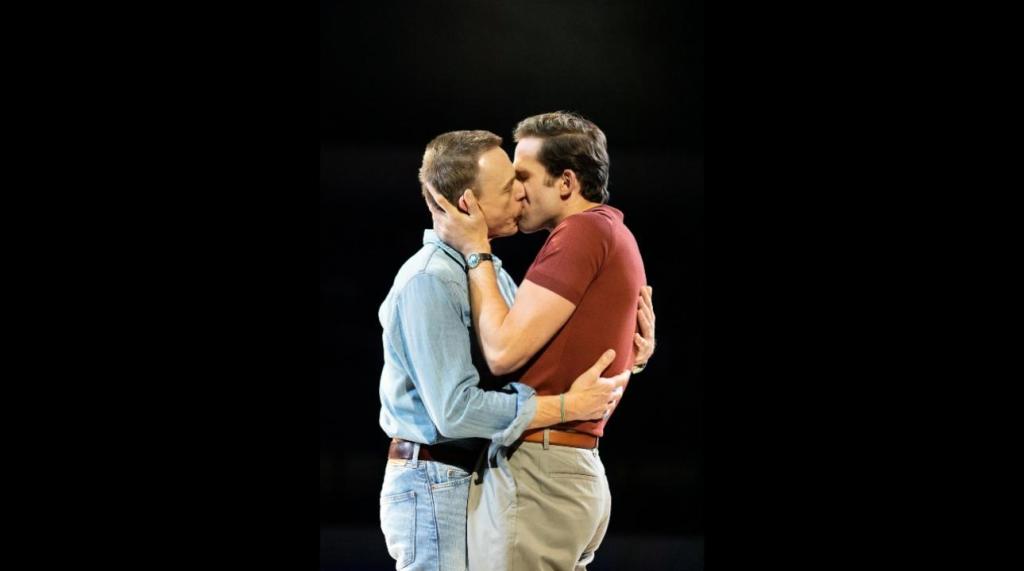
Categories
theatre

Rare Earth Mettle – Royal Court Downstairs

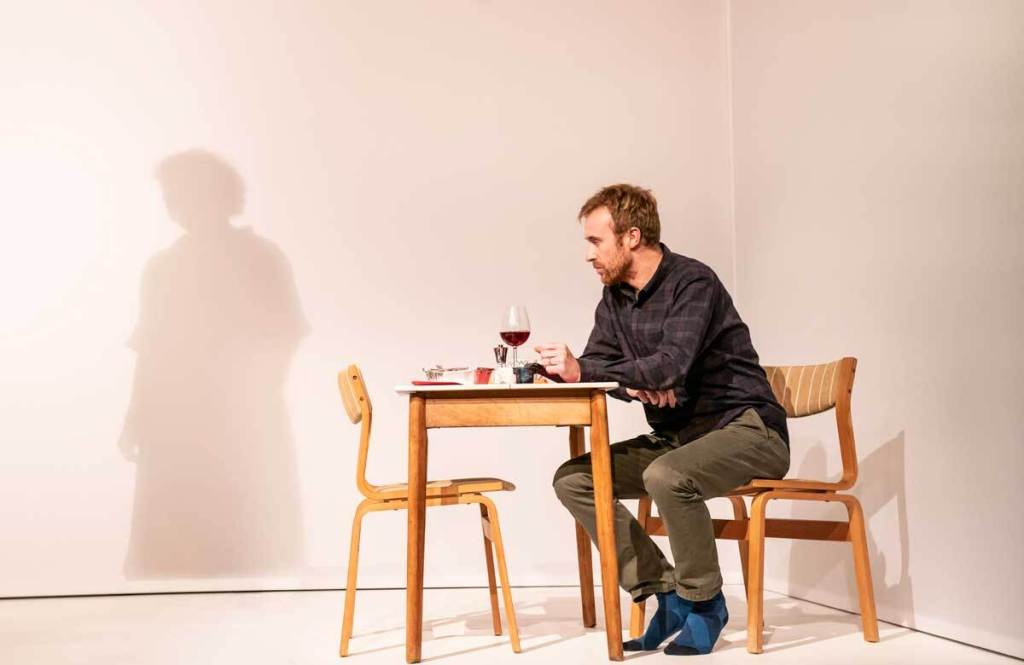
Ian Porter and Arthur Darvill in Rare Earth Mettle

I sometimes wonder how much – during the creation of a play – writers try to anticipate the ways parts of their works could be used against them. Some titles, for instance, are ripe with potential for cruel puns in dismissive headlines. In the case of Rare Earth Mettle, I was struck by the relative danger of setting a significant portion of the play within a scrapyard, filled with rusting trains. As invitations for a dissenting critics go, ‘train-wreck’ is an absolute sitter.

The play is not a train-wreck. In fact, it shines with dazzling wordplay, dizzying ideas and modern art installation-like spectacle (in a good way). Yet it feels almost impossible, and certainly critically insufficient, to examine Rare Earth Mettle’s dramatic strengths and shortcomings without addressing the alarming failures and institutional racism that marked its development, programming and staging.

It is undeniable that the process that led to this play appearing on the stage constituted a failure of stewardship and artistry, as well as actions whose results were racist. According to the Royal Court’s own timeline (published on 18th November in a ‘events and actions status update’), on 5th November, the theatre was ‘notified by members of the Jewish community that the use of this Ashkenazi Jewish name for a ‘Silicon Valley billionaire and CEO’ […] ‘on a mission to save the world’ […] ‘and make millions of dollars in the process’ – risked perpetuating antisemitic tropes.’ The character in question had been called Hershel Fink – now renamed by writer Al Smith to Henry Finn. The theatre has since committed to further antiracism work and does seem to be engaging seriously with the errors that have been made. Yet arguably most alarming in the statement is the admission that the issue had been raised by a Jewish director, in a workshop in September 2021, but ‘this was not taken further, nor passed on to the writer.’ An internal review is underway, ‘to interrogate how this happened across all areas of the organisation’ and how it went ‘unchecked and unchanged.’

The fact that this did go ‘unchecked and unchanged’ is even more striking when the play’s rocky journey to the stage is considered. Originally programmed for April 2020, Rare Earth Mettle had begun rehearsals – with a half-different cast – when lockdown began. It would be rather unreasonable to expect the theatre to have spent the intervening 18 months expending much time and resources on an ostensibly finished play (especially during such a difficult time for shuttered theatres). Yet the additional time makes the fundamental lack of reflection seem even more baffling. That it went through pre-production twice should have provided greater perspective, and at least allowed the artists involved to return to it with fresh eyes. Indeed, the play has clearly been updated – peppered as it now is with references to Coronavirus, now set during the second quarter of 2020.

Reflecting on Rare Earth Mettle, I think that its major problems (the antisemitic connotations being foremost among them) can be attributed to a failure of dramaturgy. This is to say, the development, testing out and analysing the play was subject to before being announced (let alone staged) was insufficient. Dramaturgy should be an antiracist process. It is all about helping a writer say exactly what they want to say. Watching Rare Earth Mettle on stage, some might conclude that the intentions were not antisemitic – yet not only is the effect of racism on its victims far more important than intentionality, but dramaturgy is all about interrogating every aspect of a work and considering its effects on an audience. Good dramaturgy is about serving the ideas of the writer – and making their play’s effect line up with their intentions. Strenuous dramaturgical processes should have raised and questioned the antisemitic effect of the name choice, combined with Finn’s characterisation.

This is also not to say that the problem could have simply been solved by greater time and thinking, but instead dramaturgy should be sure to represent communities more widely. Arguably, this incident ultimately reveals a failure of Jewish representation among those who developed the play.

Critics’ responses to the play have largely ranged from muted to negative. Unsurprisingly, no one wants to endorse a racist play (though some have taken it upon themselves to proclaim it racism-free, just bad drama). Just as I have spent over 500 words summarising and commenting on the antisemitic naming of its central character, so too have critics’ reviews filled up their wordcounts with handwringing discomfort. Yet the result is that the play will receive less critical attention than it otherwise might. This might just be swept away, kept as an uncomfortable footnote in an otherwise auspicious history for the Royal Court. I found it hard to agree with the barrage of one- and two-star reviews – though it is sprawling, has surprisingly rough edges for a play so long in the making, and it is extremely difficult to forget the original name choice for Henry Finn.

In the Royal Court there is a sense of pained embarrassment in the air – not in the actors’ performances themselves, but certainly in the brief, singular bow given by the cast before they disappeared backstage, despite the audience’s continued applause. The shop is empty of scripts of Rare Earth Mettle, normally sold for £4 in the place of a programme. The entire lot have been pulped and will be reprinted with the name ‘Henry Finn’ instead (but only, seemingly, by mid-January, after the run has finished). Perhaps it was an atypical evening, but at the performance I saw (which was not press night), a striking number of people in the (relatively sparse) audience had notebooks with them. Though I am sure they all had various reasons for note-taking, it gave many audience members an appearance of journalistic neutrality – as if their watching the play constituted no endorsement, and that they were duty-bound to note their findings for later report.
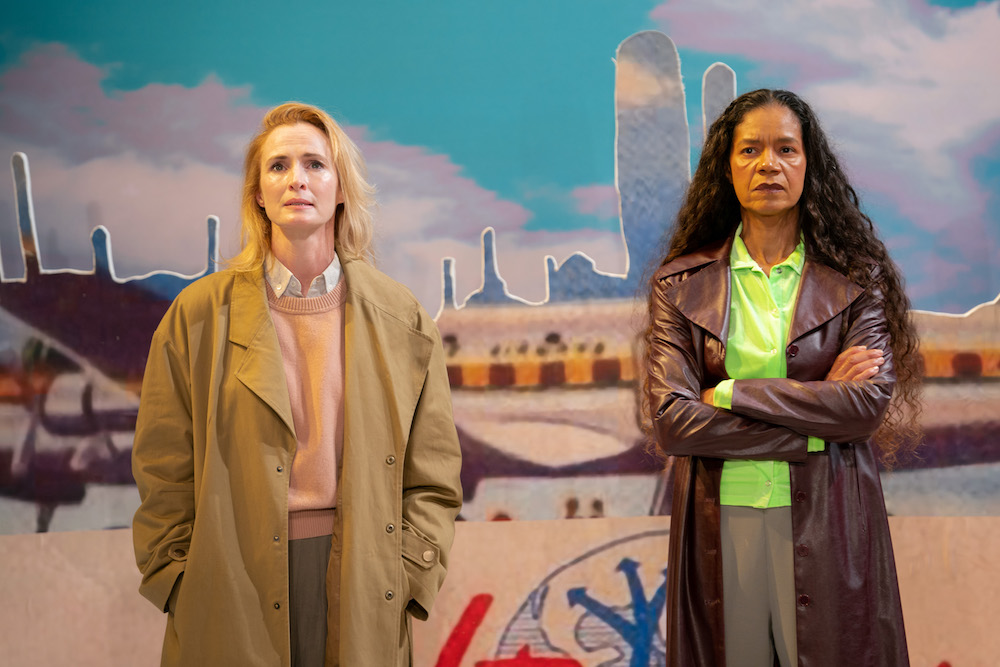
Genevieve O’Reilly and Jaye Griffiths in Rare Earth Mettle

So, we return to the trains that open the play – in a Bolivian train cemetery, on top of a salt flat that contains 70% of the world’s lithium. The trains are rusting relics of empire – built by the British to aid the extraction of silver from the Bolivian mountains, through processes that have harmed the natural environment and led to an epidemic of blood cancer in the local area. In one of them lives Kimsa, a local who cares for his dying daughter (who has the cancer that afflicts so many) in one of the old carriages. British and American interest in the land beneath his feet will potentially evict him from his home. Thus, Rare Earth Mettle tells a new, old story of western meddling, colonialism, ecological damage, and disputes over access to minerals. It is oddly paced play – its relatively short first half taking far too long to introduce any moral weight, while the second half is overstuffed. Here too is where more rigorous dramaturgy would have significantly improved the play.

Among the play’s successes, I would count Moi Tran’s set – though it may sharply divide audiences. A checked white floor (somewhere between graph paper and bathroom tiles) is filled with cut-outs, which are wheeled in and out as required. It frequently resembles a high-concept installation piece, with a giant sand (or perhaps salt) timer appearing above the stage, moving back and forth like a pendulum at the beginning and end – perhaps ticking down towards our climate crisis-driven doom. At another the design resembles something by Damien Hirst, a glass box descending from above – filled with occasionally twitching rats. I personally loved the look, especially the dazzling three-dimensional projections that seemed genuinely innovative, but it’s surely a marmite aesthetic. The modular elements also make you feel the length of scene changes – quirky, hypnotic music and robotic dancing accompanying them. In a play so long, some of these moments felt a little redundant.

As for the main characters themselves, Henry Finn – played with arrogant aplomb by Arthur Darvill – is a preening narcissist, though written as a too-bland approximation of Elon Musk. In light of this, the original name choice seems all the more baffling; Musk is not Jewish. By the time we get to the end though, his character has not developed at all. In fact, Smith chooses to double down on the characterisation of Finn as completely emotionally detached. It is Henry’s defining characteristic. Perhaps it is an accurate portrayal of a billionaire, but it is not the most dramatically engaging choice. Henry wants the lithium to power batteries for his new electric car. Smith gives him the slightest touch of benevolence; his determination to sell the car for $35,000, rather than the ‘aspirational’ price of $100,000 is driven by his belief that eco-consciousness should not only be for the wealthy. Still, he remains a billionaire and seeks to profit hugely from the sale.

Genevieve O’Reilly is understatedly brilliant as his nemesis (of sorts) – an NHS doctor called Anna who wants the lithium for a plan that is, at best, a moonshot. O’Reilly contends well with the odd clunky line and almost convinces in her explanation that she wants to introduce lithium to the British water supply – thus giving everyone better, stabler mental health and improving quality of life, especially in poorer areas of the UK. Her trial in Stockport is, to her, a huge success, yet Smith cannily uses the pandemic to trash the study’s verifiability. Of course mental health A&E presentations were down, another scientist tells her; there’s a pandemic so A&E presentations were lower in general. Anna does not stop for a moment to consider social factors for Stockport’s poor mental health – yet the play barely does either, where a stronger critique could be usefully levelled at Anna’s confirmation bias. Fundamentally, she and Henry (though at odds) are deeply similar in their belief in technological solutions to national and global problems – even if she argues that people should give things up and have usage of various products restricted, in the case of antibiotics. Henry, on the other hand, is summed up by Smith’s neat epitomising quote: ‘You don’t tell an American to turn off their light; you build them a better light bulb.’

Underneath O’Reilly’s clipped, understated ruthlessness is a strange, somewhat undefinable personal history. When seemingly revealed, her backstory doesn’t really convince. A 12-year-old she briefly treated was wrongly given penicillin, despite an allergy. Officially, he died due to a ‘constellation of errors’ – a bureaucratic phrase which essentially meant that everyone got to wash their hands of responsibility. Yet though it confers a general sense of tragedy, there is structural disconnect in the play between her desperate attempt to improve mental health outcomes and the past she is trying to atone for. It would make much more sense, dramatically, for it to have been mental health or suicide related – though these are perhaps less likely to have been clinical errors.

Later on, we do find out (in passing), that her father was sectioned – lending more specificity. He thought he was a god, just like Henry, she says. As Smith wryly suggests, delusion works very differently, depending on wealth. Indeed, Henry’s delusional outlook, exemplified by his hypothetical cars, seems to be the thing that actually makes him money (while his company simultaneously haemorrhages money). Yet the control of information is rather muddled, and it does not seem clearly what we are supposed to make of Anna’s motivation. At the end, Anna says the reason she stopped treating patients was ultimately because she felt nothing when the child died. Yet her new mission does not logically follow from this either – unless we are to think that her plan to alleviate her own anhedonia is to treat the mental health of others?

Marcello Cruz, Jaye Griffiths and Carlo Albán in Rare Earth Mettle

The other main character, Nayra, shares the ruthlessness of Henry and Anna, yet she functions in the play too much as an obstacle and tool for the western characters – rather than a particularly nuanced figure in her own right. She secures the presidency, partly by manipulating Henry into buying controlling shares in the major advertising companies of the local television companies. Yet though she cuts Henry out of their deal once elected, Henry ends up getting his own back – mustering his vast personal fortune against, which he uses to literally rewrite history.

The play frequently works better in the minutiae of individual scenes than it does altogether – particularly true in Smith’s frequently inventive dialogue. Data miners are described as ‘binary truffle pigs’, while Henry’s poor grasp of Spanish has him identify himself as a ‘soy bean Americano’. The second half contains a call-back about quinoa that transcends all of the (many) jokes about hipsters I’ve ever heard during plays. Arguably the play would run more smoothly if it simply committed to being the gag-laden farce it sometimes is.

Yet for every compliment, one feels the gravity of play’s fundamental error. Rare Earth Mettle seems so attuned to the nuances of language, but this makes the excuse of ‘unconscious bias’ (as the Royal Court described it as in a 6th November statement on Twitter) all the more surprising. How could something so defined and specific in places have blundered so significantly?

Sometimes the play’s grasp of contemporary politics is razor sharp. As Anna and Henry vie for the rights to the salt flat’s lithium, they cite rather than obfuscate the toxic legacy of silver mining as part of their arguments. Perversely, the offer to repair (financially and literally) the damage of colonialism can now be leveraged in a business deal. Elsewhere, Smith considers compassion engineering – which builds difficulty into accessing products (for instance, the slow-release open of an iPhone box) to improve our haptic relationship to products (and, by implication, improve our loyalty). Here, Smith brilliantly examines how capitalism is not just a cold, free-market machine, but something which can turn its empathy on and off, depending on profit potential.

Similarly astute are observations about western service economies. ‘Ideas are the new coal’, Anna tells Kimsa’s daughter, Alejandra, while treating her cancer. She asks, in reply, what if they find ideas cheaper somewhere else? Moments like this skewer western supremacist ideas about the value of ideas themselves – yet they feel poorly integrated into the play as a whole. A brilliant scene sees Henry simultaneously blackmailing and bribing a Californian Professor of South American history into inventing an extra indigenous nation – exactly where the salt flats are situated. Money bends the truth with shocking speed. The start of the second half also has a memorable routine about keynote speeches and how companies need to sell a narrative. A high-end speechwriter, who has written for Trump, tells Henry that the best thing that happened to Apple was Steve Jobs was getting cancer.

Yet this is all they are: routines. Some are overplayed considerably, such as a running joke about mistranslation, which is hilarious in the opening scene but wearying by its third prolonged iteration. Kimsa’s desire to gather all of the main characters together in one place retrospectively seems like his chance to best them all – beating them all at their own game. Yet it also feels like the play wants all the characters back together for its denouement, which feels a little artificial.

Having used Henry’s influence to get himself declared a nation of one, and the sole owner of the salt flats, Kimsa’s natural resources seem to give him control. He agrees to sell to Henry, once he has the permission of his daughter. But she can only consent, Kimsa says, when she is 18, in six years’ time.

Lesley Lemon, Arthur Darvill, Marcello Cruz, Jaye Griffiths and Carlo Albán in Rare Earth Mettle

Late in the play, Smith suddenly finds a moral and emotional intensity lacking elsewhere in a terrific scene in which Henry and Anna argue, before agreeing to a horrifically manipulative deal for their mutual benefit. Smith scripts an electrifying discussion over the value of public healthcare – giving the devil’s advocate all the best tunes, but little that seems to stand up to scrutiny. It is hard to argue that the failure of NHS healthcare is poor value for money, when America spends around 17% of GDP on healthcare compared to the UK’s 10% – especially when, as Anna argues, ‘half the country’ can’t afford to pay. Yet in their scheming, they find common ground – the powerful climax finally fulfilling the potential of the play’s premise. Anna agrees to walk away, no longer treating Kimsa’s daughter, who will now likely die within a year, meaning Kimsa will agree to sell Henry the lithium. Money wins. I found it a profoundly moving note to end on, Carlos Gutiérrez Quiroga’s musical score almost imperceptibly heightening the emotional weight of the bleak ending.

As I have thought over Rare Earth Mettle this week, I have frequently thought back to the script of Harrogate – Al Smith’s beautifully wrought two-hander play which the Royal Court staged in 2015. Every moment of Harrogate is precision engineered to convey moral complexity, to wrong-foot and place the audience in an uncomfortable position as they watch the events on stage. It is probably one of the best British plays of the century so far and has a devastating sadness in it, especially towards the end. I longed for some of the same moral ambiguity and searching, tender writing here. There is a glimpse in the agonising final confrontation of Anna and Henry, when Anna says she’ll walk away if Henry says the name of the girl he wants to condemn to death. ‘Alejandra’, he says, after barely a pause. Yet the audience has largely been made uncomfortable not by complicity or complexity with its troubling characters, but by the theoretically excised antisemitism that still lingers heavily in the memory. There is a far better play in the midst of this material, but no one has been quite able to find it. With more careful dramaturgy, and greater cultural sensitivity, perhaps it could have been found.

Rare Earth Mettle

Written by Al Smith, Directed by Hamish Pirie, Design by Moi Tran, Lighting by Lee Curran, Composition by Carlos Gutiérrez Quiroga, Sound Design by Ella Wahlström, Movement Direction by Yami Löfvenberg, Starring Carlo Albán, Arthur Darvill, Jaye Griffiths, Genevieve O’Reilly, Marcello Cruz, Lesley Lemon, Racheal Ofori, Ian Porter, Ashleigh Castro, Giselle Martinez
Reviewed 22nd November 2021
Categories
theatre

The Wife of Willesden – Kiln

Clare Perkins, Marcus Adolphy, Andrew Frame, George Eggay, Theo Solomon and Scott Miller in The Wife of Willesden

Arguably, the best way of making old texts, written in unfamiliar vernaculars, engaging to contemporary audiences is to make them funny. Yet better than simply sprinkling new jokes onto otherwise dry material is finding the comic truth of the original and exposing it for a new audience.

This is precisely what Zadie Smith has brilliantly achieved in The Wife of Willesden, a reworking of Geoffrey Chaucer’s ‘Wife of Bath’s Tale’ from The Canterbury Tales, written in the late 14th century. This new piece was commissioned to celebrate Brent being awarded the title London Borough of Culture in 2020 (out of the 32 eligible). Hence, it is no longer set on the road to Canterbury, but in a very different destination of many a pilgrimage: the pub. Specifically, the Sir Colin Campbell pub in Kilburn – directly across the road, in fact, from the Kiln Theatre. Smith’s premise is that one evening, while she was in the pub, Polly the pub landlord announced a lock-in, during which everyone told stories. The best will receive the coveted prize of a full English breakfast the next morning, on the house – and with chips.

Already, this seems like a winning frame for a similar portmanteau to The Canterbury Tales. Yet, as the ‘Author’ tells us – Crystal Condie, playing a slightly neurotic character, recognisable as a version of Smith herself – most of the stories told were not worth hearing. The speakers were: ‘Mostly men. Not because they had better stories but because they had no doubt we should hear them.’ Yet, one story stands out to the fictionalised Smith – as the ‘Wife of Bath’s Tale’ has to many readers of Chaucer. Here, it is told by Alvira, the Wife of Willesden – so named for her five marriages to five different men.

Crystal Condie in The Wife of Willesden

We spend most of the play being delighted by the Prologue, which utilises Chaucer magnificently to mount a ripe satire of the lives of present-day women, and the actions of men. Smith recognises the often-riotous comedy of The Canterbury Tales, and garnishes original jokes with contemporary references. Yet most of the political substance to the play’s critiques has its roots in a text over 600 years old; references to men’s rights activists and Jordan Peterson only serve Smith’s source with added relatability. One of the most striking – and entertaining – revisions is Smith’s retooling of Chaucer’s critique of religious hypocrisy over gender inequality (complete with wry Biblical analysis) as a rejoinder to the contemporary Christianity of Alvira’s aunt and her aunt’s preacher.

It is clearly a work of exceptional intelligence, yet Indhu Rubasingham’s production makes sure The Wife of Willesden is a pleasure to watch – with belly laughs throughout, rather than wry chuckles. When Biblical figures appear – including God, St Paul and ‘Black Jesus’ – their holiness is conveyed with a gold serving tray held up behind their heads, like a saint in a stained-glass window. Wry touches abound; in a whistle-stop tour of historical female murderers, Rubasingham dramatises Clytaemnestra’s murder of her husband in the bath with the scrapy string stabs from Psycho’s shower scene. A level of detail and care have been lavished upon the production, which the text absolutely deserves.

At the heart of this all, selling the play as the absolute triumph it is, is Clare Perkins. She is utterly compelling as Alvira, holding the audience in the palm of her hand in every moment – her comic bravado played simultaneously with something more nuanced and human. Ultimately, she makes the play feel extremely alive – as if we are in the pub with her, an illusion further sustained by Robert Jones’s remarkably transformative set.

The evening and is never anything less than engaging. However, there is the occasional longueur. Smith plays on the relative length (‘over 8,000 lines’) of the Prologue compared to the Wife of Bath/Willesden’s Tale itself. Yet though comparatively shorter, for me, it is the Tale where the play loses pace. By comparison, Alvira’s own life is just a bit more interesting.

The tale itself represents a curious challenge to the contemporary reader or listener. Like the Wife of Bath’s Prologue, there is an ostensible feminism to it – though not one exactly calibrated to modern-day sensibilities. In the original Chaucer, a queen presents a man with what is essentially a riddle – what is it that every woman wants? In return for the correct answer, he will receive a stay of execution; if he fails to answer within a year, he will be killed. Especially given the one-year reprieve, the tale reads like a feminist echo of Gawain and the Green Knight – except the punishment is not due to arrogance per se. The man is a rapist.

A cynical reading of the original Chaucer could interpret it as the story of a rapist escaping justice on a technicality, before being rewarded with a marriage to a chaste, loyal, beautiful woman. Yet Smith chooses to smooth out the harsh edges of the tale, gently meditating on the relationship of the state, prisons and capital punishment to feminist justice. Queen Nanny – as she is here – opines that ‘capital punishment will only go so far’; instead, she is interested in ‘restorative justice’. His rape of a ‘virgin, with no interest’ in him is treated as a crime not only against the individual, but against women as a whole. Thus, he is instructed to understand ‘who you hurt and why’. There begins his quest into discovering what women most desire.

Scott Miller and Clare Perkins in The Wife of Willesden

Unfortunately, the quest is perhaps the least successful part of The Wife of Willesden. Perhaps the production knows this, never trying harder to engage its audience visually than here – with giant palm trees appearing almost miraculously out of nowhere, and the questing man wandering through the audience to ask if they know what women most want. Yet it feels a bit like we are treading water, the script lacking the wit and force of argument present earlier in the play.

What Smith is holding off revealing is Chaucer’s answer to the queen’s question: that women want men to ‘submit to their wives’ wills’ (as Smith writes). This neat inversion of Paul’s sentiments in Ephesians is a satisfying answer, met with a roar of laughter in the theatre. Yet this is the one place where advance knowledge of the original text hinders the play. The reveal is played quite similarly to the original – and arrived a little too slowly.

Also unsurprising is Chaucer’s sting in the tale. An old woman promises to tell him the secret if he agrees to one request from her. He agrees but does not check what she wants in advance. And so it is revealed, too late, that she wants to marry him. He reluctantly accepts, bound by his word, leading on to the final twist of the story. His wife tells him that she could transform into someone beautiful, but would be unfaithful to him, or she could remain ‘old and ugly’, though chaste. After agonising for a while, he remembers what he has learned and suggests she chooses – out of love for him. As a result, she transforms into someone both beautiful and chaste – his internal transformation mirrored by her external one. Smith has the ‘Old Wife’ transform into Alvita – with her ‘fabulous, thick, middle-aged beauteousness’. The result is a partial reworking, skewering some of the original text’s assumptions about age and beauty, while also playing out the original beats largely unaltered. Though smart choices are made – resetting the tale from Arthurian England to 18th century Jamaica, for instance – there has not been quite the same energy directed at updating this part, than there is so brilliantly at the rest of the play.

These criticisms however are slight compared to the scale of invention on the page and the stage, and the tour de force of Clare Perkins’ leading role. Smith even takes the opportunity to pre-empt and respond to criticism, in a brilliant version of Chaucer’s ‘Retraction’ – in which he accepted responsibility for various alleged failures in The Canterbury Tales and the rest of his work. Here, Smith apologises for the ‘cultural appropriation’, ‘dodgy sex’, and ‘the existential bleakness’ of respective past novels, humblebrags about setting the play in verse (‘No more couplets… That shit’s exhausting to write’) and attempts to credit Chaucer with anything we enjoyed about the experience. The posture is brilliantly in keeping with her source material and lends an already hilarious show a perfectly judged touch of the meta – never tipping into overplayed or smug. Smith’s confessions and apologies are ultimately drowned out by music and dance; she recognises her foremost purpose is perhaps to entertain, which The Wife of Willesden does in spades.

The Wife of Willesden

Written by Zadie Smith, Directed by Indhu Rubasingham, Design by Robert Jones, Lighting Design by Guy Hoare, Composition and Sound Design by Ben and Max Ringham, Starring Clare Perkins, Marcus Adolphy, Jessica Clark, Crystal Condie, George Eggay, Andrew Frame, Scott Miller, Hussina Raja, Theo Solomon, Ellen Thomas
Reviewed 16th November 2021
Categories
theatre

Love and Other Acts of Violence – Donmar Warehouse

Tom Mothersdale and Abigail Weinstock in Love and Other Acts of Violence

After unplanned then planned closures due to Coronavirus and building redevelopments, the Donmar Warehouse has reopened with its first full-length run of a play in the building since Far Away closed in March 2020. It is emblematic of the Donmar’s terrific recent programming that they have taken a risk on a politically rich and thorny new play from Cordelia Lynn, examining antisemitism, fascism, and the fear of their resurgence. Yet the results are often haunting and challenging, brought to life in Elayce Ismail’s frequently beautiful production.

For most of its runtime, Love and Other Acts of Violence is a sparse, prop-free two-hander, depicting the blossoming, toxifying love of a young couple – Her and Him – who age from their mid-twenties to mid-thirties over the play’s decade span, as fascism sweeps to power in the United Kingdom. This essential form of has been especially common on post-Covid stages, such as in Constellations, Camp Siegfried, or Lungs – the latter remounted as a streaming play by the Old Vic during lockdown. Yet Love and Other Acts of Violence is quite formally different. Its shape is far more varied – punctuated with poetic inserts, and bright, intense lighting. Some moments seem to occur within the minds and bodies of its characters, the stage ablaze with throbbing, passionate reds, while ASMR-like whispers of poetry are intoned from above.

Towards the end though, the relatively simple style is completely overhauled. A moving, surprising, historical final act transports us back just over a century – to the pogrom of Lemberg in 1918. Most of the play is free from stage directions, but the Epilogue demands specific naturalistic detail. The ‘ground-floor apartment’ is filled with ‘the bric-a-brac of life’ and ‘the paraphernalia of Jewish religious practice.’ Lynn’s detail is meticulous, from the wooden dresser to the trimmed beard of the carpenter who made it. In the note on the set, she writes that ‘It should look, sound and smell, suddenly, like Life.’

Naturalism descends on us, quite literally. Bania Bińkowska’s set lowers from the ceiling, with menacing, mechanical, clanking intensity – bolstered by Richard Hammarton’s excellent sound design. We realise that the apartment set has been above the stage – hanging over the characters – the whole time. The contrast between the sparse near-future scenes and the sudden realism concretises the historical violence. Though all of the characters are invented, Him and Her exist on a higher level of fictionality than Baba, Tatte and the soldier – who stand somewhat symbolically for the real victims and perpetrators of the pogrom of Lemberg, and other historical scenes of antisemitic violence. The future, however, is in flux – alarming but uncertain.

Yet there is also a terrifying inevitably in the Her-Him narrative, which ends with Her suggesting that ‘I think perhaps that it was all already written. I think it was written this way.’ The characters both have submerged, largely unknown histories of violence – and thus, Lynn suggests, have inherited trauma. (An epigraph from E. Valentine Daniel reads ‘The violent event persists like crushed glass in one’s eye. The light it generates, rather than helping us to see, is blinding.’)

Earlier in the play, Him and Her discover that they are from the same place, Lviv in present-day Ukraine (known in German as Lemberg). His family were ‘forcibly resettled in Warsaw’, but originally came from the same place as Her, where many her family were killed in the pogrom. ‘Maybe they knew each other’, Him says, somewhat flippantly – not quite registering the fuller context. ‘You’re not Jewish’, Her responds, ‘It’s better in fact […] If they didn’t.’

The Epilogue dramatises such a meeting. On stage, the actors’ doubling and the juxtaposition of scenes tell us that we are witnessing characters whose descendants are Her and Him. The playtext is unequivocal; they are their great-grandmother and great-grandfather. The scene, though short, is shocking and powerful – an eerie quiet tension disrupted by noise outside, which grows to a bombardment of flashing lights and loud gunfire. The Holocaust is inevitably referenced in the play, but there is something deliberate about Lynn’s choice to look earlier in history here. Antisemitism pre-dates Nazi persecution by many hundreds of years, and the Holocaust came after decades of increasing hostility across Europe – of which a snapshot is presented, in the narrative of Baba and Tatte, attempting to survive the threat of pogroms.

In the flat lies the bodies of Baba’s father, Tatte, and her two children, killed by the Man who now sits in the ruins. He is a soldier, tasked with punishing the Jews for allegedly siding with the Ukrainians and against the Poles. He is waiting until Baba emerges from the dresser she has hidden in – a dresser specifically built with a space in which to hide, its use a grim necessity. The Man steals their silverware and as his gun sits ominously on the table, the scene is underlined with a gut-gnawing tension that it could end in a struggle for his weapon. But instead, he tells her that he will spare her life, ‘because your hair is so beautiful.’ But only if she begs for it.

The play concludes with the haunting image of Baba (Her) begging the Man (Him) to spare her life, on his instructions – praying in Hebrew as snow falls from above. It is a striking, horrifying moment. Thus, both survive so that, a century later, their descendants can meet – this unknown traumatic legacy living, festering within them.

Abigail Weinstock and Tom Mothersdale in Love and Other Acts of Violence

The play’s contemporary strand is somewhat knottier. It begins with the two characters at a party, Him shouting over loud music that we can barely hear. (Coincidentally, both Anna X and Camp Siegfried have begun similarly in recent productions. It certainly adds variety and energy to potentially static two-hander scenes, to have the characters forced to shout.) Him is talking at Her about the university they work at. (She teaches physics, while he teaches English.) Specifically, he is talking about their university’s justification of the low wages paid to cleaning staff. The cleaners are not covered by the university’s commitments for fairer pay as they are sub-contracted by an external company. Here, Him is the archetypal man-splainer and -spreader, not realising (lack of self-awareness heightened by inebriation) that he is leaning over her, cornering her and making her ‘nervous’. His critique can essentially be boiled down to an opposition to ‘capitalism’, a word he proclaims as if will make the scales fall from her eyes. The audience laughs – though whether at the political content, the method of delivery, or because they realise that this is his (at least, at first) unsuccessful attempt to hit on her likely varies between watchers.

Some of what he says is clearly ridiculous. His claim that ‘As the son of immigrants and the child of a cleaner I identify with the cleaners’ replaces terms of Marxist solidarity with a politics of identity. Cleaning is not an inherent characteristic or inherited trait, but a social role with a material and financial relationship to the world. To lobby and advocate for their workers’ rights does not require a shared culture or identity.

Yet an interesting part of the play’s gesture is that – though undeniably simplistic and often wearingly communicated – Him’s arguments are essentially proved correct. Lynn seems to be serving a rejoinder to a line of political argument that has grown increasingly familiar: that calling things ‘fascism’ could dilute the potency of the term. Perhaps it could, the play seems to say, but if you do not engage with the idea that egregious government behaviour could be fascist, then you are more likely to end up living under fascism itself.

Her later agrees with his initial assertion that science is hearken to political pressure. ‘Science does not exist in a vacuum. It is subject to the politics of its time’, Him drunkenly rambles in the opening scene. Yet by the end his warnings about eugenics prove horrifyingly prescient (as well as historically literate), and Her defeatedly agrees: ‘‘Back then I felt derisive, in fact what I thought was, He probably doesn’t even know what a vacuum is. […] But you were right.’ She has been asked to teach and research things that are ‘helpfully perceivable’ within government ideology. The laws of physics may be objective, but dissemination of these facts can be curtailed by repressive laws of the land.

The play brilliantly examines the way in which the move from higher education as a vital social good to a product bought and sold has weaponised students as angry customers against unionised university staff. Strike action is now perceived as offering poor value for money. Yet these things are even more concerning because the struggle for better pay and conditions is deeply tied, Lynn suggests, to broader social forces. She argues that the corporatisation of universities goes hand in hand with an erosion of academic freedoms, and even the rise of fascism.

Lynn also suggests an affinity between protesting against antisemitism and class struggle, while also examining how damaging left-wing antisemitism can be. There is a particularly shocking moment when Him asks Her why she is not protesting. (Her is Jewish, while Him is not.) ‘I’ll just fuck right off back to the kitchen where I belong’, he ironically imagines her saying, were her laboratory to ban her from working there. He continues: ‘just fuck off back to the oven where I’. ‘LINE!’, she exclaims, as the audience gasps. ‘There was a line. Just then.’ The line seems to be that arguments against fascism should never utilise its rhetoric or imagery.

Yet Lynn identifies the most substantial material threat to Jewish life as coming from the far right – thus there should be solidarity between anti-fascist protestors and Jews, she suggests. As the Epilogue horrifyingly demonstrates, Jews have had their property seized repeatedly throughout history, their lives interrupted by forced migration. These should be points of solidarity. In the play, Her is privileged; her parents have bought her a flat. A by-product of this is an unfortunate correlation of Jewishness with wealth, yet as the play progresses, her flat is requisitioned by the government, because she is Jewish. Her relative wealth has always had a fundamental precarity.

Though some of the play speaks with an electrifying political clarity, other moments are more evasive. The Her-Him drama ‘takes place over roughly a decade, roughly now’ yet how much it should be read as a direct commentary on contemporary issues is a little uncertain. For instance, some viewers might hold up early scenes where Her is criticised and protested by her students as emblematic of a political interest in ‘cancel culture’ in the play. Her is the target of criticism for setting an exam on the same day as large-scale protests, which in retrospect seem like last-ditch efforts to keep fascism at bay. Him says that she has ‘force[d] them to choose between their education […] their degree, job prospects and fighting for […] basic liberties’. In response, students have started signing a petition for Her to resign and shout ‘collaborator’ at her in the street. Yet is this really intended as a demonstration of the chilling effects on academic freedom of (potentially antisemitic) student activism? As ostracised as Her feels – and the play clearly sympathises with the human cost of organised campaigning, both for protestors and people caught up in it, like Her – the students are far from the most profound threat to academic freedom in the play. The withdrawal of government funding from certain research projects is a far more dangerous form of censorship, and Lynn seems to use the university setting as a microcosm for wider government influence over culture.

Yet where does this all fit into modern Britain? Are comparative examples, such as new government rules proposed this year to protect ‘distinctively British’ public service broadcasting or laws restricting the right to protest, a sign of how far we have travelled down this dark path? The play leaves comparisons to the contemporary world largely to us. Yet this is frustrating when trying to discern the play’s political perspective. The play highlights the police’s position in society and their ability to exercise state power tyrannically on the individual, especially on protestors. Him tells Her, after having been assaulted by officers that ‘I think you’re going to have to finally take on board. Going forward, wherever it is we’re going. That we don’t have a police like you think we have. You don’t have a police. Any more.’ Depending on perspective, the words evoke the historical terrors of the Gestapo and brownshirts, or contemporary police brutality. Yet Lynn’s critique comes in the play once the police have seemingly transformed into state-sanctioned paramilitaries; whether contemporary repressive policing is being criticised is less clear.

The play is a searing warning about how easily nationalism can slide into fascism, with Jews scapegoated and made targets of anger. But it is less successful in offering a clear commentary on the contemporary world. In 2019, I watched Robert Icke’s play The Doctor at the Almeida (a play which should return to the West End next year). It was tautly written and directed with phenomenal precision, yet I wondered if its almost entirely rapturous reception was in part due to its ability to play to different audiences all at the same time. It could be considered a ‘mirror play’, or a ‘Rorschach play’ even, meaning an audience sees in it an expression of their pre-existing political position. As much as we might think we like drama to challenge us, our interpretations can often be intensely guided by the beliefs we already hold – and some plays are particularly pliant to such a Rorschach-like reading. There is an argument that Love and Other Acts of Violence is something of a mirror play – and for me, Him’s description of the police exemplifies this. The idea that the police are not what Her imagines them to be ‘Any more’ implies that the police were once (perhaps even recently, perhaps even now) a force for good. At the same time, a proponent of police abolition would also appreciate the damning critique of their use of force – and the argument that they can serve fascist interests.

Another issue I had with the play was the somewhat unsuccessful presentation of the central relationship itself. As performed here, I did often wonder why the couple were together at all. The script suggests what keeps the couple functioning is an insatiable, intensely bodily need – part-lust, but also an almos gravitational attraction that pulls them together. This inspires their initial meeting, which recovers from his ‘two’-out-of-ten attempt at chatting her up, to his alarming decision to turn up at her house in the middle of the night afterwards. It also explains why they give things another go when they acrimoniously break up. It is a toxic combination that ends in a shockingly visceral fight; the few stage directions in the Her-Him scenes describe how ‘She doesn’t stop kicking him for a long time.’ Yet it never quite comes to life on stage.

The chemistry of Tom Mothersdale and Abigail Weinstock is sometimes passionate and sensual, but is often a little too muted. The relationship is often too confrontational with not enough warmth beneath it all. Mothersdale can have tremendous force on stage, and his appearance in Robert Alan Evans’ powerhouse 2018 Royal Court drama The Woods particularly lingers in my memory. But here, Mothersdale makes his character just a little too belligerent, lacking the poetic smoothness the character has on the page. Weinstock is more compelling as Baba in the Epilogue than as Her, perhaps partly as the contemporary role often merely consists of being a defensive foil to Him’s political truculence. In some scenes, you do feel their need to be in other’s orbits, but if their mutual infatuation was more evident throughout, their journey might feel more compelling. Instead, their mutual toxicity (and, in retrospect, their ancestral history) culminate in Him destroying a carved wooden ram. It is over one hundred years old and survived the pogrom of Lemberg. We really feel the weight of his actions, yet there is something a little too irredeemable about his unpleasantness and cruelty. It is more than an unthinking lapse in love.

Indeed, Him claims that this destruction was motivated not by a sudden loss of love, but by the extent of his powerful love for Her. Were this moment sold a little more convincingly, then the play’s curious central theme of love’s fundamental relationship to violence may have been a little less inscrutable. Him describes his destruction of a ram ‘when we broke up that time’; ‘I loved you so much I hated you so I threw it in the river.’ There is an implicit discussion being had over loving and hateful modes of violence, but I found the acting obscured rather than revealed this peculiar strand of Lynn’s drama.

Where the play truly comes to life is where Lynn leans into her characters’ strangeness, and its these moments that will linger in my mind for a long time. The play startling depicts the way legacies of antisemitism weigh on Jews in the present day – past trauma coupled with an intense fear of a future where violence could resurge. This psychological weight makes a terrific contrast with the play’s interest in Marxist politics – in which material conditions and financial inequality are central. Love and Other Acts of Violence asks, how can a Marxist movement account for the far less measurable psychological disparities between different communities? Lynn does not provide a straightforward answer, but reminds us not to underestimate the toll that history can have on the present.

Love and Other Acts of Violence

Written by Cordelia Lynn, Directed by Elayce Ismail, Design by Basia Bińkowska, Lighting Design by Joshua Pharo, Sound Design by Richard Hammarton, Starring Tom Mothersdale, Abigail Weinstock, Richard Katz, Alexander Fitzgerald, Finley Glasgow, Daniel Lawson, Charlie Tumbridge
Reviewed 6th November 2021
Categories
theatre

Hamlet – Young Vic

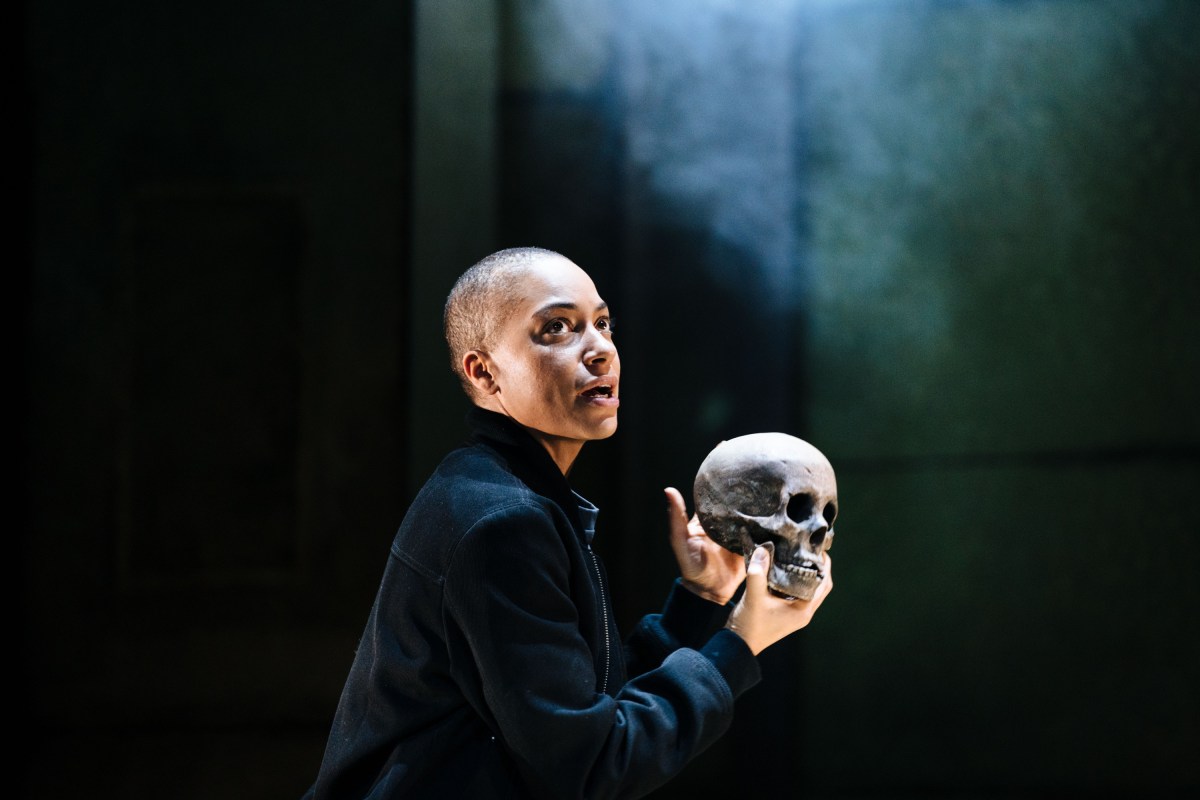
Cush Jumbo in Hamlet

The Young Vic’s audience has waited almost a year and a half to see Cush Jumbo perform the title role, and Jumbo herself lives up to expectations, even if the production she is in does not. She excels in comic moments and brings a freshness to Hamlet’s madness, through a bravura mixture of wry wit and ebullient clowning. Hamlet here is most compelling when interacting with the younger characters, who teem with vivacity. There is such warmth between Hamlet and Horatio especially, and Jonathan Livingstone makes Horatio a memorable presence from the play’s opening scene to its final soliloquy.

One reading of the play could suggest that Hamlet, and his fellow younger characters, are trapped in the world of the play, repressed by courtly strictures and Claudius’ kingly ambitions. Yet here, the younger actors almost seem trapped themselves, their lively energy blending oddly with the other very different acting styles on display. Hersov’s sprawling production has great moments, from the characters’ terror at the ghost of Hamlet’s father in the opening scene to the dumbshow, but there is an utter lack of cohesion. This manifests in the costuming – a modern dress melee of outfits which vary from practical, to chic, to formal, and somewhat inexplicably to spy-like dark suits and sunglasses – as well as the music choices. The singing of Norah Lopez Holden’s Ophelia is moving, yet it feels like it belongs to a very different production.

Jonathan Livingstone in Hamlet

Yet most of all, what jars is the clash in style between the traditional Shakespearean delivery of Claudius, Polonius and Gertrude’s roles and the looser naturalism of the younger characters. Perhaps this was intentional, but the effect ends up grating. Adrian Dunbar’s approach to Claudius is initially promising, projecting a kingly authority with overtures of friendship and just a hint of menace. Yet as the play goes on, he lacks interiority, behaving in private almost identically to his public performances. Everything is pronounced rather than spoken, his words those of a patrician and patriarch. Such a choice makes sense when he addresses Hamlet, yet it makes his marriage to Gertrude seem entirely functional – perhaps a consolidation of power.

Tara Fitzgerald’s Gertrude is even more thinly sketched. It makes sense that Claudius would marry the previous queen to maintain a grip on the throne, but Hersov, Dunbar and Fitzgerald’s cold approach makes the text feels flattened – with no sense of (even private) passion between the pair. This seems especially strange given the tenor of Hamlet’s disgust at his mother; he is horrified not so much by the usurpation and abuse of power than the ‘incest’ the remarriage constitutes. Yet Claudius and Gertrude barely touch, sharing one kiss in the play which feels motivated only by a regard for their public perception. In this version, they are not that into each other. It is a valid interpretation, but you cannot help but feel this production often chooses the duller option at each of these narrative crossroads. In this version of the script, the decision does bump up against textual problems too, such as Hamlet’s insistence that his mother begin practising abstinence, and that with time it will grow easier. Here, there does not seem to be the need.

In many ways, the narrative of Claudius and Gertrude plays as an anti-tragedy, particularly a rejoinder to Macbeth (though Shakespeare wrote that later). The pursuit of monarchical supremacy through murder is pure tedium, according to Hamlet, especially Hersov’s version. The murder is an offstage event before the play begins and there is no passion or power-lust. Claudius simply seems to have thought that killing his brother would be a good career move. Again, this seems representative of the production’s frequent decision to leave psychological richness un-mined. Sometimes it feels like the play is only ‘doing Hamlet’, rather than examining the emotional realities of the play’s world.

Adrian Dunbar in Hamlet

Anna Fleischle’s set design is strangely monolithic – containing giant rectangular blocks which fill up the back half of the stage. The grimy gold colour scheme conveys the gilded cage Hamlet finds himself in. As he remarks to Rosencrantz and Guildenstern, ‘Denmark’s a prison’ – though he fails to notice how he himself imprisons Ophelia. Yet the design limits the stage space and hampers the action. Polonius standing behind a curtain is replaced by him standing behind a block, the effect of Jumbo stabbing behind it cumbersome and bathetic, making the scene dramatically inert. At other times, the production cannot decide how it wants to represent action in the design. The ghost of King Hamlet is initially an offstage presence, machine guns trained on the audience with palpable fear. Yet the effect is diluted by having the ghost later appear in strange (often indecipherable) projections behind the characters, as well as given physical form in one scene by Adrian Dunbar. The production tries a bit of everything, but the result seems unfocused and indecisive – less than the sum of its parts.

There is one textual idea here which borders on brilliant though. The existence of Hamlet in three versions – the much shorter First Quarto, thought by some to be a pirated copy or poor imitation, the Second Quarto and the Folio – forces directors to select the text they want to perform in far more detail than simply where to make cuts. Hersov, like many other directors before him, has found the ‘To be or not to be’ speech to be particularly pliant, and he moves the iconic lines (Act 3 Scene 1 in the Cambridge edition) to the middle of Act 2 Scene 2, after Hamlet has played the fool in conversation with Polonius.

Hamlet implicitly mocks Polonius for being old as he paraphrases the ‘Words, words, words’ he has just been reading. He describes how ‘old men have grey beards, that their faces are wrinkled, their eyes purging thick amber and plumtree gum, and that they have a plentiful lack of wit, together with most weak hams.’ These sentences could be dismissed as incoherent rambles in service of Hamlet’s pretended madness, yet in their juxtaposition with Hamlet’s renowned words, they seem much more important.

Hamlet’s ironic mockery of ageing forces him to acknowledge his own mortality – but even worse, the cruelty of a life which keeps going on. Hersov and Jumbo thus deliver the well-worn soliloquy with a resonance that feels genuinely unusual. Instead of contemplating mortality and suicide, the speech is recast as a meditation on ageing. ‘These tedious old fools!’ Hamlet proclaims, in Act 2 Scene 2, immediately before ‘To be or no to be’. He is a young man tyrannised by the ambitions of the old, yet, when left alone, he reconsiders. Is this a fate that awaits him one day too – the ‘calamity of so long life’?

Norah Lopez Holden and Cush Jumbo in Hamlet

If Hersov’s tonally inconsistent production has a unifying gesture it is a trend for sudden reversal, specifically from Jumbo’s hilariously energetic physical comedy to haunting, horrified introspection. Another such contrast comes in Act 5’s grave scenes. Though the production’s music choices are generally odd and eclectic, ‘Three Little Birds’ is an inspired choice for the gravedigger’s entry. He is a ‘fellow [with] no feeling of his business’, who ‘sings in grave-making’, and his cheer perfectly contrasts his solemn task. The scene continues as riotous comic routine, shot through with sickening dramatic irony: we know Ophelia is dead, while Hamlet does not. Jumbo reads ‘Alas, poor Yorick’ with impish sarcasm and bubbles with chaotic mirth as she shares the gravedigger’s detachment – a detachment Hamlet will soon struggle to maintain. In isolation, the scene is a triumph of acting and, unlike in most of the play, the tone is perfectly judged.

It makes for a strong contrast with the solemn funeral that follows. Jonathan Ajayi is particularly impressive as Laertes – his resolve after his father’s death (in his attempts to comfort Ophelia) now shattered by the devastating further loss of Ophelia. Yet the restrictiveness of the set – and the resultingly poor blocking – pushes Hamlet off the main stage, crouched in the shadows. Why has this moment, which should be a whiplash realisation for Hamlet, been hidden? Hamlet’s anagnorisis should surely not be invisible.

This moment is emblematic of the problems of the production as a whole – particularly as Hersov and Jumbo interpret Hamlet as fundamentally bored by life, rather than exercised by injustice or plagued by suicidal ideation. Death registers as a shrug for him, but though seeing a man so worn down by life’s ‘slings and arrows’ that he will go quietly to his death can be deeply moving, in this version Hamlet has already been in this state for most of the play. The final deaths play out as a formality – though the swordfight (here using knives) is deftly choreographed by Kev McCurdy in the limited stage space. As a result, I felt little of the tragic weight that should accompany the ending. The play only stops, rather than ends.

Hamlet

Written by William Shakespeare, Directed by Greg Hersov, Design by Anna Fleischle, Lighting Design by Aideen Malone, Sound Design by Emma Laxton, Video Design by Nina Dunn, Movement Direction by Lucy Hind, Starring Cush Jumbo, Jonathan Ajayi, Joana Borja, Adrian Dunbar, Tara Fitzgerald, Norah Lopez Holden, Jonathan Livingstone, Joseph Marcell, Adesuwa Oni, Taz Skylar, and Leo Wringer
Reviewed 12th November 2021
Categories
theatre

Camp Siegfried – Old Vic

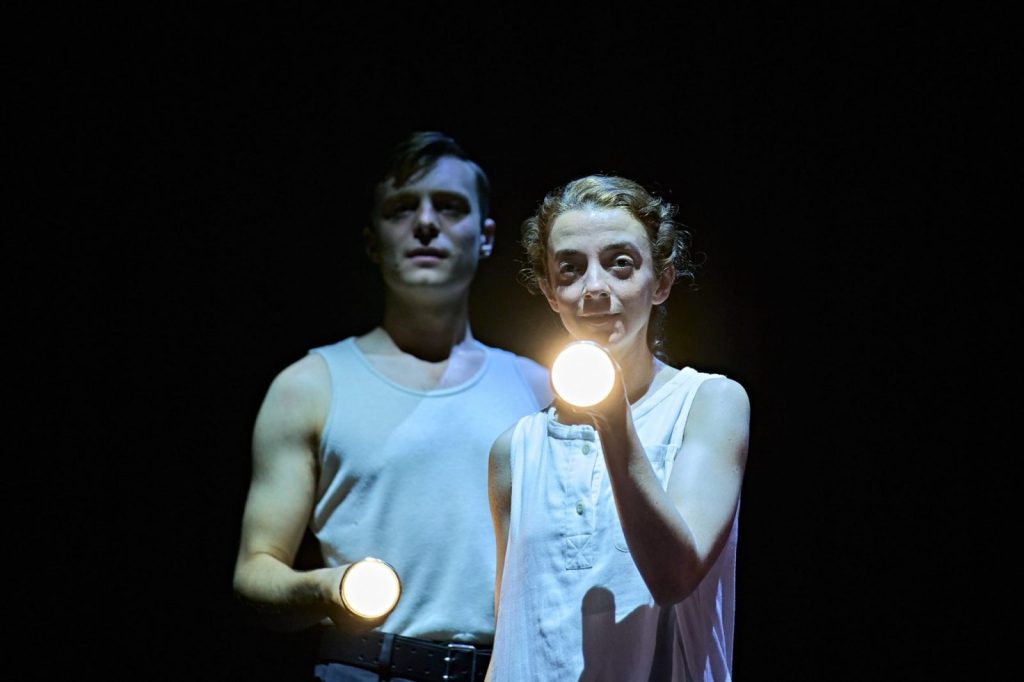
Luke Thallon and Patsy Ferran in Camp Siegfried

‘Things fester in dark spaces’

This is how radicalisation is often imagined. With the advent of the Internet, these ‘dark spaces’ now have the dim glow of a screen but remain dark nonetheless in our imaginations. Niche conspiracy websites and private messages only facilitate old grooming techniques. Yet it is perhaps even more alarming when radicalisation occurs in the clear light of day.

In Camp Siegfried, Bess Wohl’s new play about the Nazi radicalisation of American teenagers in the 1930s, the idea that ‘things fester in dark spaces’ is not born of child-protectionist panic at all. They are the words of a fascist-sympathising aunt, worried her niece will stay at home rather than partaking in the titular Nazi-run holiday camp on Long Island. As we gut-wrenchingly realise, the camp’s barely secret purpose is for its adolescents to breed with other ‘pure’ Germans. In an inversion of the aunt’s statement, in Camp Siegfried, toxic beliefs spread amid the bright and cheery, alcohol-fuelled celebrations of the camp’s inhabitants.

Wohl’s two-hander presents characters known only as Him and Her, a seventeen- and sixteen-year-old respectively, who have come to the camp for the summer. Their identities have been reduced on the page – in line with Nazi ideology – to a staunch gender division. Otherwise, they are anonymous. (To emphasise this, the text is set out without character names; ‘His dialogue is in italics. Hers is in standard type’. Unfortunately, this does make the script somewhat difficult to read.)

Patsy Ferran’s Her is overcome with nervousness, terrified of participating in any sports or camp activities. It brings to mind the hypersensitivity of her knockout lead performance as Alma in Summer and Smoke (at the Almeida in 2018). Ferran is nearly as good here, though the role has a little less inner conflict to really get into; Her simply grows in confidence before losing it again. Luke Thallon plays well against her, finding a faltering self-esteem in the part – his amiable smiling always on the cusp of turning into the rage that seethes beneath. He completely sells the warm cruelty that pervades Him’s dialogue, repeatedly calling Her a ‘dummy’, usually to hide his own embarrassment by accusing her of stupidity.

The script plays out a typical-seeming story of first love, yet constantly unsettles us with an alarming political context of which the characters accept largely unchallenged. They bond over living on bordering streets; she is staying on ‘Hitler Way’ while he is on the ‘corner of Hitler and Goebbels’. What is so shocking is how normalised these red flags are. (Indeed, red swastikas – stipulated in the script, but avoided on stage – would inspire emotions of allegiance for Him and Her, while making an audience uncomfortable.) Yet their support for an ideology now synonymous with evil is incubated not in a dark space, but in a bright holiday camp.

The motif of light pervades Wohl’s play, from the opening scene’s bright ‘outdoor lights’ for an oompah disco to the penultimate scene’s fireworks. An effect of Rosanna Vize’s slightly too stark set, which essentially consists of a row of vertical timber planks, is that Rob Casey’s lighting becomes absolutely central to the play’s design. It plunges us from darkness (bar torchlight) to a dazzling, disorientating glow that scorches the eyes. (Though such moments were visually impressive, the production did feel a little basic, considering the Old Vic sells a large proportion of their tickets for £65.) The play builds to a final moment in which the characters stare out to sea, enchanted by the ‘bright’ future ahead. We are left to conclude for ourselves whether this is a resurgence of ideological zeal for Nazism, or a premonition of the oncoming bombing across Europe.

Camp Siegfried is largely about the way radicalisation happens in the open. Near the end of the play, Her recalls a doctor telling her that humans can ‘make ourselves believe almost anything’ and that the ‘best and worst of us is our infinite capacity for delusion’. Delusion is not darkness though; it is being shown the world in the wrong light. While extremist fringes do flourish in the shadows, Wohl is looking at the different, broader issue of the widespread normalisation of fascist politics. Evil here is not banal due to the dullness of bureaucratic or technological detachment, as often imagined, but by sprouting within a commonplace of American culture: the summer camp. It is true that toxic ideologies may fester in the dark, but fascism spreads far faster in the clear light of day.

This idea of brightly banal white supremacy is one that animated Ari Aster’s 2019 folk horror drama Midsommar. The horror film genre is arguably the natural home of dark, festering things. Generally, in recent horror cinema, these films have featured dour or naturalist colour palettes – sometimes flecked with the deep red of blood. (An entirely anecdotal list of recent examples: Saint Maud, The Lighthouse, The Witch, Censor, In the Earth, Relic, and Aster’s debut picture Hereditary.) Yet in making a drama about recruitment into cults, Aster avoids this typical look in favour of bright, cheerful colours and brilliant whites. It tricks the senses; we do not expect barbarity amid the beauty of the bright summer countryside. Yet as the film goes on, the disjuncture between content and tone – a dark film bathed in light – only adds to its disconcerting effects.

Midsommar follows a group of college students, who visit fictional pagan cult the Hårga in a remote Swedish commune. Gradually, the cult works to induct the film’s protagonist, Dani, into their group, while killing off the rest of her friends for apparently disrespecting their customs – or trying to escape. The film ends with an image of pure delight, as Dani smiles, as if she has found home at last, while her ex-boyfriend Christian is burned alive before her. Though this moment has been interpreted positively by some, for me the sense of elation the audience share should be considered problematic. The film is ultimately an allegory for white supremacy and how suffering can make people vulnerable to extremist ideologies. (Dani is grieving for her entire family, who die at the very start of the film.) The Hårga cult are fascist-coded – obsessed with fertility and the propagation of an exclusively white population. They also commit (seemingly voluntary) ritual senicide, the commune’s elderly jumping from a cliff once they reach the age of seventy-two. Dani’s conversion would be horrifying to us, but we have shared her extreme experiences and view her through her own radicalised eyes.

The final shot of Midsommar, featuring Florence Pugh as Dani

Yet the radicalisation is so effective because it presents itself as a form of community. The Hårga legitimises its acts of violence as necessary rituals, a valid alternative way of life that should be respected – up until the point they crush all other alternatives. Seeing shocking deaths such as the film’s ritualised suicides unsettles the characters in a way which makes them more vulnerable. By contrast, in Camp Siegfried, the charactersinstead undergo the terrifying pressures of puberty. Characters who are, naturally, trying to figure out their own identities, are presented with the monolithic identity of Nazism to internalise. En masse, it offers them a purpose.

In the play, brightness and clarity are fundamentally political. The crimes of the Nazis were not unknown, only overlooked and appeased, throughout the 1930s – even as they built very different kinds of Nazi camp to that which Wohl depicts, which would later turn from imprisoning dissenters, to murdering Jews and those deemed lacking in social value. The young German-American characters perfectly encapsulate the scepticism towards what many viewed as Hitler’s overreaching rhetoric and general excess, but their fundamental acceptance of the overriding ideology. The information was available; people either chose to believe the Nazis didn’t really mean it, or were actually in agreement.

Camp Siegfried works better as a study of how radicalisation occurs, than how it can be averted. By the end of the play, though laced with some ambiguity, we are presented with Him as a burgeoning Nazi, and Her as largely de-radicalised. In the final scene of the play, Her delivers a potent monologue – describing a journey into New York to see a doctor about the leg injuries she has suffered undertaking the camp’s exacting programme of physical activities. She eventually ends up meeting a kind doctor who offers her dinner and a room for the night, who is implied to be perhaps Jewish. (His children are called Rachel and Sam, and the production inserted a reference to (I think) Kreplach dumplings, not present in the script.) I found this monologue amazingly powerful and moving, terrifically performed by an entirely compelling Patsy Ferran. Yet as brilliant as Wohl’s writing is here, it slots slightly awkwardly into the broader narrative of the play.

In Scene Five, Her has been chosen as the Jugendredner – the most accomplished camper, who gives a speech about their time in the camp – causing friction with the jealous Him. In Scene Eight, Her delivers the speech. At first, she is extremely nervous, her words punctuated by long, agonising silences. Yet as she finds her voice, she falls into a more natural register and addresses more overtly political matters than the speech is expected to discuss. By the end, it is full of Hitler-esque Nazi rhetoric, decrying the malign influence of ‘foreign interests’ and threatening ‘Bolsheviks Communists and a global conspiracy of Jews’, who she wants to ‘Tear […] out by the roots’. Her’s sudden veering into fully fledged fascism is horrifying and – under the pressure of the moment – rings true. Yet less convincing is the almost complete change of mind that occurs by the play’s end in Scene Ten.

Arifa Akbar, writing in the Guardian, noted how ‘suddenly’ her ‘conversion to Nazi fanaticism’ begins and is halted, yet rather than a seeing this as a dramaturgical shortcoming, I would be inclined to suggest this as a deliberate choice from Wohl. The suddenness is precisely her point.

Instead of presenting the all-consuming, heavily reinforced radicalisation of, for instance, Midsommar, Wohl explores a shallower (yet still profound) social pressure to conform. In these adrenalized and peer pressure-fuelled conditions, it seems extremely likely that many individuals would fall in with the prevailing ideology. That I agree with. Impressionable young people are, of course, the perfect targets. An instance of misdirected confidence boosting (such as allowing Her to give the speech to the camp) could be the beginning of a startling journey into extremism. My issue is with the play’s analysis of de-radicalisation. Are we really to believe that, once subjected to such conditions, the spell can be broken with only kindness and soup?

I find myself a bit torn. The moment just about works in the play due to the writing’s raw emotion, especially when sold so well by Ferran, yet it comes off as somewhat politically naïve about the complexity of de-radicalisation. It does not seem an unfair leap to suggest that we are supposed to read Camp Siegfried in some way in conversation with contemporary radicalisation – particularly the resurgence of the far-right across North America, South America and Europe. As such, we should not read the play solely as a narrative of how past atrocities could have been prevented but instead as considering how the present-day far right can be countered.

Read as a fairly literal parable, Camp Siegfried’s conclusions are a little troubling. The idea that radical kindness could be a solution to extremism appeals to an innate idealism shared by many. Yet while the world would undoubtedly be a better place with more kindness in it, to say so isn’t exactly a remarkable statement. What is more worthy of scrutiny is the implicit idea that victims (or potential victims) have a role – or even responsibility – in de-radicalising their would-be oppressors.

In some ways, the play put me in mind of the more recent trend of the incel. The term is a concatenation of ‘involuntary celibate’ and was initially used in the 1990s as a self-descriptor for people who wanted to be having sex were not having any. By the mid-2010s, instances of incel violence led to the term denoting a more specific type of misogynistic man. Notably, in 2014, Elliot Rodger became known as an ‘incel hero’ for his murder of six people, injuring fourteen others. These killings became a fulcrum of feminist debate, as many considered how we should pre-empt future similar acts of terrorism.

Amia Srinivasan examines the incident in her brilliant essay The Right to Sex, recently published in a book of the same name. She writes, ‘Soon after Rodger’s killings, incels took to the manosphere to explain that women (and feminism) were in the end responsible for what had happened’. To think that one woman sleeping with Rodger would have neutralised his misogyny and ultimate violence is of course deeply simplistic, entirely unprovable, and deeply offensive. As Srinivasan argues strongly, no-one has a ‘right to sex’. It is an insulting proposition to suggest that one woman’s willingness to have sex with him would have altered the course of events. Suggesting that Rodger would have had a better life and have been less inclined towards violence if he had received more kindness in his life is a different proposition to saying that someone should have taken pity on him sexually. Yet even so, there is a kernel of a (far more extreme and misdirected) philosophy of kindness at play in the anti-feminist arguments. It at least raises a question of broader concern: if potential extremists want and need kindness, then who is obligated to give it to them, especially when some consider the sexual submission of women to be one such act of kindness?

Perhaps Her’s treatment by the doctor was not meant by Wohl as a picture of a potential solution to processes of radicalisation, but a depiction of a lucky escape – revealing just how fertile some young, vulnerable minds are to such ideas, while offering hope. Yet the play focuses in on the effects of interactions between individuals as holding the key to de-radicalisation, rather than instead analysing what society or the state should be doing. The work of a state-affiliated fascist structure is neutralised in one person by the kindness of another. As a result, it implicitly suggests the horrifying possibility of a counterfactual in which Jews de-radicalise Nazis by serving them dinner. It is not the well-trodden path of the ‘would you kill baby Hitler’ argument, but a thornier one, which enlists future victims as de-radicalisers. Yet at its heart, there is almost a logic of appeasement in this part of Camp Siegfried – though perhaps not intended to appear this way.

It should be stressed that Wohl makes no specific claims about incel radicalisation. However, the play is alive with subtle parallels; Wohl shows that fascism has legitimised some men’s instincts to coerce and rape women. The young men, in particular, are encouraged to be ‘social’ as part of the ‘kampf’ – the struggle of the German nation. The encouragement is built into the camp’s geography. As Him tells Her to her shock, ‘Did you ever wonder [why] the Jungen tents are only less than ten feet away from the Mädchen tents’. Their ‘duty as pure Germans’ is to reproduce and consent only stands in the way of the ‘kampf’.

Nazism here shares incel ideology’s sense of entitlement to women’s bodies, as well as being obsessed with a similar underlying social hierarchy. Srinivasan considers incels to be surprisingly disinterested in sex itself, instead more concerned with social status. She diagnoses incels as fundamentally angry with where they rank on a social hierarchy of desirability (defined largely by the value society confers on a person for having them as a sexual partner, which Srinivasan calls ‘fuckability’). They think that they should be entitled to women – specifically the high-status, ‘fuckable’ women. At no point do they instead question or challenge the hierarchy; they simply feel entitled to being high status themselves. For ‘pure Germans’, Nazism recodifies this ranking on a grand scale – conferring far higher status on previously low-status white Germans while regarding all difference as impure.

Male sexual violence exists on the fringes of Camp Siegfried and is sketched with delicate horror. ‘You know Emily Fisher’, says Her, ‘She hasn’t eaten a bite in two weeks ever since she went into the woods with that James’. By the end of the play, Him wants to ‘join up’ to a youth movement which will inevitably become part of the German army within a year while Her imagines living among ‘all kinds of people’, struck by the diversity of New York. Their striking political divergence is more convincing when viewed as a product of their gendered treatment. Him is given a (superficial, at least) sense of purpose by the camp’s ideology. Her, on the other hand, is expected to produce babies and accept the violence against her female friends (and against herself, in the end, by Him) as mere collateral of the regime. Her Jugendredner speech would likely be the most significant contribution she would be allowed to make. The play ends with them staring into the horizon, towards Europe where Him will soon travel. They stare together and eventually she begins to see something akin to what he sees: ‘the future’. ‘It’s so bright’, Her says, in the play’s final line. Wohl leaves ambiguous – and up to us – whether this brightness is hopeful or is instead Her beginning to see again by the wrong light. The events of Camp Siegfried play out against the backdrop of our own historical awareness. We know just how far Nazi fascism will go in the 1940s, but also that it is beaten – at a heavy price. Yet we also share the characters’ state of flux; we cannot know what the future holds for us in the present day. Does a bright future glow with hope, or the carnage of resurging fascism? The play cannot tell us. It is up to us to prevent it, though Camp Siegfried’s message of kindness and compassion (which underlies its gesture in inviting sympathy for Nazis-in-waiting) is perhaps too simple to truly neutralise such a powerful threat.

Camp Siegfried

Written by Bess Wohl, Directed by Katy Rudd, Set and Costume Design by Rosanna Vize, Lighting Design by Rob Casey, Sound Design by Ian Dickinson, Video Design by Tal Rosner, Movement Direction by Rachel Leah-Hosker, Starring Patsy Ferran and Luke Thallon
Reviewed 26th October 2021
Categories
theatre

Rockets and Blue Lights – National Theatre Dorfman

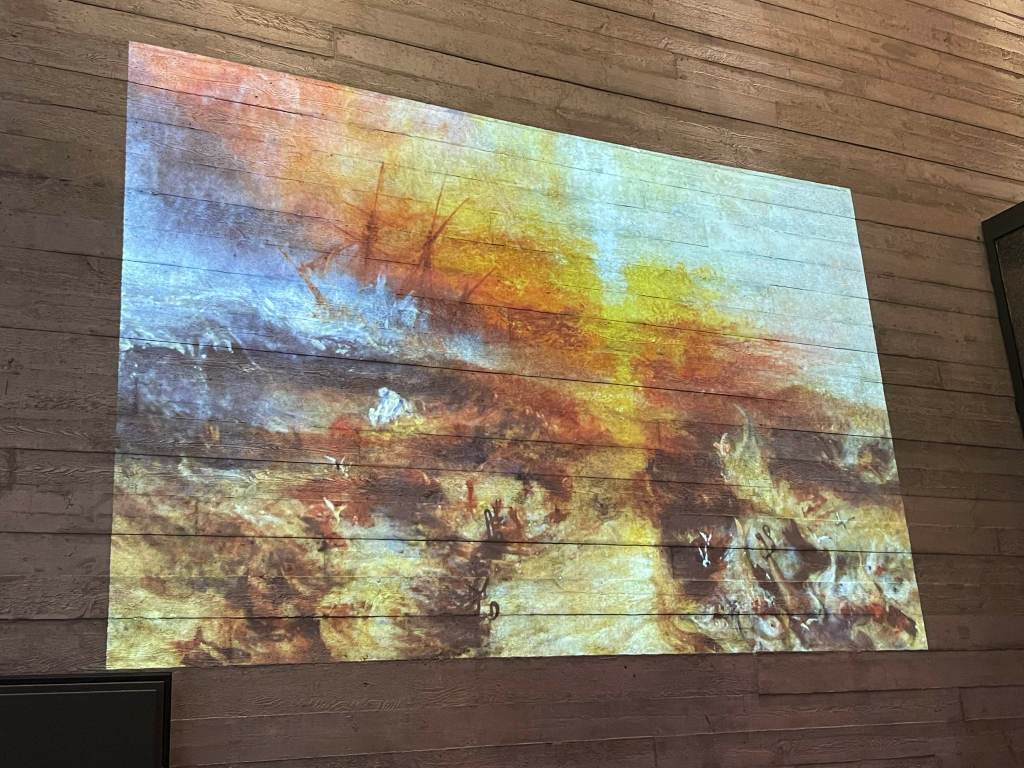
The Slave Ship (Slavers Throwing Overboard the Dead and Dying, Typhoon Coming On) by J.M.W. Turner

It is unusual for the most striking work in an exhibition to be a painting that isn’t there. However, the curators of Turner’s Modern World at Tate Britain earlier this year considered The Slave Ship (completed in 1840) to be of such significance that they made it an absent centrepiece. The painting itself is in the Museum of Fine Arts in Boston and is too fragile to travel, but the high-quality reproduction hung in the middle of the exhibition – to shocking effect.

The painting famously depicts the 1781 Zong massacre, which occurred when J.M.W. Turner was only six – though there are counter-theories that it depicts a similar, later event. When the Zong slave ship charted the wrong course and began to run out of drinking water, over 130 enslaved people were thrown overboard. The first thought of the ship’s owners, on landing in Jamaica, was to attempt to make an insurance claim for the murdered slaves. Turner’s decision to make such a scene the subject of a painting has been figured by critics (and the Tate themselves) as a sign of his growing liberal perspective, and guilt over the ways he had profited from the slave trade. The Tate contextualises the work with the fact that the ‘personal fortunes of some of Turner’s early patrons came from slavery’, while Turner himself, in 1805, ‘sought to benefit from it’ by investing ‘£100 in a proposed cattle farm in Jamaica to be worked by enslaved people.’ The venture fell through, and Turner lost his money.

The painting is also an absent presence in Winsome Pinnock’s extraordinary Rockets and Blue Lights. It is never seen on stage in any form, but the play begins with a powerful ekphrastic description of its colours: ‘Amber, gold, chrome, the darkest-darkest sea.’ Yet Pinnock is keen to show that artistic appreciation is not neutral. ‘All I could see was Turner’s use of colour, his elegant suggestion of bloodshed in a captured sunset. I didn’t think about what had just happened to those poor men, women, children. They were invisible’, Lou says. Looking is revealed not as a primordial, pre-political act, but the product of conditioning and constructed norms of artistic taste. To see the bodies, just visible in the swirling tides, Lou ‘had to look, really look’. Looking upon such a dark history can be challenging, and Pinnock seems to encapsulate the competing impulses to stare and to look away in the title of the play, which references another Turner painting, completed later in the same year – metaphorical eyes skating onto a less confronting work. The play is not merely a debate over whether Turner’s art is ‘problematic’. Instead, Pinnock asks a more profound question: how does the way we look at art and artefacts affect our understanding of history? Both The Slave Ship and Rockets and Blue Lights are projected in the Dorfman foyer as we leave, ripe for re-evaluation.

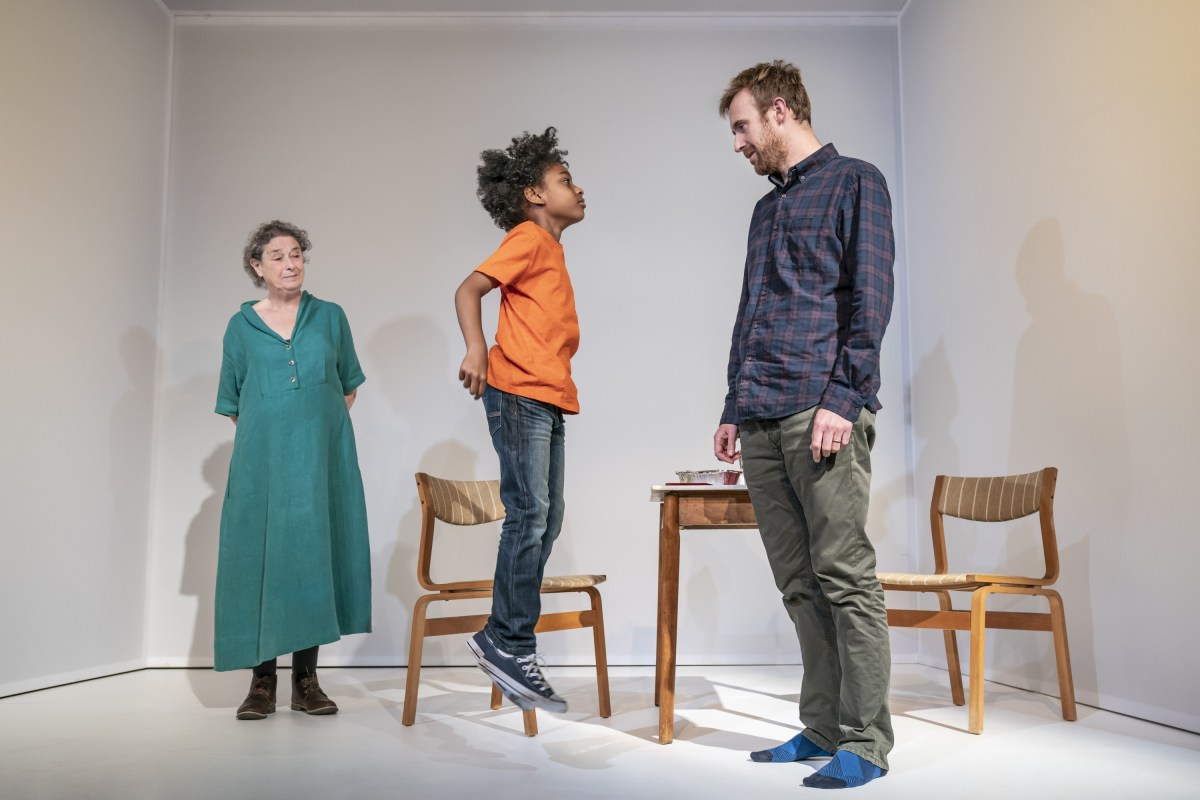
Luke Wilson and Kiza Deen in Rockets and Blue Lights

The play examines the value of compromised art in general. Lou (a terrific Kiza Deen) is an actor in a fictional film called The Ghost Ship. In it she plays the ghost of a slave, Olu, who is imagined haunting Turner as he completes The Slave Ship, inspiring him to tell her story. Yet any initial radicalism of the film project is sapped away by studio-mandated rewrites; they increasingly tell Turner’s story over that of Olu. At a readthrough of a rewritten scene, Lou is surprised to read that ‘Olu appears naked, wet’ – the nudity added only after she has agreed to perform in the film. Not only is this change manipulative for Lou, it undermines the story being told and the way the film’s audience is being invited to look at an enslaved character. The ‘wonderful material about Olu’s life before she was captured’ has been excised due to ‘cuts’ demanded by the film’s financiers, while Turner’s life has been presented in even more detail. Apparently, the audience will ‘feel cheated’ if they are not shown the reasons why Turner paints The Slave Ship. The film’s audience are invited to look on Turner as a ‘complex’ figure, where Olu is now a depersonalised, eroticised body.

When Lou threatens to walk over the alterations, writer-director Trevor responds, ‘Which would you prefer? That the film gets made, that people get to hear this story, or that it just disappears?’ Here, Pinnock encapsulates the Hobson’s choice faced particularly by Black creatives; either they can make compromised art, or no art at all. What compromises them most is, of course, money. The Ghost Ship is funded by a grant from the ‘Abolition Legacy Foundation’, a fictional organisation symbolic of Britain’s ongoing revisionism over the abolition of slavery. The existence of abolition is treated as a piece of heritage worthy of celebration, rather than a cause of shame. Yet as Pinnock writes in her ‘Note on Play’ at the start of the text, the passing of a law did not translate to the end of the slave trade itself: ‘slavery wasn’t properly abolished until around 1838, and may have continued beyond that.’

The play’s second narrative strand, set in 1840, directly examines the persistence of slavery. It fictionalises an account of Turner’s painting of The Slave Ship, in which he travels incognito on a supposedly decommissioned slave ship called ‘The Glory’ to gain inspiration for his seascapes. Yet Pinnock lends equal weight to the story of Thomas, a sailor who ends up enslaved when their voyage reveals its true purpose: illegally transporting slaves almost a decade after 1833’s Slavery Abolition Act.

Karl Collins and Paul Bradley in Rockets and Blue Lights

The structure allows for clever transitions between 1840 and the contemporary film set of a period drama. In one historical scene, Olu refuses to be fed and is punished with a whip. Pinnock directly criticises contemporary art’s all-too-common impulse to depict brutalised Black bodies, most commonly on screen. As the scene continues, it seamlessly shifts to the set of The Ghost Ship. Seemingly overcome by the intensity of the scene – or perhaps infuriated by the violence’s persistence as a trope – Lou grabs the whip and starts retaliating at her assailants. Seemingly the financial interests behind the film have encouraged Trevor to make the production grittier and more visceral, but the result is – as Lou says – ‘the usual torture porn’. Pinnock’s powerful critique attests to the power of images in our understanding of slave narratives. While diminishing the realities of historical suffering would be counter-productive, depicting violence can reify a white supremacist hierarchy. As Lou says, ‘every single lash sends a subliminal message that to be white means to have never been a slave’.

You can feel the play grappling with itself, trying to find the balance. Yet theatre seems better suited to representing such violence, compared to film’s more realist instincts. Miranda Cromwell’s production has the captor whip the ground, while Olu cries out in agony on the other side of the stage. The effect remains horrifying, but there is a symbolic separation of the undeniable historical violence of forced transportation and the real body of an actor, as viewed by an audience.

Part of the problem in representations of slavery is in power imbalance between characters; dramatizing a position of powerlessness can lead to some characters only being subjugated – and thus dehumanised. Pinnock examines this particularly in the second half of the play, in the struggle over who the main character in The Ghost Ship is. The issue is epitomised in the respective awards received by Lou and Roy, for playing Olu and Turner. He won best actor, where she was nominated for best supporting actress. Roy attempts to redress the balance, accepting his award on behalf of Lou and saying it belongs to a descendant of enslaved people rather than him. ‘By the end they were all standing up, applauding… not a dry eye in the house’, Roy recalls. Yet this is just another white man using a slave narrative to receive a standing ovation. However well-meaning, he has centred himself once again – just as his script suggestions to producers have centred Turner in the film, inadvertently (or perhaps not) tipping the balance away from Lou being eligible for the best actress award.

The play does not lose sight of the fact that Lou is still in a privileged position, though her wings have been clipped. After all, her whipping of a comparatively unknown actor is quickly smoothed over as a ‘prank’ and a ‘joke’. Yet even when elevated, she exists in the shadow of Turner (and Roy) – as the whole play does. Roy claims that ‘It’s not my film. It’s Turner’s’, to which Lou responds, ‘It is not his. It belongs to the enslaved.’

In what I felt to be the play’s most powerful moment, Pinnock suggests that what makes the world’s artistic response to slavery truly compromised is the fact that enslavement, transportation and mass killings like the Zong massacre destroyed generations of artists. ‘Among those people who drowned were artists, musicians, mothers, fathers, daughters, generations of unborn babies’, Lou says. Regardless of whether slavery art is exploitative or an attempt at commemoration, it is almost always being created from an outside view, a perspective which defines how we look at art in general. The Slave Ship ‘isn’t about our suffering’, says Lou. ‘It’s about his.’ Generations of potential artists were enslaved and killed, along with their potential descendants – thus rendered unable to express their suffering in art themselves. This is the yardstick Turner’s ‘greatness’ should be measured against.

Yet as a result of these missing stories and artworks, we are forced to consult Turner as a major source. The question of why Turner painted The Slave Ship is cleverly dealt with in Rockets and Blue Lights; the impossibility of knowing makes it hard to be definitive, and narratives such as The Ghost Ship hide the grim facts of slavery behind a cloak of mysticism. Instead, Pinnock uses the historical strand to expose the existence of slavery long beyond supposed abolition, while Turner’s guilt at investing in a sugar works is presented as fundamentally pathetic. He confesses the fact to Thomas with little real apology, only shame at his grubby little secret – for which he is only punished in the play with the ship’s custom ‘Pollywog’, a game in which the sailors momentarily simulate drowning. It hardly compares to the vast number of people drowned by slavers in the Atlantic. Thus, the painting is not treated as the final act in a grand redemption arc – like in The Ghost Ship, whose final image is of the completed canvas. Pinnock does not want us to replace our blinkered appreciation of Turner’s use of colour with a reductive analysis of his white guilt. There is nothing especially radical about repositioning him from ‘genius’ to ‘troubled genius’.

Instead, Turner’s work is valuable because of what it can tell us about a lost history – if we truly look. Writing in a feature for the Tate, Pinnock argues that ‘Slave Ship isn’t like the statue of Edward Colston in Bristol, which was erected in order for people to venerate a man who gained his wealth through the slave trade.’ The removal of a statue like Colston’s – an object of self-fashioned propaganda – is a correction to a distorted historical record, rather than destroying a source. Turner’s painting, however, is far more complicated. As Pinnock says, ‘it’s important that people see this painting, and think about what it is saying.’

Towards the end of Rockets and Blue Lights, the character Reuben presents Lou with ‘a lump of metal’, revealed to be ‘ballast [which] compensated’ for the losses of slaves overboard on Atlantic journeys. Pinnock’s stage directions indicate that Lou ‘holds it as though it is sacred’; physical objects like this take on such significance when so much information is missing. It has huge value as a record which makes slavery a semi-tangible, comprehensible thing, rather than something abstract, of the past, and from which we look away. Yet we must look again. It is too easy for us to think of the painting as the product of ‘Turner’s Modern World’, looking back on the slave trade as a historical aberration or defunct economic system. Instead, slavery was a core part of industrialised modernity – long after abolition. Whether or not British ships and sailors continued transporting the enslaved in the second leg of the triangular trade route after 1833 – and the play makes a compelling case that they did – Britain still remained complicit. The cotton Britain bought from America was not ethically neutral.

So much knowledge of the history of slavery has been lost to shipwrecks – including the estimated ten to twenty per cent of people who died while being abducted from Africa and forcibly moved to America. Laura Hopkins’ ingenious set pools with water at the end of the play. As the cast bow, the water lapping around their ankles almost suggests that the ephemeral event of the play is lost to time too, like narratives of slavery passed down only by speech, or lost entirely. Indeed, the play is set in what looks like the ruins of a ship. Yet the cumulative effect of Pinnock’s skilful dramaturgy being brought to life by a superb cast, directed with focus, care and empathy, is a play that lingers in the mind long after it ends, rather than being lost to time.

Rockets and Blue Lights

Written by Winsome Pinnock, Directed by Miranda Cromwell, Design by Laura Hopkins, Starring Kiza Deen, Anthony Aje, Paul Bradley, Karl Collins, Rochelle Rose, Matthew Seadon-Young, Kudzai Sitim, Cathy Tyson, Everal A Walsh, Luke Wilson
Reviewed 25th September 2021
Categories
theatre

What If If Only – Royal Court Downstairs

John Heffernan, Jasmine Nyenya and Linda Bassett in What If If Only

I was reading about this man who spent ten years trying to paint an apple so it looked just like an apple. That was eighteen to twenty eight.

Then he spent seven years trying to paint an apple so it looked nothing like an apple.

Then he died.

This is the sort of thing that interests you. That used to interest you.

In What If If Only, Caryl Churchill tries to write a ghost story. Then she writes something nothing like a ghost story. But here she does it all at the same time.

In her latest short play for the Royal Court, Churchill upends the usual ghost story structure. Typically, a ghost story will follow someone once living continuing to exist in some form beyond death. Here we are presented with the ghost (or ghosts) of dead futures, cursed never to have been alive and with no possibility of becoming alive. Though brief, at only twenty minutes (and a sparse, pause-filled twenty minutes at that), the production teems with raw emotion, humane philosophical enquiry, and political reflection. That it feels so rich is nothing short of a marvel.

Directing a Caryl Churchill play comes with many challenges, but What If If Only sees James Macdonald approach yet another Churchill offering with superb focus. The difficulty is the need to interpret the script’s elusive ideas, while leaving the effect thematically indeterminate. The production needs to be highly specific and careful, without losing its emotional power. This capacity for balancing directorial interpretation and authorial intention, while leaving space for audiences to make up their own minds seems exactly why writers such as Churchill, Lucy Kirkwood and Annie Baker have given Macdonald their wonderfully detailed and exacting scripts in recent years.

The script here is delightful and hard to pin down. Yet despite its strangeness (and sometimes our uncertainty over what we are actually watching), it begins with a command of semi-naturalist characterisation which is utterly masterful. Churchill subtly sketches her bereaved subject, Someone – played as a man here by a breath-taking John Heffernan. He talks to a partner who is not there, his long silences filled with hurt and blame. (We soon discover that his partner died by suicide.) Though overuse has often made such moments feel clichéd, Churchill’s shifts in tense between ‘are’ and ‘were’ when Someone talks about his dead partner express a fresh emotional truth. The trope is examined. Churchill grapples with the simultaneous deadness and continuity of the recently deceased; Someone describes the artist, saying ‘I think he was a difficult person like you’re a difficult person. Were. Are.’

Bitter that his partner sends no ghostly sign, he remarks ‘Are you not trying? If you’d wanted to talk to me you could have stayed alive.’ Churchill always seems to find the right words, even when feeding us exposition. ‘Would he kill himself? You know what it takes to kill yourself, would he do that?’, Someone asks. These barbed recriminations generate empathy, but I also felt that he is quite a difficult person too.

After the slow opening monologue, John Heffernan is joined on stage by Linda Bassett, who gives a very different yet complementary performance as a variety of apparitions: a Future, Futures, and the Present. Heffernan acts with slowly mounting intensity – which, depending on the night you see it, can burst into volcanic crying or something quieter and whimpering. (Both are hugely moving.) Bassett meanwhile displays a remarkable range, conveying the impish delight of utopia, the maelstrom of the chaotically competing possible futures, and the cool detachment of the present.

Miriam Buether’s set is a minimalist triumph, slotting well in front of the brickwork and plywood frame of Is God Is. The stage has an almost painterly composition. John Heffernan’s Someone is hemmed into one corner, sat across a table from an empty chair. The left half of the stage is entirely empty, the space enclosed by white walls that give the scene the look of a three-dimensional canvas. The emptiness is striking and simple; the room is too big for only one person.

The effect of Heffernan’s almost motionless performance (he fiddles at little with some fruit) is to make the stage look like a very empty painting. Indeed, ‘still life’ would be an apt subtitle for the play. After all, what is a ghost but life still going on when corporeal existence has stopped. The curious opening monologue establishes What If If Only as a play concerned with art and its limitations – a space for imagining possible futures and mirroring reality. The reason the artist shifts from trying to render apple in exact detail to pure abstraction is left unspecified, but it arguably reflects Churchill’s own shift as a dramatist. Most of her 21st century work would fit the description ‘fantastical’; generally, she has eschewed realism for something stranger. She does not simply paint an apple.

Perhaps this is an objection to realism as a tool for political analysis and debate – her own literary canon rife with experiments in political drama that does not look at all like conventional British examples. Would the artist paint the same apple or replace it with a ‘perfectly ripe apple’ each morning, Someone wonders. The folly of the artist trying to perfectly represent an apple which will have rotted away by the time the work is completed could be read as a comment on the short use by date much direct political writing will have. The gesture behind many of Churchill’s more recent plays (Escaped Alone, Kill and Imp spring to mind particularly) seems to be to evoke contemporary social and political forces, unmoored from our own world – though sprinkled with details from it. (In Escaped Alone’s apocalyptic world ‘eighty per cent of food was diverted to tv programmes’ such that ‘commuters watch breakfast on iPlayer’). Arguably the still life’s counterpart in drama is the state-of-the-nation genre, hinging on the representation of (or sometimes the attempt to reveal) how things are. Yet for Churchill, not only are some things in a constant state of flux, but others are lost to the past forever. Drama is too slow a medium to address the politics of the moment.

This makes it fascinating that What If If Only can be watched in the same evening as Lucy Kirkwood’s bravura Maryland, a rapid-response play written in only two days and staged script-in-hand just over a week later. It mounts a coruscating examination of violence against women and the police, particularly responding to the murders of Sarah Everard and Sabina Nessa. Kirkwood’s play shows the immense value of directly political contemporary writing in playing out versions of all-too-common scenes from real life. Kirkwood’s play does something a bit different; it is (in Kirkwood’s words) a ‘howl’.

There are occasional, directly political moments in What If If Only. The utopia represented by Future is coded as specifically left-wing. Future notes that ‘I’ve been glimpsed I’ve been died for in China and Russia and South America and here’, aligning its politics with Socialism and Communism – though served with ‘equality and cake and no bad bits at all’ to sweeten the deal for potential detractors. Yet here, though begging to be made to happen, there is a resigned quality to Bassett’s performance. This is a future which thinks it will not happen, symbolic of the decline of left-wing idealism in the second half of the 20th century, to the present day.

Arguably one of the main themes of the play is political inertia, restated in Present’s monologue. She says that ‘the Present always has wars and any Future that promised no more is dead dead dead’. The present increasingly resembles Mrs Jarrett’s visions of the end of the world in Escaped Alone, and Far Away’s conflict-ridden world of ecological breakdown seems less and less far away than it did in 2000. Though the world may be chaotic and violent, at the same time the prevailing political and economic ideas remain stuck, Churchill suggests.

Yet the extent to which we accept the claims of the Present seems rather up to us. Indeed, our present malaise seems reflected in the grief-heightened cynicism of Someone. We have lost faith, not only in the soul persisting after death, but possible futures themselves. The Present is here to stay; ‘it will be the Present as it always is’. It is the end of history, not in terms of liberal democratic stability, but due to our tacit acceptance of our inability to reshape the world into something better. We no longer believe in a future or the possibility that we could shape it.

The play does push against this idea too though. It ends with a Child Future (winningly played with energy by Jasmine Nyenya and Samir Simon-Keegan) insisting ‘I’m going to happen’. The image is striking, filled with naivety and pure earnestness. Though the play is extremely sober in its representation of what has been irretrievably lost, it does not mean there is no future.

What If If Only

Written by Caryl Churchill, Directed by James Macdonald, Design by Miriam Buether, Starring John Heffernan, Linda Bassett, Jasmine Nyenya and Samir Simon-Keegan
Reviewed 11th October 2021
Categories
theatre

The Tragedy of Macbeth – Almeida

Saoirse Ronan in The Tragedy of Macbeth

Stars, hide your fires; let not light see my black and deep desires.

These words, used throughout the promotion for the Almeida’s exquisite play The Tragedy of Macbeth, are typically held up as signs of Macbeth’s simultaneous ambition and guilt. Yet here it comes across far more literally; this Macbeth is all about desire. The play presents a central relationship which feels distinctively modern in its toxic consequences and the sublime Saoirse Ronan and James McArdle convey a tragedy caused by a fatal mixture of ambition, insecurity and mutual lust.

Director Yaël Farber has said that ‘People tend to think of this as a couple who have transcended morality but in many ways it’s one of the most functional marriages Shakespeare has written.’ Here, the Macbeths are deeply loving, yet capable of cruelty to each other as well others. Lady Macbeth goads her husband with taunts of inadequacy when his qualms over the morality of regicide threaten to halt their murderous plans. The marriage is truly alive and in the opening act the couple are incandescent with sexual attraction; they seem aroused by the power that seems within reach and hatch their plan in a fit of passion on their marital bed.

One of the reasons the theme of sexual potency seems so present here is perhaps because Farber uses it to examine the issue of childlessness – or, more specifically, child loss – in far more detail than many recent productions. ‘I have given suck’, Lady Macbeth famously says in Act 1, begging the question of where these children are in the play itself. Perhaps they are dead, or have come from a previous marriage, but the extent to which they constitute a significant offstage presence is one of the main decisions a director of Macbeth must make.

This production was announced as a ‘feminist’ version of Shakespeare’s tragedy, yet many recent productions’ feminism has made them uncomfortable in tying a woman’s identity to her (lack of) motherhood. Thus, they often simply eschew the psychological possibilities of the absent children. Yet without it, Lady Macbeth’s character becomes unfortunately thin – un-feminist in a different way.

Here, Farber seems to have made a definite decision about the status of Lady Macbeth’s children. The three suited wyrd sisters, ethereal and spirit-like, function as intermediaries between the worlds of the living and the dead. They beckon Lady Macduff (a compelling Akiya Henry), her children and eventually Lady Macbeth as they die. Throughout the play, they hold three blankets. The trio cradled the sheets as if they were the swaddling clothes of new-borns. I wondered if they represented dead children, three losses that haunt the Macbeths, as much as they attempt to avoid confronting their grief. Heartbreakingly, the blankets are routinely spread out to form the bed in which these three dead children were likely conceived.

As a result, Lady Macbeth’s notorious pronouncement ‘unsex me here’ seems like a response to the trauma of child loss, attempting to dissociate from her bodily relationship to them and suppress all maternal instincts. She swears off children in favour of power – just as Macbeth starts saying that her offspring should ‘compose nothing but males’. As a royal wife, she is expected to stifle her trauma in service of a doomed line of succession.

The vocal refrain ‘Come Away’ – lyrics taken from Thomas Middleton’s The Witch (c.1615) – is sung plaintively by the character of Lady Macduff, accompanied by Aoife Burke’s melancholy cello. (Tom Lane’s score is stunning throughout.) The words of this recurring tune ultimately seem to beckon Lady Macbeth to join her children in the grave.

Maureen Hibbert, Diane Fletcher and Valerie Lilley as the Wyrd Sisters

However, Lady Macbeth is not simply trapped by the patriarchal demands of her husband. Farber makes small emendations to the play in order to ensure what is the case at the beginning remains true throughout: this is equally the tragedy of Macbeth and Lady Macbeth.

In a particularly judicious edit to the text, Farber gives Lady Macbeth the line ‘Who can be wise, amazed, temp’rate, and furious, / Loyal and neutral in a moment? No man’ when Macbeth confesses the rage-fuelled murder of the king’s grooms. The scene, as written, has little for her to do but be distraught at the murder of Duncan. The extent to which this is feigned or represents a first bout of guilt is for directors to experiment with. Ronan invests Lady Macbeth’s clear fakery with an almost comic edge. Her sadness evaporates when her husband falters. Admitting murder of the king’s grooms, it almost seems as if his entire resolve is wobbling. His words dry up and on the cusp of being found out, Lady Macbeth intervenes with a sudden burst of controlled rhetoric – words usually spoken by Macbeth in defending himself. In these radical yet subtle alterations, Farber’s feminist vision crystallises. The responsibility for the murder and the subsequent power struggle is shared between them.

Ronan recently told the BBC that Kim Kardashian and Kanye West were part of their inspiration for the leading roles here and though I wasn’t particularly struck by the comparison in the performances, Farber does emphasise the play’s central relationship as something both private and public. Never is this more apparent than in the banquet scene, where Macbeth’s horror and guilt are treated as a public embarrassment and PR disaster by his wife. She springs to his defence over the microphone, dismissing the outburst as a ‘custom’, whilst inwardly seething at her husband’s failure to maintain his public image. Just as when she defends his murder of the king’s guards, his shortcomings are supplemented by her intervention. Lady Macbeth ‘smear[s] / The sleepy grooms with blood’ when her husband cannot out of guilt whilst she has been unable to commit the act herself due to Duncan’s likeness to her father. The Macbeths’ relationship is a fatally toxic; each pushes the other to violence neither would have been otherwise capable of enacting. The result is totally compelling.

James McArdle and Saoirse Ronan as the Macbeths

I cannot recall seeing any Macbeth before which has made the return after the interval more thrilling than what has come before it. Arguably one of the flaws of the text on the page is the contrast between the drive of the first three acts and the more meandering downfall. Macbeth’s return to the witches sometimes comes across as an attempt to inject stakes back into a play whose psychological tension has dissipated into a more underwhelming account of military manoeuvres.

In another small textual alteration, Farber has Lady Macbeth deliver the messenger’s warning to Lady Macduff. She should flee with her children immediately if she is to survive. Yet they are interrupted by the arrival of the murderers. Thus, Lady Macbeth is forced to watch in silent horror as the family is killed before her eyes. The grimness of murder, with screaming children and a stabbed, then drowned Lady Macduff, cannot be dressed up in the borrowed robes of noble language. Macbeth describes King Duncan’s murder as an ‘assassination’. This is a brutal slaughtering.

In this scene, Farber almost entirely solves the usual problem of Lady Macbeth’s madness. Like Ophelia in Hamlet, the role’s early promise usually gives way to an underwritten conclusion. Where Macbeth fights to his last breath, mad with paranoia, Lady Macbeth sleepwalks her way to a quiet end. Yet placing her onstage for the murder of Macduff’s family provides a vital point of transition in her arc. Here, it is the murder of children that presages Lady Macbeth’s decline. Her earlier claim that she would have ‘plucked [her] nipple from his boneless gums / And dashed the brains out’ of her own child contrasts her sudden confrontation with the horrors of child death. The ‘milk of human kindness’ returns, the maternal instincts she has repeatedly sworn remembered. The impossibility of living a life with her grief forever suppressed is written across Saoirse Ronan’s haunted expression – a truly great performance, alive with painful psychological truth. Thus, Lady Macbeth’s madness stems not from simple guilt, or a heavily gendered inner weakness as is so often unfortunately implied, but from the awful fact that the repression of her own grief has reproduced it so brutally in others.

However, this momentous scene is unfortunately followed by a long exchange between Macduff and Malcolm. The production is not short – at over three hours – and whilst it does not feel it, this long scene is a rare moment where I was left wanting less rather than more. The arrival of Ross with the news of the murdered Macduff family is deeply moving, but it comes at the end of a scene which has sapped some of the production’s considerable momentum. After all, as McArdle has said in interviews, the play (and especially this version) is a ‘love story’. At this point I yearned instead to see how the action was affecting the Macbeths’ marriage – or indeed, whether they speak to each other at all. Shakespeare’s text can only be stretched so far though. Perhaps this is why Act 4 and 5 are often less satisfying; Macbeth and Lady Macbeth never interact onstage after Act 3.

I have only one other major reservation about this production. At the end of the play, after Macduff proclaims Malcolm’s accession to the throne, the wyrd sisters re-emerge to speak their opening lines again. ‘Hover through the fog and filthy air’, they say as the lights come up on Fleance, sat in a chair with a gun cocked. The message is clear: tragedy is a wheel that will never stop turning. Power corrupts, as does the desire for it. There is no stable throne. (Though, of course, when performed for James I, the original play’s surface meaning was that the line of succession should be respected as the only path to stability.)

It is unfortunate that the ending here was played out in a very similar fashion only three years ago, in Polly Findlay’s horror-inflected RSC version. There the death of Duncan set a clock in motion, counting down from two hours until the death of Macbeth (Christopher Eccleston). At the end, the clock rapidly wound back up, implying Fleance’s role in a continued tragic cycle. I found this moment to be the most compelling aspect of a partly successful version of the play. Yet it struck me as by far the weakest part of Farber’s triumphant production.

Though I felt a sudden sense of unoriginality in an otherwise innovative production, I was mainly disappointed by how ill-fitting the ending seemed to this version of the play as a whole. Where Findlay’s take explored the corrupting nature of male power, with Lady Macbeth pushed aside by her warring husband, Farber’s tragedy hinges on their toxic collaboration. The tragedy is dual. Therefore, suggesting Fleance will inevitably instigate another cycle of violence somewhat undermines the overall message.

The ending works structurally; the final image before the interval is of Fleance screaming over his father’s corpse so it makes this a fitting endnote. Ross Anderson lends Banquo a striking insistence early in the play, demanding a royal prophecy from the witches with the same force as Macbeth himself which foreshadows this ending. Yet the production extendedly suggests the tragedy is specific to Macbeth and Lady Macbeth themselves. Without their mutual strengths and weaknesses, their ambition, Lady Macbeth’s streak of cruelty and their passionate sexual magnetism, Duncan would have remained king. Though the play did not leave me assured of the stability of Scotland’s throne – far from it – the suggestion that a tragedy like that just witnessed would inevitably repeat itself seems unsatisfyingly conventional. If Lady Macbeth is the co-author of the Macbeths’ tragic downfall, then how could a similar arc play out without the presence of a Lady Fleance?

Yet despite this slight objection, it is unlikely that a better Macbeth will be seen on a British stage for quite some time. McArdle is good as a warring tyrant, yet even better when racked by doubt and hesitation – his greatest fear the disapproval of his wife. Ronan is the perfect complement: luminous and understatedly spellbinding. This revelatory production works precisely because it largely throws off the often-bland universalising force of ‘tragedy’ in favour of the specific toxicity produced by Macbeth and Lady Macbeth in fatal combination. The tragedy is felt as a bodily thing, lust giving way to visceral violence. As such, the production’s treatment of Lady Macbeth seems newly definitive – setting a compelling template for a role which so often wastes the talents of brilliant woman actors. I would be surprised if many future directors did not adopt (and adapt) Farber’s textual alterations as a new standard, teasing out the psychological complexity present in Shakespeare’s original character through Lady Macbeth’s greater stage time.

The Tragedy of Macbeth

Written by William Shakespeare, Directed by Yaël Farber, Starring James McArdle, Saoirse Ronan, Michael Abubakar, Ross Anderson, Aoife Burke, Emun Elliott, Diane Fletcher, William Gaunt, Myles Grant, Akiya Henry, Maureen Hibbert, Reuben Joseph, Gareth Kennerley, Valerie Lilley, Jamie-Lee Martin, Adam McNamara, Henry Meredith, Dereke Oladele, Richard Rankin, Emet Yah Khai, K-ets Yah Khai
Reviewed 13th October 2021
Categories
theatre

The Normal Heart – National Theatre Olivier

Liz Carr and Ben Daniels in The Normal Heart

Many plays based in facts set themselves up as attempts at finding or renegotiating justice. Such plays generally contain elements of journalistically composed evidence, an indictment of the culpable, and an attempt at memorialising real victims.

These plays take many different forms and concentrate of varying scales of injustice. Anna Ziegler’s Photograph 51 positions itself as an act of restorative feminist justice, re-examining the discovery of the DNA double-helix and placing scientist Rosalind Franklin at the heart of a previously male-dominated narrative. Lucy Prebble’s A Very Expensive Poison is a factual drama (albeit with delightful Vaudevillian diversions) about the murder (indeed, assassination) of Alexander Litvinenko in 2006. The play offers itself as a self-consciously poor substitute for the indictment of Russia in the murder of Alexander Litvinenko that the UK government has refused to issue. Lucy Kirkwood’s Maryland – playing a short script-in-hand run at the Royal Court Upstairs at the moment – fuses semi-journalistic representations of (fictionalised, though very real) police failures in dealing with (and creating) violence against women with a howl of anger.

Larry Kramer’s The Normal Heart – first staged in New York in 1985 and now revived in the UK for the first time since 1986 at the National’s Olivier theatre, attempts something similar – however the play itself and this new production appear to have subtly different aims.

The play and its landmark productions are almost model cases for theatre as both journalism and memorial. The 2011 revival notably ended with a list of names projected onto the walls around the stage, echoing the original 1985 run – during which the names of the dead were written around the theatre, the audience invited to contribute more if they had them each night. The play became a living record. As Emily Garside wrote last year in The Queer Review (shortly after his death), Kramer fused ‘art and activism’. The names were documentary, an interactive memorial, and a political declaration.

Perhaps unwilling to copy the simple but devastatingly effective design choices of previous versions (and hamstrung by the Olivier’s current in-the-round layout for which this production is poorly suited), Dominic Cooke instead begins with silence. The entire cast stand on stage, whilst a flame is light. This fire burns above the stage throughout the performance, recalling the eternal flames of war memorials. It sets an appropriately sombre tone, though lacks the double intentions of the list of names – an unspecific ritual remembrance rather than a document of the crisis.

Ben Daniels and Dino Fetscher in The Normal Heart

Robert Lepage and theatre company Ex Machina’s epic production The Seven Streams of the River Ota (originally staged in 1994 and refined ever since), which played in the National’s Lyttleton Theatre in early 2020 grappled with its roles documenting and remembering the Hiroshima bombing. One of its biggest problems was its focus on victims from an outsider’s perspective. It opens with an American soldier ‘discovering’ the injuries of a Hibakusha (a survivor of the atomic bombs dropped on Japan in 1945), and this act of peering in persists across its seven hours.

One of the play’s best ‘streams’ (the play is constructed from seven interwoven sections) foregrounds an American man, living with AIDS in the 1980s, choosing euthanasia as a quicker, more painless death. A few pages of text last almost an hour on stage, the silence leaving space for memorial. His individual death stands for many, and the audience are given time to cry. The events are not filtered through another set of western eyes.

In the penultimate stream, set on the 50th anniversary of the Hiroshima bombing, Lepage (surely deliberately) holds a minute of silence. On the face of it, this might be Lepage finally memorialising the hundreds of thousands of civilian deaths, yet the silence is held for perfunctory reasons: an interview’s film crew need some room tone for their audio recording. It is perhaps a grimly ironic enaction the western world’s failure to consider the scale of destruction and harm caused in dropping of atomic bombs. But even this sympathetic reading doesn’t quite work. Even if this moment is both memorial and critique at once, the play is relatively toothless without proper restitution. Lepage and his company produced something documentary, even at times memorialising, but which failed to apportion blame, culpability or morality to the atomic bombing in whose wake its stories unfold.

A similar problem afflicts The Normal Heart – less problematic in its first performances, during which its purpose was rather different, but concerning now. The play is not completely without critique; newspaper owners are blamed for their silence, Kramer exposes the ostracising doctors could suffer for speaking out, and Reagan hardly gets off lightly. Yet the play largely assumes the awfulness of those with political power rather than unpicking it, instead surveying the internal dynamics of a community divided in fear. The suffering is heartrendingly visceral, but the characterisation feels somewhat thin – though there are terrific turns from Ben Daniels, Daniel Monks and Danny Lee Wynter in particular. The play lionises its lead’s singular fight for gay men to take individual responsibility for their actions, and essentially give up having sex. The result is a dialectical struggle between protagonist Ned Weeks’ anti-sex rationalism and the gay liberationist perspective, which locates gay sex itself as a site of political struggle. Thus, the very act is a form of praxis. At other points, the oppositional conflict is between Ned the vocal campaigner and the public silence of the closeted. Yet this feels like it lets the wrong people off the hook. The source of the shame never quite enters the frame. Ned’s individualistic campaigning feels a little misdirected and even ill-timed amid another pandemic in which individual responsibility has been used to divert criticism from government inaction.

Perhaps what feels most unfortunate about this production is the timing. Though originally scheduled to commemorate the 35th anniversary of the play, the Coronavirus pandemic delayed its appearance and gave it a grimly ironic parallel. However, it also makes the production feel like a sometimes-odd attempt at meta-journalism. There are points where the comparison feels somewhat apposite, and others where it just doesn’t work at all. Arifa Akbar rightly notes one of the major differences in The Guardian. Ned Weeks says that ‘We are living an epidemic while the rest of the world is going on around us. We are living a war while they are living in peace-time.’

Yet parts of the play feel frustratingly generalised. What appears to have been so effective in the original production is blunted here. The list of names was both memorial and journalism, whilst Kramer clearly is asking the audience to listen and to help him seek justice. Replacing the list of names with a flame is just one way the play has become less specific. If one so wished, the flame could be read as a more sweeping remembrance for the casualties of Coronavirus, or more cynically as an empty expression of LGBTQ solidarity without any commitment to present-day advocacy or struggle.

Ultimately, as the problems of Seven Streams remind us, an act of memorial must know who it is designed for – both living and dead. Dominic Cooke’s production does present the raw horror of the AIDS crisis. The reveal of a dark lesion upon a character’s body generates a sudden, seismic shift in tone here just as a similar moment does in Tony Kushner’s Angels in America. That such a scene remains shocking rather than a formal cliché is a testament to the lack of such stories in the intervening 36 years. However, this production seems sparse, unmoored from its time period, yet also curiously dated. Is this a play remembering the tragedy of the AIDS pandemic, a rallying cry against contemporary crises in the LGBTQ community (see Hailey Bachrach’s excellent piece in Exeunt), or an attempt to understand our current circumstances living with Coronavirus? Perhaps these are the wrong questions to be asking, but the uncertainty of this production’s purpose cannot help but prompt them.

The Normal Heart

Written by Larry Kramer, Directed by Dominic Cooke, Starring Ben Daniels, Robert Bowman, Richard Cant, Liz Carr, Dino Fetscher, Daniel Krikler, Daniel Monks, Elander Moore, Luke Norris, Henry Nott, Jonathan Dryden Taylor, Samuel Thomas, Danny Lee Wynter
Reviewed 30th September 2021
Categories
theatre

Hymn – Almeida

Adrian Lester and Danny Sapani in Hymn

In February, in the wake of a third national lockdown, London’s Almeida Theatre chose to present their previously announced ‘socially distanced season’ digitally. Adrian Lester and Danny Sapani performed – two metres apart – to an empty house, in an immaculately-shot world premiere of Lolita Chakrabarti’s Hymn. The production moved and engaged me then, but this hardly compares to the force with which the play gripped me in its triumphant in-person staging this summer.

In front of an enthusiastic, often-interactive young audience (I saw it during one of the theatre’s ‘Almeida for Free’ nights for under-25s), a quiet, tender two-hander is transformed into a lively and hilarious delight. Blanche McIntyre’s deceptively simple staging allows the outstanding performances of Lester and Sapani to drive the drama to terrific, near-ecstatic heights. Yet Hymn’s sheer joyousness makes its ultimate tragedy all the more devastating.

The play sees Benny (Sapani) and Gil (Lester) attending a funeral: Gil’s father’s funeral – and so it transpires, Benny’s too. Neither have met before, and in a terse café meeting Gil discovers that the dad he has just eulogised fathered another son, only six weeks after him. He is no longer the youngest sibling, and an uneasy friendship is struck between the newfound brothers – a friendship that blossoms into a strong bond, forming the core of the play.

Chakrabarti has said her main aim was to write a play about platonic male love, and Hymn is certainly a love story of sorts. She probes masculinity, and its intersections with race, though she keeps most of this subtextual. When Benny and Gil start training at the gym together (Gil couldn’t stand the ‘sandalwood and sage’ calm of yoga.), Gil recounts his frustration with a woman who blocked the road ahead of him. With cars lining up behind him, he is unable to reverse, but she refuses to move. He tries to break the impasse by getting out of the car to talk to her, but when he asks her to move, she rolls up the window, saying ‘I’m worried you’re going to hit me’. Chakrabarti leaves us to untangle the woman’s racial prejudices from the complications of Gil’s gender and class context. The woman’s response is clearly racially coded, yet we have also seen Gil’s amiable demeanour slip earlier in the play. Gil’s initial hostility to Benny seems driven by their disparity in class and wealth and on receipt of their belated cappuccinos he snaps at the service staff that ‘you’re not too good for this job’. Gil’s entitlement re-emerges in his retelling of the automotive stalemate. He feels that he and his BMW – his ‘BM’, as he calls it to laughed scorn from the audience – have right of way. All the more troubling is the way that Gil and Benny’s friendship blossoms in boxing practice when Benny suggests Gil imagines that the punchbag he is pummelling is ‘that woman in that car’.

Chakrabarti chronicles such encounters throughout the play with a compelling nuance. Male camaraderie grows from both mutual hate figures and shared passions. The two men become truly at ease with each other through singing and dancing – in a scene that truly comes to life in front of an audience, egging Adrian Lester on as his bashful, non-committal moves transform into athletic breakdance. The play is made far richer by these moments, that are far from mere interludes. Early in the play, a sombre rendition of ‘Lean on Me’ – Lester playing the piano in a soulful duet with Sapani – eulogises a complicated father and presages the reliance (for good and ill) that Gil and Benny will have on each other. Later, when they dance with abandon, it is as if they are reliving an adolescence they never shared. The bedrock of their relationship is a supportive masculinity of mutual affirmation. Chakrabarti’s script is rife with occasional moments which beautifully express the subtle yet sweeping ways men can support each other. When Benny’s son Louis is getting in trouble with the police, Gil tells Benny: ‘You’re his parachute – you’ve just got to wait for him to pull the cord’.

There are potential dangers too though. Hymn’s conception of masculinity is all about facades. Gil’s new business idea is to sell high-end designer stationery with matching clothes. You never really get a sense of how Gil has moved into this industry from running a chain of dry-cleaners and the idea itself works better as a stage metaphor than it would do as a practical business venture, but maybe that is the point. The idea seems tailor-made to Gil’s character. His sharp-suited professionalism belies a deep insecurity that he has never lived up to the successes of his older sisters (as well as his father). It masks an inner self-loathing that hurts those around him. His charm evaporates when reprimanding serving staff for tardiness, and when things go wrong for him, he loses all his enthusiasm and resolve, lapsing into self-pity rather than attempting to fix what he has broken. The inexorability of the play’s climax struck me as a structural weakness in February, yet seeing it again (knowing the ending for certain) I found Gil’s arc all the more tragic for its inevitability.

At the play’s end, both characters declare their love for each other in various forms, though neither has managed to tell the other to their face. Hymn ends where it begins, in church – a place earlier described as the only place where people’s expressions of feeling can be ‘complete’. For Chakrabarti, masculinity is, in part, characterised by difficulties of self-expression. As Benny suggests, in the closing monologue: it isn’t so much a problem of concealment, as of how to express yourself. Benny quotes Miles Davis, saying ‘sometimes it takes a long time to sound like yourself’. Here, it even takes someone else’s words for Benny to sound like himself.

Yet the staging suggestively proffers another place where ‘complete’ expression is possible: the theatre. The gorgeous lighting design coupled with the distinctive brickwork at the back of the Almeida’s stage evokes the space of a recently built church. As Hymn gently suggests, perhaps the possibility of expressing the tender, complicated feelings that underlie (particularly male) platonic friendships is what makes theatre near-unique – and all the better for being in the room where it happens.

Hymn

Written by Lolita Chakrabarti, Directed by Blanche McIntyre, Starring Adrian Lester and Danny Sapani
Reviewed 6th August 2021