Categories
theatre

Multiple Casualty Incident – Yard Theatre

This masterfully layered new play by Sami Ibrahim explodes the ethical fissures of overseas aid work, exploring the gap between intention and consequence, between the offer of vital help and detached white saviour-ism, and between empathetic connections and coercive abuses of power.

We meet a group of trainees preparing for work which can barely be prepared for. It’s the start of Week 2, in which they move from theory to practice, working through scenarios from pre-written cards and testing out strategies for negotiation, crisis management and care through role play. Ibrahim quickly plunges the characters into moral and logistical dilemmas. We share in their uncertainty when asked whether to disclose private medical details for the (potentially) greater good of a patient’s welfare, or whether to bribe a guard to allow the import of medical supplies across a border. We wonder with the characters what the secret is, what the magic words that will defuse a situation or yield an advantage would be. Yet the restless structure repeatedly shifts away, into semi-blackouts, scene changes, and the driving beats of Josh Anio Grigg’s compelling sound design. The production thus underscores the folly of believing in anything as simple or straightforward as an answer.

The play’s first half reminded me of Annie Baker’s The Antipodes, sharing its focus on characters imagining a hostile elsewhere from the confines of one room, the fissures and power dynamics that fizzle within a group at work, and the search for ‘success’ in a context where it is abstract, contingent, and ambiguous. Rosie Elnile’s set holds these tensions beautifully, evoking the humdrum incongruity of a drab meeting room in a way that is never visually dull. There are plasticky stacking chairs, scratched blue walls, a small sign above the hot drinks table with pictures of idyllic mountains reminding everyone to please wash up their mugs. This visual utopian cliché peels off the wall in a room in which they imagine somewhere much more desperate, in a bid to make the real world better.

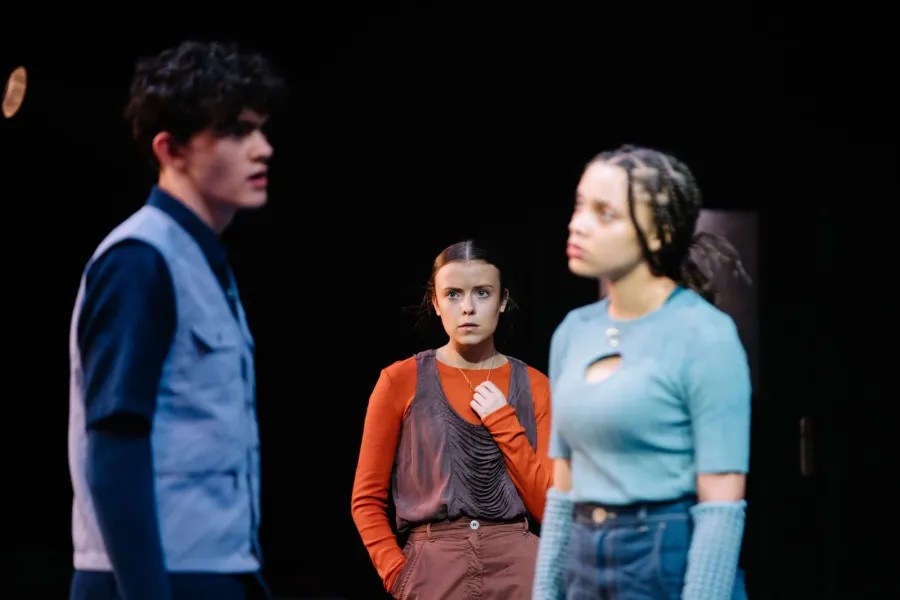
The play’s centres on a developing romance between Khaled (Luca Kamleh Chapman) and Sarah (Rosa Robson), both rocked by the stress of their coming work and by grief. Khaled sometimes struggles to confront charged topics given the relatively recent loss of his father, while Sarah later discloses her father’s death during her early childhood. Supporting characters are well served too. Fellow trainee Dan (Peter Corboy) begins with a hilarious uncouthness, and Sarah calls him out for his grating attempts at humour. Steadily though, his character attains greater sympathy; the idiosyncrasies Sarah finds unbearable are partially recast as misconceived attempts to bond with the group, blundering attempts at care. Meanwhile, course leader Nicki (Mariah Louca) balances work with caring for a sister recently diagnosed with MS. Chapman and Robson anchor the play with winning chemistry, capturing the glorious agonies of their characters’ misunderstandings and tensions. Corboy impresses with humour and subtlety, while Louca plays Nicki with an engaging brittleness, gradually shifting from someone seeking to maintain control and privacy to someone able to trust.

The ethics of overseas aid work are inherently under scrutiny, but Ibrahim also examines more extreme violations when specific accusations of abuse emerge, levelled against two senior members of their unnamed organisation, alleged to have demanded sex for medicine. Lisa, a trainee with them during Week 1 but never seen on stage, has quit, publicly condemning the organisation for its complicity. Further unsettled dilemmas are raised, and they rake over Lisa’s decision as a question of personal ethics (does she merely want to keep her conscience – and CV – clean) or an issue of collective culpability (are they legitimising the organisation with their continued presence).

Nonetheless, the characters proceed, their roleplays becoming more elaborate and complex. Soon, they become a vehicle for litigating interpersonal conflict. In character as a refugee seeking medical treatment, Dan needles Khaled for merely being a nurse and not a doctor (unlike Sarah). Yet they also become confessional spaces. Sarah divulges the death of her father while in role as aid worker ‘Laura’, such that Khaled does not initially realise what she is saying. The push and pull of roleplay fosters greater intimacy between the pair, yet holds them apart as they struggle to trust each other. In one charged moment, Laura refers to ‘my parents’ (plural), and Khaled begins to doubt her story, misconstruing her traumatic revelation as an extended fiction.

The ambivalent push-and-pull effect is mirrored in the play’s use of video. Introduced towards the end of the first half, live camera feeds become an essential part of the show’s grammar. The cameras’ diegetic function is never explained; perhaps the videos exist for posterity or for the purposes of assessment in the training programme, but their literal purpose needs no explanation. The conceit works terrifically well, a reinvigorating approach to an increasingly employed technique on London stages. The participants are scrutinised, the pressure dialling up as the watchful camera bears down on them. Yet Woodcock-Stewart’s staging, with much of centre stage obscured by television screens in the second half, relaying sometimes-oblique images, holds us at a deliberate distance while inviting us to peer closer. The screens inevitably signal the play’s thematic interest in voyeurism, but in Woodcock-Stewart’s hands the live feed takes on several different valences – tenderness, inquisitiveness, and subjectivity. The large televisions blow up intrusive closeups, while also shielding our view to give a sense of privacy.

The final stretches of the show, which use this device to full effect, include a dazzlingly written, stunningly executed sequence where the boundaries of reality, roleplay and fantasy blur. Throughout the earlier roleplays, Khaled has recurringly embodied Ali, a bullet-wounded refugee who has recently lost his father and is eagerly looking for work. Ibrahim rarely explains characters’ motivation, but it appears Khaled and Sarah have been using roleplays outside of the class as an experimental means to soothe Khaled’s grief. A turning point for them comes, later as Khaled tries to push her away emotionally, when Sarah calls Khaled ‘Ali’ by mistake. She is immediately apologetic, but the moment carries a frisson which neither character can resist. This initiates a sequence in which the previous unity of place dissolves. Instead, the scenes shift chimerically between settings, involving Dan and Nicki too; the characters seem simultaneously to be performing a training exercise getting out a hand, actually at work in the field, and also (in the case of Khaled and Sarah) engaged in an ambiguous sexual roleplay.

Ibrahim has spoken about the potential queasiness of putting a refugee camp onstage, noting that the seed of Multiple Casualty Incident came from seeking a new way for an audience to engage with refugee camps without a ‘too voyeuristic’ mode of representation. Represented on a stage in London, how can a world be evoked that is realistic, full, ethical, fair? Multiple Casualty Incident finds neat expression for these anxieties in the inherently theatrical nature of the characters’ rehearsal process. They make forms of theatre in the exercises, first stilted, halting, before bursting into a more urgent semblance of ‘real’-ness later on. Thus the play doubles as an ethical investigation of aid work and of theatre itself.

One way to conceive of theatre is as an act of preparation – a simulation of the world which readies us to go out into it and interact with it. It is a radical, activist, often-hopeful view of theatre, though is at danger of over-instrumentalising the form. The characters are playing at the role of aid worker in their training, but, as the play gently invites us to consider, this role always remains a performance, just with higher stakes, greater risk, and (hopefully, perhaps dubiously) more direct positive impact. The lack of answers to the exercises signals the messiness of a reality which cannot be reduced to a test.

The genius of Multiple Casualty Incident is the way it plays out miniature ethical crises that underpin all representation. Deliberately unspecific, the region in which the play’s humanitarian disaster is unfolding is inherently othered, and Ibrahim notes war-torn regions can have their cultural complexity telescoped down in the imagination. In a short scene early in the play, Dan offers misplaced condolences when news arrives of an incident with one hundred casualties in the same (unspecified) country as Khaled’s family. Khaled retorts that his family is from a different region, somewhere as remote from it as Dublin is from Norwich.

Though Multiple Casualty Incident collapses its walls of reality inward, Woodcock-Stewart and Ibrahim ensure that coherence triumphs over confusion, lucidly and movingly engaging with the stakes of incidents on every scale – interpersonal, romantic, workplace, geopolitical. In places, there are shades of the infamous (though highly inconclusive) Stanford Prison Guards experiment, with characters getting caught up within a monstrous fantasy. However, Ibrahim moves the play into far more interesting, morally ambivalent territory. There is something disconcertingly unethical about Khaled and Sarah’s fantasies, playing out against a backdrop of distant human suffering, yet the play lacks easy condemnation. The characters’ entanglements are simultaneously touching, grotesque and achingly human. Instead, it ambivalently questions the extent to which theatrical performance is the ‘empathy machine’ it is sometimes held up as. However much we might like theatre to be a tool to help us enrich our understanding of the world and of others, perhaps it mainly helps us to understand ourselves.

Photographs by Marc Brenner
Categories
theatre

The Hills of California – Harold Pinter Theatre

Returning to stage writing seven years after the success of The Ferryman, Jez Butterworth’s The Hills of California seizes upon aesthetic and experiential possibilities particular to theatre. The play unfolds slowly at first, taking its time to draw out its central situation while building atmosphere from an out-of-tune piano (at first heard from offstage), the labyrinthine corridors of the hotel, and the inescapable blazing heat of 1976’s famously scorching summer. As the play unspools, we learn of the four Webb sisters, raised in the hotel their mother ran, a mother who now lies dying upstairs from stomach cancer, for whom each sister feels a complicated mixture of fear and admiration.

Set across two timeframes, at points the play (and Mendes’ staging) has the feel of a Tennessee Williams ‘memory play’. The first act sets the board in both periods, as three of the four Webb sisters convene in the hotel’s stifling parlour, while in the 1950s their younger iterations practice vocal numbers under the imperious glare of their ambitious mother, Veronica. She longs for the girls to be a singing troupe in the vein of the Andrews sisters, attempting through sheer force of will and boundless dedication to push them towards stardom. Butterworth gives enough details (including many references to the now-American-dwelling eldest sister Joan, compared to the England-based others) for an audience to piece together the likely acrimonious dissolution of their group in advance, but the full details are withheld until the end of the hammer-blow second act, when an American agent comes to watch the sisters perform.

The play continues Butterworth’s interest in cultural mythology, and with this comes a pervasive sense of futility and decline. The 1976 Blackpool setting entails a curious double-fold nostalgia; the characters constantly look back to the 1950s – where their dreams of the sisters’ musical quartet died – while some audience members will be able to look back over the 48-year gap between 1976 and the present moment. The rise and fall of Blackpool as a destination du jour is conjured through the genealogy of increasingly and then decreasingly auspicious names that the ‘Sea View’ hotel (and, formerly, spa) has had over the years. Though, as a nurse wryly notes in the first scene, the name is a lie; you cannot actually see the sea from anywhere in the hotel. Their glamorous aspirations have always been built on sand.

The effect is ‘state of the nation’ in an unemphatic sense. Parallels to the present are glancing and for the audience to construct: the devastating effects of high cost-of-living on hospitality settings and culture, the dangers of ultra-hot British summers (which the climate crisis has caused with ever-increasing regularity), and the shuttering of regional theatres. By 1976, the play tells us, over fifty theatres in Blackpool have closed, leaving a mere four. With the family’s matriarch dying upstairs, the effect is a family (and nation) unmoored. Where Butterworth’s 2009 play Jerusalem partially buys into Johnny ‘Rooster’ Byron’s mythologised orientation to England and its landscape, The Hills of California works to deconstruct the hollowness of myths of showbusiness and glamour – bound up in the bathetic invocations of America throughout.

There is a recurring focus on materiality: the talent agent talks of Nat King Cole’s twenty-thousand-a-night fee; Joe is always behind on his rent; the B&B is entering a financial black hole. Yet despite this, The Hills of California articulates a somewhat contradictory theme always lurking in Butterworth’s writing – that our identity is the sum of the stories we tell. The thorny, restless third act mulls approaches of victimhood ambivalently. Joan wears her history lightly, though we are left to wonder how much she has moved on and how much she has simply alienated herself from her life and its past events. Meanwhile, victimisation weighs heavily on Gloria. As Joan says, Gloria’s ‘story’ is ‘a song she’s sung every night, for years, as she drifts off’. The play seems to argue that performance is not simply artifice; it steadily remoulds us over time.

Whether Joan does or does not eventually return is (I think) a substantial spoiler, but one I will discuss as it seems core to the play’s dramaturgy. Butterworth generates tension during the first two acts over Joan’s potential return, and we are left to wonder what kind of play we are in – an Ibsen- or Pinter-esque play of dramatic return, or whether Joan is more of a Godot figure, whose absence only serves to underscore the normality of the other sisters’ lives. The siblings even bet on whether Joan will turn up; second-eldest Gloria either disbelieves Joan’s claim to have had her flight delayed or reads it as a divinely inspired metaphor for Joan’s distant remove from the family circle. Yet Joan does eventually return, near the start of Act Three, played by Laura Donnelly – the same actor who plays the mother – and this moment, set to The Rolling Stones track ‘Gimme Shelter’ oozes with subtly stylish direction. The hotel’s rusty jukebox cranks into gear semi-magically (after previously resisting fixing), and the set spins. It is as if Joan has breathed life into a house preoccupied with death.

However, Joan surprises in her interactions with her siblings. Expecting hostility, she adopts a disarmingly laissez-faire detachment, rising to no barbs and treating sibling Ruby’s almost-fannish excitement at her return with the polite coolness of a celebrity declining an autograph. Joan knowingly asks if they have ‘elected a scapegoat’ – aware that she has been playing this function for the sisters while en route (and in the years before). Donnelly is extraordinary in both roles here, first as a portrait of Veronica’s cracked ambition, and later as the unpredictable, entertaining, difficult eldest daughter.

She is matched by uniformly strong cast, notably including Leanne Best’s ferocious Gloria, who begins the play as a waspishly comic figure, almost coming to blows when Ruby reveals her journey has been pleasant in her air-conditioned car, compared to Gloria’s nine hours of gridlock in an oven on wheels. By the end, Best mines an impeccable tenderness in the fleeting, charged moments of empathy Butterworth coaxes from his characters.

I am in two minds about the structural mechanics of the third act, which creak a little beneath the atmospheric haze of cigarette smoke and glamour ushered in by Joan’s arrival. In the third act, the characters are not quite where we left them, with two interactions revealed to have happened offstage. Firstly, Jillian tells Joan that Veronica confessed to her two weeks earlier. Jillian has then, in between Act Two and Three, divulged the talent agent’s abuse to her siblings, meaning the scene of revelation we expect is substituted with something quite different – though no less emotionally charged. This is perhaps typical of a play in which Butterworth resists staging the more obvious moral dialectics generated by the plot. For example, little debate is expended on the ethics of euthanising their mother to alleviate her pain. Meanwhile, Joan resists rising to Gloria’s taunts and jibes, responding off-handedly and forestalling many potentially debates over conflicting values or actions. Instead, The Hills of California dwells on the emotional consequences.

The arrival of a baby into the plot, who has been (a little conveniently) left outside and gone completely unnoticed by Ruby, further knocks our expectations. The results are palpably emotional, such as in a brief subsequent reconciliation of Joan and Gloria, and Joan tells a delightful story of meeting the two living Andrews sisters when delivering pizza (her musical career having ground to a halt). The play crystallises in its final moments, and Butterworth’s use of a closing musical number (‘Dream a Little Dream of Me’) for me evoked the effect of Lucy Kirkwood’s dance sequence in The Children (2016). In both plays, characters who seem almost hopelessly disarrayed from each other find momentary unity, unity which contains an image of potential future cooperation.

At the core of the play are partial, semi-successful attempts at revivification. Gloria’s husband (Shaun Dooley, gruffly entertaining as characters in both time periods) fiddles with an old jukebox in the hope of bringing it back to musical life. In the final scene, Joan’s return feels set to curdle at any moment, but the presence of her baby snaps them into a sudden sense of collective purpose. In that moment, they reorientate themselves towards the future; all is not lost. The final song suggests a partial reconciliation with the past (and each other), meaning that a more positive future is possible. The play remains ambivalent though. Despite the hopefulness, there is a tacit acceptance that, for all Joan’s proclamations about wanting to get back on her feet, she may never come back.

Categories
theatre

2023 in Theatre

Accidental Death of an Anarchist – Sheffield Crucible/Lyric Hammersmith/Theatre Royal Haymarket

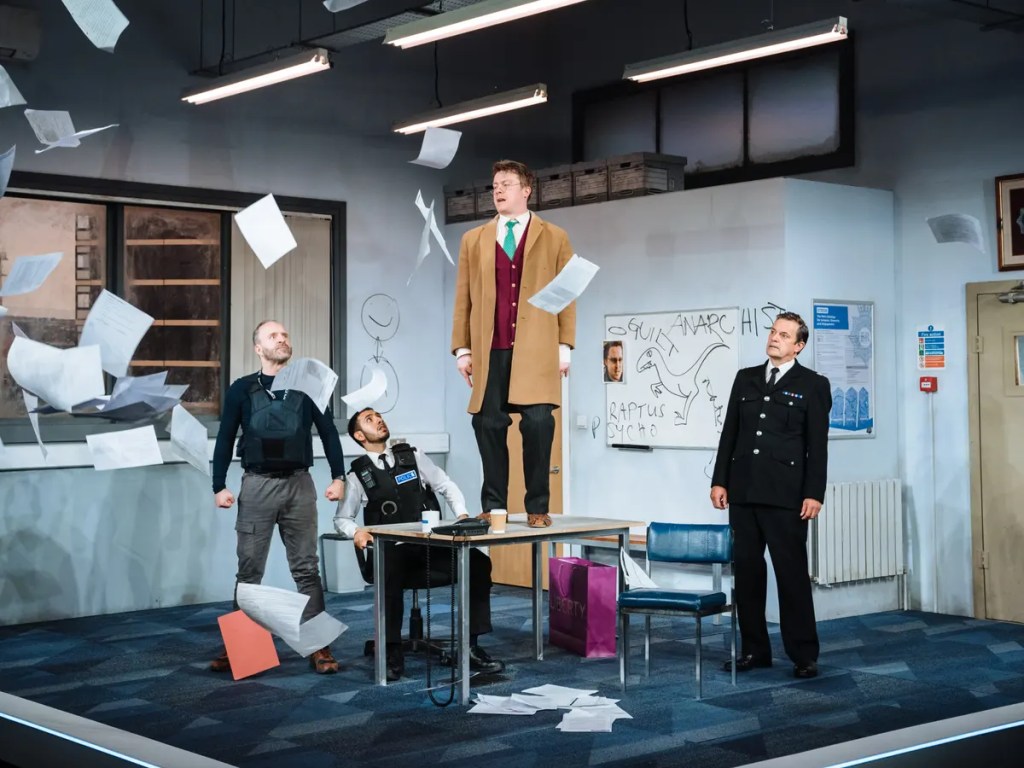
Anchored by a relentlessly energetic tour de force from Daniel Rigby as the Maniac, Tom Basden’s retelling of Dario Fo and Frances Rame’s 1970 play scabrously satirised the failings of the Metropolitan Police. Bolstered with rat-a-tat gags and clowning (a particularly funny sequence occurs when the Maniac to pretends to forget how to step off a table), the three-laughs-a-minute comedy takes its audience to one of the most starkly critical plays about the police force. Much of the humour comes from the sheer preposterousness of earnestly defending systemic and individual failings. (One of the most uproarious lines in the first half comes from the Maniac’s pompous paean to the ‘brave men and women of the Metropolitan Police’.) The force and energy is reminiscent of Joe Lycett’s stunt of claiming to be ‘very right wing actually’ on Laura Kuenssberg’s Sunday morning politics show in 2022, By mounting such an enthusiastic defence we know the speaker does not believe, the very idea of defending them is rendered unavoidably satirical.

The show rails against institutional corruption, with the audience quickly enlisted onto the Maniac’s side through direct address and sweet throwing. Yet in the play’s remarkable closing minutes, Basden injects a sharper note, the Maniac shifting from a surrogate for the expected audience’s righteous anger towards indicting them. Noting the likely ‘liberal’ politics of the play’s audience, the Maniac indicts the hollowness of disengaged liberalism under capitalism; changing things for the better might actually cost the audience something. Police violence and corruption is connected to systems of economic and social power from which many (undeservedly) benefit. It is a note of sharper radicalism, smuggled in amongst the sheer entertainment value overall comic farce. Surprising for a play which ended up in the West End, Basden’s adaptation suggests the potential for a revitalised form of political theatre.

Body Show – Pleasance Courtyard/Soho Theatre

A decade ago, Anne Washburn’s Mr Burns: A Post-Electric Play examined how stories (and capitalism) might persist in remade forms after a nuclear apocalypse. This glorious and very formally different show does similar but for gender, exploring in rapid-fire sketches and slower moments of horror how stereotypes and socialised roles are reinforced in the cultural detritus that might survive us – and could, indeed, play a role in taking us to the brink. Body Show shares Mr Burns’s melancholic and humorous orientation towards the end of life as we know it, as well as its anarchic remixing of popular media and cultural iconography.

Through breath-taking lip-synching, dazzling video design and the densest dry ice I’ve encountered in a theatre, Frankie Thompson and Liv Ello’s comedic show explores what our current world looks like from the fragments left over at the end of the world. Through pin-sharp sketches, they devastatingly expose the abstract gender roles are concretised into rigid divides. A poignant scene early on depicts the irrepressible enthusiasm of five-year-olds at a cowboys and ballerinas birthday party, with Thompson playing a young girl unable to quite comprehend that Ello might prefer being a cowboy rather than a ballerina. Even before they find a vocabulary to express it, a restricting grammar of gender has been imposed on their view of the world. The show turns on its head almost effortlessly between a serious, melancholic truth-speaking and utter hilarity. Brilliant riffs on The Great British Bake Off, Twin Peaks, and a mash-up of the petty betrayals of Come Dine With Me with the presence of Judas Iscariot in Da Vinci’s The Last Supper made this one of the most entertaining shows of the year.

The Effect – National Theatre

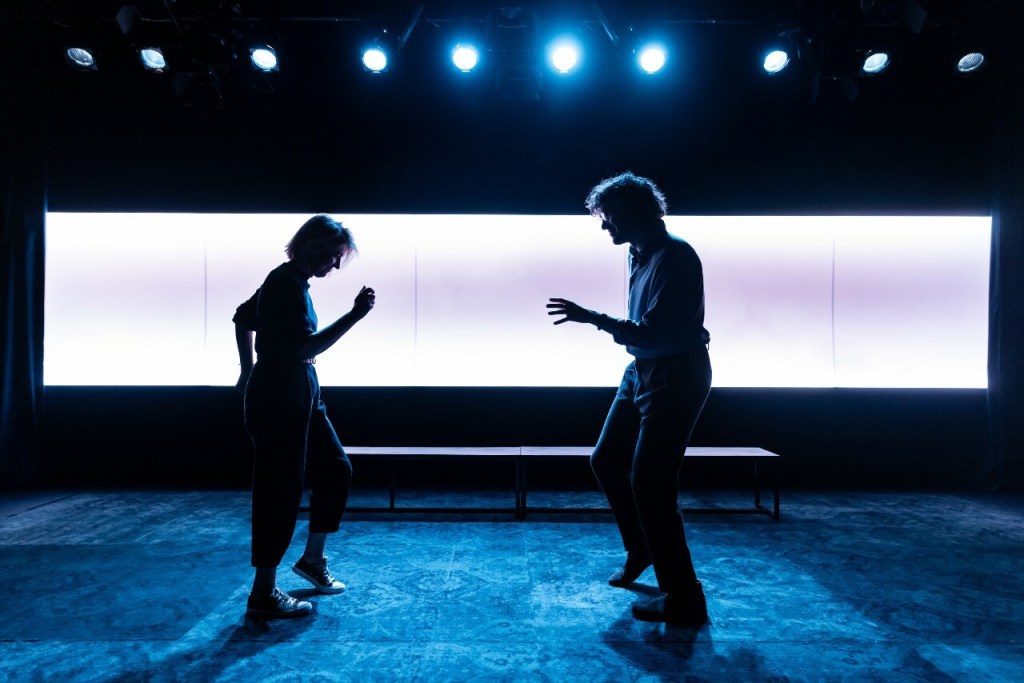
Jamie Lloyd’s customarily stripped-back staging of Lucy Prebble’s The Effect (2012) was a highlight in a largely strong year for the National Theatre. Frequent collaborator Soutra Gilmour set the action on a stage bare but for two chairs and a bucket, lit with cool LEDs from every side, including a light-up floor. As projections affirmed, Lloyd’s production drew on the idea of the play as an ‘experiment’, a crucible in which to test out ideas and feelings. Paapa Essiedu and Taylor Russell brought a hilarious, earnest passion to the drug-enhanced love story, and smart tweaks to the original 2012 script by Prebble situated the play in a more specific contemporary context, with glancing references to gentrification and racist violence.

Perhaps the greatest addition made to the play though was the dynamism of its movement, aided by the space afforded by the empty stage. Essiedu and Russell vibrated with energy throughout, juxtaposed with Michelle Austin and Kobna Holdbrook-Smith’s postures of attempted detachment as the drug trial’s organisers. Though superbly choreographed, the production adopted a winningly unfixed, semi-improvisational approach. Ad libs – verbal and in motion – abounded (at least between when I watched it and the version released recently on NT at Home). This leant the play a terrific energy, affording subsequent scenes of stillness a richer intimacy. This sublime staging found rich depths of emotion in the play’s later scenes, sometimes in unexpected places. Russell astonishingly captured the cresting waves of love, frustration and heartbreak in the closing section, when Tristram is suffering from transient global amnesia, leading to them having to have the same conversations every day. In their shared struggle, the play suggests, their love is forged as something deeper than fickle chemical feeling. It is a shared commitment, increasing over time, optimistic for the future.

While Prebble’s dialogue edits are largely effective, the play’s fundamental mechanics resist editing. Therefore, the play’s central debate over the efficacy of depression medication feels a little tangential to debates about mental health in the 2020s. (A play like Sophia Chetin-Leuner’s This Might Not Be It, which opened at the Bush in January 2024, offers a perhaps more contemporary angle on mental health treatment – with a focus on barriers to accessing treatment rather than debating effectiveness.) That said, the questions still remain somewhat pertinent as well as dramatically interesting, and for Lloyd, the drug trial does feel more of a timeless dramatic mechanism to raise questions about the origins of our feelings and the extent to which human agency is impaired or underpinned by the role chemicals play in the brain. Prebble and Lloyd are not prescriptive in answering these questions. Instead, as the ending seems to suggest, long-term feelings (such as love) are forged through actions, not just chemicals.

Infinite Life – National Theatre

Annie Baker’s latest play emerged in late 2023, after two of years of limbo following the cancellation of its 2021 run in America. Fittingly, the play is deeply concerned with forms of limbo. Infinite Life’s characters experience various forms of time distortion due to physical pain symptoms – some chronic, some self-inflicted through fasting regimens adopted in the hope of alleviating their other symptoms.

As Thomas Butler recently argued in a monograph on Baker, her plays ‘lead us to recognize the insistent realness of the lives of others’, a reason I would contend her plays (most notably The Flick) have been interpreted with some hostility from previous audiences. We are brought into a confrontation with themes, ideas and realities that carry an inherent ethical charge, making them difficult to dwell on. Infinite Life continues in this vein with its focus on pain. Elaine Scarry notably argues that central to pain is its ‘unsharability’, due to its ‘resistance to language’, and Baker here tries to find a language – dramatic as well as verbal – in which to express it, as her characters suffer in quiet agony on the nondescript sun loungers of a mid-market wellness retreat.

Baker writes in a typically reserved style, though with palpable empathy towards her characters. Her own opinions go largely undetectable in the play’s evocation of the charged world of alternative medicine. Baker is uninterested in mounting a scathing analysis of the virtues and vices of wellness. Instead, her concern remains the people caught in its eddies and the conditions in which such treatments arise. Infinite Life joins The Antipodes in presenting a culture in which the pain of women is held in an irreverent disregard. The women (and one man) on stage are mostly present because nothing else has worked for them, and there is never a conspiratorial undertone in their thinking. Most of them are just willing to try everything.

In a prefatory note to her early play Circle Mirror Transformation (2009), Baker cautions directors that ‘without its pauses, this play is satire’, a rare forthright contribution from Baker explaining her aesthetics. Her perhaps signature pauses are in evidence in James Macdonald’s staging, a vital component in fostering a verisimilitude which invites the audience to treat its characters as people. For Butler, in Baker’s plays, our ‘attention prevents us from reducing other people to symbols or ideas’, a heightened naturalism running contrary to many conventional theatrical dramaturgies steeped in symbolic plots, characters and objects. Baker’s is an ethical theatre which palliates against the irresolvable while challenging the empathetic sensibilities of an audience – and, perhaps, changing them.

Octopolis – Hampstead Theatre

Marek Horn returned to ocean depths again (after 2021’s superb Yellowfin) in this searching, romantic and ultra-dense play of ideas. Having edited it down from a draft of 30,000 words, Horn himself describes the play as ‘theatrical uranium’, yet the resultant richness is never contrived or needlessly difficult. Horn’s dazzling conjectures emerge neatly from cogent intellectual riffs from his two characters: academics driven by a rigorous, truth-seeking curiosity about the world. Through a largely unexplained dramaturgical device, we are addressed by the characters through a form of narration, enlisting us a third party to weigh their ideas for ourselves. The effect is an unusual yet compelling blend of alienation and invitation; we are made conscious to some extent of the performance, but also of the fact this performance is being put on (by the characters) for us.

Ed Madden’s adept direction accepts this dramaturgical gauntlet by brilliantly situating the play within a strangely intuitive no-place, with many actions going unembodied. Sometimes, actions curiously juxtapose the words. In Madden’s blocking, for example, Harry obstructs George’s view of Homes Under the Hammer by standing behind her, subtly calling our attention to the constructed-ness of events – two sides of an argument performed by the characters.

Ever-present is the octopus, Frances, on whom the characters’ contrasting research is centred. Anisha Fields’ compelling design incorporates an abstract octopus tank, which swirls with dry-ice, generating an octopus-like evanescence, gorgeously lit by Jamie Platt. Philosopher of science Peter Godfrey-Smith sees octopuses as a potential site of alien contact – the most genetically distant intelligence life of which humans are aware. Thus, for Horn, the sea creatures make an ideal springboard for questions about the nature of consciousness and being – approached here from three angles between the two characters: biology, anthropology and religion.

Like Yellowfin before it, this is a veiled climate crisis play, and it similarly stages characters hell bent on finding (or at least attempting to believe in the existence of) knowledge which would reconfigure human nature into something more benign. Harry’s potential discovery of an octopus soul, evidenced (he thinks) through observation of prayer rituals, is proffered as a hope of recalibrating human’s relationship to the natural world – upsetting the very binary of nature and culture. Like in Yellowfin, the hope seems laced with futility, born of a desperation at human’s destructive tendencies rather than anything more empirical. Nevertheless, it feels like a rich seam for Horn to return to again.

Paradise Now! – Bush Theatre

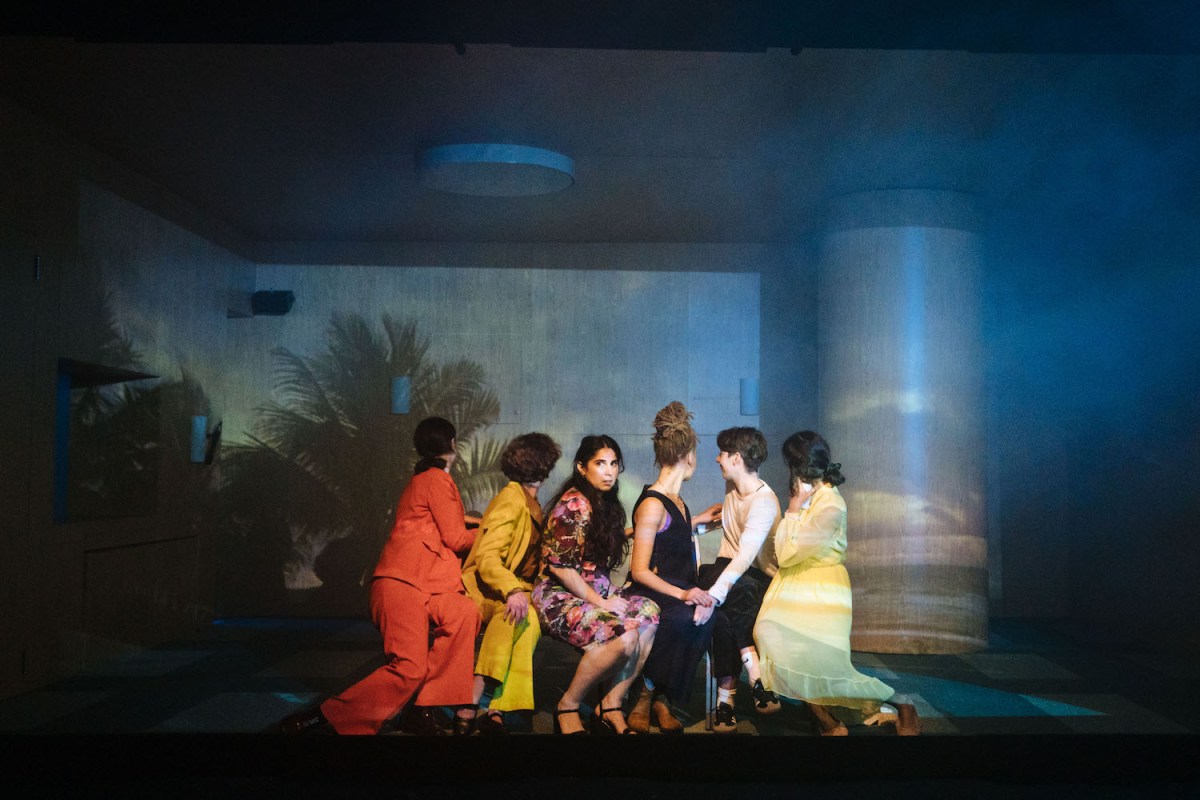
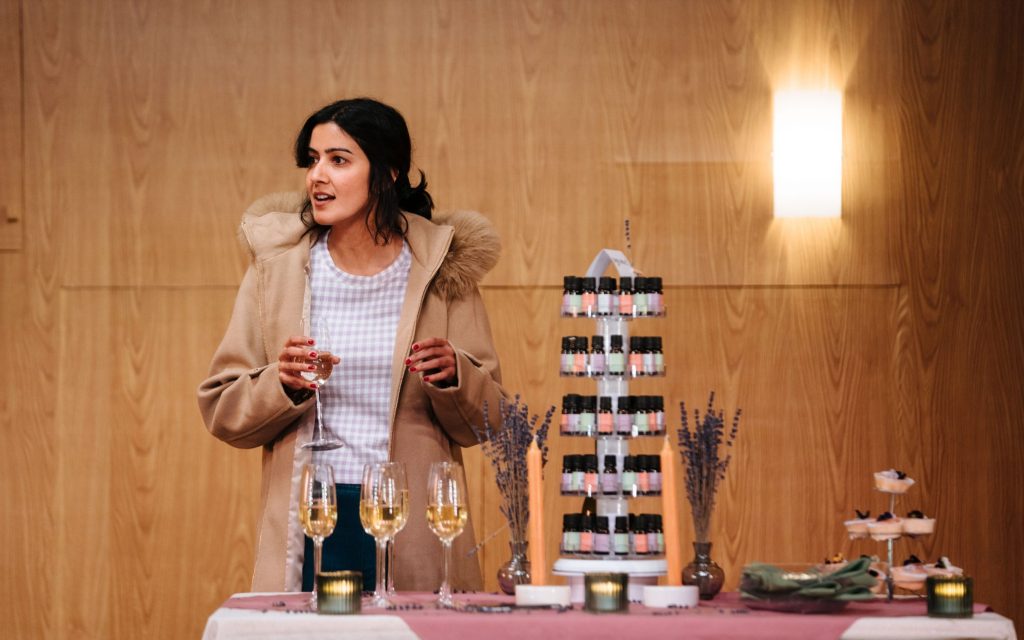
From Jaz Woodcock-Stewart’s production of Paradise Now! by Margaret Perry, small moments linger in the memory. Realising the financial ruin of her and her sister, a character ruefully, slowly, takes a bath, wryly pouring in some of the essential oils that have sealed their fate. Another character makes a sudden disclosure of deep personal pain, but despite being part of a community aiming to empower each other, her appeal goes unanswered. Elsewhere, the characters go bowling, and one of them scores a strike. Throughout, scene changes burst into life with unexpected group choreography. The result is a haunting and empathic tragedy about the value and limits of community and solidarity, unafraid to linger on moments that fill your soul with joy, only to break your heart.

Rosie Elnile’s glorious set houses a world of everyday triumph and disaster. Deeply humane, this brilliantly told tale of women entering the vortex of a pyramid scheme selling essential oils cracks open how languages of trauma and female empowerment can be captured by corporate interests. Central to this is the oxymoronic figuration of the scheme a space of mutual female support, while its fundamental financial logic demands competitive opposition, winners and losers. Woodcock-Stewart, one of the finest directors working in Britain at the moment, skilfully facilitates the coexistence of both the earnest joy of this community and the play’s sharp critique. There is space for laughter amongst grief, and every character compels sympathy, yet the pernicious dangers of the ‘Paradise’ organisation’s business model never slide from view.

Talking About the Fire – Royal Court

Chris Thorpe and director Claire O’Reilly’s show about the horror of nuclear weapons finds profundity through lo-fi stylings. Thorpe amiably invites audiences into the space, asking our names, getting to know us a bit, and trying to get us to know each other too. He spends some of the show at a desk on a rug (which he tells us he does not like). There is little regard for aesthetics of slickness. Thorpe is interested in frankness above all.

Thorpe manages audience interaction fantastically here, and I would argue that discomfort is thoughtfully and sensitively built into the show’s dramaturgy in several ways. The content of the show is unavoidably alarming, and Thorpe gradually makes us imagine nuclear weapons as something closer and closer to home – pointing out the direction of nuclear weapons stored under one hundred miles away, and modelling the blast radius of a nuclear strike on the Royal Court Theatre. Thinking about the existence of nuclear weapons so directly is inevitably disconcerting, but Thorpe memorably reminds us – half-grim, half-reassuring – that the chance of a nuclear strike is exactly the same as it was before we started thinking about it. For Thorpe, something as sweeping as a ‘solution’ seems unfeasible, echoing his previous writing on the climate crisis as well as his apocalyptic kitchen-sink fusion piece Victory Condition (2017). Denuclearisation is presented as a distant goal which requires diplomacy and sustained conversation. Therefore, the show itself is structured as a form of conversation; Thorpe solicits our ideas, quizzing us on facts about nuclear weapons, passing out biscuits, and asking people (including me) to choose a song to play on Spotify, describe our typical morning routine, or diagnose London’s greatest socio-economic problems.

In the moment of audience participation, Thorpe’s show achieves something alchemical – something that seems intensely (perhaps uniquely) theatrical – despite the The Guardian’s one-star review calling it ‘scrappy and untheatrical’. Audience interaction for most people, I would suggest, is awkward and difficult, and though attendees of previous Thorpe shows might not be surprised, Talking About the Fire is not overtly advertised as participatory (beyond the implications of its title). Choosing a song to play for a room of 80 strangers is inherently daunting, not only asking you to speak in a public forum but place something as potentially delicate as your personal taste under the scrutiny of others. How individuals respond to such a request will hinge on many variables, but this potentially (probably likely) discomforting experience seems like a core part of the show. Because you venture an answer – you choose a song (in my case, Heaven by Mitski) – and it’s fine. A metaphorical ball has been thrown to you, and you’ve returned it successfully, and now you are enmeshed in the show in a new way. This functions as something more than a metaphor; it models what Thorpe hopes will come out of the show: further conversation. The leap of suggesting a song is, the dramaturgy implies, a similar leap to that of broaching the subject of nuclear weapons with families over Christmas dinner (after all, the Royal Court run was on in December), or with people less familiar to you. Thorpe’s play is a rare theatrical experience. Those already in the know on nuclear weapons policy may derive relatively little new from its facts, but its power lies in its unusual and moving engagement with audiences.

Categories
theatre

The Seagull – Harold Pinter Theatre

… you confuse two things: solving a problem and stating a problem correctly. It is only the second that is obligatory for the artist.

I begin this review with the same quotation (from one of Chekhov’s letters) that Anya Reiss uses as the epigraph to her modernised adaptation of The Seagull. This revised version was first staged a decade ago at the Southwark Playhouse, and it is now revived in a free, sparse and intimate production by Jamie Lloyd. The quote pre-empts the declaration famously attributed to Einstein that goes (in one of many variations of phrasing), ‘If I had an hour to solve a problem I’d spend 55 minutes thinking about the problem and five minutes thinking about solutions.’ For Reiss to invoke it here marks a statement of intent about the limits of theatre (and art), concerns to which this adaptation is particularly attuned. The production has been marketed with the provocative lines ‘We need theatre, couldn’t, couldn’t do without it. Could we?’ That stumbling note of uncertainty about theatre’s value haunts the drama and is a particularly bracing statement to hear on a West End stage.

This is not medicinal theatre, prescribed by the doctor-turned-playwright, but merely the first step in diagnosis. Its efficacy is up for prolonged debate. In Jamie Lloyd’s hands, Reiss’s script becomes The Seagull anatomised, an almost scientific stab at stating the problems it raises correctly by placing the characters in a bell jar with woodchip walls, for observation and study.

The effect far from the traditional sense of a play being performed for us (as Konstantin might decry of Russia’s dull, conventional theatre). Instead, it is as if we are eavesdropping on intimate conversations, the tiniest shifts in vocal inflection altering the entire meaning. Lloyd’s signature close microphones highlight and amplify every glottal stop and half-breath in shivering detail. It is something of a cliché (though this does not make it wrong) in Chekhov criticism that characters say exactly how they feel, their tragedy being that no one listens or cares. This remains true in the case of Masha and perhaps Shamrayev and Arkadina. However, a spellbinding intimacy radiates from scenes with Nina, Konstantin and Trigorin, almost as powerful as that which Lloyd fostered in Cyrano de Bergerac (a show inevitably about the power of language and listening over the visual). This Seagull highlights where the play does involve listening, the quiet, intense conversations highlighted, as we hear every word and half-formed sentence. One of the most touching moments of the play is where Nina and Trigorin’s stilted communication blossoms into life, as she finds romantic articulacy in his own words – using a quote from her favourite book of his to convey her feelings.

Indira Varma in The Seagull

Emilia Clarke makes a good West End debut in a production she headlines but rarely defines. This is largely due to the nature of the role and the direction. That this is an ensemble drama is made all the more evident in the staging; every character is onstage throughout, other when they troop out through the stalls before the interval. It is Indira Varma as the more experienced actor Arkadina who is the ostensible lead, for whom success has come at a cost to her soul, though she would never want to admit it. She persists on acidic wit, a pressure valve that releases her pungent dissatisfaction with life without flaring into anger, Varma capturing her judgemental forcefulness with a brilliant precision.

Emilia Clarke, Indira Varma, Daniel Monks and Tom Rhys Harries in The Seagull

This production explores the play’s central dichotomy of Trigorin and Konstantin as a contrast of emotionless technical determination with naïve though admirable passion for the new – art that consumes and exhausts versus art which renews. Only love, it argues, can transcend the monotony and bathos of an ordinary life. It is notable how both artistic visions appear to succeed ever more during the gap between Act 3 and 4, Trigorin’s sales and fame continuing to grow while Konstantin, less of a commercial hit though he is, gathers a strong cult following. Both artistic visions (arguably at times manifestos) are apparently successful, yet both culminate in forms of failure. Trigorin’s life is skeletal; he picks the bones of his existence – including all sensory pleasure – for inspiration. He is plagued by anxiety during the time he is not at a desk writing. Konstantin, meanwhile, is shattered by a life pursuing artistic fulfilment, only to realise that theatre cannot provide him with what he truly yearns for. This is The Seagull retooled as an aching warning about the hollowness of celebrity.

This, in Konstantin’s case fatal, disenchantment pervades the original play, and this sense only increases in the spotlit emptiness of Soutra Gilmour’s set (with lighting from Jackie Shemesh). The play’s more stylised choices play out well, with a strange but successful juxtaposition of acting styles on display – from mumblecore intensity to almost parodic melodrama. For example, Sophie Wu’s Masha intones her despairing dialogue in a resigned monotone, but this is no mere caricature of the famously dour part. She is caught in a state of mourning for her own life, surrendering to her glum, stymied existence through a form of dissociation – a sharply modern interpretation that aptly matches Chekhov’s characterisation. Her sadness is all-pervasive, yet it also seems separate from her. To mourn one’s life you must be somehow outside of it. By this point, Masha is simply numb.

Sophie Wu in The Seagull

The second half is composed of a protracted interpretation Act 4, giving this Seagull a lopsided quality that seems quite deliberate. While Acts 1 to 3 take place over a matter of days, this Act 4 occurs a whole six years on. (In the original, it is only two.) With time has come exhaustion rather than flowering, Lloyd slowing the pace to expose how the characters’ pains, flaws and suffering have been reified by the wide gap of time, rather than soothed or overcome. The scenes have the phantom stillness of Beckett. On its own, this act has shades of the more hopeless plays of Ioensco; it is a ‘comedy’ on the cusp of tilting into pure tragedy. Significantly, the set itself changes; the back wall is removed. The MDF gives way to an empty black void. Yet even more powerful is the, at first, imperceptible change in props; one of the chairs has been removed, forcing Nina and Konstantin to share one too small seat their agonising final conversation.

The bingo game from the original Act 4 is adapted (and distended) by Reiss into a rambling game of charades. It brilliantly gives a hilarious chance for Dorn to call out Shamrayev’s bubbling cruelty and anger, in his mime for 12 Angry Men. Yet it is also a choice of startling thematic appropriacy. It makes a game out of the serious business of pretence, a theatrical impulse taken to hollow, empty ends. What is contemporary theatre but similar game, Konstantin has been implicitly asking in the first play. What is life, the play responds, but a charade? This production particularly weighs Chekhov’s debate and questioning of the deadening effects of realism on theatre, while also conceiving of real life itself as a form of deadly theatre.

Emilia Clarke in The Seagull

Konstantin’s gleam of idealism is perhaps what undoes him here. He seems mirrored with both Nina and Masha, except Nina has just enough of hope’s spark to survive, while Masha has so little hope whatsoever that suicide would seem an ill-fitting reaction. She has no energy or passion to make anything happen in her life, even hastening its end. It is Konstantin who cannot suffer life’s knocks one time more – finding his burgeoning career to be insufficient for spiritual succour.

Reiss dispenses with the play’s notoriously bathetic final line, in which Dorn interrupts to inform the surviving characters that Konstantin has shot himself. The play ends as the comedy stops for good. Here though, Dorn trails off: ‘The fact is… um… Konstantin’s…’ The script suggests he mimes a gun to his head, rather than speak the words, but Gerald Kyd’s gestures are subtler. Lloyd’s tone is sufficiently apocalyptic, the play and its ending are so famous (containing, of course, the textbook example of Chekhov’s gun), and Dorn has so achingly lost articulacy that the words need not be spoken. Konstantin’s story has come to an end.

The Seagull

Written by Anya Reiss, after Anton Chekhov, Directed by Jamie Lloyd, Set and Costume Design by Soutra Gilmour, Lighting Design by Jackie Shemesh, Sound and Composition Design by George Dennis, Casting Direction by Stuart Burt CDG, Costume Supervision by Anna Josephs, Props Supervision by Fahmida Bakht, Associate Direction by Jonathan Glew, Associate Design by Rachel Wingate, Starring Emilia Clarke, Tom Rhys Harries, Daniel Monks, Indira Varma, Sophie Wu, Jason Barnett, Robert Glenister, Mika Onyx Johnson, Gerald Kyd, Sara Powell, Understudies Katie Buchholz, Tina Harris, Joseph Langdon and David Lee-Jones
Production Photographs by Marc Brenner
Reviewed 29th August 2022
Categories
theatre

Much Ado About Nothing – National Theatre, Lyttleton

Katherine Parkinson in Much Ado About Nothing

Much Ado About Nothing, Shakespeare’s early entry into the now-perennial genre of the rom-com, is a knockabout comedy driven in both drama and humour almost entirely by rich character motivation rather than coincidence or contrivance. It contains perhaps Shakespeare’s greatest pair of lovers as leads and has more sophisticated wit than most of the other happy comedies. In A Midsummer Night’s Dream, Shakespeare celebrated marriage in the joining of couples who seemed desperate to marry but were prevented by strict laws. Much Ado internalises these restrictions, making it unusually psychological for a comedy, as Beatrice and Benedick insist on their lack of interest in – and even opposition to – the institution of marriage, only to be undone by love. Yet beneath Shakespeare’s idealising of marriage as an expression of romantic love, there simmers a darkness that can be hard to overlook in the way men treat women.

It makes perfect sense to stage Much Ado as a light-hearted show as a tentpole of a summer season, and the National Theatre have done so in their Lyttleton auditorium this year with Simon Godwin’s delightful production. The Sicilian setting of Messina is now the Hotel Messina, a glamorous resort for the rich and famous (this Beatrice is a starry actor), which invests the production with a sense of holiday detachment. The shadow of the war from which Benedick, Don Pedro and Claudio have returned is rather faint here, bar the umber combat fatigues they wear in the first act and Benedick’s soon-trimmed stubble. By contrast, Christopher Luscombe’s pair of 2014 RSC productions, Love’s Labour’s Lost and Much Ado About Nothing (there titled Love’s Labour’s Won), were set in a melancholy Edwardian England, either side of the First World War. Here, the 1930s is treated as an aesthetic, rather than a time of particular political significance. The conflict is an unspecific one used as little more than set dressing. Instead, Godwin focuses on the ‘merry war’ of words in the waspish relations of Beatrice and Benedick. All of the drama is simply interpersonal.

But what interpersonal drama it is. John Heffernan and Katherine Parkinson are brilliantly cast as the play’s famous lovers in denial. Neither of whom can summon the courage to make the first move, shielding their interest in the armour of mutual dislike. They tie themselves in Gordian knots, philosophically opposing marriage in the strongest terms. Benedick in particular disavows the notion of marriage as anathema to his fiercely independent spirit; to marry would be to submit to state of perpetual boredom that means you ‘sigh away Sundays’ in lieu of meaningful entertainment. Yet his obsession with not marrying is apophatic, pointing to the deep desires he is not yet ready to admit. He would only ever countenance marriage if a woman managed to have ‘all graces’ – ‘fair’, ‘wise’, ‘virtuous’, ‘noble’, ‘of good discourse’. (Here, Heffernan’s reading of ‘and her hair shall be of what colour it please God’ alters the original meaning that it may not be dyed to make Benedick seem more endearing; as long as she has all such qualities, he says, her hair colour is irrelevant.) Benedick constructs an elaborately reasoned logical house of cards for why no woman would ever be fit to marry him, yet it comes tumbling down with the play’s most touching romantic cadence, as Benedick realises that there is one woman who fulfils, even transcends, his criteria after all.

Getting Beatrice and Benedick, ostensibly the play’s main characters, to confess their latent feelings is debatably the A-plot, though it is Hero’s story which has the most plot significance and drama. Benedick and Don Pedro’s young soldier friend Claudio wants to marry the hotel-managing Leonato’s daughter Hero, though he is too shy. Therefore, Don Pedro sets out to woo her on Claudio’s behalf. Yet a rift between Don Pedro (Ashley Zhangazha) and his brother Don John (David Judge) threatens to break everything apart. Don John initially lies to Claudio, that Don Pedro is secretly wooing her for himself, yet this is lie is resolved with relative ease – though the trustworthiness of Don John remains undisputed. Thus, Don John confects a new rumour: that Hero is having an affair. Don John is a forerunner of Iago, albeit without the charm. He does not recruit our sympathies like Shakespeare’s tragic villain, and nor is he successful in steering the course of the play towards his intended tragedy – though for a time it seems like tragedy has occurred, for some of the characters. Yet Don John unleashes the play’s other great psychodrama (alongside Beatrice and Benedick’s mental prisons that restrain their love) – a fear of infidelity. To be married is to risk being cheated on. The horn imagery of cuckoldry is frequent in dialogue, even in Benedick’s celebratory lines at the very end: ‘there is no staff more reverend than one tipped with horn’.

The play is proof that tragedy and comedy is all about perspective, the final acts playing like a perspective trick in which most characters believe Hero has died from the shock of false accusation (a similar fate as befalls Hermione in The Winter’s Tale, and from which she also appears resurrected). Meanwhile, the audience share the knowledge of Beatrice, Benedick and Leonato – that Hero’s death is faked, while Don John’s lies are investigated. The restoration of Hermione in The Winter’s Tale could be viewed as a second go at the Hero resolution, with more artful stagecraft. Here, there is the business of marrying a suddenly remembered sister, a messier series of events that leaves Hero as a largely speechless bride.

John Heffernan and Eben Figueiredo in Much Ado About Nothing

For the most part, the production’s tone is utterly blissful, the verse delivered lightly (especially well by John Heffernan, who seems in his element here). It takes a lot of skill, on the part of actors and crew, to make Shakespeare look this easy. The more challenging or outdated pockets of Shakespeare’s language are never allowed to get in the way of the entertainment, any unfamiliar phrasing smoothed over by the brisk pace. As a result, a relatively low percentage of the laughs come from the original wordplay, yet this Much Ado has a somewhat more sophisticated take on Shakespearean comedy than simply padding out the play with anachronistic ad libs. Instead, almost every scene is invested with a potent sense of situation. Anna Fleischle’s wonderfully revolving set evokes the bustle of a busy hotel during peak holiday season, while also helping to place every scene in a specific location, inside or out, rendering the comic flights of fancy far more particular than just zany interludes to spice up the script.

At times, scenes are composed of two elements, relatively simplistically juxtaposed: Shakespeare’s original words and unrelated physical comedy. This is particularly notable in the scene where Dogberry, now the hotel’s security guard rather than the Constable of Messina, delivers pompous instructions to his juniors before sitting (as we know he inevitably will) onto a piled-high plate of spaghetti bolognese that has been inexplicably present on stage since the beginning of the scene. The scene progresses hilariously as his assistants try to clean the residue of Chekhov’s pasta off his trousers while he remains continues to speak obliviously. The original script here is conspicuously, deliberately secondary in importance. In the Dogberry scenes in particular, entertainment is the highest priority.

Other moments utilise random comic business to heighten not only the humour but the characterisation of the play, such as the mirrored scenes in which Beatrice and Benedick overhear that the other has confessed love for them in secret (in rumours set about by the matchmaking Don Pedro). Benedick’s is a particularly funny sequence; he cocoons himself in a hammock to eavesdrop but falls painfully onto the ground below on hearing of Beatrice’s alleged affections. He then clambers across the set to listen, before secreting himself in an ice cream cart to overhear more closely. In a sequence of pure farce, Don Pedro, Claudio and Balthasar help themselves to ice cream – in the full knowledge that Benedick is hidden inside the compartment now revealed to be the cart’s built-in rubbish bin. They gleefully spoon ice cream and shower sprinkles onto Benedick, while remarking on how strong Beatrice’s love is. At the end, Benedick emerges through the bin’s hole, streaked with residue and trying to remain composed – an extremely effective comic sequence, even if Shakespeare’s hand is nowhere near it.

Godwin directs something similar for Beatrice in the following scene. However, the ice cream routine is understandably hard to top, and he is hamstrung a little bit the order of the play. Comic logic would dictate then that the funnier Benedick scene goes second. The enjoyable clowning of the Beatrice scene is entertaining (she ends up entangled in a beach changing tent, adopting the uniform of a passing porter), but it is not quite as viscerally amusing, lending it a slightly repetitious sense of anti-climax. It is unfortunate, but largely the case, that in this production the men are allowed to get the biggest laughs – both from their wit and their humiliation.

Ioanna Kimbook, Celeste Dodwell, Katherine Parkinson and Phoebe Horn in Much Ado About Nothing

The thinness of the female roles is felt noticeably in Ioanna Kimbook’s performance of Hero, which exposes the writing’s limitations, as many strong actors’ interpretations of Shakespeare’s female parts do. Kimbook wrings as much emotion and nuance as she can from a part that asks only that Hero is charmed into silence and then victimised. Particularly good are the scenes where Hero is enlisted into misleading Beatrice. Hero coolly intones about Benedick’s apparent affection for Beatrice, while getting hugely and hilariously frustrated at her companion’s unconvincing woodenness.


This production struggles to sell the romance with Claudio though. Eben Figueiredo plays him as fairly meek at first, which is pretty much as Claudio is written, youthful and shy, but this makes Hero seem even meeker in her silent delight at the match. The intention seems to be for a sweetly dorky union of two shy people, Beatrice’s meta-joke ‘Speak, count, ’tis your cue’ followed here by a comically protracted silence. Neither can find the words, at least in public, and the silence can only be broken by a kiss. Yet the result makes both characters seem a little too dramatically inert, Hero so unknown to us at this point that her silence is hard to read as either being overwhelmed with love or full of uncertainty and reservation. The first act is the production’s weakest (and possibly the play’s too). The substitution of Don Pedro’s villainy (in the mistaken belief that he is wooing Hero for himself) for the real cruel intentions of his brother Don John later on could be a highly dramatic tale of the psychology of betrayal – central to the play’s themes of misbelieved rumours, for good and ill, and adultery. Yet it plays out here as an unfortunate longueur in this otherwise snappy take, delivered with not quite enough dramatic intensity.

The other point at which the production comes a little unstuck is at the dramatic peak – the apparent revelation that Hero let in a gentleman at her window during the night before her wedding, revealed only during the ceremony itself. Claudio has been cruelly tricked by Don John and his associates (he mistook Margaret and her lover for Hero), but that cannot excuse the ferocity of his response – nor that of every male character in the play, bar Benedick and the good-natured friar, who discovers he will not be marrying anyone that day after all. It is, of course, in the original play, but the lightness of Godwin’s interpretation elsewhere cannot be easily squared with the torrent of pure misogyny unleashed into the play, which would feel unnecessarily cruel even were the accusations true.

The convivial Leonato has until then proved to be a warm and gentle father, blunting any of suggestions that the match of Claudio and Hero was arranged against her will. Yet now he turns into a toxic combination of Egeus (Hermia’s cruel father from A Midsummer Night’s Dream) and Leontes (the jealous king who flies into a rage, wrongly suspecting his wife Hermione of adultery in The Winter’s Tale). Leonato wishes his daughter dead, Rufus Wright playing the anger in a serious, violent register: ‘Death is the fairest cover for her shame that may be wished for.’ Patriarchal anger is certainly a valid tone to strike when staging Shakespearean comedy – which is often filled with dark, violent and threatening moments. However, it seems fundamentally jarring with the earlier tone of playfulness and even more so with the relative ease with which the play’s tensions are resolved. It is hard to feel that all can be simply and immediately forgiven – with either father or fiancé – especially as Hero has so little agency in the play’s ending, treated like a prop who can be summoned at will to complete the marriage as if nothing has changed.

The text itself gives only scant acknowledgement to the mountain that must be climbed to resolve the animosity of Claudio in particular. Claudio strikes a tone of attempted amity, but he misdirects the apologies towards a father who has just condemned Hero as strongly (believing Hero to be dead). Figueiredo impressively delivers the speech where Claudio asks him for forgiveness, diverging from Shakespeare, who has Claudio plead his innocence – saying ‘sinned I not, But in mistaking’. Figueiredo’s phrasing instead emphasises contrition over his technical (and extremely dubious) innocence. Godwin tries to enrich Hero’s meagre portion of lines by amending the script with lines from Shakespeare’s Sonnet 29, which she intones from under a veil at the funeral procession being held for her. The line ‘Like to the lark at break of day arising from sullen earth’ takes on the spinetingling register of resurrection, as she will seemingly rise from the grave in the next scene. Yet its deployment is largely to paper over the text’s utter silence on whether or not she still loves Claudio. Godwin’s answer is that she does, even if we can barely see why.

It is also curious that Shakespeare presents such an unusually brisk resolution. The final scene runs to only 120 lines and contains the unions of Hero and Claudio, Beatrice and Benedick, and the entreaty that Don Pedro ‘get thee a wife’. The equivalent scene in Twelfth Night runs to 400 lines, Measure for Measure almost 550, while Love’s Labour’s Lost closes with the longest single scene in Shakespeare – a notorious 900 lines (over a third of the entire play). While Much Ado has somewhat less ado to remedy in the final scene (in terms of pure plot mechanics at least) than any of these plays, there is perhaps a greater deal of emotional complexity to deal with. Shakespeare seems to sidestep the difficulty of emotionally rehabilitating Claudio and Hero’s marriage; instead, he makes it work only practically, in securing Leonato’s consent. Hero’s willingness to marry and her forgiveness will always be an issue for a director of the play to negotiate, and Godwin’s decision to play it relatively straight (bar the added sonnet) does not fully assuage our potential concerns.

The show closes with a joyous musical number, performed by the entire cast and the jazz band who pop up charmingly throughout. No notes of melancholy remain; all is forgotten by the characters on stage, but whether we can forget is quite another matter. The tone is so fantastically calibrated for the most part – Heffernan’s attention-seeking impishness mixing particularly well with Parkinson’s blend of ice and acid. Yet the limits are exposes in the Hero plot. The recurring issue of whether Shakespearean men deserve forgiveness is hardly improved by going so unacknowledged. Despite this, Godwin’s production channels its actors’ brilliant chemistry into one of the most entertaining and watchable Shakespearean comedies I have ever seen, even if this comes at the cost of the overlooking play’s more challenging darker depths.

Much Ado About Nothing

Written by William Shakespeare, Directed by Simon Godwin, Set Design by Anna Fleischle, Costume Design by Evie Gurney, Lighting Design by Lucy Carter, Movement Direction by Coral Messam, Composition by Michael Bruce, Sound Design by Christopher Shutt, Fight Direction by Kate Waters, Associate Set Designer Cat Fuller, Music Associate Lindsey Miller, Company Voice Work by Jeannette Nelson, Staff Director Hannah Joss, Dramaturg Emily Burns, Music Direction and Guitars played by Dario Rossetti-Bonell, Drum Kit played by Shane Forbes, Upright Bass played by Nicki Davenport, Woodwind played by Jessamy Holder, Trumpet played by Steve Pretty, Starring Katherine Parkinson, John Heffernan, Ioanna Kimbook, Eben Figueiredo, Rufus Wright, Ashley Zhangazha, David Judge, Phoebe Horn, Wendy Kweh, David Fynn, Al Coppola, Celeste Dodwell, Olivia Forrest, Ashley Gillard, Brandon Grace, Nick Harris, Kiren Kebaili-Dwyer, Marcia Lecky, Ewan Miller, Mateo Oxley
Production Photographs by Manuel Harlan
Reviewed 23rd August 2022
Categories
theatre

The Trials – Donmar Warehouse

Twelve jurors, aged between twelve and seventeen, take their places in the deliberating room to decide the fates of three defendants in their fifties and sixties. They are charged with having exceeded reasonable carbon emission limits after 2018, while over the age of eighteen, and earning above the average wage. This is just day one though. Over two weeks, this jury will deliberate over the guilt of thirty, but the events of this fateful day will leave them shattered and uncertain in their quest for justice. Piled up behind the stage are the remnants of part-dismantled theatre seats. Georgia Lowe’s set design suggests that the space is a converted theatre – a dark mirror of the ‘Nightingale courts’ from the pandemic, which refitted auditoriums for court hearings. In this collapsing future world, this almost ritualised act of justice is the closest to theatre they can muster.

Dawn King builds a convincing hinterland from jagged shards of catastrophe. The jurors speak of bodies floating in floodwater, pollution warnings, and sitting in the dark to conserve energy. One of the first shows to open after lockdown was the Donmar Warehouse’s audio-recorded production Blindness, and at a striking moment, when the plague of blindness seems to lift, a large window opened out onto the street below, allowing sunlight to stream in. The Trials echoes this with a grim subversion. Despite entreaties not to, Tomaz opens the window, allowing not sunlight but acrid yellow smoke to billow in, the fumes hanging in the air pungently – a horrifying sight which the characters have learned to live with on a daily basis.

As vivid as these moments are, the play operates with the logic of a thought experiment rather than that of a realist drama. Time pressure means they only have fifteen minutes of deliberation time per defendant, yet each jury only judges three people each day. How such a vast (and seemingly mechanised, in execution) judicial infrastructure survives amid constant disaster is also questionable, though it very much seems part of King’s presentation of humanity’s retributive impulses that punishment (in the name of justice) has become the highest legislative priority. The practicalities are relatively unimportant though; they serve to examine our present-day ethical decisions – namely the power of peer pressure, doing what everyone else does. Though climate change is the most striking example of potential intergenerational betrayal, the play works even more broadly a metaphor which weighs how harms done in the past have a material effect on the present – and whether inequities can be addressed or redressed. Powerfully, The Trials combines discussion of how we condemn or excuse the past with the inescapable fact that we ourselves will soon become it.

We learn that the first round of trials focused on high-profile climate criminals – the ecocidal bosses and shareholders of major polluters, and presumably government officials who failed to act in time. Yet now, we hear, waves of trials keep coming and coming, ambiguously triggered by continuing seething anger and the practical justification that resource shortages necessitate population control. Only one of the jurors questions the underlying system at play – and the ethics of capital punishment. The pressures of the time leave no space to pause and reflect; there are simply not enough resources to keep all the people alive.

Joe Locke, Honor Kneafsey and Meréana Tomlinson in The Trials

The future is imagined as dark and bright. Disclosing personal pronouns has become standard in introductions, and King presents a world in which popular consensus (at least among the youth) has rendered social issues and discrimination largely absent. That is not to say the youth are all in agreement though. The only schism that seems to affect the young people of the future is one between empathy and bloodthirsty hatred for the ‘dinosaur’ older generations. The jury room is a pressure cooker, literally; the broken air conditioning is useless against the sweltering summer temperatures. There is a recurring danger in works about future catastrophe that they take on a masochistic ‘doomer’ quality, an act of performative self-castigation. Yet The Trials is brilliantly frank about its future world’s problems; the question of how much to judge is precisely the issue it explores.

On the one hand is a (perhaps excessive) enthusiasm for vengeance. Characters Gabi and Noah are initially happy to see everyone above the limit die, a deserved punishment for climate crimes which have no reasonable excuse. Indeed, their verdicts are essentially pre-judged. The content of the speech each defendant makes (in excuse and apology) is irrelevant to them. Thus, King evokes the real-world limitations of jury trials. In America, (where sentencing is not solely the preserve of judges and pre-established conventions) death penalty juries must be ‘death-qualified’ – meaning that jury members must not be morally opposed to the death penalty outright. An unavoidable consequence is that death-qualified juries are significantly more willing and likely to hand down a death sentence than population at large.

King draws a veil over the political machinery that has led to this evolution of the judicial system. There seem to be no lawyers, only the brief personal statements. Additional information can be provided by the anonymous ‘they’ who run the proceedings, but there is limited time and little access to a meaningful defence. Of course, the jury room is a metaphor, rather than a prediction, but there has been some sort of (perhaps revolutionary) shift, either electoral or simply through the breakdown of society amid the climate crisis, that has led to the young standing in moral and legal judgment over the old. Society here is kept afloat by the Climate Defence Force, while resources are generally lacking – hence the need to control the population size, or so the logic goes. There are gestures to collective action and even anarchist political systems; jury foreperson Ren tells them to ‘self-organise’ in deciding how to vote, though soon gently wrests control of the voting system, replacing anonymous paper voting with a ‘quicker’ suggestion that allows only her to see how the others have voted.

In contrast, there is also a growing unease at the retributive nature of this justice system epitomised in the character of Mohammad (a seriously impressive Francis Dourado, in his professional stage debut). Mohammad is disconcerted by the impulse behind the trials from the start and is always the first to spring to the defence of the defendant – irrespective of their actions or relative guilt. He is most concerned by the fact that only remnants of due process remain. They can only confer when all jurors are present, for instance. When Noah (a compelling Joe Locke) storms out of the room in protest, he essentially shuts down the debate, returning only when it is time for them to enter the guilty verdict.

Mohammad posits, ‘what if the government is just throwing these people overboard, so everyone else on the sinking ship will feel better’. He is widely dismissed in the room as a conspiracy theorist. He is told to ‘look around you’ and note ‘that there aren’t enough resources for everyone.’ Yet there is a sad ring of truth to his words. King presents a society so wracked by systemic injustice that it is now devotes outsized effort and resources into mass prosecution – in a rushed, violent system. Late in the play, Mohammad reflects, ‘I hope we’re on the right side of history.’ At the heart of the play is the fact that we will always become the past, us now, and the generations in the future. The youth are in many ways right to judge here, to feel let down, but there is no monopoly on justice; as everyone grows old, they will be judged on their actions. Time will judge us all. We can only hope it will be fair.

Lucy Cohu in The Trials

At the core of this is the tension between legal and moral law. Arguably, the titular trials seek to square a circle, applying a heavily legalistic framework to a fundamentally moral situation. Thus, the Nuremberg trials are evoked as a striking contrast, in which the defence that one only followed the law of the time was also considered inadmissible. The extent of the similarity between the trials remains relatively unexplored, but perhaps the key difference is the essential separation from harm’s consequence in the case of climate inaction (and destructive action). Prospective climate deaths could be considered relatively random, though they will of course not be proportionate across the world or between socio-economic groups. They are unpredictable, though, and delayed from the point of action. The Nazis’ actions, by contrast, were fully intentional and often immediate. It points to the same moral question that underpins ‘trolleyology’ – the philosophy of the perennial thought experiment that demands we choose whether to divert a runaway train to save five and kill only one, by pulling a lever or pushing a man from a bridge. Generally, participants are much more willing to pull a lever than touch their victim, even if the effects are the same. Abstraction creates a sense of moral excuse – whether or not it is necessarily justified. Pollution may cumulatively kill millions, but it lacks the visceral immediacy of pulling a trigger.

Natalie Abrahami’s production handles the play with energy and tenderness. Though some voices dominate more than others, no character remains elusive – the smaller roles all getting their moments. Particularly great are sequences in which the usually recalcitrant Tomaz (Charlie Reid) play-acts with Zoe (Taya Tower), the youngest juror. Never having experienced either plane travel and or snow, he creates the experience for them, in the gaps between the deliberations. Bubbles drift through the auditorium in the place of imaginary snowflakes.

This world is crying out for a little imagination – perhaps a little theatre. Yet King implicitly self-implicates in the case of Defendant Two, who represents the debatable hypocrisy of being an artist amid climate breakdown. The case for and against the value of art is left undecided here, many of the jurors quick to dismiss environmentally conscious sentiments as signs of greater complicity. (If they knew, why did they not change their ways rather than simply raising awareness?) Yet the point that art makes life something worth being alive for reverberates with a subtle power even in the room’s loudest firebrands.

Another aspect of the play which is fascinatingly rendered is the characters’ navigation of responsibility for their own parents’ actions. Kako’s dads were wealthy corporate lawyers – large-scale carbon emitters, with multiple houses around the world. They ate veal and mostly lived, the three of them, in a house with five bedrooms – enough for twenty refugees. It inverts a school playground dynamic of bragging about the relative importance of a parent’s profession; here, this is barbed with the fact that their parents might be dead – from the climate catastrophe or execution – or culpable. The twist in the third deliberation shines a light on this all the more brightly, as Ren (played with a moving, steely determination by Honor Kneafsey) reveals that the last defendant is her mother. Some of the dialogue voices the unlikeliness of the coincidence, but given The Trials’ underlying moral debate structure, it feels like a natural progression for the drama – ratcheting up the stakes. Having seemingly been a greenwashing sustainability officer for an oil company, the third defendant seems the guiltiest of them all in personal carbon liability. Yet the room is naturally less willing to convict, splitting six-four in favour of guilt, with two undecideds: Ren, and Amelia, who is wracked with guilt at potentially making the wrong choice. An outright majority is needed though.

Partly to save Amelia from making the decision be ‘my fault’, Ren interrupts the discussion to concur with the guilty verdict. The sense of recrimination is palpable and potent, as Ren attempts to square her familial connection with a gut-certainty about the illegitimacy of her mother’s actions. The only choice remaining is whether or not to watch the executions. Abrahami renders these as a mechanised spectacle of complicity, with the condemned lowered on a gantry from the ceiling for all to look upon. To me, it quietly evoked Caryl Churchill’s notorious hat parade in Far Away (revived at the Donmar in 2020), with its slightly baroque display of public death – an ominous message from a generation unable to forgive.

The impression we are left with by the play’s ending (all three defendants are found guilty) is of the widespread destruction of the old at the hands of the young – a poignant reversal of the usual language of intergenerational betrayal. The fact that the young have been invested with such power is fascinating, pointing to a prevailing sense of the young’s inherent innocence – which the play carefully undermines by making them as rich and flawed as adults. As righteous as the characters feel, their views seem to be the logical response to the world they find themselves in, rather than an inherent moral superiority. Who is to say how they would have acted if they had been alive now.

Weighing up intergenerational morality is the play’s main focus. Not having children is discussed as a mark of climate virtue; the first defendant is mocked for his extravagant three while the second pleads her innocence for not having had any. The children have mostly subscribed to a population-centric climate response – focused on reducing the number of people alive, rather than the load on the environment caused by their consumption and emissions. This also points to a complete breakdown in the intergenerational contract. Having been failed by their elders, the young have broadly rounded on them, content to see them die, rather than having to live with their mistakes and care for an older generation who failed them – an ambiguous blend of cold pragmatism, hard justice, and authoritarian cruelty.

The Trials

Written by Dawn King, Directed by Natalie Abrahami, Design by Georgia Lowe, Lighting Design by Jai Morjaria, Sound Design and Composition by Xana, Movement Direction by Anna Morrissey and Aaron Parsons, Video Design by Nina Dunn, Casting Direction by Anna Cooper, Voice Coach Emma Woodvine, Associate Direction by Joseph Hancock, Starring Elise Alexandre, Francis Dourado, Jowana El-Daouk, William Gao, Pelumi Ibiloye, Honor Kneafsey, Joe Locke, Rue Millwood, Charlie Reid, Meréana Tomlinson, Taya Tower, Jairaj Varsani, Nigel Lindsay, Lucy Cohu, Sharon Small
Production Photographs by Helen Murray
Reviewed 20th August 2022
Categories
theatre

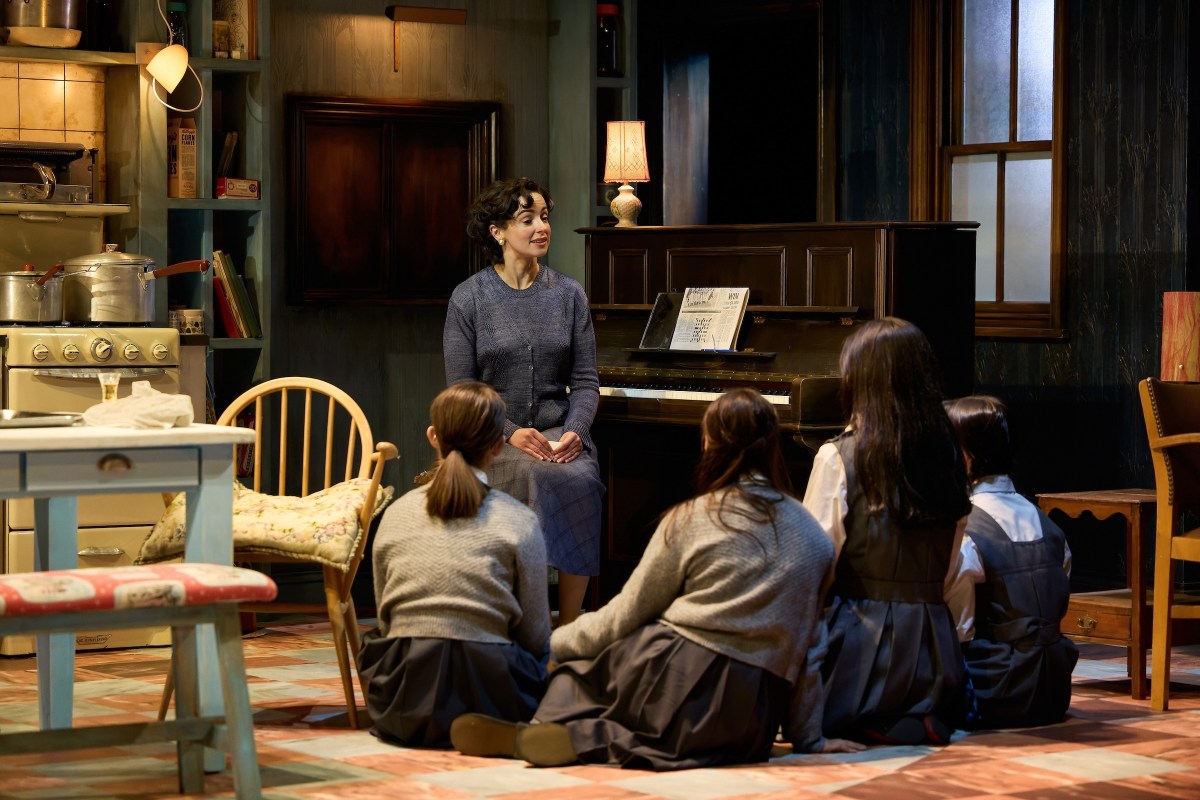
Translations – Abbey Theatre, Dublin

Leonard Buckley in Translations

As Brian Friel’s pluralised title suggests, Translations is a play that holds multiple perspectives in constant tension, a play that examines the porousness of language and the way that it can hold entire cultures in miniature. Of course, all of the characters (who are mostly Irish) themselves speak in translated words of sorts. On stage, Irish is English, and English is also English, as we hear it. A hedge school in 1830s Donegal is translated onto the stage before us. The setting is not romanticised, but its characters are full of romance, richly drawn figures whose relationships are worn lightly while casting long shadows – performed in the Abbey Theatre’s fantastic new production by a wonderful cast.

The play is richly political, but political with a subtle small ‘p’. Caitríona McLaughlin’s production is engaged with the play’s contemporary significances, proving the play’s fundamental adaptability. First performed in Derry in 1980, the performance context is significantly different in present-day Dublin. Yet Friel’s words remain a potent comment on history and the present, forging an almost mythic tale out of the Ordnance Survey mapping of Ireland and the chilling spectre of famine. Friel contends that this story, with all its particularity, could be as fundamental as the Greek myths so beloved of the plays older – though oddly child-like – characters Jimmy and Hugh. Time is only proving this contention to be all the truer.

Translations startlingly enduring timelessness is located not only in the ever-relevant political context of the United Kingdom’s relationship to Ireland, but perhaps in an essence even more fundamental. Famously, Friel claimed that it is ‘a play about language and only about language’, a statement that seems easy to counter until you see that everything else it is about (history, myth, culture, identity, love, and the relationships forged between people) is built from the blocks of language and communication. The underlying philosophy is almost Wittgensteinian; the world is shaped by, understood with, and even made from language. Thus, the act of translation can never be neutral, for it is in the language, Friel suggests, that cultures flourish. To lose the language is an ‘eviction’ of their culture and identity.

Andy Doherty and Ronan Leahy in Translations

At the heart of the play is Owen, the ambiguous prodigal son returning home at last, acting as a bridge between cultures. He is at once the successful and outgoing wunderkind, quietly resented by his brother Manus for having the life he could not, and deeply compromised by his affiliation with the British Army. He is slick and shiny, as played by Leonard Buckley, bubbling with energetic enthusiasm. Beneath this bravado, there is the powerful sense that his career has entailed a cost to his soul – one that also saps away at his British fellow mapmaker, Lieutenant Yolland. Their task is to Anglicise – or as the British see it, standardise – the sound and spelling of Irish place names, measuring the land partly to levy more accurate (presumably higher) taxation and to imprint British authority on yet another overseas country.

Some of Friel’s most brilliantly intelligent writing is located in the scenes where Owen translates between military leader Captain Lancey and the hedge school’s occupants. Lancey is a perfectly ridiculous symbol of British imperialism in his assumption that the Irish characters will understand him if he talks loudly and slowly enough. Eventually, Owen steps into translate, his fraught collaboration laid bare in his attempts to smooth diplomatic relations through creative translation. He obfuscates the military’s more dominating demands while trying to protect his people, censoring their harsher responses. Yet miscommunication, Friel suggests, is likely to lead to disaster. At the end of the play, Owen’s efforts are hopeless in preventing the levelling of Baile Beag and the surrounding area in a series of increasingly vicious reprisals. Owen seems to realise too late that, quite the opposite of protecting his family and community, he has inadvertently led the wolf to the door.

McLaughlin’s production is filled with perfectly chosen touches. In one exquisite moment, late in the play, Zara Devlin’s Maire tries to explain where Yolland lives and finds herself turning to an impromptu map. Typical of Friel, mapping can be a dangerous, militarised and politically oppressive, but also tender, embodying a quest for knowledge and understanding – to reach out beyond one’s own boundaries and borders. Unlike in the stage directions, in which Maire’s ‘finger traces out an outline map’ on the ground, McLaughlin has Maire build an improvised three-dimensional model from the detritus of the hedge school. Stools and buckets denote small Norfolk villages, and Maire even scrunches up the map Owen has been making to signify an English landmark – with a place name she has learned and remembered in its original language. This is a map that seeks to understand and learn, rather than alter, homogenise or impose external authority.

Zara Devlin and Ronan Leahy in Translations

Marty Rea is particularly compelling as a sometimes-ferocious, sometimes-gentle, heart-breaking Manus, a man whose life seems limited by others: the alcoholic father who fell across his cradle as an infant, leaving him with a lifelong limp; the brother who went on to brighter if not better things. He represents another way in which language can be weaponised as resistance; he refuses to speak English to Yolland, despite knowing it. Meanwhile, his beautifully ambiguous ache of a romance with Maire feels tenderly realistic. There is mutual affection, though both dream of a better life for each other and themselves. As the play develops, it is an inner flaw that comes to the fore however – his relative lack of ambition and unwillingness to stand up for himself against his father. It stymies the promise of happy, romantic resolution that the play’s first act offers. Manus does go on to find some of that ambition, but it is too late, when Maire has found someone else. All the while, Manus barely notices the affection Sarah, the woman who he is helping learn to speak, has for him – one of the play’s quiet tragedies, as Sarah stares at Manus, who stares at Maire, neither quite knowing how to express themselves.

In stark contrast, Yolland and Maire invent a breathtakingly beautiful love language of their own in the tender scene that opens the second half. Having been at a local dance together, elated by the atmosphere and each other’s company, they hazard a stumbling effort at a conversation, even though neither speaks the other’s language. Maire only has one sentence of English – the innuendo-laden ‘in Norfolk we besport ourselves around the maypoll’ – and Yolland’s laughter at the words leads her to panic hilariously that she has been tricked, having been taught something dirty. Yolland tries to extend a linguistic hand out to Maire in return but finds he only knows the place names – names that he has been working to replace, to eradicate. Yet Yolland is entranced by their beauty, increasingly certain that he is ill-suited to a life working for the Army or British Empire. Instead, he wants to learn Irish and attempt to integrate, Aidan Moriarty capturing the intense earnestness of his conviction with a beautiful solemnity. As they talk, a miraculous synergy builds between the two of them. Their uncertain ‘What-what?’ and ‘Sorry-sorry’ dialogue transforms into a stunning concordance of purpose: ‘Don’t stop – I know what you’re saying.’ Another potential romantic ending seems possible as they kiss in the moonlight – if only it could last.

Brian Doherty in Translations

It is Yolland’s disappearance after the events of this scene that drives the final act of the play, a largely quiet, meditative conclusion, even as violence is meted out offstage. Jimmy’s rambling, romantic entreaties to Athene, the Greek goddess he considers to be the finest woman of all, have a desperate, somewhat apocalyptic feel, reminiscent almost of Beckett. The eerie sweet smell – a harbinger of famine that ‘dooms [them] all’ – hangs over the stage, inexorably wafting like the dry ice. What remains though, even as the sappers destroy their homes and the potatoes rot in the ground, is language. McLaughlin follows Friel’s suggestion to end on a slow fade to black, the concluding ellipsis fading into silence, as Hugh describes events from the Trojan War. The play ends with his stories still ongoing. The stories will endure. The rich poetry of Friel’s writing seems perfect evidence that the Irish voice has not and be silenced, albeit with one vast caveat; the play is written and performed in English.

Translations

Written by Brian Friel, Directed by Caitríona McLaughlin, Set Design by Joanna Parker, Costume Design by Catherine Fay, LX Design by Paul Keogan, Sound Design by Carl Kennedy, Movement Direction by Sue Mythen, Casting Direction by Sarah Jones, Voice Direction by Andrea Ainsworth, Assistant Direction by Laura Sheeran, Starring Leonard Buckley, Ruby Campbell, Zara Devlin, Andy Doherty, Brian Doherty, Ronan Leahy, Aidan Moriarty, Marty Rea, Suzie Seweify, Howard Teale
Reviewed 26th July 2022
Categories
theatre

Patriots – Almeida

Tom Hollander in Patriots

A gifted scientist, led by infinite ambition and limitless imagination, creates a monster which grows beyond his control. Frankenstein, Mary Shelley’s 1818 novel of ambition, inquiry and overreach, has given us tropes that are now familiar. It provides a cautioning message to anyone who believes they can transcend human limitations – part-Prometheus, part-Icarus in its mythic warning. It also takes the fatal flaw which usually undoes a tragic protagonist and externalises it – an unwitting self-destruction.

This narrative shape is put to excellent use in Peter Morgan’s new historical drama, which dramatises the life of Boris Berezovsky (in this case, a gifted mathematician rather than experimental scientist) as the genius who is blind to the dangers of his own creation – until it is too late. Patriots largely operates as a biography of Berezovsky, from his early childhood (he was born in 1946) to death by suicide (in 2013). Yet by the second half, it becomes less the story of Berezovsky as the origin story of an even more significant figure: Vladimir Putin.

Tom Hollander, who seems subtly but significantly to improve everything he appears in, plays Berezovsky marvellously. He is frequently light and fun, leavening the play with delightful swings between razor-sharp focus and confidence, and bathetic notes of self-pity. His darkly vindictive side emerges on a hair trigger. Yet beneath this all, a pungent melancholy pervades his homesick Russian soul, when exiled from Russia by the very man he promoted. In flashback sequences, Hollander embodies the impishly arrogant child Boris, showing him gradually turning away from his childhood passion of mathematics and his determination to win a Nobel Prize: ‘They pay a million dollars’. (Asked what he would do with the money, he simply replies, ‘Gloat.’) Instead, Berezovsky becomes a titan of Russian commerce – one of the first big businessmen to operate there after the collapse of the Soviet Union, raring to go from the moment Gorbachev ‘permitted small-scale private enterprise.’ Berezovsky saw an opportunity and seized it, his luminous imagination envisioning the chain of events that would lead to Russia’s increasingly capitalistic economy and allowing him to prepare. He is obsessed by the infinite and limitless; ‘Ambition’, he says, as a child, ‘is the belief that the infinite is possible.’ Whether that works in practice, rather than just on paper, is another matter.

Jamael Westman and Yolanda Kettle in Patriots

Berezovsky repeatedly cites his degree in decision making mathematics – especially as leverage in business deals. He can tell them, with scientific confidence, that they are making a good or bad choice. Yet Morgan seeks to expose how complex calculations can go awry when mapped onto real, unknowable people. Morgan and director Rupert Goold withhold just enough from us that a chance encounter in Act One Scene Six crackles into life with sudden realisation and humorous surprise. Attentive viewers will already realise that the Deputy Mayor who Boris is unable to bribe is Vladimir Putin, but it is easy to miss his identity – particularly as Will Keen plays him with a powerful anti-charisma, at first, softly spoken, austere and seemingly banal. Held back as a sudden shock is the revelation that the ‘kid’ – in Boris’ words – who he is reluctantly meeting is Roman Abramovic, known for his regular press coverage as the former owner of Chelsea FC. Morgan stages their meeting as a deliberate jolt; ‘Roman Abramovich. Vladimir Putin,’ says Berezovsky in a mutual introduction which hammers home just how timely this drama will be. The bit players are soon to become protagonists in their own stories. Meanwhile, Berezovsky is unaware of the potent dramatic irony as we see his inevitable downfall in the mere presence of the apparent inferiors who will outgrow him.

Abramovic is played as magnificently bashful by the brilliant Luke Thallon, who shone recently in Camp Siegfried and After Life, as well as the Almeida’s original 2017 production of Albion (also directed by Goold). Like Putin, Abramovic is another Russian of immense geopolitical significance who Berezovsky appears to create. He acts as a ‘Krysha’ to Abramovic, an almost familial relationship, a form of business protection, support and sponsorship. The word literally means ‘roof’. In return, Berezovsky receives informal, undocumented payments – which amount to at least fifty percent of Abramovic’s profits. Morgan’s script states ‘thirty million dollars’ as the floor figure for his payment, but Goold cannily changes this to a percentage, demonstrating that this arrangement is ongoing and cannot easily be escaped.

At times, Boris carries his vast wealth and power lightly, yet he also dictates the rhythm of every conversation he is in with stunning authority. That is, until he doesn’t anymore. In a meeting with then-incipient oligarch Abramovic, Berezovsky insists on keeping jazz piano live in the background. ‘It soothes me’, he says, though it quietly irks his associate. Yet when Abramovic demands greater clarity in their financial relationship, Boris slams the piano lid shut – intimidatingly yelling at the pianist ‘SILENCE!! WHAT IS THIS IMBELIC TINKERING?! IT TORMENTS ME!!’ The message is clear: like the piano music itself, Boris can be a soothing presence, opening doors, providing a roof and making you rich, but he can also be a formidable tormentor. He will allow you to be rich, but your money is made only by his grace.

Yet this arrangement will be mirrored in Putin’s Russia, where oligarchs’ activities and interests are permitted at the leader’s behest. Will Keen completing the leading trio well, playing Russia’s future ruler as a bureaucratic presence, stiff and drained of life – albeit with an undeniably vigorous work ethic, whose power, once attained, cannot be contested. He stands in the shame-riddled shadow of his military service in East Germany (where, Boris claims, ‘they generally sent the desk jockeys, the altar boys, the softies’). Berezovsky’s claim that not being selected as a real ‘KGB man of action’ attests to him ‘as a human being’, but the remark is barbed; Morgan notes that, here, Putin looks ‘eviscerated’. Berezovsky becomes too accustomed to this power play, seeing Putin as intrinsically weak and relatively low-status – even has he elevates him higher and higher, forgetting the potential risks. When Berezovsky helps Putin to get installed as Prime Minister of Russia, he assumes that he has attained political office himself. Yet Putin is no puppet. When Boris Yeltsin – perhaps the only man in Russia Boris cannot control, but only influence – names Putin as his successor as President (on the final day of the 20th century), Putin’s power comes close to absolute.

Berezovsky watches on in horror as his power runs dry. Hollander perfectly captures Boris’ initial denial, falteringly trying to tell Putin what he must do, but there is now no need for Putin to listen. His terrorising shouts only worked when backed up with real financial and political power. The man who, in Morgan’s telling, Boris near-singlehandedly groomed for puppet governance inevitably turns on his creator – a modern Frankenstein’s monster, who forces Berezovsky into exile in London. Berezovsky’s obsession with the infinite, the mathematical concept that so fascinated him as a child and which now functions as his prevailing ideology, has led him to overlook his finite, dwindling authority. One miscalculation is all it takes to undo him and those around him – such as personal bodyguard Alexander Litvinenko, known to his friends as Sasha, who was notoriously assassinated in London in 2006.

Tom Hollander in Patriots

The play succeeds in exposing us to a story we might not otherwise know, or at least only know in part. The Almeida generally programmes shows late, allowing it to be more responsive than most theatres (both to world events and its high-calibre stars’ availability). Patriots was announced in May this year, and the play has inevitably existed long before Russia’s invasion of Ukraine. Yet, while the Donmar Warehouse’s meditation of the ethics of war in Max Webster’s Henry V seemed grimly serendipitous in its coincidental programming, Patriots feels far more deliberately placed. Thus, it works as something of a documentary play, a form of almost-journalism that seeks to inform us on a subject we should know more about.

Yet, Morgan’s drama never feels too urgent in its focus, particularly compared to the last major play to tackle Putin on a London stage. Lucy Prebble’s 2019 play A Very Expensive Poison, based on Luke Harding’s book of the same name and staged at the Old Vic, examined a similar subject by focusing on the murder of Berezovsky’s bodyguard, Alexander Litvinenko, who tried to raise the issue of FSB corruption with its then-leader, Putin. Prebble tackles Russia as a sprawling and rich culture, rather than Morgan’s simpler dichotomy of eastern, Siberian wastes and the cities of Moscow and St Petersburg, where political power is concentrated. While Morgan translates history to the stage with poise and wit, Patriots does not share Prebble’s ambition and flair. A Very Expensive Poison not only documents the story of Alexander Litvinenko, but it also searches for theatrical and real-world justice – honouring both his memory and the ongoing fight for the legal inquiry which his widow Marina Litvinenko lobbied for long after his death.

Marina appears in Patriots too as a character on the fringes. At first, she accorded a sense of power by Morgan – with Boris wooing her, rather than her husband, to leave the FSB and become his personal bodyguard. Yet she is treated more like a prop in the second half – telling Boris to settle down and find a wife, synthesising her (all too real) grief into a somewhat artificial call to action for the protagonist. In a fictional drama, we might not bat an eyelid, but it rings a little hollow considering the determined, passionate advocacy and activism of Marina, campaigning for the British government to take Sasha’s murder seriously. Here, she seems to have almost given up on life, telling Boris to save himself while he can, even if it is too late for her.

In A Very Expensive Poison, Prebble mounts a sustained assault on the fourth wall, its Vaudevillian stylings capturing the sheer theatre of Putin’s regime – with Reece Shearsmith’s Putin goading the audience, heckling from the private boxes, and even giving a talk about theatre itself. He casts himself as the master storyteller (and liar). Yet the play culminates in a powerfully emotional final puncture to the fourth wall, where MyAnna Buring’s Marina asked audience members ‘How do you do’ until all the artifice fell away. ‘I am obviously not Marina Litvinenko’, she says, before Sasha’s actual words are read out for us. Prebble indicts those who she considers culpable: not just the Kremlin and their Russian agents, but the British government response. Theresa May, Home Secretary before she was Prime Minister, is quoted – denying an inquiry into the murder due to ‘the cost to the public’ – a justification that three high court judges later found insufficient. Ignorance, Prebble argues, is too great a cost. Morgan is driven by a similar impulse, but it takes him a little less far, preferring character study to direct political statements.

Morgan’s drama mostly addresses the question of how we got here, rather than where we can go next, but it still stands as a strong and compelling take on an underexplored subject, powered by a tremendous central performance. Rupert Goold’s pacy production delivers political thrills and at times some visceral chills, playing out on a fabulous set from Miriam Buether, drenched in Jack Knowles’ moodily red-tinged lighting.

Whether Morgan successfully captures Russia could be debated. A repeated monologue bookends the drama, in which Boris tells us that westerners ‘have no idea’ what Russia is like, listing items of clothing and food as symbolic of Russian life and culture. Yet Morgan’s gestures toward authenticity seem a little hollow. The mocking of London for being too ‘metropolitan’, for example, speaks in a cynical language familiar to contemporary British politics. The word is pejorative in current British media rather than Noughties Russia, replete with connotations of wealthy liberal hypocrisy and functioning as sweeping shorthand in the same way ‘North London’ and (the Almeida’s own borough) ‘Islington’ have done. Boris tells us that we consider Russia to be ‘a cold, bleak place, full of hardship and cruelty’, yet Patriots hardly disproves this, leaning into it at times. It is only despite (or perhaps because of) these difficulties that Russia is so loved and treasured as a home by people like Boris Berezovsky.

In fact, the effect of the opening monologue’s repetition – fashioned into a sort of fourth-wall breaking suicide note – seems unintentionally to affirm the play’s limitations. After two and a half hours, we are charged with the same ignorance we had at the start; it has apparently taught us nothing. Perhaps the implication is that our incomprehension is a condition of western-ness, not a lack of knowledge per se. Yet on the page, Morgan’s intentions for the scene seem clearer. He asks that the sound of Vladimir Vysotsky’s ‘unmistakable’ singing voice be heard, while street vendors sell pelmenyi dumplings, a visible mirage of Boris’ nostalgia – nostalgia in its most literal, etymological sense: homesickness. This speech is summoning into being the Russia that he loves, so that – in his mind at least – he can die there, rather than in a perpetual exile. Goold, however, opts to play the scene straight, without manifesting Russia before us so literally. It is a very understandable impulse of restraint here; the mental image Morgan generates likely outshines the stage action that would be possible. It feels like not much has replaced these stage directions though, giving us the sense that little has changed over the course of the play.

Ultimately, as the title suggests, the major theme of Morgan’s drama is patriotism. It is a theme that quietly underpins most of his work, given his recurring interest in the British Royal Family, most notably. His last play, The Audience (staged in the West End in 2013), examines this through the contrastingly patriotic roles of monarch and Prime Minister. Here, Morgan names his focus explicitly. As a western play looking in, you might expect it to have a greater focus on how patriotism (and nationalism) operates in British politics, though this never quite manifests beyond the occasional winking satire. (Lines about the follies of elected government generate even more knowing laughter than they usually might.) The battle for Russia’s power and its soul is not fought between patriotic true Russians and western interlopers, hellbent on bringing deregulated free-market capitalism to Russia, Morgan contends. Instead, the play depicts two opposing forms of sincere patriotism. Putin and Berezovsky’s respective motives are partly self-aggrandising, power- and money-driven, yet both consider themselves to be acting for the good of Russia. They consider themselves to be the bridge between the present and an illustrious future. Yet, tellingly, it is always the nation itself that is identified as the beneficiary of patriotic altruism, rather than its citizens themselves.

Morgan takes them mostly at face value, as earnest – if conniving – lovers of Russia. Boris pines for his home from his life of luxurious exile, and Putin refuses his entreaties to return to life a quiet (and probably not even affluent) life as a mathematics professor – motivated, it seems, by a conviction that he must protect Russia from his westernised economic and political pressure.

Jamael Westman and Tom Hollander in Patriots

In the second half of the play, Putin instates Abramovic as the governor of (what The Guardian calls) ‘the frozen far-eastern province’ Chukotka, six thousand kilometres from Moscow. In a March 2022 feature for The New Yorker, Patrick Radden Keefe called the province ‘comically inhospitable’ – noting that its ‘winds are fierce enough to blow a grown dog off its feet.’ Abramovic ‘pumped plenty of his own money into the region’, Keefe writes, and Morgan dramatises as fact something that is widely believed to be true: that Abramovic was very much steered into this apparently thankless role by Putin’s guiding hand. (Catherine Belton particularly advances this view in her 2020 book Putin’s People.) Though Boris may have been Abramovic’s Krysha once, in contemporary Russia, Putin acts as Krysha to all of the oligarchs. They keep their wealth only because Putin permits. Yet the scene where Putin visits Chukotka seems redolent of Morgan’s main theme; the billionaire is not only being groomed for his loyalty, but Putin appears to be testing Abramovic’s patriotism. The poverty of Chukotka is still far preferable to a life in exile elsewhere.

This is the vision of patriotism that crystallises in the drama: the pain of separation as greater than any hardships that life may contain. Berezovsky would surrender his wealth to keep his home, and Putin leverages that power against him, as Berezovsky leveraged power against others and him. Yet it is almost a moment where a vital fault line of the play is exposed; how much of what we are witnessing is true? It is another perennial concern in Morgan’s writing, and he treads a line between dramatizing facts of historical record and inventing within plausible parameters. The play bears no caveats about its level of fictionality, nor any acknowledged sources; its content does not signal (as Prebble’s gloriously absurd touches did) where gaps have been creatively filled.

In the bid to dramatise these lacunae, some moments strike false notes. The opening scene is one such example. We hear that the nine-year-old Boris has solved the Kaliningrad Bridge Problem – a traditional problem (previously called the Seven Bridges of Königsberg) in which a city’s seven bridges, connecting its various islands, must all be crossed on a single route, crossing no bridge more than once. The play as performed (but not the script) describes the fact that Euler solved the puzzle in the negative – meaning that he proved it has no solution. Euler effectively devised a new branch of mathematics in the process, and now – for mathematicians familiar with such methods – it is not too difficult a problem to solve. Unless Euler were catastrophically wrong (which he was not), solving it in the positive would be impossible.

This could just be stage shorthand for mathematical genius that contains a fairly fundamental flaw, or perhaps this is a deliberate tell, a sign that the drama is an imperfect, inherently unreal rendering of a life. The gist is true; Boris was an ambitious, intelligent man, and so too would his childhood have been. Either way, Patriots demands our attention in sifting hard fact from elegant fiction. Are we to take the characters’ claims of patriotism on trust, or should our suspicions be raised throughout? It would benefit from a little more direct admission of its inventions, but maybe fiction is what we are supposed to expect.  

Patriots

Written by Peter Morgan, Directed by Rupert Goold, Set Design by Miriam Buether, Costume Design by Deborah Andrews and Miriam Buether, Lighting Design by Jack Knowles, Sound Design and Composition by Adam Cork, Movement Direction by Polly Bennett, Casting Direction by Robert Sterne CDG, Voice Coaching by Joel Trill, Assistant Direction by Sophie Drake, Russia Consultant Yuri Goligorsky, Starring Matt Concannon, Stephen Fewell, Ronald Guttman, Aoife Hinds, Tom Hollander, Will Keen, Yolanda Kettle, Sean Kingsley, Paul Kynman, Jessica Temple, Luke Thallon, Jamael Westman
Production Photographs by Marc Brenner
Reviewed 8th July 2022
Categories
theatre

Sun & Sea – The Albany

Having watched Sun and Sea a couple of weeks ago, I have found my mind returning to it more and more due to news coverage of this record-breaking heatwave. Despite being a major weather event – pointing to severe and rapid global heating – the media response, at least in the run up and early stages was, for the most part, shockingly glib. This was matched by Deputy Prime Minister Dominic Raab encouraging everyone simply to ‘enjoy the sunshine’. Yet in other quarters, there have been pockets of utter doomerism – widespread suffering considered a taste of our medicine, just desserts, laced with the masochistic pleasure of having been proved right. Frequently, however, even following a ‘red warning’ for ‘exceptional heat’ – never before issued by the Met Office in the UK – and the risk of huge excess mortality, outlets have returned to the imagery of the beach – a stock film staple of the sunny weather VT. The climate crisis is no beach holiday.

Sun & Sea, a durational opera by Lina Lapelytė, Vaiva Grainytė and Rugilė Barzdžiukaitė, aptly examines the beach – specifically the sandy beach favoured by many holidaymakers – as a nexus of our relationship to the planet, as well as a representation of contemporary life in microcosm. As part of the LIFT Festival, The Albany’s auditorium has been transformed into a two-tier arena to play host to the opera, which has previously played across Europe (most notably the Venice Biennale, where it won the top prize, the Golden Lion). From above, the audience watch over the beach scene below, where deck chairs and towels are populated by various beach dwellers – most of whom are characters in the opera, taking solos, duets, and occasionally choral roles in the few group numbers. Billed as an opera, it seems more redolent of song cycles – with loosely juxtaposed pieces circling around central themes. You watch for an hour, and it repeats over and over (sometimes up to eight hours in total). Its looping format negates the possibility of any overarching linear plot. Yet any narrative would seem antithetical to its attempt to represent a beach scene. Instead, we hear sometimes-surreal snapshots of various lives.

The opera is implicitly about the ethical weight of our decisions. Flying to go on a beach holiday, as the ‘Wealthy Mommy’ character has (collecting the different seas her eight-year-old son has swum in on a bucket list) cannot be considered a neutral act. The beach is a space where people’s relationship to the planet and to each other meet in theoretical harmony – but are fraught with danger. The heat is an ambiguous climate of joyous relaxation and simultaneous alarm. Like the news in recent days, Sun & Sea places implicit pressure on the semantics of weather; we are so used to associating heat with ‘good weather’, yet it has clear dangers – far beyond mere sunburn. Meanwhile, the shore is under threat from rising sea levels and falling biodiversity.

The libretto conceives of this beach as an explicit escape from the demands of capitalism, though it remains impossible to escape its effects – psychological and ecological. The ‘Song of Exhaustion’, delivered by the ‘Workaholic’ (characters are anonymous, identified by vague types they fit into), is the most direct expression of a soul under threat from the grind of office labour. His ‘suppressed emotions’ have become ‘knotted up in [his] psyche’, and even on the beach, he is unable to switch off; he cannot ‘let [himself] slow down, because my colleagues will look down on me’. Everything he does is soaked in shame, his pent up anguish building to a moment that never arrives here but inevitably will – where he ‘lose[s his] cool in public’ and mortifyingly embarrasses himself – or worse. He worries that his ‘suppressed negativity’ will burst out of him ‘like lava’. His maleness is unspecified in the text, though the role implicitly seems to imagine some toxic masculine behaviour as an uncontrolled, volcanic outpouring stemming from exhaustion – like the earthquakes caused by tectonic plates under immense pressure. We are invited to sympathise but not necessarily excuse such an explosion.

One of the show’s great triumphs is its understanding and presentation of sheer pettiness. The recurring iterations of the ‘Chanson of Admiration’ – short stanzas of praise for beauty of the sky, seabirds and jellyfish – juxtapose the longer incarnations of the ‘Song of Complaint’. ‘What’s wrong with people’, the first bout of complaining begins. People with dogs are accused of ‘leav[ing] shit on the beach, fleas in the sand’, while beer drinkers mean ‘it smells like a slum-hole’. The song is woven with casual contempt for the poor and homeless – who the singer has seemingly holidayed to escape from contact with – and one description of finding the fishy remains of someone’s lunch under their blanket describes the object (with a seemingly deliberate loaded quality) as ‘a foreign body’. The closest thing to a narrative payoff in the opera comes in the second part of the song, in which the singer reminisces about the ‘unpleasant associations’ of fish that came from being force fed it by her (now-deceased) grandmother. The gesture deepens her character. Like the Workaholic, her attitudes are not legitimised but explained with a surprising tenderness, while opening up the fissures of entitlement and exclusivity that pervade some holidays.

Relatively simple moments can be hugely effective. The rhythms of visiting a beach are put under the microscope in catchy songs such as ‘Sunscreen Bossa Nova’, while a hugely moving conversation between a couple sees them repeatedly counting the hours they have left together before one goes away. They take solace in plans to make an omelette and refuel the car, unable to full express their anticipated emotions beyond simply the fact of them ‘getting sad’. Also brilliantly incorporated are the volunteer participants dotted around the edge of the beach, soaking up the simulated sun, reading, playing games, and seemingly befriending each other before our eyes. Though I am unable to see a dog on stage without being reminded of Ella Hickson’s The Writer (in which a character claims that ‘There should not be a dog’ on stage, ‘unless you’re going to cut its […] tongue out’), Sun & Sea is a rare piece of theatre where a dog’s unpredictability adds to the scene’s verisimilitude, rather than highlighting its fakery and breaking the theatrical illusion. The extent of the opera’s artifice is abundantly clear (given that we are literally inside), yet that does not preclude ostensibly real (certainly new, unrehearsed and unreproducible) events occurring in the space.

The music itself plays second fiddle to the superb design concept, with the vocal lines beautifully sung over relatively sparse backing. The lyrics are at their best when taking more surreal turns, such as in a song entitled ‘Dream’, in which one sunbather tell us about dreaming of meeting someone with an egg-sized tumour in his brain. Another thread describes vast flight disruption from an unexpected volcano eruption, leaving a couple stranded together in an uneasily idyllic extended holiday. The brilliant ‘3D Sisters’ Song’ is a downright bizarre highlight. It features duetting identical twins contemplating the mortality of the human body, before fantasising about 3D-printing coral reefs back into existence; ‘Yet with the press of a single button, I will remake this world again. 3D corals fade away! […] 3D me lives forever.’ Are we to implicitly wonder if the sisters have themselves been 3D-printed from the same design? Strange and wonderful possibilities abound, and Sun & Sea is uninterested in simple answers. This beach has room for dreams of transhumanist immortality alongside increasingly ambitious rallies of badminton.

The final song in the libretto – though the nature of the piece means that the audience constantly ebb and flow in and out, and we experience no defined end or beginning – describes the ‘sea as green as a forest’, imagining the human body ‘covered with a slippery green fleece’, their swimming costumes ‘filling up with algae’. The climate crisis hangs over events, largely unspoken. The ‘Philosopher’ considers our normalisation of vast-scale importing – ‘to give us a feeling of bliss’ for only ‘one bite’ – while the 3D Sisters envision an ‘empty planet without birds, animals and corals’. The final image of eutrophication is another gesture towards climate breakdown, though suffused with a greater ambiguity. This is an algal bloom that seems delightful in its life, but is destabilising to the ecosystem – leaving ‘empty snail homes, swollen seaweed, [and] fish remains’.

Ice Watch by Olafur Eliasson, 2018

Durational installations perhaps prime us for the gradual nature of life and ecosystems – transcending the present moment and placing as a part of something longer term. They provide a way of comprehending that which is far greater than us. Perhaps the most notable recent example is Olafur Eliasson’s Ice Watch. In December 2018, the Icelandic-Danish artist brought 30 blocks of Greenlandic ice to London, as he had done previously in Copenhagen and Paris. Most were placed on the Southbank, by the Thames, just outside the Tate Modern, where visitors and passers-by alike could observe and engage with the blocks – as they slowly melted away. The aim was part-pedagogical, part-chiding, giving people – in Eliasson’s words – ‘a very tangible encounter with the consequences of their actions’.

Yet works like this (as with Sun and Sea) can encounter accusations of hypocrisy that threaten to blunt their actions. After all, Eliasson has literally contributed to melting Arctic ice through removing 30 chunks of it. Attempting to head off such criticism, three times the carbon offset cost was donated to the Woodland Trust, and while some would spin this as making the project carbon-neutral or even net-positive, this overlooks the fact that such emissions were fundamentally avoidable. Yet just because emissions occurred does not delegitimise the project outright. Instead, it is a core part of the ethical tangle that artists face; almost all art is made from resources with some carbon cost.

The Venice production of Sun & Sea featured over 25 tonnes of imported sand – imported at an inevitable price. Yet this is also the logic used to undermine the efforts of climate change campaigners in many sectors. Climate crisis art can never really escape the bind that – even if carbon neutral, with reused or upcycled design – there is a debatable opportunity cost – even then. When time is running out and urgent practical, political intervention is required, then all art could be considered a self-indulgent (and even harmful) luxury. Writing on Sun & Sea (as well as other recent climate-themed exhibitions and shows), Eloise Hendy notes that ‘the performers’ dilemma is the same one we all face, namely how to spend our days at the end of the world; how to fiddle while the world burns’. Does anything that is not purely activist itself have value?

For all the claims made about the power of art, it is highly unlikely that art will ever save us in and of itself. Sun & Sea seems to know this. Art plays a role in protest, yet protest likely cannot be artistic alone. Perhaps the true value of art in a time of emergency is its provision of a space of ethical reflection. Art’s merits are not in activism as an end in itself, but instead in how it equips audiences with knowledge and tools that make activism more effective – as well as making life worth living. Theatre, particularly, is a shared space, in which the cold facts of the climate crisis meet the complex human reality of life. Art, then, is perhaps akin to a beach holiday; it can be something of a luxury, but also brings you together with strangers, offering relaxation and rejuvenation, before returning to action elsewhere revitalised. In Sun & Sea, we look down on the beachgoers, perhaps in judgement, but it is ourselves we are judging too. This judgement is no mere condemnation, but – hopefully – a resolution for action.

Sun & Sea

Composed by Lina Lapelytė, Libretto by Vaiva Grainytė, Translated from Lithuanian by Rimas Užgiris, Direction and Scenography by Rugilė Barzdžiukaitė, Concept and Development by Lina Lapelytė, Vaiva Grainytė and Rugilė Barzdžiukaitė
Reviewed 7th July 2022
Categories
theatre

The 47th – Old Vic

Bertie Carvel in The 47th

‘Art needs time and space and reflection we can all agree on that.’

From Shipwreck, by Anne Washburn (2019)

It is a lexical quirk of the American political system that Presidents become known by their number. Trump was, and is, the 45th, Obama 44th. Joe Biden is the 46th, and – should he not run again in 2024 – we are only a couple of years away from the 47th. However, only one US President (so far) is known by two numerals. Grover Cleveland, by dint of winning Presidential office twice, separated by the Presidency of Benjamin Harrison, thus counts as the 22nd and 24th President of the USA. It is a pub quiz trivia staple and remains unique in US political history. Perhaps, that is, until 2024, should Donald Trump run successfully again.

This creeping liberal dread that Trump might emerge victorious again underpins Mike Bartlett’s The 47th. The title seems – at least before you see the play – as if it cannot bear to speak Trump’s name, referring to him by an undeserved moniker he has rendered mock-heroic. In the play itself though, it is a wry, satisfying touch from Bartlett that the title does not refer to Trump after all, but Kamala Harris. She is instated by Biden in his place as his health deteriorates, in an act that seems to reverse-mirror Trump’s own refusal to share power when ill with Coronavirus. It is a canny substitution, though in no meaningful way does the character of Donald Trump have second billing here – either on the page, or in Bertie Carvel’s scene-chewing and -stealing, magisterial turn. This is, to use language of many reviewers during his Presidency (as they did about Brexit), a ‘Trump play’.

Lydia Wilson and Tamara Tunie in The 47th

The 47th seems most obviously reminiscent of Bartlett’s 2014 play King Charles III, which shares a future-history premise and a director in Rupert Goold. While King Charles III opened at the Almeida, of which Goold is Artistic Director, The 47th arrives in the much vaster space of the Old Vic – aware that a play with as zeitgeisty a subject and Carvel in such a headline-grabbing lead would attract a larger potential audience. In King Charles III, Bartlett sought out the human weaknesses and follies beneath the grandeur, tradition, and clipped rhetoric of the monarchy – unearthing the seething political opinions and ambitions that lie beneath the long-cultivated veneer of neutrality. The problem with applying the same logic to Trump is that he appears to have no filter. The thrill of seeing a protagonist soliloquising in private – one of the great attractions of Shakespeare’s history plays – is far less edifying when his every thought has been blasted across rolling news coverage. There is relatively little at stake dramatically when he so sorely lacks self-doubt – little interiority to be found. He appears to be a man whose every thought is bluntly, digressively articulated, and, though riven with contradiction, there is little actual conflict within him.

Bartlett does not seem interested in subverting this popular view of Trump here – actively tailoring his Trump to goad us. He remains the cartoon villain we expect, entering on a golf buggy and bragging to us about his achievements from the off. The main difference from the real Trump is the infusion of a greater awareness of liberal sensibilities and things he is mocked for. Trump repeatedly both-sides-ed racial violence and propagated the ‘birther’ conspiracy theory about Obama’s citizenship, yet chiding liberals for discriminating against him for the (orange) ‘colour my skin’ speaks in a liberal vernacular that seems unlikely. He claims to be an entertainer and ‘Your devil’, swearing revenge on those who have ‘exile[d]’ him from the White House and taking us along for the ride. The spirit of pantomime is deliberately alive in his words; he is villain who loves to be a villain.

I was also reminded of Anne Washburn’s wordily brilliant Shipwreck, one of the first plays (perhaps even the first) to put Trump on the London stage. Directed by Goold again, at the Almeida, this mostly portrayed a group of liberals gathering in a remote farmhouse, during a worsening storm, before revealing Trump himself – during a terrifying recreation of his ‘loyalty dinner’ with James Comey. Shipwreck’s rich poetry seemed like a space of solace – of intellectual defiance against the Trump administration, and refusing to fight his brash, name-calling rhetoric on its own terms.

Bartlett’s play too seems to hope that an ostensibly anti-intellectual problem can have an intellectual solution too – that empathy, intelligence and culture will ultimately win out – though it is perhaps less convincing. Its formal gesture seems something of a comfort blanket – not least because it is a return to a specific form, for which Bartlett was previously garlanded. Trump’s angular rhythms are strangely transposed into iambic pentameter, and there seems to be an implicit aesthetic critique that comes from the uncanny juxtaposition. Yet the problem of Trump is not merely the way he talks. Though his manner of speech is an undeniable part of his troubling, dangerous speech acts, it is far from the whole. One of the arguments implicit in Shipwreck seems to be that a liberal critique of Trump that dwells only on formal matters, rather than content is doomed to failure. As Michael Billington wrote in his review in The Guardian, it ‘does something you rarely see in the theatre: it takes Donald Trump seriously rather than as a subject for easy satire.’ The 47th attempts to rationalise the way Trump seems to be an obvious baddie – yet remains a political danger. Yet the impulse it springs from does seem too cheaply comic. What if Trump was King Lear? Wouldn’t that be funny?

Bertie Carvel’s Trump is far more accurate – in mannerism, appearance and voice – than Shipwreck’s version, played by Elliot Cowan in the original Almeida production. Yet for all his realism, The 47th gives Trump only crude malignancy, rather than active malice. Carvel’s performance is a strong recreation, but Cowan’s unhinged tyrant, bare-chested and painted gold, is a more interesting interpretation of his self-aggrandised horror.

In much of the play, Bartlett seems intent to serve up a (somewhat hollow) form of narrative justice for Trump’s actions. Trump is arrested and placed in jail, the imagery of him orange boiler-suited seems like liberal wish fulfilment, after his real-life double impeachment was exposed as functionally meaningless without Senate backing and investigations into his tax affairs have yielded little legal consequence. Perhaps inevitably given its genre of Shakespearean (future) history meets tragedy, Trump dies at the end, in a sequence fashioned presumably as an oblique comeuppance for Trump’s gutting of Obamacare. Slightly implausibly, Trump’s financial folly has led to him not even being covered by health insurance. He is given a private room in the hospital, as in jail, only for security reasons.

The second half falls into a slightly repetitive pattern, hinging on two fairly similar tête-à-têtes between Harris and Trump that buttress the drama. With such fixed positions, based on life, there is little either can gain from each other, apart from the most begrudging form of mutual respect. Elsewhere, the characters simply do not have enough depth to sustain major scenes. Ivanka (an icily composed Lydia Wilson) runs rings around her siblings too easily to create the Succession-like thrills that seem to be intended, as the Trump children jockey for position. This is compounded by Ivanka clearly being her father’s favourite. In Succession, the only daughter Shiv’s relative competence is offset by her father’s lingering preference for his sons – this dynamic functioning as the central thread of the second series. The best scenes with Trump offstage follow siblings Charlie and Rosie Takahashi, one a (Democrat-supporting) journalist, the other a Republican working for Ivanka’s Presidential campaign. The personal stakes of politics emerge in their confrontations, sibling loyalty tussling with political allegiance.

Like Washburn, Bartlett approaches Trump with a curious formal abstraction. Shipwreck is dubbed a ‘history play about 2017’ (which was first staged in early 2019), while The 47th (like King Charles III) is a future history, documenting the hypothetical events of the 2024 election. Perhaps it is because Trump seems so literal and unsubtle; speaking truth to power by simply representing a simulation of the truth won’t cut it. Instead, stepping back (or forward) allows us to observe him within a broader cultural moment.

Yet Shakespeare too, even more than in King Charles III, operates as a genre in of itself – as well as being another form of abstraction. The plot is shaped partly by real-world conjecture about a coming electoral race, combined with recognisable pastiche of Shakespearean moments. Most clearly, the play begins with Trump as King Lear – and the overall shape of Trump’s arc in the play could be (very) loosely mapped onto that character. He begins by musing on his coming demise; instead of a kingdom, he has an inheritance to divide up. Bartlett commits to a conception of Trump which is virtually indistinguishable in public and private, exacting calculated cruelty on his family and stroppily demanding each child flatters him into making them his sole heir. Don Jr. and Eric make their fawning, self-abasing arguments, before Ivanka follows the Shakespearean pattern of Cordelia and refuses to partake in his spiteful game. Instead of banishing her though, Trump remarks ‘And just like that the mic is roundly dropped. […] She had no competition.’ Inevitably – and Bartlett’s script spells out this many times – Trump is presented a monstrously inverted Freudian embodiment of the Oedipus complex – the father who wants to have sex with his daughter. She was always going to be his heir.

Shakespeare plays are often performed in large theatres. (The National’s Olivier hosts one most years, as does their Lyttleton stage.) Yet this is as much to do with the reliability of Shakespeare selling tickets (and perhaps the decline in the fashion for doubling supporting roles, and thus the need of large casts) than the quality of the plays themselves. Though the Globe Theatre has become a cultural touchstone for Shakespearean performance, his plays were often presented in smaller venues – more akin to Shakespeare’s Globe’s winter venue, the Sam Wanamaker Playhouse. There is an intimacy to Shakespearean drama that is often lost – though a great production can create this in a large space. The 47th does lack this intimacy. Partly, this could be the venue. (You wonder what the experience would have been like if Goold had programmed it in the 325 seat Almeida.) Yet there is also something remote about the characters themselves. They appear largely as they do on the news – self-possessed, even as they lose control of events. The rich, archaeological characterisation that you might expect from a Shakespearean drama is mostly missing.

Lydia Wilson in The 47th

Goold’s choice of plays to direct evinces a desire to grasp the nettle of many contemporary political issues. Albion, another Almeida collaboration with Bartlett (in 2017, and revived again in February 2020), was held up as ‘The play that Britain needs right now’ by Dominic Cavendish’s five-star review in The Daily Telegraph. Though Cavendish avoided saying ‘Brexit’ in his review, his subtext was fairly evident, and other reviewers made the connection explicit in other, largely glowing write-ups. Yet even this allegorical drama about restoring an English garden to its (apparent) former glory was designed with a structural abstraction – utilising an overtly Chekhovian structure, with four acts (one for each season), and an ending redolent of The Cherry Orchard.

Sometimes this impulse towards political (or at least politicised) drama has been misjudged. Ava Wong Davies’s brilliant review of The Hunt for Exeunt perfectly captures the tension between admiration for Goold’s typically compelling direction and deep unease at its implications, by scripting a conversation between a defending voice and a detracting one. Dramatizing the descent of a teacher, who is falsely accused of sexually abusing a child, I think that play (an adaptation of Thomas Vinterberg’s 2012 film) likely stemmed from an impulse of exploration, rather than apology or excuse for abusive male behaviour, keen to examine how public opinion is formed and how it shifts. Yet the underlying unlikeliness of the plotting and the political context of high-profile allegations as part of #MeToo made it seem a deeply reactionary piece of theatre, unfortunately placing sympathy squarely with the accused rather than the abused.

The 47th seems to emerge from a similar nettle-grasping political drive, yet the results seem fairly modest. Though most of my detractions are with the script, the production too lacks Goold’s usual fast-pace and flair. The costuming and prosthetics that produce Trump before us are hugely impressive, yet the rest of the design underwhelms a little. Miriam Buether, who designed such a gorgeous garden set which changed with each season in Albion, here channels the marble of the White House and the shape of the Oval Office, in a two-tier set. Unfortunately, it gets caught between naturalistic and stylised aesthetics though, and ends up feeling slightly visually bland. (Her latest collaboration with Goold, Patriots at the Almeida, is a triumph.) Enlivening the space, however, is Neil Austin’s use of light, which generates a palpable menace in scenes with QAnon – Buether evoking the horrifying aesthetic of the January 6th Capitol rioters.

Bartlett’s drama operates as both future prediction and post-mortem, willing into being the end of the Trump story. By contrast, Shipwreck is less about the political events of 2017 itself as liberal hypocrisy (‘There’s a little bit [of money] offshore’, one character admits) and handwringing as American culture adjusts to its new President. Washburn even refers to the trend of dressing up Shakespeare for different political occasions, as a way of coping with the uncertain moment. One character describes ‘that Shakespeare in the Park thing’ where ‘the man who plays Julius Caesar has a weird orange blond wig, […] and in the end he’s assassinated by a lot of brown people’. The production did happen – directed by Oskar Eustis – and was repeatedly interrupted by right-wing activists calling for an end to ‘political violence’ against the right. Yet despite their claims, reinterpreted Shakespeare can hardly be called violence, and there are clear limits to its effectiveness as resistance too. Shipwreck captures the ineffectualness of most art in its attempts to hold power to account. Instead, such productions are more a form of political therapy – giving the illusion of engagement as a substitute for meaningful (and potentially dangerous) political action. Another of Washburn’s characters responds ‘how are we finding a way to process all of this thoughtfully [and] is Shakespeare any kind of answer? Is Shakespeare really relevant to the current day?’

Washburn’s questions seem fascinatingly apt to The 47th. Shakespeare, her characters debate, is both a second choice and the only option; ‘I think they’d use a contemporary play only there isn’t one’. There is no drama ‘about this exact moment’, so old stories must be re-dressed for the occasion. Bartlett attempts to square the circle – drawing on Shakespearean heft with a drama about the coming moment, as the present one is arguably too ephemeral to bottle. Another voice chimes in: ‘Why don’t we just give up already, why don’t we give up and agree that plays are never going to be about the current moment and they shouldn’t be about the current moment. Plays are about the Eternal moment, yes?’ The claim that plays are expressions of universal truth is not entirely convincing, and I don’t believe Washburn expects us to agree with such a sweeping statement, but the eventual point at which this discussion comes to rest seems fair: ‘Art needs time and space and reflection we can all agree on that.’ Yet The 47th seems oddly airless, without this space. Bartlett has not (yet) described how the play came into being – whether it was part-designed to coincide with the 2020 election, before Covid cancellations hit, perhaps. Yet though the gesture of reflection – in this case looking into the future – is present, there is a sense that time and space are not.

Ultimately, while The 47th sees Bartlett returning to the writerly instinct that generated King Charles III, for Goold it seems more of a return to Shipwreck’s idea space. Washburn’s play is thornier – its problems less reducible to one man or one set of circumstances. Its problems are elemental – evoking her earlier play Mr Burns in its gesture of gathering characters around a campfire to tell stories in the dark. In its mythologising and Shakespeare-ising of Trump, The 47th attributes far more to one man than perhaps it should. Trump is a symptom of a political moment, perhaps an opportunist who rode its wave, rather than the sole author of many of the regressive steps America is taking. Even three months on, some aspects of the play feel outdated. As horrifying as the January 6th Capitol attack was, the decline of liberalism is happening in courtrooms rather than on the streets. The January 6th investigation is still ongoing.

Bartlett’s play entertains in spades, and Carvel is impressively accurate while not hamstrung by the demands of the impression, yet Bartlett does not quite succeed in having the last word on Trump. It might be an attempt at a literary exorcism, but the real Trump – rather than just a realistic-looking one – remains elusive.

The 47th

Written by Mike Bartlett, Directed by Rupert Goold, Set Design by Miriam Buether, Costume Design by Evie Gurney, Lighting Design by Neil Austin, Sound Design by Tony Gayle, Original Music and Sound Score by Adam Cork, Video Design by Ash J Woodward, Movement Direction by Lynne Page, Starring Berte Carvel, Tamara Tunie, Lydia Wilson, David Carr, Joss Carter, Kaja Chan, James Cooney, Charles Craddock, Flora Dawson, Eva Fontaine, James Garnon, Richard Hansell, Oscar Lloyd, Jenni Maitland, Freddie Meredith, Ben Onwukwe, Cherrelle Skeete, David Tarkenter, Ami Tredrea, Simon Williams
Production Photographs by Marc Brenner
Reviewed 9th April 2022