
In late December 2021, an article by Parul Sehgal in The New Yorker caused a minor stir. ‘The Case Against the Trauma Plot’ set out a detailed and nuanced criticism of the emergence of trauma as its own literary genre, with such narratives circling around the suppressed and relapsing memories of trauma. Trauma has been its own field of literary study for a while now, particularly popularised by the work of trauma theorist Cathy Caruth, from the 1990s onwards. Popular awareness has led to trauma becoming a dominant lens for reading both books and people, with results Sehgal rails against, such as the reduction of character behaviour to mere symptoms. She notes that there are ‘636,120 possible symptom combinations [that] can be attributed to P.T.S.D.’ The statistic reveals the intense complexity of different experiences and the absurdity of trying to write a condition rather than a character. Furthermore, she despairs at how ‘[t]rauma trumps all other identities, evacuates personality, remakes it in its own image’ and how ‘[t]rauma has become synonymous with backstory’ leading to the ‘tyranny of backstory’. Every character is in need of trauma to seem three-dimensional, but it ironically flattens and dims a character’s vitality.
Sehgal’s article was also a contribution to the broader literary discussion of personal trauma, the roman-a-clef confessional semi-fictional mode, and (perhaps most controversially) the ownership of narrative. ‘My trauma, I’ve heard it said, with an odd note of caress and behind it something steely, protective’, Sehgal writes, arguing that trauma is often viewed as something to be guarded rather than alleviated. It could go beyond being a character trait but become someone’s definition – whether fictional or real. Disclosure narratives have become a growing sub-genre, but so too have the dangers of forced disclosure – including the outing, even doxing – of someone’s trauma become rightfully considered problematic. Partly this is a moral question, but with the creep of intellectual property rights as the cornerstone of mass media it is now also legal and financial. Stealing someone’s (tragic) life story is not only cruel but sits ambiguously close to an act of plagiarism.
Into these discussions, rather surprisingly, enters See How They Run, a frothy, gently parodic spoof murder mystery, set during the early stages of Agatha Christie’s West End smash The Mousetrap. Yet it is also a film about the lure of money, contractual idiosyncrasies of intellectual property law and, most startlingly, the ownership and exploitation of trauma.
Of course, the murder mystery genre inherently requires violent deaths, but that does not mean that the genre is composed solely of abyss-staring, nihilism and traumatic recollection. In fact, the ironic juxtaposition of evil acts with a pervasive tone of cosiness is often one of their draws. James Greig’s witty polemic, published in Gawker in February, denounced the spread of such ‘cozy crime’ (from authors including Richard Osman, Rev. Richard Coles, and Ian Moore), arguing that their genteel attempts at social commentary are deeply flawed. By contrast, Christie herself wrote from a class-conscious position of satire. Her books were not a way of tuning out social issues with a literary crossword puzzle, but split open the fissures of resentment, corruption and criminality that ran beneath the veneers of social etiquette and performative politeness. Christie’s choice to make her best-known sleuth, Poirot, an immigrant in a society frequently suspicious of him was surely a somewhat deliberate decision, though the extent of her radicalism can easily be overstated. For all its absorption into the safely inoffensive rhythms of daytime television schedules, there is a sharpness that has been widely forgotten.
To accuse See How They Run of cosiness outright would be to miss the way it deliberately plays with our faulty collective memories of the stylings and content of ‘Golden Age’ murder mysteries. (The term generally refers to the prolific period during the 1920s and 30s, in which ‘Queens of Crime’ Christie, Margery Allingham, and Dorothy L. Sayers, and other authors served up murder plots by the dozen. However, Christie’s popular longevity endured throughout her lifetime.) See How They Run does convey a certain degree of cosiness, which is subverted only in part. It presents a sanitised London of memory, with few of the social issues, only the set dressing of historical events. (The Rillington Place murders are being dealt with in the same office, alluded to only in passing.)
To the trappings of mid-century murder mysteries, director Tom George adds the comic stylings of Wes Anderson. The film never has quite the same visual detail as is found in Anderson’s precise, frequently symmetrical shot composition, but occasionally the more dynamic camera moves feel inspired by his style, along with the design and colour palette. Perhaps the influence is felt most in the tone created by Daniel Pemberton’s soundtrack, which apes the ticking drum lines and offbeat rhythms of The Grand Budapest Hotel. Both films also feature a scene-chewing, delightfully unpleasant turn from Adrien Brody.
Yet, in its striking denouement (which I will avoid spoiling, though will allude to the killer’s motivation), the film keys into something much deeper – the ethics of writing (and exploiting) someone else’s story. Even in the 1950s, trauma sells tickets; but did Christie (and do we) have the right to sell another person’s (tragic) truth as an integral part of her fiction? The trauma of real victims continues to be dramatized on stage, night after night, in London’s West End to this day.

See How They Run follows a similar pattern to Edgar Wright’s 2021 film Last Night in Soho. In both, the aesthetic world of mid-20th century London (for George, 1953, rather than Wright’s evocatively half-remembered 1960s) is used as the playground for self-consciously genre-influenced drama, before deepening and twisting into an exploration of far more contemporary ethics. Wright pits our collective cultural memory of the 1960s as a decade of sexual liberation – when ‘sexual intercourse began’ as Larkin’s poetry notoriously claimed – against a grim reality of sexual violence, unpunished judicially and without significant cultural reappraisal. Last Night in Soho feels like a male filmmaker’s attempt to reckon with the uneasy aesthetic valorising an ethically dubious period and moment, as well as with the abuses perpetuated and covered up under the aegis of Hollywood power. George, on the other hand, questions the extent to which his own entertainment’s relationship to the real (including real violence) is problematic. The Russian doll effect is pleasingly neat, but with just enough seriousness to seem like an effective discussion.
As its marketing is keen to proclaim, the film also has a similarity to Knives Out, though these comparisons will not necessarily flatter See How They Run’s valid, but altogether different intentions. Both have large and impressive ensemble casts, led by major stars as relatively idiosyncratic detectives. Both also infuse their classic mystery stylings with notes of social commentary. Yet See How They Run does not fizz with quite the same intensity as Knives Out, which reveals itself early on to be keyed into contemporary issues such as nepotism, wealth and healthcare inequality. Instead, See How They Run’s thematic richness comes as a pleasing, last-minute surprise, with far less room to develop or breathe.
The comparison also makes you realise how effectively Rian Johnson managed his large ensemble cast, in script and direction. At times here, Mark Chappell’s script seems deliberately structured to maximise availability and minimise shoot days for many of its superb cast. Notably, the film requires all of two scenes with the suspects all in one room. Reece Shearsmith, Harris Dickinson, Pearl Chanda and David Oyelowo are given lively enough characterisation to work with, while Ruth Wilson, Pippa Bennett-Warner and Sian Clifford feel particularly underused. Popping up here and there, Tim Key is fantastic as a senior detective, who contributes a sheer comic energy and idiosyncratic oddness which sparkles in his run-ins with his junior officers. As the unfortunate victim, Adrien Brody scintillates in his charismatically odious fourth-wall breaking opening, though his absence is felt later on. Many of the film’s funniest moments come when he pops up again in the dreaded flashback (as is ironically lamented in the film’s many meta-touches).
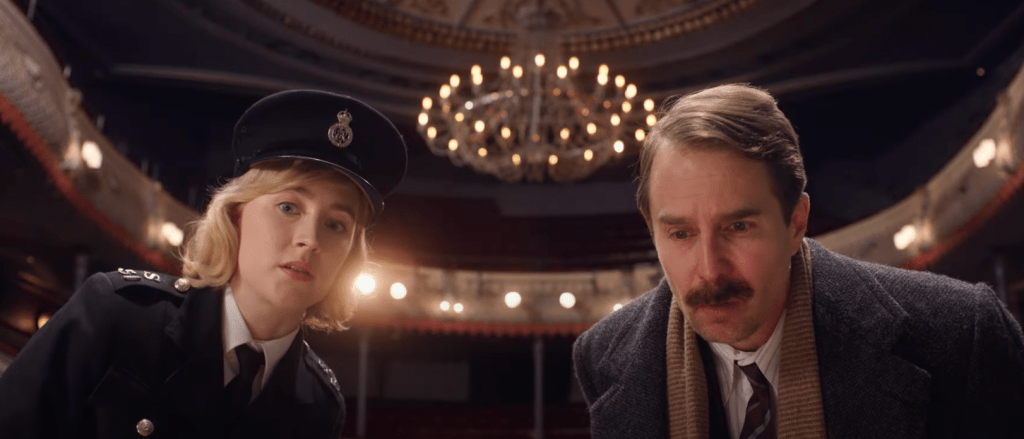
Even if some players feel a little spare, the cast is the film’s greatest asset, George bringing out hugely entertaining performances across the board. As an overly enthusiastic relative-rookie, Saoirse Ronan is especially brilliant, revealing huge reserves of comic talent that her varied career has yet been unable to showcase. Opposite her, as ostensibly the lead (but only by dint of police seniority, rather than how the film focuses its attention), Sam Rockwell does his best with the comparatively thinner part of Inspector Stoppard. The intention with his character seems to be the mounting of similar bait and switch subversion to the ending – substituting narrative cliché with a sudden surprising depth. Chappell constructs an archetypal alcoholic cop with demons, but there is comparatively little pathos to wring from the part, even in the hands of an Oscar winner. One image is devastatingly effective though, in which we see Stoppard surrounded by the jigsaw puzzles he has lovingly made, but (for reasons we later learn) no longer needs. It glimmers with a meta-irony that this professional clue-smith spends his time off making puzzles, but it also lends a film with generally low stakes with a bit more heart.

In recent Guardian feature, Michael Billington laments the film’s mangling of theatrical accuracy (for example, utilising the oversized foyer and auditorium of the Dominion and Old Vic theatres in lieu of the ‘cosy intimacy of the Ambassadors’). His claim that the theatre’s small size contributed to the play’s air of mystery and secretiveness rings true, but the film seems to tiptoe around the actual events of The Mousetrap for a fairly good legal reason; Christie only permitted an adaptation to be made six months after it closed, to conceal the solution that gave it such an allure. It is, of course, still going strong to this day. Painstaking accuracy is not the name of the game. Billington also demands to know why the ‘very engaging’ figure of Peter Saunders (The Mousetrap’s producer) has been replaced by a ‘fictive female’ (played by Ruth Wilson), which again mistakes the film’s deliberate purpose. It has been cast to be representative of the present day, rather than in line with real historical events, a fact signposted most strongly by the denouement’s use of more contemporary ideas of stolen stories. Another reason could also be to increase the realistic pool of suspects; the film would perhaps not get away with accusing Richard Attenborough of murder – even of a fictional victim.
There is certainly a frisson though in including the real John Woolf (a wonderfully spiky Reece Shearsmith), who schemes to turn the play into a film – albeit having foolishly agreed to Christie’s stipulation that production could only commence after the play had closed. The film knows it cannot spoil The Mousetrap’s distinctive mystery – though its putative uniqueness discounts its many similarities to Christie’s earlier novel Hercule Poirot’s Christmas, down to the falling snow outside. Instead, the film spends its slightly protracted second act flirting with and overplaying us a red herring solution similar to that of the actual Mousetrap play. Even for a film running to a brief 98 minutes, we feel it is too early for the real mystery to be solved, and the film plays its mislead little too straight. Though See How They Run seems keenly aware of our likely expectations for the most part, here the audience will likely be ahead of it.
In the end, the actual solution is a clever synthesis of classic murder mystery tropes, and those in the know will appreciate how its reveal rhymes in another way with the solution to The Mousetrap, without spoiling it. What weakens it though is the noticeable lack of Agatha Christie-esque clueing. Throwaway lines are crosscut in order to construct the sense of a guessable motive, even though it is the film’s editing that raises this as an option, rather than much of Stalker and Stoppard’s investigation. The film disregards the mechanics of the crime itself, and very little time is spent on establishing opportunity. It is taken as blanket fact that anyone could have stolen out and killed Brody’s swaggering film producer. The red herrings simply mislead us, rather than opening up to reveal alternative meanings, and the effect is that the twists and turns feel a little artificial. The film would not really work were it not a definitional character trait of Constable Stalker that she jumps to conclusions. Furthermore, one of the few things that could be considered a clue (albeit extremely vaguely) is offered up by the murderer themselves, for reasons that seem retrospectively inscrutable.
Without revealing too many details, the motivation concerns the actions of Agatha Christie and the play’s producers, who utilised a real story of child abuse perpetuated in the 1940s as a basis for the plot of The Mousetrap. (No stranger to weaving fiction from the headlines, Christie had previously found inspiration for Murder on the Orient Express in the kidnapping and murder of aviator Charles Lindbergh’s baby in 1932.) Seghal warns that the effect of defining a character’s identity in terms of trauma can be reductive and ‘totalizing’. To complain of this in a murder mystery seems glib, given how puzzle-like the genre can be, where motive (with opportunity) count for everything. Yet the role of the murderer is consciously defined by little more than the character’s trauma here. Like most of the suspects, the role is impeccably performed – before and after the reveal – by a terrific actor, who elevates their fairly brief material superbly. Yet, as a searching study of stolen trauma, it remains largely undeveloped. Could this be one such case of what Sehgal calls ‘evacuate[d] personality’? In fact, while the motivation is clever and subversive for the mystery form, it does not fully transcend the cynical exploitation it criticises. This is hardly a wholly sympathetic portrayal of a real-life victim both of abuse and commercial artistic exploitation, but another commercial artistic project which utilises real trauma – a thorny irony of which the film is surely aware.

It spoils only a minor surprise to reveal that Agatha Christie herself makes an appearance at the film’s climax. (In the film’s promotional material, she is billed simply as ‘The Dame’.) In a neat subversion, the murderer is the one who has rounded up the suspects for the denouement, by sending them fake invitations to Agatha Christie’s home. Christie is an interesting figure for such a narrative, given not only that she drew on real cases but that her disappearance in 1926 generated its own share of exploitative media interests and narratives. Yet the film declines to explore any parallel to this, instead casting Christie (Shirley Henderson) as a semi-heroic, semi-maniacal figure, dispensing narrative – if not ethical or moral – justice with a startling ferocity.
Perhaps the film is therefore intended as an extended meta-comeuppance for the characters’ willingness to exploit a tragic story for profit. Suffering the comparatively smaller blow of highly caricatured (mis)representation here is maybe fair game. Michael Billington’s chagrin might be part of the point. Do these people have an automatic right to realistic and accurate representation anyway, as the characters themselves argue? Yet See How They Run’s irreverence comes from a place of deep love for its source, generously (though perhaps contractually) obscuring the play’s famously secret denouement, even as it tips winks towards it. The film’s title refers to a Philip King comedy, whose title in turn comes from the nursery rhyme ‘Three Blind Mice’ – which was The Mousetrap’s original title. Further thespian references are sprinkled across the script, including a pun based on Tom Stoppard’s play-within-a-play mystery The Real Inspector Hound. It even ends with Inspector Stoppard asking us not to spoil the film, drowning out the end of The Mousetrap play on stage.
The brief debate See How They Run raises boils down to a violent killer’s brief pre-death self-advocacy, followed by an only partially convincing retort from Christie that writers should be allowed to write what they like. Yet this uses the wider struggle for the freedom of expression of the censured and oppressed as a clumsy shield for a specific instance of arguably misused power. The film enacts minor literary revenge by parodying Christie as fundamentally bloodthirsty, writing murder novels as psychological outlet for violent impulses. At a pivotal moment, she has to be told to stop bludgeoning a body with a snow shovel, Henderson’s eyes burning with rage and vengeance as an inner bloodlust is shockingly revealed as she stretches the definition of self-defence to (and beyond) its limits.
Overall, See How They Run feels caught a little between tones. It is not quite the gag-a-minute rat-a-tat comedy it could be, like some of its most notable antecedents (such as the pun-riddled delights of Hot Fuzz), though does it land some great laughs. Nor does the solution feel fully explored – a clever idea for motivation twinned with relatively pedestrian mystery mechanics and police plodding. You wonder if there is a funnier comedy, a more intense drama, and a sharper mystery waiting in the wings here, though it remains a delightfully theatrical treat.
See How They Run
Directed by Tom George, Written by Mark Chappell, Produced by Damian Jones and Gina Carter, Cinematography by Jamie D. Ramsay, Edited by Gary Dollner and Peter Lambert, Music by Daniel Pemberton, Starring Sam Rockwell, Saoirse Ronan, Adrien Brody, Ruth Wilson, Reece Shearsmith, Harris Dickinson, David Oyelowo, Charlie Cooper, Shirley Henderson, Pippa Bennett-Warner, Pearl Chanda, Paul Chahidi, Sian Clifford, Jacob Fortune-Lloyd, Lucian Msamati, Tim Key


 Joshua Robey