Categories
theatre

Much Ado About Nothing – National Theatre, Lyttleton

Katherine Parkinson in Much Ado About Nothing

Much Ado About Nothing, Shakespeare’s early entry into the now-perennial genre of the rom-com, is a knockabout comedy driven in both drama and humour almost entirely by rich character motivation rather than coincidence or contrivance. It contains perhaps Shakespeare’s greatest pair of lovers as leads and has more sophisticated wit than most of the other happy comedies. In A Midsummer Night’s Dream, Shakespeare celebrated marriage in the joining of couples who seemed desperate to marry but were prevented by strict laws. Much Ado internalises these restrictions, making it unusually psychological for a comedy, as Beatrice and Benedick insist on their lack of interest in – and even opposition to – the institution of marriage, only to be undone by love. Yet beneath Shakespeare’s idealising of marriage as an expression of romantic love, there simmers a darkness that can be hard to overlook in the way men treat women.

It makes perfect sense to stage Much Ado as a light-hearted show as a tentpole of a summer season, and the National Theatre have done so in their Lyttleton auditorium this year with Simon Godwin’s delightful production. The Sicilian setting of Messina is now the Hotel Messina, a glamorous resort for the rich and famous (this Beatrice is a starry actor), which invests the production with a sense of holiday detachment. The shadow of the war from which Benedick, Don Pedro and Claudio have returned is rather faint here, bar the umber combat fatigues they wear in the first act and Benedick’s soon-trimmed stubble. By contrast, Christopher Luscombe’s pair of 2014 RSC productions, Love’s Labour’s Lost and Much Ado About Nothing (there titled Love’s Labour’s Won), were set in a melancholy Edwardian England, either side of the First World War. Here, the 1930s is treated as an aesthetic, rather than a time of particular political significance. The conflict is an unspecific one used as little more than set dressing. Instead, Godwin focuses on the ‘merry war’ of words in the waspish relations of Beatrice and Benedick. All of the drama is simply interpersonal.

But what interpersonal drama it is. John Heffernan and Katherine Parkinson are brilliantly cast as the play’s famous lovers in denial. Neither of whom can summon the courage to make the first move, shielding their interest in the armour of mutual dislike. They tie themselves in Gordian knots, philosophically opposing marriage in the strongest terms. Benedick in particular disavows the notion of marriage as anathema to his fiercely independent spirit; to marry would be to submit to state of perpetual boredom that means you ‘sigh away Sundays’ in lieu of meaningful entertainment. Yet his obsession with not marrying is apophatic, pointing to the deep desires he is not yet ready to admit. He would only ever countenance marriage if a woman managed to have ‘all graces’ – ‘fair’, ‘wise’, ‘virtuous’, ‘noble’, ‘of good discourse’. (Here, Heffernan’s reading of ‘and her hair shall be of what colour it please God’ alters the original meaning that it may not be dyed to make Benedick seem more endearing; as long as she has all such qualities, he says, her hair colour is irrelevant.) Benedick constructs an elaborately reasoned logical house of cards for why no woman would ever be fit to marry him, yet it comes tumbling down with the play’s most touching romantic cadence, as Benedick realises that there is one woman who fulfils, even transcends, his criteria after all.

Getting Beatrice and Benedick, ostensibly the play’s main characters, to confess their latent feelings is debatably the A-plot, though it is Hero’s story which has the most plot significance and drama. Benedick and Don Pedro’s young soldier friend Claudio wants to marry the hotel-managing Leonato’s daughter Hero, though he is too shy. Therefore, Don Pedro sets out to woo her on Claudio’s behalf. Yet a rift between Don Pedro (Ashley Zhangazha) and his brother Don John (David Judge) threatens to break everything apart. Don John initially lies to Claudio, that Don Pedro is secretly wooing her for himself, yet this is lie is resolved with relative ease – though the trustworthiness of Don John remains undisputed. Thus, Don John confects a new rumour: that Hero is having an affair. Don John is a forerunner of Iago, albeit without the charm. He does not recruit our sympathies like Shakespeare’s tragic villain, and nor is he successful in steering the course of the play towards his intended tragedy – though for a time it seems like tragedy has occurred, for some of the characters. Yet Don John unleashes the play’s other great psychodrama (alongside Beatrice and Benedick’s mental prisons that restrain their love) – a fear of infidelity. To be married is to risk being cheated on. The horn imagery of cuckoldry is frequent in dialogue, even in Benedick’s celebratory lines at the very end: ‘there is no staff more reverend than one tipped with horn’.

The play is proof that tragedy and comedy is all about perspective, the final acts playing like a perspective trick in which most characters believe Hero has died from the shock of false accusation (a similar fate as befalls Hermione in The Winter’s Tale, and from which she also appears resurrected). Meanwhile, the audience share the knowledge of Beatrice, Benedick and Leonato – that Hero’s death is faked, while Don John’s lies are investigated. The restoration of Hermione in The Winter’s Tale could be viewed as a second go at the Hero resolution, with more artful stagecraft. Here, there is the business of marrying a suddenly remembered sister, a messier series of events that leaves Hero as a largely speechless bride.

John Heffernan and Eben Figueiredo in Much Ado About Nothing

For the most part, the production’s tone is utterly blissful, the verse delivered lightly (especially well by John Heffernan, who seems in his element here). It takes a lot of skill, on the part of actors and crew, to make Shakespeare look this easy. The more challenging or outdated pockets of Shakespeare’s language are never allowed to get in the way of the entertainment, any unfamiliar phrasing smoothed over by the brisk pace. As a result, a relatively low percentage of the laughs come from the original wordplay, yet this Much Ado has a somewhat more sophisticated take on Shakespearean comedy than simply padding out the play with anachronistic ad libs. Instead, almost every scene is invested with a potent sense of situation. Anna Fleischle’s wonderfully revolving set evokes the bustle of a busy hotel during peak holiday season, while also helping to place every scene in a specific location, inside or out, rendering the comic flights of fancy far more particular than just zany interludes to spice up the script.

At times, scenes are composed of two elements, relatively simplistically juxtaposed: Shakespeare’s original words and unrelated physical comedy. This is particularly notable in the scene where Dogberry, now the hotel’s security guard rather than the Constable of Messina, delivers pompous instructions to his juniors before sitting (as we know he inevitably will) onto a piled-high plate of spaghetti bolognese that has been inexplicably present on stage since the beginning of the scene. The scene progresses hilariously as his assistants try to clean the residue of Chekhov’s pasta off his trousers while he remains continues to speak obliviously. The original script here is conspicuously, deliberately secondary in importance. In the Dogberry scenes in particular, entertainment is the highest priority.

Other moments utilise random comic business to heighten not only the humour but the characterisation of the play, such as the mirrored scenes in which Beatrice and Benedick overhear that the other has confessed love for them in secret (in rumours set about by the matchmaking Don Pedro). Benedick’s is a particularly funny sequence; he cocoons himself in a hammock to eavesdrop but falls painfully onto the ground below on hearing of Beatrice’s alleged affections. He then clambers across the set to listen, before secreting himself in an ice cream cart to overhear more closely. In a sequence of pure farce, Don Pedro, Claudio and Balthasar help themselves to ice cream – in the full knowledge that Benedick is hidden inside the compartment now revealed to be the cart’s built-in rubbish bin. They gleefully spoon ice cream and shower sprinkles onto Benedick, while remarking on how strong Beatrice’s love is. At the end, Benedick emerges through the bin’s hole, streaked with residue and trying to remain composed – an extremely effective comic sequence, even if Shakespeare’s hand is nowhere near it.

Godwin directs something similar for Beatrice in the following scene. However, the ice cream routine is understandably hard to top, and he is hamstrung a little bit the order of the play. Comic logic would dictate then that the funnier Benedick scene goes second. The enjoyable clowning of the Beatrice scene is entertaining (she ends up entangled in a beach changing tent, adopting the uniform of a passing porter), but it is not quite as viscerally amusing, lending it a slightly repetitious sense of anti-climax. It is unfortunate, but largely the case, that in this production the men are allowed to get the biggest laughs – both from their wit and their humiliation.

Ioanna Kimbook, Celeste Dodwell, Katherine Parkinson and Phoebe Horn in Much Ado About Nothing

The thinness of the female roles is felt noticeably in Ioanna Kimbook’s performance of Hero, which exposes the writing’s limitations, as many strong actors’ interpretations of Shakespeare’s female parts do. Kimbook wrings as much emotion and nuance as she can from a part that asks only that Hero is charmed into silence and then victimised. Particularly good are the scenes where Hero is enlisted into misleading Beatrice. Hero coolly intones about Benedick’s apparent affection for Beatrice, while getting hugely and hilariously frustrated at her companion’s unconvincing woodenness.


This production struggles to sell the romance with Claudio though. Eben Figueiredo plays him as fairly meek at first, which is pretty much as Claudio is written, youthful and shy, but this makes Hero seem even meeker in her silent delight at the match. The intention seems to be for a sweetly dorky union of two shy people, Beatrice’s meta-joke ‘Speak, count, ’tis your cue’ followed here by a comically protracted silence. Neither can find the words, at least in public, and the silence can only be broken by a kiss. Yet the result makes both characters seem a little too dramatically inert, Hero so unknown to us at this point that her silence is hard to read as either being overwhelmed with love or full of uncertainty and reservation. The first act is the production’s weakest (and possibly the play’s too). The substitution of Don Pedro’s villainy (in the mistaken belief that he is wooing Hero for himself) for the real cruel intentions of his brother Don John later on could be a highly dramatic tale of the psychology of betrayal – central to the play’s themes of misbelieved rumours, for good and ill, and adultery. Yet it plays out here as an unfortunate longueur in this otherwise snappy take, delivered with not quite enough dramatic intensity.

The other point at which the production comes a little unstuck is at the dramatic peak – the apparent revelation that Hero let in a gentleman at her window during the night before her wedding, revealed only during the ceremony itself. Claudio has been cruelly tricked by Don John and his associates (he mistook Margaret and her lover for Hero), but that cannot excuse the ferocity of his response – nor that of every male character in the play, bar Benedick and the good-natured friar, who discovers he will not be marrying anyone that day after all. It is, of course, in the original play, but the lightness of Godwin’s interpretation elsewhere cannot be easily squared with the torrent of pure misogyny unleashed into the play, which would feel unnecessarily cruel even were the accusations true.

The convivial Leonato has until then proved to be a warm and gentle father, blunting any of suggestions that the match of Claudio and Hero was arranged against her will. Yet now he turns into a toxic combination of Egeus (Hermia’s cruel father from A Midsummer Night’s Dream) and Leontes (the jealous king who flies into a rage, wrongly suspecting his wife Hermione of adultery in The Winter’s Tale). Leonato wishes his daughter dead, Rufus Wright playing the anger in a serious, violent register: ‘Death is the fairest cover for her shame that may be wished for.’ Patriarchal anger is certainly a valid tone to strike when staging Shakespearean comedy – which is often filled with dark, violent and threatening moments. However, it seems fundamentally jarring with the earlier tone of playfulness and even more so with the relative ease with which the play’s tensions are resolved. It is hard to feel that all can be simply and immediately forgiven – with either father or fiancé – especially as Hero has so little agency in the play’s ending, treated like a prop who can be summoned at will to complete the marriage as if nothing has changed.

The text itself gives only scant acknowledgement to the mountain that must be climbed to resolve the animosity of Claudio in particular. Claudio strikes a tone of attempted amity, but he misdirects the apologies towards a father who has just condemned Hero as strongly (believing Hero to be dead). Figueiredo impressively delivers the speech where Claudio asks him for forgiveness, diverging from Shakespeare, who has Claudio plead his innocence – saying ‘sinned I not, But in mistaking’. Figueiredo’s phrasing instead emphasises contrition over his technical (and extremely dubious) innocence. Godwin tries to enrich Hero’s meagre portion of lines by amending the script with lines from Shakespeare’s Sonnet 29, which she intones from under a veil at the funeral procession being held for her. The line ‘Like to the lark at break of day arising from sullen earth’ takes on the spinetingling register of resurrection, as she will seemingly rise from the grave in the next scene. Yet its deployment is largely to paper over the text’s utter silence on whether or not she still loves Claudio. Godwin’s answer is that she does, even if we can barely see why.

It is also curious that Shakespeare presents such an unusually brisk resolution. The final scene runs to only 120 lines and contains the unions of Hero and Claudio, Beatrice and Benedick, and the entreaty that Don Pedro ‘get thee a wife’. The equivalent scene in Twelfth Night runs to 400 lines, Measure for Measure almost 550, while Love’s Labour’s Lost closes with the longest single scene in Shakespeare – a notorious 900 lines (over a third of the entire play). While Much Ado has somewhat less ado to remedy in the final scene (in terms of pure plot mechanics at least) than any of these plays, there is perhaps a greater deal of emotional complexity to deal with. Shakespeare seems to sidestep the difficulty of emotionally rehabilitating Claudio and Hero’s marriage; instead, he makes it work only practically, in securing Leonato’s consent. Hero’s willingness to marry and her forgiveness will always be an issue for a director of the play to negotiate, and Godwin’s decision to play it relatively straight (bar the added sonnet) does not fully assuage our potential concerns.

The show closes with a joyous musical number, performed by the entire cast and the jazz band who pop up charmingly throughout. No notes of melancholy remain; all is forgotten by the characters on stage, but whether we can forget is quite another matter. The tone is so fantastically calibrated for the most part – Heffernan’s attention-seeking impishness mixing particularly well with Parkinson’s blend of ice and acid. Yet the limits are exposes in the Hero plot. The recurring issue of whether Shakespearean men deserve forgiveness is hardly improved by going so unacknowledged. Despite this, Godwin’s production channels its actors’ brilliant chemistry into one of the most entertaining and watchable Shakespearean comedies I have ever seen, even if this comes at the cost of the overlooking play’s more challenging darker depths.

Much Ado About Nothing

Written by William Shakespeare, Directed by Simon Godwin, Set Design by Anna Fleischle, Costume Design by Evie Gurney, Lighting Design by Lucy Carter, Movement Direction by Coral Messam, Composition by Michael Bruce, Sound Design by Christopher Shutt, Fight Direction by Kate Waters, Associate Set Designer Cat Fuller, Music Associate Lindsey Miller, Company Voice Work by Jeannette Nelson, Staff Director Hannah Joss, Dramaturg Emily Burns, Music Direction and Guitars played by Dario Rossetti-Bonell, Drum Kit played by Shane Forbes, Upright Bass played by Nicki Davenport, Woodwind played by Jessamy Holder, Trumpet played by Steve Pretty, Starring Katherine Parkinson, John Heffernan, Ioanna Kimbook, Eben Figueiredo, Rufus Wright, Ashley Zhangazha, David Judge, Phoebe Horn, Wendy Kweh, David Fynn, Al Coppola, Celeste Dodwell, Olivia Forrest, Ashley Gillard, Brandon Grace, Nick Harris, Kiren Kebaili-Dwyer, Marcia Lecky, Ewan Miller, Mateo Oxley
Production Photographs by Manuel Harlan
Reviewed 23rd August 2022
Categories
theatre

The Father and the Assassin – National Theatre Olivier

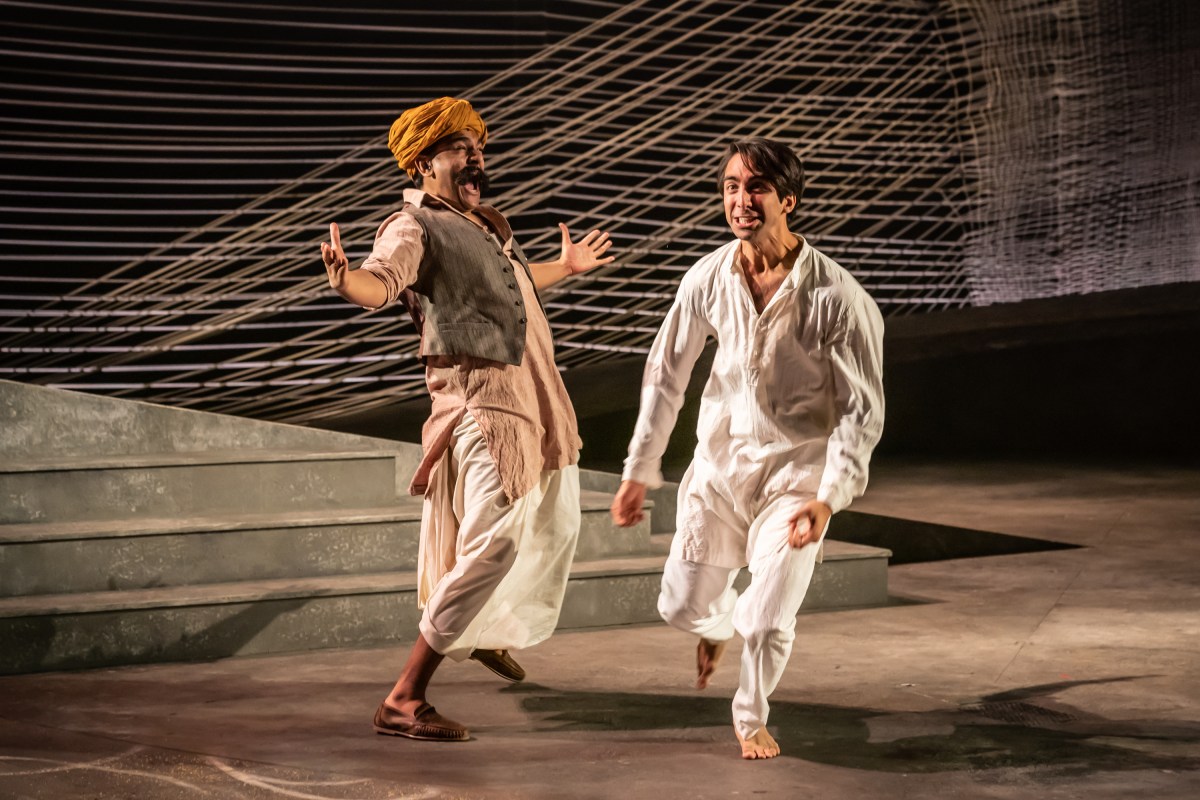
Nadeem Islam and Shubham Saraf in The Father and the Assassin

Generally speaking, for a theatre equipped with such a muscular infrastructure (physical, in the stage revolves and fly floors, and creative, as Britain’s national theatre), the Olivier has a lower hit rate than one might expect for new plays. The sheer size of the auditorium is a potential struggle; most stories, through little fault of their own, would simply not be big enough to fill the space. Yet here Anupama Chandrasekhar has found the alchemical mixture required, delivering a sharp script which is matched by Indhu Rubasingham’s brilliant production and Shubham Saraf’s bravura lead performance, to create the best new play I have seen in this space.

Chandrasekhar utilises the arena-like quality of the Olivier from the off, with Saraf’s opening monologue jokingly engaging the audience (to the point of exchanging brief, gig-like chat with some stalls-dwellers) and recruiting our complicity. He accosts us: ‘What are you staring at? Have you never seen a murderer up close before?’ Saraf plays Nathuram Godse, a man about whom ‘not much is known’ (by Chandrasekhar’s account in her ‘Note on the Play’), his nervy demeanour offset by a sometimes swaggeringly narcissistic confidence. His claim to notoriety is that, in 1948, he killed Mahatma Gandhi. The Father and the Assassin follows these two characters – Gandhi, popularly known as the father of the nation, and Godse, his killer – weaving their lives together into a complex exploration of radicalisation, colonial occupation, and the ethics of violence.

Saraf carries these weighty themes with a compelling lightness, and the show is so delightful largely because it leans so heavily into comedy, as well as containing moments of sheer weirdness. From the start, Godse mocks ‘that fawning Attenborough film’ with Ben Kingsley – promising to show a stranger and dubiously more accurate version of Gandhi’s life and death, alongside his own. Godse appears to be narrating from some sort of afterlife, where – at the end – he bumps into Gandhi again. He will never be free of the man that once enthralled him, then disappointed him. Meanwhile, Gandhi was barely aware of Godse’s existence.

Ayesha Dharker in The Father and the Assassin

The play is very interested in the way in which history is inscribed. Godse’s implicit justification for holding our attention and being the subject of a play at all is that he is ‘etched in India’s history’. Yet Godse speaks to his discomfort with the moniker ‘assassin’ – ‘a word that gives the killer a high status because of the one he killed’. Godse prefers ‘murderer’, imagining himself to have gained such a status on merit. The obvious rejoinder is that, of course, his historical importance is bound up in this singular act of murder. The imprint left upon history is, for the most part, not quite so indelible though as the imagery of etching suggests. Indeed, the play stages an attempt – ostensibly by Godse himself – to rehabilitate his actions and reputation, rewriting a history that sees him only as the evil killer of Gandhi, rather than a coherent political thinker. Chandrasekhar cleverly leads us up this fraught garden path, before giving us a firm reminder of who has taken us by the hand.

Her theme is beautifully mapped out in Rajha Shakiry’s set design, the backdrop containing a vast loom in mid-weave which bears down on stage events. The right-hand part is tightly wound, the rest yet to take shape – ambiguously in the middle of being made or possibly being undone. It is a literal reference to Godse’s profession (a tailor), yet it balances the play’s presentation of the production of narrative and history as an ongoing process with the image of nation potentially about to unravel – as partition (in 1947) separates one into two. History is certainly more porous and malleable than Godse’s images of ‘etch[ing]’; the thread may be the same, but it can be stitched into many shapes and patterns by a skilled weaver.

The most interesting gesture of the play is the bait and switch that it pulls close to the interval. Chandrasekhar has written a captivating Godse, interpreted with such tremendous lightness and force by Saraf, and we follow the breadcrumbs of his inchoate political philosophy. The moral bind at the crux of the play is the danger that virtuous non-violence (or ahimsa, as Gandhi called it) will allow any authorities willing to use violence to crush you almost by default. In many ways, it is a debate between Kantian morality and consequentialism, the former sitting uncomfortably with the practicalities of revolutionary social change. Gandhi’s insistence on keeping his hands clean could lead only to more suffering; Godse argues he is giving up without the necessary fight. For most of the first half, this perspective is thoroughly and rigorously considered. The audience seems intended to share Godse’s aching frustration at Gandhi’s ineffectual moments, and though the murder we know is coming never really seems justified, we at least understand Godse’s viewpoint.

Yet his budding political zeal leads him to befriend Vinayak Savarkar, who visits the tailors where Godse works. Eventually, Savarkar begrudgingly agrees to take Godse and his friend Narayan Apte under his wing, preaching revolutionary ideas to them in a way that initially rings with a logic that, if not convinces, at least coheres – dovetailing neatly with Godse’s frustrations over Gandhi’s methods. Yet his ideas start to sound alarm bells with the suggestion that ‘we are too bloody welcoming of other cultures’. Soon after, there is a sudden jolt as we realise the true political ends of Savarkar’s thinking. ‘The Germans have it right. The key to nation building is homogeneity’, Savarkar claims. ‘One culture, one nation. The minority culture must embrace the practices of the majority culture.’ The invocation of Nazi fascism looms as a clear warning about the dangers of pursuing a Hindu nation, without pluralism. The aim is not peace or liberation, but authoritarian policing of identity.

Paul Bazely in The Father and the Assassin

The play is politically searing. It stages issues still discussed in contemporary Indian politics. In 2019, Narender Modi distanced himself from some of his party’s candidates who called Godse ‘a patriot’. Yet it also carries a more UK-specific message about how support for an imposed homogenised monoculture can lead to fascism far quicker than you might expect. The contemporariness is signalled in overt, comic references to the political presence, such as Brexit – with Godse narrating from a distinctly transtemporal and transcendental place – as well as being folded into themes which chime with undeniable relevance. This breadth of scope lends the play a real epic quality, utilising a complex history (underrepresented on the British stage) to tell a sharply contemporary story, while Saraf’s personable style ensures it remains intimate – even as Godse loses our sympathy somewhat in the second half, unable to recruit our support for his more radical, or radicalised ideas. Instead, Godse is sharply upbraided – by his family, friends and Gandhi himself, played with a commanding air of calm by Paul Bazely, on the verge of his murder – for lacking personal responsibility and failing to amount to anything. Fascistic ideas, Chandrasekhar implies, lash out at others in order to excuse the moral and personal weaknesses of the individuals who hide behind them.

A great play is rarely the last word in a conversation but a substantial step forward in a discussion with the baton passed to us by the end. Such is the case here. We are left with a challenge from Godse: ‘A Gandhi is no use to you when tomorrow’s battles are fought with deadlier weapons. No, you’ll need a Godse.’ Godse is never treated wholly as a recurring villain we must repeatedly endeavour to prevent or a necessary instrument of violence, but remains a complex mixture of zeal, anger and narcissism. Yet we should clearly be wary of believing too completely the narrative he weaves.

The Father and the Assassin

Written by Anupama Chandrasekhar, Directed by Indhu Rubasingham, Set and Costume Design by Rajha Shakiry, Lighting Design by Oliver Fenwick, Movement Direction by Lucy Cullingford, Composition by Siddhartha Khosla, Musical Direction by David Shrubsole, Sound Design by Alexander Caplen, Fight Direction by Rachel Bown-Williams and Ruth Cooper-Brown, Dialect Coaching by Shereen Ibrahim, Company Voice Work by Jeannette Nelson, Staff Direction by Gitika Buttoo, Dramaturg Emily McLaughlin, Starring Sagar Arya, Ankur Bahl, Paul Bazely, Ayesha Dharker, Marc Elliott, Ravin J Ganatra, Dinita Gohil, Irvine Iqbal, Nadeem Islam, Tony Jayawardena, Sid Sagar, Shubham Saraf, Peter Singh, Maanuv Thiara, Ralph Birtwell, Halema Hussain, Sakuntala Ramanee, Anish Roy, Akshay Shah
Reviewed 11th June 2022
Categories
theatre

Rockets and Blue Lights – National Theatre Dorfman

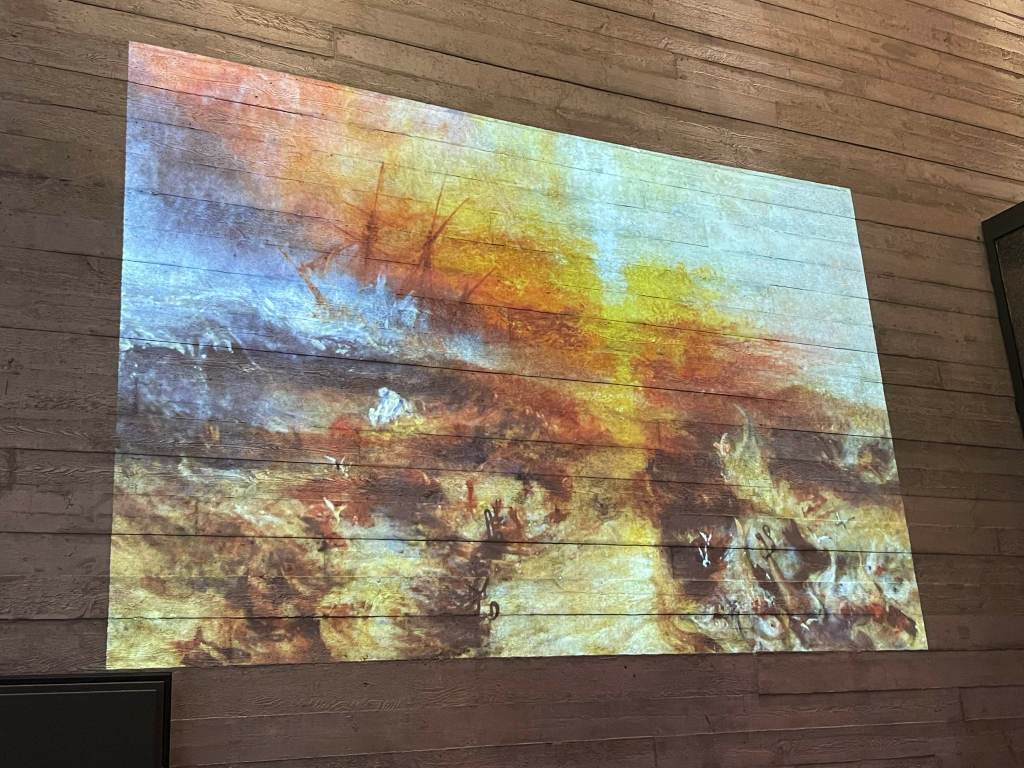
The Slave Ship (Slavers Throwing Overboard the Dead and Dying, Typhoon Coming On) by J.M.W. Turner

It is unusual for the most striking work in an exhibition to be a painting that isn’t there. However, the curators of Turner’s Modern World at Tate Britain earlier this year considered The Slave Ship (completed in 1840) to be of such significance that they made it an absent centrepiece. The painting itself is in the Museum of Fine Arts in Boston and is too fragile to travel, but the high-quality reproduction hung in the middle of the exhibition – to shocking effect.

The painting famously depicts the 1781 Zong massacre, which occurred when J.M.W. Turner was only six – though there are counter-theories that it depicts a similar, later event. When the Zong slave ship charted the wrong course and began to run out of drinking water, over 130 enslaved people were thrown overboard. The first thought of the ship’s owners, on landing in Jamaica, was to attempt to make an insurance claim for the murdered slaves. Turner’s decision to make such a scene the subject of a painting has been figured by critics (and the Tate themselves) as a sign of his growing liberal perspective, and guilt over the ways he had profited from the slave trade. The Tate contextualises the work with the fact that the ‘personal fortunes of some of Turner’s early patrons came from slavery’, while Turner himself, in 1805, ‘sought to benefit from it’ by investing ‘£100 in a proposed cattle farm in Jamaica to be worked by enslaved people.’ The venture fell through, and Turner lost his money.

The painting is also an absent presence in Winsome Pinnock’s extraordinary Rockets and Blue Lights. It is never seen on stage in any form, but the play begins with a powerful ekphrastic description of its colours: ‘Amber, gold, chrome, the darkest-darkest sea.’ Yet Pinnock is keen to show that artistic appreciation is not neutral. ‘All I could see was Turner’s use of colour, his elegant suggestion of bloodshed in a captured sunset. I didn’t think about what had just happened to those poor men, women, children. They were invisible’, Lou says. Looking is revealed not as a primordial, pre-political act, but the product of conditioning and constructed norms of artistic taste. To see the bodies, just visible in the swirling tides, Lou ‘had to look, really look’. Looking upon such a dark history can be challenging, and Pinnock seems to encapsulate the competing impulses to stare and to look away in the title of the play, which references another Turner painting, completed later in the same year – metaphorical eyes skating onto a less confronting work. The play is not merely a debate over whether Turner’s art is ‘problematic’. Instead, Pinnock asks a more profound question: how does the way we look at art and artefacts affect our understanding of history? Both The Slave Ship and Rockets and Blue Lights are projected in the Dorfman foyer as we leave, ripe for re-evaluation.

Luke Wilson and Kiza Deen in Rockets and Blue Lights

The play examines the value of compromised art in general. Lou (a terrific Kiza Deen) is an actor in a fictional film called The Ghost Ship. In it she plays the ghost of a slave, Olu, who is imagined haunting Turner as he completes The Slave Ship, inspiring him to tell her story. Yet any initial radicalism of the film project is sapped away by studio-mandated rewrites; they increasingly tell Turner’s story over that of Olu. At a readthrough of a rewritten scene, Lou is surprised to read that ‘Olu appears naked, wet’ – the nudity added only after she has agreed to perform in the film. Not only is this change manipulative for Lou, it undermines the story being told and the way the film’s audience is being invited to look at an enslaved character. The ‘wonderful material about Olu’s life before she was captured’ has been excised due to ‘cuts’ demanded by the film’s financiers, while Turner’s life has been presented in even more detail. Apparently, the audience will ‘feel cheated’ if they are not shown the reasons why Turner paints The Slave Ship. The film’s audience are invited to look on Turner as a ‘complex’ figure, where Olu is now a depersonalised, eroticised body.

When Lou threatens to walk over the alterations, writer-director Trevor responds, ‘Which would you prefer? That the film gets made, that people get to hear this story, or that it just disappears?’ Here, Pinnock encapsulates the Hobson’s choice faced particularly by Black creatives; either they can make compromised art, or no art at all. What compromises them most is, of course, money. The Ghost Ship is funded by a grant from the ‘Abolition Legacy Foundation’, a fictional organisation symbolic of Britain’s ongoing revisionism over the abolition of slavery. The existence of abolition is treated as a piece of heritage worthy of celebration, rather than a cause of shame. Yet as Pinnock writes in her ‘Note on Play’ at the start of the text, the passing of a law did not translate to the end of the slave trade itself: ‘slavery wasn’t properly abolished until around 1838, and may have continued beyond that.’

The play’s second narrative strand, set in 1840, directly examines the persistence of slavery. It fictionalises an account of Turner’s painting of The Slave Ship, in which he travels incognito on a supposedly decommissioned slave ship called ‘The Glory’ to gain inspiration for his seascapes. Yet Pinnock lends equal weight to the story of Thomas, a sailor who ends up enslaved when their voyage reveals its true purpose: illegally transporting slaves almost a decade after 1833’s Slavery Abolition Act.

Karl Collins and Paul Bradley in Rockets and Blue Lights

The structure allows for clever transitions between 1840 and the contemporary film set of a period drama. In one historical scene, Olu refuses to be fed and is punished with a whip. Pinnock directly criticises contemporary art’s all-too-common impulse to depict brutalised Black bodies, most commonly on screen. As the scene continues, it seamlessly shifts to the set of The Ghost Ship. Seemingly overcome by the intensity of the scene – or perhaps infuriated by the violence’s persistence as a trope – Lou grabs the whip and starts retaliating at her assailants. Seemingly the financial interests behind the film have encouraged Trevor to make the production grittier and more visceral, but the result is – as Lou says – ‘the usual torture porn’. Pinnock’s powerful critique attests to the power of images in our understanding of slave narratives. While diminishing the realities of historical suffering would be counter-productive, depicting violence can reify a white supremacist hierarchy. As Lou says, ‘every single lash sends a subliminal message that to be white means to have never been a slave’.

You can feel the play grappling with itself, trying to find the balance. Yet theatre seems better suited to representing such violence, compared to film’s more realist instincts. Miranda Cromwell’s production has the captor whip the ground, while Olu cries out in agony on the other side of the stage. The effect remains horrifying, but there is a symbolic separation of the undeniable historical violence of forced transportation and the real body of an actor, as viewed by an audience.

Part of the problem in representations of slavery is in power imbalance between characters; dramatizing a position of powerlessness can lead to some characters only being subjugated – and thus dehumanised. Pinnock examines this particularly in the second half of the play, in the struggle over who the main character in The Ghost Ship is. The issue is epitomised in the respective awards received by Lou and Roy, for playing Olu and Turner. He won best actor, where she was nominated for best supporting actress. Roy attempts to redress the balance, accepting his award on behalf of Lou and saying it belongs to a descendant of enslaved people rather than him. ‘By the end they were all standing up, applauding… not a dry eye in the house’, Roy recalls. Yet this is just another white man using a slave narrative to receive a standing ovation. However well-meaning, he has centred himself once again – just as his script suggestions to producers have centred Turner in the film, inadvertently (or perhaps not) tipping the balance away from Lou being eligible for the best actress award.

The play does not lose sight of the fact that Lou is still in a privileged position, though her wings have been clipped. After all, her whipping of a comparatively unknown actor is quickly smoothed over as a ‘prank’ and a ‘joke’. Yet even when elevated, she exists in the shadow of Turner (and Roy) – as the whole play does. Roy claims that ‘It’s not my film. It’s Turner’s’, to which Lou responds, ‘It is not his. It belongs to the enslaved.’

In what I felt to be the play’s most powerful moment, Pinnock suggests that what makes the world’s artistic response to slavery truly compromised is the fact that enslavement, transportation and mass killings like the Zong massacre destroyed generations of artists. ‘Among those people who drowned were artists, musicians, mothers, fathers, daughters, generations of unborn babies’, Lou says. Regardless of whether slavery art is exploitative or an attempt at commemoration, it is almost always being created from an outside view, a perspective which defines how we look at art in general. The Slave Ship ‘isn’t about our suffering’, says Lou. ‘It’s about his.’ Generations of potential artists were enslaved and killed, along with their potential descendants – thus rendered unable to express their suffering in art themselves. This is the yardstick Turner’s ‘greatness’ should be measured against.

Yet as a result of these missing stories and artworks, we are forced to consult Turner as a major source. The question of why Turner painted The Slave Ship is cleverly dealt with in Rockets and Blue Lights; the impossibility of knowing makes it hard to be definitive, and narratives such as The Ghost Ship hide the grim facts of slavery behind a cloak of mysticism. Instead, Pinnock uses the historical strand to expose the existence of slavery long beyond supposed abolition, while Turner’s guilt at investing in a sugar works is presented as fundamentally pathetic. He confesses the fact to Thomas with little real apology, only shame at his grubby little secret – for which he is only punished in the play with the ship’s custom ‘Pollywog’, a game in which the sailors momentarily simulate drowning. It hardly compares to the vast number of people drowned by slavers in the Atlantic. Thus, the painting is not treated as the final act in a grand redemption arc – like in The Ghost Ship, whose final image is of the completed canvas. Pinnock does not want us to replace our blinkered appreciation of Turner’s use of colour with a reductive analysis of his white guilt. There is nothing especially radical about repositioning him from ‘genius’ to ‘troubled genius’.

Instead, Turner’s work is valuable because of what it can tell us about a lost history – if we truly look. Writing in a feature for the Tate, Pinnock argues that ‘Slave Ship isn’t like the statue of Edward Colston in Bristol, which was erected in order for people to venerate a man who gained his wealth through the slave trade.’ The removal of a statue like Colston’s – an object of self-fashioned propaganda – is a correction to a distorted historical record, rather than destroying a source. Turner’s painting, however, is far more complicated. As Pinnock says, ‘it’s important that people see this painting, and think about what it is saying.’

Towards the end of Rockets and Blue Lights, the character Reuben presents Lou with ‘a lump of metal’, revealed to be ‘ballast [which] compensated’ for the losses of slaves overboard on Atlantic journeys. Pinnock’s stage directions indicate that Lou ‘holds it as though it is sacred’; physical objects like this take on such significance when so much information is missing. It has huge value as a record which makes slavery a semi-tangible, comprehensible thing, rather than something abstract, of the past, and from which we look away. Yet we must look again. It is too easy for us to think of the painting as the product of ‘Turner’s Modern World’, looking back on the slave trade as a historical aberration or defunct economic system. Instead, slavery was a core part of industrialised modernity – long after abolition. Whether or not British ships and sailors continued transporting the enslaved in the second leg of the triangular trade route after 1833 – and the play makes a compelling case that they did – Britain still remained complicit. The cotton Britain bought from America was not ethically neutral.

So much knowledge of the history of slavery has been lost to shipwrecks – including the estimated ten to twenty per cent of people who died while being abducted from Africa and forcibly moved to America. Laura Hopkins’ ingenious set pools with water at the end of the play. As the cast bow, the water lapping around their ankles almost suggests that the ephemeral event of the play is lost to time too, like narratives of slavery passed down only by speech, or lost entirely. Indeed, the play is set in what looks like the ruins of a ship. Yet the cumulative effect of Pinnock’s skilful dramaturgy being brought to life by a superb cast, directed with focus, care and empathy, is a play that lingers in the mind long after it ends, rather than being lost to time.

Rockets and Blue Lights

Written by Winsome Pinnock, Directed by Miranda Cromwell, Design by Laura Hopkins, Starring Kiza Deen, Anthony Aje, Paul Bradley, Karl Collins, Rochelle Rose, Matthew Seadon-Young, Kudzai Sitim, Cathy Tyson, Everal A Walsh, Luke Wilson
Reviewed 25th September 2021
Categories
theatre

The Normal Heart – National Theatre Olivier

Liz Carr and Ben Daniels in The Normal Heart

Many plays based in facts set themselves up as attempts at finding or renegotiating justice. Such plays generally contain elements of journalistically composed evidence, an indictment of the culpable, and an attempt at memorialising real victims.

These plays take many different forms and concentrate of varying scales of injustice. Anna Ziegler’s Photograph 51 positions itself as an act of restorative feminist justice, re-examining the discovery of the DNA double-helix and placing scientist Rosalind Franklin at the heart of a previously male-dominated narrative. Lucy Prebble’s A Very Expensive Poison is a factual drama (albeit with delightful Vaudevillian diversions) about the murder (indeed, assassination) of Alexander Litvinenko in 2006. The play offers itself as a self-consciously poor substitute for the indictment of Russia in the murder of Alexander Litvinenko that the UK government has refused to issue. Lucy Kirkwood’s Maryland – playing a short script-in-hand run at the Royal Court Upstairs at the moment – fuses semi-journalistic representations of (fictionalised, though very real) police failures in dealing with (and creating) violence against women with a howl of anger.

Larry Kramer’s The Normal Heart – first staged in New York in 1985 and now revived in the UK for the first time since 1986 at the National’s Olivier theatre, attempts something similar – however the play itself and this new production appear to have subtly different aims.

The play and its landmark productions are almost model cases for theatre as both journalism and memorial. The 2011 revival notably ended with a list of names projected onto the walls around the stage, echoing the original 1985 run – during which the names of the dead were written around the theatre, the audience invited to contribute more if they had them each night. The play became a living record. As Emily Garside wrote last year in The Queer Review (shortly after his death), Kramer fused ‘art and activism’. The names were documentary, an interactive memorial, and a political declaration.

Perhaps unwilling to copy the simple but devastatingly effective design choices of previous versions (and hamstrung by the Olivier’s current in-the-round layout for which this production is poorly suited), Dominic Cooke instead begins with silence. The entire cast stand on stage, whilst a flame is light. This fire burns above the stage throughout the performance, recalling the eternal flames of war memorials. It sets an appropriately sombre tone, though lacks the double intentions of the list of names – an unspecific ritual remembrance rather than a document of the crisis.

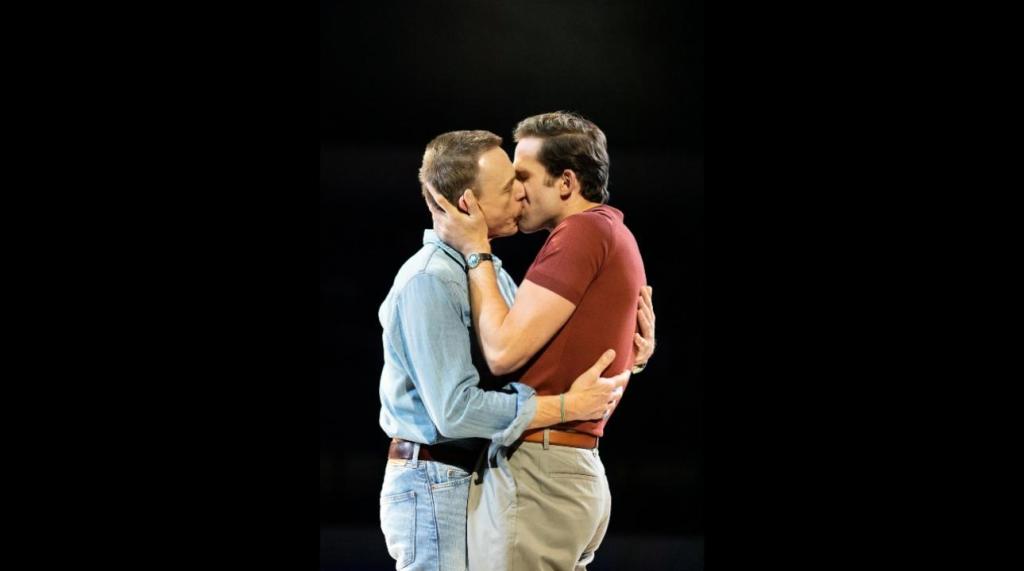
Ben Daniels and Dino Fetscher in The Normal Heart

Robert Lepage and theatre company Ex Machina’s epic production The Seven Streams of the River Ota (originally staged in 1994 and refined ever since), which played in the National’s Lyttleton Theatre in early 2020 grappled with its roles documenting and remembering the Hiroshima bombing. One of its biggest problems was its focus on victims from an outsider’s perspective. It opens with an American soldier ‘discovering’ the injuries of a Hibakusha (a survivor of the atomic bombs dropped on Japan in 1945), and this act of peering in persists across its seven hours.

One of the play’s best ‘streams’ (the play is constructed from seven interwoven sections) foregrounds an American man, living with AIDS in the 1980s, choosing euthanasia as a quicker, more painless death. A few pages of text last almost an hour on stage, the silence leaving space for memorial. His individual death stands for many, and the audience are given time to cry. The events are not filtered through another set of western eyes.

In the penultimate stream, set on the 50th anniversary of the Hiroshima bombing, Lepage (surely deliberately) holds a minute of silence. On the face of it, this might be Lepage finally memorialising the hundreds of thousands of civilian deaths, yet the silence is held for perfunctory reasons: an interview’s film crew need some room tone for their audio recording. It is perhaps a grimly ironic enaction the western world’s failure to consider the scale of destruction and harm caused in dropping of atomic bombs. But even this sympathetic reading doesn’t quite work. Even if this moment is both memorial and critique at once, the play is relatively toothless without proper restitution. Lepage and his company produced something documentary, even at times memorialising, but which failed to apportion blame, culpability or morality to the atomic bombing in whose wake its stories unfold.

A similar problem afflicts The Normal Heart – less problematic in its first performances, during which its purpose was rather different, but concerning now. The play is not completely without critique; newspaper owners are blamed for their silence, Kramer exposes the ostracising doctors could suffer for speaking out, and Reagan hardly gets off lightly. Yet the play largely assumes the awfulness of those with political power rather than unpicking it, instead surveying the internal dynamics of a community divided in fear. The suffering is heartrendingly visceral, but the characterisation feels somewhat thin – though there are terrific turns from Ben Daniels, Daniel Monks and Danny Lee Wynter in particular. The play lionises its lead’s singular fight for gay men to take individual responsibility for their actions, and essentially give up having sex. The result is a dialectical struggle between protagonist Ned Weeks’ anti-sex rationalism and the gay liberationist perspective, which locates gay sex itself as a site of political struggle. Thus, the very act is a form of praxis. At other points, the oppositional conflict is between Ned the vocal campaigner and the public silence of the closeted. Yet this feels like it lets the wrong people off the hook. The source of the shame never quite enters the frame. Ned’s individualistic campaigning feels a little misdirected and even ill-timed amid another pandemic in which individual responsibility has been used to divert criticism from government inaction.

Perhaps what feels most unfortunate about this production is the timing. Though originally scheduled to commemorate the 35th anniversary of the play, the Coronavirus pandemic delayed its appearance and gave it a grimly ironic parallel. However, it also makes the production feel like a sometimes-odd attempt at meta-journalism. There are points where the comparison feels somewhat apposite, and others where it just doesn’t work at all. Arifa Akbar rightly notes one of the major differences in The Guardian. Ned Weeks says that ‘We are living an epidemic while the rest of the world is going on around us. We are living a war while they are living in peace-time.’

Yet parts of the play feel frustratingly generalised. What appears to have been so effective in the original production is blunted here. The list of names was both memorial and journalism, whilst Kramer clearly is asking the audience to listen and to help him seek justice. Replacing the list of names with a flame is just one way the play has become less specific. If one so wished, the flame could be read as a more sweeping remembrance for the casualties of Coronavirus, or more cynically as an empty expression of LGBTQ solidarity without any commitment to present-day advocacy or struggle.

Ultimately, as the problems of Seven Streams remind us, an act of memorial must know who it is designed for – both living and dead. Dominic Cooke’s production does present the raw horror of the AIDS crisis. The reveal of a dark lesion upon a character’s body generates a sudden, seismic shift in tone here just as a similar moment does in Tony Kushner’s Angels in America. That such a scene remains shocking rather than a formal cliché is a testament to the lack of such stories in the intervening 36 years. However, this production seems sparse, unmoored from its time period, yet also curiously dated. Is this a play remembering the tragedy of the AIDS pandemic, a rallying cry against contemporary crises in the LGBTQ community (see Hailey Bachrach’s excellent piece in Exeunt), or an attempt to understand our current circumstances living with Coronavirus? Perhaps these are the wrong questions to be asking, but the uncertainty of this production’s purpose cannot help but prompt them.

The Normal Heart

Written by Larry Kramer, Directed by Dominic Cooke, Starring Ben Daniels, Robert Bowman, Richard Cant, Liz Carr, Dino Fetscher, Daniel Krikler, Daniel Monks, Elander Moore, Luke Norris, Henry Nott, Jonathan Dryden Taylor, Samuel Thomas, Danny Lee Wynter
Reviewed 30th September 2021