Categories
theatre

Patriots – Almeida

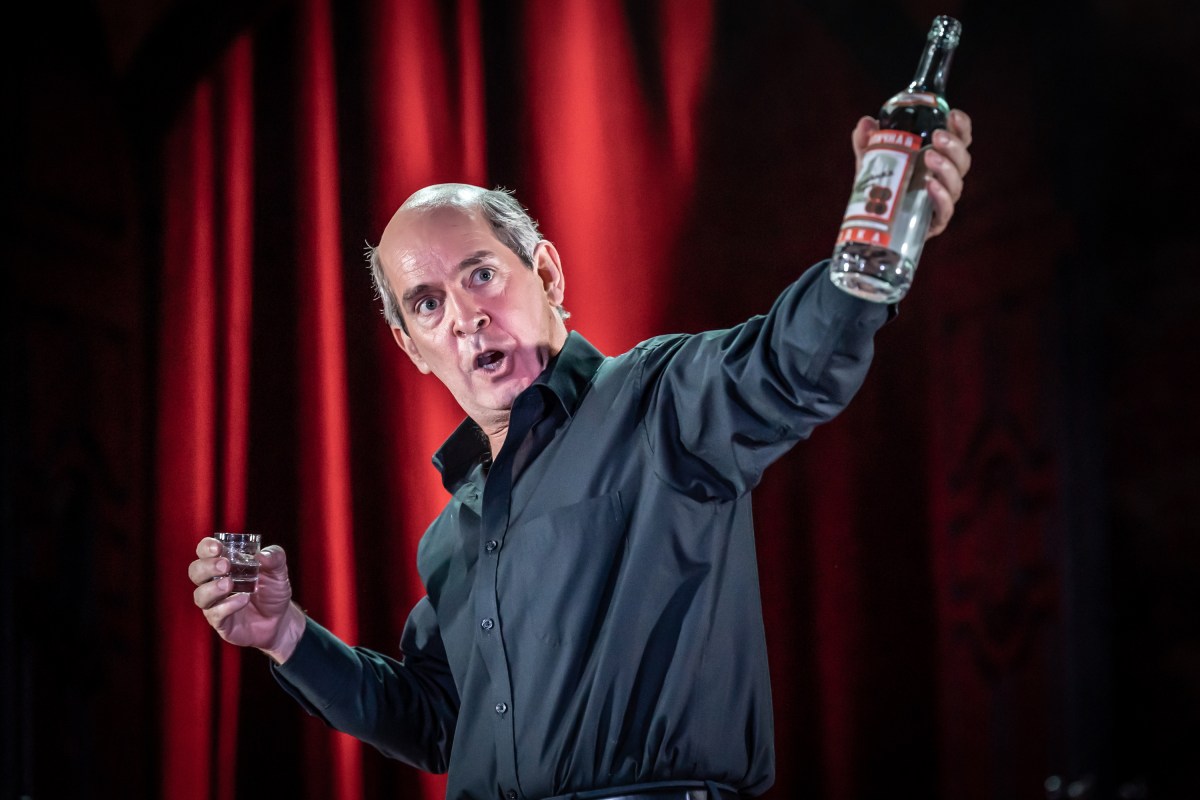
Tom Hollander in Patriots

A gifted scientist, led by infinite ambition and limitless imagination, creates a monster which grows beyond his control. Frankenstein, Mary Shelley’s 1818 novel of ambition, inquiry and overreach, has given us tropes that are now familiar. It provides a cautioning message to anyone who believes they can transcend human limitations – part-Prometheus, part-Icarus in its mythic warning. It also takes the fatal flaw which usually undoes a tragic protagonist and externalises it – an unwitting self-destruction.

This narrative shape is put to excellent use in Peter Morgan’s new historical drama, which dramatises the life of Boris Berezovsky (in this case, a gifted mathematician rather than experimental scientist) as the genius who is blind to the dangers of his own creation – until it is too late. Patriots largely operates as a biography of Berezovsky, from his early childhood (he was born in 1946) to death by suicide (in 2013). Yet by the second half, it becomes less the story of Berezovsky as the origin story of an even more significant figure: Vladimir Putin.

Tom Hollander, who seems subtly but significantly to improve everything he appears in, plays Berezovsky marvellously. He is frequently light and fun, leavening the play with delightful swings between razor-sharp focus and confidence, and bathetic notes of self-pity. His darkly vindictive side emerges on a hair trigger. Yet beneath this all, a pungent melancholy pervades his homesick Russian soul, when exiled from Russia by the very man he promoted. In flashback sequences, Hollander embodies the impishly arrogant child Boris, showing him gradually turning away from his childhood passion of mathematics and his determination to win a Nobel Prize: ‘They pay a million dollars’. (Asked what he would do with the money, he simply replies, ‘Gloat.’) Instead, Berezovsky becomes a titan of Russian commerce – one of the first big businessmen to operate there after the collapse of the Soviet Union, raring to go from the moment Gorbachev ‘permitted small-scale private enterprise.’ Berezovsky saw an opportunity and seized it, his luminous imagination envisioning the chain of events that would lead to Russia’s increasingly capitalistic economy and allowing him to prepare. He is obsessed by the infinite and limitless; ‘Ambition’, he says, as a child, ‘is the belief that the infinite is possible.’ Whether that works in practice, rather than just on paper, is another matter.

Jamael Westman and Yolanda Kettle in Patriots

Berezovsky repeatedly cites his degree in decision making mathematics – especially as leverage in business deals. He can tell them, with scientific confidence, that they are making a good or bad choice. Yet Morgan seeks to expose how complex calculations can go awry when mapped onto real, unknowable people. Morgan and director Rupert Goold withhold just enough from us that a chance encounter in Act One Scene Six crackles into life with sudden realisation and humorous surprise. Attentive viewers will already realise that the Deputy Mayor who Boris is unable to bribe is Vladimir Putin, but it is easy to miss his identity – particularly as Will Keen plays him with a powerful anti-charisma, at first, softly spoken, austere and seemingly banal. Held back as a sudden shock is the revelation that the ‘kid’ – in Boris’ words – who he is reluctantly meeting is Roman Abramovic, known for his regular press coverage as the former owner of Chelsea FC. Morgan stages their meeting as a deliberate jolt; ‘Roman Abramovich. Vladimir Putin,’ says Berezovsky in a mutual introduction which hammers home just how timely this drama will be. The bit players are soon to become protagonists in their own stories. Meanwhile, Berezovsky is unaware of the potent dramatic irony as we see his inevitable downfall in the mere presence of the apparent inferiors who will outgrow him.

Abramovic is played as magnificently bashful by the brilliant Luke Thallon, who shone recently in Camp Siegfried and After Life, as well as the Almeida’s original 2017 production of Albion (also directed by Goold). Like Putin, Abramovic is another Russian of immense geopolitical significance who Berezovsky appears to create. He acts as a ‘Krysha’ to Abramovic, an almost familial relationship, a form of business protection, support and sponsorship. The word literally means ‘roof’. In return, Berezovsky receives informal, undocumented payments – which amount to at least fifty percent of Abramovic’s profits. Morgan’s script states ‘thirty million dollars’ as the floor figure for his payment, but Goold cannily changes this to a percentage, demonstrating that this arrangement is ongoing and cannot easily be escaped.

At times, Boris carries his vast wealth and power lightly, yet he also dictates the rhythm of every conversation he is in with stunning authority. That is, until he doesn’t anymore. In a meeting with then-incipient oligarch Abramovic, Berezovsky insists on keeping jazz piano live in the background. ‘It soothes me’, he says, though it quietly irks his associate. Yet when Abramovic demands greater clarity in their financial relationship, Boris slams the piano lid shut – intimidatingly yelling at the pianist ‘SILENCE!! WHAT IS THIS IMBELIC TINKERING?! IT TORMENTS ME!!’ The message is clear: like the piano music itself, Boris can be a soothing presence, opening doors, providing a roof and making you rich, but he can also be a formidable tormentor. He will allow you to be rich, but your money is made only by his grace.

Yet this arrangement will be mirrored in Putin’s Russia, where oligarchs’ activities and interests are permitted at the leader’s behest. Will Keen completing the leading trio well, playing Russia’s future ruler as a bureaucratic presence, stiff and drained of life – albeit with an undeniably vigorous work ethic, whose power, once attained, cannot be contested. He stands in the shame-riddled shadow of his military service in East Germany (where, Boris claims, ‘they generally sent the desk jockeys, the altar boys, the softies’). Berezovsky’s claim that not being selected as a real ‘KGB man of action’ attests to him ‘as a human being’, but the remark is barbed; Morgan notes that, here, Putin looks ‘eviscerated’. Berezovsky becomes too accustomed to this power play, seeing Putin as intrinsically weak and relatively low-status – even has he elevates him higher and higher, forgetting the potential risks. When Berezovsky helps Putin to get installed as Prime Minister of Russia, he assumes that he has attained political office himself. Yet Putin is no puppet. When Boris Yeltsin – perhaps the only man in Russia Boris cannot control, but only influence – names Putin as his successor as President (on the final day of the 20th century), Putin’s power comes close to absolute.

Berezovsky watches on in horror as his power runs dry. Hollander perfectly captures Boris’ initial denial, falteringly trying to tell Putin what he must do, but there is now no need for Putin to listen. His terrorising shouts only worked when backed up with real financial and political power. The man who, in Morgan’s telling, Boris near-singlehandedly groomed for puppet governance inevitably turns on his creator – a modern Frankenstein’s monster, who forces Berezovsky into exile in London. Berezovsky’s obsession with the infinite, the mathematical concept that so fascinated him as a child and which now functions as his prevailing ideology, has led him to overlook his finite, dwindling authority. One miscalculation is all it takes to undo him and those around him – such as personal bodyguard Alexander Litvinenko, known to his friends as Sasha, who was notoriously assassinated in London in 2006.
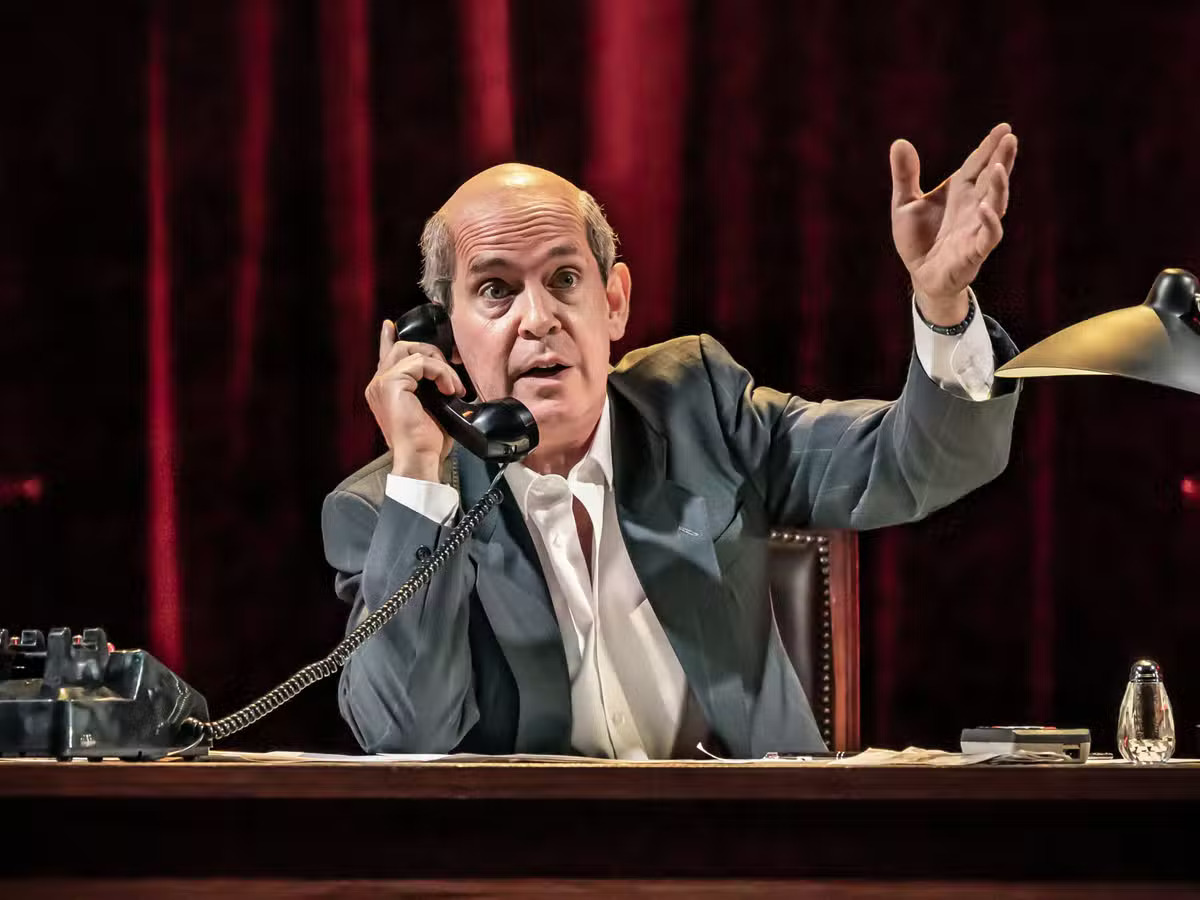
Tom Hollander in Patriots

The play succeeds in exposing us to a story we might not otherwise know, or at least only know in part. The Almeida generally programmes shows late, allowing it to be more responsive than most theatres (both to world events and its high-calibre stars’ availability). Patriots was announced in May this year, and the play has inevitably existed long before Russia’s invasion of Ukraine. Yet, while the Donmar Warehouse’s meditation of the ethics of war in Max Webster’s Henry V seemed grimly serendipitous in its coincidental programming, Patriots feels far more deliberately placed. Thus, it works as something of a documentary play, a form of almost-journalism that seeks to inform us on a subject we should know more about.

Yet, Morgan’s drama never feels too urgent in its focus, particularly compared to the last major play to tackle Putin on a London stage. Lucy Prebble’s 2019 play A Very Expensive Poison, based on Luke Harding’s book of the same name and staged at the Old Vic, examined a similar subject by focusing on the murder of Berezovsky’s bodyguard, Alexander Litvinenko, who tried to raise the issue of FSB corruption with its then-leader, Putin. Prebble tackles Russia as a sprawling and rich culture, rather than Morgan’s simpler dichotomy of eastern, Siberian wastes and the cities of Moscow and St Petersburg, where political power is concentrated. While Morgan translates history to the stage with poise and wit, Patriots does not share Prebble’s ambition and flair. A Very Expensive Poison not only documents the story of Alexander Litvinenko, but it also searches for theatrical and real-world justice – honouring both his memory and the ongoing fight for the legal inquiry which his widow Marina Litvinenko lobbied for long after his death.

Marina appears in Patriots too as a character on the fringes. At first, she accorded a sense of power by Morgan – with Boris wooing her, rather than her husband, to leave the FSB and become his personal bodyguard. Yet she is treated more like a prop in the second half – telling Boris to settle down and find a wife, synthesising her (all too real) grief into a somewhat artificial call to action for the protagonist. In a fictional drama, we might not bat an eyelid, but it rings a little hollow considering the determined, passionate advocacy and activism of Marina, campaigning for the British government to take Sasha’s murder seriously. Here, she seems to have almost given up on life, telling Boris to save himself while he can, even if it is too late for her.

In A Very Expensive Poison, Prebble mounts a sustained assault on the fourth wall, its Vaudevillian stylings capturing the sheer theatre of Putin’s regime – with Reece Shearsmith’s Putin goading the audience, heckling from the private boxes, and even giving a talk about theatre itself. He casts himself as the master storyteller (and liar). Yet the play culminates in a powerfully emotional final puncture to the fourth wall, where MyAnna Buring’s Marina asked audience members ‘How do you do’ until all the artifice fell away. ‘I am obviously not Marina Litvinenko’, she says, before Sasha’s actual words are read out for us. Prebble indicts those who she considers culpable: not just the Kremlin and their Russian agents, but the British government response. Theresa May, Home Secretary before she was Prime Minister, is quoted – denying an inquiry into the murder due to ‘the cost to the public’ – a justification that three high court judges later found insufficient. Ignorance, Prebble argues, is too great a cost. Morgan is driven by a similar impulse, but it takes him a little less far, preferring character study to direct political statements.
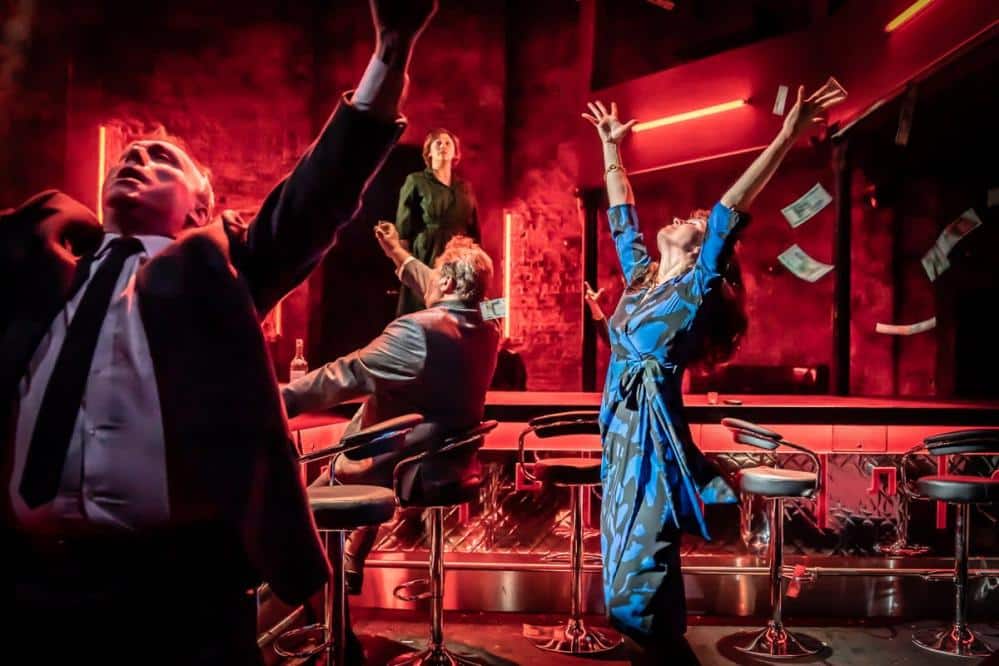
Morgan’s drama mostly addresses the question of how we got here, rather than where we can go next, but it still stands as a strong and compelling take on an underexplored subject, powered by a tremendous central performance. Rupert Goold’s pacy production delivers political thrills and at times some visceral chills, playing out on a fabulous set from Miriam Buether, drenched in Jack Knowles’ moodily red-tinged lighting.

Whether Morgan successfully captures Russia could be debated. A repeated monologue bookends the drama, in which Boris tells us that westerners ‘have no idea’ what Russia is like, listing items of clothing and food as symbolic of Russian life and culture. Yet Morgan’s gestures toward authenticity seem a little hollow. The mocking of London for being too ‘metropolitan’, for example, speaks in a cynical language familiar to contemporary British politics. The word is pejorative in current British media rather than Noughties Russia, replete with connotations of wealthy liberal hypocrisy and functioning as sweeping shorthand in the same way ‘North London’ and (the Almeida’s own borough) ‘Islington’ have done. Boris tells us that we consider Russia to be ‘a cold, bleak place, full of hardship and cruelty’, yet Patriots hardly disproves this, leaning into it at times. It is only despite (or perhaps because of) these difficulties that Russia is so loved and treasured as a home by people like Boris Berezovsky.

In fact, the effect of the opening monologue’s repetition – fashioned into a sort of fourth-wall breaking suicide note – seems unintentionally to affirm the play’s limitations. After two and a half hours, we are charged with the same ignorance we had at the start; it has apparently taught us nothing. Perhaps the implication is that our incomprehension is a condition of western-ness, not a lack of knowledge per se. Yet on the page, Morgan’s intentions for the scene seem clearer. He asks that the sound of Vladimir Vysotsky’s ‘unmistakable’ singing voice be heard, while street vendors sell pelmenyi dumplings, a visible mirage of Boris’ nostalgia – nostalgia in its most literal, etymological sense: homesickness. This speech is summoning into being the Russia that he loves, so that – in his mind at least – he can die there, rather than in a perpetual exile. Goold, however, opts to play the scene straight, without manifesting Russia before us so literally. It is a very understandable impulse of restraint here; the mental image Morgan generates likely outshines the stage action that would be possible. It feels like not much has replaced these stage directions though, giving us the sense that little has changed over the course of the play.

Ultimately, as the title suggests, the major theme of Morgan’s drama is patriotism. It is a theme that quietly underpins most of his work, given his recurring interest in the British Royal Family, most notably. His last play, The Audience (staged in the West End in 2013), examines this through the contrastingly patriotic roles of monarch and Prime Minister. Here, Morgan names his focus explicitly. As a western play looking in, you might expect it to have a greater focus on how patriotism (and nationalism) operates in British politics, though this never quite manifests beyond the occasional winking satire. (Lines about the follies of elected government generate even more knowing laughter than they usually might.) The battle for Russia’s power and its soul is not fought between patriotic true Russians and western interlopers, hellbent on bringing deregulated free-market capitalism to Russia, Morgan contends. Instead, the play depicts two opposing forms of sincere patriotism. Putin and Berezovsky’s respective motives are partly self-aggrandising, power- and money-driven, yet both consider themselves to be acting for the good of Russia. They consider themselves to be the bridge between the present and an illustrious future. Yet, tellingly, it is always the nation itself that is identified as the beneficiary of patriotic altruism, rather than its citizens themselves.

Morgan takes them mostly at face value, as earnest – if conniving – lovers of Russia. Boris pines for his home from his life of luxurious exile, and Putin refuses his entreaties to return to life a quiet (and probably not even affluent) life as a mathematics professor – motivated, it seems, by a conviction that he must protect Russia from his westernised economic and political pressure.
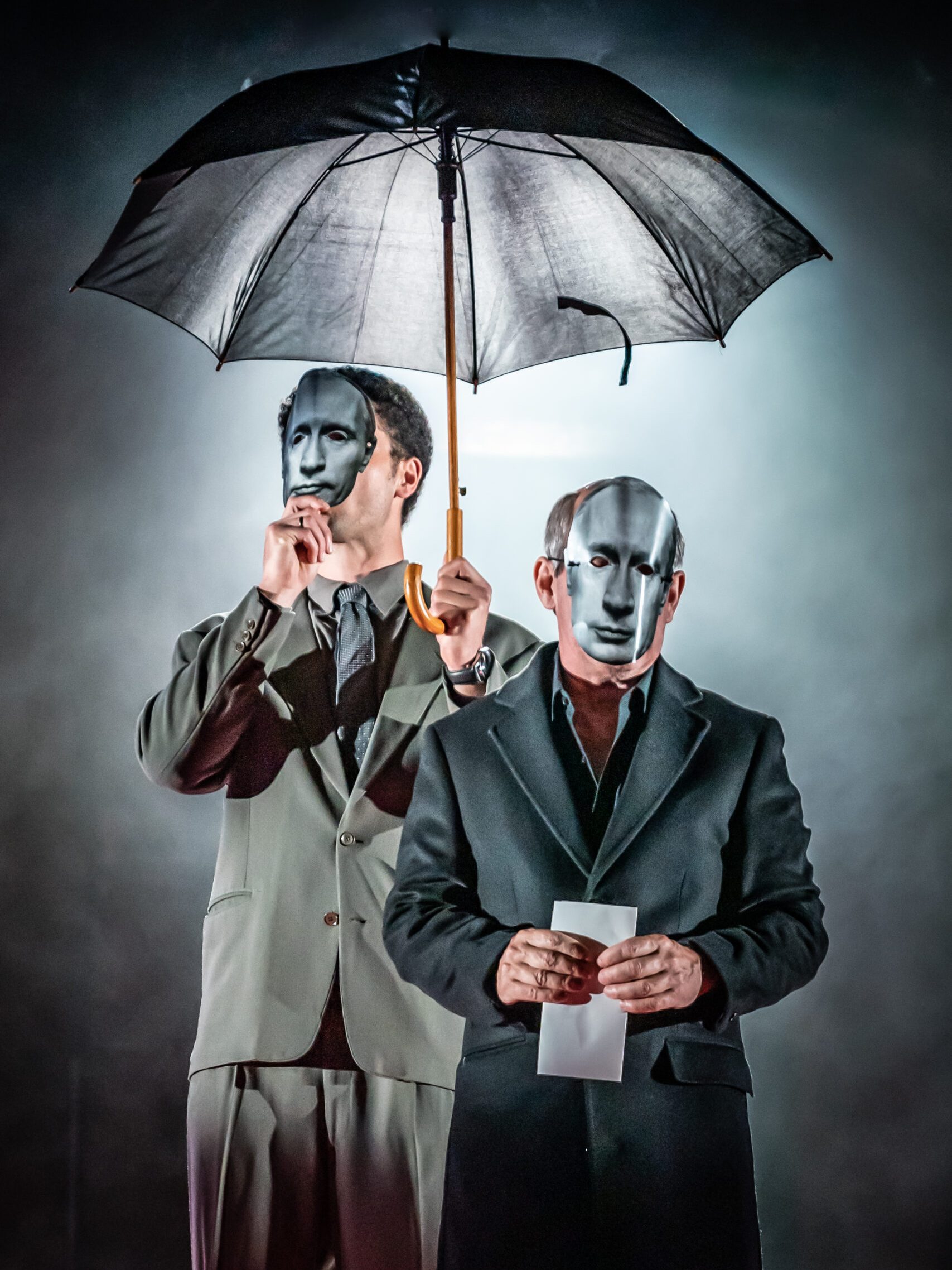
Jamael Westman and Tom Hollander in Patriots

In the second half of the play, Putin instates Abramovic as the governor of (what The Guardian calls) ‘the frozen far-eastern province’ Chukotka, six thousand kilometres from Moscow. In a March 2022 feature for The New Yorker, Patrick Radden Keefe called the province ‘comically inhospitable’ – noting that its ‘winds are fierce enough to blow a grown dog off its feet.’ Abramovic ‘pumped plenty of his own money into the region’, Keefe writes, and Morgan dramatises as fact something that is widely believed to be true: that Abramovic was very much steered into this apparently thankless role by Putin’s guiding hand. (Catherine Belton particularly advances this view in her 2020 book Putin’s People.) Though Boris may have been Abramovic’s Krysha once, in contemporary Russia, Putin acts as Krysha to all of the oligarchs. They keep their wealth only because Putin permits. Yet the scene where Putin visits Chukotka seems redolent of Morgan’s main theme; the billionaire is not only being groomed for his loyalty, but Putin appears to be testing Abramovic’s patriotism. The poverty of Chukotka is still far preferable to a life in exile elsewhere.

This is the vision of patriotism that crystallises in the drama: the pain of separation as greater than any hardships that life may contain. Berezovsky would surrender his wealth to keep his home, and Putin leverages that power against him, as Berezovsky leveraged power against others and him. Yet it is almost a moment where a vital fault line of the play is exposed; how much of what we are witnessing is true? It is another perennial concern in Morgan’s writing, and he treads a line between dramatizing facts of historical record and inventing within plausible parameters. The play bears no caveats about its level of fictionality, nor any acknowledged sources; its content does not signal (as Prebble’s gloriously absurd touches did) where gaps have been creatively filled.

In the bid to dramatise these lacunae, some moments strike false notes. The opening scene is one such example. We hear that the nine-year-old Boris has solved the Kaliningrad Bridge Problem – a traditional problem (previously called the Seven Bridges of Königsberg) in which a city’s seven bridges, connecting its various islands, must all be crossed on a single route, crossing no bridge more than once. The play as performed (but not the script) describes the fact that Euler solved the puzzle in the negative – meaning that he proved it has no solution. Euler effectively devised a new branch of mathematics in the process, and now – for mathematicians familiar with such methods – it is not too difficult a problem to solve. Unless Euler were catastrophically wrong (which he was not), solving it in the positive would be impossible.

This could just be stage shorthand for mathematical genius that contains a fairly fundamental flaw, or perhaps this is a deliberate tell, a sign that the drama is an imperfect, inherently unreal rendering of a life. The gist is true; Boris was an ambitious, intelligent man, and so too would his childhood have been. Either way, Patriots demands our attention in sifting hard fact from elegant fiction. Are we to take the characters’ claims of patriotism on trust, or should our suspicions be raised throughout? It would benefit from a little more direct admission of its inventions, but maybe fiction is what we are supposed to expect.  

Patriots

Written by Peter Morgan, Directed by Rupert Goold, Set Design by Miriam Buether, Costume Design by Deborah Andrews and Miriam Buether, Lighting Design by Jack Knowles, Sound Design and Composition by Adam Cork, Movement Direction by Polly Bennett, Casting Direction by Robert Sterne CDG, Voice Coaching by Joel Trill, Assistant Direction by Sophie Drake, Russia Consultant Yuri Goligorsky, Starring Matt Concannon, Stephen Fewell, Ronald Guttman, Aoife Hinds, Tom Hollander, Will Keen, Yolanda Kettle, Sean Kingsley, Paul Kynman, Jessica Temple, Luke Thallon, Jamael Westman
Production Photographs by Marc Brenner
Reviewed 8th July 2022
Categories
theatre

The 47th – Old Vic

Bertie Carvel in The 47th

‘Art needs time and space and reflection we can all agree on that.’

From Shipwreck, by Anne Washburn (2019)

It is a lexical quirk of the American political system that Presidents become known by their number. Trump was, and is, the 45th, Obama 44th. Joe Biden is the 46th, and – should he not run again in 2024 – we are only a couple of years away from the 47th. However, only one US President (so far) is known by two numerals. Grover Cleveland, by dint of winning Presidential office twice, separated by the Presidency of Benjamin Harrison, thus counts as the 22nd and 24th President of the USA. It is a pub quiz trivia staple and remains unique in US political history. Perhaps, that is, until 2024, should Donald Trump run successfully again.

This creeping liberal dread that Trump might emerge victorious again underpins Mike Bartlett’s The 47th. The title seems – at least before you see the play – as if it cannot bear to speak Trump’s name, referring to him by an undeserved moniker he has rendered mock-heroic. In the play itself though, it is a wry, satisfying touch from Bartlett that the title does not refer to Trump after all, but Kamala Harris. She is instated by Biden in his place as his health deteriorates, in an act that seems to reverse-mirror Trump’s own refusal to share power when ill with Coronavirus. It is a canny substitution, though in no meaningful way does the character of Donald Trump have second billing here – either on the page, or in Bertie Carvel’s scene-chewing and -stealing, magisterial turn. This is, to use language of many reviewers during his Presidency (as they did about Brexit), a ‘Trump play’.

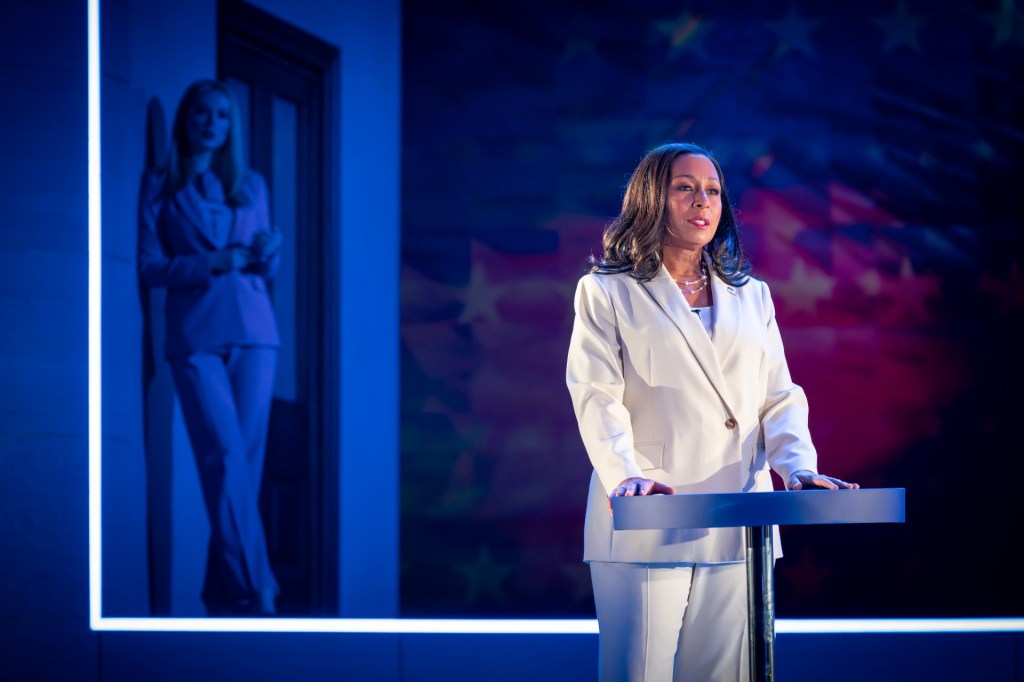
Lydia Wilson and Tamara Tunie in The 47th

The 47th seems most obviously reminiscent of Bartlett’s 2014 play King Charles III, which shares a future-history premise and a director in Rupert Goold. While King Charles III opened at the Almeida, of which Goold is Artistic Director, The 47th arrives in the much vaster space of the Old Vic – aware that a play with as zeitgeisty a subject and Carvel in such a headline-grabbing lead would attract a larger potential audience. In King Charles III, Bartlett sought out the human weaknesses and follies beneath the grandeur, tradition, and clipped rhetoric of the monarchy – unearthing the seething political opinions and ambitions that lie beneath the long-cultivated veneer of neutrality. The problem with applying the same logic to Trump is that he appears to have no filter. The thrill of seeing a protagonist soliloquising in private – one of the great attractions of Shakespeare’s history plays – is far less edifying when his every thought has been blasted across rolling news coverage. There is relatively little at stake dramatically when he so sorely lacks self-doubt – little interiority to be found. He appears to be a man whose every thought is bluntly, digressively articulated, and, though riven with contradiction, there is little actual conflict within him.

Bartlett does not seem interested in subverting this popular view of Trump here – actively tailoring his Trump to goad us. He remains the cartoon villain we expect, entering on a golf buggy and bragging to us about his achievements from the off. The main difference from the real Trump is the infusion of a greater awareness of liberal sensibilities and things he is mocked for. Trump repeatedly both-sides-ed racial violence and propagated the ‘birther’ conspiracy theory about Obama’s citizenship, yet chiding liberals for discriminating against him for the (orange) ‘colour my skin’ speaks in a liberal vernacular that seems unlikely. He claims to be an entertainer and ‘Your devil’, swearing revenge on those who have ‘exile[d]’ him from the White House and taking us along for the ride. The spirit of pantomime is deliberately alive in his words; he is villain who loves to be a villain.

I was also reminded of Anne Washburn’s wordily brilliant Shipwreck, one of the first plays (perhaps even the first) to put Trump on the London stage. Directed by Goold again, at the Almeida, this mostly portrayed a group of liberals gathering in a remote farmhouse, during a worsening storm, before revealing Trump himself – during a terrifying recreation of his ‘loyalty dinner’ with James Comey. Shipwreck’s rich poetry seemed like a space of solace – of intellectual defiance against the Trump administration, and refusing to fight his brash, name-calling rhetoric on its own terms.

Bartlett’s play too seems to hope that an ostensibly anti-intellectual problem can have an intellectual solution too – that empathy, intelligence and culture will ultimately win out – though it is perhaps less convincing. Its formal gesture seems something of a comfort blanket – not least because it is a return to a specific form, for which Bartlett was previously garlanded. Trump’s angular rhythms are strangely transposed into iambic pentameter, and there seems to be an implicit aesthetic critique that comes from the uncanny juxtaposition. Yet the problem of Trump is not merely the way he talks. Though his manner of speech is an undeniable part of his troubling, dangerous speech acts, it is far from the whole. One of the arguments implicit in Shipwreck seems to be that a liberal critique of Trump that dwells only on formal matters, rather than content is doomed to failure. As Michael Billington wrote in his review in The Guardian, it ‘does something you rarely see in the theatre: it takes Donald Trump seriously rather than as a subject for easy satire.’ The 47th attempts to rationalise the way Trump seems to be an obvious baddie – yet remains a political danger. Yet the impulse it springs from does seem too cheaply comic. What if Trump was King Lear? Wouldn’t that be funny?

Bertie Carvel’s Trump is far more accurate – in mannerism, appearance and voice – than Shipwreck’s version, played by Elliot Cowan in the original Almeida production. Yet for all his realism, The 47th gives Trump only crude malignancy, rather than active malice. Carvel’s performance is a strong recreation, but Cowan’s unhinged tyrant, bare-chested and painted gold, is a more interesting interpretation of his self-aggrandised horror.

In much of the play, Bartlett seems intent to serve up a (somewhat hollow) form of narrative justice for Trump’s actions. Trump is arrested and placed in jail, the imagery of him orange boiler-suited seems like liberal wish fulfilment, after his real-life double impeachment was exposed as functionally meaningless without Senate backing and investigations into his tax affairs have yielded little legal consequence. Perhaps inevitably given its genre of Shakespearean (future) history meets tragedy, Trump dies at the end, in a sequence fashioned presumably as an oblique comeuppance for Trump’s gutting of Obamacare. Slightly implausibly, Trump’s financial folly has led to him not even being covered by health insurance. He is given a private room in the hospital, as in jail, only for security reasons.

The second half falls into a slightly repetitive pattern, hinging on two fairly similar tête-à-têtes between Harris and Trump that buttress the drama. With such fixed positions, based on life, there is little either can gain from each other, apart from the most begrudging form of mutual respect. Elsewhere, the characters simply do not have enough depth to sustain major scenes. Ivanka (an icily composed Lydia Wilson) runs rings around her siblings too easily to create the Succession-like thrills that seem to be intended, as the Trump children jockey for position. This is compounded by Ivanka clearly being her father’s favourite. In Succession, the only daughter Shiv’s relative competence is offset by her father’s lingering preference for his sons – this dynamic functioning as the central thread of the second series. The best scenes with Trump offstage follow siblings Charlie and Rosie Takahashi, one a (Democrat-supporting) journalist, the other a Republican working for Ivanka’s Presidential campaign. The personal stakes of politics emerge in their confrontations, sibling loyalty tussling with political allegiance.

Like Washburn, Bartlett approaches Trump with a curious formal abstraction. Shipwreck is dubbed a ‘history play about 2017’ (which was first staged in early 2019), while The 47th (like King Charles III) is a future history, documenting the hypothetical events of the 2024 election. Perhaps it is because Trump seems so literal and unsubtle; speaking truth to power by simply representing a simulation of the truth won’t cut it. Instead, stepping back (or forward) allows us to observe him within a broader cultural moment.

Yet Shakespeare too, even more than in King Charles III, operates as a genre in of itself – as well as being another form of abstraction. The plot is shaped partly by real-world conjecture about a coming electoral race, combined with recognisable pastiche of Shakespearean moments. Most clearly, the play begins with Trump as King Lear – and the overall shape of Trump’s arc in the play could be (very) loosely mapped onto that character. He begins by musing on his coming demise; instead of a kingdom, he has an inheritance to divide up. Bartlett commits to a conception of Trump which is virtually indistinguishable in public and private, exacting calculated cruelty on his family and stroppily demanding each child flatters him into making them his sole heir. Don Jr. and Eric make their fawning, self-abasing arguments, before Ivanka follows the Shakespearean pattern of Cordelia and refuses to partake in his spiteful game. Instead of banishing her though, Trump remarks ‘And just like that the mic is roundly dropped. […] She had no competition.’ Inevitably – and Bartlett’s script spells out this many times – Trump is presented a monstrously inverted Freudian embodiment of the Oedipus complex – the father who wants to have sex with his daughter. She was always going to be his heir.

Shakespeare plays are often performed in large theatres. (The National’s Olivier hosts one most years, as does their Lyttleton stage.) Yet this is as much to do with the reliability of Shakespeare selling tickets (and perhaps the decline in the fashion for doubling supporting roles, and thus the need of large casts) than the quality of the plays themselves. Though the Globe Theatre has become a cultural touchstone for Shakespearean performance, his plays were often presented in smaller venues – more akin to Shakespeare’s Globe’s winter venue, the Sam Wanamaker Playhouse. There is an intimacy to Shakespearean drama that is often lost – though a great production can create this in a large space. The 47th does lack this intimacy. Partly, this could be the venue. (You wonder what the experience would have been like if Goold had programmed it in the 325 seat Almeida.) Yet there is also something remote about the characters themselves. They appear largely as they do on the news – self-possessed, even as they lose control of events. The rich, archaeological characterisation that you might expect from a Shakespearean drama is mostly missing.

Lydia Wilson in The 47th

Goold’s choice of plays to direct evinces a desire to grasp the nettle of many contemporary political issues. Albion, another Almeida collaboration with Bartlett (in 2017, and revived again in February 2020), was held up as ‘The play that Britain needs right now’ by Dominic Cavendish’s five-star review in The Daily Telegraph. Though Cavendish avoided saying ‘Brexit’ in his review, his subtext was fairly evident, and other reviewers made the connection explicit in other, largely glowing write-ups. Yet even this allegorical drama about restoring an English garden to its (apparent) former glory was designed with a structural abstraction – utilising an overtly Chekhovian structure, with four acts (one for each season), and an ending redolent of The Cherry Orchard.

Sometimes this impulse towards political (or at least politicised) drama has been misjudged. Ava Wong Davies’s brilliant review of The Hunt for Exeunt perfectly captures the tension between admiration for Goold’s typically compelling direction and deep unease at its implications, by scripting a conversation between a defending voice and a detracting one. Dramatizing the descent of a teacher, who is falsely accused of sexually abusing a child, I think that play (an adaptation of Thomas Vinterberg’s 2012 film) likely stemmed from an impulse of exploration, rather than apology or excuse for abusive male behaviour, keen to examine how public opinion is formed and how it shifts. Yet the underlying unlikeliness of the plotting and the political context of high-profile allegations as part of #MeToo made it seem a deeply reactionary piece of theatre, unfortunately placing sympathy squarely with the accused rather than the abused.

The 47th seems to emerge from a similar nettle-grasping political drive, yet the results seem fairly modest. Though most of my detractions are with the script, the production too lacks Goold’s usual fast-pace and flair. The costuming and prosthetics that produce Trump before us are hugely impressive, yet the rest of the design underwhelms a little. Miriam Buether, who designed such a gorgeous garden set which changed with each season in Albion, here channels the marble of the White House and the shape of the Oval Office, in a two-tier set. Unfortunately, it gets caught between naturalistic and stylised aesthetics though, and ends up feeling slightly visually bland. (Her latest collaboration with Goold, Patriots at the Almeida, is a triumph.) Enlivening the space, however, is Neil Austin’s use of light, which generates a palpable menace in scenes with QAnon – Buether evoking the horrifying aesthetic of the January 6th Capitol rioters.

Bartlett’s drama operates as both future prediction and post-mortem, willing into being the end of the Trump story. By contrast, Shipwreck is less about the political events of 2017 itself as liberal hypocrisy (‘There’s a little bit [of money] offshore’, one character admits) and handwringing as American culture adjusts to its new President. Washburn even refers to the trend of dressing up Shakespeare for different political occasions, as a way of coping with the uncertain moment. One character describes ‘that Shakespeare in the Park thing’ where ‘the man who plays Julius Caesar has a weird orange blond wig, […] and in the end he’s assassinated by a lot of brown people’. The production did happen – directed by Oskar Eustis – and was repeatedly interrupted by right-wing activists calling for an end to ‘political violence’ against the right. Yet despite their claims, reinterpreted Shakespeare can hardly be called violence, and there are clear limits to its effectiveness as resistance too. Shipwreck captures the ineffectualness of most art in its attempts to hold power to account. Instead, such productions are more a form of political therapy – giving the illusion of engagement as a substitute for meaningful (and potentially dangerous) political action. Another of Washburn’s characters responds ‘how are we finding a way to process all of this thoughtfully [and] is Shakespeare any kind of answer? Is Shakespeare really relevant to the current day?’

Washburn’s questions seem fascinatingly apt to The 47th. Shakespeare, her characters debate, is both a second choice and the only option; ‘I think they’d use a contemporary play only there isn’t one’. There is no drama ‘about this exact moment’, so old stories must be re-dressed for the occasion. Bartlett attempts to square the circle – drawing on Shakespearean heft with a drama about the coming moment, as the present one is arguably too ephemeral to bottle. Another voice chimes in: ‘Why don’t we just give up already, why don’t we give up and agree that plays are never going to be about the current moment and they shouldn’t be about the current moment. Plays are about the Eternal moment, yes?’ The claim that plays are expressions of universal truth is not entirely convincing, and I don’t believe Washburn expects us to agree with such a sweeping statement, but the eventual point at which this discussion comes to rest seems fair: ‘Art needs time and space and reflection we can all agree on that.’ Yet The 47th seems oddly airless, without this space. Bartlett has not (yet) described how the play came into being – whether it was part-designed to coincide with the 2020 election, before Covid cancellations hit, perhaps. Yet though the gesture of reflection – in this case looking into the future – is present, there is a sense that time and space are not.

Ultimately, while The 47th sees Bartlett returning to the writerly instinct that generated King Charles III, for Goold it seems more of a return to Shipwreck’s idea space. Washburn’s play is thornier – its problems less reducible to one man or one set of circumstances. Its problems are elemental – evoking her earlier play Mr Burns in its gesture of gathering characters around a campfire to tell stories in the dark. In its mythologising and Shakespeare-ising of Trump, The 47th attributes far more to one man than perhaps it should. Trump is a symptom of a political moment, perhaps an opportunist who rode its wave, rather than the sole author of many of the regressive steps America is taking. Even three months on, some aspects of the play feel outdated. As horrifying as the January 6th Capitol attack was, the decline of liberalism is happening in courtrooms rather than on the streets. The January 6th investigation is still ongoing.

Bartlett’s play entertains in spades, and Carvel is impressively accurate while not hamstrung by the demands of the impression, yet Bartlett does not quite succeed in having the last word on Trump. It might be an attempt at a literary exorcism, but the real Trump – rather than just a realistic-looking one – remains elusive.

The 47th

Written by Mike Bartlett, Directed by Rupert Goold, Set Design by Miriam Buether, Costume Design by Evie Gurney, Lighting Design by Neil Austin, Sound Design by Tony Gayle, Original Music and Sound Score by Adam Cork, Video Design by Ash J Woodward, Movement Direction by Lynne Page, Starring Berte Carvel, Tamara Tunie, Lydia Wilson, David Carr, Joss Carter, Kaja Chan, James Cooney, Charles Craddock, Flora Dawson, Eva Fontaine, James Garnon, Richard Hansell, Oscar Lloyd, Jenni Maitland, Freddie Meredith, Ben Onwukwe, Cherrelle Skeete, David Tarkenter, Ami Tredrea, Simon Williams
Production Photographs by Marc Brenner
Reviewed 9th April 2022
Categories
theatre

What If If Only – Royal Court Downstairs

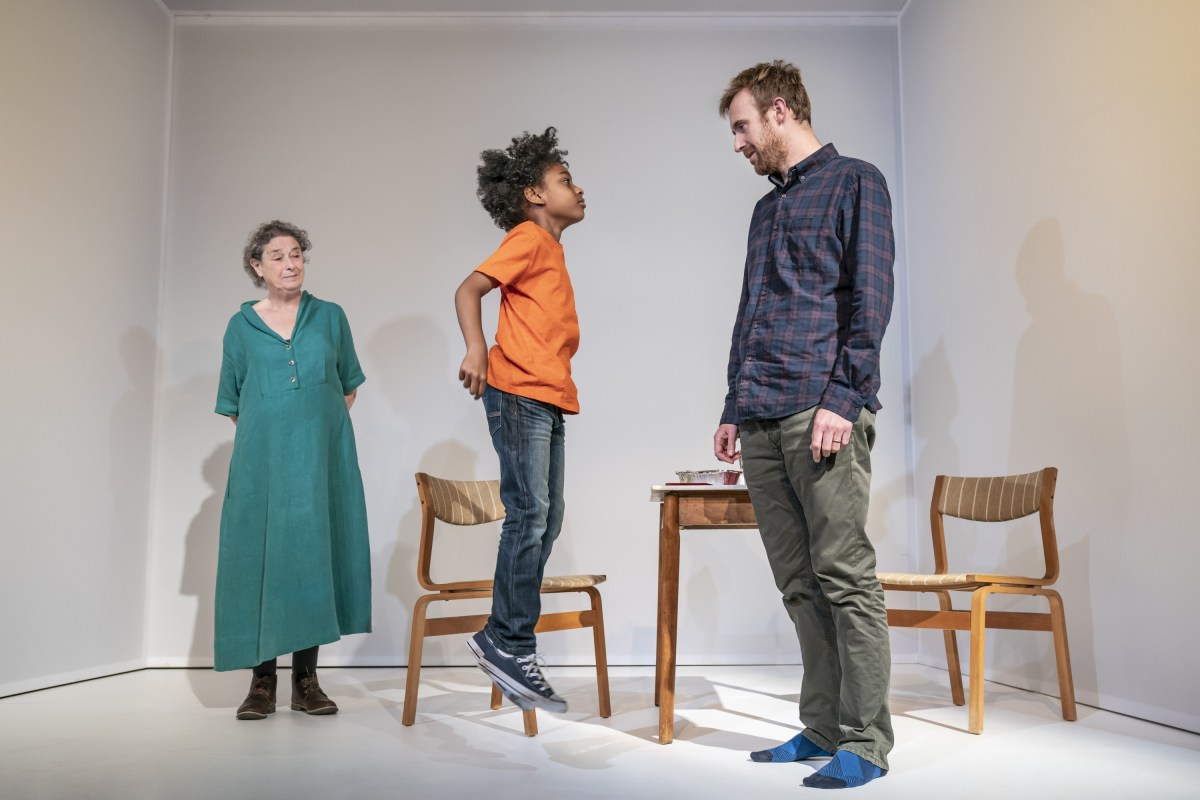
John Heffernan, Jasmine Nyenya and Linda Bassett in What If If Only

I was reading about this man who spent ten years trying to paint an apple so it looked just like an apple. That was eighteen to twenty eight.

Then he spent seven years trying to paint an apple so it looked nothing like an apple.

Then he died.

This is the sort of thing that interests you. That used to interest you.

In What If If Only, Caryl Churchill tries to write a ghost story. Then she writes something nothing like a ghost story. But here she does it all at the same time.

In her latest short play for the Royal Court, Churchill upends the usual ghost story structure. Typically, a ghost story will follow someone once living continuing to exist in some form beyond death. Here we are presented with the ghost (or ghosts) of dead futures, cursed never to have been alive and with no possibility of becoming alive. Though brief, at only twenty minutes (and a sparse, pause-filled twenty minutes at that), the production teems with raw emotion, humane philosophical enquiry, and political reflection. That it feels so rich is nothing short of a marvel.

Directing a Caryl Churchill play comes with many challenges, but What If If Only sees James Macdonald approach yet another Churchill offering with superb focus. The difficulty is the need to interpret the script’s elusive ideas, while leaving the effect thematically indeterminate. The production needs to be highly specific and careful, without losing its emotional power. This capacity for balancing directorial interpretation and authorial intention, while leaving space for audiences to make up their own minds seems exactly why writers such as Churchill, Lucy Kirkwood and Annie Baker have given Macdonald their wonderfully detailed and exacting scripts in recent years.

The script here is delightful and hard to pin down. Yet despite its strangeness (and sometimes our uncertainty over what we are actually watching), it begins with a command of semi-naturalist characterisation which is utterly masterful. Churchill subtly sketches her bereaved subject, Someone – played as a man here by a breath-taking John Heffernan. He talks to a partner who is not there, his long silences filled with hurt and blame. (We soon discover that his partner died by suicide.) Though overuse has often made such moments feel clichéd, Churchill’s shifts in tense between ‘are’ and ‘were’ when Someone talks about his dead partner express a fresh emotional truth. The trope is examined. Churchill grapples with the simultaneous deadness and continuity of the recently deceased; Someone describes the artist, saying ‘I think he was a difficult person like you’re a difficult person. Were. Are.’

Bitter that his partner sends no ghostly sign, he remarks ‘Are you not trying? If you’d wanted to talk to me you could have stayed alive.’ Churchill always seems to find the right words, even when feeding us exposition. ‘Would he kill himself? You know what it takes to kill yourself, would he do that?’, Someone asks. These barbed recriminations generate empathy, but I also felt that he is quite a difficult person too.

After the slow opening monologue, John Heffernan is joined on stage by Linda Bassett, who gives a very different yet complementary performance as a variety of apparitions: a Future, Futures, and the Present. Heffernan acts with slowly mounting intensity – which, depending on the night you see it, can burst into volcanic crying or something quieter and whimpering. (Both are hugely moving.) Bassett meanwhile displays a remarkable range, conveying the impish delight of utopia, the maelstrom of the chaotically competing possible futures, and the cool detachment of the present.

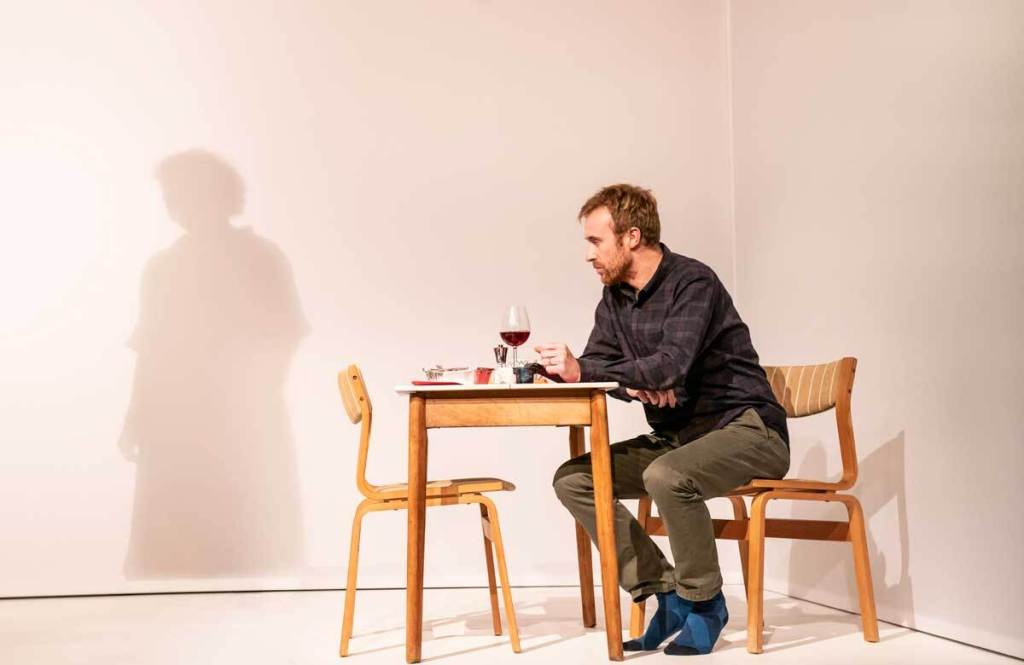
Miriam Buether’s set is a minimalist triumph, slotting well in front of the brickwork and plywood frame of Is God Is. The stage has an almost painterly composition. John Heffernan’s Someone is hemmed into one corner, sat across a table from an empty chair. The left half of the stage is entirely empty, the space enclosed by white walls that give the scene the look of a three-dimensional canvas. The emptiness is striking and simple; the room is too big for only one person.

The effect of Heffernan’s almost motionless performance (he fiddles at little with some fruit) is to make the stage look like a very empty painting. Indeed, ‘still life’ would be an apt subtitle for the play. After all, what is a ghost but life still going on when corporeal existence has stopped. The curious opening monologue establishes What If If Only as a play concerned with art and its limitations – a space for imagining possible futures and mirroring reality. The reason the artist shifts from trying to render apple in exact detail to pure abstraction is left unspecified, but it arguably reflects Churchill’s own shift as a dramatist. Most of her 21st century work would fit the description ‘fantastical’; generally, she has eschewed realism for something stranger. She does not simply paint an apple.

Perhaps this is an objection to realism as a tool for political analysis and debate – her own literary canon rife with experiments in political drama that does not look at all like conventional British examples. Would the artist paint the same apple or replace it with a ‘perfectly ripe apple’ each morning, Someone wonders. The folly of the artist trying to perfectly represent an apple which will have rotted away by the time the work is completed could be read as a comment on the short use by date much direct political writing will have. The gesture behind many of Churchill’s more recent plays (Escaped Alone, Kill and Imp spring to mind particularly) seems to be to evoke contemporary social and political forces, unmoored from our own world – though sprinkled with details from it. (In Escaped Alone’s apocalyptic world ‘eighty per cent of food was diverted to tv programmes’ such that ‘commuters watch breakfast on iPlayer’). Arguably the still life’s counterpart in drama is the state-of-the-nation genre, hinging on the representation of (or sometimes the attempt to reveal) how things are. Yet for Churchill, not only are some things in a constant state of flux, but others are lost to the past forever. Drama is too slow a medium to address the politics of the moment.

This makes it fascinating that What If If Only can be watched in the same evening as Lucy Kirkwood’s bravura Maryland, a rapid-response play written in only two days and staged script-in-hand just over a week later. It mounts a coruscating examination of violence against women and the police, particularly responding to the murders of Sarah Everard and Sabina Nessa. Kirkwood’s play shows the immense value of directly political contemporary writing in playing out versions of all-too-common scenes from real life. Kirkwood’s play does something a bit different; it is (in Kirkwood’s words) a ‘howl’.

There are occasional, directly political moments in What If If Only. The utopia represented by Future is coded as specifically left-wing. Future notes that ‘I’ve been glimpsed I’ve been died for in China and Russia and South America and here’, aligning its politics with Socialism and Communism – though served with ‘equality and cake and no bad bits at all’ to sweeten the deal for potential detractors. Yet here, though begging to be made to happen, there is a resigned quality to Bassett’s performance. This is a future which thinks it will not happen, symbolic of the decline of left-wing idealism in the second half of the 20th century, to the present day.

Arguably one of the main themes of the play is political inertia, restated in Present’s monologue. She says that ‘the Present always has wars and any Future that promised no more is dead dead dead’. The present increasingly resembles Mrs Jarrett’s visions of the end of the world in Escaped Alone, and Far Away’s conflict-ridden world of ecological breakdown seems less and less far away than it did in 2000. Though the world may be chaotic and violent, at the same time the prevailing political and economic ideas remain stuck, Churchill suggests.

Yet the extent to which we accept the claims of the Present seems rather up to us. Indeed, our present malaise seems reflected in the grief-heightened cynicism of Someone. We have lost faith, not only in the soul persisting after death, but possible futures themselves. The Present is here to stay; ‘it will be the Present as it always is’. It is the end of history, not in terms of liberal democratic stability, but due to our tacit acceptance of our inability to reshape the world into something better. We no longer believe in a future or the possibility that we could shape it.

The play does push against this idea too though. It ends with a Child Future (winningly played with energy by Jasmine Nyenya and Samir Simon-Keegan) insisting ‘I’m going to happen’. The image is striking, filled with naivety and pure earnestness. Though the play is extremely sober in its representation of what has been irretrievably lost, it does not mean there is no future.

What If If Only

Written by Caryl Churchill, Directed by James Macdonald, Design by Miriam Buether, Starring John Heffernan, Linda Bassett, Jasmine Nyenya and Samir Simon-Keegan
Reviewed 11th October 2021