Following his recent critically acclaimed, devastating family drama The Son and Oscar-winning film adaptation The Father, the return of French playwright Florian Zeller to the British stage is a welcome one. Translated again by Christopher Hampton, Zeller’s new play The Forest arrives at Hampstead Theatre as a world premiere. Though it shares some of the previous plays’ experimental touches, this production lacks the emotional pull of previous works – suffused instead with a coolly detached, almost surgical sheen; though there are moments of bloody violence, the overall effect remains pristine – perhaps like an operating theatre.
Even more so here than in previous plays, Zeller employs narrative pyrotechnics to explore his theme formally. In The Forest, the nameless main character is an eminent surgeon – but written on the page as two people, Man 1 and Man 2. The role is doubled (by the excellent Toby Stephens and Paul McGann) – contrasting the amiable father and husband with the conniving cheat, the slick, successful healer of others with his desperate urge for self-preservation. The strength of Stephens and McGann’s performances resists such a simple dichotomy though. All of the selves are encapsulated in both; the dual role simply makes these differences more immediately intelligible.
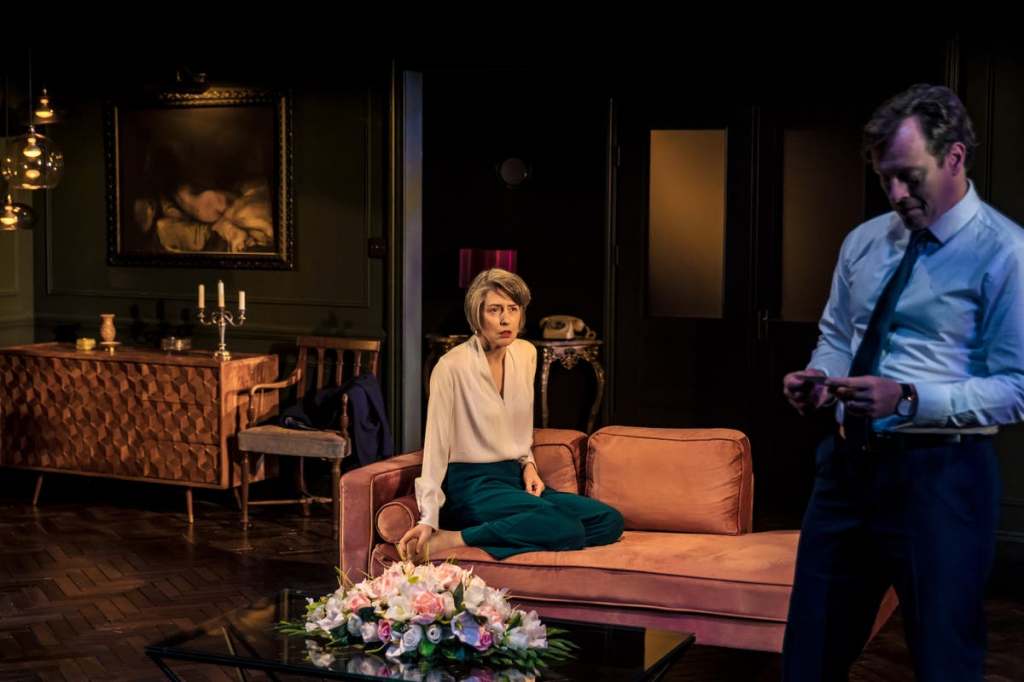
Gina McKee and Toby Stephens in The Forest
Zeller’s thesis – that men contain many selves, and thus the capacity for cruelty and violence – becomes apparent quickly, and the play’s structural twists and turns largely serve to generate intrigue in the relatively simple plot, rather than build on this theme. It is undeniably a powerful dramaturgical device, and Stephens and McGann thoughtfully generate a continuity between the two parts, but I found that the unfortunate by-product was the implicit suggestion of male complexity – as opposed to female simplicity. Why is it that all of the male roles alternate between the male actors – not only with Man 1 and Man 2, but with the other men interchanging as various friends and colleagues too? The intention seems to be critical of men and male behaviour, but the effect is almost contradictory; the men exist in exquisite complication while the women are singular and simple – even one-note in places.
At its heart, The Forest seems to be a play about gender – but it rarely digs into the social factors that might cause this male multifariousness – or prohibit it for women. The idea that men exist in multiple selves while women – in general – do not could potentially be examined in light of social and historical norms. Perhaps women are not permitted to be complicated in these ways? Yet Zeller’s drama largely steers away from a concept of gender that is socialised, historical or constructed. The structure – baked into the drama from the very start – gestures towards a crude biological determinism, which goes without interrogation. By definition here, maleness involves a tendency to lie and manipulate. Womanhood, in contrast, is presented as a form of victimhood – every main female character wronged by a man’s (usually sexual, sometimes violent) behaviour. The Forest seems to assert this as a precondition, not a product, of society – interested mainly in the effects of this inescapable psychological prison than on potential solutions to the problem. The harm is to everyone – though the male experience of internal struggle is vividly staged, while women’s pain is expressed either in silence – or is rendered completely inaccessible, when the women are pushed offstage or killed.
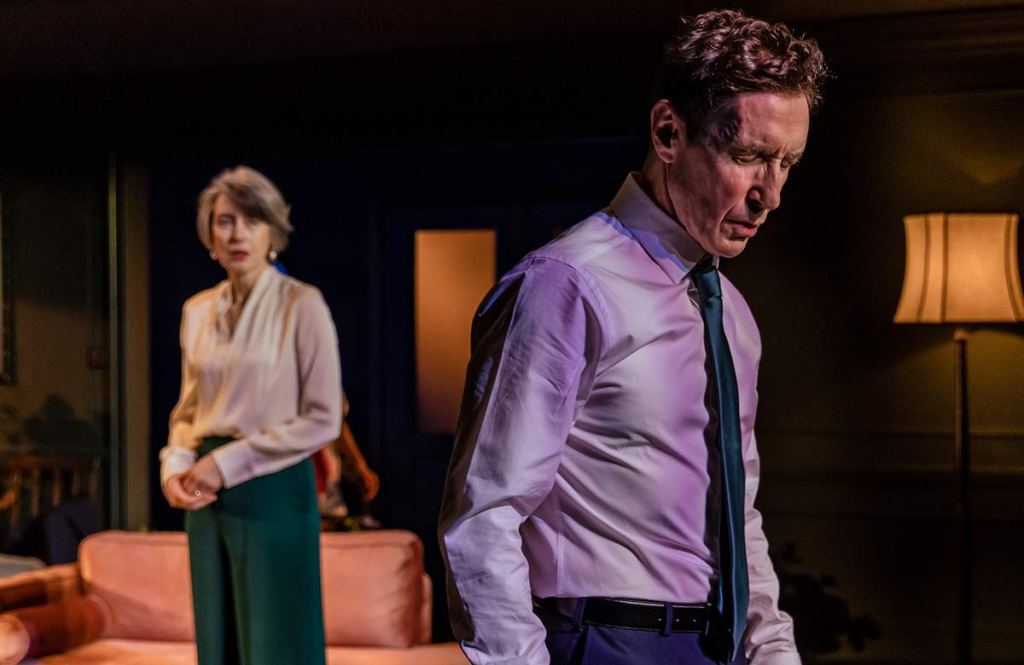
Jonathan Kent’s direction is extremely slick, and the cast wring as much from the material as they can. Gina McKee and Angel Coulby should be especially commended – locating emotion in their sometimes cipher-like characters. McKee particularly remains etched in my mind for the way her suspicions, disappointments and ultimate exhaustion seem to play across her face – especially given the relative lack of expression the Wife is given in dialogue. She exists on stage largely through the play’s repeated actions – clearing up wine glasses and fetching water, frowning at the greetings card on some unexpected flowers. Never is McKee’s understated presence more palpable than near the play’s ending, where her crushing disappointment with her husband is expressed in a vast silence. ‘What is it?’, the Man asks, but she says nothing. As Zeller writes in his stage directions: ‘She indicates “nothing” with her head. But her serious expression seems to suggest the opposite. An interminable pause, loaded with subtext.’ This moment could have ended the play – a reminder of the cost of male vices on women. Instead, Zeller goes on, choosing to conclude with the Man’s weeping, under a spotlight – rather expressing the play’s gendered priorities in miniature.
Gina McKee and Paul McGann in The Forest
Similarly unexamined (or left only to subtext) are other social dynamics in the play – particularly the class and cultural specificities which allow the Man to live the life he does. The Forest is another play in which upper middle-class people have wine and affairs, leading to internal catastrophe – but which has very little effect on the material circumstances of the protagonist. The play’s intentions tend heavily towards the psychological. Yet when the female perspective is so underexplored, heterosexual infidelity (where the man cheats) lacks the same emotional heft of Zeller’s previous subjects (such as dementia and depression). Formally, it seems to be a story about fundamental gender differences, yet the presence of pharmaceutical corruption, bribery and organised murder steer the story into something more generic, yet less universal.
The Forest’s title comes from a recurring metaphor in the play – a nightmare expressing a potent fear of being lost in a forest, every tree different but looking so similar. The experience of watching play is a bit like being lost in a forest at night, with its sinister, uncanny sense that we have been this way before – but that things have changed. (This is often a good thing, and the play is certainly entertaining – its narrative repetitions and variations reeling you in rather than pushing you away.) The space of the forest has long held contrasting symbolism of wildness and wilderness, but also human (male) power; there is danger in the natural world, but which can also be tamed by hunters. Zeller evokes this heady mix of images, replete as it is with traditional ideas of male conquest – the hunt sometimes analogous to romantic endeavour. Yet it is hard not to feel these ideas could have cohered into something more than (admittedly impressive) stage imagery.
Toby Stephens and Gina McKee in The Forest
Zeller and Kent craft a show filled with strange, sometimes fabulous images – designed impeccably by Anna Fleischle. The downstairs portion of the stage slowly fills with more and more flowers, which appear almost magically. A large painting imperceptibly changes, its style becoming more photorealistic while also changing to display the image of the Girlfriend by the end. In the bedroom of her small flat – which looms above the stage, like the sword of Damocles – we see the Girlfriend’s bloody body laid across the bed, over and over. It is a queasy image though, rather aestheticized – as female corpses too often are. At the end of the play, the lights come up on the bedroom set to reveal a huge deer – shot dead – spreadeagled across the bed, reaffirming the earlier metaphor of forests and conquest. The Girlfriend has become the victim of cruel, male endeavour.
The reason for her murder is simply that – growing tired and jealous of the Man’s marriage to the Wife – she threatens to reveal the affair, unless he commits to be exclusive with her. Coulby mostly sells the characterisation, though play struggles to conceive of any relationship desired by a woman that does not amount to heterosexual monogamy. Yet for all of the Man’s obvious flaws, I also found his willingness to commit murder (by proxy, though one scene presents Man 2 firing and wiping the barrel clean of fingerprints) unconvincing – a stretch too far for a man whose morality seemed merely deficient, rather than a complete void.
If The Forest is meant to imply that these are horrifying depths to which men may sink, given the opportunity, in shallow self-preservation, then its logic is not developed quite enough. Murder here felt too easy – its reveal a relatively cheap twist, a feat of rapid costume changing and sly set design, rather than a source of psychological horror. In its presentation of wronged women, the weight of the betrayal is relatively weak, when the female characters are so thinly sketched. Zeller’s writing merely invites us to pity them, rather than sympathise with their suffering.
The Forest
Written by Florian Zeller, Translated by Christopher Hampton, Directed by Jonathan Kent, Set Design by Anna Fleischle, Lighting Design by Hugh Vanstone, Sound Design by Isobel Waller-Bridge, Starring Toby Stephens, Gina McKee, Millie Brady, Paul McGann, Angel Coulby, Eddie Toll, Silas Carson, Sakuntala Ramanee, Finbar Lynch Reviewed 17th February 2022
Hampstead Theatre’s 60th anniversary celebrations have been long-belated. Following the birthday itself (on 24th September 2019), a programme of four classic revivals was announced in January 2020 – a season comprised exclusively of plays that had their UK (or world) premiere on Hamsptead’s stage. Two years later, following pandemic interruptions, the final production – a sixth, additional play (added along with The Memory of Water) from the vault, dubbed a ‘Hampstead Theatre Original’ – has completed its run.
Though the season would have originally lasted under a year – and only in the larger of Hampstead’s two spaces – it does feel like quite a long time has been spent looking back at the past, while the world peers uncertainly into the future. There is certainly merit in reappraising old favourites – and indeed, new productions can make compelling claims for relatively unknown works’ longevity and value. Yet, having been able to see three of the six anniversary productions, I remain rather unconvinced by the reasoning behind some of the programming. Watching Peggy for You especially, I couldn’t help but think of the now-familiar spin on a traditional adage: nostalgia isn’t what it used to be.
Partly the issue seems to have been the choices of the plays themselves. A thrilling season of powerful, overlooked works was surely possible given the wealth of plays to choose from. Instead though, the plays selected tended to be safe yet somehow simultaneously alienating. By far the most successful production I saw was Sam Yates’ precise staging of Tennessee Williams’ The Two Character Play – masterfully performed by Zubin Varla and Kate O’Flynn. Yet this was still undeniably strange – relying on the author’s name to draw audiences to something that then held them at arm’s length. Followed up by Marsha Norman’s ‘night Mother – in an unfortunately bland and lacklustre production – what seemed to be linking the plays together was a fundamental dourness. (I cannot comment on the productions themselves, but Harold Pinter’s The Dumb Waiter, Shelagh Stephenson’s The Memory of Water and to a lesser extent Alfred Fagon’s The Death of a Black Man share some of these gloomier themes too.) Even the tonally light Peggy for You culminates with the sudden shock of suicide (compared to ‘night Mother’s interest in its banality).
Any greater organising principle, beyond their presence in a 60-year back catalogue, seems hard to identify. They seem bound together by an underlying nostalgia, with relatively little thought given to their timeliness (particularly in the cases of ‘night Mother and Peggy for You) – somewhat odd, given the contemporary bent of their Downstairs studio space, ostensibly a new writing venue. In the main house meanwhile, productions played with relatively little obvious self-justification. At times it felt like Hampstead was laying claim to a classic they had premiered (The Dumb Waiter particularly), asserting (rightly) a part in British theatre history. Yet I often felt that a better celebration would look forward (as well as back). It comes as a relief that Hampstead’s coming main stage season is comprised entirely of new works.
Danusia Samal, Tamsin Greig and Trevor Fox in Peggy for You
I arrived at the theatre for Peggy for You with many of these concerns already formed in my mind. Yet, unfamiliar with the play, I was surprised to find it somehow responding to many of my thoughts quite directly.
Alan Plater’s 1999 play about the real literary agent Peggy Ramsay, who counted J.B. Priestley, Eugène Ionesco and David Hare – to name only a few – among her clients, is a frothy comedy that marks a substantial diversion from the grim and doom-laden plays staged during 2021. It is light, powered by Greig’s acerbic wit, while Richard Wilson’s focused direction keep it moving onwards. It already has sprinklings of meta-drama, which Greig occasionally embellishes with the occasional glance askance at the audience.
‘What is a play’ is the central question that drives Peggy for You, especially in the first half, when a new writer called Simon (a brilliantly nervy Josh Finan) extrapolates a theoretical challenge from Peggy’s offhanded appraisal of his work as ‘not really a play’. This minor quest to discover that elusive quality of being a play is the quiet motor, keeping the drama moving slowly forward. Yet questioning stories and their forms does not drive the characters towards searching, elemental, humanitarian concerns – as it does in Annie Baker’s The Antipodes or even, more implicitly, in Anne Washburn’s Mr Burns. Instead, it generates a patina of wry irony. It is part of the fun, I suppose, that conversations about the qualifying criteria for a play are being had within (what seems to be, at least) a play. Instead where these meandering formal questions most profitably lead is a relatively brief consideration of the ethics of realism.
It could be argued that ‘night Mother was engaged in a not dissimilar discussion. Through the meticulous depiction of suicide planning – especially in the suicidal Jessie’s stage labour of accruing enough non-perishable goods to keep the titular mother stocked for the rest of her lifetime – Norman’s drama attempts to find and articulate a deep, existential truth. Perhaps it should be read as a diagnosis of intergenerational malaise – younger generations feeling like they no longer wish to inhabit the world made for them by their parents, though Jessie spends much of her time caring for her mother, and building her world for her. Yet Norman’s methodology is somewhat in conflict with contemporary concerns and guidance about depictions of suicide and suicidal ideation in art. The unflinching, hard stare approach is potentially dangerous – especially in naturalistic descriptions or depictions of suicide methods. To these, we can add age-old (though highly debatable) critiques of realism as a stultifying, static mode, to which the audience are only passive observers – which ‘night Mother seeks to refute – though I am not sure Roxana Silbert’s production succeeded.
Peggy for You’s treatment of realism is rather different, characterised by a tendency to separate the realist and the real. The play signals how it bypasses actual events in the line ‘Any play about a real person should be a pack of lies’ – a statement which sums up the Peggy onstage, while hiding the real Peggy behind a veil of paradoxical logic. Where naturalist realisms – particularly the tribunal play, or other verbatim theatres – often contend that the accretion of true details helps to reveal an overall truth, here Plater offers a wry opposite: make up enough lies and the character will come to life as they should be.
Trevor Fox and Tamsin Greig in Peggy for You
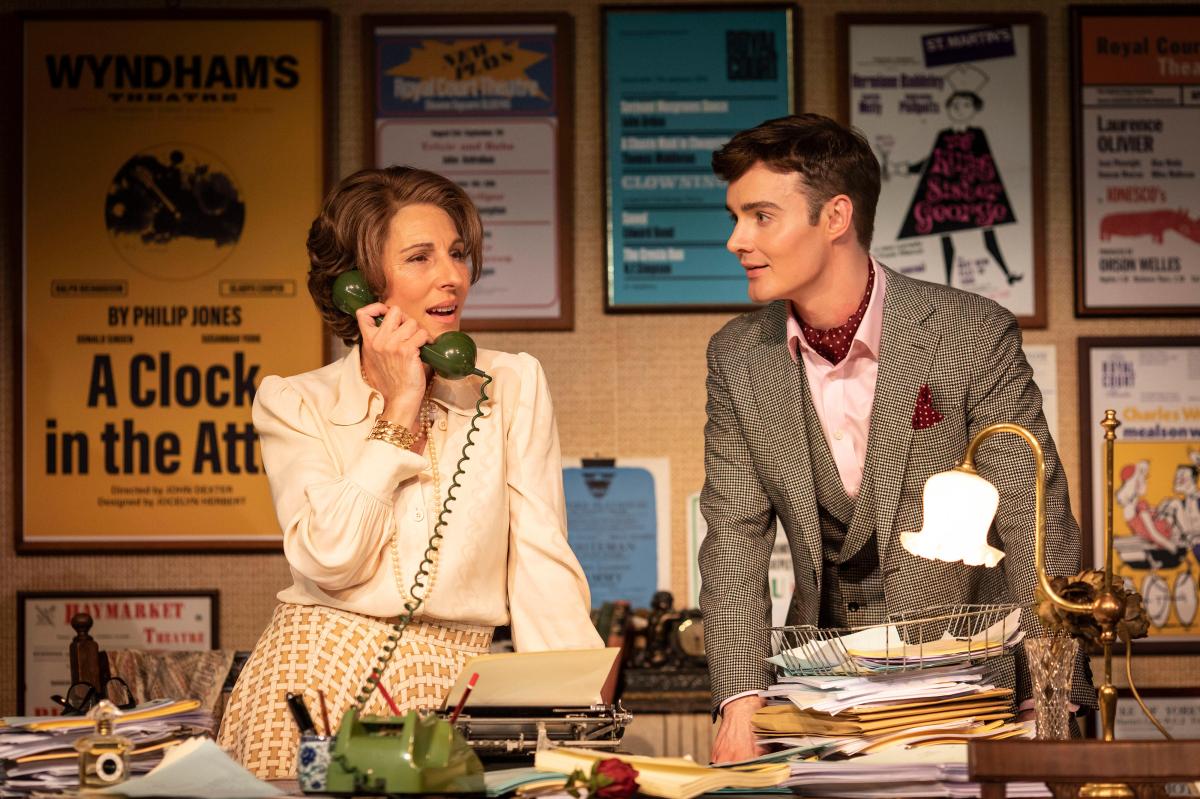
The play’s meta flourishes have been present since its first performances in 1999, yet Wilson’s staging strikingly reflects on Hampstead’s own 60th anniversary season. It is hard to know exactly how deliberately intended these effects are, functioning as a strange retraction or self-critique. Most glaring is the moment when Ramsay berates someone at the top of the National Theatre for programming an entire season of old plays – with no new writing. She is invited to see Uncle Vanya that evening, wryly critiquing the aesthetic richness and dramaturgical paucity of productions that have ‘built the entirety of Russia’ in the set while the character drama remains stodgy. Peggy is hardly a singular authoritative voice in the play – the ending particularly reading as a partly sympathetic critique of her callousness – though the criticism of elaborate set design as anathema to good drama seems in curious tension with James Cotterill’s immaculate office set, which is stuffed with reams of papers and binders, and borders on indistinguishable from the real thing. By boxing them into a rectangle, it does have the effect of making the scene feel a little remote. Meanwhile, Hampstead staged Uncle Vanya, in a rather excellent production, as recently as 2019. Perhaps this only adds to the irony?
Elsewhere in the play, Plater voices a case for doing plays again. An older writer – Henry – argues that he does not make money from writing new plays, only from companies staging his old ones. It is an understandable case – though it does not hold for long-dead writers like Chekhov and Shakespeare, or most of this season in fact. Of the six playwrights represented, only Marsha Norman and Shelagh Stephenson are still alive.
Successful writer Philip, when asked what a play is by Peggy, claims that they are messages to the future – arguing that they encapsulate what life was like at the time they were written, implicit state of the nation dramas that inform us of the details, emotions and detritus of life at a particular moment. This is immediately complicated by the fact that Peggy for You was written in 1999 but set on a single day in the 1960s; which time is contained within Plater’s capsule? Philip’s notion is intriguing, but fundamentally quite bleak – suggesting that plays are merely repositories of historical information. It flattens plays into rigid, fixed objects – assuming them to be impervious to directorial interpretation, or variance in audience tastes. It certainly seems the point of view of a certain type of writer, though Peggy for You does not necessarily agree with Philip. His implicit view that the crux of good drama is archivism does chime a little with the production’s surrounding context; the play is arguably here because it shows what Hampstead Theatre was up to two decades ago.
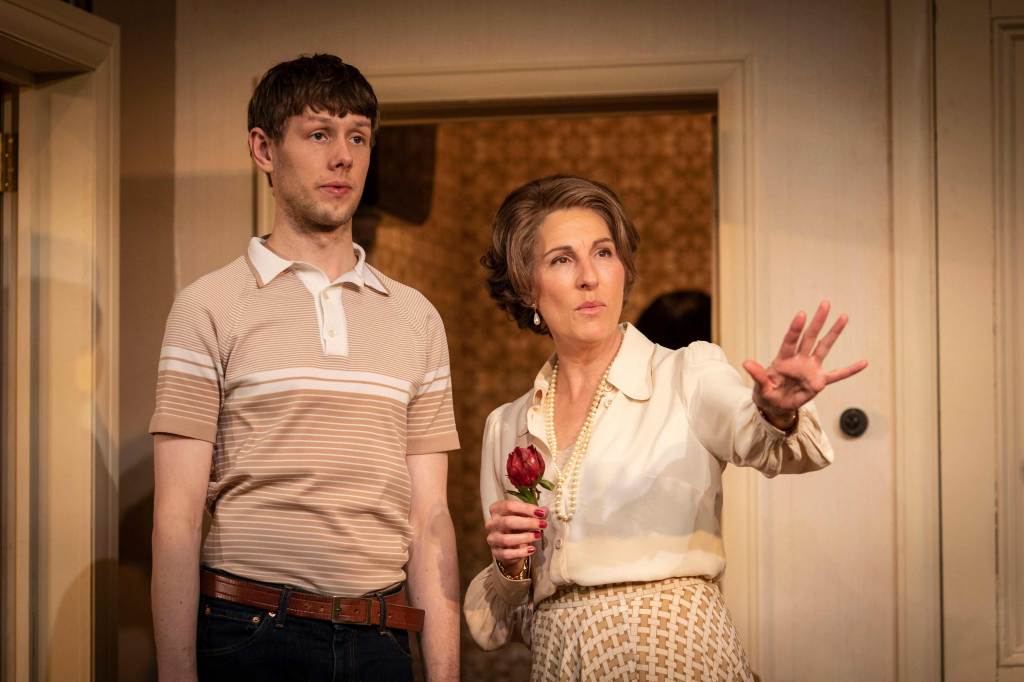
Josh Finan and Tamsin Greig in Peggy for You
It is difficult to get too het up about these meta-questions while actually watching the play though, carried as it is by the consistently fantastic work of its cast. Tamsin Greig blazes through the play, Peggy’s acid-tongue dispensing withering asides at a startling rate. The role is the structural heart of the play – dominating a little too much even – and Peggy is rarely offstage, rendering the other parts clearly supporting in their function. However, there is brilliant work being done elsewhere – especially by Josh Finan, conveying naïve optimism, and Danusia Samal as the put-upon secretary Tessa, whose name Peggy has not been bothered to learn. Tessa particularly represents the human cost of Peggy’s blustery, rather unempathetic personality. She is on stage almost constantly too, quietly carrying out a near-endless slew of administrative tasks. Samal is phenomenally restrained in the play’s final moments – her quiet grief channelling a gush of emotion into a previously arid play, exposing Peggy’s emotional hollowness by contrast.
With 60 years of drama to draw on, it is hard to feel that this season has played to Hampstead’s strengths enough. It ends on an entertaining crowd-pleaser, but the play’s purpose seems uncertain – internally and externally. It neither advocates for theatre as a site of pure entertainment, nor particularly for ethical purpose. This ultimate hesitation perhaps mirrors Peggy for You’s other driving question, after ‘What is a play’: why does Peggy Ramsay do it? The job has left her cruel and ruthless, though it is often fun. Like Plater’s Peggy, though not as outrageous it thinks it is, the play ends by casting doubt over whether fun is justification enough.
Peggy for You
Written by Alan Plater, Directed by Richard Wilson, Design by James Cotterill, Lighting by Johanna Town, Sound by Tingying Dong, Starring Josh Finan, Trevor Fox, Tamsin Greig, Danusia Samal, Jos Vantyler Reviewed 19th January 2022
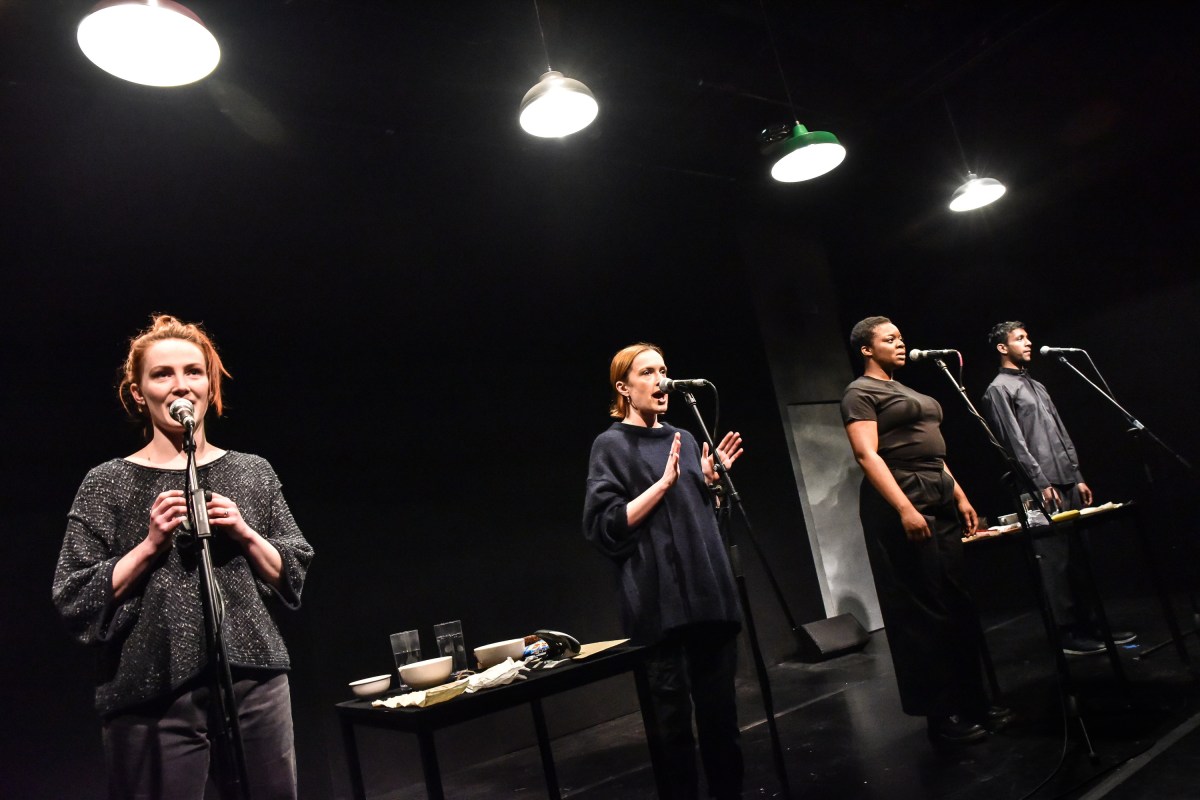
Eve Ponsonby, Eleanor Henderson, Morónkẹ́ Akinọlá and Ragevan Vasan in little scratch
There is something a little uncanny about seeing little scratch on stage. Rebecca Watson’s brilliant novel – my favourite of 2021 – follows the often simultaneous and overlapping thoughts of a woman, over a single Friday in London, in the wake of a traumatic event. Set within the confines of a mind, the book probes at what it means to exist within a body – a fact of existence which is sometimes horrifying. To put such a text on a stage though means giving these themes a literal body – or bodies. Miriam Battye’s adaptation is largely faithful, its most radical deviation being the choice to dramatise the unnamed protagonist’s mental processes with four actors – four voices, not one.
Yet in Katie Mitchell’s focused staging, the overall effect remains peculiarly disembodied. Four actors stand in a line in front of microphones, as if they are about to record a radio play. Watching the play, though, is not quite the same as only listening – and not just because of the inherently theatrical experience of sitting in an audience. Though there is none of the complex microphone choreography present in Marek Horn’s recent play Yellowfin, the subtlest of gestures and interactions with the amplification feel radical in light of little scratch’s muted aesthetic. Hand positions – tugging at a sleeve or clutched to one’s chest – feel fraught with emotion.
For a lot of the performance, it felt as if the actors were channelling something. In part, they channel a faithful rendering of Watson’s extraordinary source text, attempting to lose as little of its precision and nuance as possible as they transfer it to the stage. But there is something more elemental at work too. Though rendered with four actors, they are all giving voice to one self – though a self which is alienated from itself by trauma and the grind of contemporary work. The effect is almost like Samuel Beckett’s Not I, the disembodied gaping mouth alienated from its body and self. On the page, the overlapping scattered text seemed to represent the sensory simultaneity of the city, our constant mental stimulation, and inner emotional lives. Interior and exterior blurred in perception. Emails arrived with the same on-the-page grammar as her intrusive thoughts. Here, the four individual bodies give the appearance more of a split personality – though not in a literal or schlocky way, but as a representation of the different competing selves and impulses contained within us. We navigate our way onto trains, in the informal queue and in through the doors thinking about the workday ahead, while a part of us – angrier than we’d like to admit – craves the comfort of a seat. ‘Seat. Seat. SEAT!’
While seeing little scratch given corporeal form is in some ways surprising, there is an inherent theatricality to the original novel that should not be overlooked. Arguably, it is so effective as a novel because it imports textual innovations of drama to another medium. Its layout on the page could be an experiment of Caryl Churchill, and (perhaps mostly directly) resembles the fragmented layout of Sarah Kane’s 4.48 Psychosis. (Indeed, Watson cites Kane as an influence in the programme.) Its rush of sensory stimuli even reminded me of Churchill’s depiction of the experience of dying in Act 2 of Here We Go.
Perhaps most of all, I was reminded of Alistair McDowall’s terrific one act play all of it. Staged in early 2020, it is surely too recent to have been an inspiration, but they share some interesting affinities. Both examine the lives of women (over the course of a day and a life respectively), and use jangling single-word phrases like ‘rushing’ and ‘red’ to describe waking, commuting, and birth. Though brief, McDowall’s play lodged in my mind to such an extent that when I read little scratch at the start of this year, I imagined it performed with the same drive and pace of Kate O’Flynn’s break-neck, heart-rending performance. In Mitchell’s staging though, the pace is a little slower – and Watson too opts for something less hectic in the audiobook.
Morónkẹ́ Akinọlá and Ragevan Vasan in little scratch
Watson calls the play a ‘true sister’ to the book, and the adaptation is certainly faithful. Writing in Exeunt, Brendan Macdonald suggests that the stage adaptation ‘gives the appearance of experimentalism within the medium, but actually in its substance is rooted in heavily conventional practices’. Perhaps this is more of a comment on the marketing of the book, rather than any claims the text or Watson make themselves. It is probably true that little scratch is the first work of pure hybrid fiction that has attained wide popular success (and, of course, continued life in a stage adaptation) in a while. Max Porter’s Grief is the Thing With Feathers and Lanny were maybe the last major entries to this informal canon.
Yet I would argue that – as surprising as the form will be to many readers – the true innovation of Watson’s novel is its fashioning of older forms into something remarkably contemporary. Watson consciously situates herself within a modernist lineage; why else would she set the novel on a single day in June – like Virginia Woolf’s Mrs Dalloway and James Joyce’s Ulysses before it? (Woolf is also named as an influence by Watson.) Yet compared to Clarissa Dalloway’s leisure, and her slow passage along Bond Street to buy flowers, Watson’s protagonist is flung headlong into a rush of work tasks, sensory over-stimulation, and relationship worries – all overshadowed by trauma. For Watson, there seems to be a link between the long, flowing sentences of early 20th century stream-of-consciousness fiction and the angular contemporary hybrid fiction of little scratch; both attempt to represent thought as it is. Yet in the modern day, multiple streams exist within the mind at once, the attention span shortened, all underscored with anxiety.
One by-product of the staging is that you begin to notice the almost imperceptible differences between each of actors, and how they take on slightly different roles. It is almost as if they represent various parts of the character’s psyche – delineated a little more clearly than on the page. The book had a rough organisational pattern in columns, but these would regularly shift and change position. On stage, each voice is contained within a discrete body. There is a trace of the all of it-style piece which little scratch could have become, in Eve Ponsonby’s (arguably leading) role. She certainly provides much of the character’s most conscious thought, and seems to have the most dialogue. Though little scratch would work as a monologue, the resulting loss of the simultaneity would detract from the overall effect and Battye and Mitchell’s bold choice pays off considerably.
Thus the script’s main authorial and editorial interventions, beyond some canny trimming, are in the distribution of the various streams of consciousness. As well as designating Ponsonby’s role as voicing most cognisant, deliberately thought thoughts, there are other underlying patterns. Eleanor Henderson often represents irrepressible feelings which lurk beneath the banality of her daily tasks. Bad puns and innuendos spill out, but also there is the pervasive, irrepressible sense of ‘dread’ which Mitchell’s production conveys so well – aided by the scrapy strings of Melanie Wilson’s superb sound score. Ragevan Vasan, perhaps a little conventionally as the only man in the cast, lends his voice to the male characters, as well as public announcements. Yet these are filtered through the wittily overfamiliarity of the protagonist’s mind: ‘If you see something that doesn’t look right […] sea it, suet, sautéd.’
Seeing all four actors together is to witness a propulsive, dazzling display of intricate choreography, recalling Mitchell’s 2017 production Anatomy of a Suicide at the Royal Court. Performed in three simultaneous time streams, Alice Birch’s play was rehearsed to a click track, and I wouldn’t be surprised if little scratch has been too, given the tightly interlocked dialogue. You can certainly see why Katie Mitchell was compelled to stage it, formally as well as thematically.
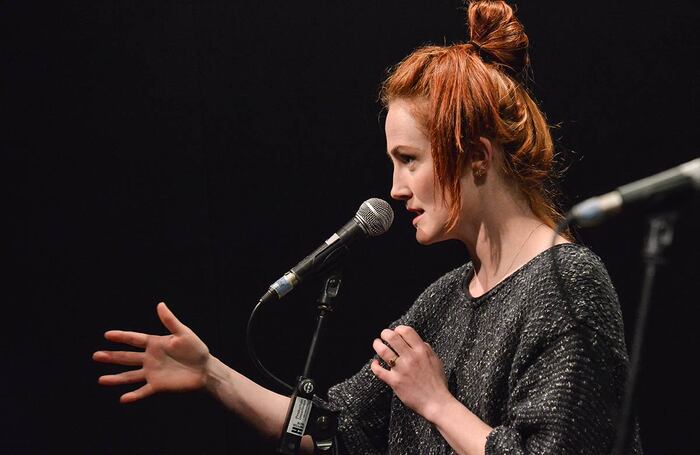
Eve Ponsonby in little scratch
When I read little scratch, I felt that one of the effects its form was to itemise the stuff of everyday life in such a way that every action and interaction seemed, through some inexorable gravitational pull, dragged within the realm of work. little scratch sits (I would say at the forefront) of a burgeoning new genre of workplace novel in contemporary fiction. Eloise Hendy recently called them ‘burnout books’ – fiction which dramatises the exhaustion of labour, especially mental exhaustion. Other notable examples of this genre, I would suggest, include Candice Carty-Williams’ Queenie, Hilary Leichter’s Temporary, Christine Smallwood’s The Life of the Mind, and Lauren Oyler’s Fake Accounts. (As this list indicates, it appears to be a genre currently contributed to by women in particular.) Yet little scratch’s protagonist is not – predominantly, at least – crushed by the daily grind of her job, but by the sexual assault she has suffered, perpetrated by her boss. Indeed, as Watson noted in an interview with Rhiannon Lucy Cosslett in The Guardian, ‘The office routine is something that she relies on to essentially suppress the assault’.
Yet work permeates every aspect of little scratch,an insidious presence, mutating her interactions with the world – even how she processes the assault. The suppression itself seems traumatising. Watson’s distinctive form is not only an attempt to express unmediated thought in language, but shows how every action has ended up as an itemised task she is expected to perform – by her job, by her boyfriend, by the rules governing social etiquette, or by her inner neuroses. Everything from brushing one’s teeth, to commuting, to reading emails, to buying soup, to cycling home, to attempting to tell one’s boyfriend about one’s sexual assault are, as a result, placed on a continuum of labour and described in the language of work. It is there from the very beginning of little scratch; moments after waking, the protagonist realises that she has ‘got to do this thing again, the waking up thing, the day thing, the work thing, the disentangling from my duvet thing, this is something, this is a thing I have to do then’.
In the mind of the protagonist, everything is task – micromanaged by her own self-policing. The inner monologue has mutated from the free-flowing modernist stream-of-consciousness of Virginia Woolf, say, into splintered shards of internalised time management. The self is almost robotic, automated by the demands of the capitalist system which she has internalised. Here, I was also reminded of McDowall again; his protagonist’s adult life is rendered with the crushing repetition of ‘Driving to work’, over and over – redolent of Watson’s ‘pedalling pedalling’ and ‘rush rush rush’. The commute seems emblematic of a life half-lived, a time of clinging on, stuck in a liminal space, waiting for life to resume. (Despite this, the novel and play are never an exercise in monotony. Watson’s canny plotting alleviates this possibility in subtle ways – such as the decision for the character getting the train to work, where she has left her bike behind the day before, so she can cycle home. Thus, we experience two types of commute through the protagonist’s eyes.)
The 1983 book The Managed Heart saw Arlie Russell Hochschild introduce the now-ubiquitous term ‘emotional labour’. At the time, she meant for it to describe some very specific (and very often gendered) demands made by paid employment. Aeroplanes proved to be a particularly relevant site of gendered emotional labour, with female flight attendants expected to manage the emotions of passengers – compared to the invisible authority of the usually male pilots. Men were expected to manage their emotions in some jobs too, such as in the case of security guards – whose bodies are the last line of defence between a would-be thief and someone else’s property. Nowadays, we might also point to the emotional labour of digital moderators, scouring social media sites to find, review and take down offensive, violent and sexual content, with little therapeutic support provided.
Yet Hochschild’s term has grown far beyond her intentions – and against her wishes. In 2018, she publicly stated that housework does not count as emotional labour under her definition – an implicit rebuttal of many feminists’ instincts to widen (in Hochschild’s view, dilute) its scope. Yet despite her detractions, from the publication of The Managed Heart feminists saw the potential and value in expanding the meaning of ‘emotional labour’. Hochschild was writing around the height of the Wages of Housework campaign, which argued for the classification of domestic tasks as labour in order to give them a statutory salary. Hochschild’s delineation of labour as something done during a job has also become increasingly unfixed. The rise of the zero-hours contract and the gig economy, and latterly the pandemic, have seen the lines of home and work blur – as the widespread availability of mobile phones and the Internet did before that. Every new wave of technological development has ushered in further ways for work to saturate our lives.
What Watson’s formal innovations seem to embody is this stealth invasion of our mental processes by work-logic – of tasks and deadlines and procrastination. I was struck not only by the emotional charge of the protagonist’s attempt at disclosing her assault, but how this too seemed to enter the realm of work. little scratch almost implicitly asks, should disclosure of rape be considered a form of emotional labour? She delays and puts off telling her boyfriend like it’s a work task, the novel building to a moment of aborted disclosure. The central character summons up her courage on the bike ride home, before arriving at her boyfriend’s home and deciding not to say anything – at least for that night. You sense that this is a cycle that will reoccur over and over.
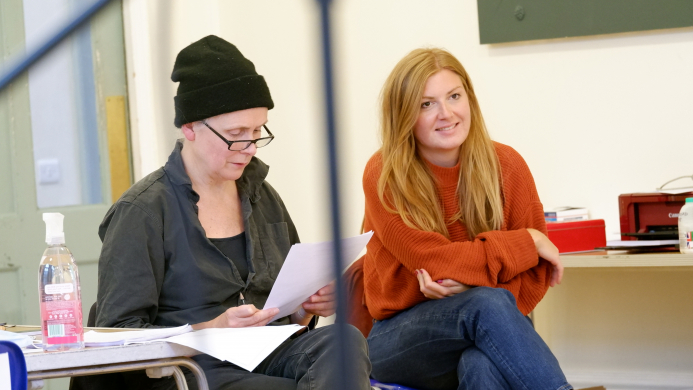
Katie Mitchell and Miriam Battye in the rehearsal room of little scratch
The novel is often misidentified as a roman-à-clef testimony of sexual violence and Watson has repeatedly had to state in interviews that the book is a work of fiction. It emerged from creating the character’s voice first, rather than choosing sexual violence as a theme or attempting to express something directly personal. (The book actually began with the scene in which she is asked what she’s read recently and suddenly cannot think of any books she has ever read in her life.) The events described are not untypical – a point made in little scratch when she googles sexual assault statistics, an act of ‘confirming ordinariness’. Yet this misidentification does perhaps speak to something in contemporary literary culture – partly a widespread expectation that writing by women is restricted in focus on the domestic or autobiographical, but also an incorrect assumption of genre. little scratch was seemingly identified with other recent cultural contributions – such as Fiona Apple’s Fetch the Bolt Cutters and Michaela Coel’s I May Destroy You – which attempt to process their creators’ sexual assault in the making of the art. Yet though little scratch is not part of this emerging contemporary genre of post-MeToo feminist testimony, it certainly seems in conversation with it – even engaged in an implicit critique of the cultural pressures it exists within.
The initial gesture of #MeToo was participatory. In October 2017, Alyssa Milano asked women ‘who have been sexually harassed or assaulted’ to reply ‘Me too’ to her tweet, as Tarana Burke had done previously on MySpace in 2006. It was an invitation for women to acknowledge publicly (but semi-anonymously, disclosing no further details) that violence had been perpetuated against them by men. It enacted a version of the allegations prominently levelled at Harvey Weinstein earlier that month, showing that such violence was typical of systemic, misogynistic abuse rather than one bad apple. The #MeToo gesture in 2017 arguably inaugurated a new mode of public confession, which typified many women’s loss of faith in the police in tackling sexual violence.
A moment in Episode 5 of I May Destroy You seems emblematic of this gesture. On stage, at a reading of her work, Coel’s character Arabella announces that ‘Zain Tareen is a rapist’, doxing him for ‘stealthing’ (the non-consensual removal of a condom, an act which legally and morally amounts to rape). It’s a powerful moment – yet not one which Coel presents as an unequivocal good. It leads to Arabella becoming somewhat reliant upon online praise for her self-esteem, while this disclosure does not result in restitution. Coel reveals later on that Zain retains his book contract and merely publishes under a pseudonym. Yet little scratch seems in conversation with this post-#MeToo image of accusation, exposing another side to what has become a bleak commonplace in the news – that the act of revealing one’s sexual assault is fraught with immense personal difficulty.
Eve Ponsonby and Eleanor Henderson in little scratch
The driving force of the last half hour of little scratch is her final main task of the day: telling her boyfriend what has happened to her. As Hochschild describes the air stewardess’ need to manage the emotions of a difficult customer, little scratch’s protagonist needs to manage the emotions of her boyfriend, on top of her own. The central character caught between the social pressure (perhaps even a sense of feminist duty) to disclose and the appalling impossibility of giving the events words. In Tomorrow Sex Will Be Good Again, Katherine Angel argues that this ‘incitement to discourse’ (a phrase used more generally by Foucault) creates a pressure to speak that itself can be retraumatising – both in the case #MeToo-style public disclosure, and in the summons to testify in court.
In little scratch, is not that her boyfriend (‘my him’) is particularly antagonistic in any way. His relatively brief appearance in person (as well as his infrequent texts) shows him to be either busy or a little distant, but overall a sympathetic presence in her life. He would likely show her sympathy were she to tell him what happened – though how can you ever really tell how someone will react to such a thing? Yet this compassion could soon curdle into ‘pity pity pity’. In attempting to avoid this, she tries to fashion herself into being ‘unraped’, as she thinks she currently is in her boyfriend’s mind. Rather than divulging her boss’s actions, she and her boyfriend have sex, but she fails to climax – distracted by mental images of her attack. She chooses expediency, terrified that to deny sex in favour of a difficult conversation may put him off sex with her forever – expressed in the haunting question: ‘Will he still want to touch me?’
One the most striking moments in the novel and play is when she remembers her sexual awakening – where she suddenly felt part of something that was initially alien. We are probably not intended to read too much into the character’s association of asexuality with abnormality and feeling excluded – or at least, I hope not. little scratch’s melancholy horror instead seems largely based on the fear of losing one’s active sexuality (rather than the asexual experience of never having had it). Watson has talked about a social illiteracy in differentiating sex and rape, and this aspect feels at the heart of her theme. The feminist assertion that rape is not sex – though certainly true – is an epistemic separation, rather than a practical one. Trauma sustained in rape cannot simply be minimised in sex by a theoretical framework or mental delineation. Nor, as Watson’s protagonist imagines in detail, is another person’s perception of you so easily managed.
little scratch formally embodies the horror of being trapped in one’s mind – to no longer be able to identify with one’s body, as a response to trauma, and others’ well-meaning yet devastating changes in interactions with it. What she wants from her boyfriend is to be treated the same way, as if she is ‘unraped almost’. On stage, though embodied by actors, little scratch startlingly conveys this alienation. She is a voice with many voices, and the stage bodies that don’t seem quite there. There is something ghostly about their presences, especially when evening arrives in the story. Bethany Gupwell’s lighting almost imperceptibly dims, drawing us down into the character’s sleep with her. The figures on stage fade into greater obscurity and we squint to perceive them.
Ava Wong Davies wrote that the ‘extraordinary’ lighting at the end of the play ‘really carefully allows the full, cumulative weight of the piece to land.’ It is ‘overwhelming but you feel held, too’. Though the play’s themes are extremely confronting, there is an underlying kindness to little scratch that should be noted. It tries to be a space for processing trauma and fostering empathy at the same time and though I cannot speak to effective it has been for audiences (and it would certainly benefit from a readmission policy) there is an underlying generosity to it and care taken in presenting trauma in a way that minimises harm, while maximising effect. Unlike in the book, there is none of the difficulty of not knowing what order to read the text of little scratch in when it appears in the linear form of stage drama. Yet it also cannot simply be put down or paused – necessitating a far greater duty of care to its audience. Others may disagree, but I felt immensely comforted by the seriousness with which Battye, Mitchell, the cast and production team had taken this responsibility.
little scratch
Novel written by Rebecca Watson, Adapted for the stage by Miriam Battye, Directed by Katie Mitchell, Sound Score by Melanie Wilson, Lighting Design by Bethany Gupwell, Starring Morónkẹ́ Akinọlá, Eleanor Henderson, Eve Ponsonby, Ragevan Vasan Reviewed 25th November 2021






 Joshua Robey