Categories
Film

Don’t Worry Darling

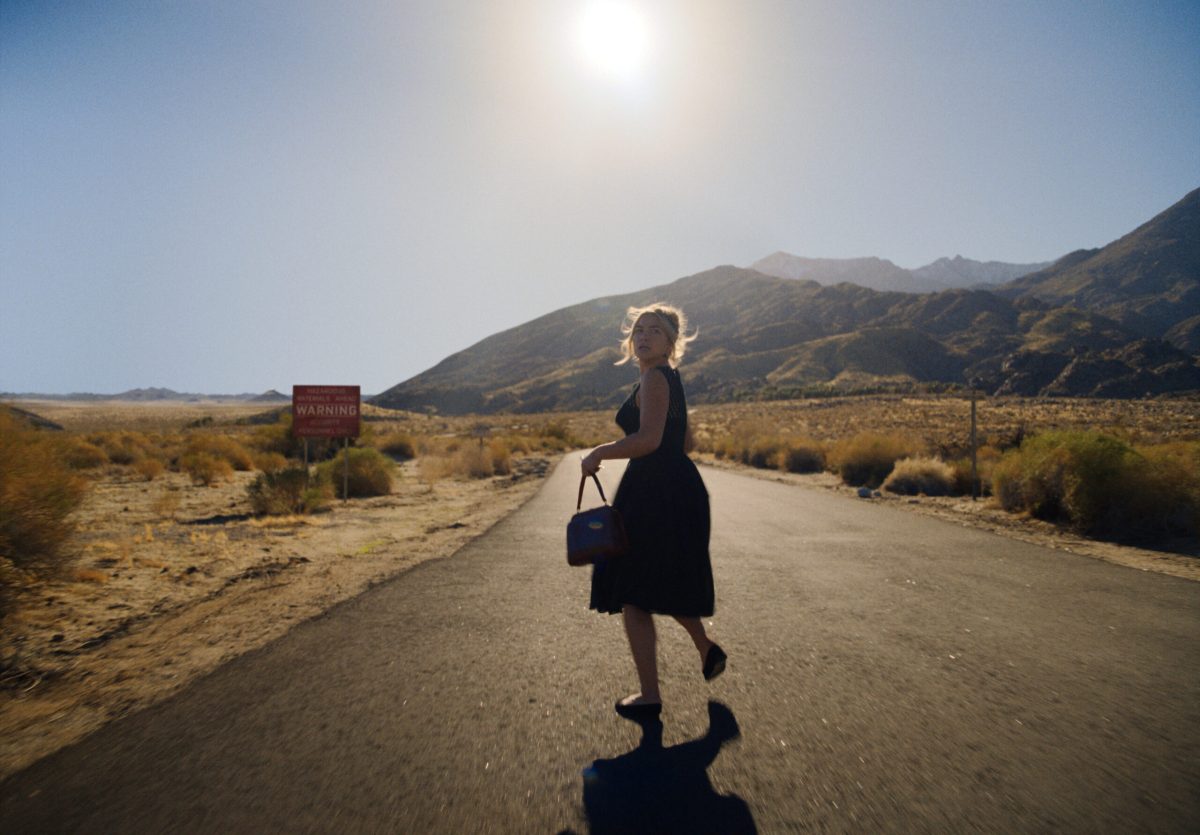
Florence Pugh in Don’t Worry Darling

Don’t Worry Darling, as the publicity primes us to expect, is a twist film. Something is not right, and it is part of the fun to work out what. Yet it is surprising just how late this twist actually arrives. Though storytelling should hardly be flattened to essential structures or beats, the reveal feels like it should happen at the start of its second act, rather than the beginning of the third. The result is a pervasive sense of treading water, awaiting a deferred explanation, while its panoply of strange, (often fantastic) imagery swirls before our eyes. A lot of the film is simply consummate, especially in its performances, design and music, though it is hampered by a script which rushes its ending in favour of serving a slow and slightly predictable cocktail of a dubious, haunted idyll, drenched in a 1950s aesthetic.

Florence Pugh’s Alice lives a life of sterile domesticity, her time split between hosting receptions and parties, cooking and cleaning, and enjoying a cool drink by the pool. Meanwhile, Harry Styles’ Jack is employed by the ambiguous Victory Project, where he and Victory’s other men go in a vintage car convoy every morning. Wilde depicts the gendered dynamics in detail, though seems comparatively uninterested in interrogating the racism of either the 1950s or the present day, casting the roles effectively race-blind. We are at first misled to believe that Victory is a strange sort of weapons development programme, a vast conurbation provided seemingly in return for shady, top-secret work in the heart of the desert. The non-domestic jobs in the town itself seem to be being completed by an underclass of men, whose place is never fully explained.

The film’s biggest issues are in the screenplay – an inventive, flawed script from Katie Silberman (reworked from one by Carey and Shane Van Dyke, which made the 2019 Black List). The story is unfortunately marred by plotting contrivances and occasionally sheer incomprehensibility. Its ostensible twist, that protagonist Alice has been unknowingly placed in the simulation by her boyfriend Jack, is slightly unsatisfying when it eventually arrives, perhaps due to the twist simply not being that surprising. The fact that something is wrong and Alice is being controlled is obvious. That this is a computerised rather than medical prison is signposted only very lightly. Furthermore, things that seem like clues (a crashing aeroplane, the walls closing in, reflections behaving strangely in mirrors) go unexplained and unacknowledged; they are presumably just glitches in the matrix (a film Wilde cites as an influence, along with Inception and The Truman Show), pointing to the world’s fictionality.
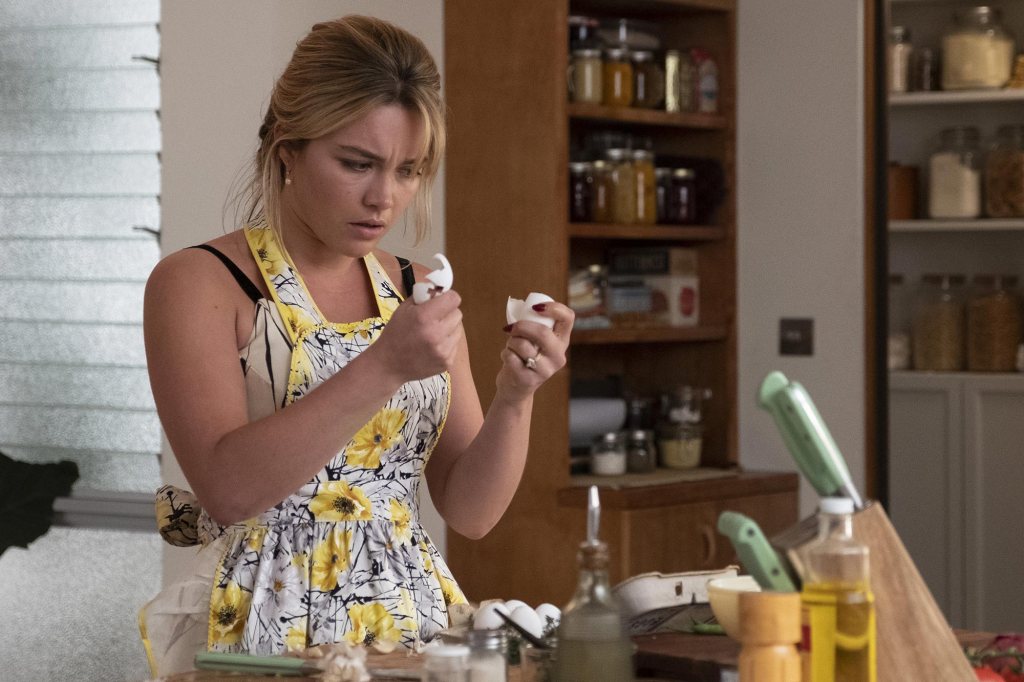
Florence Pugh in Don’t Worry Darling

Styles’ performance is not the disaster that some have claimed, though he is comprehensively outshone at every stage by the range of Florence Pugh, wringing pathos from inconsistent material. Pugh is a compelling lead, highly engaging as she attempts to figure out the mystery of the Victory Project. Were her character more naturally curious from the very beginning though, both Alice and the film itself would be more captivating. She crackles in scenes opposite Chris Pine’s Frank, Victory’s founder, who is revealed to be a men’s rights activist thought-leader (modelled consciously on figures such as Jordan Peterson) who pushes her to test the limits of his simulated world more and more. To him, she is a proof of the extent of his power, a virus testing the strength of his computer’s security.

Though much of his performance is merely functional, Styles is surprisingly good in the short flashback sequence, playing the embittered partner to Pugh’s exhausted but purposeful maternity doctor. Playing against type, living in a dingy flat with a patchy beard, his veneer of ineffectuality hides a growing malevolence. When his character complains of being ‘starving’ upon her return from a thirty-hour shift, Styles lends the line just the right amount of implied blame – that she should have been cooking for him, rather than working – to pitch his character as an insidious closet misogynist, in the midst of radicalisation down an internet rabbit hole of male supremacism. (The protagonist’s name, Alice Warren, curiously evokes Alice in Wonderland, falling down the rabbit hole only because her partner pushes her in.) In these scenes, you can see the bones of a much more interesting film lurking within this one. Though its distinctive aesthetic palette, delivered through immaculate costuming by Arianne Phillips and soaring cinematography from Matthew Libatique, is a clear plus point for Don’t Worry Darling, there is an arguably more worthwhile story to be told in the everyday squalor of normal disappointing life.

This blast of social realism seems much more interesting and much thornier compared to the ambiguous stakes of the simulated world. Alice’s long shifts point to a health sector in crisis, running off the passion and care of its doctors, while the psychology of Jack’s search for validation is much more complex than the well-made illusion he presents in Victory. I kept waiting for a clash in the real world between Jack and Alice; once introduced, the real versions seem like the heart of the film. The original script did end with such a scene, and it feels like an important omission. (The available summary of this script seems convoluted in a different but also problematic way, so Wilde and Silberman’s edits are understandable though.) However, the twist immediately hollows out the already thinly sketched Victory-world. Before, with Frank’s claims of hating chaos, far-right adjacent rhetoric of the world being ‘ours’, and the jingoistic ring of the name ‘Victory’, the film seemed like an apt metaphor for the world of incels, men’s rights activists and radicalisation. The reveal that the Victory Project is simply a futuristic version of such ideas is not quite the bracing twist it could be. Instead, it makes the film seem like a straightforward rehearsal of these themes.

After waking up from the simulation, and undergoing part-digital, part-medical reprogramming, Alice is readmitted into the Victory world, seemingly brainwashed. From here on, the strictures of the simulation are defined hastily, and we begin a scramble to the finish. The rules remain slippery though, concretised in dialogue just too late for the emotions to hit home. An argument leads to Alice braining Jack with a heavy-bottomed glass, leaving him dead. I wondered if she would now be tragically trapped in the simulation forever, a mind in a slowly dying body no one knows how to find, hooked up to a computer. Yet we soon learn (rather conveniently) that there are physical locations which let you exit the world – foreshadowed vaguely in Victory’s one rule, which forbids the women to visit Victory Headquarters. Yet this just doesn’t feel like the way such a simulation would be designed, with such an escape route, given its purpose is to imprison and control. Furthermore, the film is hampered by our likely knowledge of existing genre conventions. The logic that dying in the simulation equals death in reality comes without any foreshadowing and is not what we would typically expect. Again, would simulation architects really build it that way, that an in-world accident automatically kills the real body? The science of the simulation is largely irrelevant, but one of the film’s strongest points is understanding the psychology of misogynists, and here the logic of Victory is fumbled.

Florence Pugh and Harry Styles in Don’t Worry Darling

The film’s mismanagement of audience expectations is felt in the marketing too. Don’t Worry Darling is pretty much exactly the film you might expect it is, its plot mechanics largely revealed in its trailers. Given its reliance on images – creating a patina of a misremembered, nostalgic 1950s aesthetic before cracking it apart – it seems remiss for quite so many of its most striking visuals to have been spoiled in advance; the sight of Alice being crushed by a wall against a window, suffocating herself with clingfilm, and even key parts of the car chase which closes the film are present in the trailers. Nor has the film’s frequently baffling media tour helped. The events on set of Don’t Worry Darling exist somewhere between the excesses of an out-of-hand marketing campaign and a genuine failure of stewardship from the film’s core creatives and producers. The details are vague though potentially alarming, with Pugh largely absent from the film’s promotion. Wilde has called out double standards, suggesting that male filmmakers get much more a pass for poor on-set behaviour, but (though likely true) this hardly works as an excuse. Yet Don’t Worry Darling does not seem like a troubled production on screen though. In fact, its solid premise and production are most in want of subtler script editing, with a more cogent thesis allowed to emerge than what Adrian Horton (writing in The Guardian) calls its ‘empty feminism’.

There has been a strange emphasis on female pleasure as an inherently feminist act in Wilde’s promotion too. The view that female pleasure can be political and liberatory is shared by many feminists and convincingly connects sex to ethics, gender and social behaviour. However, as a theme it seems vastly ill-suited to the film’s actual contents, given how exploitative (and by definition non-consensual) Jack’s sex acts are, however much his and Alice’s sex life foregrounds cunnilingus over the male orgasm. In a sexual context, the simulation seems almost like a metaphor for date-rape drugs, distorting Alice’s sense of reality and crucially undermining her ability to give informed consent. Yet in interviews, such as one in Variety in August, Wilde sets out her vision for feminist sex scenes; ‘Men don’t come in this film […] Only women here!’ While deprioritising the male orgasm has long been a sex-positive feminist goal, the discrepancy between such promotion and the film’s content is jarring, called out by Horton as ‘borderline offensive’.

Wilde laments that ‘the focus on men as the recipients of pleasure is almost ubiquitous’ in depictions of heterosexual sex, yet the extent to which Wilde is deliberately distracting from her twist or missing that the film depicts no real, consensual female pleasure at all is unclear. Wilde is keen to show sex as pleasurable for women in a heterosexual context, as has become more common in LGBTQ cinema. Yet Don’t Worry Darling is a startling metaphor for the imprisoning effects of heterosexuality on women; there is not one relationship in the film not influenced by vast manipulation and male control. ‘My early conversations with the cast were all about how the audience has to buy into the fantasy’ of the world, Wilde says, including the ‘extreme passion’ Jack and Alice seem to have for each other. It is exclusively Jack’s fantasy though. When Frank leads chants of ‘Whose world is it?’ the first-person plural reply of ‘Ours!’ seems strictly limited to the men.
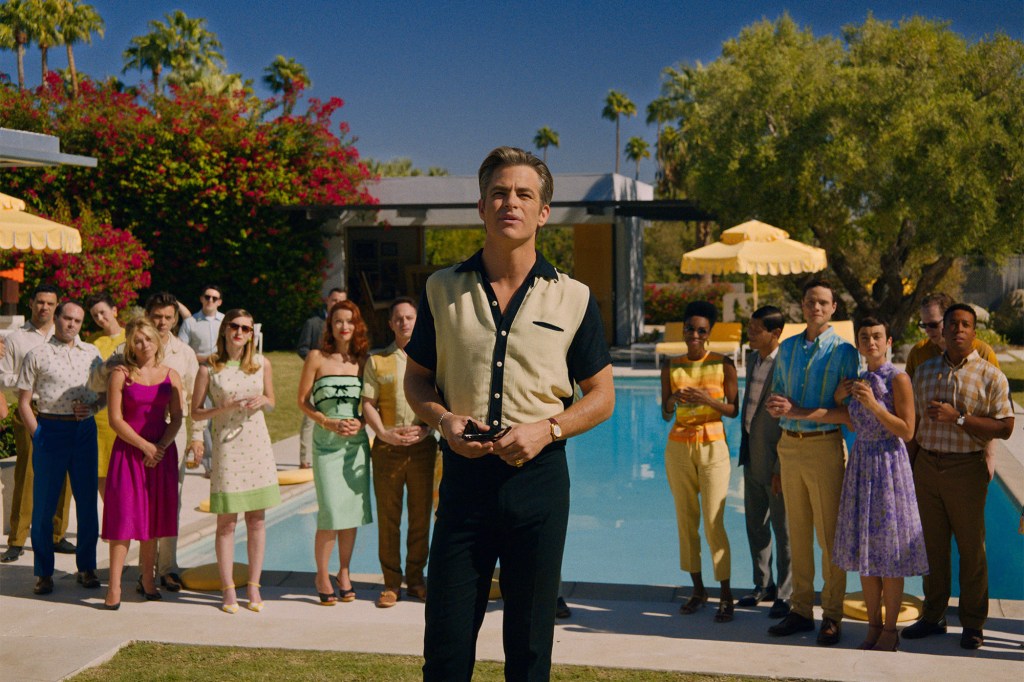
Chris Pine in Don’t Worry Darling

Thematically, Don’t Worry Darling is a film about the importance of female choice and the insidious ways men control and limit those choices – first, in the gendered semiotics of a husband going out to work and the wife expected to stay at home, then in more violent manipulation. At moments, it wants to be a searching film about the nuances of female choice and pleasure, evident in the reveal that Alice’s best friend Bunny has always known the truth. She has, she tells Alice, voluntarily entered the world, though the ethical nuances of such a choice are skated over. If participation in the Victory Project could be consented to (itself debatable), what about voluntarily deciding to leave? Presumably, the men in red would try to stop Bunny if she made a break from the headquarters too. Bunny implies though that she would never want to leave, mainly as her children are there – seemingly replicas of children who died in the real world. Ideas like this, the attraction for some of controlling ideologies as an escape from difficult pain, are fascinating but disappointingly underexplored. Delaying of its reveal so late into the runtime leaves a breathless dash to a very literal exit portal finish line, generating propulsive energy at the cost of depth.

Some themes feel richer, and the presentation of notional hysteria and female madness within the form of a psychological thriller is compelling, served particularly well by the presence of Timothy Simons as the project’s doctor. Also interesting is its presentation of Jack’s underlying misery in Victory, in part the self-loathing that hides beneath a growing bravado but also resentment that he must leave every day to go to work – to ‘pay for this place’ in real job he hates. One aspect of the incel fantasy is that men gain near-total power over women and their families, in return for being providers. Yet the results are misconceived at every level, fuelled by a horrifying saviour complex; Jack thinks he is rescuing Alice from being a doctor, misunderstanding the draw of rewarding difficulty over soulless ease. Yet Wilde and the screenplay neatly combine the techno-misogyny with the capitalist grift that underlies so much incel-oriented media. Men are spurred to work, not merely to provide, but to fund the gurus who inspire them. The wealth seems to trickle upwards, in this case to Frank, who runs and charges for participation in the simulation – a grand metaphor for the publishing and media industries which enrich promoters of pseudo-scientific essentialism and lifestyle advice.

Florence Pugh in Don’t Worry Darling

Ultimately, Don’t Worry Darling is a far stronger film about the psychology of men and the causes of patriarchy and abuse than it is about women and feminist responses. The women of Victory are spurred into a hurried revolt again male authority, through little action of Alice. (Why is Alice believed, while Margaret is widely dismissed as hysterical?) Gemma Chan’s highly composed Shelley stabs Frank suddenly, twisting the knife in revenge, but her motivations are kept offscreen. The makings of a revolution are here, but it seems convenient, a film’s happy ending. What happens when these women wake up (potentially tied up, as we see in Alice’s case) next to their abusive partners? The film understands the lengths to which could go in order to assert control, strikingly mirroring real-world behaviour, but its feminist solutions are inapplicable outside of the grammar of cinema.

Wilde’s direction offers some arresting images to complement its timely and interesting, if inconsistent, array of themes. A recurring birds-eye view of a ring of dancers fluttering in and out like the dilations of an iris is later revealed as a form of loading screen, as you enter and exit the system. The production design fills Victory with subtle V-shapes (including Frank’s tie-free suit style, which some of the other men hastily try to adopt in a sharply satirical beat), and the colour palette is perfect for subversion – as the primly immaculate pastels turns to blood-drenched horror. The desert car chase inevitably evokes the aesthetics of Mad Max, but also reminded me of the grit of Coralie Fargeat’s 2017 feminist interrogation of violence and feminist justice Revenge. Victory is rendered through a clever mixture of location shooting and seamless CGI, plausible and disquietingly unreal in the same moment. Underneath, John Powell’s score dissolves from lilting string swoons of apparently perfect love into dissonant tones and breathily sampled vocals, reminiscent of the (albeit more adventurous) work of composer Cristobal Tapia de Veer. The final sequence is particularly striking for its thunderous bass twinned with the sounds of female exhaustion.

All of this should add up to a bit more, and it is a shame that the good work turned in by most departments and actors is not matched by enough deftness in the writing. Don’t Worry Darling is surely destined to be remembered for its alleged production turbulence, rather than its more intriguing (though occasionally alarming) substance. As a comment on incel activities, it works as a functional satire, though the script is largely content to demonstrate gendered violence rather than offer a detail feminist critique or diagnose a solution.

Don’t Worry Darling

Directed by Olivia Wilde, Screenplay by Katie Silberman, Story by Carey Van Dyke, Shane Van Dyke, and Katie Silberman, Produced by Olivia Wilde, Katie Silberman, Miri Yoon, and Roy Lee, Cinematography by Matthew Libatique, Edited by Affonso Gonçalves, Music by John Powell, Starring Florence Pugh, Harry Styles, Olivia Wilde, Gemma Chan, KiKi Layne, Nick Kroll, Chris Pine
Categories
Film

See How They Run

In late December 2021, an article by Parul Sehgal in The New Yorker caused a minor stir. ‘The Case Against the Trauma Plot’ set out a detailed and nuanced criticism of the emergence of trauma as its own literary genre, with such narratives circling around the suppressed and relapsing memories of trauma. Trauma has been its own field of literary study for a while now, particularly popularised by the work of trauma theorist Cathy Caruth, from the 1990s onwards. Popular awareness has led to trauma becoming a dominant lens for reading both books and people, with results Sehgal rails against, such as the reduction of character behaviour to mere symptoms. She notes that there are ‘636,120 possible symptom combinations [that] can be attributed to P.T.S.D.’ The statistic reveals the intense complexity of different experiences and the absurdity of trying to write a condition rather than a character. Furthermore, she despairs at how ‘[t]rauma trumps all other identities, evacuates personality, remakes it in its own image’ and how ‘[t]rauma has become synonymous with backstory’ leading to the ‘tyranny of backstory’. Every character is in need of trauma to seem three-dimensional, but it ironically flattens and dims a character’s vitality.

Sehgal’s article was also a contribution to the broader literary discussion of personal trauma, the roman-a-clef confessional semi-fictional mode, and (perhaps most controversially) the ownership of narrative. ‘My trauma, I’ve heard it said, with an odd note of caress and behind it something steely, protective’, Sehgal writes, arguing that trauma is often viewed as something to be guarded rather than alleviated. It could go beyond being a character trait but become someone’s definition – whether fictional or real. Disclosure narratives have become a growing sub-genre, but so too have the dangers of forced disclosure – including the outing, even doxing – of someone’s trauma become rightfully considered problematic. Partly this is a moral question, but with the creep of intellectual property rights as the cornerstone of mass media it is now also legal and financial. Stealing someone’s (tragic) life story is not only cruel but sits ambiguously close to an act of plagiarism.

Into these discussions, rather surprisingly, enters See How They Run, a frothy, gently parodic spoof murder mystery, set during the early stages of Agatha Christie’s West End smash The Mousetrap. Yet it is also a film about the lure of money, contractual idiosyncrasies of intellectual property law and, most startlingly, the ownership and exploitation of trauma.

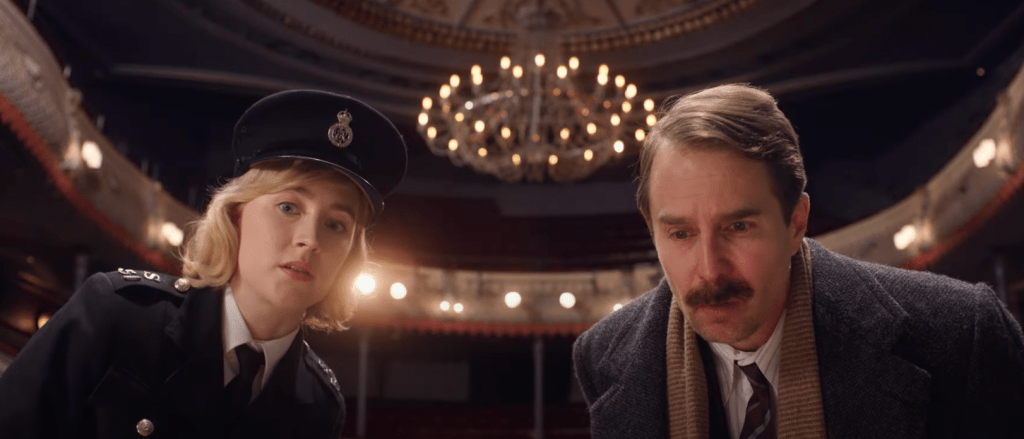
Saoirse Ronan and Sam Rockwell in See How They Run

Of course, the murder mystery genre inherently requires violent deaths, but that does not mean that the genre is composed solely of abyss-staring, nihilism and traumatic recollection. In fact, the ironic juxtaposition of evil acts with a pervasive tone of cosiness is often one of their draws. James Greig’s witty polemic, published in Gawker in February, denounced the spread of such ‘cozy crime’ (from authors including Richard Osman, Rev. Richard Coles, and Ian Moore), arguing that their genteel attempts at social commentary are deeply flawed. By contrast, Christie herself wrote from a class-conscious position of satire. Her books were not a way of tuning out social issues with a literary crossword puzzle, but split open the fissures of resentment, corruption and criminality that ran beneath the veneers of social etiquette and performative politeness. Christie’s choice to make her best-known sleuth, Poirot, an immigrant in a society frequently suspicious of him was surely a somewhat deliberate decision, though the extent of her radicalism can easily be overstated. For all its absorption into the safely inoffensive rhythms of daytime television schedules, there is a sharpness that has been widely forgotten.

To accuse See How They Run of cosiness outright would be to miss the way it deliberately plays with our faulty collective memories of the stylings and content of ‘Golden Age’ murder mysteries. (The term generally refers to the prolific period during the 1920s and 30s, in which ‘Queens of Crime’ Christie, Margery Allingham, and Dorothy L. Sayers, and other authors served up murder plots by the dozen. However, Christie’s popular longevity endured throughout her lifetime.) See How They Run does convey a certain degree of cosiness, which is subverted only in part. It presents a sanitised London of memory, with few of the social issues, only the set dressing of historical events. (The Rillington Place murders are being dealt with in the same office, alluded to only in passing.)

To the trappings of mid-century murder mysteries, director Tom George adds the comic stylings of Wes Anderson. The film never has quite the same visual detail as is found in Anderson’s precise, frequently symmetrical shot composition, but occasionally the more dynamic camera moves feel inspired by his style, along with the design and colour palette. Perhaps the influence is felt most in the tone created by Daniel Pemberton’s soundtrack, which apes the ticking drum lines and offbeat rhythms of The Grand Budapest Hotel. Both films also feature a scene-chewing, delightfully unpleasant turn from Adrien Brody.

Yet, in its striking denouement (which I will avoid spoiling, though will allude to the killer’s motivation), the film keys into something much deeper – the ethics of writing (and exploiting) someone else’s story. Even in the 1950s, trauma sells tickets; but did Christie (and do we) have the right to sell another person’s (tragic) truth as an integral part of her fiction? The trauma of real victims continues to be dramatized on stage, night after night, in London’s West End to this day.

Reece Shearsmith, Ruth Wilson and David Oyelowo in See How They Run

See How They Run follows a similar pattern to Edgar Wright’s 2021 film Last Night in Soho. In both, the aesthetic world of mid-20th century London (for George, 1953, rather than Wright’s evocatively half-remembered 1960s) is used as the playground for self-consciously genre-influenced drama, before deepening and twisting into an exploration of far more contemporary ethics. Wright pits our collective cultural memory of the 1960s as a decade of sexual liberation – when ‘sexual intercourse began’ as Larkin’s poetry notoriously claimed – against a grim reality of sexual violence, unpunished judicially and without significant cultural reappraisal. Last Night in Soho feels like a male filmmaker’s attempt to reckon with the uneasy aesthetic valorising an ethically dubious period and moment, as well as with the abuses perpetuated and covered up under the aegis of Hollywood power. George, on the other hand, questions the extent to which his own entertainment’s relationship to the real (including real violence) is problematic. The Russian doll effect is pleasingly neat, but with just enough seriousness to seem like an effective discussion.

As its marketing is keen to proclaim, the film also has a similarity to Knives Out, though these comparisons will not necessarily flatter See How They Run’s valid, but altogether different intentions. Both have large and impressive ensemble casts, led by major stars as relatively idiosyncratic detectives. Both also infuse their classic mystery stylings with notes of social commentary. Yet See How They Run does not fizz with quite the same intensity as Knives Out, which reveals itself early on to be keyed into contemporary issues such as nepotism, wealth and healthcare inequality. Instead, See How They Run’s thematic richness comes as a pleasing, last-minute surprise, with far less room to develop or breathe.

The comparison also makes you realise how effectively Rian Johnson managed his large ensemble cast, in script and direction. At times here, Mark Chappell’s script seems deliberately structured to maximise availability and minimise shoot days for many of its superb cast. Notably, the film requires all of two scenes with the suspects all in one room. Reece Shearsmith, Harris Dickinson, Pearl Chanda and David Oyelowo are given lively enough characterisation to work with, while Ruth Wilson, Pippa Bennett-Warner and Sian Clifford feel particularly underused. Popping up here and there, Tim Key is fantastic as a senior detective, who contributes a sheer comic energy and idiosyncratic oddness which sparkles in his run-ins with his junior officers. As the unfortunate victim, Adrien Brody scintillates in his charismatically odious fourth-wall breaking opening, though his absence is felt later on. Many of the film’s funniest moments come when he pops up again in the dreaded flashback (as is ironically lamented in the film’s many meta-touches).

Even if some players feel a little spare, the cast is the film’s greatest asset, George bringing out hugely entertaining performances across the board. As an overly enthusiastic relative-rookie, Saoirse Ronan is especially brilliant, revealing huge reserves of comic talent that her varied career has yet been unable to showcase. Opposite her, as ostensibly the lead (but only by dint of police seniority, rather than how the film focuses its attention), Sam Rockwell does his best with the comparatively thinner part of Inspector Stoppard. The intention with his character seems to be the mounting of similar bait and switch subversion to the ending – substituting narrative cliché with a sudden surprising depth. Chappell constructs an archetypal alcoholic cop with demons, but there is comparatively little pathos to wring from the part, even in the hands of an Oscar winner. One image is devastatingly effective though, in which we see Stoppard surrounded by the jigsaw puzzles he has lovingly made, but (for reasons we later learn) no longer needs. It glimmers with a meta-irony that this professional clue-smith spends his time off making puzzles, but it also lends a film with generally low stakes with a bit more heart.

Charlie Cooper in See How They Run

In recent Guardian feature, Michael Billington laments the film’s mangling of theatrical accuracy (for example, utilising the oversized foyer and auditorium of the Dominion and Old Vic theatres in lieu of the ‘cosy intimacy of the Ambassadors’). His claim that the theatre’s small size contributed to the play’s air of mystery and secretiveness rings true, but the film seems to tiptoe around the actual events of The Mousetrap for a fairly good legal reason; Christie only permitted an adaptation to be made six months after it closed, to conceal the solution that gave it such an allure. It is, of course, still going strong to this day. Painstaking accuracy is not the name of the game. Billington also demands to know why the ‘very engaging’ figure of Peter Saunders (The Mousetrap’s producer) has been replaced by a ‘fictive female’ (played by Ruth Wilson), which again mistakes the film’s deliberate purpose. It has been cast to be representative of the present day, rather than in line with real historical events, a fact signposted most strongly by the denouement’s use of more contemporary ideas of stolen stories. Another reason could also be to increase the realistic pool of suspects; the film would perhaps not get away with accusing Richard Attenborough of murder – even of a fictional victim.

There is certainly a frisson though in including the real John Woolf (a wonderfully spiky Reece Shearsmith), who schemes to turn the play into a film – albeit having foolishly agreed to Christie’s stipulation that production could only commence after the play had closed. The film knows it cannot spoil The Mousetrap’s distinctive mystery – though its putative uniqueness discounts its many similarities to Christie’s earlier novel Hercule Poirot’s Christmas, down to the falling snow outside. Instead, the film spends its slightly protracted second act flirting with and overplaying us a red herring solution similar to that of the actual Mousetrap play. Even for a film running to a brief 98 minutes, we feel it is too early for the real mystery to be solved, and the film plays its mislead little too straight. Though See How They Run seems keenly aware of our likely expectations for the most part, here the audience will likely be ahead of it.

In the end, the actual solution is a clever synthesis of classic murder mystery tropes, and those in the know will appreciate how its reveal rhymes in another way with the solution to The Mousetrap, without spoiling it. What weakens it though is the noticeable lack of Agatha Christie-esque clueing. Throwaway lines are crosscut in order to construct the sense of a guessable motive, even though it is the film’s editing that raises this as an option, rather than much of Stalker and Stoppard’s investigation. The film disregards the mechanics of the crime itself, and very little time is spent on establishing opportunity. It is taken as blanket fact that anyone could have stolen out and killed Brody’s swaggering film producer. The red herrings simply mislead us, rather than opening up to reveal alternative meanings, and the effect is that the twists and turns feel a little artificial. The film would not really work were it not a definitional character trait of Constable Stalker that she jumps to conclusions. Furthermore, one of the few things that could be considered a clue (albeit extremely vaguely) is offered up by the murderer themselves, for reasons that seem retrospectively inscrutable.

Without revealing too many details, the motivation concerns the actions of Agatha Christie and the play’s producers, who utilised a real story of child abuse perpetuated in the 1940s as a basis for the plot of The Mousetrap. (No stranger to weaving fiction from the headlines, Christie had previously found inspiration for Murder on the Orient Express in the kidnapping and murder of aviator Charles Lindbergh’s baby in 1932.) Seghal warns that the effect of defining a character’s identity in terms of trauma can be reductive and ‘totalizing’. To complain of this in a murder mystery seems glib, given how puzzle-like the genre can be, where motive (with opportunity) count for everything. Yet the role of the murderer is consciously defined by little more than the character’s trauma here. Like most of the suspects, the role is impeccably performed – before and after the reveal – by a terrific actor, who elevates their fairly brief material superbly. Yet, as a searching study of stolen trauma, it remains largely undeveloped. Could this be one such case of what Sehgal calls ‘evacuate[d] personality’? In fact, while the motivation is clever and subversive for the mystery form, it does not fully transcend the cynical exploitation it criticises. This is hardly a wholly sympathetic portrayal of a real-life victim both of abuse and commercial artistic exploitation, but another commercial artistic project which utilises real trauma – a thorny irony of which the film is surely aware.

Sam Rockwell and Saoirse Ronan in See How They Run

It spoils only a minor surprise to reveal that Agatha Christie herself makes an appearance at the film’s climax. (In the film’s promotional material, she is billed simply as ‘The Dame’.) In a neat subversion, the murderer is the one who has rounded up the suspects for the denouement, by sending them fake invitations to Agatha Christie’s home. Christie is an interesting figure for such a narrative, given not only that she drew on real cases but that her disappearance in 1926 generated its own share of exploitative media interests and narratives. Yet the film declines to explore any parallel to this, instead casting Christie (Shirley Henderson) as a semi-heroic, semi-maniacal figure, dispensing narrative – if not ethical or moral – justice with a startling ferocity.

Perhaps the film is therefore intended as an extended meta-comeuppance for the characters’ willingness to exploit a tragic story for profit. Suffering the comparatively smaller blow of highly caricatured (mis)representation here is maybe fair game. Michael Billington’s chagrin might be part of the point. Do these people have an automatic right to realistic and accurate representation anyway, as the characters themselves argue? Yet See How They Run’s irreverence comes from a place of deep love for its source, generously (though perhaps contractually) obscuring the play’s famously secret denouement, even as it tips winks towards it. The film’s title refers to a Philip King comedy, whose title in turn comes from the nursery rhyme ‘Three Blind Mice’ – which was The Mousetrap’s original title. Further thespian references are sprinkled across the script, including a pun based on Tom Stoppard’s play-within-a-play mystery The Real Inspector Hound. It even ends with Inspector Stoppard asking us not to spoil the film, drowning out the end of The Mousetrap play on stage.

The brief debate See How They Run raises boils down to a violent killer’s brief pre-death self-advocacy, followed by an only partially convincing retort from Christie that writers should be allowed to write what they like. Yet this uses the wider struggle for the freedom of expression of the censured and oppressed as a clumsy shield for a specific instance of arguably misused power. The film enacts minor literary revenge by parodying Christie as fundamentally bloodthirsty, writing murder novels as psychological outlet for violent impulses. At a pivotal moment, she has to be told to stop bludgeoning a body with a snow shovel, Henderson’s eyes burning with rage and vengeance as an inner bloodlust is shockingly revealed as she stretches the definition of self-defence to (and beyond) its limits.

Overall, See How They Run feels caught a little between tones. It is not quite the gag-a-minute rat-a-tat comedy it could be, like some of its most notable antecedents (such as the pun-riddled delights of Hot Fuzz), though does it land some great laughs. Nor does the solution feel fully explored – a clever idea for motivation twinned with relatively pedestrian mystery mechanics and police plodding. You wonder if there is a funnier comedy, a more intense drama, and a sharper mystery waiting in the wings here, though it remains a delightfully theatrical treat.

See How They Run

Directed by Tom George, Written by Mark Chappell, Produced by Damian Jones and Gina Carter, Cinematography by Jamie D. Ramsay, Edited by Gary Dollner and Peter Lambert, Music by Daniel Pemberton, Starring Sam Rockwell, Saoirse Ronan, Adrien Brody, Ruth Wilson, Reece Shearsmith, Harris Dickinson, David Oyelowo, Charlie Cooper, Shirley Henderson, Pippa Bennett-Warner, Pearl Chanda, Paul Chahidi, Sian Clifford, Jacob Fortune-Lloyd, Lucian Msamati, Tim Key
Categories
Film

Happening

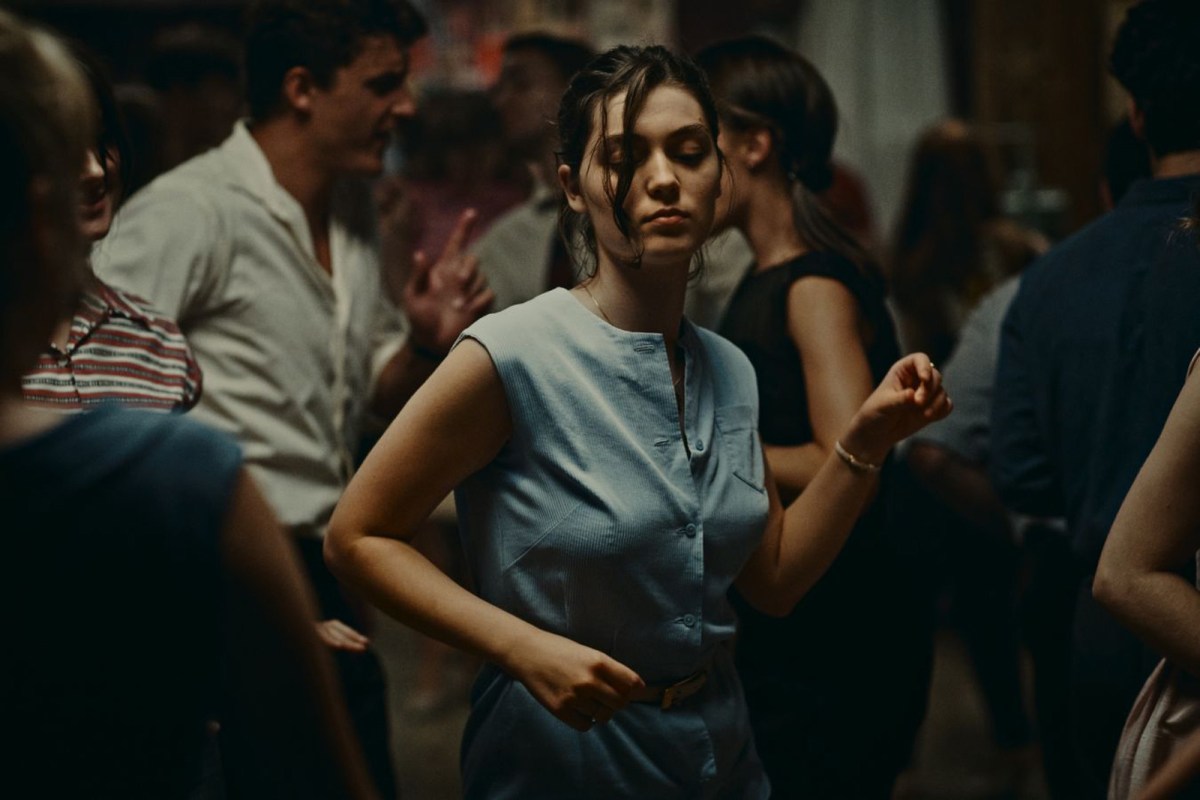
Anamaria Vartolomei in Happening

Early on in Happening, Audrey Diwan’s Golden Lion-winning adaptation of Annie Ernaux’s 2000 memoir, a professor of literature asks author-alike Anne what the literary name for a figure of repetition is, in front of a lecture theatre of fellow students. ‘Anaphora,’ she confidently replies. This moment seems like Diwan partially revealing her hand, tipping a wink to the rhythmical structure which underpins the film’s shape – a pattern of dramatic repetition.

Everything changes for Anne on discovery of her unwanted pregnancy. It is the event (the happening, l’événement, as in the French title) which can barely be named – partly for the veil of enforced secrecy that renders any attempt at termination illegal, partly for its sheer incomprehensible horror. Happening follows Anne’s repeated and arduous attempts at getting an abortion in 1960s France – and the failure of each in turn. This anaphoric pattern of relief quickly thwarted creates a recurring rocking motion between hope and despair throughout the film, more potent than mere constant dread.

Perhaps the most significant difference between Ernaux’s memoir and the film is this shift from the interior terror of unwanted pregnancy, albeit abstracted a little by time, to the more external film narrative. We are told and shown that Anne has a brilliant mind and would be a terrible loss from academia and contemporary literature, unlike the book – which communicates this through the subtler implication that, had the pregnancy gone ahead, there would be no memoir at all. Thus, the film is slightly more interpretable as a questionable cautionary tale about the effects of restrictive policies on the exceptional and deserving. Yet Diwan’s choices mitigate such effects, with Anamaria Vartolomei’s subtle central performance foregrounding the sheer human pain over Anne’s relative exceptionality. It is everyone else who is obsessed by her academic potential, which ends up as yet another cruel bureaucracy, heaping pressure upon Anne as she attempts to escape the prisons of motherhood and the state, and survive.

Anamaria Vartolomei in Happening

Anaphora maps onto Anne’s tragic descent. Anne is a star student, knowing all the answers while another female student is upbraided for poor focus. Yet late in the film she receives similar criticism from the same professor, her written work and in-class concentration badly affected by her situation. (Indeed, one effect of the call-back is to make us question the circumstances of the earlier student; perhaps there was more to her ignorance than inattentiveness.) Anaphora also powerfully drives the film’s queasy oscillating motion between seemingly successful escape from pregnancy to each abortion attempt being revealed as a failure. The first doctor does not entertain her request for an abortion, asking her to leave. Yet a second one prescribes Anne something, appearing to be receptive to Anne’s pleading entreaties. The medication does not work. In fact, we later learn that this prescription was designed to strengthen the foetus and make it more difficult to abort. The same process of imagined relief and disappointment occurs again and again – failing to end the pregnancy with a knitting needle, and even by a trip to a Parisian abortionist. Only on a second visit is the pregnancy finally ended, but almost at the cost of Anne’s life.

The film has the visual stylings of a conventional biopic, its close-up focus on Anne compounded by the claustrophobically square aspect ratio. Unshowy on-screen intertitles, starting ‘7 semaines’ and counting the weeks as they tick by from there, rachet up the tension with the simple dread of a ticking clock. The film commits to several startling visual moments – such as unbroken shots of attempted medical procedures – yet the sound-world Diwan has curated also lends the film an eerie tension. Evgueni and Sacha Galperine score Happening like a horror film, punctuated by strange, muted piano and string notes which crackle with building menace. Diwan scores many moments with only silence, shifting sound levels to evoke Anne’s world tilting off its axis. After Anne’s diagnosis, everything sounds very loud, except other people – who are muffled into obscurity. She is alone in a dissonant, hostile world.

The film commits to a pervasive realism, especially true of its frank medical scenes. Two abortion attempts are presented in real time, the second in a long single shot that captures Anne’s agony and the focused precision of abortionist Mme Rivière. It plays out with the grim logic of a horror drama as Rivière tells Anne that if she screams then she will have to stop. If the neighbours overhear the abortion, they could both end up in prison. Anne must endure agony silently, almost akin to the wincing pain of 2018 horror film A Quiet Place. Yet this horror is distinctly realistic and real. As Mme Rivière is almost finished, Anne lets out a sudden cry. The abortionist gives her a look, then quickly finishes up – the scream yet another anaphoric moment of potential failure. Diwan’s realism extends to the offhand glimpses we are given of other similar though untold horror stories, with tragic outcomes. Mme Rivière washes her instruments in boiled water to sterilise them, rather than disinfectant, remarking: ‘bleach in a uterus. And you wonder why they die.’

Anamaria Vartolomei in Happening

Happening is rendered political by its received context more than its literal content. Diwan stages no debates over ethics, methods, efficacy or regulation. French abortion policy is condemned by implication only; its effects are clearly inhumane, cruel and unlikely even to prevent abortions as intended. Happening is instead about the visceral body horror of something growing inside you that you do not want there – and the shockingly obliterative effects of forced birth on women’s lives. Anne describes herself as having ‘[t]he illness that strikes only women and turns them into housewives’. The terms are apocalyptic; pregnancy is literally ‘the end of the world’ for Anne. The toxic patriarchal combination of abortion bans and a society in which mothers are siloed from economic and creative participation in society makes birth a life-altering, even life-ending, event.

As Anthony Lane writes in The New Yorker, ‘Nobody is moved to ruminate on the rights and wrongs of the situation.’ There is a far greater sense of urgency from Anne, to save herself from a terrible fate, while the barrier to action is legal, not personal or moral. Lane writes that the film’s ‘pragmatic’ morality is entirely ‘grounded in a universal terror of breaking the law’. Anne’s friend Brigitte is so terrified of going to prison that her sympathies for one of her closest friends are neutralised, and she keeps her distance in an act of self-preservation. Yet when Anne’s roommate Olivia is forced into complicity, by cutting the umbilical cord, we see the anguished calculations momentarily playing out on her face – balancing shock, horror, and fear of prison – before empathy nullifies legal or moral concerns in favour of the pressing need to assist and provide care in that moment.

Happening shares the same focus on the dehumanising nature of abortion restriction that 2020 US abortion drama Never Rarely Sometimes Always charts. The latter film is set in a country where, at the time of making, abortion was theoretically protected by law. Yet access is rendered expensive and often out of reach, the title evoking the bureaucratic maze of invasive questionnaires that the system demands are answered. In Happening though, the French state is not so much casually cruel in its abortion restriction as outright ignoring the very idea that abortion could be a debate. The result is maddening and alienating – forcing Anne to keep secrets from anyone she cannot entirely trust.

The film works hugely effectively as a contemporary parable about the necessity of reproductive healthcare, as well as a chronicle of a unique period in history. The 1963 setting makes the events feel all the more acute, a time of increasing social sexual pressure not yet matched by availability of birth control or abortion. In many ways, 1963 is a darkly apt mirror of the present day; social pressures remain, just as reproductive healthcare comes under attack from the religious right – especially in America. The grim consequences of such an inchoate sexual revolution – yet to take significant mainstream notice of female pleasure – are depicted in the warped logic of Anne’s male acquaintances. One friend, Jean, tells her that ‘There’s no risk if you’re pregnant’, during his bid to seduce her. Yet, Diwan purposefully hard cuts from his claim to one of Anne’s friends inspecting a mark on her body, suggesting it could be syphilis. By the end of Happening, Diwan arrives at a more nuanced and optimistic view of sexual pleasure, though there remains huge risk when health problems are met with stigma and hostility by the medical establishment.

Perhaps Diwan’s primary theme in Happening is freedom – implicitly asking what it is and how it can be achieved. She documents a society in transition where entrenched beliefs and norms are in flux. Such a shift in intergenerational perspective is evident in one scene where Anne speaks to her mother, who reprimands her by saying: ‘Can we afford to do what we feel like?’ In the mother’s remarks rings the sound of a life unfulfilled. The film clearly prompts us to ask: why not? It is an appeal to the utopian and liberatory which still seems apt now.

Anamaria Vartolomei and Sandrine Bonnaire in Happening

Happening continues to mull the words of Anne’s mother and Jean. While Diwan’s initial juxtaposition makes clear the fallacious logic of there being ‘no risk if you’re pregnant’, it seems to lodge in Anne’s mind, culminating in a stunning sequence in which Anne leverages her pregnancy’s unique silver lining – the protection from conception at least – to have passionate, pleasurable sex without inhibition. From the way she stares, quietly wide-eyed, at her roommate’s demonstration of masturbation on a pillow, Diwan seems to encourage us to deduce that the (off-screen) sex which began Anne’s pregnancy was far from satisfying or pleasurable. Thus, Diwan builds on Ernaux’s coolly retrospective yet tense narrative to add an oasis of joy into its grim, panicked crescendo. It lends a fantastic texture to the film – a catching of breath before the ordeal of the two abortion attempts, which will almost cost Anne’s life.

One of Happening’s defining themes is that of arbitrariness. So much hinges on the kindness of individual doctors within the system. The film shows us three. One is deliberately duplicitous, in prescribing drugs to undermine Anne’s efforts. Another is merely kindly, rather than actually kind. He makes no show of pretending the pregnancy is good news and the line ‘Accept it. You have no choice’ is read with the somewhat good-natured empathy of a man who feels his hands are entirely tied, despite the crushing effect of those words for Anne’s autonomy and future. A third doctor appears, blurrily out of focus and almost entirely unseen, at the film’s ending. Anne lies bleeding on a hospital trolley, and he is asked to make a snap-verdict on her condition which will define the rest of her life. One word from will save her from years in prison. ‘Miscarriage,’ he says.

The palette of the film seems to subtly darken as the film progresses, yet after this it flashes to white as the image swims and fades out. Upon her recovery, everything seems brighter.

In the memoir Happening, Ernaux describes her experience of abortion as defined by ‘clandestinity’, arguing that her story is still worth telling, even though such clandestine experiences are ‘a thing of the past’ due to the legalisation of abortion (in France, and in many western nations). However, the repeal of Roe vs. Wade in America epitomises the many regressive steps that can and have been taken. Ernaux characterises the memoir as a reckoning with a major life experience, and she is convincing in her argument that her story should not be shrouded by a ‘veil of secrecy’ – nor should she ‘remain silent on the grounds that “now it’s all over.”’ Yet two decades on from publication, Happening is a shocking personal tale with sweeping contemporary relevance. It is not only testimony of the past’s cruel bureaucracies but a warning that abortion is unpreventable; all that can, and should, be stopped are the harms caused to those forced to carry foetuses to term against their will. The film’s structural anaphora maps onto a far broader trend. This is one personal iteration of a story that happens again, and again, and again.

Happening

Directed by Audrey Diwan, Screenplay by Audrey Diwan, Marcia Romano and Anne Berest, Based on L’événement by Annie Ernaux, Cinematography by Laurent Tangy, Edited by Géraldine Mangenot, Music by Evgueni Galperine and Sacha Galperine, Starring Anamaria Vartolomei, Kacey Mottet Klein, Sandrine Bonnaire, Louise Orry-Diquero, Louise Chevillotte, Pio Marmaï, Anna Mouglalis, Fabrizio Rongione, Luàna Bajrami, Leonor Oberson
Categories
Film

Boiling Point

Vinette Robinson and Stephen Graham in Boiling Point

Andy Jones is clearly under pressure.

Philip Barantini’s film, which follows the unfolding disasters of one evening in a high-end London restaurant, is both a study of the head chef’s tragic downfall and a dynamic ensemble piece, following the interweaving tales of his staff and punters through this pressure-cooker work environment. The film begins with Andy’s shuffling (a bit faster than is comfortable) towards the restaurant, later than he should be – as usual. He is leaving an apologetic voicemail, to the wife he is currently divorcing, seemingly apologising for letting down his son. Stephen Graham’s tremendous gift for communicating a character’s quietly exhausted determination shines through every minute, this brief opening scene creating an effective contrast between the father losing authority within his family and the chef struggling to maintain the respect of his team. By the end of the film, we assume the ambiguous let-down has something to do with his drug addiction. The camera comes to rest after 90 minutes, as an overdose leaves Andy spasming on the floor, alone a back room, his muffled gasps drowned out by laughing patrons.

Drugs are Andy’s coping mechanism for the stress that occupies his every working (and waking) moment. Stress is probably Boiling Point’s main theme. Perhaps the most obvious recent comparison would be to the inexorable escalation of the plot of Uncut Gems, though Graham excels even further in portraying the wounded humanity beneath the bravado. Both are playing men just trying to do what they have to do, and in both cases, money is at the heart of the anxiety. Though his restaurant is successful – indeed, overbooked on the night in question – Andy lives in the shadow of a £200,000 debt to a rival restauranteur, former (and potentially future) collaborator Alastair Skye (a deliciously waspish Jason Flemying).

Unlike Sam Mendes’ entertaining (if a little exhausting) one-shot World War One drama 1917, which hid its cuts through (mostly convincing) camera tricks, Boiling Point is the real deal. There are a few moments where cuts could have been hidden (perhaps deliberately included as fail-safes), but Barantini uses none of them. The film is one take from start to finish. Watching Boiling Point, you probably already know this – though the film’s character-led drama helps you to forget quickly. Boiling Point truly is a rare film whose one-shot structure is wholly justified by content, but it is an undeniably powerful gimmick nonetheless – probably the film’s second-biggest individual selling point, from a marketing perspective, after the presence of the mighty Stephen Graham.

1917’s cinematography, which, though impressive at times, felt a little hampered during some action sequences by the laborious repositioning required of the camera. By contrast, Boiling Point’s fluid camerawork is a triumph of artful choreography. We peel off entirely naturally to follow various restaurant staff in the kitchen, serving tables, washing up, and working front of house, smoothly glimpsing impeccably scripted mini-narratives as we go. One waiter is vivaciously camp with a table of drunk women, but the performance evaporates the second he turns away; instead, he seems tired, crushed and demeaned. Elsewhere, we are shown the difference in courtesy afforded to different waitresses, due to ethnicity; when the maltreated Black waitress is sent back to the kitchen with an apparently unsatisfactory plate of lamb, she is then further slighted, this time by the kitchen staff who assume she has failed to explain the dish sufficiently. How could the aggressions of a racist patron be explained in an environment anathema to empathy? The pressure kills – rather than creates – camaraderie. Instead, downright hostility is fostered between the different teams of staff – each perpetually (and irrationally) suspicious of sabotage.

Naturally, the film is structured as a series of nearly worst-possible events. A health and safety inspection bumps their hygiene rating down from the full 5 to a mere 3 – largely due to Andy’s poor record-keeping and a culture of insufficient handwashing. They do not have enough ingredients, and the restaurant is overbooked. Then Alastair Skye turns up with a new business proposal and a food critic in tow. Bar a major fire, it is hard to imagine a more perfect storm of gastronomic incompetence, more and more mistakes creeping in as the team is stretched to its limits.

Jason Flemying and Lourdes Faberes in Boiling Point

Boiling Point can be read as an apt comment on the pressures of filmmaking – the restaurant acting as a canny parallel for a film set. Both environments find artistic vision hitting against the practical limitations of time and money – while attempting to cater to a financially viable audience. They are potentially collegiate and creative but often turn hostile. Andy seems to epitomise the responsibility a director wields (and too frequently lack), simultaneously authoritative – kitchens, like film sets, have rigorously established chains of command – but with a duty to provide pay, resources and foster a positive work environment. Andy fails on almost every count; the team is stretched to breaking point, crushed by the emotional and physical labour of their jobs. Meanwhile, Andy seems to have cash flow issues, asked about late wages and challenged over his failure to ‘do the orders’. For a restaurant, not having enough food – and being forced to scrimp on portion sizes – is far from ideal. When everything spirals out of control, Alastair encourages Andy to blame second-in-command chef Carly (a steely Vinette Robinson, in an understated star turn). Thus, Boiling Point catalogues and cautions against the dangers of exploitation in pressurised workplaces. Split-second failures have morale-crushing consequences for both staff and patrons.

It is highly apt, then, that a film focused on the stress of a restaurant kitchen, where nothing can go wrong and timing is essential, has been shot in such a highly pressured single way. Production circumstances compound the meta-stress of the enterprise. The film was almost never made, shot the week before national lockdown was imposed in 2020. With its modest budget, only eight takes were scheduled over four days. Either they pulled it off or they didn’t. (In the end, only the third take was used.)

The film climaxes with two medical emergencies, first of a customer and then of Andy himself. When the kitchen mixes up the allergy requirements of a diner (whose partner was planning to propose to her that evening), it feels grimly inevitable. If you watch closely, you can see it happen before your eyes. The allergy is not recorded on the system, and Andy’s lack of ordering means that they run out of salad dressing. In a split-second decision, he tells a junior chef just to use another – which, it later transpires, contains the nuts to which she is dangerously allergic.

The film keeps many plates spinning in the air, deftly weaving subplot after subplot into a rich tapestry. Early in the film, Andy tells off a pastry chef for not rolling up his sleeves, before moving on to the main kitchen; the camera lingers to reveal that he is concealing evidence of self-harm. He is consoled by a fellow chef, but these moments of empathy are few and far between in such an intense workplace. Barantini and James Cummings script these details lightly, but they would be enough to sustain stories of their own. Boiling Point succeeds as a potent brew of tension, stress and the crushing weight of failure – a horror story of creative disappointment and anxiety, whose technical mastery should be admired, though it never distracts from the film’s gripping, compulsive effect.

Boiling Point

Directed by Philip Barantini, Written by Philip Barantini and James Cummings, Cinematography by Matthew Lewis, Edited by Alex Fountain, Music by Aaron May and David Ridley, Starring Stephen Graham, Vinette Robinson, Alice Feetham, Hannah Walters, Malachi Kirby, Taz Skylar, Lauryn Ajufo, Daniel Larkai, Lourdes Faberes, Jason Flemying, Ray Panthaki
Categories
Film

The Lost Daughter

Olivia Colman in The Lost Daughter

Reading Elena Ferrante’s 2006 novel The Lost Daughter shortly after watching Maggie Gyllenhaal’s film adaptation is to discover something relatively unsurprising: that the adaptation takes few liberties with Ferrante’s text. Instead, the film communicates the delicate intricacies of the novel on screen, in an astonishing work of cross-medium translation. Gyllenhaal’s screenplay follows a direction already laid out, yet it never puts a foot wrong in its subtle, respectful deviations. Parenthetical first-person observations have been deftly moved into dialogue – such as the phrase ‘children are a crushing responsibility’, which feels like something of a mission statement for the film (or is at least the thesis The Lost Daughter is testing). At other moments though, Gyllenhaal’s writing simply trusts the precision and subtlety of her performers. Her faith is particularly rewarded by the ever-brilliant Olivia Colman, as protagonist Leda, and the even more astonishing Jessie Buckley, Leda’s younger self, who both wring out textual nuances that could only work, in words, on the page.

The Lost Daughter is a stunning, short shiver of a novel. The film is comparatively more languorous (though of course it takes about half as long to watch as it does to read the book). Where Gyllenhaal breathes most air into Ferrante’s taut writing is in the flashbacks – extending them and grading them with a richer, brighter colour palette, than the paradoxically chillier, washed-out Greek beach scenes. Gyllenhaal privileges the past a little more than the book does, and so the film becomes more about memory – as well as the pain, joy and regret that can come with motherhood.

Gyllenhaal’s careful close reading of the text leads her to elevate some of Ferrante’s sublime throwaways to pride of place. A brief line about the nearby lighthouse becomes a recurring image, as its brilliant light streams into the flat, disrupting her sleep and creating the impression of consistent scrutiny and observation. Later, a sequence where her husband picks up hitchhikers is relocated from their car to a house – perhaps to make the filming technically simpler – but the effect is well-judged. As the young Leda drinks and sings with her (previously unwanted) visitors, there is a particularly static oasis of calm created; it is a rest stop on the rambler’s journey, but also a moment for Leda to pause herself, and take stock of whether she really wants to stay with her husband. After their departure, Leda stares at the slept-in guest bed, with an intricate mixture of longing, desire and grief.

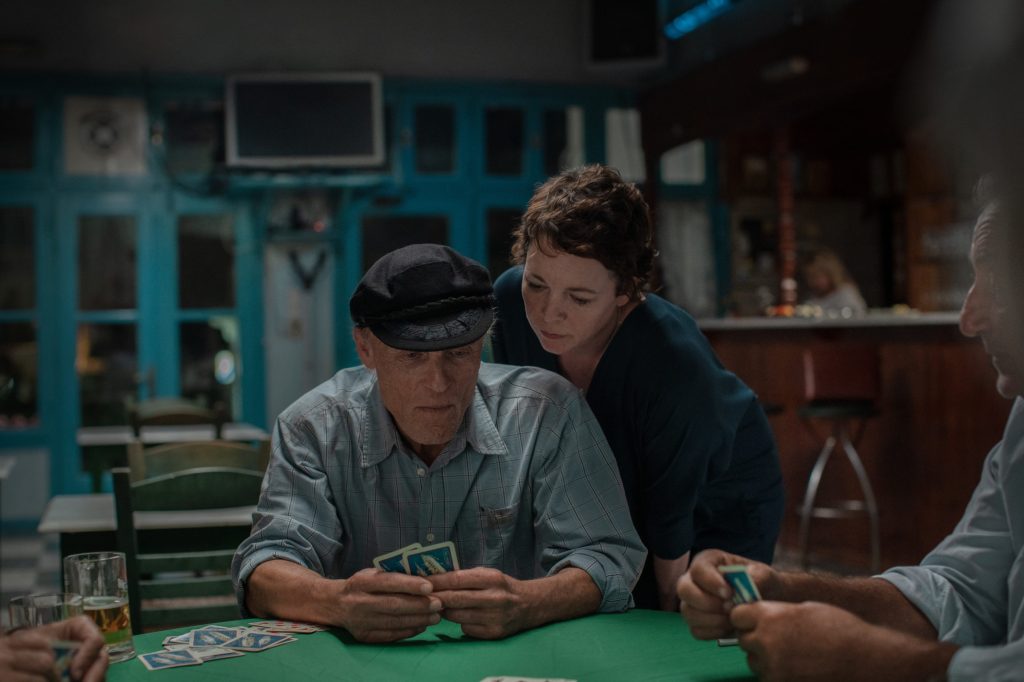
Ed Harris and Olivia Colman in The Lost Daughter

In his review in The New Yorker – which calls the film ‘a major achievement’, but also ‘sluggish’ and ‘spotty’ – Richard Brody argues that the film’s failure lies in its ‘reduction of a literary source to the framework of a plot.’ While I dispute this thoroughly, he also argues that the film should have been more literal in places – suggesting that the theft of the doll (a scene of ‘crucial physicality’) should have been shown on screen. ‘The artifice of that object’s prominence, and that theft’s centrality to the character of Leda and to the plot, cries out for reality at both ends—physically, with a straightforward and detailed view, as in a crime drama, and psychologically, with reference to the layers of Leda’s experience, memory, and emotion’, Brody writes. Though his underlying contention that film is a far more physical medium that prose is entirely reasonable and true, reading the novel confirms what perhaps remains a little uncertain in the film: there is no explanation that has been cut.

Here, Gyllenhaal mirrors the novel exactly, especially in the unsettling impossibility of answering the question of why Leda took the doll. It is as if Leda has momentarily forgotten herself, realising what she has done only when the action had already been completed. The reveal of the stolen doll, secreted among Leda’s books, is as cryptically elusive on the page: ‘I had taken the doll, she was in my bag.’ Leda herself does not know why she has done it, but reckoning with this impulse, and attempting to give the doll back, will drive the film onwards. The Lost Daughter is not about a woman who steals a doll, but instead about someone who finds herself having done so, before being trapped by the peculiar gravity it exerts upon her.

What taking the doll is supposed to achieve for Leda is deliberately unclear, and we spend most of the duration peering with unsettled curiosity – trying to figure out what it is supposed to be a substitute for. By drawing a veil over the theft itself, it simultaneously seems like a potential act of cruelty, desperation, petty revenge, or even love. Perhaps she is jealous of Nina’s superficially happier experience of motherhood – though by the end, Nina declares ‘I can’t take it anymore’ – or it could be an attempt to assert power in small way. A quietly devastating scene sees Leda attend a film screening, only for a group of raucous youths to traipse in, noisily talking over the film. When she tells them to be quiet, they mock her, and she leaves in shame. Though a poised intellectual, seemingly secure in her academic abilities, Leda almost has an underlying vulnerability, powerlessness, or insecurity about her place in the world.

Fiction frequently treats dolls as uncanny substitutes. A cursory Freudian reading of an obsession with a doll might suggest that it is the recipient of rerouted desires – some kind of maternal instinct forcefully visited upon it. Where the novel is rather vague about the psychological substitution at work, Gyllenhaal’s potent imagery implies that the doll may be a surrogate for Leda’s own childhood doll, which, when vandalised by her daughter, she flung out of the top-storey window. The most striking shot of the film is a brief close-up of the doll shattering on the street below. Yet Ferrante and Gyllenhaal keenly suggest themes of replacement and iteration, in subtle, almost game-like ways. Characters repeatedly mishear names, which Ferrante positions to be deliberately tricksy. Nina’s daughter is nicknamed Ledù, but called Elena – itself a significant name for being shared with Ferrante, though the author is famously pseudonymous. Elena’s doll is called Nani (an anagram of Nina, her mother) – making the doll not a substitute child but instead a strange maternal surrogate, a pacifier that stops her from crying. Leda and Elena chime, Rosaria mishears Leda as ‘Neda’, and the characters Gino and Gianni are Rosaria and Leda’s husband and ex- respectively. (Gyllenhaal anglicises the names of now-American and British characters, other than Leda, however.)

Into this tangled mesh, Leda christens the stolen doll Mina – another variation on Nina, but quite different to Elena’s ‘Nani’. (Perhaps ‘Mina’ carries a ring of ‘mine’, or ‘mine now’?) In his ‘Philosophy of Toys’, Charles Baudelaire wrote that he ‘believe[d] that generally children dominate their toys’, yet he also says ‘I would not assert that the contrary does not sometimes happen – I mean that toys do not sometimes dominate children.’ Though he couches himself in a thicket of negatives, Baudelaire formulates the relationship of children to toys as one of – rather shocking – power, domination, and perhaps even violence, potentially in both directions. The Lost Daughter makes a compelling case for extending this formulation to adulthood, with Leda alternating between hiding, locking away, and slamming the doll into the bin, and being compelled to tenderly nursing it back to health. She washes the sand out of it and buys new clothes in a colour she finds more tasteful. (She must quickly devise an alibi when into the toy shop comes Nina.) Leda’s actual motive is inscrutable, but this seems to be the point. This richly symbolic object has become the subject of multiple cruelties and dominations, while also exerting a powerful aura – almost as if it made Leda take it. When she finally returns it, Nina responds with violent shock, driving a hatpin into Leda’s side – who sits down on the sofa in pained silence, utterly baffled by what has occurred.

Jessie Buckley in The Lost Daughter

Undoubtedly the most powerful scenes are those set in the past, with Jessie Buckley’s gripping turn as the younger Leda – crushed and ‘suffocating’ with her two infant toddlers. The young child’s ultimatum ‘I’ll give you three seconds to come back’ presents almost as much of a gut-wrench in the trailer as in the film, while Buckley’s suffocation is evoked in claustrophobic close-ups and the palpable summer heat. The film is somewhat psychoanalytic in its return to the past, searching for answers as to how Leda has arrived at the present. Yet Buckley elevates what could be a cryptic turn, into something desperate – grieving for a joy that she cannot find, prompting her significant exit in which she leaves her husband and children. The film swells with elation when, attending a literary conference, a softly spoken, avuncular English professor (Gyllenhaal’s husband, Peter Sarsgaard) picks out her work by name as worthy of regard. The ensuing affair between them is a moment of transgressive relief and seems inevitable from the moment Gyllenhaal trains the camera on Buckley’s smile, as his public praise washes warmly over her.

The novel and film both reckon with these ethically fraught moments of abandon; in them, Leda transcends her exhausting circumstances and feels herself. At the heart of The Lost Daughter – the open wound probed at almost twenty years later – is Leda’s parental regret, and her decision to leave her husband and children, not seeing them for two years. To be dissatisfied with one’s children remains something of a cultural taboo; the scales generally tip towards children – and how their forms of unhappiness can be traced back to overbearing parenting, or neglect. There is also, without doubt, a strong social pressure to have children – which is felt far more by women than men. Yet this is partially offset by what is now a defined counterculture of antinatalism – driven by philosophical, ethical, feminist, or often simply financial considerations – though this far from neutralises the damage to those who choose not to have children – or find they cannot. Ferrante and Gyllenhaal try to negotiate a third category: those who have children but regret the decision. The film is an extended attempt to articulate this potentially unspeakable, usually unspoken sentiment.

Children are undoubtedly a significant source of regret – either in the having or the not having of them – and parents must generally grieve, in some large or small way, the passage from infancy to adulthood, and the inevitable deviation from the path expected or most desired for them. Leda’s description of motherhood as a ‘crushing responsibility’ – especially when delivered in dialogue to a pregnant Rosaria – perhaps threatens to overwhelm the film’s conception of children. Colman’s sincerity is so compelling that it would be easy to mistake this gently delivered, yet weighty judgement as the film’s view. Yet though Gyllenhaal is best at depicting the suffocation and claustrophobia of motherhood – made worse by the apathy of Leda’s husband, during the flashbacks – there are some powerful moments which counterbalance this.

Olivia Colman in The Lost Daughter

The film’s final shot sees the Leda sat on the beach, peeling an orange. This is used as a recurring motif by Gyllenhaal, encapsulating a subtle joy from childhood: peeling the fruit in a single motion, so that the peel remains in one piece – like a snake. Yet it epitomises the devastating high-wire act of parenthood – the licence to share childish joys again, mixed with the impending worries that something might give way. ‘Don’t let it break. Peel it like a snake’, they chant, in the final shot of the film, which flashes back to a bright, warm beach of a past holiday. Though there is delight in this moment, breakage and rupture are not far away.

Sitting on a Greek beach in the present day, Leda answers her phone. ‘I saw Marta’s name, I felt a great contentment, I answered’, Ferrante writes, her normally poised sentences here running into one, the narrative voice perhaps dizzy from Leda’s stab wound. The words tell of a joy, alien for much of the novel, as Leda delights in her children with a relatively straightforward affection. It feels like the curtains being pulled back, the sun allowed in. I found Gyllenhaal’s ending to be a little more ambivalent, however – certainly regarding Leda’s motherhood. Instead of a sudden rush of relief, pleasure and satisfaction, Colman maintains the patina of uncertainty. Yet in cutting between this ambivalent present and a pocket on joy in the past, Gyllenhaal reveals the hope that was there from the beginning but was not enough to sustain Leda. As she says on phone, ‘I’m dead, but I’m fine.

The Lost Daughter

Directed and Adapted by Maggie Gyllenhaal, The Lost Daughter by Elena Ferrante, Starring Olivia Colman, Jessie Buckley, Dakota Johnson, Ed Harris, Peter Sarsgaard, Paul Mescal, Dagmara Domińczyk, Jack Farthing, Oliver Jackson-Cohen
Categories
Film

Belfast

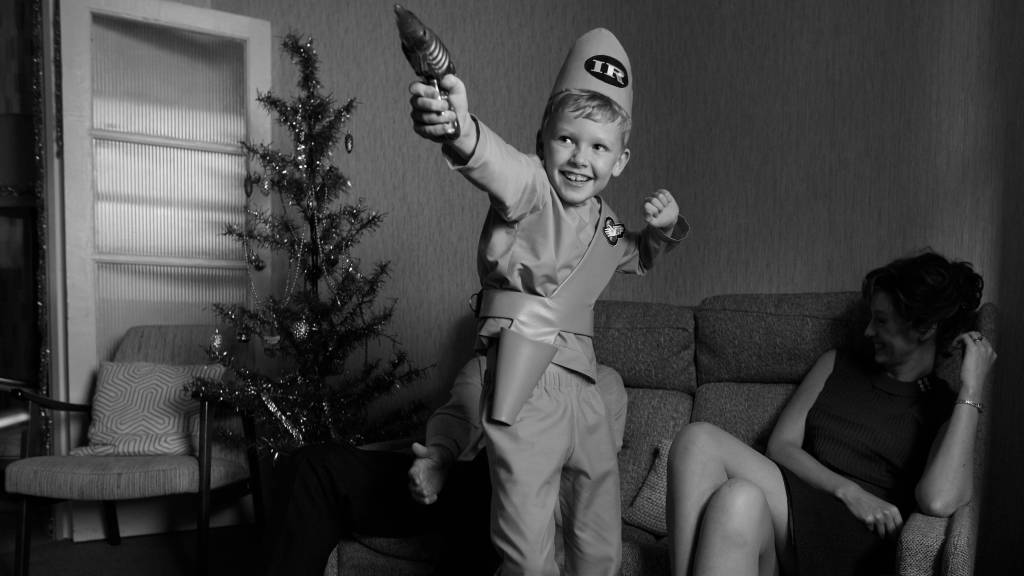
Jamie Dornan and Jude Hill in Belfast

After a montage of Belfast in the present day, Kenneth Branagh’s camera slowly rises above a wall to reveal a street in 1969 – in black-and-white. Children are playing, kicking footballs and chatting good-naturedly with passing adults. Among them is nine-year-old Buddy – mock-fighting in the street, with his wooden toy sword and a bin-lid as a shield. In the distance, there is the rumble of noise – at first indistinct, but then a sense of dread hits. The camera wheels around him in a circle, young actor Jude Hill brilliantly conveying his understated curiosity and fear, as we spin around him again and again to reveal the armed crowd madding at the end of the road. Then his face again. Then the crowd. Round and round.

This is first of many striking choices from Branagh and cinematographer Haris Zambarloukos that are simply breath-taking in their simple effectiveness. The movement feels centrifugal, the rollercoaster-like sensation of your stomach dropping evoking the raw terror of the violence that could unfold. As the Protestant rioters begin to attack the homes of Catholic residents, smashing windows, setting fires and throwing rocks, Buddy’s mother runs to grab him – using the bin-lid as a literal defence against the flying projectiles. As a symbolic loss of innocence, you can’t get much more startling – an object of pretend significance proving urgently useful. They desperately attempt to get inside – to escape from the violence – and hide under a table, praying it will end.

Jude Hill in Belfast

This is the first escape of many depicted – or considered – in Belfast, and it is perhaps the main theme of Kenneth Branagh’s extraordinarily affecting family drama. Faced with the rising violence, the family consider an escape to the commonwealth – Jamie Dornan’s Pa particularly drawn to Sydney or Vancouver. Meanwhile, Buddy escapes momentarily into entertainment and culture; Star Trek plays constantly on their television, while the stage and cinema hold him especially enraptured. Yet while the characters dream of various escapes, Judi Dench and Ciarán Hinds’ exquisitely tender couple (Pa’s parents) embody a loyalty to their home, shared by all of the characters. Though eventually choosing to move to England, the family struggle to escape the gravity which Belfast exerts on them. Only after the death of Hinds’ character Pop (Buddy’s grandfather) are they finally untethered – feeling able to depart, though leaving Dench’s Granny sadly alone. She understands why they are going but feels she cannot go with them.

Branagh places pressure though on the very idea that leaving Belfast amounts to an escape. Despite fleeing for their safety (from job insecurity and debt, as well as violence and threats), there is a pervasive sense of guilt – particular from Buddy’s mother – over leaving. The film is grappling with Branagh’s own departure from Ireland, aged nine, and the complex mixture of homesickness, regret and even shame that stems from having left – a decision which led him into the life he has now.

That Buddy is analogous to Branagh is evident not only from the correspondence of dates (both born in 1960 and leaving Belfast in 1969), but in the film’s perspective. Though it does not stick entirely to Buddy’s view of events, his perspective is dominant. Caitríona Balfe and Jamie Dornan play, with supreme sensitivity, the parents known only as Ma and Pa. Many of their frantic discussions about impending financial ruin – as they attempt to get on top of back taxes – are overheard by us, shot through the gaps in the bannisters that a child peers through. Near the end, there is even a reference that feels like a delightfully meta joke. Buddy sits in the street, lost in the world of a comic book about Thor. Branagh would go on to direct Thor, released in 2011, as part of the Marvel Comic Universe franchise. In combination, these moments show that Belfast is a drama of memory – the specifics of The Troubles generally remaining vague, beyond the (to a child’s view) baffling binary division and propulsive sense of fear. Even the inter-scenes of helicopter-view looting and street violence, as well as patrolling guards, feel like dramatizations of news footage – watched back or remembered.

Held in tension at the heart of the film’s child-view of The Troubles is a fundamental moral uncertainty – coupled with Buddy’s strong desire to do good. After a rabble-rousing sermon – delivered in startlingly zoomed-in close-up – describing a ‘fork in the road’, Buddy’s fear and confusion take over. He is desperate to do the right thing, but utterly unsure what that is. He gets the two roads muddled, muttering to himself that he cannot remember which is which. Instead, Dornan’s closing monologue argues for tolerance with a concrete morality beneath it. Religion should be irrelevant, he suggests, but values such as being good to each other matter absolutely. A message like this would almost always tend towards the syrupy and trite, yet such is the power of Jude Hill’s performance that every scene he is in is carried along by a compelling, wide-eyed earnestness.

These are the same wide eyes that look on at culture with amazement. One of the film’s distinctive technical tricks is to shoot entirely in gentle blacks and whites – but with occasional glows of colours. Aside from the opening and closing montages, the only colour present is on cinema screens and stages – representing a Wizard of Oz-like escape into the land of fiction. One beautiful shot sees the colourful light reflected in Judi Dench’s glasses. Sometimes the film’s craft is simply beautiful; at others it is often very funny, with masterly shot composition. In an early scene, Judi Dench loiters in inky blackness in the corner of the frame, before intervening with an acerbic quip, pulling focus quite literally as we realise she has been there the whole time. Elsewhere, a more typical – yet stunningly effective – cut from a light-hearted family discussion about Catholic obsessions with guilt to a fear mongering Protestant minister acts as a hilarious demonstration of Protestant hypocrisy.

Judi Dench in Belfast

Moment by moment, Belfast is meticulously composed, and the care and attention lavished upon it is evident. Yet the overall edit of the film does feel a little choppy. There is not quite enough plot to sustain it completely – or at least some subplots are underdeveloped. There is plenty of situation, but less in the way of character-driven events, though this is perhaps a natural consequence of the film’s major focus on a child. While Belfast always holds the attention, the pace flags in some places – while other moments are a little rushed.

For instance, one of the film’s least elegant subplots features Lara McDonnell’s character Moira inducting Buddy into a gang – which ultimately, unsurprisingly, escalates from robbing a sweetshop to smashing up and looting a supermarket. The arc is not only predictable but a little too sudden; talk of a gang in one scene leads later to the theft, then to the raid. There is too little sense of one event leading to another. Perhaps we are meant to feel caught up in events, like Buddy is, yet the conclusion feels a little too disjointed.

The scenes of the raid are brilliantly shot, switching between an overhead perspective for scale and close-ups of violent destruction. In the midst of this, Buddy is utterly moving. Despite initial reticence, when Moira insists he takes something from the shop, he considers what will be useful for his family: washing powder. Even in the mess of the trashed shop, he takes something that will help make things clean. Yet when Ma discovers that Buddy has stolen washing powder, she physically drags them through the street violence, back into the shop, forcing them to return it. It makes such little material difference to the riot, yet Ma represents the respect for one’s home that runs through Belfast so powerfully. Vandalism is a transgression against one’s community that, for Branagh, is truly despicable. Implicitly, the film suggests that one of the most distressing parts of The Troubles was the way that people would, in staking a claim to a place as their home, end up destroying significant parts of it.

Jude Hill and Caitríona Balfe in Belfast

Yet Belfast remains, rebuilt in places – as we assured in the opening and closing moments. It opens with long shots of present-day Belfast, its purple evening skies shot in rich colour. It seems a little bit like a tourist-eye view of the city: the Harland and Woolf cranes, then the Titanic Museum, the murals, the precipitous flat peak of Cave Hill overlooking the city. Perhaps that is part of the film’s gesture – to set up then subvert the expectations of its viewers. The film’s title certainly makes claims of authoritativeness and authenticity, far beyond the remit of a potted history. Branagh returns to the cranes at the end, with the onscreen text overlayed: ‘For the ones who stayed. For the ones who left. And for all the ones who were lost.’ Such a dedication feels self-evident at this point.

Though overused, the phrase ‘a love letter to cinema’ seems entirely apt here. The cinema provided Branagh a colourful childhood escape from political tensions and the more universal challenges of growing up. Yet Belfast is also a love letter to his first home too: the titular city. Cinema seems to be a close second.

Ultimately, Belfast makes peace with leaving for England by suggesting that the tragedy of being wrenched from home is in the wrenching, not the leaving itself. You just need to say a proper goodbye – as Buddy manages to do to his classmate crush Catherine – and make a solemn promise to come back. It feels like the film is Branagh keeping that promise – a symbolic, long-planned return home. I found it far less rose-tinted than some reviewers did, brutal at times and with a palpable underlying sense of fear, yet it also insists not just on nostalgia but moments of pure delight. Though sometimes devastating, Belfast is also filled with utter joy.

Belfast

Directed and Written by Kenneth Branagh, Starring Jude Hill, Caitríona Balfe, Jamie Dornan, Judi Dench, Ciaràn Hinds, Colin Morgan