Categories
theatre

The Trials – Donmar Warehouse

Twelve jurors, aged between twelve and seventeen, take their places in the deliberating room to decide the fates of three defendants in their fifties and sixties. They are charged with having exceeded reasonable carbon emission limits after 2018, while over the age of eighteen, and earning above the average wage. This is just day one though. Over two weeks, this jury will deliberate over the guilt of thirty, but the events of this fateful day will leave them shattered and uncertain in their quest for justice. Piled up behind the stage are the remnants of part-dismantled theatre seats. Georgia Lowe’s set design suggests that the space is a converted theatre – a dark mirror of the ‘Nightingale courts’ from the pandemic, which refitted auditoriums for court hearings. In this collapsing future world, this almost ritualised act of justice is the closest to theatre they can muster.

Dawn King builds a convincing hinterland from jagged shards of catastrophe. The jurors speak of bodies floating in floodwater, pollution warnings, and sitting in the dark to conserve energy. One of the first shows to open after lockdown was the Donmar Warehouse’s audio-recorded production Blindness, and at a striking moment, when the plague of blindness seems to lift, a large window opened out onto the street below, allowing sunlight to stream in. The Trials echoes this with a grim subversion. Despite entreaties not to, Tomaz opens the window, allowing not sunlight but acrid yellow smoke to billow in, the fumes hanging in the air pungently – a horrifying sight which the characters have learned to live with on a daily basis.

As vivid as these moments are, the play operates with the logic of a thought experiment rather than that of a realist drama. Time pressure means they only have fifteen minutes of deliberation time per defendant, yet each jury only judges three people each day. How such a vast (and seemingly mechanised, in execution) judicial infrastructure survives amid constant disaster is also questionable, though it very much seems part of King’s presentation of humanity’s retributive impulses that punishment (in the name of justice) has become the highest legislative priority. The practicalities are relatively unimportant though; they serve to examine our present-day ethical decisions – namely the power of peer pressure, doing what everyone else does. Though climate change is the most striking example of potential intergenerational betrayal, the play works even more broadly a metaphor which weighs how harms done in the past have a material effect on the present – and whether inequities can be addressed or redressed. Powerfully, The Trials combines discussion of how we condemn or excuse the past with the inescapable fact that we ourselves will soon become it.

We learn that the first round of trials focused on high-profile climate criminals – the ecocidal bosses and shareholders of major polluters, and presumably government officials who failed to act in time. Yet now, we hear, waves of trials keep coming and coming, ambiguously triggered by continuing seething anger and the practical justification that resource shortages necessitate population control. Only one of the jurors questions the underlying system at play – and the ethics of capital punishment. The pressures of the time leave no space to pause and reflect; there are simply not enough resources to keep all the people alive.
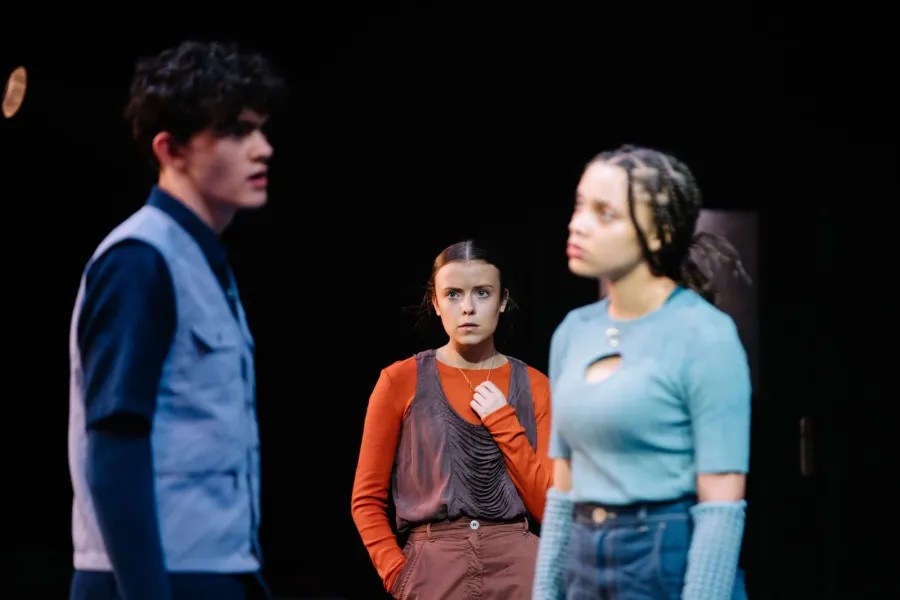
Joe Locke, Honor Kneafsey and Meréana Tomlinson in The Trials

The future is imagined as dark and bright. Disclosing personal pronouns has become standard in introductions, and King presents a world in which popular consensus (at least among the youth) has rendered social issues and discrimination largely absent. That is not to say the youth are all in agreement though. The only schism that seems to affect the young people of the future is one between empathy and bloodthirsty hatred for the ‘dinosaur’ older generations. The jury room is a pressure cooker, literally; the broken air conditioning is useless against the sweltering summer temperatures. There is a recurring danger in works about future catastrophe that they take on a masochistic ‘doomer’ quality, an act of performative self-castigation. Yet The Trials is brilliantly frank about its future world’s problems; the question of how much to judge is precisely the issue it explores.

On the one hand is a (perhaps excessive) enthusiasm for vengeance. Characters Gabi and Noah are initially happy to see everyone above the limit die, a deserved punishment for climate crimes which have no reasonable excuse. Indeed, their verdicts are essentially pre-judged. The content of the speech each defendant makes (in excuse and apology) is irrelevant to them. Thus, King evokes the real-world limitations of jury trials. In America, (where sentencing is not solely the preserve of judges and pre-established conventions) death penalty juries must be ‘death-qualified’ – meaning that jury members must not be morally opposed to the death penalty outright. An unavoidable consequence is that death-qualified juries are significantly more willing and likely to hand down a death sentence than population at large.

King draws a veil over the political machinery that has led to this evolution of the judicial system. There seem to be no lawyers, only the brief personal statements. Additional information can be provided by the anonymous ‘they’ who run the proceedings, but there is limited time and little access to a meaningful defence. Of course, the jury room is a metaphor, rather than a prediction, but there has been some sort of (perhaps revolutionary) shift, either electoral or simply through the breakdown of society amid the climate crisis, that has led to the young standing in moral and legal judgment over the old. Society here is kept afloat by the Climate Defence Force, while resources are generally lacking – hence the need to control the population size, or so the logic goes. There are gestures to collective action and even anarchist political systems; jury foreperson Ren tells them to ‘self-organise’ in deciding how to vote, though soon gently wrests control of the voting system, replacing anonymous paper voting with a ‘quicker’ suggestion that allows only her to see how the others have voted.

In contrast, there is also a growing unease at the retributive nature of this justice system epitomised in the character of Mohammad (a seriously impressive Francis Dourado, in his professional stage debut). Mohammad is disconcerted by the impulse behind the trials from the start and is always the first to spring to the defence of the defendant – irrespective of their actions or relative guilt. He is most concerned by the fact that only remnants of due process remain. They can only confer when all jurors are present, for instance. When Noah (a compelling Joe Locke) storms out of the room in protest, he essentially shuts down the debate, returning only when it is time for them to enter the guilty verdict.

Mohammad posits, ‘what if the government is just throwing these people overboard, so everyone else on the sinking ship will feel better’. He is widely dismissed in the room as a conspiracy theorist. He is told to ‘look around you’ and note ‘that there aren’t enough resources for everyone.’ Yet there is a sad ring of truth to his words. King presents a society so wracked by systemic injustice that it is now devotes outsized effort and resources into mass prosecution – in a rushed, violent system. Late in the play, Mohammad reflects, ‘I hope we’re on the right side of history.’ At the heart of the play is the fact that we will always become the past, us now, and the generations in the future. The youth are in many ways right to judge here, to feel let down, but there is no monopoly on justice; as everyone grows old, they will be judged on their actions. Time will judge us all. We can only hope it will be fair.

Lucy Cohu in The Trials

At the core of this is the tension between legal and moral law. Arguably, the titular trials seek to square a circle, applying a heavily legalistic framework to a fundamentally moral situation. Thus, the Nuremberg trials are evoked as a striking contrast, in which the defence that one only followed the law of the time was also considered inadmissible. The extent of the similarity between the trials remains relatively unexplored, but perhaps the key difference is the essential separation from harm’s consequence in the case of climate inaction (and destructive action). Prospective climate deaths could be considered relatively random, though they will of course not be proportionate across the world or between socio-economic groups. They are unpredictable, though, and delayed from the point of action. The Nazis’ actions, by contrast, were fully intentional and often immediate. It points to the same moral question that underpins ‘trolleyology’ – the philosophy of the perennial thought experiment that demands we choose whether to divert a runaway train to save five and kill only one, by pulling a lever or pushing a man from a bridge. Generally, participants are much more willing to pull a lever than touch their victim, even if the effects are the same. Abstraction creates a sense of moral excuse – whether or not it is necessarily justified. Pollution may cumulatively kill millions, but it lacks the visceral immediacy of pulling a trigger.

Natalie Abrahami’s production handles the play with energy and tenderness. Though some voices dominate more than others, no character remains elusive – the smaller roles all getting their moments. Particularly great are sequences in which the usually recalcitrant Tomaz (Charlie Reid) play-acts with Zoe (Taya Tower), the youngest juror. Never having experienced either plane travel and or snow, he creates the experience for them, in the gaps between the deliberations. Bubbles drift through the auditorium in the place of imaginary snowflakes.

This world is crying out for a little imagination – perhaps a little theatre. Yet King implicitly self-implicates in the case of Defendant Two, who represents the debatable hypocrisy of being an artist amid climate breakdown. The case for and against the value of art is left undecided here, many of the jurors quick to dismiss environmentally conscious sentiments as signs of greater complicity. (If they knew, why did they not change their ways rather than simply raising awareness?) Yet the point that art makes life something worth being alive for reverberates with a subtle power even in the room’s loudest firebrands.

Another aspect of the play which is fascinatingly rendered is the characters’ navigation of responsibility for their own parents’ actions. Kako’s dads were wealthy corporate lawyers – large-scale carbon emitters, with multiple houses around the world. They ate veal and mostly lived, the three of them, in a house with five bedrooms – enough for twenty refugees. It inverts a school playground dynamic of bragging about the relative importance of a parent’s profession; here, this is barbed with the fact that their parents might be dead – from the climate catastrophe or execution – or culpable. The twist in the third deliberation shines a light on this all the more brightly, as Ren (played with a moving, steely determination by Honor Kneafsey) reveals that the last defendant is her mother. Some of the dialogue voices the unlikeliness of the coincidence, but given The Trials’ underlying moral debate structure, it feels like a natural progression for the drama – ratcheting up the stakes. Having seemingly been a greenwashing sustainability officer for an oil company, the third defendant seems the guiltiest of them all in personal carbon liability. Yet the room is naturally less willing to convict, splitting six-four in favour of guilt, with two undecideds: Ren, and Amelia, who is wracked with guilt at potentially making the wrong choice. An outright majority is needed though.

Partly to save Amelia from making the decision be ‘my fault’, Ren interrupts the discussion to concur with the guilty verdict. The sense of recrimination is palpable and potent, as Ren attempts to square her familial connection with a gut-certainty about the illegitimacy of her mother’s actions. The only choice remaining is whether or not to watch the executions. Abrahami renders these as a mechanised spectacle of complicity, with the condemned lowered on a gantry from the ceiling for all to look upon. To me, it quietly evoked Caryl Churchill’s notorious hat parade in Far Away (revived at the Donmar in 2020), with its slightly baroque display of public death – an ominous message from a generation unable to forgive.

The impression we are left with by the play’s ending (all three defendants are found guilty) is of the widespread destruction of the old at the hands of the young – a poignant reversal of the usual language of intergenerational betrayal. The fact that the young have been invested with such power is fascinating, pointing to a prevailing sense of the young’s inherent innocence – which the play carefully undermines by making them as rich and flawed as adults. As righteous as the characters feel, their views seem to be the logical response to the world they find themselves in, rather than an inherent moral superiority. Who is to say how they would have acted if they had been alive now.

Weighing up intergenerational morality is the play’s main focus. Not having children is discussed as a mark of climate virtue; the first defendant is mocked for his extravagant three while the second pleads her innocence for not having had any. The children have mostly subscribed to a population-centric climate response – focused on reducing the number of people alive, rather than the load on the environment caused by their consumption and emissions. This also points to a complete breakdown in the intergenerational contract. Having been failed by their elders, the young have broadly rounded on them, content to see them die, rather than having to live with their mistakes and care for an older generation who failed them – an ambiguous blend of cold pragmatism, hard justice, and authoritarian cruelty.

The Trials

Written by Dawn King, Directed by Natalie Abrahami, Design by Georgia Lowe, Lighting Design by Jai Morjaria, Sound Design and Composition by Xana, Movement Direction by Anna Morrissey and Aaron Parsons, Video Design by Nina Dunn, Casting Direction by Anna Cooper, Voice Coach Emma Woodvine, Associate Direction by Joseph Hancock, Starring Elise Alexandre, Francis Dourado, Jowana El-Daouk, William Gao, Pelumi Ibiloye, Honor Kneafsey, Joe Locke, Rue Millwood, Charlie Reid, Meréana Tomlinson, Taya Tower, Jairaj Varsani, Nigel Lindsay, Lucy Cohu, Sharon Small
Production Photographs by Helen Murray
Reviewed 20th August 2022
Categories
theatre

Henry V – Donmar Warehouse

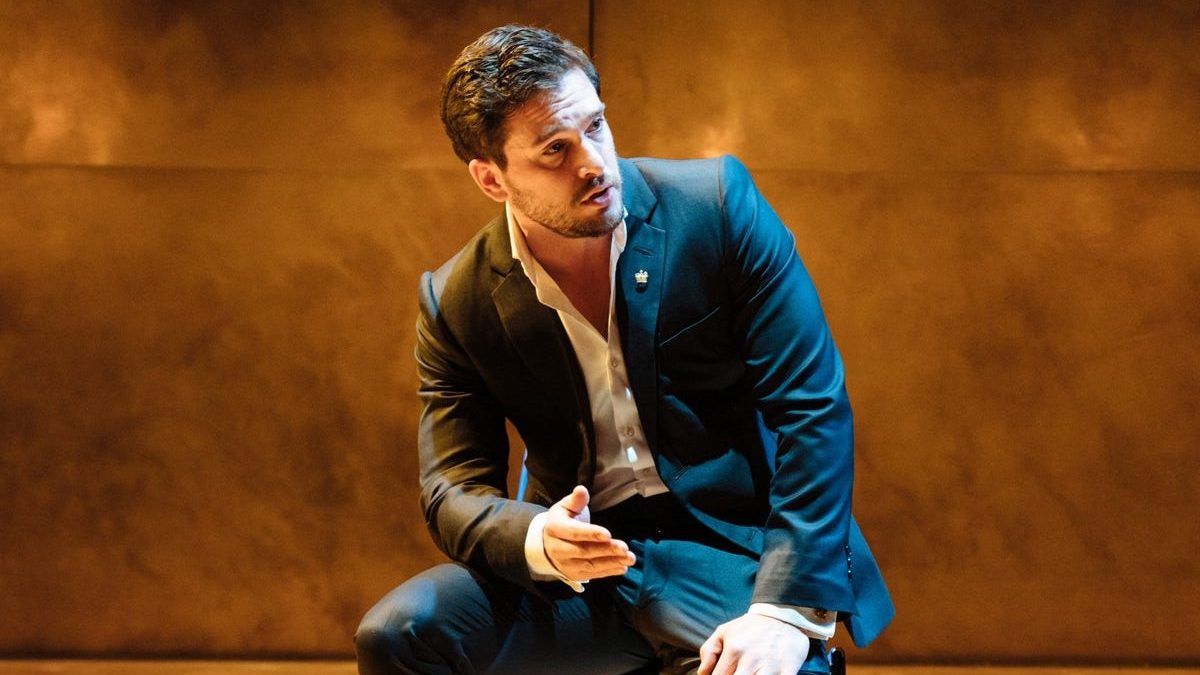
Kit Harington in Henry V

Shakespeare’s war drama Henry V has on various occasions been programmed, staged and filmed with a calculated and deliberate geopolitical message. In 1944, late in the Second World War, Laurence Olivier’s patriotism-drenched film version cast Henry as a brilliant military leader enjoying a deserved triumph over the French. That the French had become allies did not stop the sentiment, and the film was even dedicated to British soldiers ‘whose ancestors it has been humbly attempted to recapture’. More recently, the National Theatre’s 2003 production was received largely as a strong, satirical critique of the UK’s involvement in the Iraq War, treating Henry’s invasion as largely unjustifiable, paralleling British and American military action. Yet in this new, just as timely production, the resonances are shockingly coincidental, yet startling to watch.

Max Webster’s stirring staging echoes the combat fatigues and gritty violence of Nicholas Hytner’s Iraq War critique, yet Webster leans far more into the play’s notorious ambiguity, rather than espousing the clearly ‘pacifist leanings’ Michael Billington identified in 2003. This is not to say that Webster presents war as anything less than a nightmarish horror, which is intensified by Fly Davis, Carolyn Downing and Lee Curran’s terrific design (of set, sound and lighting respectively). Yet Webster’s nuance is slightly, and unavoidably, blunted by the shadow of world events which hangs across the play – obvious long before Kit Harington’s curtain call address, in which he notes that Henry V is a play about invasion, before asking the audience to spare some change for the humanitarian relief effort in Ukraine.

Shakespeare’s depiction of the cost and violence of conquest grimly mirrors Russia’s ongoing attempt to invade Ukraine. This run was announced in mid-2021 and the invasion began a fortnight into its run – though the growing prospect of conflict surely hung over the rehearsal period – so its staging is only a tragically apt coincidence. Thus, there are not direct references made in the play itself. Instead, this already electric staging flickers with a palpable unease, that while the stage is filled with impressive military choreography (from fight director Kate Waters, movement director Benoit Swan Pouffer, and with additional guidance from former Royal Marine Commando Tom Leigh), this is happening for real elsewhere. This is merely a ‘wooden O’, in which war is simulated.

Millicent Wong is terrific as the Chorus, implicitly justifying the role’s presence in the play. (Such a persistent narrator is unusual for Shakespeare.) Yet the infamous apology for the limitations of the stage that opens Henry V seems less necessary than usual. The production inclines to bombast (incredibly effectively), with guns, military manoeuvres and the ever-present sound of circling helicopters. There is no need of ‘imaginary forces’ – Shakespeare’s pun describing mental faculties and pretend armies – when the production depicts semi-realistic modern warfare before our eyes. And yet, scenes of war are now so present on the news, it also seems obvious to suggest that theatre is inadequate in depicting it.

Norman Rabkin famously compared Henry V to drawing of an animal, variously seen as either a rabbit or a duck. Most people can see both at will, mentally switching between the right-facing rabbit and the left-facing duck. However, no matter how hard you try, you cannot see both at once. In Rabkin’s reading, the character of Henry and the moral justifications for the war are like the rabbit-duck. Henry is either a heroic leader of one of England’s crowning military triumphs, or he is barbarous example of the brutality and folly of war. (As the Chorus reminds us at the play’s conclusion, Agincourt’s gains will be lost under Henry VI.) For Rabkin, this ambiguity is to be relished rather than resolved. ‘Mystery is their mode’, he writes, of Shakespeare’s ‘great plays’; ‘the questions aroused by them seem unanswerable’. Thus, to direct Henry V is to either decide on a reading or attempt to embody this tension – leaving the play functioning as a moral challenge for its audience to decode.

Webster strikingly leans into the latter, though it is even more difficult to harbour sympathy for a violent invader now than usual. In this production, the play seems deliberately structured as a series of moral tests. Is Henry admirably ruthless in his determination or a perpetrator of undue, merciless cruelty? In an attempt to bolster the presentation of Henry as a person in his own right, rather than the politician or war leader he appears as in most versions of the play, Webster lifts from Henry IV Part 2 to craft a new opening sequence, in which he is decadent and wayward figure. The Chorus’s Prologue ends with the onset of pounding music, Henry staggering onstage in a stained office shirt, enjoying Bullingdon Club-esque hedonism, and vomiting in the middle of the stage. It is swiftly cleared up, but the smeary remnants glisten under the lights for the next eighty minutes until the interval. Soon he is thrust into power by the death of his father (Henry IV). Yet though he suits up into a suddenly more respectable, disciplined leader, the loutish behaviour lingers in the mind.

Kit Harington in Henry V

The first true test comes in Act 1 Scene 2 of the original Henry V, beginning a trend in Webster’s drama to retain and spruce up the more intractable monologues, rather than simply cutting them. This does make for a long show (over three hours in all), especially given the addition of the opening, yet Webster’s directorial innovations and interventions are compelling and hugely effective. Here, in one such flourish, the Archbishop of Canterbury’s rather turgid explanation of Henry’s claim to the French throne is delivered via PowerPoint presentation. In a neat inversion of the usual audience slump, the characters on stage are visibly bored – yawning, sighing and even swearing when he adds reason after tenuous reason for Henry to stake his claim. Instead, we laugh at the tortuous logic and spider web of a spider web of a family tree, shown in Andrzej Goulding’s superb video projections. That Henry can be convinced by this seems surprising though, and it even grimly evokes Putin’s thin justifications for supposedly ‘liberating’ Ukraine. Henry’s actions are, of course, predicated on an argument about monarchical legitimacy that ignores how the French would self-determine their own nationality.

Henry sits quietly in this scene, epitomising that much-coveted, but nebulous quality of statesmanlike-ness. He has gained authority from his sudden promotion, though perhaps his rigid, silent demeanour is also that of a man still trying to sober up. For all the production’s tendency to overwhelm, Webster plays these subtler moments well; Henry’s power is demonstrated by the simple fact that he is the only one with a chair. After surviving the archbishop’s presentation, Henry is persuaded – calling on ‘God’s help’ to speed their victory, though really it is the vast pledge of church money in support of military action that has tipped the scales for the King. At the end of Act One, Henry is presented with a provocative gift of tennis balls from the Dauphin, an insult to Henry’s ‘youth and vanity.’ Yet you feel the ethical cogs whirring in Webster’s drama; they are derogatory, yes, but are they really an acceptable justification for violent incursion? Yet, Harington explodes with rage, and you feel that ‘chid[ing] this Dauphin at his father’s door’ is hugely understating his aims.

The first half proceeds with a measured pace, next testing Henry with the revelation of the Earl of Cambridge’s plot to assassinate him. The dramatic irony hangs thickly in the air as he tricks them into signing their own death warrants. He tells them of a man who, in drunken excess, ‘railed against our person’. Yet he proposes merciful treatment and allows the plotters to argue against leniency. Accomplice Scroop insists ‘Let him be punished, sovereign, lest example / Breed by his sufferance more of such a kind.’ All three betrayers are in agreement; a King must be feared as well as loved, cruel and kind. Thus, Henry presents them with papers, detailing their own treasonous crimes. When they make their inevitable pleas for mercy, Henry simply gestures to their own hypocrisy. Harington plays Henry here as a clever schemer, his lines half-test, half-trick – playing on the public loyalty everyone must show to him in making them argue against clemency. Shakespeare implicitly questions Henry’s actions; are they start of a slippery slope towards the cruel and dictatorial, or the actions of a just King, only hanging them with their own rope?

This question is, horrifyingly posed again before the interval, when Bardolph is hanged for alleged stealing from a church. While Henry is theoretically upholding a moral standard, in staking a dubiously rightful claim without unnecessary violence or larceny, Webster plays the moment as a grimly mechanised public spectacle – displaying Henry’s swollen power for all to see. Henry watches remorselessly as her body twitches above Donmar’s stage, even though Webster’s additions from Henry IV Part 2 show his youthful friendship with Bardolph, suggesting perhaps that they might have been lovers. There is a potent sense, by this point, that Henry might have gone too far – the killing sapping the morale of Henry’s old Eastcheap friends, Pistol and Nym, and even threatening the customary comic subplot’s mirth.

Kit Harington in Henry V

John Sutherland and Cedric Watts famously place Shakespeare’s Henry on trial in Henry V, War Criminal?, ascribing him that anachronistic moniker, though it has an important partial echo in the original text. After Henry has decided to execute the French prisoners of war, Welsh soldier Llewellyn objects as it is ‘expressly against the law of arms’. Webster slightly updates the phrase to the ‘rules of battle’ – a deliberate shift away from codes of chivalry, respect and fairness, towards modern concepts of human rights and conventions of war. This decision to contravene these rules is the clinching piece of evidence for Sutherland and Watts – as it was in a 2010 mock trial Washington, D.C., which included Supreme Courts justices Samuel Alito and Ruth Bader Ginsburg, where they unanimously found against Henry in the matter of executing prisoners. It is the darkest moment of moral testing in the play, and Webster makes it look for a brief moment like Henry has caught himself in the midst of his tyrannical violence and might retreat from it. Yet instead, defiant of his soldiers’ reluctance, the king graphically slits the throat of one of the prisoners before restating his order. Webster places blood firmly on Henry’s hands.

Yet even amid this horror, there is the rabbit-duck of admirability in amongst the violence. As much as the throat-slitting is a horrifying signifier of just how far Henry has gone, it also, rather perversely, shows him to be a man who leads from the front. He never expects his soldiers to do something he would not be willing to do himself. Henry even skulks covertly around the camp the night before battle, attempting to boost morale. By contrast, the Dauphin avoids the actual fighting, but is still rewarded. Despite the scepticism towards many of Henry’s actions in Shakespeare’s text, Henry’s victory comes through effort, while the French are far from sympathetic victims.

A crucial point after Henry’s victory is his confrontation with Michael Williams (here, one of many gender-swapped roles, like Bardolph). During his night incognito, Henry ends up embroiled in a rather contrived dispute, which leads to the promise of a delayed ‘box on the ear’, if he were ever to come up to her and say, ‘This is my glove’. Of course, Henry eventually does so, prompting immediate terror from Williams as she realises her jest of a threat is now treasonous. Yet Henry pardons the soldier, despite an ominous sense that he might turn against his own army into a completely tyrannical autocrat, more in the vein of Richard III. Instead, Harington’s features crease with warmth and he good-humouredly demands that her glove be filled with money. The stage devolves into a wild party, with drinking, dancing and the blasting underscore of Darude’s ‘Sandstorm’.

Millicent Wong in Henry V

In Shakespeare’s text, this could be read as a pivotal moment of transformation in Henry – the point at which he looks over the precipice, but without falling (as many others have done in the rise-and-fall de causibus tragic form, found variously in history plays such as Richard II and Richard III). A structural reading would align Henry V’s conclusion with the genre of comedy – ending as it does with the wooing of the King of France’s daughter, Katherine, and the promise of their marriage. Yet, typically, Shakespeare infuses a rich ambiguity in these final scenes, a gift to directors (like Webster) who wish to take a more sinister interpretation.

This production treats the awkwardness of the play’s comic resolution as the last of the play’s moral tests, one which – for me – Henry completely fails. Though attempting to be amorous across the language divide, Harington soon turns off Henry’s charm. He is brokering a military deal, as the victor, and as a result his requests are actually demands suffused with a threat of violence and destruction. There is no way that he could straightforwardly court Katherine’s affection. Anoushka Lucas is a standout as Katherine, playing her with a steely determination and wringing as much pathos as possible from her character’s hopeless situation – despite the limitations of the relatively small role. In this staging, the fairly early play Henry V seems to foreshadow the dark undertones of The Winter’s Tale’s resolution (and those of the other late plays), in which the (seemingly) resurrected Hermione does not directly forgive or even address her husband Leontes, whose groundless accusations of adultery led to her apparent death. Leontes hurries everyone offstage before the potential powder keg of unspoken feelings can detonate – and perhaps lead to further tyrannical violence. As with Henry V, Shakespeare’s language denies us the happiness we might expect from the marriage plot’s structural comedy.

Henry V is the third biggest role in Shakespeare – both by raw line count and percentage of the play’s dialogue (32%) – yet I was struck by how small the role felt here, especially in the first half. Kit Harington is cannily cast; of course, his presence will sell tickets, yet he also exudes a quiet celebrity, which fits this interpretation of Henry as a slick-suited, potentially populist monarch. Though Andzrej Łukowski contends in his Time Out review that this production ‘approach[es the play] as a great character study’, I was left with the quite contrasting sense that the play was asking us to judge – as the public, perhaps even as voters – whether we found the King and his actions justifiable, ethical and moral. The frequent projections of Harington’s face on the back wall serve a powerful sense that he is a national leader whose inner thoughts remain largely inaccessible to us. Henry here almost seems like a new take on the Chorus’ invocation ‘Into a thousand parts divide one man’ – not only an entreaty to imagine the stage much wider in scope, but a comment on Henry’s fractured self. He is many things to many people – more of an idea than a psychological presence, and more of a motivational speaker than a soliloquist. We judge him from a distance, rather than suffer with him – as we might with Lear, Macbeth and Lady Macbeth, or Prospero.

Kit Harington in Henry V

Much of the production plays like a glossy modern miniseries, combining stylised stage imagery with realistic verisimilitude. The funeral of Henry’s father (Henry IV) is an operatic, epic scene of stately slow-motion, the Donmar’s medium-sized stage filled with black coats and wet umbrellas. Later, Webster chooses to translate the French scenes back into their original language (with surtitles), a cleverly disruptive choice which elevates the French characters from comic ciphers by giving them their own voice. It forces the audience to engage with the words and lean in, rather than let the drama simply wash over them. Yet it also signifies the French characters’ own defined, different culture – equally real on stage, avoiding the sense that the play is being performed as a history told by the English victors. Even the ostensibly comic scenes crackle with a violent danger. The rather unwieldly comedy of the only originally French scene, in which Katherine learns the English words for body parts (‘de fingres’, ‘de hand’, ‘de bilbow’ and so on) is energised by being set to boxing session. Katherine sharpens her defences, physical and linguistic, knowing that she will likely be part of the peace settlement with Henry.

It is a marvel how well the production’s chaotic clash of imagery works. War is rendered as a baroque spectacle, underscored with live choral music from a quartet of actor-musicians, yet it is also hi tech, with sonar pings, helicopter blades and automatic weaponry. As the army goes ‘Once more unto the breach’, the gold back wall of Fly Davis’ set splits apart into four parts, with red lights blazing through the gaps – a vast St George’s Cross, underlining the pungency of nationalism in this Henry V. England are loutish victors, the flag in the set design literally setting alight as the stage fills with a debauched carnival of celebration, giving a new meaning the Chorus’ earlier statement that ‘all the youth of England are on fire’. Now they are on fire with antisocial raving.

Before the play begins, a quotation is projected on the back wall of the stage: ‘There is no document of civilisation that is not also a document of barbarism.’ Walter Benjamin’s statement chimes with Rabkin’s polysemy, inviting the audience to judge – weighing the evidence, as well as potentially condemning Henry. It is a testament to the intentional ambiguity of Webster’s production, though this neutrality is crushed by the weight of real-world events. Strangely, the actions of Putin make this production seem like a far more definite critique of English nationalism than was perhaps originally intended. For all the play acts as a literary optical illusion, flattering Henry with good qualities of bravery, leadership and determination as well as bad, in Webster’s ambitious take, rhetoric can only distract from Henry’s moral outrages – in no way excusing them.

Henry V

Written by William Shakespeare, Directed by Max Webster, Design by Fly Davis, Lighting Design by Lee Curran, Sound Design by Carolyn Downing, Video Design by Andrzej Goulding, Movement Direction by Benoit Swan Pouffer, Fight Direction by Kate Waters, Casting by Anna Cooper, Composition by Andrew T Mackay, Starring Kit Harington, Jude Akuwudike, Gethin Alderman, Seumas Begg, Claire-Louise Cordwell, Kate Duchêne, Olivier Huband, David Judge, Melissa Johns, Danny Kirrane, Anoushka Lucas, Adam Maxey, Steven Meo, Joanna Songi, Marienella Phillips, Millicent Wong
Production Photographs by Helen Murray
Reviewed 12th March 2022
Categories
theatre

Force Majeure – Donmar Warehouse

Rory Kinnear and Lyndsey Marshal in Force Majeure

Force Majeure, adapted from Ruben Östlund’s 2014 dark comedy film, finds its characters perched on a precipice – literally in Jon Bausor’s vertiginous artificial ski slope set and metaphorically, as Tomas and Ebba contemplate whether to continue or end their marriage. On a skiing holiday in the French Alps, a Swedish family find themselves almost crushed by an avalanche, which stops just short of the restaurant in which they are dining. Everyone is safe and, apart from feeling a little shaken up by it, that should be the end of the matter. Yet Tomas’ reaction to the imminent danger exposes a fissure running to the heart of their relationship – and initiates searching questions over masculinity, cowardice and shame.

Faced by the oncoming snow, Tomas grabs his phone and his gloves and runs. He simply runs away, abandoning his family in a fantastically directed slow-motion sequence. As the stage is blasted with avalanche smoke, Tomas takes to his heels, shoving waiting staff to the ground and stampeding for the exit. Having set Tomas up as a provider – the reason the family can afford an expensive skiing holiday at all – his assumed social credibility as the father of the family is jettisoned by his shameful abandonment of them at a time of crisis.

Yet, significant though this symbolic betrayal is, Force Majeure considers what comes after to be Tomas’ true error. A fight or flight response could be forgiven as just that – an innate response to danger. Yet instead of seeking absolution, Tomas proceeds to deny it happened. He didn’t run away. He was going to come back and dig them out. He wasn’t screaming. (A video conveniently emerges showing him running and screaming.) At every turn, he alters his story – insisting that multiple narratives could exist simultaneously and that the truth itself is fundamentally inaccessible or open for debate. In this regard, Force Majeure compellingly locates an inability to admit mistakes at the heart of male shame.

Rory Kinnear and Sule Rimi in Force Majeure

Unfortunately, the script largely does not live up to this premise. This detonating opening incident should set in motion a controlled avalanche, revealing hidden truths about gender, family roles and shame. Yet what follows is neither the high-octane farce nor the intense character drama which could emerge. Like too many shows, it gets lost in the valley between laugh-a-minute comedy and tautly dramatic satire, never truly hilarious while lacking dramatic bite. The more negative press reviews have aimed squarely at the writing, and though it wants for more laughs, thematic focus and plot consequences, one of the biggest problems for me was the pacing. Lines whose wit perhaps rested in their thrown away quality are delivered as big punchlines. Though the audience are generally receptive, this allows the play to sag unnecessarily.

Some of writing does deserve credit. There’s the lovely line, exhaustedly delivered by Rory Kinnear, that suggests that all the children’s time is ‘me time’ – which is why he and Ebba particularly need ‘me time’ for themselves. It gets a good laugh, but also builds nicely into the play’s subtle probing of the lot of children. One of the strengths of Force Majeure is its consideration of the impositions of family from the side of both generations; the children are frequently irritants and nuisances, yet their treatment by their parents also borders on unacceptable. Other great moments include a compelling scene where Ebba reveals she has been considering an affair, while a brief line in which a man jokes about hunting down and killing his partner’s exes manages to say more about cruel and violent male insecurity than most of the rest of the play.

Yet Force Majeure plays too much as a set of dislocated routines. Ebba ponders infidelity for an engaging five minutes, but it does not seem to lead anywhere. (Tomas is the only character allowed to jeopardise his family significantly through his actions.) The idea is entertained, but there is little payoff. Nor is it something truly exposed by the avalanche. Tomas’ actions initiate some soul-searching, but Ebba has clearly been thinking about this for a while. Perhaps the play is arguing that monogamy acts like a form of gravity – pulling its inhabitants back together, if unhappily, through social (and legal) demands and expectations. In a wry concluding scene, Ebba pretends to be injured, so that the children can see their father ‘save’ her – a symbolic reunion after worries of a potential divorce. Though these moments are judged and directed well, the overarching narrative remains disjointed, rather than playing as a continuous escalation, or descent.

Siena Kelly and Sule Rimi in Force Majeure

There is an unfortunate blandness to much of the dialogue and the script’s thinness is felt most is in its opening ten minutes – where Price slowly introduces the family during their arrival at the resort. The avalanche premise kicks in during Scene Two, and while the play need not open with the family in the restaurant, shortening the time spent on character setup would help immensely. We learn very little indeed about the characters in this time and the family are sketched too thinly. Though the child actors should be commended for excellent performances which ably match the adult actors, they are written in the broadest of brushstrokes: feral, stroppy, impulsive, obsessed with their phones.

Some of the inertia felt here can be excused by the production’s mitigating circumstances. Though I saw Force Majeure about a month into its run, cancellations due to Covid isolations meant that it was technically still in previews. The cast noticeably warmed up as the play went on – understandable after a fortnight offstage, a month since rehearsals ended. Rory Kinnear sometimes finds depth in Tomas and movingly conveys the shame that rots his character’s core, but for Force Majeure to work we either need to empathise despite his flaws or pity him absolutely. Tomas is a stereotype of a dad who does not quite pull his weight. Sometimes he looks after the children; mostly he is too busy looking at his phone. The result is neither likeable nor especially interesting. We are asked to identify solely with an everyman quality, which was not quite enough for me. Ebba is comparatively richer and Lyndsey Marshal quietly brings the play to life at times. Yet every flicker of dramatic interest for Ebba fizzles out – her character encapsulating the stasis which the play contends is the tragedy of heterosexual, monogamous marriage.

Rory Kinnear, Holly Cattle and Sule Rimi in Force Majeure

The second half is improved partly by the more significant roles of other characters, Mats and Jenny in particular (Sule Rimi and Siena Kelly, both excellent). They provide a welcome contrast to the relatively ordinary marital difficulties of the central couple, though feature far less than they might. Kelly (who played a major role in Teenage Dick also at the Donmar, and in Lucy Kirkwood’s Adult Material on Channel 4) seems particularly wasted here, giving an extremely detailed performance in quite a minor role. Their scenes are a highlight though, especially an extended section at the start of Act Two. In Act One, Jenny compares Mats to Tomas, saying that ‘you and Tomas are the same kind of man’. Hours later, this has bubbled up inside him into a paroxysm of anxiety and he stays up all night questioning what has made her say it. Jenny would prefer to sleep, but hours go by while he paces around. He attempts to prove his manhood through violent descriptions and removes the covers from the bed to prevent her from sleeping – forcing Jenny to listen. Price cleverly plays into Force Majeure’s dominant theme of perception; the fear of being thought of as a man who would abandon their family is perhaps worse than actually doing it, the play suggests. Masculinity is all about being seen as a man (with its connotations both positive and negative) – rather than actually being one.

The play concludes with a slightly underdeveloped coda, which seeks to conclude its analysis of gendered shame. In a scene which feels undeniably forced, Ebba does a similar thing to her husband during the avalanche. The plays’ main characters are all squeezed into a lift, which then malfunctions. Ebba forces her way out in terror, her claustrophobia having been set up earlier in the play. The lesson seems to be that there is no gendered monopoly on such failures, cruelties and insufficiencies. Yet men generally find it harder to admit their errors. By contrast, Ebba owns up and asks for forgiveness. In his own way, Tomas learns to (just a bit). His two children see him smoking (the older daughter, Vera, already knew he did). He apologises, promising to be honest and give up when he gets home. It sums up his secret shame – futilely hiding this habit from his children to avoid their disapproval. Kinnear sells his promise as earnestly intended and it is a touching – if quite glib – conclusion.

Lyndsey Marshal and Rory Kinnear in Force Majeure

Ultimately, what is lost in translation – from film to stage, and Swedish to English – is the cultural significances on which a drama like this should surely play. Yet the central family have so little cultural specificity that the occasional references to Scandinavia and the names Tomas and Ebba are the only signs they are Swedish. Essentially, they come across as an archetypal bumbling, middle-class English family – drawn in the broadest strokes. They are objects of satire, yet their generic portrayal stymies any chance of incisive critique. Force Majeure attempts to reach towards something more elemental, psychological – something not socialised or based on class or nationality; after all, the avalanche exposes the characters’ priorities when there is no chance to consider how they will be perceived. Yet attempting to write a satire without any cultural specificity leaves everything dangling vaguely, the characters floating through the drama rather formlessly.

In the script, Tim Price’s stage directions note, in relation to the outfits of the more experienced skiers, that ‘No other normal amount of apparel can project quite as much kitsch and aggression about patterns, colours and logos’. It is an usually charged description, compared to the detached style of Price’s other directions, mocking the appearance of the rather standoffish semi-professional skiers. Yet what is the object of the satire? On stage, the joke seems to be that the family seem intimidated – inexperienced in skiing (though due to its relative unaffordability, or just lack of recent practice). Is it intended that we laugh at the aesthetic gaudiness of ski equipment in general? Or is it a more class-based comment, suggesting that they lack taste, with their ‘kitsch’, cheap but expensive attire, in a satire of nouveau riche tendencies? This ambiguity seems emblematic of the decision to leave such matters unexplored. A far more interesting staging of Force Majeure could have examined the connections between gender, familial relationships, class, wealth and comfort. Instead, skiing is only a coincidental setting of the play, rather than a crystallisation of its underlying interests and anxieties.

Force Majeure

Adapted for the stage by Tim Price, From the film by Ruben Östlund, Design by Jon Bausor, Lighting Design by Lucy Carter, Sound Design by Donato Wharton, Movement Direction by Sasha Milavic Davies, Starring Nathalie Armin, Bo Bragason, Holly Cattle, Raffaello Degruttola, Florence Hunt, Henry Hunt, Siena Kelly, Rory Kinnear, Lyndsey Marshal, Kwami Odoom, Sule Rimi, Oliver Savell, Arthur Wilson
Reviewed 3rd January 2022
Categories
theatre

Love and Other Acts of Violence – Donmar Warehouse

Tom Mothersdale and Abigail Weinstock in Love and Other Acts of Violence

After unplanned then planned closures due to Coronavirus and building redevelopments, the Donmar Warehouse has reopened with its first full-length run of a play in the building since Far Away closed in March 2020. It is emblematic of the Donmar’s terrific recent programming that they have taken a risk on a politically rich and thorny new play from Cordelia Lynn, examining antisemitism, fascism, and the fear of their resurgence. Yet the results are often haunting and challenging, brought to life in Elayce Ismail’s frequently beautiful production.

For most of its runtime, Love and Other Acts of Violence is a sparse, prop-free two-hander, depicting the blossoming, toxifying love of a young couple – Her and Him – who age from their mid-twenties to mid-thirties over the play’s decade span, as fascism sweeps to power in the United Kingdom. This essential form of has been especially common on post-Covid stages, such as in Constellations, Camp Siegfried, or Lungs – the latter remounted as a streaming play by the Old Vic during lockdown. Yet Love and Other Acts of Violence is quite formally different. Its shape is far more varied – punctuated with poetic inserts, and bright, intense lighting. Some moments seem to occur within the minds and bodies of its characters, the stage ablaze with throbbing, passionate reds, while ASMR-like whispers of poetry are intoned from above.

Towards the end though, the relatively simple style is completely overhauled. A moving, surprising, historical final act transports us back just over a century – to the pogrom of Lemberg in 1918. Most of the play is free from stage directions, but the Epilogue demands specific naturalistic detail. The ‘ground-floor apartment’ is filled with ‘the bric-a-brac of life’ and ‘the paraphernalia of Jewish religious practice.’ Lynn’s detail is meticulous, from the wooden dresser to the trimmed beard of the carpenter who made it. In the note on the set, she writes that ‘It should look, sound and smell, suddenly, like Life.’

Naturalism descends on us, quite literally. Bania Bińkowska’s set lowers from the ceiling, with menacing, mechanical, clanking intensity – bolstered by Richard Hammarton’s excellent sound design. We realise that the apartment set has been above the stage – hanging over the characters – the whole time. The contrast between the sparse near-future scenes and the sudden realism concretises the historical violence. Though all of the characters are invented, Him and Her exist on a higher level of fictionality than Baba, Tatte and the soldier – who stand somewhat symbolically for the real victims and perpetrators of the pogrom of Lemberg, and other historical scenes of antisemitic violence. The future, however, is in flux – alarming but uncertain.

Yet there is also a terrifying inevitably in the Her-Him narrative, which ends with Her suggesting that ‘I think perhaps that it was all already written. I think it was written this way.’ The characters both have submerged, largely unknown histories of violence – and thus, Lynn suggests, have inherited trauma. (An epigraph from E. Valentine Daniel reads ‘The violent event persists like crushed glass in one’s eye. The light it generates, rather than helping us to see, is blinding.’)

Earlier in the play, Him and Her discover that they are from the same place, Lviv in present-day Ukraine (known in German as Lemberg). His family were ‘forcibly resettled in Warsaw’, but originally came from the same place as Her, where many her family were killed in the pogrom. ‘Maybe they knew each other’, Him says, somewhat flippantly – not quite registering the fuller context. ‘You’re not Jewish’, Her responds, ‘It’s better in fact […] If they didn’t.’

The Epilogue dramatises such a meeting. On stage, the actors’ doubling and the juxtaposition of scenes tell us that we are witnessing characters whose descendants are Her and Him. The playtext is unequivocal; they are their great-grandmother and great-grandfather. The scene, though short, is shocking and powerful – an eerie quiet tension disrupted by noise outside, which grows to a bombardment of flashing lights and loud gunfire. The Holocaust is inevitably referenced in the play, but there is something deliberate about Lynn’s choice to look earlier in history here. Antisemitism pre-dates Nazi persecution by many hundreds of years, and the Holocaust came after decades of increasing hostility across Europe – of which a snapshot is presented, in the narrative of Baba and Tatte, attempting to survive the threat of pogroms.

In the flat lies the bodies of Baba’s father, Tatte, and her two children, killed by the Man who now sits in the ruins. He is a soldier, tasked with punishing the Jews for allegedly siding with the Ukrainians and against the Poles. He is waiting until Baba emerges from the dresser she has hidden in – a dresser specifically built with a space in which to hide, its use a grim necessity. The Man steals their silverware and as his gun sits ominously on the table, the scene is underlined with a gut-gnawing tension that it could end in a struggle for his weapon. But instead, he tells her that he will spare her life, ‘because your hair is so beautiful.’ But only if she begs for it.

The play concludes with the haunting image of Baba (Her) begging the Man (Him) to spare her life, on his instructions – praying in Hebrew as snow falls from above. It is a striking, horrifying moment. Thus, both survive so that, a century later, their descendants can meet – this unknown traumatic legacy living, festering within them.

Abigail Weinstock and Tom Mothersdale in Love and Other Acts of Violence

The play’s contemporary strand is somewhat knottier. It begins with the two characters at a party, Him shouting over loud music that we can barely hear. (Coincidentally, both Anna X and Camp Siegfried have begun similarly in recent productions. It certainly adds variety and energy to potentially static two-hander scenes, to have the characters forced to shout.) Him is talking at Her about the university they work at. (She teaches physics, while he teaches English.) Specifically, he is talking about their university’s justification of the low wages paid to cleaning staff. The cleaners are not covered by the university’s commitments for fairer pay as they are sub-contracted by an external company. Here, Him is the archetypal man-splainer and -spreader, not realising (lack of self-awareness heightened by inebriation) that he is leaning over her, cornering her and making her ‘nervous’. His critique can essentially be boiled down to an opposition to ‘capitalism’, a word he proclaims as if will make the scales fall from her eyes. The audience laughs – though whether at the political content, the method of delivery, or because they realise that this is his (at least, at first) unsuccessful attempt to hit on her likely varies between watchers.

Some of what he says is clearly ridiculous. His claim that ‘As the son of immigrants and the child of a cleaner I identify with the cleaners’ replaces terms of Marxist solidarity with a politics of identity. Cleaning is not an inherent characteristic or inherited trait, but a social role with a material and financial relationship to the world. To lobby and advocate for their workers’ rights does not require a shared culture or identity.

Yet an interesting part of the play’s gesture is that – though undeniably simplistic and often wearingly communicated – Him’s arguments are essentially proved correct. Lynn seems to be serving a rejoinder to a line of political argument that has grown increasingly familiar: that calling things ‘fascism’ could dilute the potency of the term. Perhaps it could, the play seems to say, but if you do not engage with the idea that egregious government behaviour could be fascist, then you are more likely to end up living under fascism itself.

Her later agrees with his initial assertion that science is hearken to political pressure. ‘Science does not exist in a vacuum. It is subject to the politics of its time’, Him drunkenly rambles in the opening scene. Yet by the end his warnings about eugenics prove horrifyingly prescient (as well as historically literate), and Her defeatedly agrees: ‘‘Back then I felt derisive, in fact what I thought was, He probably doesn’t even know what a vacuum is. […] But you were right.’ She has been asked to teach and research things that are ‘helpfully perceivable’ within government ideology. The laws of physics may be objective, but dissemination of these facts can be curtailed by repressive laws of the land.

The play brilliantly examines the way in which the move from higher education as a vital social good to a product bought and sold has weaponised students as angry customers against unionised university staff. Strike action is now perceived as offering poor value for money. Yet these things are even more concerning because the struggle for better pay and conditions is deeply tied, Lynn suggests, to broader social forces. She argues that the corporatisation of universities goes hand in hand with an erosion of academic freedoms, and even the rise of fascism.

Lynn also suggests an affinity between protesting against antisemitism and class struggle, while also examining how damaging left-wing antisemitism can be. There is a particularly shocking moment when Him asks Her why she is not protesting. (Her is Jewish, while Him is not.) ‘I’ll just fuck right off back to the kitchen where I belong’, he ironically imagines her saying, were her laboratory to ban her from working there. He continues: ‘just fuck off back to the oven where I’. ‘LINE!’, she exclaims, as the audience gasps. ‘There was a line. Just then.’ The line seems to be that arguments against fascism should never utilise its rhetoric or imagery.

Yet Lynn identifies the most substantial material threat to Jewish life as coming from the far right – thus there should be solidarity between anti-fascist protestors and Jews, she suggests. As the Epilogue horrifyingly demonstrates, Jews have had their property seized repeatedly throughout history, their lives interrupted by forced migration. These should be points of solidarity. In the play, Her is privileged; her parents have bought her a flat. A by-product of this is an unfortunate correlation of Jewishness with wealth, yet as the play progresses, her flat is requisitioned by the government, because she is Jewish. Her relative wealth has always had a fundamental precarity.

Though some of the play speaks with an electrifying political clarity, other moments are more evasive. The Her-Him drama ‘takes place over roughly a decade, roughly now’ yet how much it should be read as a direct commentary on contemporary issues is a little uncertain. For instance, some viewers might hold up early scenes where Her is criticised and protested by her students as emblematic of a political interest in ‘cancel culture’ in the play. Her is the target of criticism for setting an exam on the same day as large-scale protests, which in retrospect seem like last-ditch efforts to keep fascism at bay. Him says that she has ‘force[d] them to choose between their education […] their degree, job prospects and fighting for […] basic liberties’. In response, students have started signing a petition for Her to resign and shout ‘collaborator’ at her in the street. Yet is this really intended as a demonstration of the chilling effects on academic freedom of (potentially antisemitic) student activism? As ostracised as Her feels – and the play clearly sympathises with the human cost of organised campaigning, both for protestors and people caught up in it, like Her – the students are far from the most profound threat to academic freedom in the play. The withdrawal of government funding from certain research projects is a far more dangerous form of censorship, and Lynn seems to use the university setting as a microcosm for wider government influence over culture.

Yet where does this all fit into modern Britain? Are comparative examples, such as new government rules proposed this year to protect ‘distinctively British’ public service broadcasting or laws restricting the right to protest, a sign of how far we have travelled down this dark path? The play leaves comparisons to the contemporary world largely to us. Yet this is frustrating when trying to discern the play’s political perspective. The play highlights the police’s position in society and their ability to exercise state power tyrannically on the individual, especially on protestors. Him tells Her, after having been assaulted by officers that ‘I think you’re going to have to finally take on board. Going forward, wherever it is we’re going. That we don’t have a police like you think we have. You don’t have a police. Any more.’ Depending on perspective, the words evoke the historical terrors of the Gestapo and brownshirts, or contemporary police brutality. Yet Lynn’s critique comes in the play once the police have seemingly transformed into state-sanctioned paramilitaries; whether contemporary repressive policing is being criticised is less clear.

The play is a searing warning about how easily nationalism can slide into fascism, with Jews scapegoated and made targets of anger. But it is less successful in offering a clear commentary on the contemporary world. In 2019, I watched Robert Icke’s play The Doctor at the Almeida (a play which should return to the West End next year). It was tautly written and directed with phenomenal precision, yet I wondered if its almost entirely rapturous reception was in part due to its ability to play to different audiences all at the same time. It could be considered a ‘mirror play’, or a ‘Rorschach play’ even, meaning an audience sees in it an expression of their pre-existing political position. As much as we might think we like drama to challenge us, our interpretations can often be intensely guided by the beliefs we already hold – and some plays are particularly pliant to such a Rorschach-like reading. There is an argument that Love and Other Acts of Violence is something of a mirror play – and for me, Him’s description of the police exemplifies this. The idea that the police are not what Her imagines them to be ‘Any more’ implies that the police were once (perhaps even recently, perhaps even now) a force for good. At the same time, a proponent of police abolition would also appreciate the damning critique of their use of force – and the argument that they can serve fascist interests.

Another issue I had with the play was the somewhat unsuccessful presentation of the central relationship itself. As performed here, I did often wonder why the couple were together at all. The script suggests what keeps the couple functioning is an insatiable, intensely bodily need – part-lust, but also an almos gravitational attraction that pulls them together. This inspires their initial meeting, which recovers from his ‘two’-out-of-ten attempt at chatting her up, to his alarming decision to turn up at her house in the middle of the night afterwards. It also explains why they give things another go when they acrimoniously break up. It is a toxic combination that ends in a shockingly visceral fight; the few stage directions in the Her-Him scenes describe how ‘She doesn’t stop kicking him for a long time.’ Yet it never quite comes to life on stage.

The chemistry of Tom Mothersdale and Abigail Weinstock is sometimes passionate and sensual, but is often a little too muted. The relationship is often too confrontational with not enough warmth beneath it all. Mothersdale can have tremendous force on stage, and his appearance in Robert Alan Evans’ powerhouse 2018 Royal Court drama The Woods particularly lingers in my memory. But here, Mothersdale makes his character just a little too belligerent, lacking the poetic smoothness the character has on the page. Weinstock is more compelling as Baba in the Epilogue than as Her, perhaps partly as the contemporary role often merely consists of being a defensive foil to Him’s political truculence. In some scenes, you do feel their need to be in other’s orbits, but if their mutual infatuation was more evident throughout, their journey might feel more compelling. Instead, their mutual toxicity (and, in retrospect, their ancestral history) culminate in Him destroying a carved wooden ram. It is over one hundred years old and survived the pogrom of Lemberg. We really feel the weight of his actions, yet there is something a little too irredeemable about his unpleasantness and cruelty. It is more than an unthinking lapse in love.

Indeed, Him claims that this destruction was motivated not by a sudden loss of love, but by the extent of his powerful love for Her. Were this moment sold a little more convincingly, then the play’s curious central theme of love’s fundamental relationship to violence may have been a little less inscrutable. Him describes his destruction of a ram ‘when we broke up that time’; ‘I loved you so much I hated you so I threw it in the river.’ There is an implicit discussion being had over loving and hateful modes of violence, but I found the acting obscured rather than revealed this peculiar strand of Lynn’s drama.

Where the play truly comes to life is where Lynn leans into her characters’ strangeness, and its these moments that will linger in my mind for a long time. The play startling depicts the way legacies of antisemitism weigh on Jews in the present day – past trauma coupled with an intense fear of a future where violence could resurge. This psychological weight makes a terrific contrast with the play’s interest in Marxist politics – in which material conditions and financial inequality are central. Love and Other Acts of Violence asks, how can a Marxist movement account for the far less measurable psychological disparities between different communities? Lynn does not provide a straightforward answer, but reminds us not to underestimate the toll that history can have on the present.

Love and Other Acts of Violence

Written by Cordelia Lynn, Directed by Elayce Ismail, Design by Basia Bińkowska, Lighting Design by Joshua Pharo, Sound Design by Richard Hammarton, Starring Tom Mothersdale, Abigail Weinstock, Richard Katz, Alexander Fitzgerald, Finley Glasgow, Daniel Lawson, Charlie Tumbridge
Reviewed 6th November 2021