
Twelve jurors, aged between twelve and seventeen, take their places in the deliberating room to decide the fates of three defendants in their fifties and sixties. They are charged with having exceeded reasonable carbon emission limits after 2018, while over the age of eighteen, and earning above the average wage. This is just day one though. Over two weeks, this jury will deliberate over the guilt of thirty, but the events of this fateful day will leave them shattered and uncertain in their quest for justice. Piled up behind the stage are the remnants of part-dismantled theatre seats. Georgia Lowe’s set design suggests that the space is a converted theatre – a dark mirror of the ‘Nightingale courts’ from the pandemic, which refitted auditoriums for court hearings. In this collapsing future world, this almost ritualised act of justice is the closest to theatre they can muster.
Dawn King builds a convincing hinterland from jagged shards of catastrophe. The jurors speak of bodies floating in floodwater, pollution warnings, and sitting in the dark to conserve energy. One of the first shows to open after lockdown was the Donmar Warehouse’s audio-recorded production Blindness, and at a striking moment, when the plague of blindness seems to lift, a large window opened out onto the street below, allowing sunlight to stream in. The Trials echoes this with a grim subversion. Despite entreaties not to, Tomaz opens the window, allowing not sunlight but acrid yellow smoke to billow in, the fumes hanging in the air pungently – a horrifying sight which the characters have learned to live with on a daily basis.
As vivid as these moments are, the play operates with the logic of a thought experiment rather than that of a realist drama. Time pressure means they only have fifteen minutes of deliberation time per defendant, yet each jury only judges three people each day. How such a vast (and seemingly mechanised, in execution) judicial infrastructure survives amid constant disaster is also questionable, though it very much seems part of King’s presentation of humanity’s retributive impulses that punishment (in the name of justice) has become the highest legislative priority. The practicalities are relatively unimportant though; they serve to examine our present-day ethical decisions – namely the power of peer pressure, doing what everyone else does. Though climate change is the most striking example of potential intergenerational betrayal, the play works even more broadly a metaphor which weighs how harms done in the past have a material effect on the present – and whether inequities can be addressed or redressed. Powerfully, The Trials combines discussion of how we condemn or excuse the past with the inescapable fact that we ourselves will soon become it.
We learn that the first round of trials focused on high-profile climate criminals – the ecocidal bosses and shareholders of major polluters, and presumably government officials who failed to act in time. Yet now, we hear, waves of trials keep coming and coming, ambiguously triggered by continuing seething anger and the practical justification that resource shortages necessitate population control. Only one of the jurors questions the underlying system at play – and the ethics of capital punishment. The pressures of the time leave no space to pause and reflect; there are simply not enough resources to keep all the people alive.
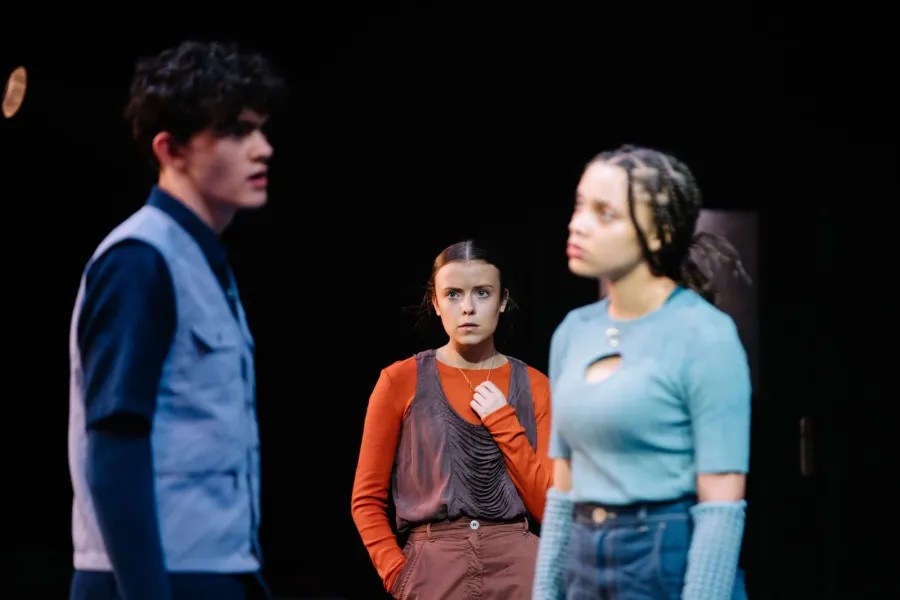
The future is imagined as dark and bright. Disclosing personal pronouns has become standard in introductions, and King presents a world in which popular consensus (at least among the youth) has rendered social issues and discrimination largely absent. That is not to say the youth are all in agreement though. The only schism that seems to affect the young people of the future is one between empathy and bloodthirsty hatred for the ‘dinosaur’ older generations. The jury room is a pressure cooker, literally; the broken air conditioning is useless against the sweltering summer temperatures. There is a recurring danger in works about future catastrophe that they take on a masochistic ‘doomer’ quality, an act of performative self-castigation. Yet The Trials is brilliantly frank about its future world’s problems; the question of how much to judge is precisely the issue it explores.
On the one hand is a (perhaps excessive) enthusiasm for vengeance. Characters Gabi and Noah are initially happy to see everyone above the limit die, a deserved punishment for climate crimes which have no reasonable excuse. Indeed, their verdicts are essentially pre-judged. The content of the speech each defendant makes (in excuse and apology) is irrelevant to them. Thus, King evokes the real-world limitations of jury trials. In America, (where sentencing is not solely the preserve of judges and pre-established conventions) death penalty juries must be ‘death-qualified’ – meaning that jury members must not be morally opposed to the death penalty outright. An unavoidable consequence is that death-qualified juries are significantly more willing and likely to hand down a death sentence than population at large.
King draws a veil over the political machinery that has led to this evolution of the judicial system. There seem to be no lawyers, only the brief personal statements. Additional information can be provided by the anonymous ‘they’ who run the proceedings, but there is limited time and little access to a meaningful defence. Of course, the jury room is a metaphor, rather than a prediction, but there has been some sort of (perhaps revolutionary) shift, either electoral or simply through the breakdown of society amid the climate crisis, that has led to the young standing in moral and legal judgment over the old. Society here is kept afloat by the Climate Defence Force, while resources are generally lacking – hence the need to control the population size, or so the logic goes. There are gestures to collective action and even anarchist political systems; jury foreperson Ren tells them to ‘self-organise’ in deciding how to vote, though soon gently wrests control of the voting system, replacing anonymous paper voting with a ‘quicker’ suggestion that allows only her to see how the others have voted.
In contrast, there is also a growing unease at the retributive nature of this justice system epitomised in the character of Mohammad (a seriously impressive Francis Dourado, in his professional stage debut). Mohammad is disconcerted by the impulse behind the trials from the start and is always the first to spring to the defence of the defendant – irrespective of their actions or relative guilt. He is most concerned by the fact that only remnants of due process remain. They can only confer when all jurors are present, for instance. When Noah (a compelling Joe Locke) storms out of the room in protest, he essentially shuts down the debate, returning only when it is time for them to enter the guilty verdict.
Mohammad posits, ‘what if the government is just throwing these people overboard, so everyone else on the sinking ship will feel better’. He is widely dismissed in the room as a conspiracy theorist. He is told to ‘look around you’ and note ‘that there aren’t enough resources for everyone.’ Yet there is a sad ring of truth to his words. King presents a society so wracked by systemic injustice that it is now devotes outsized effort and resources into mass prosecution – in a rushed, violent system. Late in the play, Mohammad reflects, ‘I hope we’re on the right side of history.’ At the heart of the play is the fact that we will always become the past, us now, and the generations in the future. The youth are in many ways right to judge here, to feel let down, but there is no monopoly on justice; as everyone grows old, they will be judged on their actions. Time will judge us all. We can only hope it will be fair.

At the core of this is the tension between legal and moral law. Arguably, the titular trials seek to square a circle, applying a heavily legalistic framework to a fundamentally moral situation. Thus, the Nuremberg trials are evoked as a striking contrast, in which the defence that one only followed the law of the time was also considered inadmissible. The extent of the similarity between the trials remains relatively unexplored, but perhaps the key difference is the essential separation from harm’s consequence in the case of climate inaction (and destructive action). Prospective climate deaths could be considered relatively random, though they will of course not be proportionate across the world or between socio-economic groups. They are unpredictable, though, and delayed from the point of action. The Nazis’ actions, by contrast, were fully intentional and often immediate. It points to the same moral question that underpins ‘trolleyology’ – the philosophy of the perennial thought experiment that demands we choose whether to divert a runaway train to save five and kill only one, by pulling a lever or pushing a man from a bridge. Generally, participants are much more willing to pull a lever than touch their victim, even if the effects are the same. Abstraction creates a sense of moral excuse – whether or not it is necessarily justified. Pollution may cumulatively kill millions, but it lacks the visceral immediacy of pulling a trigger.
Natalie Abrahami’s production handles the play with energy and tenderness. Though some voices dominate more than others, no character remains elusive – the smaller roles all getting their moments. Particularly great are sequences in which the usually recalcitrant Tomaz (Charlie Reid) play-acts with Zoe (Taya Tower), the youngest juror. Never having experienced either plane travel and or snow, he creates the experience for them, in the gaps between the deliberations. Bubbles drift through the auditorium in the place of imaginary snowflakes.
This world is crying out for a little imagination – perhaps a little theatre. Yet King implicitly self-implicates in the case of Defendant Two, who represents the debatable hypocrisy of being an artist amid climate breakdown. The case for and against the value of art is left undecided here, many of the jurors quick to dismiss environmentally conscious sentiments as signs of greater complicity. (If they knew, why did they not change their ways rather than simply raising awareness?) Yet the point that art makes life something worth being alive for reverberates with a subtle power even in the room’s loudest firebrands.

Another aspect of the play which is fascinatingly rendered is the characters’ navigation of responsibility for their own parents’ actions. Kako’s dads were wealthy corporate lawyers – large-scale carbon emitters, with multiple houses around the world. They ate veal and mostly lived, the three of them, in a house with five bedrooms – enough for twenty refugees. It inverts a school playground dynamic of bragging about the relative importance of a parent’s profession; here, this is barbed with the fact that their parents might be dead – from the climate catastrophe or execution – or culpable. The twist in the third deliberation shines a light on this all the more brightly, as Ren (played with a moving, steely determination by Honor Kneafsey) reveals that the last defendant is her mother. Some of the dialogue voices the unlikeliness of the coincidence, but given The Trials’ underlying moral debate structure, it feels like a natural progression for the drama – ratcheting up the stakes. Having seemingly been a greenwashing sustainability officer for an oil company, the third defendant seems the guiltiest of them all in personal carbon liability. Yet the room is naturally less willing to convict, splitting six-four in favour of guilt, with two undecideds: Ren, and Amelia, who is wracked with guilt at potentially making the wrong choice. An outright majority is needed though.
Partly to save Amelia from making the decision be ‘my fault’, Ren interrupts the discussion to concur with the guilty verdict. The sense of recrimination is palpable and potent, as Ren attempts to square her familial connection with a gut-certainty about the illegitimacy of her mother’s actions. The only choice remaining is whether or not to watch the executions. Abrahami renders these as a mechanised spectacle of complicity, with the condemned lowered on a gantry from the ceiling for all to look upon. To me, it quietly evoked Caryl Churchill’s notorious hat parade in Far Away (revived at the Donmar in 2020), with its slightly baroque display of public death – an ominous message from a generation unable to forgive.
The impression we are left with by the play’s ending (all three defendants are found guilty) is of the widespread destruction of the old at the hands of the young – a poignant reversal of the usual language of intergenerational betrayal. The fact that the young have been invested with such power is fascinating, pointing to a prevailing sense of the young’s inherent innocence – which the play carefully undermines by making them as rich and flawed as adults. As righteous as the characters feel, their views seem to be the logical response to the world they find themselves in, rather than an inherent moral superiority. Who is to say how they would have acted if they had been alive now.
Weighing up intergenerational morality is the play’s main focus. Not having children is discussed as a mark of climate virtue; the first defendant is mocked for his extravagant three while the second pleads her innocence for not having had any. The children have mostly subscribed to a population-centric climate response – focused on reducing the number of people alive, rather than the load on the environment caused by their consumption and emissions. This also points to a complete breakdown in the intergenerational contract. Having been failed by their elders, the young have broadly rounded on them, content to see them die, rather than having to live with their mistakes and care for an older generation who failed them – an ambiguous blend of cold pragmatism, hard justice, and authoritarian cruelty.
The Trials
Written by Dawn King, Directed by Natalie Abrahami, Design by Georgia Lowe, Lighting Design by Jai Morjaria, Sound Design and Composition by Xana, Movement Direction by Anna Morrissey and Aaron Parsons, Video Design by Nina Dunn, Casting Direction by Anna Cooper, Voice Coach Emma Woodvine, Associate Direction by Joseph Hancock, Starring Elise Alexandre, Francis Dourado, Jowana El-Daouk, William Gao, Pelumi Ibiloye, Honor Kneafsey, Joe Locke, Rue Millwood, Charlie Reid, Meréana Tomlinson, Taya Tower, Jairaj Varsani, Nigel Lindsay, Lucy Cohu, Sharon Small
Production Photographs by Helen Murray
Reviewed 20th August 2022
 Joshua Robey