Categories
theatre

Patriots – Almeida

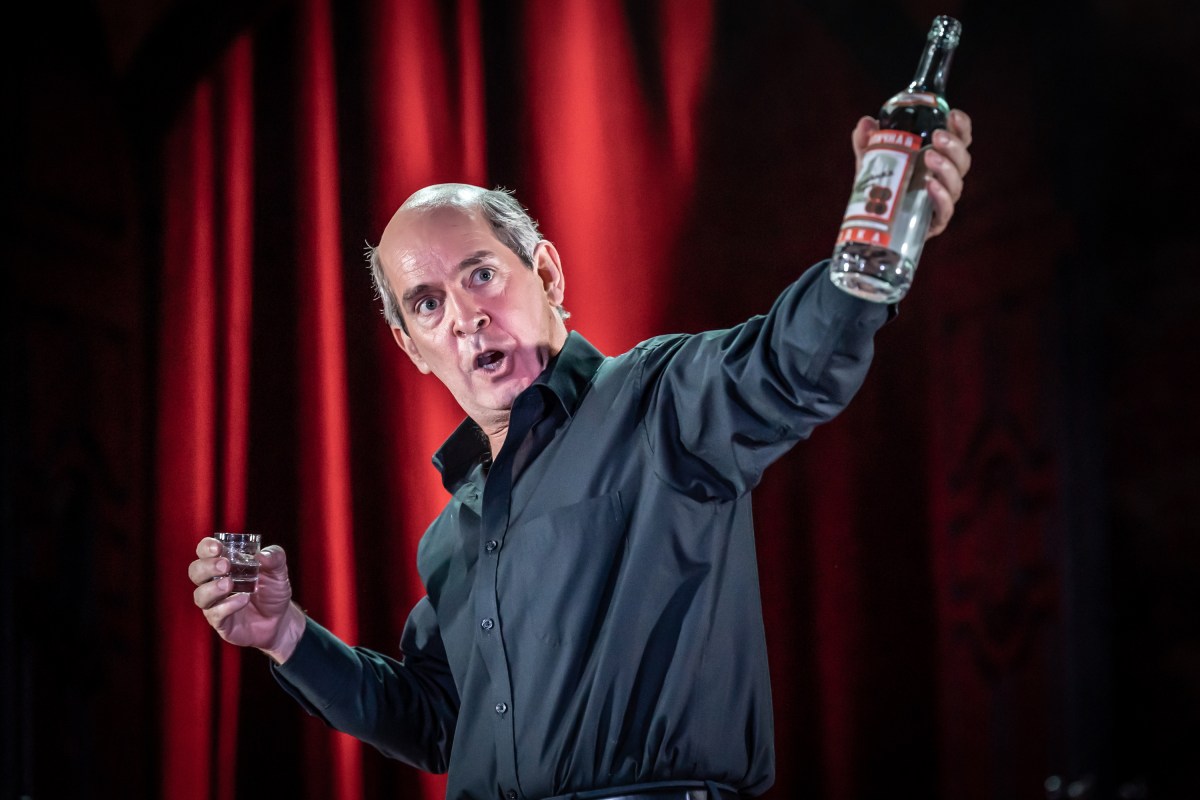
Tom Hollander in Patriots

A gifted scientist, led by infinite ambition and limitless imagination, creates a monster which grows beyond his control. Frankenstein, Mary Shelley’s 1818 novel of ambition, inquiry and overreach, has given us tropes that are now familiar. It provides a cautioning message to anyone who believes they can transcend human limitations – part-Prometheus, part-Icarus in its mythic warning. It also takes the fatal flaw which usually undoes a tragic protagonist and externalises it – an unwitting self-destruction.

This narrative shape is put to excellent use in Peter Morgan’s new historical drama, which dramatises the life of Boris Berezovsky (in this case, a gifted mathematician rather than experimental scientist) as the genius who is blind to the dangers of his own creation – until it is too late. Patriots largely operates as a biography of Berezovsky, from his early childhood (he was born in 1946) to death by suicide (in 2013). Yet by the second half, it becomes less the story of Berezovsky as the origin story of an even more significant figure: Vladimir Putin.

Tom Hollander, who seems subtly but significantly to improve everything he appears in, plays Berezovsky marvellously. He is frequently light and fun, leavening the play with delightful swings between razor-sharp focus and confidence, and bathetic notes of self-pity. His darkly vindictive side emerges on a hair trigger. Yet beneath this all, a pungent melancholy pervades his homesick Russian soul, when exiled from Russia by the very man he promoted. In flashback sequences, Hollander embodies the impishly arrogant child Boris, showing him gradually turning away from his childhood passion of mathematics and his determination to win a Nobel Prize: ‘They pay a million dollars’. (Asked what he would do with the money, he simply replies, ‘Gloat.’) Instead, Berezovsky becomes a titan of Russian commerce – one of the first big businessmen to operate there after the collapse of the Soviet Union, raring to go from the moment Gorbachev ‘permitted small-scale private enterprise.’ Berezovsky saw an opportunity and seized it, his luminous imagination envisioning the chain of events that would lead to Russia’s increasingly capitalistic economy and allowing him to prepare. He is obsessed by the infinite and limitless; ‘Ambition’, he says, as a child, ‘is the belief that the infinite is possible.’ Whether that works in practice, rather than just on paper, is another matter.

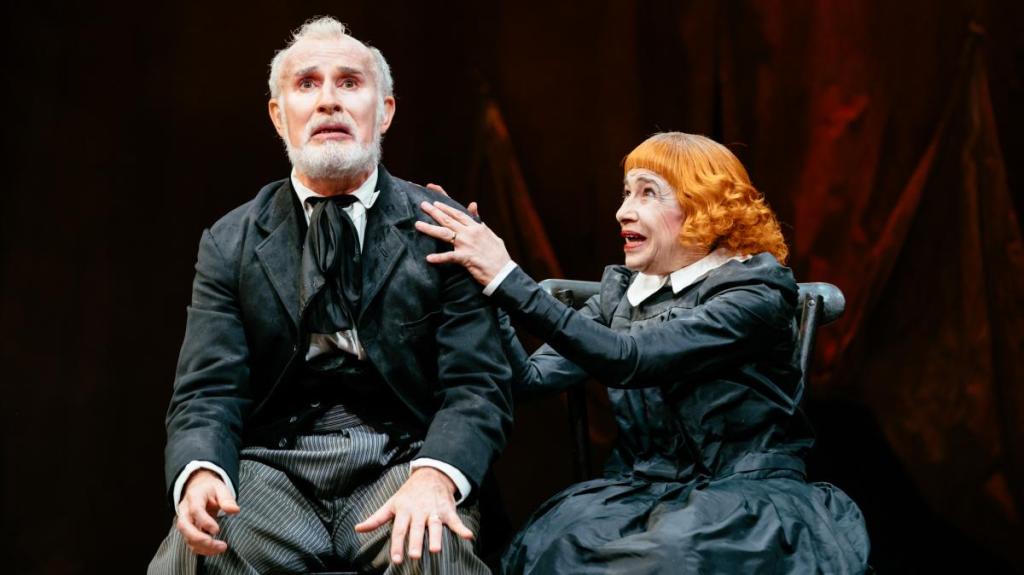
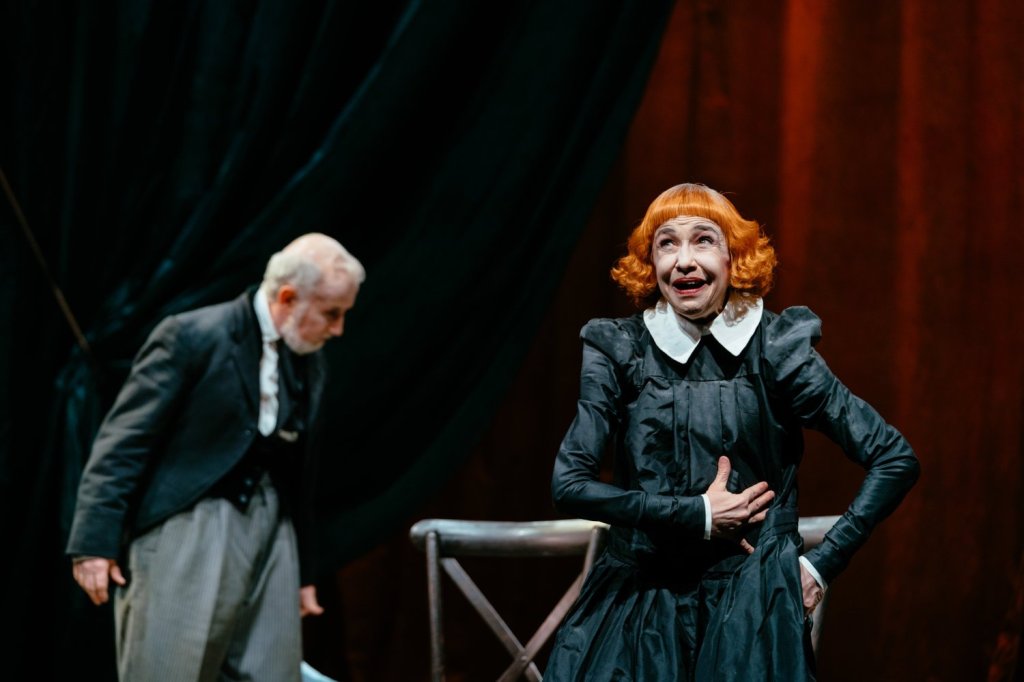
Jamael Westman and Yolanda Kettle in Patriots

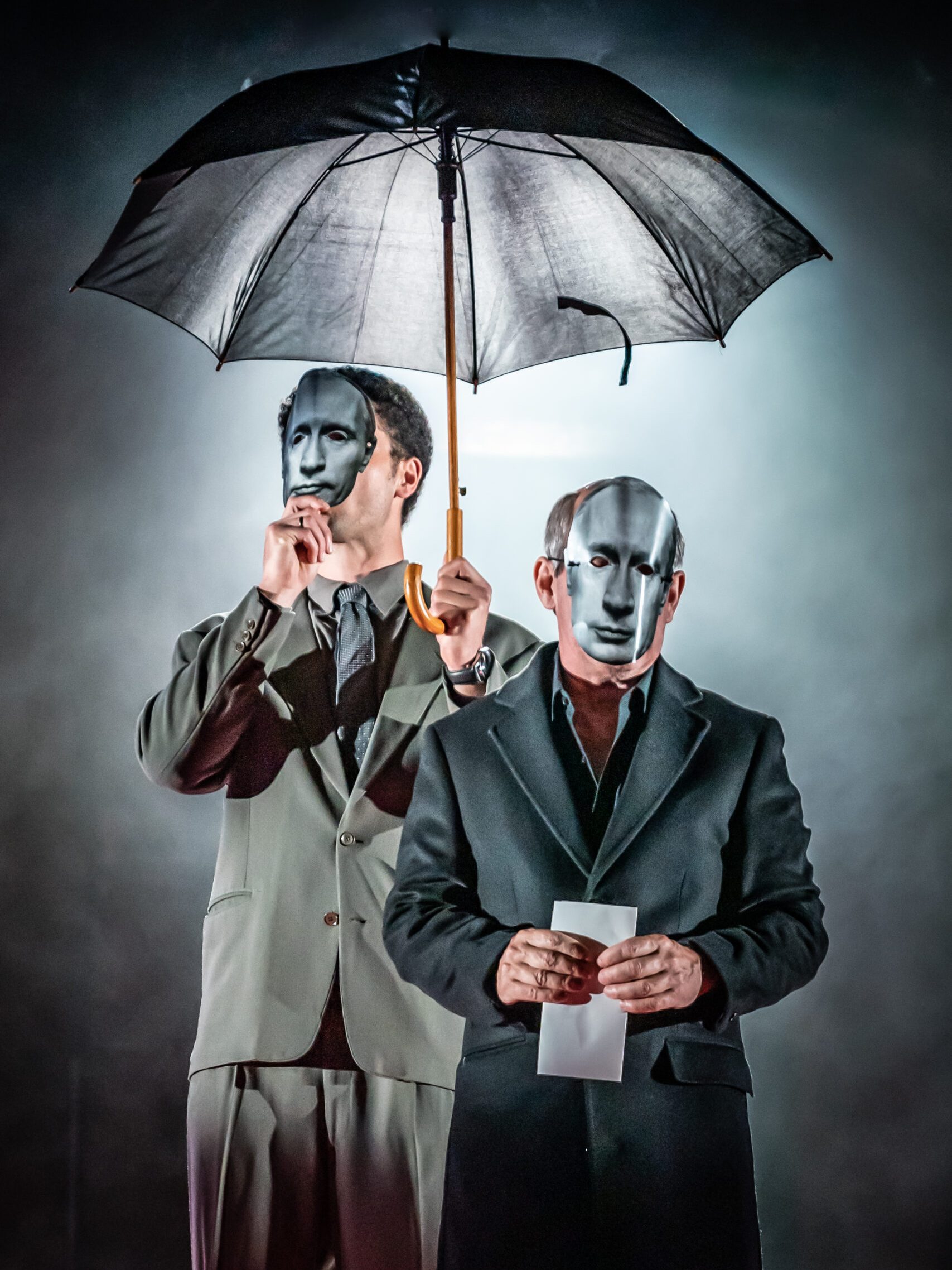
Berezovsky repeatedly cites his degree in decision making mathematics – especially as leverage in business deals. He can tell them, with scientific confidence, that they are making a good or bad choice. Yet Morgan seeks to expose how complex calculations can go awry when mapped onto real, unknowable people. Morgan and director Rupert Goold withhold just enough from us that a chance encounter in Act One Scene Six crackles into life with sudden realisation and humorous surprise. Attentive viewers will already realise that the Deputy Mayor who Boris is unable to bribe is Vladimir Putin, but it is easy to miss his identity – particularly as Will Keen plays him with a powerful anti-charisma, at first, softly spoken, austere and seemingly banal. Held back as a sudden shock is the revelation that the ‘kid’ – in Boris’ words – who he is reluctantly meeting is Roman Abramovic, known for his regular press coverage as the former owner of Chelsea FC. Morgan stages their meeting as a deliberate jolt; ‘Roman Abramovich. Vladimir Putin,’ says Berezovsky in a mutual introduction which hammers home just how timely this drama will be. The bit players are soon to become protagonists in their own stories. Meanwhile, Berezovsky is unaware of the potent dramatic irony as we see his inevitable downfall in the mere presence of the apparent inferiors who will outgrow him.

Abramovic is played as magnificently bashful by the brilliant Luke Thallon, who shone recently in Camp Siegfried and After Life, as well as the Almeida’s original 2017 production of Albion (also directed by Goold). Like Putin, Abramovic is another Russian of immense geopolitical significance who Berezovsky appears to create. He acts as a ‘Krysha’ to Abramovic, an almost familial relationship, a form of business protection, support and sponsorship. The word literally means ‘roof’. In return, Berezovsky receives informal, undocumented payments – which amount to at least fifty percent of Abramovic’s profits. Morgan’s script states ‘thirty million dollars’ as the floor figure for his payment, but Goold cannily changes this to a percentage, demonstrating that this arrangement is ongoing and cannot easily be escaped.

At times, Boris carries his vast wealth and power lightly, yet he also dictates the rhythm of every conversation he is in with stunning authority. That is, until he doesn’t anymore. In a meeting with then-incipient oligarch Abramovic, Berezovsky insists on keeping jazz piano live in the background. ‘It soothes me’, he says, though it quietly irks his associate. Yet when Abramovic demands greater clarity in their financial relationship, Boris slams the piano lid shut – intimidatingly yelling at the pianist ‘SILENCE!! WHAT IS THIS IMBELIC TINKERING?! IT TORMENTS ME!!’ The message is clear: like the piano music itself, Boris can be a soothing presence, opening doors, providing a roof and making you rich, but he can also be a formidable tormentor. He will allow you to be rich, but your money is made only by his grace.

Yet this arrangement will be mirrored in Putin’s Russia, where oligarchs’ activities and interests are permitted at the leader’s behest. Will Keen completing the leading trio well, playing Russia’s future ruler as a bureaucratic presence, stiff and drained of life – albeit with an undeniably vigorous work ethic, whose power, once attained, cannot be contested. He stands in the shame-riddled shadow of his military service in East Germany (where, Boris claims, ‘they generally sent the desk jockeys, the altar boys, the softies’). Berezovsky’s claim that not being selected as a real ‘KGB man of action’ attests to him ‘as a human being’, but the remark is barbed; Morgan notes that, here, Putin looks ‘eviscerated’. Berezovsky becomes too accustomed to this power play, seeing Putin as intrinsically weak and relatively low-status – even has he elevates him higher and higher, forgetting the potential risks. When Berezovsky helps Putin to get installed as Prime Minister of Russia, he assumes that he has attained political office himself. Yet Putin is no puppet. When Boris Yeltsin – perhaps the only man in Russia Boris cannot control, but only influence – names Putin as his successor as President (on the final day of the 20th century), Putin’s power comes close to absolute.

Berezovsky watches on in horror as his power runs dry. Hollander perfectly captures Boris’ initial denial, falteringly trying to tell Putin what he must do, but there is now no need for Putin to listen. His terrorising shouts only worked when backed up with real financial and political power. The man who, in Morgan’s telling, Boris near-singlehandedly groomed for puppet governance inevitably turns on his creator – a modern Frankenstein’s monster, who forces Berezovsky into exile in London. Berezovsky’s obsession with the infinite, the mathematical concept that so fascinated him as a child and which now functions as his prevailing ideology, has led him to overlook his finite, dwindling authority. One miscalculation is all it takes to undo him and those around him – such as personal bodyguard Alexander Litvinenko, known to his friends as Sasha, who was notoriously assassinated in London in 2006.
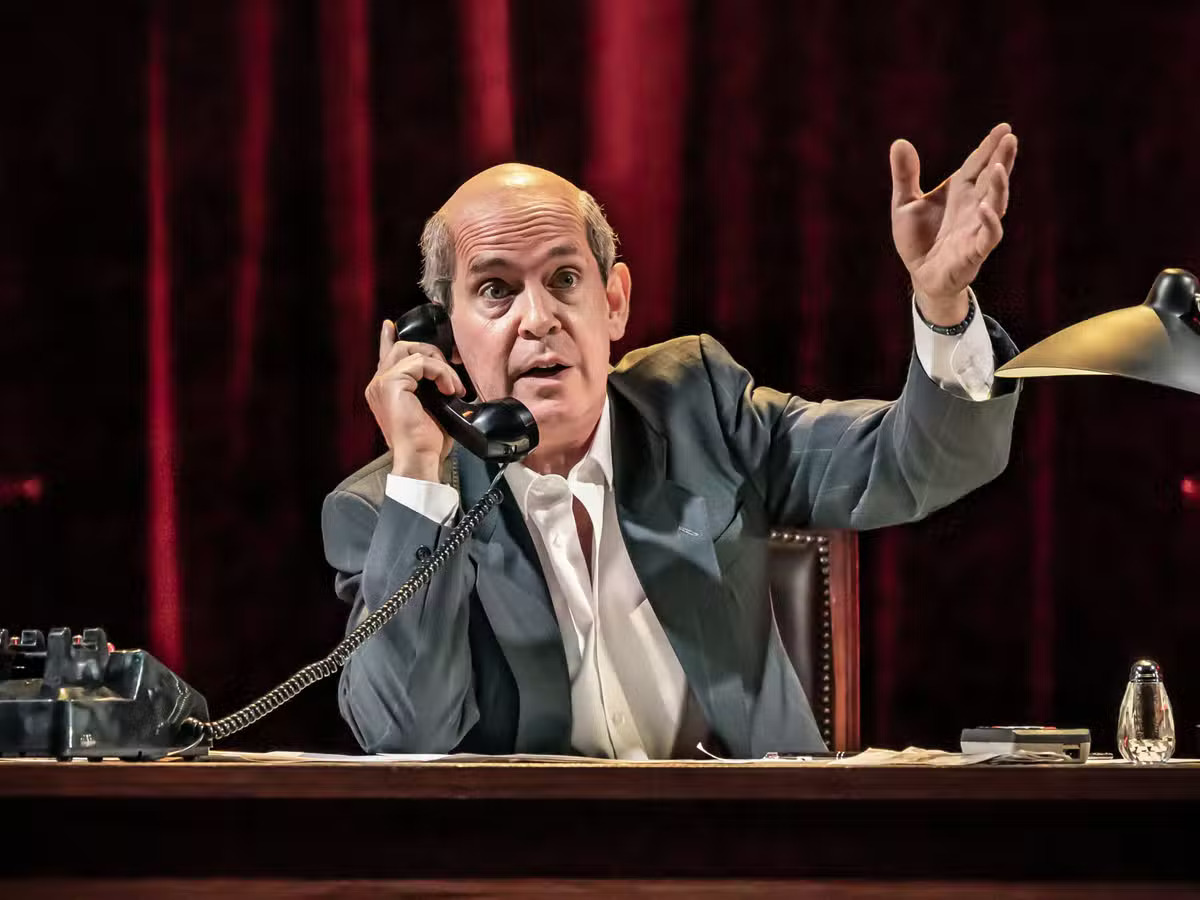
Tom Hollander in Patriots

The play succeeds in exposing us to a story we might not otherwise know, or at least only know in part. The Almeida generally programmes shows late, allowing it to be more responsive than most theatres (both to world events and its high-calibre stars’ availability). Patriots was announced in May this year, and the play has inevitably existed long before Russia’s invasion of Ukraine. Yet, while the Donmar Warehouse’s meditation of the ethics of war in Max Webster’s Henry V seemed grimly serendipitous in its coincidental programming, Patriots feels far more deliberately placed. Thus, it works as something of a documentary play, a form of almost-journalism that seeks to inform us on a subject we should know more about.

Yet, Morgan’s drama never feels too urgent in its focus, particularly compared to the last major play to tackle Putin on a London stage. Lucy Prebble’s 2019 play A Very Expensive Poison, based on Luke Harding’s book of the same name and staged at the Old Vic, examined a similar subject by focusing on the murder of Berezovsky’s bodyguard, Alexander Litvinenko, who tried to raise the issue of FSB corruption with its then-leader, Putin. Prebble tackles Russia as a sprawling and rich culture, rather than Morgan’s simpler dichotomy of eastern, Siberian wastes and the cities of Moscow and St Petersburg, where political power is concentrated. While Morgan translates history to the stage with poise and wit, Patriots does not share Prebble’s ambition and flair. A Very Expensive Poison not only documents the story of Alexander Litvinenko, but it also searches for theatrical and real-world justice – honouring both his memory and the ongoing fight for the legal inquiry which his widow Marina Litvinenko lobbied for long after his death.

Marina appears in Patriots too as a character on the fringes. At first, she accorded a sense of power by Morgan – with Boris wooing her, rather than her husband, to leave the FSB and become his personal bodyguard. Yet she is treated more like a prop in the second half – telling Boris to settle down and find a wife, synthesising her (all too real) grief into a somewhat artificial call to action for the protagonist. In a fictional drama, we might not bat an eyelid, but it rings a little hollow considering the determined, passionate advocacy and activism of Marina, campaigning for the British government to take Sasha’s murder seriously. Here, she seems to have almost given up on life, telling Boris to save himself while he can, even if it is too late for her.

In A Very Expensive Poison, Prebble mounts a sustained assault on the fourth wall, its Vaudevillian stylings capturing the sheer theatre of Putin’s regime – with Reece Shearsmith’s Putin goading the audience, heckling from the private boxes, and even giving a talk about theatre itself. He casts himself as the master storyteller (and liar). Yet the play culminates in a powerfully emotional final puncture to the fourth wall, where MyAnna Buring’s Marina asked audience members ‘How do you do’ until all the artifice fell away. ‘I am obviously not Marina Litvinenko’, she says, before Sasha’s actual words are read out for us. Prebble indicts those who she considers culpable: not just the Kremlin and their Russian agents, but the British government response. Theresa May, Home Secretary before she was Prime Minister, is quoted – denying an inquiry into the murder due to ‘the cost to the public’ – a justification that three high court judges later found insufficient. Ignorance, Prebble argues, is too great a cost. Morgan is driven by a similar impulse, but it takes him a little less far, preferring character study to direct political statements.
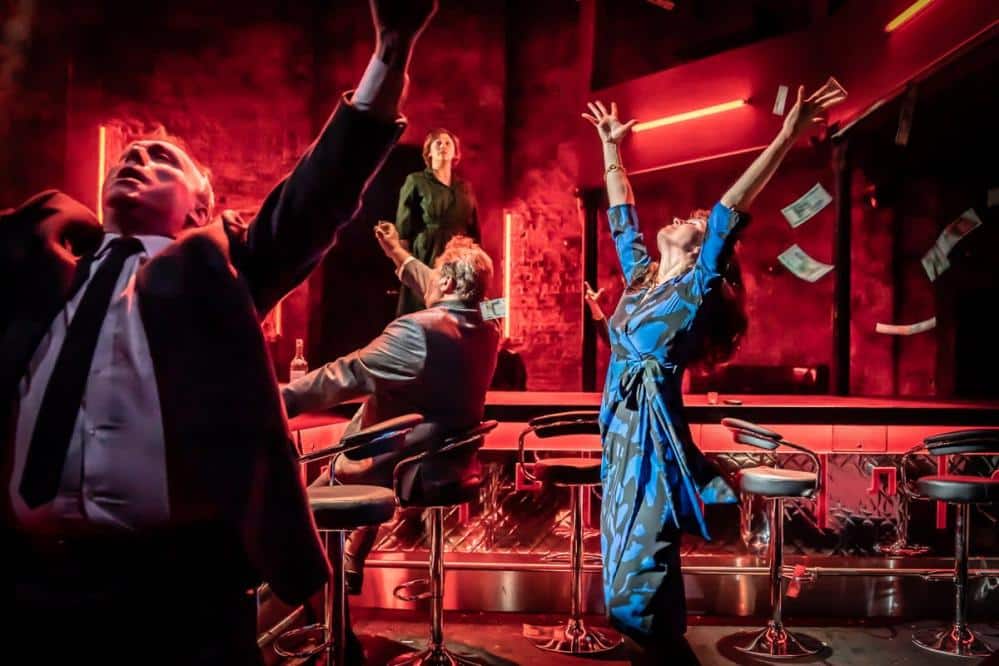
Morgan’s drama mostly addresses the question of how we got here, rather than where we can go next, but it still stands as a strong and compelling take on an underexplored subject, powered by a tremendous central performance. Rupert Goold’s pacy production delivers political thrills and at times some visceral chills, playing out on a fabulous set from Miriam Buether, drenched in Jack Knowles’ moodily red-tinged lighting.

Whether Morgan successfully captures Russia could be debated. A repeated monologue bookends the drama, in which Boris tells us that westerners ‘have no idea’ what Russia is like, listing items of clothing and food as symbolic of Russian life and culture. Yet Morgan’s gestures toward authenticity seem a little hollow. The mocking of London for being too ‘metropolitan’, for example, speaks in a cynical language familiar to contemporary British politics. The word is pejorative in current British media rather than Noughties Russia, replete with connotations of wealthy liberal hypocrisy and functioning as sweeping shorthand in the same way ‘North London’ and (the Almeida’s own borough) ‘Islington’ have done. Boris tells us that we consider Russia to be ‘a cold, bleak place, full of hardship and cruelty’, yet Patriots hardly disproves this, leaning into it at times. It is only despite (or perhaps because of) these difficulties that Russia is so loved and treasured as a home by people like Boris Berezovsky.

In fact, the effect of the opening monologue’s repetition – fashioned into a sort of fourth-wall breaking suicide note – seems unintentionally to affirm the play’s limitations. After two and a half hours, we are charged with the same ignorance we had at the start; it has apparently taught us nothing. Perhaps the implication is that our incomprehension is a condition of western-ness, not a lack of knowledge per se. Yet on the page, Morgan’s intentions for the scene seem clearer. He asks that the sound of Vladimir Vysotsky’s ‘unmistakable’ singing voice be heard, while street vendors sell pelmenyi dumplings, a visible mirage of Boris’ nostalgia – nostalgia in its most literal, etymological sense: homesickness. This speech is summoning into being the Russia that he loves, so that – in his mind at least – he can die there, rather than in a perpetual exile. Goold, however, opts to play the scene straight, without manifesting Russia before us so literally. It is a very understandable impulse of restraint here; the mental image Morgan generates likely outshines the stage action that would be possible. It feels like not much has replaced these stage directions though, giving us the sense that little has changed over the course of the play.

Ultimately, as the title suggests, the major theme of Morgan’s drama is patriotism. It is a theme that quietly underpins most of his work, given his recurring interest in the British Royal Family, most notably. His last play, The Audience (staged in the West End in 2013), examines this through the contrastingly patriotic roles of monarch and Prime Minister. Here, Morgan names his focus explicitly. As a western play looking in, you might expect it to have a greater focus on how patriotism (and nationalism) operates in British politics, though this never quite manifests beyond the occasional winking satire. (Lines about the follies of elected government generate even more knowing laughter than they usually might.) The battle for Russia’s power and its soul is not fought between patriotic true Russians and western interlopers, hellbent on bringing deregulated free-market capitalism to Russia, Morgan contends. Instead, the play depicts two opposing forms of sincere patriotism. Putin and Berezovsky’s respective motives are partly self-aggrandising, power- and money-driven, yet both consider themselves to be acting for the good of Russia. They consider themselves to be the bridge between the present and an illustrious future. Yet, tellingly, it is always the nation itself that is identified as the beneficiary of patriotic altruism, rather than its citizens themselves.

Morgan takes them mostly at face value, as earnest – if conniving – lovers of Russia. Boris pines for his home from his life of luxurious exile, and Putin refuses his entreaties to return to life a quiet (and probably not even affluent) life as a mathematics professor – motivated, it seems, by a conviction that he must protect Russia from his westernised economic and political pressure.
Jamael Westman and Tom Hollander in Patriots

In the second half of the play, Putin instates Abramovic as the governor of (what The Guardian calls) ‘the frozen far-eastern province’ Chukotka, six thousand kilometres from Moscow. In a March 2022 feature for The New Yorker, Patrick Radden Keefe called the province ‘comically inhospitable’ – noting that its ‘winds are fierce enough to blow a grown dog off its feet.’ Abramovic ‘pumped plenty of his own money into the region’, Keefe writes, and Morgan dramatises as fact something that is widely believed to be true: that Abramovic was very much steered into this apparently thankless role by Putin’s guiding hand. (Catherine Belton particularly advances this view in her 2020 book Putin’s People.) Though Boris may have been Abramovic’s Krysha once, in contemporary Russia, Putin acts as Krysha to all of the oligarchs. They keep their wealth only because Putin permits. Yet the scene where Putin visits Chukotka seems redolent of Morgan’s main theme; the billionaire is not only being groomed for his loyalty, but Putin appears to be testing Abramovic’s patriotism. The poverty of Chukotka is still far preferable to a life in exile elsewhere.

This is the vision of patriotism that crystallises in the drama: the pain of separation as greater than any hardships that life may contain. Berezovsky would surrender his wealth to keep his home, and Putin leverages that power against him, as Berezovsky leveraged power against others and him. Yet it is almost a moment where a vital fault line of the play is exposed; how much of what we are witnessing is true? It is another perennial concern in Morgan’s writing, and he treads a line between dramatizing facts of historical record and inventing within plausible parameters. The play bears no caveats about its level of fictionality, nor any acknowledged sources; its content does not signal (as Prebble’s gloriously absurd touches did) where gaps have been creatively filled.

In the bid to dramatise these lacunae, some moments strike false notes. The opening scene is one such example. We hear that the nine-year-old Boris has solved the Kaliningrad Bridge Problem – a traditional problem (previously called the Seven Bridges of Königsberg) in which a city’s seven bridges, connecting its various islands, must all be crossed on a single route, crossing no bridge more than once. The play as performed (but not the script) describes the fact that Euler solved the puzzle in the negative – meaning that he proved it has no solution. Euler effectively devised a new branch of mathematics in the process, and now – for mathematicians familiar with such methods – it is not too difficult a problem to solve. Unless Euler were catastrophically wrong (which he was not), solving it in the positive would be impossible.

This could just be stage shorthand for mathematical genius that contains a fairly fundamental flaw, or perhaps this is a deliberate tell, a sign that the drama is an imperfect, inherently unreal rendering of a life. The gist is true; Boris was an ambitious, intelligent man, and so too would his childhood have been. Either way, Patriots demands our attention in sifting hard fact from elegant fiction. Are we to take the characters’ claims of patriotism on trust, or should our suspicions be raised throughout? It would benefit from a little more direct admission of its inventions, but maybe fiction is what we are supposed to expect.  

Patriots

Written by Peter Morgan, Directed by Rupert Goold, Set Design by Miriam Buether, Costume Design by Deborah Andrews and Miriam Buether, Lighting Design by Jack Knowles, Sound Design and Composition by Adam Cork, Movement Direction by Polly Bennett, Casting Direction by Robert Sterne CDG, Voice Coaching by Joel Trill, Assistant Direction by Sophie Drake, Russia Consultant Yuri Goligorsky, Starring Matt Concannon, Stephen Fewell, Ronald Guttman, Aoife Hinds, Tom Hollander, Will Keen, Yolanda Kettle, Sean Kingsley, Paul Kynman, Jessica Temple, Luke Thallon, Jamael Westman
Production Photographs by Marc Brenner
Reviewed 8th July 2022
Categories
theatre

Daddy – Almeida

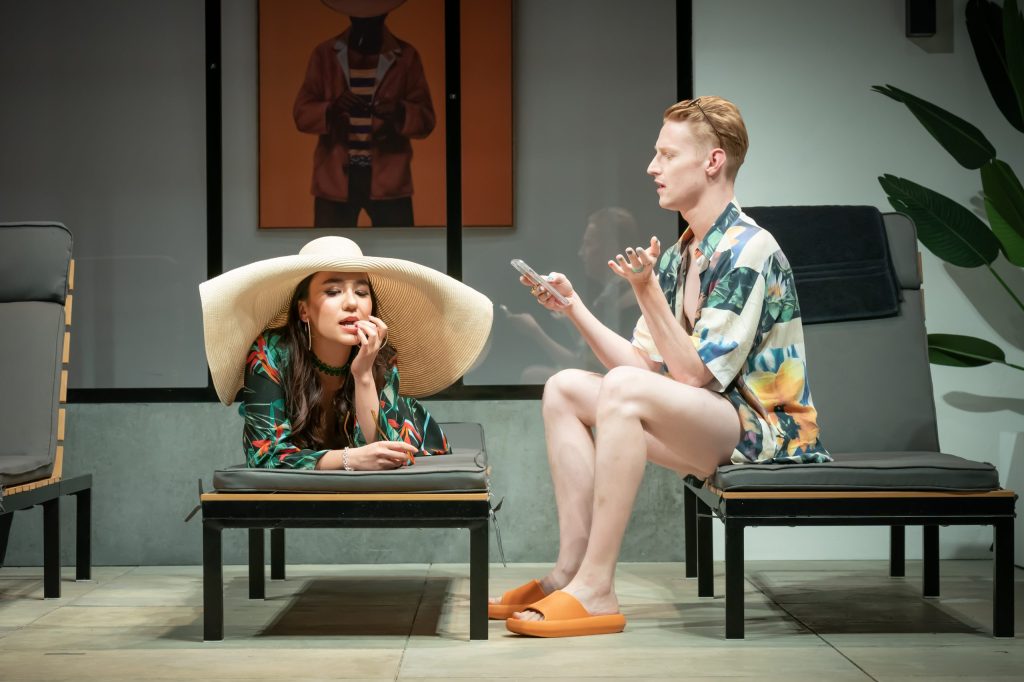
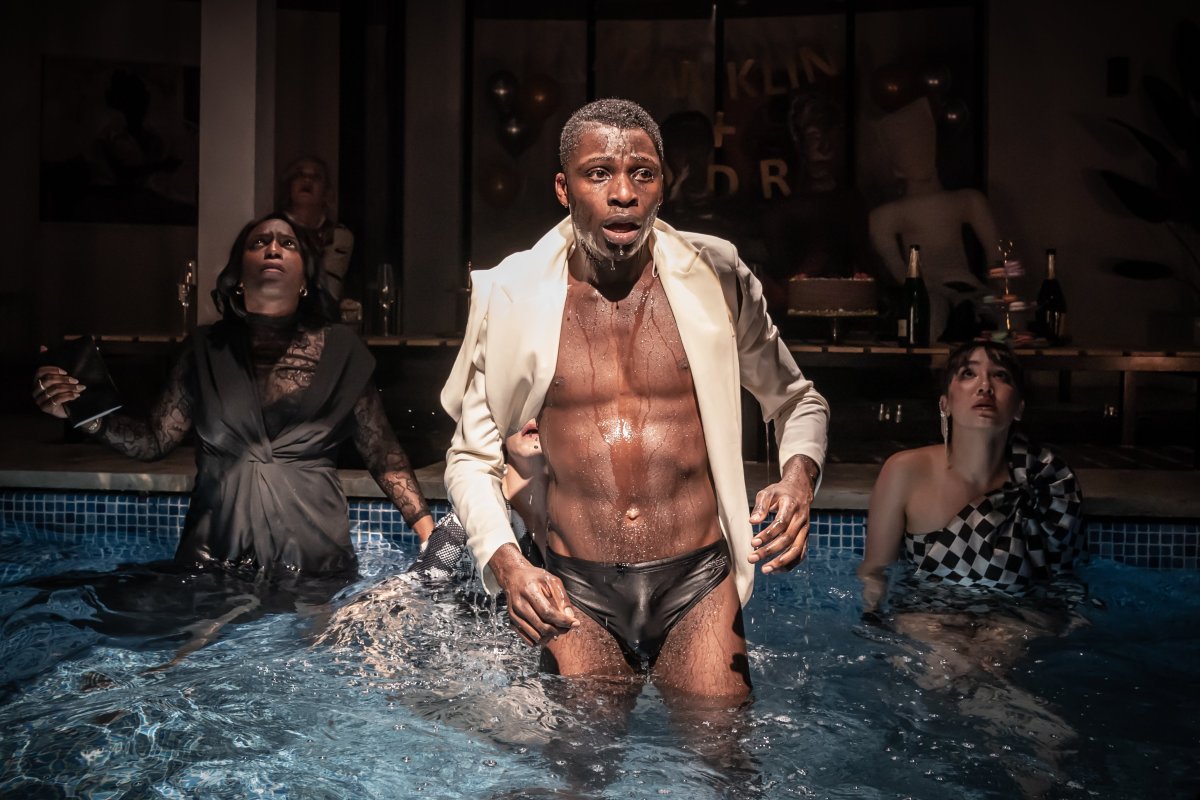
Sharlene Whyte, Terique Jarrett and Ioanna Kimbook in Daddy

A swimming pool dominates the set of Daddy. It acts as a glittering mirror, a cool space of relief and relaxation, yet it also it fills with bodies, sweat, spit, fluids, and mess. Immaculately designed by Matt Saunders, it is a grand, melodramatic metaphor which befits the play absolutely – representing the opulent, palatial open-plan home in which the action occurs, and the complicated warmth and malice of the play’s dangerous central relationship.

Daddy follows the rise of young artist Franklin, as he meets Andre, a wealthy art collector, potential patron, and (as the frequent and hilariously literal renditions of George Michael attest) substitute ‘Father Figure’. The play opens with Franklin – ‘high on molly’ – dripping wet from the pool, lost in his thoughts and surroundings. Having met Andre at a gallery opening, they have come back to Andre’s place – their simmering, sometimes-troubling, sometimes-affectionate sexual-romantic relationship taking uncertain shape before our eyes. Andre christens Franklin ‘Naomi’, due to having ‘legs like Naomi [Campbell]’, and Franklin will continue to be fetishized, as well as infantilised, as the play goes on.

Daddy is an earlier work than Jeremy O. Harris’s Broadway hit Slave Play (which is yet to appear on a London stage). The plays demonstrate impressive range, with substantially different formal and thematic interests, though there are some fascinating shared preoccupations: the relationship of sex to games, the complication of romantic and sexual relationships by power, history and society, as well as grand gestures in design. (Slave Play’s original setholds up a literal mirror to its audience.) Where Slave Play scrutinises historical trauma in the power dynamics of interracial couples, Daddy adds to this divisions of age and importantly wealth too. Harris seems to view drama as an ideal space to analyse and attempt to draw the line between power’s eroticism, and its tendency towards the problematic or abusive.

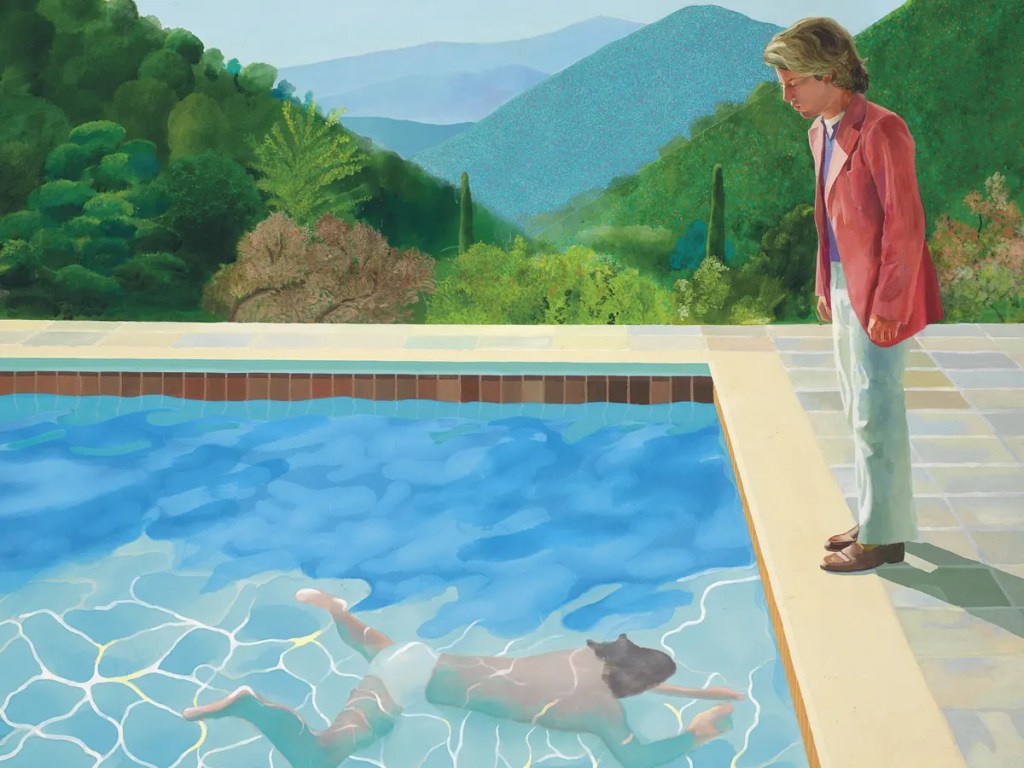
Portrait of an Artist (Pool with Two Figures) by David Hockney (1972)

Harris has described David Hockney as an aesthetic influence on the play – particularly his 1972 work Portrait of an Artist (Pool with Two Figures). It was one of many pictures on a mood board in the Almeida’s foyer (along with Hockney’s equally famous 1967 painting A Bigger Splash), and the script’s ‘Note on Style’ instructs the reader to ‘Google’ it. The image of the standing figure (the artist Peter Schlesinger) peering down at swimmer beneath the water seems apt to this play of gaze, longing and looking. There is a yearning in the standing figure, perhaps even a note of melancholy. Daddy dramatises (and inverts) a version of this scene. Now the artist, Franklin, is more often swimming, while being observed longingly by Andre. Yet the painting seems relevant to Daddy not just as art, but as an artefact, tying into a thesis the play repeatedly tests: that art (and possibly everything) loses its value if it can be owned. At Christie’s, in 2018, Hockney’s large canvas set a record for the most expensive painting ever sold at auction by a living artist. An unknown buyer purchased the piece for $90.3 million. Thus, Portrait of an Artist is not only a mirror of the play’s dynamics, or an aesthetic touchstone for its design, but a model of the fraught ownership Daddy interrogates.

Hockney himself is perhaps something of a muse for the play – caught as he is in the eddies and ripples of commercial art. An air of effortlessness pervades his work, from the lightly stylised rendering of the figures and landscape in Portrait of an Artist to his recent work, such as his rather disappointing digital paintings collectively titled ‘The Arrival of Spring, Normandy, 2020’. For some, money has clearly harmed his artistry; Tom Whyman has called this trend in Hockney’s work his ‘Art of Doing the Bare Minimum’, citing ‘rubbish late-period’ pieces including his particularly half-hearted commercial commissions like his low-effort redesign of the logo for Piccadilly Circus station. Whyman contemplates the gesture, suggesting and then rejecting the idea that it mounts a ‘rebellion of the idle’ in reminding commuters that they need not try too hard. Instead, he concludes, it is an ‘arrogant gesture of aristocratic contempt’.

Ioanna Kimbook and John McCrea in Daddy

At stake is the position of the artist in society, the play charting both a regression into childhood – in child-like sexual role play and thumb sucking – and a coming-of-age into an adult and artist. Artistic success is arguably compromising though. Late in the play, Franklin clarifies the claim he made early on, arguing that making art on commission, for a gallery or show, feels tainted – compared to making art for art’s sake. Daddy itself was not commissioned; Harris wrote it on spec, and it is the play that got him into the Yale School of Drama – after which it was rewritten and reworked to become today’s version. Thus, it is a play that questions his own idealism – at the start of a career that so far has been extremely illustrious. Patronage is presented as both elevation and destruction – a valid and important historical model (à la the Medicis), or a relic of a bygone age. Franklin is supported financially and given opportunity, yet he is at risk of selling his soul. Harris, however, considers the artist to be inherently powerful. Though Andre has clear material and social advantages, he comes to realise that Franklin’s comments about ownership were not so much social commentary, or even a prediction of his coming infantilisation by Andre, but a ‘warning’ – ‘that if you [Franklin] could get me [Andre], have me, if I would have you, that I would become worthless in your arms’. It was never simply the exercise of Andre’s dominance over Franklin, but a complex mutual interplay of power.

These rich, interpersonal dynamics are handled with aplomb by the play’s leads. Terique Jarrett stunningly captures Franklin’s fluctuations in confidence and uncertainty – self-assuredly opining about Cy Twombly but still clearly an artist in the making. The best scenes in the play are those between him and Claes Bang’s Andre, which crackle with chemistry, mutual infatuation and menace. Bang is probably most familiar to British audiences as Dracula in the 2020 BBC series of the same name (as well as the lead of Palme d’Or winner The Square, also set in the art world), and he conveys a similarly winning mixture of charm and threat here as the suave, ambiguously vampiric art collector. We begin to wonder if Andre collects not just artworks, but also artists. Despite his ostensible power, he feels somewhat incapable when it comes to expressing his deepest feelings. Yet he is also hilariously expressive, such as in Danya Taymor and choreographer Anjali Mehra’s fantastically staged dance sequence, which closes the first act.

Meanwhile, Harris’s supporting characters, especially young wannabe influencer Bellamy, undergo one of my favourite dramatic transformations: a shift from comically superficial and affected to subtly profound. Their affectations are retrospectively exposed as signs of the characters’ richly drawn neuroses. Delivering a speech for the wedding of Franklin and Andre, Bellamy struggles to find the words she needs, alighting on the phrase ‘When it’s summer every day, when even is it?’ Ioanna Kimbook gives the line a devastatingly discontented reading, puncturing the glossily filtered world that she has helped curate, through her posts and their embedded worldview. At the beginning of the text, Harris notes that ‘She has 9.3K Instagram followers’ and ‘She’s quite happy with her own directionlessness.’ By the end, she seems adrift, and we are left not quite so sure. Strong support also comes from John McCrea, as well as Sharlene Whyte as Franklin’s mother – who becomes a commanding presence in the second half, engaged in an unacknowledged power struggle with Andre, as mother and father figures respectively.

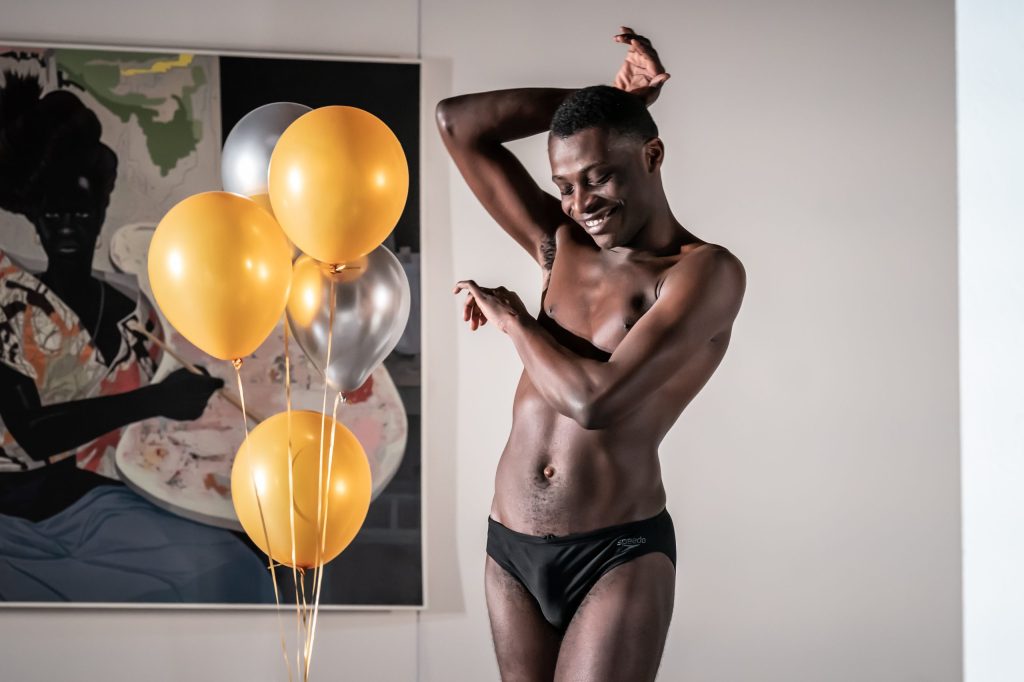
Terique Jarrett in Daddy

Harris’s gleeful determination to deconstruct the theatrical form is in evidence here, though Slave Play’s extended examination of the ethics of play, plays and playing develops this further. Daddy’s disruptions are slightly less assured, yet they reveal a playwright thinking about – and outside of – his chosen medium. Harris has clearly noted the peculiar tension that arises in a theatre when a phone goes off. I recently witnessed the engrossing offstage drama of a man’s palpable relief when a ringtone turned out to be from the phone of his seat neighbour and not his own faux pas. Yet some dramatists are increasingly realising that this miniature ritual of anxiety, shame and judgement will occur both when the phone belongs to an audience member or is part of the play. The jolt of tension created is an arguably unavoidable distancing effect, alienating and reasserting the drama’s fictionality, as the viewer momentarily scrambles to check or remember if they had turned theirs off.

Here, Franklin’s phone repeatedly rings – which is distancing for Franklin himself, pulling him out of his world. Lee Kinney’s sound design melds the distinctive chimes (the iPhone ringtone ‘Opening’) into longer pads, slowing them down and creating alarming soundscapes. Coupled with Isabella Byrd’s lighting, the mood is one filled with potent horror. At the end of the play, we learn that the call Franklin has been silencing is from his father. The anxiety, fear and guilt caused by phones ringing in theatres aptly parallels the feelings evoked by Franklin’s father. It is a neat touch, bringing the play full circle and identifying the major source of trauma in the play. Perhaps Daddy slightly over-resolves itself, and the ending becomes slightly protracted, yet the play remains a hugely engrossing examination of the ethics of art and love.

Daddy

Written by Jeremy O. Harris, Directed by Danya Taymor, Set Design by Matt Saunders, Costume Design by Montana Levi Blanco and Peter Todd, Lighting Design by Isabella Byrd, Sound Design and Original Music by Lee Kinney, Music Supervision by Tim Sutton, Original Vocal Score by Darius Smith and Brett Macias, Hair and Makeup Design by Cynthia De La Rosa, Choreography and Movement Direction by Anjali Mehra, Intimacy and Fight Direction by Yarit Dor, Casting Direction by Amy Ball, Doll Design by Tschabalala Self, Dialect Coaching by Brett Tyne, Costume Supervision by Olivia Ward, Assistant Direction by Mumba Dodwell, Playwright’s Assistant Raffi Donatich, Assistant Sound Design by Ali Taie, Starring Rebecca Bernice Amissah, Keisha Atwell, Claes Bang, Terique Jarrett, Ioanna Kimbook, John McCrea, Jenny Rainsford, Sharlene Whyte, T’Shan Williams
Production Photographs by Marc Brenner
Reviewed 1st April 2022
Categories
theatre

The Chairs – Almeida

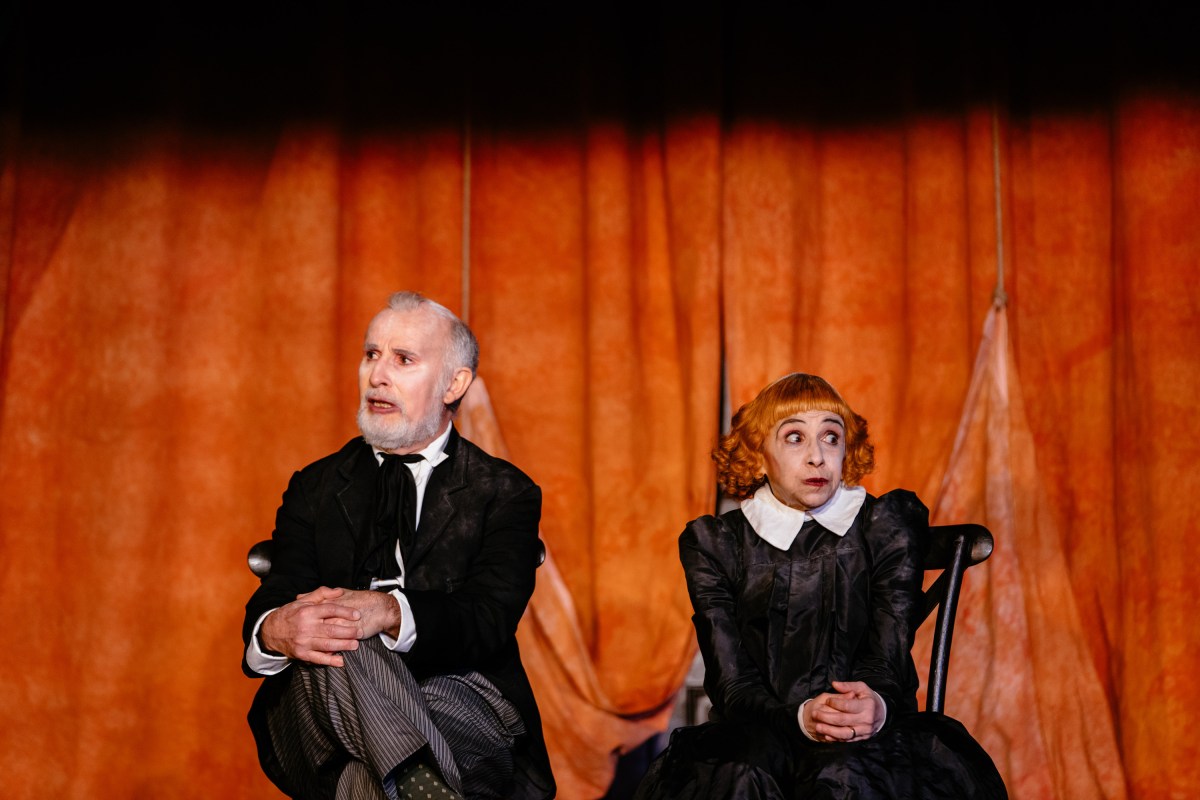
Marcello Magni and Kathryn Hunter in The Chairs

In a playful and intimate new version from translator-director Omar Elerian, The Chairs at the Almeida Theatre is a fantastically disruptive, rambunctious and chaotic meta-drama. It is unlike much else on contemporary British stages (certainly in the larger venues), driven by an offbeat comic intensity, powerhouse performances and searing insight into both Ionesco’s text and the 21st century world his drama is now performed in.

In updating Eugène Ionesco’s classic script, Elerian substitutes the blasted heath no-place, fairly typical of the Theatre of the Absurd, for a dilapidated theatre – which literally falls apart as the show goes on. Presiding over this space are the Old Man and Old Woman, nonagenarians who proceed to welcome invisible guests to watch an upcoming speech, setting out an ever-increasing array of chairs from which the apparent message of salvation they have been promised may be witnessed.

The performances here are utterly virtuosic, with real-life married couple Kathryn Hunter and Marcello Magni playing the affectionate, tatty hosts with true precision. The mutual warmth is palpable, despite their constant low-level rowing, and the Old Woman calls her husband ‘Crumpet’ with a loving twinkle. Kathryn Hunter’s performance particularly transcends age; the Old Woman’s seniority manifests not through slowness, but in a spritely, child-like impishness, hunched and small though moving with striking agility, while her voice is gruff but squeaks with youth. Elerian makes excellent use of their masterful physicality, and the characters are tremendous assets in the play’s slowly building first hour. Where a director might usually be forced to tighten up and trim down, here the sheer joy exuded by Hunter and Magni allows Elerian to extend the play with delightful stage business – including some hilarious prop work involving an invisible table, and the repetitive, though idiosyncratically evocative language. They constantly mutter phrases like ‘titters and tatters’, enjoying the words for their alliterative quality while alluding to the ruined apocalyptic world outside, which they avoid acknowledging. The play’s pace increases as the show goes on, swirling into a frenzy when the stage revolves – filling with the titular chairs in a breath-taking display of technical, artful choreography.

Marcello Magni and Kathryn Hunter in The Chairs

Yet the comedy of Hunter and Magni is not an elaborate way to delay the play’s conclusion. Instead seems fundamental to the production’s dramaturgy. I found myself acutely aware of my laughter in a way that I had rarely, if ever, felt before. Here, metatheatre is a powerful engine of both comedy and ethics – far more than the nod and a wink fourth wall breaking that audiences are generally more familiar with. After all, the central image of The Chairs is of a stage filled with empty seats – an audience who are not present, perhaps unrepresented on stage or simply the couple’s shared delusion. The audience are always part of the theatrical event (the prerequisite, as in Peter Brook’s famous definition in The Empty Space), yet we have a particularly unstable relationship to The Chairs. The play parallels us as spectators to a message. Yet, as two unwitting front-row dwellers discover, when enlisted in a sudden bout of audience participation, we are as real to the characters as the unreal, onstage audience. The fourth wall is porous and leaky, and it is as if we too are the delusions of the characters.

Very often, the serious British theatre experience for audiences is defined by a pretence of not existing – trying to dissociate from potential bodily discomfort, bound by unwritten codes of etiquette that dictate that the merest rustle of a sweet packet is a transgression against the theatrical illusion. Such dissociation is all but impossible here. From the start, in an extremely funny, several-minute section added to the play’s beginning, we are made aware of our presence. Sat under the house lights, the audience overhears the actors through an intercom they purportedly do not realise is broadcasting. We are denied the customary plunge of the space into darkness – at which point we often would, for all intents and purposes, cease to exist. Instead, we sit – waiting for the show to begin (but of course it already has) – oddly aware of ourselves as the actors peek through the curtains and note that we’re all sitting there waiting.

The play seems in some ways timeless, or of the very end of time, but is shot through with a knowing contemporary edge. The actor playing the Old Man ensconces himself backstage, insisting that he does not wish to perform, saying ‘tell them I’ve got Covid’ – grimly apt given the premature end to the Almeida’s Spring Awakening in January due to positive cases in the company. Later, the Old Woman’s age is wryly quantified in the twenty-one booster vaccines she has been eligible for – a good joke, but one which places the events of the play within touching distance of now, in the most frightening form of apocalyptic dystopia: the near future, within our own expected lifetimes.

Marcello Magni and Kathryn Hunter in The Chairs

Elerian and the company retool Ionesco’s drama for the present day far more significantly than just in these (well-judged) asides though – most strikingly in the complete overhaul of the play’s distinctive, bathetic ending. The Chairs’ (more frequently performed in Britain) counterpart in absurdist drama is Samuel Beckett’s Waiting for Godot, whose infamous ending in which Godot does not show up is known by the vast majority of audience members in advance. Tragic, however, is not merely his absence, but the absurd, doomed hope that Vladimir and Estragon entertain that Godot could be a source of transformation. That Waiting for Godot’s (lack of) plot is widely known is hardly a problem for the play though. It is not a twist ending, but a dawning realisation – obvious to anyone who has read the programme notes. Yet, if you peruse a programme for a performance of The Chairs, you will ordinarily see a short cast list of three: the Old Man, the Old Woman, and the Orator – who does appear.

Beckett’s play was first staged a year after Ionesco’s, and it could be argued that Beckett is extending, and making more absurd, the misidentification of hope as found in The Chairs. Unlike Godot, the Orator turns up. But just like him, the Orator fails to provide salvation, deliverance, or even coherent words. It is arguably bleaker to see hope which actively fails, rather than a hope postponed indefinitely. Yet though Waiting for Godot is a ‘tragicomedy in two acts’ – suffused with a base humour of impotence – Ionesco denotes his play a ‘tragic farce’. The Chairs is a tragedy because the chairs are really empty and the Orator fails to speak, but it is also a farce because it is witnessed by a real audience, an interplay of genre of which Elerian seems keenly aware. Interviewed by Natasha Tripney in The Stage, he quotes Charlie Chaplin, saying: ‘Life is tragedy up close and comedy in long shot.’ A theatre audience is in the perhaps unique position of having close proximity and abstracted distance all at once.

Marcello Magni, Kathryn Hunter and Toby Sedgwick in The Chairs

Ionesco’s original play expressed not only a general existentialist futility, but the fear that grips writers and potentially audiences too: that theatre (and art) which claims to have a message of salvation is actually voiceless and futile. Partly it dramatises a fear of writer’s block, which mirrors a wider political anxiety that we cannot dream up a better future. Yet it also challenges the grand, implicit promise of many works of art, that they can elevate and transcend material circumstances, wielding the power to change minds with empathy and ideas. The Chairs is a core part of a theatrical tradition that wonders if we have got a bit carried away.

Yet, rather brilliantly, Elerian’s version wonders if the infamous silences, absences and privations of existentialist tragedy have become too much of a spectacle in of themselves. The Orator’s inability to form words constitutes a powerful message in itself – an articulately ineloquent expression of artistic and political failures of imagination. Elerian instead subverts everything which makes the original entrance of the Orator grand and symbolic. Toby Sedgwick plays him amid collapsing scenery and without the relevant costume, with a powerful disaffection – half in character, half the reluctant stagehand who has been roped in to play a character with two other actors who wilfully deviate from the script. Hunter and Magni have a brainwave, when a curtain collapses on top of Sedgwick, using the fabric as the imperial robes of the (usually invisible) Emperor – gleefully trampling over the original dramaturgy while Sedgwick visibly seethes. When the time comes for the Orator to attempt to speak, Sedgwick apologetically addresses us, taking a galumphing, conversational tack in striking contrast to Hunter and Magni’s precision. He punctures the magic of theatre with a shrug – telling us that he was not able to change his costume and pulling away fake, stuck-on mutton chops and whiskers from his face with a baffled expression. None of it is real. This is theatre in collapse.

The most substantial deviation Elerian makes from Ionesco is the replacement of the deaf-mute Orator’s ‘Jou, gou, hou, hou’ noises with a fourth-wall breaking address – yet one riddled with the same powerful bathos. Instead of literal nonsense, we hear relatively empty words. His profound truth is still inaccessible, but now lost in what Elerian describes as the ‘so many conflicting truths’ we are subject to in our daily lives.

Marcello Magni and Kathryn Hunter in The Chairs

The Orator references Guy Debord’s Society of the Spectacle, with pronounced indifference – neatly encapsulating the intellectual apathy which Debord diagnosed as a consequence of capitalism on culture. Yet Debord is a potent addition to the production, introducing his notably theatrical terminology of spectacle – and, implicitly criticised, the passivity, transfixion and vulnerability of spectatorship. Many theorists and theatre makers have sought to mitigate the assumed inactivity and nonparticipation of theatre audiences in drama – which Peter Brook diagnosed as the ‘slump’ caused by theatrical ‘deadliness’. The dramaturgies of Bertolt Brecht and Augusto Boal are designed to deliberately include, exclude and probe their audiences. The latter proposed the term ‘spect-actors’, insisting that to watch drama is not passive, but active, a proposition later argued by Jacques Rancière in The Emancipated Spectator (2009). ‘Emancipation begins when we challenge the opposition between viewing and acting’, he writes, arguing that the spectator ‘observes, selects, compares, [and] interprets’ – all active engagements with the drama. As in Debord, one of the great dangers of the spectacle though is the general sense of helplessness it can engender – as if the drama would be happening anyway, regardless of the presence of the audience.

While some critics – such as Matt Wolf in the New York Times – lamented the production’s ‘fussy’-ness and questioned the need of the final scene’s elongation, for me, Sedgwick’s closing monologue seems essential. The tragedy of this The Chairs contrasts the original, a riposte to the dramatically bathetic anti-climax of the original, absurdist theatre finding an oxymoronic grandeur in the renunciation of hope or resolution. This puts the whimper back into the way the world ends. It is not as simple as a failure of vision from political leaders or artists, but an unwillingness on the part of the audience to sift the wisdom from the noise – leaving meaning in ‘titters and tatters.’

The Chairs

Written by Eugène Ionesco, Directed and Translated by Omar Elerian, Design by Cécile Trémolières and Naomi Kuyck-Cohen, Lighting Design by Jackie Shemesh, Sound Design by Elena Peña and Pete Malkin, Wigs, Hair and Makeup Co-Designed by Suzanne Scotcher, Voice Coaching by Michaela Kennen, Assistant Direction by Nastazja Domaradzka, Magic Consultant Patrick Ashe, Starring Kathryn Hunter, Marcello Magni, Toby Sedgwick
Production Photographs by Helen Murray
Reviewed 11th February 2022
Categories
theatre

The Tragedy of Macbeth – Almeida

Saoirse Ronan in The Tragedy of Macbeth

Stars, hide your fires; let not light see my black and deep desires.

These words, used throughout the promotion for the Almeida’s exquisite play The Tragedy of Macbeth, are typically held up as signs of Macbeth’s simultaneous ambition and guilt. Yet here it comes across far more literally; this Macbeth is all about desire. The play presents a central relationship which feels distinctively modern in its toxic consequences and the sublime Saoirse Ronan and James McArdle convey a tragedy caused by a fatal mixture of ambition, insecurity and mutual lust.

Director Yaël Farber has said that ‘People tend to think of this as a couple who have transcended morality but in many ways it’s one of the most functional marriages Shakespeare has written.’ Here, the Macbeths are deeply loving, yet capable of cruelty to each other as well others. Lady Macbeth goads her husband with taunts of inadequacy when his qualms over the morality of regicide threaten to halt their murderous plans. The marriage is truly alive and in the opening act the couple are incandescent with sexual attraction; they seem aroused by the power that seems within reach and hatch their plan in a fit of passion on their marital bed.

One of the reasons the theme of sexual potency seems so present here is perhaps because Farber uses it to examine the issue of childlessness – or, more specifically, child loss – in far more detail than many recent productions. ‘I have given suck’, Lady Macbeth famously says in Act 1, begging the question of where these children are in the play itself. Perhaps they are dead, or have come from a previous marriage, but the extent to which they constitute a significant offstage presence is one of the main decisions a director of Macbeth must make.

This production was announced as a ‘feminist’ version of Shakespeare’s tragedy, yet many recent productions’ feminism has made them uncomfortable in tying a woman’s identity to her (lack of) motherhood. Thus, they often simply eschew the psychological possibilities of the absent children. Yet without it, Lady Macbeth’s character becomes unfortunately thin – un-feminist in a different way.

Here, Farber seems to have made a definite decision about the status of Lady Macbeth’s children. The three suited wyrd sisters, ethereal and spirit-like, function as intermediaries between the worlds of the living and the dead. They beckon Lady Macduff (a compelling Akiya Henry), her children and eventually Lady Macbeth as they die. Throughout the play, they hold three blankets. The trio cradled the sheets as if they were the swaddling clothes of new-borns. I wondered if they represented dead children, three losses that haunt the Macbeths, as much as they attempt to avoid confronting their grief. Heartbreakingly, the blankets are routinely spread out to form the bed in which these three dead children were likely conceived.

As a result, Lady Macbeth’s notorious pronouncement ‘unsex me here’ seems like a response to the trauma of child loss, attempting to dissociate from her bodily relationship to them and suppress all maternal instincts. She swears off children in favour of power – just as Macbeth starts saying that her offspring should ‘compose nothing but males’. As a royal wife, she is expected to stifle her trauma in service of a doomed line of succession.

The vocal refrain ‘Come Away’ – lyrics taken from Thomas Middleton’s The Witch (c.1615) – is sung plaintively by the character of Lady Macduff, accompanied by Aoife Burke’s melancholy cello. (Tom Lane’s score is stunning throughout.) The words of this recurring tune ultimately seem to beckon Lady Macbeth to join her children in the grave.

Maureen Hibbert, Diane Fletcher and Valerie Lilley as the Wyrd Sisters

However, Lady Macbeth is not simply trapped by the patriarchal demands of her husband. Farber makes small emendations to the play in order to ensure what is the case at the beginning remains true throughout: this is equally the tragedy of Macbeth and Lady Macbeth.

In a particularly judicious edit to the text, Farber gives Lady Macbeth the line ‘Who can be wise, amazed, temp’rate, and furious, / Loyal and neutral in a moment? No man’ when Macbeth confesses the rage-fuelled murder of the king’s grooms. The scene, as written, has little for her to do but be distraught at the murder of Duncan. The extent to which this is feigned or represents a first bout of guilt is for directors to experiment with. Ronan invests Lady Macbeth’s clear fakery with an almost comic edge. Her sadness evaporates when her husband falters. Admitting murder of the king’s grooms, it almost seems as if his entire resolve is wobbling. His words dry up and on the cusp of being found out, Lady Macbeth intervenes with a sudden burst of controlled rhetoric – words usually spoken by Macbeth in defending himself. In these radical yet subtle alterations, Farber’s feminist vision crystallises. The responsibility for the murder and the subsequent power struggle is shared between them.

Ronan recently told the BBC that Kim Kardashian and Kanye West were part of their inspiration for the leading roles here and though I wasn’t particularly struck by the comparison in the performances, Farber does emphasise the play’s central relationship as something both private and public. Never is this more apparent than in the banquet scene, where Macbeth’s horror and guilt are treated as a public embarrassment and PR disaster by his wife. She springs to his defence over the microphone, dismissing the outburst as a ‘custom’, whilst inwardly seething at her husband’s failure to maintain his public image. Just as when she defends his murder of the king’s guards, his shortcomings are supplemented by her intervention. Lady Macbeth ‘smear[s] / The sleepy grooms with blood’ when her husband cannot out of guilt whilst she has been unable to commit the act herself due to Duncan’s likeness to her father. The Macbeths’ relationship is a fatally toxic; each pushes the other to violence neither would have been otherwise capable of enacting. The result is totally compelling.

James McArdle and Saoirse Ronan as the Macbeths

I cannot recall seeing any Macbeth before which has made the return after the interval more thrilling than what has come before it. Arguably one of the flaws of the text on the page is the contrast between the drive of the first three acts and the more meandering downfall. Macbeth’s return to the witches sometimes comes across as an attempt to inject stakes back into a play whose psychological tension has dissipated into a more underwhelming account of military manoeuvres.

In another small textual alteration, Farber has Lady Macbeth deliver the messenger’s warning to Lady Macduff. She should flee with her children immediately if she is to survive. Yet they are interrupted by the arrival of the murderers. Thus, Lady Macbeth is forced to watch in silent horror as the family is killed before her eyes. The grimness of murder, with screaming children and a stabbed, then drowned Lady Macduff, cannot be dressed up in the borrowed robes of noble language. Macbeth describes King Duncan’s murder as an ‘assassination’. This is a brutal slaughtering.

In this scene, Farber almost entirely solves the usual problem of Lady Macbeth’s madness. Like Ophelia in Hamlet, the role’s early promise usually gives way to an underwritten conclusion. Where Macbeth fights to his last breath, mad with paranoia, Lady Macbeth sleepwalks her way to a quiet end. Yet placing her onstage for the murder of Macduff’s family provides a vital point of transition in her arc. Here, it is the murder of children that presages Lady Macbeth’s decline. Her earlier claim that she would have ‘plucked [her] nipple from his boneless gums / And dashed the brains out’ of her own child contrasts her sudden confrontation with the horrors of child death. The ‘milk of human kindness’ returns, the maternal instincts she has repeatedly sworn remembered. The impossibility of living a life with her grief forever suppressed is written across Saoirse Ronan’s haunted expression – a truly great performance, alive with painful psychological truth. Thus, Lady Macbeth’s madness stems not from simple guilt, or a heavily gendered inner weakness as is so often unfortunately implied, but from the awful fact that the repression of her own grief has reproduced it so brutally in others.

However, this momentous scene is unfortunately followed by a long exchange between Macduff and Malcolm. The production is not short – at over three hours – and whilst it does not feel it, this long scene is a rare moment where I was left wanting less rather than more. The arrival of Ross with the news of the murdered Macduff family is deeply moving, but it comes at the end of a scene which has sapped some of the production’s considerable momentum. After all, as McArdle has said in interviews, the play (and especially this version) is a ‘love story’. At this point I yearned instead to see how the action was affecting the Macbeths’ marriage – or indeed, whether they speak to each other at all. Shakespeare’s text can only be stretched so far though. Perhaps this is why Act 4 and 5 are often less satisfying; Macbeth and Lady Macbeth never interact onstage after Act 3.

I have only one other major reservation about this production. At the end of the play, after Macduff proclaims Malcolm’s accession to the throne, the wyrd sisters re-emerge to speak their opening lines again. ‘Hover through the fog and filthy air’, they say as the lights come up on Fleance, sat in a chair with a gun cocked. The message is clear: tragedy is a wheel that will never stop turning. Power corrupts, as does the desire for it. There is no stable throne. (Though, of course, when performed for James I, the original play’s surface meaning was that the line of succession should be respected as the only path to stability.)

It is unfortunate that the ending here was played out in a very similar fashion only three years ago, in Polly Findlay’s horror-inflected RSC version. There the death of Duncan set a clock in motion, counting down from two hours until the death of Macbeth (Christopher Eccleston). At the end, the clock rapidly wound back up, implying Fleance’s role in a continued tragic cycle. I found this moment to be the most compelling aspect of a partly successful version of the play. Yet it struck me as by far the weakest part of Farber’s triumphant production.

Though I felt a sudden sense of unoriginality in an otherwise innovative production, I was mainly disappointed by how ill-fitting the ending seemed to this version of the play as a whole. Where Findlay’s take explored the corrupting nature of male power, with Lady Macbeth pushed aside by her warring husband, Farber’s tragedy hinges on their toxic collaboration. The tragedy is dual. Therefore, suggesting Fleance will inevitably instigate another cycle of violence somewhat undermines the overall message.

The ending works structurally; the final image before the interval is of Fleance screaming over his father’s corpse so it makes this a fitting endnote. Ross Anderson lends Banquo a striking insistence early in the play, demanding a royal prophecy from the witches with the same force as Macbeth himself which foreshadows this ending. Yet the production extendedly suggests the tragedy is specific to Macbeth and Lady Macbeth themselves. Without their mutual strengths and weaknesses, their ambition, Lady Macbeth’s streak of cruelty and their passionate sexual magnetism, Duncan would have remained king. Though the play did not leave me assured of the stability of Scotland’s throne – far from it – the suggestion that a tragedy like that just witnessed would inevitably repeat itself seems unsatisfyingly conventional. If Lady Macbeth is the co-author of the Macbeths’ tragic downfall, then how could a similar arc play out without the presence of a Lady Fleance?

Yet despite this slight objection, it is unlikely that a better Macbeth will be seen on a British stage for quite some time. McArdle is good as a warring tyrant, yet even better when racked by doubt and hesitation – his greatest fear the disapproval of his wife. Ronan is the perfect complement: luminous and understatedly spellbinding. This revelatory production works precisely because it largely throws off the often-bland universalising force of ‘tragedy’ in favour of the specific toxicity produced by Macbeth and Lady Macbeth in fatal combination. The tragedy is felt as a bodily thing, lust giving way to visceral violence. As such, the production’s treatment of Lady Macbeth seems newly definitive – setting a compelling template for a role which so often wastes the talents of brilliant woman actors. I would be surprised if many future directors did not adopt (and adapt) Farber’s textual alterations as a new standard, teasing out the psychological complexity present in Shakespeare’s original character through Lady Macbeth’s greater stage time.

The Tragedy of Macbeth

Written by William Shakespeare, Directed by Yaël Farber, Starring James McArdle, Saoirse Ronan, Michael Abubakar, Ross Anderson, Aoife Burke, Emun Elliott, Diane Fletcher, William Gaunt, Myles Grant, Akiya Henry, Maureen Hibbert, Reuben Joseph, Gareth Kennerley, Valerie Lilley, Jamie-Lee Martin, Adam McNamara, Henry Meredith, Dereke Oladele, Richard Rankin, Emet Yah Khai, K-ets Yah Khai
Reviewed 13th October 2021
Categories
theatre

Hymn – Almeida

Adrian Lester and Danny Sapani in Hymn

In February, in the wake of a third national lockdown, London’s Almeida Theatre chose to present their previously announced ‘socially distanced season’ digitally. Adrian Lester and Danny Sapani performed – two metres apart – to an empty house, in an immaculately-shot world premiere of Lolita Chakrabarti’s Hymn. The production moved and engaged me then, but this hardly compares to the force with which the play gripped me in its triumphant in-person staging this summer.

In front of an enthusiastic, often-interactive young audience (I saw it during one of the theatre’s ‘Almeida for Free’ nights for under-25s), a quiet, tender two-hander is transformed into a lively and hilarious delight. Blanche McIntyre’s deceptively simple staging allows the outstanding performances of Lester and Sapani to drive the drama to terrific, near-ecstatic heights. Yet Hymn’s sheer joyousness makes its ultimate tragedy all the more devastating.

The play sees Benny (Sapani) and Gil (Lester) attending a funeral: Gil’s father’s funeral – and so it transpires, Benny’s too. Neither have met before, and in a terse café meeting Gil discovers that the dad he has just eulogised fathered another son, only six weeks after him. He is no longer the youngest sibling, and an uneasy friendship is struck between the newfound brothers – a friendship that blossoms into a strong bond, forming the core of the play.

Chakrabarti has said her main aim was to write a play about platonic male love, and Hymn is certainly a love story of sorts. She probes masculinity, and its intersections with race, though she keeps most of this subtextual. When Benny and Gil start training at the gym together (Gil couldn’t stand the ‘sandalwood and sage’ calm of yoga.), Gil recounts his frustration with a woman who blocked the road ahead of him. With cars lining up behind him, he is unable to reverse, but she refuses to move. He tries to break the impasse by getting out of the car to talk to her, but when he asks her to move, she rolls up the window, saying ‘I’m worried you’re going to hit me’. Chakrabarti leaves us to untangle the woman’s racial prejudices from the complications of Gil’s gender and class context. The woman’s response is clearly racially coded, yet we have also seen Gil’s amiable demeanour slip earlier in the play. Gil’s initial hostility to Benny seems driven by their disparity in class and wealth and on receipt of their belated cappuccinos he snaps at the service staff that ‘you’re not too good for this job’. Gil’s entitlement re-emerges in his retelling of the automotive stalemate. He feels that he and his BMW – his ‘BM’, as he calls it to laughed scorn from the audience – have right of way. All the more troubling is the way that Gil and Benny’s friendship blossoms in boxing practice when Benny suggests Gil imagines that the punchbag he is pummelling is ‘that woman in that car’.

Chakrabarti chronicles such encounters throughout the play with a compelling nuance. Male camaraderie grows from both mutual hate figures and shared passions. The two men become truly at ease with each other through singing and dancing – in a scene that truly comes to life in front of an audience, egging Adrian Lester on as his bashful, non-committal moves transform into athletic breakdance. The play is made far richer by these moments, that are far from mere interludes. Early in the play, a sombre rendition of ‘Lean on Me’ – Lester playing the piano in a soulful duet with Sapani – eulogises a complicated father and presages the reliance (for good and ill) that Gil and Benny will have on each other. Later, when they dance with abandon, it is as if they are reliving an adolescence they never shared. The bedrock of their relationship is a supportive masculinity of mutual affirmation. Chakrabarti’s script is rife with occasional moments which beautifully express the subtle yet sweeping ways men can support each other. When Benny’s son Louis is getting in trouble with the police, Gil tells Benny: ‘You’re his parachute – you’ve just got to wait for him to pull the cord’.

There are potential dangers too though. Hymn’s conception of masculinity is all about facades. Gil’s new business idea is to sell high-end designer stationery with matching clothes. You never really get a sense of how Gil has moved into this industry from running a chain of dry-cleaners and the idea itself works better as a stage metaphor than it would do as a practical business venture, but maybe that is the point. The idea seems tailor-made to Gil’s character. His sharp-suited professionalism belies a deep insecurity that he has never lived up to the successes of his older sisters (as well as his father). It masks an inner self-loathing that hurts those around him. His charm evaporates when reprimanding serving staff for tardiness, and when things go wrong for him, he loses all his enthusiasm and resolve, lapsing into self-pity rather than attempting to fix what he has broken. The inexorability of the play’s climax struck me as a structural weakness in February, yet seeing it again (knowing the ending for certain) I found Gil’s arc all the more tragic for its inevitability.

At the play’s end, both characters declare their love for each other in various forms, though neither has managed to tell the other to their face. Hymn ends where it begins, in church – a place earlier described as the only place where people’s expressions of feeling can be ‘complete’. For Chakrabarti, masculinity is, in part, characterised by difficulties of self-expression. As Benny suggests, in the closing monologue: it isn’t so much a problem of concealment, as of how to express yourself. Benny quotes Miles Davis, saying ‘sometimes it takes a long time to sound like yourself’. Here, it even takes someone else’s words for Benny to sound like himself.

Yet the staging suggestively proffers another place where ‘complete’ expression is possible: the theatre. The gorgeous lighting design coupled with the distinctive brickwork at the back of the Almeida’s stage evokes the space of a recently built church. As Hymn gently suggests, perhaps the possibility of expressing the tender, complicated feelings that underlie (particularly male) platonic friendships is what makes theatre near-unique – and all the better for being in the room where it happens.

Hymn

Written by Lolita Chakrabarti, Directed by Blanche McIntyre, Starring Adrian Lester and Danny Sapani
Reviewed 6th August 2021