Following his recent critically acclaimed, devastating family drama The Son and Oscar-winning film adaptation The Father, the return of French playwright Florian Zeller to the British stage is a welcome one. Translated again by Christopher Hampton, Zeller’s new play The Forest arrives at Hampstead Theatre as a world premiere. Though it shares some of the previous plays’ experimental touches, this production lacks the emotional pull of previous works – suffused instead with a coolly detached, almost surgical sheen; though there are moments of bloody violence, the overall effect remains pristine – perhaps like an operating theatre.
Even more so here than in previous plays, Zeller employs narrative pyrotechnics to explore his theme formally. In The Forest, the nameless main character is an eminent surgeon – but written on the page as two people, Man 1 and Man 2. The role is doubled (by the excellent Toby Stephens and Paul McGann) – contrasting the amiable father and husband with the conniving cheat, the slick, successful healer of others with his desperate urge for self-preservation. The strength of Stephens and McGann’s performances resists such a simple dichotomy though. All of the selves are encapsulated in both; the dual role simply makes these differences more immediately intelligible.
Gina McKee and Toby Stephens in The Forest
Zeller’s thesis – that men contain many selves, and thus the capacity for cruelty and violence – becomes apparent quickly, and the play’s structural twists and turns largely serve to generate intrigue in the relatively simple plot, rather than build on this theme. It is undeniably a powerful dramaturgical device, and Stephens and McGann thoughtfully generate a continuity between the two parts, but I found that the unfortunate by-product was the implicit suggestion of male complexity – as opposed to female simplicity. Why is it that all of the male roles alternate between the male actors – not only with Man 1 and Man 2, but with the other men interchanging as various friends and colleagues too? The intention seems to be critical of men and male behaviour, but the effect is almost contradictory; the men exist in exquisite complication while the women are singular and simple – even one-note in places.
At its heart, The Forest seems to be a play about gender – but it rarely digs into the social factors that might cause this male multifariousness – or prohibit it for women. The idea that men exist in multiple selves while women – in general – do not could potentially be examined in light of social and historical norms. Perhaps women are not permitted to be complicated in these ways? Yet Zeller’s drama largely steers away from a concept of gender that is socialised, historical or constructed. The structure – baked into the drama from the very start – gestures towards a crude biological determinism, which goes without interrogation. By definition here, maleness involves a tendency to lie and manipulate. Womanhood, in contrast, is presented as a form of victimhood – every main female character wronged by a man’s (usually sexual, sometimes violent) behaviour. The Forest seems to assert this as a precondition, not a product, of society – interested mainly in the effects of this inescapable psychological prison than on potential solutions to the problem. The harm is to everyone – though the male experience of internal struggle is vividly staged, while women’s pain is expressed either in silence – or is rendered completely inaccessible, when the women are pushed offstage or killed.
Jonathan Kent’s direction is extremely slick, and the cast wring as much from the material as they can. Gina McKee and Angel Coulby should be especially commended – locating emotion in their sometimes cipher-like characters. McKee particularly remains etched in my mind for the way her suspicions, disappointments and ultimate exhaustion seem to play across her face – especially given the relative lack of expression the Wife is given in dialogue. She exists on stage largely through the play’s repeated actions – clearing up wine glasses and fetching water, frowning at the greetings card on some unexpected flowers. Never is McKee’s understated presence more palpable than near the play’s ending, where her crushing disappointment with her husband is expressed in a vast silence. ‘What is it?’, the Man asks, but she says nothing. As Zeller writes in his stage directions: ‘She indicates “nothing” with her head. But her serious expression seems to suggest the opposite. An interminable pause, loaded with subtext.’ This moment could have ended the play – a reminder of the cost of male vices on women. Instead, Zeller goes on, choosing to conclude with the Man’s weeping, under a spotlight – rather expressing the play’s gendered priorities in miniature.
Gina McKee and Paul McGann in The Forest
Similarly unexamined (or left only to subtext) are other social dynamics in the play – particularly the class and cultural specificities which allow the Man to live the life he does. The Forest is another play in which upper middle-class people have wine and affairs, leading to internal catastrophe – but which has very little effect on the material circumstances of the protagonist. The play’s intentions tend heavily towards the psychological. Yet when the female perspective is so underexplored, heterosexual infidelity (where the man cheats) lacks the same emotional heft of Zeller’s previous subjects (such as dementia and depression). Formally, it seems to be a story about fundamental gender differences, yet the presence of pharmaceutical corruption, bribery and organised murder steer the story into something more generic, yet less universal.
The Forest’s title comes from a recurring metaphor in the play – a nightmare expressing a potent fear of being lost in a forest, every tree different but looking so similar. The experience of watching play is a bit like being lost in a forest at night, with its sinister, uncanny sense that we have been this way before – but that things have changed. (This is often a good thing, and the play is certainly entertaining – its narrative repetitions and variations reeling you in rather than pushing you away.) The space of the forest has long held contrasting symbolism of wildness and wilderness, but also human (male) power; there is danger in the natural world, but which can also be tamed by hunters. Zeller evokes this heady mix of images, replete as it is with traditional ideas of male conquest – the hunt sometimes analogous to romantic endeavour. Yet it is hard not to feel these ideas could have cohered into something more than (admittedly impressive) stage imagery.
Toby Stephens and Gina McKee in The Forest
Zeller and Kent craft a show filled with strange, sometimes fabulous images – designed impeccably by Anna Fleischle. The downstairs portion of the stage slowly fills with more and more flowers, which appear almost magically. A large painting imperceptibly changes, its style becoming more photorealistic while also changing to display the image of the Girlfriend by the end. In the bedroom of her small flat – which looms above the stage, like the sword of Damocles – we see the Girlfriend’s bloody body laid across the bed, over and over. It is a queasy image though, rather aestheticized – as female corpses too often are. At the end of the play, the lights come up on the bedroom set to reveal a huge deer – shot dead – spreadeagled across the bed, reaffirming the earlier metaphor of forests and conquest. The Girlfriend has become the victim of cruel, male endeavour.
The reason for her murder is simply that – growing tired and jealous of the Man’s marriage to the Wife – she threatens to reveal the affair, unless he commits to be exclusive with her. Coulby mostly sells the characterisation, though play struggles to conceive of any relationship desired by a woman that does not amount to heterosexual monogamy. Yet for all of the Man’s obvious flaws, I also found his willingness to commit murder (by proxy, though one scene presents Man 2 firing and wiping the barrel clean of fingerprints) unconvincing – a stretch too far for a man whose morality seemed merely deficient, rather than a complete void.
If The Forest is meant to imply that these are horrifying depths to which men may sink, given the opportunity, in shallow self-preservation, then its logic is not developed quite enough. Murder here felt too easy – its reveal a relatively cheap twist, a feat of rapid costume changing and sly set design, rather than a source of psychological horror. In its presentation of wronged women, the weight of the betrayal is relatively weak, when the female characters are so thinly sketched. Zeller’s writing merely invites us to pity them, rather than sympathise with their suffering.
The Forest
Written by Florian Zeller, Translated by Christopher Hampton, Directed by Jonathan Kent, Set Design by Anna Fleischle, Lighting Design by Hugh Vanstone, Sound Design by Isobel Waller-Bridge, Starring Toby Stephens, Gina McKee, Millie Brady, Paul McGann, Angel Coulby, Eddie Toll, Silas Carson, Sakuntala Ramanee, Finbar Lynch Reviewed 17th February 2022
You first realise that this staging of A Number is beginning as rich string chords fade in across the auditorium. As the light’s come down, the music becomes recognisable as the work of Estonian minimalist composer Arvo Pärt. His piece ‘Fratres’ will recur throughout the production, scoring the interstices between the five scenes, and I found it to be a hugely powerful choice which was not only thematically apt, but revelatory even in Lyndsey Turner’s heart-breaking take on Caryl Churchill’s short play.
First performed in 2002, A Number tells a deceptively simple tale of a father (Salter) and his son (Bernard), who has seen ‘a number’ of clones of himself wandering around in the world. At first, Salter denies all knowledge, but the facades he has built soon crumble away and we learn that this Bernard is also a clone – having duplicated the first Bernard after putting him into care. Instead of having another child, Salter insists though that he wanted ‘the same’; as becomes clear, he wanted to have another go at getting fatherhood right. Though debuting amid moral panics over cloning, The essential durability of Churchill’s is epitomised by A Number – whose most searching questions concern the tyrannies of parenthood, abuse, and the socialised nature of identity. Yet in the Old Vic’s new version, Arvo Pärt’s music reveals an additional layer of spirituality – which foreshadows the interests of her recent works, such as Imp and What If If Only.
Originally composed in 1977, ‘Fratres’ has become a phenomenon of 20th century classical music. It is something of a staple in film soundtracks (notably There Will Be Blood) and I believe it is commonly used as placeholder temporary music in the making of other film and television (meaning that many scores end up sounding a bit like it). Its sublime power is undiminished though, and ‘Fratres’ exudes a potent religiosity that moves even secular listeners (including this one).
In many ways, it is the perfect piece to juxtapose with A Number. It is structured in many variations, all different, yet stemming from the same underlying patterns – as the drama’s clones differ while sharing DNA. ‘Fratres’ means ‘brothers’ in Latin, the word balancing familial and holy fellowship, while seeming to comment on the brotherly relationship of each of the piece’s sections. Its energy matches Churchill’s writing too – mercurially shifting from serene stillness and bell-like chords to dazzling, choppy motion. Churchill’s dialogue is similarly coiled like a spring – taut, often quiet and calm, yet with an angular, staccato edge.
It even seems ironically apt that ‘Fratres’ exists not in a single version – but many; the original 1977 version was written ‘without fixed instrumentation’. Thus, there is no definitive or original ‘Fratres’ – fitting given Bernard 2’s questions over the contrasting order and primacy of Salter’s clone sons. Since its composition, it has been performed (perhaps most commonly) by violin and cello soloists with a piano, by orchestras, ensembles of cellists, bands of percussionists, and even a quartet of saxophones. Yet each one shares the same framework – the same musical DNA.
Paapa Essiedu and Lennie James in A Number
Yet this production’s use of Pärt is more than a canny thematic concordance, unearthing, for me, a rich spiritual yearning at the heart of A Number. Past productions, like the Polly Findlay’s terrific 2020 version (with Colin Morgan and Roger Allam at the Bridge Theatre), have left this side of the play relatively unexplored – more than justifying Turner’s decision to remount the play so soon after its last major outing.
This spirituality is found in the structure of Pärt’s composition. In the early 1970s, Pärt converted from Lutheranism to Orthodox Christianity, and after several years, in 1976, began composing again – adopting a new method with a decidedly religious motivation. ‘Fratres’ was an early work in Pärt’s now-defining ‘tintinnabuli’ style. From ‘tintinnabulum’ (Latin for ‘bell’), this mathematical – even algorithmic – form of composition combines two main voices: the notes of the chord of the key signature, and line generally moving in step. These form a ringing harmony, plaintively beautiful – sacred yet modern.
In 1997, Björk commented that Pärt ‘has got the whole battle of this century inside him’. He considers music to have not only spiritual significance, but purpose. Describing the combination of melody with tintinnabuli chords – as in ‘Fratres’, often played on violin or cello and piano respectively – Pärt says that ‘the melodic line is our reality, our sins. But the other line [of tintinnabuli chords] is forgiving the sins’. The music ministers to human errors, an agent of forgiveness. Tom Service even argues that the dissonances that Pärt’s systematic approach creates generate simultaneous ‘sorrow’ and ‘consolation’. His music is a beautiful, though painful, form of purification.
Though some critics have questioned the Old Vic’s decision to stage A Number, less than two (pandemic-stricken) years since the Bridge’s major revival, this is arguably the first production to put forward, as the play’s main theme, forgiveness. Specifically, A Number depicts a failure to seek forgiveness – the play’s father-figure, Salter, clinging onto a tragic desperation to do and be right entirely through his own actions. This is encapsulated in the decision to use the mellower cello arrangement of ‘Fratres’, with its lower, paternal melody line – evoking the sins of the father.
What the presence of ‘Fratres’ seems to articulate, almost imperceptibly, is the alternative path Salter could have taken. The irony at the heart of the play is that the biggest mistake he should correct if he could was his decision to clone his son – a choice driven by an urge to fix past errors. This production seems to argue that Salter should have sought affirmation and forgiveness – perhaps even of a spiritual kind – rather than turn to science. There is no gesture towardness naturalness or criticism of man playing God though; the reason why turning to such a drastic scientific option is flawed is because it is fundamentally incapable of giving Salter the absolution he craves. A second child does not give him a blank slate, but a rickety house of cards – which his lies have sustained for years – which now comes tumbling down.
In Pärt’s music, mathematics and physics are transformative – allowing closeness to the divine. His musical system represents (and for some even does) the forgiveness of sins. For Salter though, science is a means to a very different end. Though the process successfully produces a clone for him to parent, he fails to acknowledge the insurmountable scientific fact of time having passed – and his past actions having had effects. Forgiveness cannot be a unilateral act of self-exoneration, nor can it be attained through further lies and fantasy. A Number is thus a powerfully moving portrait of a father who yearns for forgiveness he cannot bring himself to ask for.
Lennie James in A Number
What elevates this already philosophically and psychologically rich staging even more is the urgent force of its actors, who transform the cryptic turns of the plot into aching human relevations – the pain palpable. Paapa Essiedu is extraordinary, conveying three different but genetically identical characters with immaculate precision. In the opening scene, Salter’s clone son Bernard is rendered with humane perplexity – struggling to piece together the literal facts of his own life and the paternal betrayal simultaneously. Bernard 1, meanwhile, is tenser – coiled with an agitation and simmering menace that culminate in the revelation of his murder of Bernard 2, and then his suicide. In the final scene, Essiedu plays Michael Black – one of the twenty or so unauthorised clones of Bernard 1 – and finds another, strikingly different, register. Hugely (somewhat comically) unbothered by being a clone, the character’s presence almost raises questions as to why he is in the play at all – living a life of quiet, ordinary happiness, in contrast to the searching desperation of Salter, his parent only in biology. Yet this contrast epitomises the play’s dramatization of the alternative path; Michael does not feel the crushing need to be defined by his origins.
Lennie James, meanwhile, matches Essiedu – anchoring the play with an unshowy, subtle turn as Salter. His good-natured demeanour and stage action lull us into a security that is offset by the truth of his actions. Salter is often in motion – a proactive father – quietly undertaking housework tasks, and gently wringing tea towels with discomfort. When he talks about the difficulties of parenting, saying ‘I did cook meals now and then’, it seems less apologetic than self-effacing; he does seem – in some ways – an attentive, well-meaning dad, though with a secret eating him up inside. James opts to play him as a man who barely knows that he is lying, the effect brilliantly realised. Lies seem so customary to Salter that he cannot help it. ‘I’m not attempting to deny’, he says to Bernard 1, mere seconds after an attempted denial. James’ warmth makes Salter seem wretched rather than evil, not dissimilar to Allam’s take in 2020. It is probably the better choice, mining the role’s understated pathos rather than presenting him as a sinister, calculating manipulator. Salter does not consider himself a villain but becomes something like one through his efforts not to be.
When – almost on reflex – Salter suggests that Bernard could sue the cloning company, for infringement on his personhood, it sounds like the result of a learned cultural instinct, from the capitalist waters we swim in, rather than the result of a scheming personal greed. Systems of justice and restitution have been usurped by a purely financial logic. This implicit satire of compensation culture is perhaps one of the play’s more specific links to the early noughties – much more so than the moral panics over cloning and identity.
Though identity and the age-old nature versus nurture debate rumble below A Number’s surface, Turner presents the play mainly as an account of paternal failure and inherited consequences. Here, Churchill’s drama seems fairly certain that genetics are far lower down the deterministic pecking order than the effects of parenting and socialisation – which the final scene, quietly, devastatingly demonstrates. The early taut, domestic tension dissipates with a change to Es Devlin’s set, which replaces the sleek, minimalist, modular home with an art gallery – each canvas strikingly empty. A security guard wanders in the background, the play’s intense two-character dramaturgy substituted for something looser, more leisurely and laid-back.
There is none of the blame-filled struggle between father and son. The clone Michael provides a vision of an alternative path – the same DNA, raised differently. Yet the key difference was not that he was raised in a different style per se, but that he was not brought up by Salter. The purpose of the meeting seems to be for Salter to extract information – about Michael’s emotions and inner life. Michael, though, cannot provide all of the answers Salter is looking for, struggling to understand why the existence of other clones – and the fact he is one – would be a form of ‘losing [his] life’. ‘I’ve still got my life’, he calmly responds. Salter probes, hoping to find Michael’s essence – ‘tell me something about yourself that’s really specific to you, something really important’ – but Michael insists again and again on defining himself in relation to others. His wife, family and baby all constitute a large part of his identity; meanwhile, as Michael blithely notes, we have ‘thirty percent the same [DNA] as a lettuce’. Advocates for genetically determined difference not only overlook the vast similarities – evoked here as ‘the unifuckingversal [joy of] turning over in bed’ – but also that what particularises us as individuals is very often the unique combination of relationships we have formed with others. The reason Michael is so unaffected by the revelation of his birth is that he looks to meaningful relationships for his identity, rather than inside himself or towards a point of origin.
Lennie James and Paapa Essiedu in A Number
Salter’s fundamental mistake – his flaw, even – is that for him everything is coloured by deterministic logic, coloured quite literally in Es Devlin’s beautifully pristine set. The home setting for scenes one to four evokes the pungent vitality yet unreality of Salter’s world. Almost every single prop and feature on stage is painted the same shade of deep red. It has the sheen of a modern science lab and the intense lighting of a nuclear power station in meltdown. The effect is uncanny and unsettling; something in this home is not quite right. The hue unavoidably evokes blood. For Salter, that is where the bond between father and son is located – a biological fact, rather than a shared, social relationship. What makes Salter’s flaw so toxifying is his inability to reckon with his sons’ differences from him; though connected through blood, one’s children will always have their own lives distinct from yours – a painful fact every parent has to accept. Yet for Salter, divergence equates to a form of personal failure. Devlin’s masterfully heightened realism is matched in the dialogue’s delivery too. Churchill’s staccato rhythms are deliberately challenging, potentially open to an ultra-realist, digressive interpretation, though here the actors lend them a perfectly off-kilter, stylised edge.
As you watch Turner’s production, you peer closer – trying to see how things fit together, as Bernard 2 does at the baffling course of events in the first scene. At some point (perhaps early on, or only at the curtain call) you figure out that the Pärt-underscored inter-scenes feature not Essiedu but an understudy (Phillip Olagoke) to facilitate what seem like dazzlingly quick, magical costume changes. It is a neat touch to mirror the play’s themes in this stage magic – more Bernards wandering about than you expect.
While I certainly agree with Dan Rebellato’s claim that Caryl Churchill ‘never repeats herself’, A Number’s concerns seem so defining and important that it is not surprising to see them appearing again new forms. Churchill’s latest short play, the brilliant What If If Only – which James Macdonald staged at the Royal Court in late 2021 – spirals back to these themes, this time with a partner who the protagonist seems to will into manifestation. That’s what Bernard 2 is here – a ‘what if if only’ made flesh. Yet this production shows that it would not be fair to assert A Number is the harder sci-fi play compared to What If If Only’s ghostly spirituality. A searching, almost-but-not-quite religious quality flickers in A Number too, animated here in the transfixing and moving use of ‘Fratres’ – evoking Salter’s sins, and the failed attempts at forgiveness which he made without making an apology.
The play ends with Salter asking ‘[do] you like your life’, to which Michael replies ‘I do yes, sorry.’ Of course, ironically, Michael is the one with nothing to apologise for.
A Number
Written by Caryl Churchill, Directed by Lyndsey Turner, Set Design by Es Devlin, Costume Design by Natalie Pryce, Lighting Design by Tim Lutkin, Sound Design by Donato Wharton, Starring Paapa Essiedu, Lennie James, David Carr, Phillip Olagoke Reviewed 14th February 2022
Rachel-Leah Hosker and Nathaniel Christian in The Winston Machine
Given its title, one might expect devised theatre company Kandinsky’s new play The Winston Machine to excoriate the way World War Two has become so central in the British cultural memory – to the point of obsession. It does do this to some extent, but though it slowly turns to the potential ‘weirdness’ of this nostalgic, overly romanticised fixation on the past, I was struck by how much it has its focus trained on the present day.
After a flashback-fantasy sequence (and as the play goes on, the line between them becomes even more deliberately vague) about a spitfire pilot leaving for war, The Winston Machine plays primarily as satire of contemporary life. We follow the day of Becky (a brilliantly varied performance from Rachel-Leah Hosker), dealing with the difficulties of long-distance communication with a boyfriend she cannot love and the awfulness of office leaving party obligations. The digital world collides with reality in dialogue – ‘ring, ring’ intones Hamish McDougall, playing Becky’s phone and then her boyfriend; the style somewhat brings to mind Katie Mitchell’s recent staging of Rebecca Watson’s little scratch.
Hamish McDougall and Nathaniel Christian in The Winston Machine
Yet the play rarely alights on a single mode of storytelling for long, ever-shifting between the past and present, with impressionistic, dream-like sequences peppered through. It is at its best when communicating through simple, powerful images – which convey several layers of meaning at once. Childhood is potently staged with McDougall and Nathaniel Christian flying paper aeroplanes, both guided by Becky. She works to prevent her boyfriend and the school crush she has recently reconnected with from colliding, neatly spelling out the love triangle that forms the basis of much of the drama. Yet the simulation also reminds us, of course, of the real planes that flew and fell out of the skies – shot down in the Battle of Britain.
At the heart of the drama is a sustained consideration of, in particular, the baby boomer generation’s connection to World War Two. The paper aeroplane motif re-emerges in a scene highly symbolic of the relationship between the ‘boomer’ and ‘greatest’ generations. Andrzej Łukowski writes in his Time Out review that ‘[n]o sacred cow has been butchered more in theatre than the myth of the so-called greatest generation’, and he is right about its thematic recurrence. Yet I found The Winston Machine to be interrogating the exact generational differences more specifically and empathetically than usual. In the scene, Becky’s father makes a paper aeroplane, only for his father (who flew spitfires as an RAF pilot) to trample it in anger. There is little of the intergenerational irreverence (especially from the younger generation) customary in such narratives; the play is interested in examining sometimes far more psychological and structural than simply articulating an ‘ok, boomer’ sentiment.
The word ‘boomer’ has relatively recently gained a particular, sometimes-fraught cultural context. It is as much a metonym for certain behaviours and attitudes as a grouping of those born between 1946 and 1964. Yet The Winston Machine’s intergenerational dramaturgy probes the position of boomers in British history. Born in the shadow of such a large conflict – in its immediate economic peril and residual effects of rationing, for example – it exists for many as a disconcerting childhood memory. Yet instead of something uncanny or fear-inspiring, the war is sometimes considered as a defining identity – with some pride. Part of this overinflated pride, however, stems from a contradictory-seeming sense of inadequacy and shame.
Nathaniel Christian and Rachel-Leah Hosker in The Winston Machine
Kandinsky’s production particularly suggests that the cultural affinity for the war as a source of pride, an aesthetic, and a national myth is in large part due to its traumatic legacy, inculcated through the repressed emotions of their parents. Not only is the paper plane trampled – a lightweight approximation of the real thing – when Becky’s dad attempts to hug his father he is pushed away and stabbed repeatedly with the paper aeroplane. This literally harmless act causes a deep psychological wound.
Hamish McDougall is consistently good, playing a range of difficult men – particularly Becky’s boyfriend – pushily demanding they put an offer in on a house – and her father – constantly complaining about Harry and Meghan. Yet as the play advances, he conveys utter desperation – both when claiming World War Two re-enactments as a way to commune with ‘my history’, and quietly begging for love from his parents, being forced to hide his tears from his father. McDougall’s multi-roling culminates in a terrifying turn towards surrealism. He dons a parodic costume and smokes large cigar, playing a local man who dresses up every year as Winston Churchill for the 1940s-themed fête.
Hamish McDougall in The Winston Machine
The boundaries of conventional drama – which have been strained throughout – collapse entirely at the play’s bravura conclusion. A touching section sees Becky’s schoolfriend Lewis, an aspiring musician, sit down at his piano and tell us the story of how he will score a number one hit off the back of the chords he is improvising right there. Nathaniel Christian shines as he movingly sketches a life is filled with glamour and success, but the bubble bursts and his self-belief soon falters. He revises his expectations down and down – maybe not the penthouse in New York, maybe Glasgow instead, maybe just the number one, or not. Maybe he’ll just keep doing what he’s doing. Would that be so bad? Then suddenly he and Becky find themselves at the 1940s fête – the fête he has refused to take part in. They are being strongarmed into duetting and their protestations simply do not register. Nothing Lewis or Becky say makes any difference. They are utterly trapped. The genre seems uncanny; we are plunged into something almost resembling horror.
The world closes in around them and they are attacked symbolically by the past. Becky and Lewis attempt to fight back by imagining a future, thinking about the things they want to do and achieve. The antidote to toxic nostalgia, Kandinsky suggests, is hope for the future – specifically a vision for a future that captures the imagination better than the grip of the past. Yet that past is overwhelming – its iconography stitched deep in the mind. Just as Lewis’s aspirations became more and more muted, now they are subsumed by the all-conquering victory of a backward-looking sentimentality. The future is eaten up. If the past and future are at war, then future does not seem to be winning.
While the ‘Winston’ of the play’s title generates the most vivid mental and stage imagery, the presence of the word ‘machine’ is perhaps more fascinating – an implicit comment on the propagation (and propagandising) of World War Two as a dominating aesthetic. It seems to suggest that this nostalgia is not only generated by some unfathomable, submerged trauma in the mind, but is mechanically reproduced – particularly in cultural industries. The show’s poster depicts cardboard cut-outs of Churchill, fanning out into the distance in an almost military formation – an unstoppable advance of kitsch symbolism with a dark, imperialist underbelly. The play’s title reminded me of Marvin Carlson’s description of the theatre as a ‘memory machine’ – a space for raising ghosts (and potentially laying them to rest). Perhaps, Kandinsky’s fantastic drama claims, theatre has a key part to play in exorcising the most toxic elements of Britain’s national myth?
The Winston Machine
Directed by James Yeatman, Dramaturg and Producer Lauren Mooney, Associate Direction by Segen Yosef, Production Manager Crin Claxton, Design by Joshua Gadsby and Naomi Kuyck-Cohen, Music Composed by Zac Gvirtzman, Sound by Kieran Lucas, Stage Manager Grace Hans, Engagement Producer Peter Laycock, Starring Hamish McDougall, Nathaniel Christian, Rachel-Leah Hosker (performer-devisers) Reviewed 2nd February 2022
Hampstead Theatre’s 60th anniversary celebrations have been long-belated. Following the birthday itself (on 24th September 2019), a programme of four classic revivals was announced in January 2020 – a season comprised exclusively of plays that had their UK (or world) premiere on Hamsptead’s stage. Two years later, following pandemic interruptions, the final production – a sixth, additional play (added along with The Memory of Water) from the vault, dubbed a ‘Hampstead Theatre Original’ – has completed its run.
Though the season would have originally lasted under a year – and only in the larger of Hampstead’s two spaces – it does feel like quite a long time has been spent looking back at the past, while the world peers uncertainly into the future. There is certainly merit in reappraising old favourites – and indeed, new productions can make compelling claims for relatively unknown works’ longevity and value. Yet, having been able to see three of the six anniversary productions, I remain rather unconvinced by the reasoning behind some of the programming. Watching Peggy for You especially, I couldn’t help but think of the now-familiar spin on a traditional adage: nostalgia isn’t what it used to be.
Partly the issue seems to have been the choices of the plays themselves. A thrilling season of powerful, overlooked works was surely possible given the wealth of plays to choose from. Instead though, the plays selected tended to be safe yet somehow simultaneously alienating. By far the most successful production I saw was Sam Yates’ precise staging of Tennessee Williams’ The Two Character Play – masterfully performed by Zubin Varla and Kate O’Flynn. Yet this was still undeniably strange – relying on the author’s name to draw audiences to something that then held them at arm’s length. Followed up by Marsha Norman’s ‘night Mother – in an unfortunately bland and lacklustre production – what seemed to be linking the plays together was a fundamental dourness. (I cannot comment on the productions themselves, but Harold Pinter’s The Dumb Waiter, Shelagh Stephenson’s The Memory of Water and to a lesser extent Alfred Fagon’s The Death of a Black Man share some of these gloomier themes too.) Even the tonally light Peggy for You culminates with the sudden shock of suicide (compared to ‘night Mother’s interest in its banality).
Any greater organising principle, beyond their presence in a 60-year back catalogue, seems hard to identify. They seem bound together by an underlying nostalgia, with relatively little thought given to their timeliness (particularly in the cases of ‘night Mother and Peggy for You) – somewhat odd, given the contemporary bent of their Downstairs studio space, ostensibly a new writing venue. In the main house meanwhile, productions played with relatively little obvious self-justification. At times it felt like Hampstead was laying claim to a classic they had premiered (The Dumb Waiter particularly), asserting (rightly) a part in British theatre history. Yet I often felt that a better celebration would look forward (as well as back). It comes as a relief that Hampstead’s coming main stage season is comprised entirely of new works.
Danusia Samal, Tamsin Greig and Trevor Fox in Peggy for You
I arrived at the theatre for Peggy for You with many of these concerns already formed in my mind. Yet, unfamiliar with the play, I was surprised to find it somehow responding to many of my thoughts quite directly.
Alan Plater’s 1999 play about the real literary agent Peggy Ramsay, who counted J.B. Priestley, Eugène Ionesco and David Hare – to name only a few – among her clients, is a frothy comedy that marks a substantial diversion from the grim and doom-laden plays staged during 2021. It is light, powered by Greig’s acerbic wit, while Richard Wilson’s focused direction keep it moving onwards. It already has sprinklings of meta-drama, which Greig occasionally embellishes with the occasional glance askance at the audience.
‘What is a play’ is the central question that drives Peggy for You, especially in the first half, when a new writer called Simon (a brilliantly nervy Josh Finan) extrapolates a theoretical challenge from Peggy’s offhanded appraisal of his work as ‘not really a play’. This minor quest to discover that elusive quality of being a play is the quiet motor, keeping the drama moving slowly forward. Yet questioning stories and their forms does not drive the characters towards searching, elemental, humanitarian concerns – as it does in Annie Baker’s The Antipodes or even, more implicitly, in Anne Washburn’s Mr Burns. Instead, it generates a patina of wry irony. It is part of the fun, I suppose, that conversations about the qualifying criteria for a play are being had within (what seems to be, at least) a play. Instead where these meandering formal questions most profitably lead is a relatively brief consideration of the ethics of realism.
It could be argued that ‘night Mother was engaged in a not dissimilar discussion. Through the meticulous depiction of suicide planning – especially in the suicidal Jessie’s stage labour of accruing enough non-perishable goods to keep the titular mother stocked for the rest of her lifetime – Norman’s drama attempts to find and articulate a deep, existential truth. Perhaps it should be read as a diagnosis of intergenerational malaise – younger generations feeling like they no longer wish to inhabit the world made for them by their parents, though Jessie spends much of her time caring for her mother, and building her world for her. Yet Norman’s methodology is somewhat in conflict with contemporary concerns and guidance about depictions of suicide and suicidal ideation in art. The unflinching, hard stare approach is potentially dangerous – especially in naturalistic descriptions or depictions of suicide methods. To these, we can add age-old (though highly debatable) critiques of realism as a stultifying, static mode, to which the audience are only passive observers – which ‘night Mother seeks to refute – though I am not sure Roxana Silbert’s production succeeded.
Peggy for You’s treatment of realism is rather different, characterised by a tendency to separate the realist and the real. The play signals how it bypasses actual events in the line ‘Any play about a real person should be a pack of lies’ – a statement which sums up the Peggy onstage, while hiding the real Peggy behind a veil of paradoxical logic. Where naturalist realisms – particularly the tribunal play, or other verbatim theatres – often contend that the accretion of true details helps to reveal an overall truth, here Plater offers a wry opposite: make up enough lies and the character will come to life as they should be.
Trevor Fox and Tamsin Greig in Peggy for You
The play’s meta flourishes have been present since its first performances in 1999, yet Wilson’s staging strikingly reflects on Hampstead’s own 60th anniversary season. It is hard to know exactly how deliberately intended these effects are, functioning as a strange retraction or self-critique. Most glaring is the moment when Ramsay berates someone at the top of the National Theatre for programming an entire season of old plays – with no new writing. She is invited to see Uncle Vanya that evening, wryly critiquing the aesthetic richness and dramaturgical paucity of productions that have ‘built the entirety of Russia’ in the set while the character drama remains stodgy. Peggy is hardly a singular authoritative voice in the play – the ending particularly reading as a partly sympathetic critique of her callousness – though the criticism of elaborate set design as anathema to good drama seems in curious tension with James Cotterill’s immaculate office set, which is stuffed with reams of papers and binders, and borders on indistinguishable from the real thing. By boxing them into a rectangle, it does have the effect of making the scene feel a little remote. Meanwhile, Hampstead staged Uncle Vanya, in a rather excellent production, as recently as 2019. Perhaps this only adds to the irony?
Elsewhere in the play, Plater voices a case for doing plays again. An older writer – Henry – argues that he does not make money from writing new plays, only from companies staging his old ones. It is an understandable case – though it does not hold for long-dead writers like Chekhov and Shakespeare, or most of this season in fact. Of the six playwrights represented, only Marsha Norman and Shelagh Stephenson are still alive.
Successful writer Philip, when asked what a play is by Peggy, claims that they are messages to the future – arguing that they encapsulate what life was like at the time they were written, implicit state of the nation dramas that inform us of the details, emotions and detritus of life at a particular moment. This is immediately complicated by the fact that Peggy for You was written in 1999 but set on a single day in the 1960s; which time is contained within Plater’s capsule? Philip’s notion is intriguing, but fundamentally quite bleak – suggesting that plays are merely repositories of historical information. It flattens plays into rigid, fixed objects – assuming them to be impervious to directorial interpretation, or variance in audience tastes. It certainly seems the point of view of a certain type of writer, though Peggy for You does not necessarily agree with Philip. His implicit view that the crux of good drama is archivism does chime a little with the production’s surrounding context; the play is arguably here because it shows what Hampstead Theatre was up to two decades ago.
Josh Finan and Tamsin Greig in Peggy for You
It is difficult to get too het up about these meta-questions while actually watching the play though, carried as it is by the consistently fantastic work of its cast. Tamsin Greig blazes through the play, Peggy’s acid-tongue dispensing withering asides at a startling rate. The role is the structural heart of the play – dominating a little too much even – and Peggy is rarely offstage, rendering the other parts clearly supporting in their function. However, there is brilliant work being done elsewhere – especially by Josh Finan, conveying naïve optimism, and Danusia Samal as the put-upon secretary Tessa, whose name Peggy has not been bothered to learn. Tessa particularly represents the human cost of Peggy’s blustery, rather unempathetic personality. She is on stage almost constantly too, quietly carrying out a near-endless slew of administrative tasks. Samal is phenomenally restrained in the play’s final moments – her quiet grief channelling a gush of emotion into a previously arid play, exposing Peggy’s emotional hollowness by contrast.
With 60 years of drama to draw on, it is hard to feel that this season has played to Hampstead’s strengths enough. It ends on an entertaining crowd-pleaser, but the play’s purpose seems uncertain – internally and externally. It neither advocates for theatre as a site of pure entertainment, nor particularly for ethical purpose. This ultimate hesitation perhaps mirrors Peggy for You’s other driving question, after ‘What is a play’: why does Peggy Ramsay do it? The job has left her cruel and ruthless, though it is often fun. Like Plater’s Peggy, though not as outrageous it thinks it is, the play ends by casting doubt over whether fun is justification enough.
Peggy for You
Written by Alan Plater, Directed by Richard Wilson, Design by James Cotterill, Lighting by Johanna Town, Sound by Tingying Dong, Starring Josh Finan, Trevor Fox, Tamsin Greig, Danusia Samal, Jos Vantyler Reviewed 19th January 2022
This piece first appeared on the Crtimas newsletter, available here.
The fish have disappeared. This inexplicable, almost mythical happening underpins Marek Horn’s delightfully detailed new drama, Yellowfin, for the Southwark Playhouse. The strange premise vaguely recalls that of The Leftovers – in which two percent of the world’s population disappears instantaneously. Yet where the television series explored the implications of such an event for faith, Horn instead mines the political and legal consequences – as a group of American senators attempt to govern the ungovernable.
As much as it could have been an event of spiritual significance – or at least an impossibly rapid collapse of biodiversity – Horn suggests that such a disappearance would be most felt as a supply chain issue. Demand immediately outstrips the non-existent supply, so the price of tinned fish rockets. Governments make the sale of fish illegal, initiating an underground black market. Meanwhile, inventors start developing ‘squib fish’, but these artificial, laboratory-grown alternatives are texturally wrong – lacking in real fish’s distinctive ‘flakeage’. For a play set entirely within one room, the world of Yellowfin is remarkably detailed.
The play centres on a U.S. Senate Committee, a few decades after the fish vanished, chaired by three senators who question Mr Calantini – a former illegal fish salesman, brilliantly portrayed with a spiky defensiveness by Joshua James. Yellowfin starts by resembling the tussle of a legal cross-examination, with the witness Calantini really a suspect. Yet as the play progresses, the scope of the committee resembles something more like an enquiry. Unanswered questions left by the fish’s sudden disappearance are absent presences throughout the play, gaping like open wounds.
Nicholas Day in Yellowfin
These questions, Horn suggests, are not suited to the processes of the courtroom though. Their rigorous respect for procedure often obscures more than it reveals. The script is peppered with almost reverent murmurings of ‘for the sake of the record’, ‘due process must be observed’ and the recurring mantra ‘let the record show’, spoken close to the microphone with an almost sacred reverence. Yet these phrases divert their discussion onto an almost prewritten script, away from difficult truths. Writing in Exeunt magazine, Brendan Macdonald noted how the senators’ legalese functions in part as a defence mechanism against fear. He writes that ‘red-tape procedure can be used as a sort of epistemological safety blanket for those terrified of the unknown’. Their uncertainty is based only in terrified speculation: if the fish can just go, then we could too.
They suppress their sheer terror at the potential threat to their own extinction by falling back on bureaucracy, mirroring contemporary measures against the climate crisis. The COP26 conference in Glasgow this year often seemed more like an exercise in logistics than a site of political resolution. Even the terms agreed upon ended up couching potential action in abstractly minimising degrees of warming, rather than considering the harm done by specific human behaviour. In Yellowfin, their fear is not only of the unknown (and their potential doom), but because of a painful possibility they cannot bear to consider. Maybe they caused the fish to go. Underscoring all of their actions is this unacknowledged guilt they try not to identify with.
Watching Yellowfin, I was reminded of a recent blogpost by Dan Rebellato, about Nicolas Kent and Richard Norton-Taylor’s play Value Engineering – which condensed the enquiry into the fire at Grenfell Tower on 14th June 2017 into a verbatim play. Like Yellowfin, Value Engineering is set within the bland, bureaucratic space of a tribunal, which Rebellato argues ‘evinces a naive realism’ – attempting to present facts ‘unadorned’ and reveal ‘the simple, damning truth’ of what occurred. As much as this aesthetic spareness might be driven by respect for the tragedy and injustice of the fire, the setting ends up being rendered in meticulously banal details, while the real events remain potentially remote. As Rebellato writes, ‘real lives and real deaths [are] only allowed to emerge as subtext’.
A small moment particularly stands out for me. Roy – the oldest senator, flickering between lucid profundity and forgetful nostalgia and played with sparkling energy by Nicholas Day – recalls that his family ‘lived in England at the time’. Calantini replies ‘I’m sorry to hear that’. We laugh along at what seems to be a well-worn punchline. How awful, to live in Britain. We assume it’s part of Joshua James’ precisely perfected sardonic shtick. But then he asks, in earnest, ‘Were they all drowned’. The laughter chokes as we piece together the throwaway clues Horn has seeded. England is now entirely underwater; ‘They were all drowned’. As fictional as it is, many audience members have just laughed at a tragedy – our own tragedy, in fact.
Beruce Khan, Nancy Crane and Nicholas Day in Yellowfin
The ultimate purpose of the Senate Committee’s enquiry is to hear Calantini’s expert opinion on whether a can of tuna actually contains the high-quality Bluefin steak they desperately seek. We find out that Marianne, in particular, believes that the DNA of the Bluefin contains ‘secret information’ – which can be searched for and discovered. It could explain why the fish disappeared and potentially prevent it from happening again – this time to them. It’s a fanciful idea, but we can never be sure she is entirely wrong. Near the end of the play though, Calantini argues that false hope is making them enquire after information that cannot be found. Instead, just like their procedural language, this quest is shielding them from guilt and facing up to their potential responsibility in the fish’s disappearance. It ‘stopped us from having to look inside ourselves for an answer.’ In the play’s extended climate crisis metaphor, the answer is not necessarily difficult to discover, but tough to accept.
The play does conclude with a moment of delightful uncertainty though. With one last can of bluefin tuna remaining, pierced by a harpoon and going off by the second, Calantini encourages Roy just to eat it. ‘You’re a human being, Roy’, he says, ‘Act like one’. As the other senators panic, Roy blissfully consumes the fish inside, delighting in its flakeage. It plays on stage as a moment of transcendence – within an ironic, satirical framework, yet also sincere. Is this a metaphor for wasteful consumption and hedonic nihilism in the face of species-threatening events, or a more honest, human response to the situation? Perhaps it is preferable at least to the dubious social good which Marianne believes she is doing, hunting secret information and denying responsibility. Not all theatre is a moral quest, but pretending it is can take us further away from the answers we claim to seek.
After the play finishes, an usher hastily places a yellow caution sign over the mess left on stage, so that audience members don’t step in the remnants. There are no neat conclusions: just fish spilled across the floor. Something quite unlike a tribunal or bloodless courtroom drama has taken place, ending in an event which is morally and literally messy, but precise, detailed and perfectly textured.
Yellowfin
Written by Marek Horn, Directed by Ed Madden, Set and Costume Design by Anisha Fields, Lighting Design by Rajiv Pattani, Sound Design by Max Pappenheim, Starring Nancy Crane, Nicholas Day, Joshua James and Beruce Khan Reviewed 6th November 2021
Arriving to watch Ella Road’s Fair Play, you either know what the play is ‘about’, or you don’t. According to Kate Wyver in The Guardian, it is about ‘gender and race in sport’, while, in the Evening Standard, Farah Najib immediately identifies ‘What makes a woman?’ as the central question at the heart of Road’s drama. Yet while the play certainly does arrive at these concerns – and handles them with terrific intellect and heart – as a whole, Fair Play might not be the play you are expecting. Instead, its through line seems to be the theme of exhaustion: the tiring pressure to perform, career burnout, from the physical endurance of running itself, and (at the very end) the exhaustion of self-advocacy when the world turns against you.
The script is structured in short scenes, which Road describes as ‘reps’ – the kind of short, high-intensity training undertaken by athletes. The movement direction of Joseph Toonga and Orin ‘oriyo’ Norbert demands relentless activity, scenes interspersed with workout routines while Monique Touko directs the impeccable cast into constant motion. Naomi Dawson’s sparsely effective set is comprised off a running track floor – an arena they can never leave psychologically – and two climbing frames. Each scene is accompanied by stretching – warming down or warming up – or clambering around. You feel the sheer effort required on the part of the performers; it must be physically exhausting.
Yet constant motion and activity (felt more immediately in the theatre, where there is little chance for actors to catch their breath) is very deliberate part of Fair Play’s dramaturgy. What most people see of athletics is only duration of the race itself. (In the case of the 800m, that is about two minutes.) The years of training it took to get there are an offstage event. Similarly, when decisions are taken over what testosterone levels to allow in women’s sport, we only see the cold courtroom drama – or just the resulting headlines. Invisible are the years of hard graft preceding it that are invalidated. This is the asymmetry that Fair Play sets out to correct.
Charlotte Beaumont and NicK King in Fair Play
Road plays out the complex friendship of Ann and Sophie, played exquisitely by NicK King and Charlotte Beaumont, capturing both their determination and vulnerability simultaneously. The characters both train at a track for elite runners under a demanding coach called Paul. There is a low-level unease percolating through every interaction though – partly the dramatic inevitability of some sort of rupture, with the simmering competition potentially threatening to boil over, yet also in Road’s deliberate interplay of genres. We are never quite sure what play we are watching. At times, it is a coming-of-age drama – subverted by the fact that many of the life experiences they could be having have been replaced by training. At other points it plays as a tentative, potential romance. Reflecting on the play, I was reminded of Clare Barron’s Dance Nation – which considers somewhat similar thematic territory of female adolescence and competition, in that case within a dance troupe. Both plays contain ambiguously lecherous coaches, and Fair Play seemed poised to shift into a political drama about abuse of power at any moment. Instead, it only adds to the pervasive unease – part of the maze the young characters must navigate.
For most of its runtime, Fair Play largely follows the model of a conventional sports drama – which generally involves a slow build, leading to a significant setback, followed by eventual triumph. However, Ann’s performance does not waver on the track; all inner demons are successfully vanquished. Instead, her arc ends in tragic failure only due to the sudden interposition of something that barely seems on the cards.
Of course, if you know what the play is ‘about’ then you will likely be expecting it, but Ann’s disqualification on the grounds of high testosterone levels arrives suddenly and shockingly. The play’s dramaturgy makes us share the abruptness; it plays as sharp jolt, with little foreshadowing, causing narrative whiplash. Normally, a sudden introduction of a new theme or such a large change in direction so late in a play would draw criticism, yet here Road knows exactly how to wield deliberately dramatically unsatisfying developments to recruit our sympathies. Most of all, it simply feels unfair.
The play models this sudden disjuncture in the relationship of Ann and Sophie too. Ann’s anticipated success disappears as quickly as the central friendship which has held the play together – leaving us feeling bereft and somewhat adrift. The uncertainty of genre made me feel we were building to something significant – the tension between them a detailed mixture of personal rivalry, potentially sexual interest, romantic intentions, or even sabotage. The occasional collision in training makes us wonder about foul play, yet they also seem movingly reliant on each other for support. These undercurrents are expressed subtly, in the pauses for breath, making us lean in with curiosity. Yet the Ann’s disqualification is marked by absence, as Sophie chooses to focus on her race rather than support Ann. Sophie’s ultimate betrayal is reported later; interviewed after a race, Sophie says that ‘the organisers have to draw the line somewhere’.
Charlotte Beaumont in Fair Play
While the play has been lauded for sensitively examining a complex issue, Road’s ultimate position has been a little underexplored. Fair Play demonstrates how easy it can be to fall into ‘both sides’-ing an issue, taking a centre-ground position in the pursuit of reasonableness. Road argues that sticking to the safe middle will hurt those on the margins. The play eschews typical modes of debate, while also avoiding becoming a polemic, instead operating as a slow unpacking of ideas of fairness. Road has written what seems to be a taut and compelling love story – shockingly interrupted by an issue the characters had never even considered. Road implicitly rejects the framing of testosterone limits as a reasonable, pre-established guideline. Instead, the play makes the disqualification feel utterly arbitrary. No one warned Ann that there could even be any question over her womanhood, her hard work and effort suddenly and cruelly dismissed on grounds that feel highly dubious. Thus, Fair Play reveals itself to be a play about the damage caused by cold bureaucracies and unempathetic self-imagined pragmatists who take their assumed idea of reasonableness as gospel – and the exhaustion that it can cause those affected by these decisions.
Very often these superficially reasonable categorisations discriminate along lines of race. In attempting to define the limits of the normative woman, the guidelines disproportionately exclude Black women. Their hard work is ignored, their performance attributed solely to inherent, biological advantage, and they are told they can only compete if they undergo hormone therapy or even surgery. As Ann points out at the end, natural advantages exist in many forms – height, lactic acid thresholds, size of feet. Yet hormones are the frontier currently being policed, in theory to protect women and women’s athletics. Fair Play strongly argues that it is only white women who are benefitting though. When Sophie is faster than Ann (at the start of the play), it is seen as a sign of her hard work and talent, but when the roles reverse, Sophie is quick to devalue Ann’s work – claiming an unfair genetic advantage. Road rails against this hypocrisy, identifying the prejudices that underpin the current trends for seemingly scientific inclusion criteria.
Towards the end, you can feel the play straining against its two-person dramaturgy. It does not want Ann to have to be a completely erudite self-explainer, a Black woman patiently detailing infringements on her own freedom for the benefit of white people with bodies considered normative. Yet Road still needs to get information into the play; at the point of Ann’s disqualification, neither character seems aware of DSD (differences in sex development). To accommodate this learning curve (for the characters and audience), Road skips forward. Ann informs Sophie of some of the issues, though there is a clear implication that she should not have to spend her life engaged in exhausting self-advocacy. Yet we do lose out a little from the time jump, Ann’s experience related in retrospect rather than depicted directly.
Charlotte Beaumont and NicK King in Fair Play
A striking deviation from the printed text (and a welcome one) is the rewritten final scene, which combines the final reps together and omits some of the additional details. In the script, the final rep sees Sophie and Ann bump into each other at train station. We learn that Sophie now dates women and has become supportive of Ann at a distance (‘reading all your stuff’). They won’t be close friends anymore, but any lasting resentments seem to be resolved. Yet this feels a little too neat – too easy. The play as performed lacks such a resolution; a change of mind and an apology, though sincere, is not in itself advocacy. Sophie has still done net harm, so it is up to her to do the necessary work to make things right again. It’s a good decision, eschewing resolution for an unhealed, ongoing tension. We leave the theatre under no illusions that the problems depicted are close to being solved.
Fair Play follows Ella Road’s also-excellent debut The Phlebotomist, which was first staged at Hampstead Theatre in 2018. Both plays evince a prevailing concern from Road over the role of science in society – particularly probing the dangers of determinism, genetic certainty, and (pseudo)science’s uneasy relationship to eugenics and racism. The Phlebotomist depicted a world in which routine blood tests are analysed to give everyone a rating between 0 and 10, based on their propensity towards developing different diseases. It results in a stratified society, ratings affecting your prospects in employment, romance and social participation – the science wielded as a cover for the government to implement increasingly authoritarian policy. Fair Play is more character-focused, with less world-building, yet it shares the concern that our potentially lifesaving understanding of ourselves could be misused. Claims that science produces unshakeable facts about categorising people are alarming, potentially repressive and, Road argues, should be resisted.
Fair Play
Written by Ella Road, Directed by Monique Touko, Design by Naomi Dawson, Lighting Design by Matt Haskins, Sound Design and Composition by Giles Thomas, Movement Direction by Joseph Toonga, Assistant Movement Director Orin ‘oriyo’ Norbert, Starring Charlotte Beaumont, NicK King Reviewed 7th January 2022
Force Majeure, adapted from Ruben Östlund’s 2014 dark comedy film, finds its characters perched on a precipice – literally in Jon Bausor’s vertiginous artificial ski slope set and metaphorically, as Tomas and Ebba contemplate whether to continue or end their marriage. On a skiing holiday in the French Alps, a Swedish family find themselves almost crushed by an avalanche, which stops just short of the restaurant in which they are dining. Everyone is safe and, apart from feeling a little shaken up by it, that should be the end of the matter. Yet Tomas’ reaction to the imminent danger exposes a fissure running to the heart of their relationship – and initiates searching questions over masculinity, cowardice and shame.
Faced by the oncoming snow, Tomas grabs his phone and his gloves and runs. He simply runs away, abandoning his family in a fantastically directed slow-motion sequence. As the stage is blasted with avalanche smoke, Tomas takes to his heels, shoving waiting staff to the ground and stampeding for the exit. Having set Tomas up as a provider – the reason the family can afford an expensive skiing holiday at all – his assumed social credibility as the father of the family is jettisoned by his shameful abandonment of them at a time of crisis.
Yet, significant though this symbolic betrayal is, Force Majeure considers what comes after to be Tomas’ true error. A fight or flight response could be forgiven as just that – an innate response to danger. Yet instead of seeking absolution, Tomas proceeds to deny it happened. He didn’t run away. He was going to come back and dig them out. He wasn’t screaming. (A video conveniently emerges showing him running and screaming.) At every turn, he alters his story – insisting that multiple narratives could exist simultaneously and that the truth itself is fundamentally inaccessible or open for debate. In this regard, Force Majeure compellingly locates an inability to admit mistakes at the heart of male shame.
Rory Kinnear and Sule Rimi in Force Majeure
Unfortunately, the script largely does not live up to this premise. This detonating opening incident should set in motion a controlled avalanche, revealing hidden truths about gender, family roles and shame. Yet what follows is neither the high-octane farce nor the intense character drama which could emerge. Like too many shows, it gets lost in the valley between laugh-a-minute comedy and tautly dramatic satire, never truly hilarious while lacking dramatic bite. The more negative press reviews have aimed squarely at the writing, and though it wants for more laughs, thematic focus and plot consequences, one of the biggest problems for me was the pacing. Lines whose wit perhaps rested in their thrown away quality are delivered as big punchlines. Though the audience are generally receptive, this allows the play to sag unnecessarily.
Some of writing does deserve credit. There’s the lovely line, exhaustedly delivered by Rory Kinnear, that suggests that all the children’s time is ‘me time’ – which is why he and Ebba particularly need ‘me time’ for themselves. It gets a good laugh, but also builds nicely into the play’s subtle probing of the lot of children. One of the strengths of Force Majeure is its consideration of the impositions of family from the side of both generations; the children are frequently irritants and nuisances, yet their treatment by their parents also borders on unacceptable. Other great moments include a compelling scene where Ebba reveals she has been considering an affair, while a brief line in which a man jokes about hunting down and killing his partner’s exes manages to say more about cruel and violent male insecurity than most of the rest of the play.
Yet Force Majeure plays too much as a set of dislocated routines. Ebba ponders infidelity for an engaging five minutes, but it does not seem to lead anywhere. (Tomas is the only character allowed to jeopardise his family significantly through his actions.) The idea is entertained, but there is little payoff. Nor is it something truly exposed by the avalanche. Tomas’ actions initiate some soul-searching, but Ebba has clearly been thinking about this for a while. Perhaps the play is arguing that monogamy acts like a form of gravity – pulling its inhabitants back together, if unhappily, through social (and legal) demands and expectations. In a wry concluding scene, Ebba pretends to be injured, so that the children can see their father ‘save’ her – a symbolic reunion after worries of a potential divorce. Though these moments are judged and directed well, the overarching narrative remains disjointed, rather than playing as a continuous escalation, or descent.
Siena Kelly and Sule Rimi in Force Majeure
There is an unfortunate blandness to much of the dialogue and the script’s thinness is felt most is in its opening ten minutes – where Price slowly introduces the family during their arrival at the resort. The avalanche premise kicks in during Scene Two, and while the play need not open with the family in the restaurant, shortening the time spent on character setup would help immensely. We learn very little indeed about the characters in this time and the family are sketched too thinly. Though the child actors should be commended for excellent performances which ably match the adult actors, they are written in the broadest of brushstrokes: feral, stroppy, impulsive, obsessed with their phones.
Some of the inertia felt here can be excused by the production’s mitigating circumstances. Though I saw Force Majeure about a month into its run, cancellations due to Covid isolations meant that it was technically still in previews. The cast noticeably warmed up as the play went on – understandable after a fortnight offstage, a month since rehearsals ended. Rory Kinnear sometimes finds depth in Tomas and movingly conveys the shame that rots his character’s core, but for Force Majeure to work we either need to empathise despite his flaws or pity him absolutely. Tomas is a stereotype of a dad who does not quite pull his weight. Sometimes he looks after the children; mostly he is too busy looking at his phone. The result is neither likeable nor especially interesting. We are asked to identify solely with an everyman quality, which was not quite enough for me. Ebba is comparatively richer and Lyndsey Marshal quietly brings the play to life at times. Yet every flicker of dramatic interest for Ebba fizzles out – her character encapsulating the stasis which the play contends is the tragedy of heterosexual, monogamous marriage.
Rory Kinnear, Holly Cattle and Sule Rimi in Force Majeure
The second half is improved partly by the more significant roles of other characters, Mats and Jenny in particular (Sule Rimi and Siena Kelly, both excellent). They provide a welcome contrast to the relatively ordinary marital difficulties of the central couple, though feature far less than they might. Kelly (who played a major role in Teenage Dick also at the Donmar, and in Lucy Kirkwood’s Adult Material on Channel 4) seems particularly wasted here, giving an extremely detailed performance in quite a minor role. Their scenes are a highlight though, especially an extended section at the start of Act Two. In Act One, Jenny compares Mats to Tomas, saying that ‘you and Tomas are the same kind of man’. Hours later, this has bubbled up inside him into a paroxysm of anxiety and he stays up all night questioning what has made her say it. Jenny would prefer to sleep, but hours go by while he paces around. He attempts to prove his manhood through violent descriptions and removes the covers from the bed to prevent her from sleeping – forcing Jenny to listen. Price cleverly plays into Force Majeure’s dominant theme of perception; the fear of being thought of as a man who would abandon their family is perhaps worse than actually doing it, the play suggests. Masculinity is all about being seen as a man (with its connotations both positive and negative) – rather than actually being one.
The play concludes with a slightly underdeveloped coda, which seeks to conclude its analysis of gendered shame. In a scene which feels undeniably forced, Ebba does a similar thing to her husband during the avalanche. The plays’ main characters are all squeezed into a lift, which then malfunctions. Ebba forces her way out in terror, her claustrophobia having been set up earlier in the play. The lesson seems to be that there is no gendered monopoly on such failures, cruelties and insufficiencies. Yet men generally find it harder to admit their errors. By contrast, Ebba owns up and asks for forgiveness. In his own way, Tomas learns to (just a bit). His two children see him smoking (the older daughter, Vera, already knew he did). He apologises, promising to be honest and give up when he gets home. It sums up his secret shame – futilely hiding this habit from his children to avoid their disapproval. Kinnear sells his promise as earnestly intended and it is a touching – if quite glib – conclusion.
Lyndsey Marshal and Rory Kinnear in Force Majeure
Ultimately, what is lost in translation – from film to stage, and Swedish to English – is the cultural significances on which a drama like this should surely play. Yet the central family have so little cultural specificity that the occasional references to Scandinavia and the names Tomas and Ebba are the only signs they are Swedish. Essentially, they come across as an archetypal bumbling, middle-class English family – drawn in the broadest strokes. They are objects of satire, yet their generic portrayal stymies any chance of incisive critique. Force Majeure attempts to reach towards something more elemental, psychological – something not socialised or based on class or nationality; after all, the avalanche exposes the characters’ priorities when there is no chance to consider how they will be perceived. Yet attempting to write a satire without any cultural specificity leaves everything dangling vaguely, the characters floating through the drama rather formlessly.
In the script, Tim Price’s stage directions note, in relation to the outfits of the more experienced skiers, that ‘No other normal amount of apparel can project quite as much kitsch and aggression about patterns, colours and logos’. It is an usually charged description, compared to the detached style of Price’s other directions, mocking the appearance of the rather standoffish semi-professional skiers. Yet what is the object of the satire? On stage, the joke seems to be that the family seem intimidated – inexperienced in skiing (though due to its relative unaffordability, or just lack of recent practice). Is it intended that we laugh at the aesthetic gaudiness of ski equipment in general? Or is it a more class-based comment, suggesting that they lack taste, with their ‘kitsch’, cheap but expensive attire, in a satire of nouveau riche tendencies? This ambiguity seems emblematic of the decision to leave such matters unexplored. A far more interesting staging of Force Majeure could have examined the connections between gender, familial relationships, class, wealth and comfort. Instead, skiing is only a coincidental setting of the play, rather than a crystallisation of its underlying interests and anxieties.
Force Majeure
Adapted for the stage by Tim Price, From the film by Ruben Östlund, Design by Jon Bausor, Lighting Design by Lucy Carter, Sound Design by Donato Wharton, Movement Direction by Sasha Milavic Davies, Starring Nathalie Armin, Bo Bragason, Holly Cattle, Raffaello Degruttola, Florence Hunt, Henry Hunt, Siena Kelly, Rory Kinnear, Lyndsey Marshal, Kwami Odoom, Sule Rimi, Oliver Savell, Arthur Wilson Reviewed 3rd January 2022
David Harewood and Charles Edwards in Best of Enemies
‘There is an implicit conflict of interest, between that which is highly viewable, and that which is highly illuminating.’
So says Gore Vidal, in the closing moments of Best of Enemies, James Graham’s new play for the Young Vic. It is a wry note on which to end a drama which has been, in one sense, ‘highly viewable’ for the last two and a half hours; Best of Enemies is a rip-roaring romp of a play – filled with big characters, weighty debates delivered lightly, and regular finely crafted laughs. It remains highly typical of Graham’s earlier drama, with sprawling touches reminiscent of Lucy Prebble’s 2019 play A Very Expensive Poison, as he turns his attention to a series of debates broadcast by ABC in 1968 between conservative William F. Buckley and liberal Gore Vidal. This, Graham contends, marked the start of televised political punditry and drove a trend for culture wars which continues to poison discourse.
Yet, compared to Graham’s earlier plays and television films, there seems to be something more urgent at work in Best of Enemies, which is simultaneously bravura, self-assured, even swaggering, and searchingly uncertain about its own purpose. Interviewed on The Play Podcast, Graham has said that he thinks that he is writing about ‘anxieties’ rather than themes – and while the play is animated by many political anxieties (over freedoms of speech, assembly and protest, and the idea of a divided nation), I wondered if Best of Enemies evinced an anxiety of Graham’s own – questioning the value, social and ethical, of his own writing.
Gore Vidal’s critique (or at least the critique ventriloquised by Graham through Vidal) of ‘highly viewable’ content is phrased somewhat ambiguously. The ‘viewable’ could be that which is easy to access – certainly relevant given a major theme of Graham’s play is the effect of television on politics and people’s lives. It is viewable by dint of being in your front room, and now on your phone. But ‘highly viewable’ could also be a (tad anachronistic) synonym for watchable – ease of access not only facilitated by the mass media platform, but by the sheer entertainment value. Thus, Graham has Vidal appeal to an almost traditionalist view– that things which are worthy are often difficult, that learning is the product of stoic labour, and that mass appeal and accessibility are to be regarded with suspicion. It almost recalls moral panics over television giving you square eyes and smartphones robbing us of our attention spans.
Best of Enemies, in some senses, is ‘highly viewable’. Of course, it is currently only available in one place (though will be streamed later in January) and for a short space of time (truncated further by Covid cancellations). But it is thoroughly engaging, witty and compelling. One reading of the end of the play – which imagines a surprisingly civil debate between Buckley and Vidal, trying for once not to win but to understand each other, without a television audience – is that Graham is extolling the value of debate as a process, not a spectacle. Perhaps this is a vindication of theatre – gathering people in a room to witness an empathetic, considered conversation in which they are participating, yet also somehow not present in. Yet Graham could be indicting himself; is his work just adding to the noise, simplifying complex issues into accessible morsels and staging political debate as a mass-market pantomime?
Clare Foster and Tom Godwin in Best of Enemies
It is hard to escape the conclusion that debate, as presented in Best of Enemies, is flawed to the point of futility. Winning the debate is not the same as winning an argument – indeed, debating two opposing ideas lends both an implicit structural equivalence. Though one side might win on a particular day, better rhetoric or delivery might be all that stands in the way of the opposite result, debate occluding the ideas’ innate moral value (or lack thereof). Yet is theatre the better alternative to debate, or is it (at least sometimes) guilty of the same failings?
I would be inclined to suggest that Graham is leaning towards the latter, Best of Enemies continuing and encapsulating a question animating his recent work. Graham’s 2017 play Quiz – which he later turned into a 2020 miniseries for ITV – seemed to me to be a shocking critique of both the justice system and theatre itself, masked by the strangely idiosyncratic middle England story of the Ingrams, who may (or may not) have cheated on the quiz show Who Wants to Be a Millionaire?. The television series shares the essential format, but without the play’s garnish of immersive dramaturgy. The first half presents the case for the prosecution – a meticulously built argument that demonstrates motive, opportunity and intent through evidence. At the end, the audience are asked to vote on a keypad – a ’50:50’ between guilty and not guilty. Most voted guilty. Yet remarkably, the second half disassembles the superficially watertight case for the prosecution. The prior evidence was selective; the channel’s own motives (and financial worries) are scrutinised as the Ingram’s were. It was not enough to acquit the Ingrams in 2003. Yet with greater hindsight, Graham’s skilful defence splits the audience down the middle. We are left uncertain that the prosecution has proved their guilt, and whether the Ingrams had cheated at all.
Graham’s work, particularly Quiz and Brexit: The Uncivil War, can be interpreted as meditating on truth, and that is certainly one contemporary anxiety animating his work. Best of Enemies too presents the slippery moral storytelling of Buckley met with facts and statistics from Vidal. Yet for me, there is a bigger anxiety in Graham’s writing, concerning justice: how can justice be done when perspective can change so much? Quiz exposes the dangers of an adversarial justice system in its onstage dramaturgy, while the variance of juries is shown in the statistics projected on screen at the end of the play – of the different voting responses of audiences from recent performances. To indict this justice system is also to criticise debate itself – as well as the dialectical model theatre is so often based on (including Graham’s plays). This dialectical thinking particularly drove his 2017 play Labour of Love – and arguably reduced the party’s complex history to a dichotomy between centrists (especially Blairites) being electable though somewhat compromised, and radicals (Corbynites) being valiantly idealistic, yet unpragmatic and unlikely ever to win.
Generally, Graham’s writing falls into one (or both) of two standard shapes: dialectic, debate drama (This House, Coalition, Brexit, Labour of Love, Best of Enemies) and anti-hero narrative (Brexit again, in some ways Coalition, and Ink). Best of Enemies questions the latter category too, walking a careful line between making Buckley dramatically compelling, while not condoning his views (many of which would be generally considered outright bigotry today). Most of his charm on stage is down to David Harewood’s charisma, rather than making him outright sympathetic, but there is a curious and surely deliberate imbalance in the drama. Vidal is surrounded by a panoply of interesting figures, such as James Baldwin, Aretha Franklin and Andy Warhol – subjects of biopics of their own. (Warhol will be profiled in the Young Vic’s forthcoming show The Collaboration, which examines his work with Jean-Michel Basquiat). By contrast, Buckley has relatively anonymous acquaintances, like his wife Patricia, and his publisher. Graham almost completely resists the opportunity to let Buckley get the upper hand, partly due to the real history in which Vidal ‘won’ most of the debates according to viewers, but also to avoid letting Buckley’s unpleasant, even offensive arguments come across with any rhetoric of reasonableness. Harewood is compelling throughout, but it’s rare that he gets to make a proper point. In Act 2, he briefly gets the upper hand in one debate – but this is due to thrust and parry work, playing on Vidal’s own ego – rather than the strength of his own argument about the war in Vietnam.
In further self-analysis, Graham seems to be mounting a subtle critique of his own even-handedness in previous work, such as Ink’s sympathy-for-the-devil approach to Rupert Murdoch and the founding of The Sun newspaper. His portrayal of Dominic Cummings in Brexit: The Uncivil War was in some ways prescient of his later importance as a government adviser, but – portrayed by Benedict Cumberbatch as an unavoidably Sherlock-esque anti-hero – arguably helped reinforce dubious characteristics of strategic genius in the public consciousness. Buckley here is no such lovable rogue.
Justina Kehinde in Best of Enemies
Charles Edwards accords Vidal a pervasive air of ease; his life is not so much hedonic but leisurely. Though arguing against bigotry, he rarely seems particularly affected by it – insulated largely by his wealth and platform. Yet this does not seem especially deliberate – part of the play’s frustrating trend to flatten ideas and experiences, especially of peripheral characters. James Baldwin appears as a character and in archive footage (having debated Buckley at the Cambridge Union in 1965), yet he exists largely as a sage voice providing counsel to Vidal when he needs it – moral support rather than moral authority. His presence does raise one of the drama’s most interesting questions: ‘Did you really win?’. Debates are Trojan horses. Controlling mechanisms of power – and post-Nixon (and particularly post-Reagan) power has particularly been capital – is what really matters and lets people actually win.
The play’s weaknesses, however, lie not in ethical failings as much as its underdeveloped attribution of a sense of relevance to the play’s events. Graham has said that he ‘weaponizes’ old stories to speak to the present day – and he is acutely aware that it is not a neutral, documentary act he is engaged in. Yet though everything in Best of Enemies seems included on the rationale that it has relevance, similarity to, or was even the origin of our current world, the links are sometimes strained.
Graham’s vision of 1968 rarely feels like the site of true ideological struggle. (Nor do the debates, but that is partly the point.) The year saw protests erupting across the western world – against the war in Vietnam, as well as vast strikes in France that May. Jon Ronson’s recent podcast on the ‘culture wars’ (a term porous and dangling, which Ronson avoids defining other than through example) located origin of such social conflicts at a roughly similar time. I am happy to accept Graham’s proposition that he is telling an origin story (for both punditry and a specific form of social debate), yet Jeremy Herrin’s production gestures too much to an atmosphere of generalised chaos. There is little specific political charge. This state of pandemonium is conveyed through placards, marching protestors and bursts of archive footage. The war in Vietnam is mentioned, but rarely engaged with. Buckley and Vidal avoid discussing the political motivations for the conflict and Communism – so central to American foreign policy at the time – remains largely implicit. Graham is more interested in the fact that people are unhappy, than what they are unhappy about, as he is diagnosing a formal similarity between contemporary and historical modes of debate, direct action and protest – rather than suggesting an exact political comparison. Yet the unfortunate effect of this complex, compelling idea is that the drama becomes a little flat, the stakes hard to grasp.
Every notable event from 1968 is sucked into this overarching narrative of discontent – even the shooting of Andy Warhol. While the assassination of Martin Luther King suits Best of Enemies’s overarching narrative, I struggle to see how Warhol’s shooting by radical feminist Valerie Solanas fits – especially when Warhol is aligned so firmly with Vidal’s left-liberal coterie. Warhol is aloof to the point of simplicity – wishing everyone could just love each other and enjoy art purely aesthetically. (In many ways his cause is anathema to others’ interests in social justice, but the play does little with this.) Solanas was, until then, best known for her notorious SCUM manifesto (the name retrospectively turned into an acronym for the ‘Society for Cutting Up Men’) which she sold in radical bookshops for a dollar to women, and to men for two dollars. During a period of mental illness and convinced Warhol was going to steal her manuscript, she shot Warhol before turning herself in to the police.
‘The shooting became wrapped up in a larger narrative on gun violence when Senator Robert F. Kennedy was shot the next day’, writes Bonnie Wertheim in a 2020 retrospective obituary of Solanas in The New York Times. While the events may have felt connected at the time, Graham’s play makes little editorial intervention, despite its hindsight. Instead, everything is pulled towards this central clash of ideas between the forward-thinking liberals (not that Warhol, as he is presented here, thinks very much at all) and the surly conservatives. Combined with Vietnam protests, it feels like a historical checklist is being ticked off, adding to the rising volume of background noise like the accretive ‘I can’t take it anymore’ pressure cooker history of Billy Joel’s ‘We Didn’t Start the Fire’. This makes for a vague comparison to the present – which definitely has its degree of chaos and confusion, but over very different issues. There are subtle comparisons available – such as the sudden withdrawal Afghanistan last year – between the present and the past, but a combination of Coronavirus and public apathy means that very different issues are causing protests. In contrast to the present, Buckley’s right-wing views have a self-styled underdog quality, arguing that progressive causes have been winning in America since FDR.
Charles Edwards and Sam Otto in Best of Enemies
Where Best of Enemies seems poised to succeed most is in critiquing a politics obsessed with form, delivery and most of all civility over genuine substance. Yet the play seems unwilling to take a view – faltering between a sense that everything would be better if everyone just calmed down, to admiring the protestors’ conviction. Buckley’s advocacy of measured conversation in the play aligns this kind of debating discourse with the right-wing and the establishment (of Cambridge debating societies, for example), but I yearned for more sustained pressure on these ideas.
None of this is to say that Best of Enemies is not a good, often great show. Herrin’s production perfectly judges the balance between the comic and the serious, the performances are consistently strong, and Bunny Christie’s set design makes the audience feel part of the debating arena – close to the action. The show is frequently hilarious too; Graham’s talent for the acerbic bon-mot remains one of his great strengths. In Labour of Love, he described the Labour party’s rose symbol as a metaphor (‘looks pretty and is full of pricks’). In Quiz, he suggested that the pub quiz is such an enduring fixture because it contains British people’s favour things: ‘alcohol, and being right’. Here, he crafts many more memorable lines – competing with Gore Vidal’s own after-dinner wit – though the original authorship of each particular laugh is never entirely clear on stage.
Best of Enemies is quite a searching work, yearning for something better than currently exists, and questioning the ethical value of Graham’s own drama. It certainly succeeds in entertaining, but whether it is truly ethical is less certain. The writing is often sharp and scalpel-like – but (to stretch the metaphor) it rarely seems to know what operation it was performing. Graham’s plays generally end with a gesture towards the audience – letting them decide who is right and wrong (most literally seen in his participatory conclusion to Quiz). Here, though it is hard to argue that Graham is impartial between Buckley and Vidal (being fair to both, but politically aligned like his audience far more with the latter), the question is about the value of debates themselves. Implicitly, we are to judge them for ourselves – in their many guises, including on stage. Best of Enemies seems like the work of a dramatist engaged in self-reflection and I look forward to what Graham does next though, if this recent trend is as conscious and deliberate as it appears.
Best of Enemies
Written by James Graham, Directed by Jeremy Herrin, Design by Bunny Christie, Lighting Design by Paule Constable, Sound Design by Tom Gibbons, Video Design by Luke Halls, Music by Benjamin Kwasi Burrell, Movement Direction by Shelley Maxwell, Starring David Harewood, Charles Edwards, John Hodgkinson, Tom Godwin, Emilio Doorgasingh, Syrus Lowe, Clare Foster, Justina Kehinde, Kevin McMonagle, Sam Otto Reviewed 4th January 2022
‘In my beginning is my end. […] In my end is my beginning.’
From ‘Burnt Norton’, Four Quartets, by T.S. Eliot
So begins (and ends) ‘East Coker’, the second of the four poems which make up T.S. Eliot’s Four Quartets, which now receives a major solo rendition in the West End, self-directed by Ralph Fiennes. Widely considered Eliot’s last great poetic work, it is a text deeply concerned with time, beyond the limitations of human perception – influenced by traditions and texts ranging from the Pre-Socratics in Ancient Greece to Hinduism, Julian of Norwich and his own ‘anglo-catholic’ beliefs (as he self-described, without the customary capitalisation, in 1929).
Eliot writes with an after-dinner wit and a focused philosophical seriousness all at once, which is dryly conveyed by Fiennes’ manner, fluctuating between offhand and earnestly supplicatory at a moment’s notice. Lines such as ‘You say I am repeating / Something I have said before. I shall say it again. / Shall I say it again?’ epitomise this wry, almost coy, sense of profound uncertainty. Not even the order of events in time – nor the very notion of time itself – is reliable. The repetitiousness – in phrasing, but also its many alliterative echoes – create the sense of swimming through a sea of confusion, even fear. Yet there is something about the form of theatre, compared to poetry, which makes Fiennes’ Four Quartets feel more straightforward, from a defined beginning to end, even with its looping diversions, repetitions and echoes.
Ralph Fiennes in Four Quartets
I had considered the inherent linearity of theatre a couple of weeks earlier, watching (the excellent) little scratch at Hampstead Theatre. The text of Rebecca Watson’s novel is arguably ergodic – a term used particularly in relation to ‘cybertexts’, generally characterised by a difficulty built into in reading them. Effort is required in finding a path through the text. There might not be a definite order, its typesetting and printing deliberately obstructing its would-be reader. In little scratch – a far more reader-friendly version of this form than some – this meant different phrases scattered across the page – simultaneous yet separate, showing rapid overlapping thoughts and external stimuli. One of the few aspects lost its very faithful conversion to stage by adaptor Miriam Battye and director Katie Mitchell was this inherent formal uncertainty. The challenge of how to read (and speak) the text was tried and tested in the rehearsal room in advance – making the experience of watching far more passive by comparison.
Four Quartets is also concerned with paths and journeys. In ‘Burnt Norton’, the first of the four sections (published separately over six years, before being collected together in 1943), Eliot opens by considering the ‘passage we did not take’ before moving through a rose garden. In the final poem, ‘Little Gidding’, he contemplates ‘the route you would likely take / From the place you would likely come from’, before ending by ‘arriv[ing] where we started’. Not only – as is often examined – is Four Quartets fascinated by beginnings and endings, but passing between them is also a vexed, hypothetical, elusive matter. It seems somewhat antithetical to the blurred distinctions of beginning and end for the piece to finish with applause and bowing – those familiar signifiers of finality. Perhaps it was this desire to avoid the formal cliches of theatre that inspired the production’s decision not to dim the house lights for several minutes into the play.
Yet, as little scratch transformed into something more linear and external when placed on stage, Four Quartets also shifts into a far more linear work in Ralph Fiennes’ performance. It is not that Eliot’s poems are to be thought of as formally non-linear themselves. Giorgio Agamben’s definition of poetry as having ‘the possibility of enjambment’ implicitly argues that a poem’s fundamental property – differentiating it from all other forms – is its lineation. With the exception of some reverse poems and experiments in ‘cybertext’, the form is defined by downward movement. Even the historicist mode of literary criticism commonly applied to Eliot is steeped in cause and effect, and the linear narrative of Eliot’s own life. His conversion to Christianity is a dominant framework for interpreting his developing poetic style (especially compared to the avowed atheism of The Waste Land and ‘The Love Song of J. Alfred Prufrock’).
However, a reader of Eliot is certainly not as constrained as a viewer is – free to skip back, retrace the logic of Eliot’s circular arguments, or compare repeated images. In an audience, we have no choice but to let the words wash over us; there is no going back, the performance prioritising our feelings over the possibility of a particularly detailed intellectual engagement. Though Fiennes never rushes the verse, delivering it with a finely tuned, methodical intensity, there is little space to think about the words for more than a moment, for fear of missing what comes next.
Ralph Fiennes in Four Quartets
Fiennes – as both performer and director – seems engaged in an earnest attempt to share his passion for Four Quartets. He matches the text’s seriousness and sense of philosophical inquiry, while stressing its lighter moments of occasional comedy when they come. I personally prefer Eliot’s earlier writing, when his sometimes-nihilistic worldview is tempered by a rich poetic wit and singularly vivid command of imagery. In this later work, religion interposes, though with little of the usually attendant salvation, hope or delight; the possibility of the divine only seems to make human lives smaller, less definable and more adrift in the currents of time.
Given Fiennes’ apparent sincerity, I am sure that he has many insightful readings of Eliot’s text which I would be curious to read were he to essay his thoughts. Yet on stage, Fiennes’ own ideas remain largely opaque – which Eliot’s are also elusive. Instead, what we get is a generalised sense of profundity – with Fiennes small and barefoot beneath the two hulking stone monoliths behind him, designed by Hildegard Bechtler – combined with a general tendency to literalise the text in performance. In ‘East Coker’, the speaker’s simile ‘As, in a theatre, / The lights are extinguished, for the scene to be changed’ is dramatized by the dimming of the house lights into complete darkness. During ‘Burnt Norton’, Fiennes sits at the end of a stanza, before beginning the next: ‘Descend lower’. He duly sits cross-legged on the floor. Elsewhere, he dances. The description of ‘this twittering world’ that we inhabit draws laughter – but the joke is coincidental, an instance of accidental foresight rather than textual revelation.
Ralph Fiennes in Four Quartets
This production is the outcome of Fiennes’ lockdown endeavours – and the work is tinged by it, as its last three poems are by the toll of World War Two and the bombing of London. Its quiet and uncertain, yet intense philosophy is in part Eliot’s response to contemporary crisis, and Fiennes finds similar connections to ours: a sense of time losing its meaning, the unknown path forward (where progress out of lockdown is reversed by new variants), and the sense that humans are tiny in the face of oblivion and nature. Yet the play rarely commits to a comparison, instead only implying similitude to our current situation.
I appreciated the experience of the play as a chance to encounter the poem anew – but wished that we could have been offered more of an interpretation of Four Quartets than just the well-performed, emotive, though sometimes-too-literal delivery Fiennes gives. Perhaps it is a limitation of the form, and its driving linearity, which bends the text into a somewhat new shape. Some will be awed by it, and arguably that is part of the point; after all, Four Quartets is in part about feeling small when considering timelessness and the divine. Others, though, will feel like they’re eating their greens – in much the same way as some Shakespeare-viewers may feel. I enjoyed Fiennes’ production as an evening in the company of an enthusiast, sharing his delight in something to which I was almost already converted. I was not convinced, however, that the emotions of the text had been truly mined – instead only grafted on, while the text was spoken to us, rather than revealed.
Four Quartets
Written by T.S. Eliot, Performed and Directed by Ralph Fiennes, Designed by Hildegard Bechtler, Lighting Design by Tim Lutkin, Sound Design by Christopher Shutt, Assistant Directed by Eva Sampson, Movement by Fin Walker. Reviewed 2nd December 2021
Eve Ponsonby, Eleanor Henderson, Morónkẹ́ Akinọlá and Ragevan Vasan in little scratch
There is something a little uncanny about seeing little scratch on stage. Rebecca Watson’s brilliant novel – my favourite of 2021 – follows the often simultaneous and overlapping thoughts of a woman, over a single Friday in London, in the wake of a traumatic event. Set within the confines of a mind, the book probes at what it means to exist within a body – a fact of existence which is sometimes horrifying. To put such a text on a stage though means giving these themes a literal body – or bodies. Miriam Battye’s adaptation is largely faithful, its most radical deviation being the choice to dramatise the unnamed protagonist’s mental processes with four actors – four voices, not one.
Yet in Katie Mitchell’s focused staging, the overall effect remains peculiarly disembodied. Four actors stand in a line in front of microphones, as if they are about to record a radio play. Watching the play, though, is not quite the same as only listening – and not just because of the inherently theatrical experience of sitting in an audience. Though there is none of the complex microphone choreography present in Marek Horn’s recent play Yellowfin, the subtlest of gestures and interactions with the amplification feel radical in light of little scratch’s muted aesthetic. Hand positions – tugging at a sleeve or clutched to one’s chest – feel fraught with emotion.
For a lot of the performance, it felt as if the actors were channelling something. In part, they channel a faithful rendering of Watson’s extraordinary source text, attempting to lose as little of its precision and nuance as possible as they transfer it to the stage. But there is something more elemental at work too. Though rendered with four actors, they are all giving voice to one self – though a self which is alienated from itself by trauma and the grind of contemporary work. The effect is almost like Samuel Beckett’s Not I, the disembodied gaping mouth alienated from its body and self. On the page, the overlapping scattered text seemed to represent the sensory simultaneity of the city, our constant mental stimulation, and inner emotional lives. Interior and exterior blurred in perception. Emails arrived with the same on-the-page grammar as her intrusive thoughts. Here, the four individual bodies give the appearance more of a split personality – though not in a literal or schlocky way, but as a representation of the different competing selves and impulses contained within us. We navigate our way onto trains, in the informal queue and in through the doors thinking about the workday ahead, while a part of us – angrier than we’d like to admit – craves the comfort of a seat. ‘Seat. Seat. SEAT!’
While seeing little scratch given corporeal form is in some ways surprising, there is an inherent theatricality to the original novel that should not be overlooked. Arguably, it is so effective as a novel because it imports textual innovations of drama to another medium. Its layout on the page could be an experiment of Caryl Churchill, and (perhaps mostly directly) resembles the fragmented layout of Sarah Kane’s 4.48 Psychosis. (Indeed, Watson cites Kane as an influence in the programme.) Its rush of sensory stimuli even reminded me of Churchill’s depiction of the experience of dying in Act 2 of Here We Go.
Perhaps most of all, I was reminded of Alistair McDowall’s terrific one act play all of it. Staged in early 2020, it is surely too recent to have been an inspiration, but they share some interesting affinities. Both examine the lives of women (over the course of a day and a life respectively), and use jangling single-word phrases like ‘rushing’ and ‘red’ to describe waking, commuting, and birth. Though brief, McDowall’s play lodged in my mind to such an extent that when I read little scratch at the start of this year, I imagined it performed with the same drive and pace of Kate O’Flynn’s break-neck, heart-rending performance. In Mitchell’s staging though, the pace is a little slower – and Watson too opts for something less hectic in the audiobook.
Morónkẹ́ Akinọlá and Ragevan Vasan in little scratch
Watson calls the play a ‘true sister’ to the book, and the adaptation is certainly faithful. Writing in Exeunt, Brendan Macdonald suggests that the stage adaptation ‘gives the appearance of experimentalism within the medium, but actually in its substance is rooted in heavily conventional practices’. Perhaps this is more of a comment on the marketing of the book, rather than any claims the text or Watson make themselves. It is probably true that little scratch is the first work of pure hybrid fiction that has attained wide popular success (and, of course, continued life in a stage adaptation) in a while. Max Porter’s Grief is the Thing With Feathers and Lanny were maybe the last major entries to this informal canon.
Yet I would argue that – as surprising as the form will be to many readers – the true innovation of Watson’s novel is its fashioning of older forms into something remarkably contemporary. Watson consciously situates herself within a modernist lineage; why else would she set the novel on a single day in June – like Virginia Woolf’s Mrs Dalloway and James Joyce’s Ulysses before it? (Woolf is also named as an influence by Watson.) Yet compared to Clarissa Dalloway’s leisure, and her slow passage along Bond Street to buy flowers, Watson’s protagonist is flung headlong into a rush of work tasks, sensory over-stimulation, and relationship worries – all overshadowed by trauma. For Watson, there seems to be a link between the long, flowing sentences of early 20th century stream-of-consciousness fiction and the angular contemporary hybrid fiction of little scratch; both attempt to represent thought as it is. Yet in the modern day, multiple streams exist within the mind at once, the attention span shortened, all underscored with anxiety.
One by-product of the staging is that you begin to notice the almost imperceptible differences between each of actors, and how they take on slightly different roles. It is almost as if they represent various parts of the character’s psyche – delineated a little more clearly than on the page. The book had a rough organisational pattern in columns, but these would regularly shift and change position. On stage, each voice is contained within a discrete body. There is a trace of the all of it-style piece which little scratch could have become, in Eve Ponsonby’s (arguably leading) role. She certainly provides much of the character’s most conscious thought, and seems to have the most dialogue. Though little scratch would work as a monologue, the resulting loss of the simultaneity would detract from the overall effect and Battye and Mitchell’s bold choice pays off considerably.
Thus the script’s main authorial and editorial interventions, beyond some canny trimming, are in the distribution of the various streams of consciousness. As well as designating Ponsonby’s role as voicing most cognisant, deliberately thought thoughts, there are other underlying patterns. Eleanor Henderson often represents irrepressible feelings which lurk beneath the banality of her daily tasks. Bad puns and innuendos spill out, but also there is the pervasive, irrepressible sense of ‘dread’ which Mitchell’s production conveys so well – aided by the scrapy strings of Melanie Wilson’s superb sound score. Ragevan Vasan, perhaps a little conventionally as the only man in the cast, lends his voice to the male characters, as well as public announcements. Yet these are filtered through the wittily overfamiliarity of the protagonist’s mind: ‘If you see something that doesn’t look right […] sea it, suet, sautéd.’
Seeing all four actors together is to witness a propulsive, dazzling display of intricate choreography, recalling Mitchell’s 2017 production Anatomy of a Suicide at the Royal Court. Performed in three simultaneous time streams, Alice Birch’s play was rehearsed to a click track, and I wouldn’t be surprised if little scratch has been too, given the tightly interlocked dialogue. You can certainly see why Katie Mitchell was compelled to stage it, formally as well as thematically.
Eve Ponsonby in little scratch
When I read little scratch, I felt that one of the effects its form was to itemise the stuff of everyday life in such a way that every action and interaction seemed, through some inexorable gravitational pull, dragged within the realm of work. little scratch sits (I would say at the forefront) of a burgeoning new genre of workplace novel in contemporary fiction. Eloise Hendy recently called them ‘burnout books’ – fiction which dramatises the exhaustion of labour, especially mental exhaustion. Other notable examples of this genre, I would suggest, include Candice Carty-Williams’ Queenie, Hilary Leichter’s Temporary, Christine Smallwood’s The Life of the Mind, and Lauren Oyler’s Fake Accounts. (As this list indicates, it appears to be a genre currently contributed to by women in particular.) Yet little scratch’s protagonist is not – predominantly, at least – crushed by the daily grind of her job, but by the sexual assault she has suffered, perpetrated by her boss. Indeed, as Watson noted in an interview with Rhiannon Lucy Cosslett in The Guardian, ‘The office routine is something that she relies on to essentially suppress the assault’.
Yet work permeates every aspect of little scratch,an insidious presence, mutating her interactions with the world – even how she processes the assault. The suppression itself seems traumatising. Watson’s distinctive form is not only an attempt to express unmediated thought in language, but shows how every action has ended up as an itemised task she is expected to perform – by her job, by her boyfriend, by the rules governing social etiquette, or by her inner neuroses. Everything from brushing one’s teeth, to commuting, to reading emails, to buying soup, to cycling home, to attempting to tell one’s boyfriend about one’s sexual assault are, as a result, placed on a continuum of labour and described in the language of work. It is there from the very beginning of little scratch; moments after waking, the protagonist realises that she has ‘got to do this thing again, the waking up thing, the day thing, the work thing, the disentangling from my duvet thing, this is something, this is a thing I have to do then’.
In the mind of the protagonist, everything is task – micromanaged by her own self-policing. The inner monologue has mutated from the free-flowing modernist stream-of-consciousness of Virginia Woolf, say, into splintered shards of internalised time management. The self is almost robotic, automated by the demands of the capitalist system which she has internalised. Here, I was also reminded of McDowall again; his protagonist’s adult life is rendered with the crushing repetition of ‘Driving to work’, over and over – redolent of Watson’s ‘pedalling pedalling’ and ‘rush rush rush’. The commute seems emblematic of a life half-lived, a time of clinging on, stuck in a liminal space, waiting for life to resume. (Despite this, the novel and play are never an exercise in monotony. Watson’s canny plotting alleviates this possibility in subtle ways – such as the decision for the character getting the train to work, where she has left her bike behind the day before, so she can cycle home. Thus, we experience two types of commute through the protagonist’s eyes.)
The 1983 book The Managed Heart saw Arlie Russell Hochschild introduce the now-ubiquitous term ‘emotional labour’. At the time, she meant for it to describe some very specific (and very often gendered) demands made by paid employment. Aeroplanes proved to be a particularly relevant site of gendered emotional labour, with female flight attendants expected to manage the emotions of passengers – compared to the invisible authority of the usually male pilots. Men were expected to manage their emotions in some jobs too, such as in the case of security guards – whose bodies are the last line of defence between a would-be thief and someone else’s property. Nowadays, we might also point to the emotional labour of digital moderators, scouring social media sites to find, review and take down offensive, violent and sexual content, with little therapeutic support provided.
Yet Hochschild’s term has grown far beyond her intentions – and against her wishes. In 2018, she publicly stated that housework does not count as emotional labour under her definition – an implicit rebuttal of many feminists’ instincts to widen (in Hochschild’s view, dilute) its scope. Yet despite her detractions, from the publication of The Managed Heart feminists saw the potential and value in expanding the meaning of ‘emotional labour’. Hochschild was writing around the height of the Wages of Housework campaign, which argued for the classification of domestic tasks as labour in order to give them a statutory salary. Hochschild’s delineation of labour as something done during a job has also become increasingly unfixed. The rise of the zero-hours contract and the gig economy, and latterly the pandemic, have seen the lines of home and work blur – as the widespread availability of mobile phones and the Internet did before that. Every new wave of technological development has ushered in further ways for work to saturate our lives.
What Watson’s formal innovations seem to embody is this stealth invasion of our mental processes by work-logic – of tasks and deadlines and procrastination. I was struck not only by the emotional charge of the protagonist’s attempt at disclosing her assault, but how this too seemed to enter the realm of work. little scratch almost implicitly asks, should disclosure of rape be considered a form of emotional labour? She delays and puts off telling her boyfriend like it’s a work task, the novel building to a moment of aborted disclosure. The central character summons up her courage on the bike ride home, before arriving at her boyfriend’s home and deciding not to say anything – at least for that night. You sense that this is a cycle that will reoccur over and over.
Katie Mitchell and Miriam Battye in the rehearsal room of little scratch
The novel is often misidentified as a roman-à-clef testimony of sexual violence and Watson has repeatedly had to state in interviews that the book is a work of fiction. It emerged from creating the character’s voice first, rather than choosing sexual violence as a theme or attempting to express something directly personal. (The book actually began with the scene in which she is asked what she’s read recently and suddenly cannot think of any books she has ever read in her life.) The events described are not untypical – a point made in little scratch when she googles sexual assault statistics, an act of ‘confirming ordinariness’. Yet this misidentification does perhaps speak to something in contemporary literary culture – partly a widespread expectation that writing by women is restricted in focus on the domestic or autobiographical, but also an incorrect assumption of genre. little scratch was seemingly identified with other recent cultural contributions – such as Fiona Apple’s Fetch the Bolt Cutters and Michaela Coel’s I May Destroy You – which attempt to process their creators’ sexual assault in the making of the art. Yet though little scratch is not part of this emerging contemporary genre of post-MeToo feminist testimony, it certainly seems in conversation with it – even engaged in an implicit critique of the cultural pressures it exists within.
The initial gesture of #MeToo was participatory. In October 2017, Alyssa Milano asked women ‘who have been sexually harassed or assaulted’ to reply ‘Me too’ to her tweet, as Tarana Burke had done previously on MySpace in 2006. It was an invitation for women to acknowledge publicly (but semi-anonymously, disclosing no further details) that violence had been perpetuated against them by men. It enacted a version of the allegations prominently levelled at Harvey Weinstein earlier that month, showing that such violence was typical of systemic, misogynistic abuse rather than one bad apple. The #MeToo gesture in 2017 arguably inaugurated a new mode of public confession, which typified many women’s loss of faith in the police in tackling sexual violence.
A moment in Episode 5 of I May Destroy You seems emblematic of this gesture. On stage, at a reading of her work, Coel’s character Arabella announces that ‘Zain Tareen is a rapist’, doxing him for ‘stealthing’ (the non-consensual removal of a condom, an act which legally and morally amounts to rape). It’s a powerful moment – yet not one which Coel presents as an unequivocal good. It leads to Arabella becoming somewhat reliant upon online praise for her self-esteem, while this disclosure does not result in restitution. Coel reveals later on that Zain retains his book contract and merely publishes under a pseudonym. Yet little scratch seems in conversation with this post-#MeToo image of accusation, exposing another side to what has become a bleak commonplace in the news – that the act of revealing one’s sexual assault is fraught with immense personal difficulty.
Eve Ponsonby and Eleanor Henderson in little scratch
The driving force of the last half hour of little scratch is her final main task of the day: telling her boyfriend what has happened to her. As Hochschild describes the air stewardess’ need to manage the emotions of a difficult customer, little scratch’s protagonist needs to manage the emotions of her boyfriend, on top of her own. The central character caught between the social pressure (perhaps even a sense of feminist duty) to disclose and the appalling impossibility of giving the events words. In Tomorrow Sex Will Be Good Again, Katherine Angel argues that this ‘incitement to discourse’ (a phrase used more generally by Foucault) creates a pressure to speak that itself can be retraumatising – both in the case #MeToo-style public disclosure, and in the summons to testify in court.
In little scratch, is not that her boyfriend (‘my him’) is particularly antagonistic in any way. His relatively brief appearance in person (as well as his infrequent texts) shows him to be either busy or a little distant, but overall a sympathetic presence in her life. He would likely show her sympathy were she to tell him what happened – though how can you ever really tell how someone will react to such a thing? Yet this compassion could soon curdle into ‘pity pity pity’. In attempting to avoid this, she tries to fashion herself into being ‘unraped’, as she thinks she currently is in her boyfriend’s mind. Rather than divulging her boss’s actions, she and her boyfriend have sex, but she fails to climax – distracted by mental images of her attack. She chooses expediency, terrified that to deny sex in favour of a difficult conversation may put him off sex with her forever – expressed in the haunting question: ‘Will he still want to touch me?’
One the most striking moments in the novel and play is when she remembers her sexual awakening – where she suddenly felt part of something that was initially alien. We are probably not intended to read too much into the character’s association of asexuality with abnormality and feeling excluded – or at least, I hope not. little scratch’s melancholy horror instead seems largely based on the fear of losing one’s active sexuality (rather than the asexual experience of never having had it). Watson has talked about a social illiteracy in differentiating sex and rape, and this aspect feels at the heart of her theme. The feminist assertion that rape is not sex – though certainly true – is an epistemic separation, rather than a practical one. Trauma sustained in rape cannot simply be minimised in sex by a theoretical framework or mental delineation. Nor, as Watson’s protagonist imagines in detail, is another person’s perception of you so easily managed.
little scratch formally embodies the horror of being trapped in one’s mind – to no longer be able to identify with one’s body, as a response to trauma, and others’ well-meaning yet devastating changes in interactions with it. What she wants from her boyfriend is to be treated the same way, as if she is ‘unraped almost’. On stage, though embodied by actors, little scratch startlingly conveys this alienation. She is a voice with many voices, and the stage bodies that don’t seem quite there. There is something ghostly about their presences, especially when evening arrives in the story. Bethany Gupwell’s lighting almost imperceptibly dims, drawing us down into the character’s sleep with her. The figures on stage fade into greater obscurity and we squint to perceive them.
Ava Wong Davies wrote that the ‘extraordinary’ lighting at the end of the play ‘really carefully allows the full, cumulative weight of the piece to land.’ It is ‘overwhelming but you feel held, too’. Though the play’s themes are extremely confronting, there is an underlying kindness to little scratch that should be noted. It tries to be a space for processing trauma and fostering empathy at the same time and though I cannot speak to effective it has been for audiences (and it would certainly benefit from a readmission policy) there is an underlying generosity to it and care taken in presenting trauma in a way that minimises harm, while maximising effect. Unlike in the book, there is none of the difficulty of not knowing what order to read the text of little scratch in when it appears in the linear form of stage drama. Yet it also cannot simply be put down or paused – necessitating a far greater duty of care to its audience. Others may disagree, but I felt immensely comforted by the seriousness with which Battye, Mitchell, the cast and production team had taken this responsibility.
little scratch
Novel written by Rebecca Watson, Adapted for the stage by Miriam Battye, Directed by Katie Mitchell, Sound Score by Melanie Wilson, Lighting Design by Bethany Gupwell, Starring Morónkẹ́ Akinọlá, Eleanor Henderson, Eve Ponsonby, Ragevan Vasan Reviewed 25th November 2021

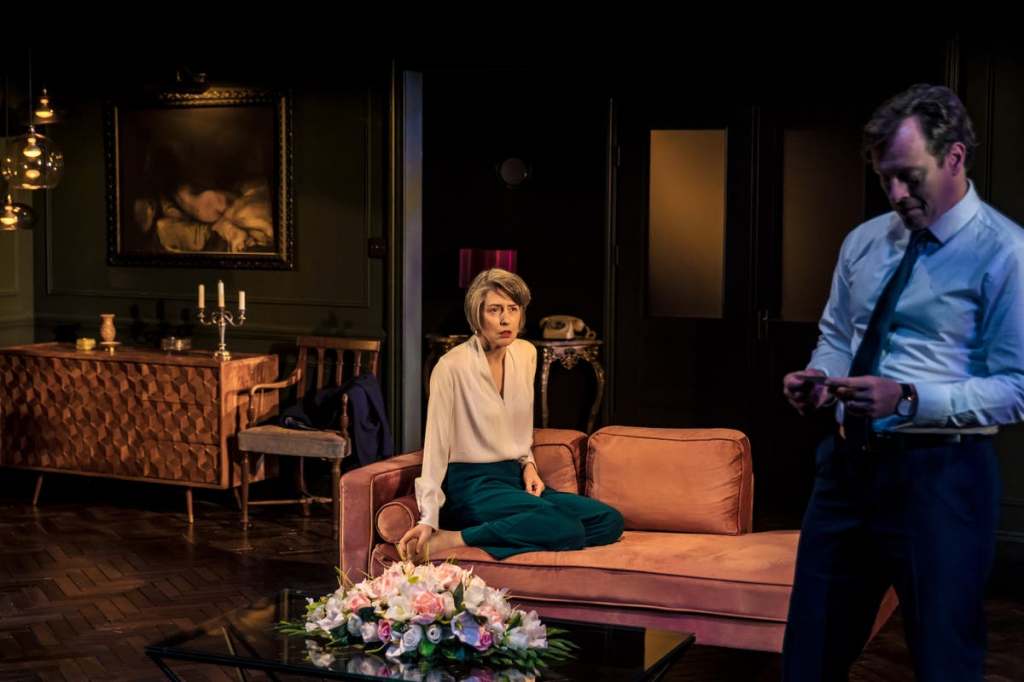
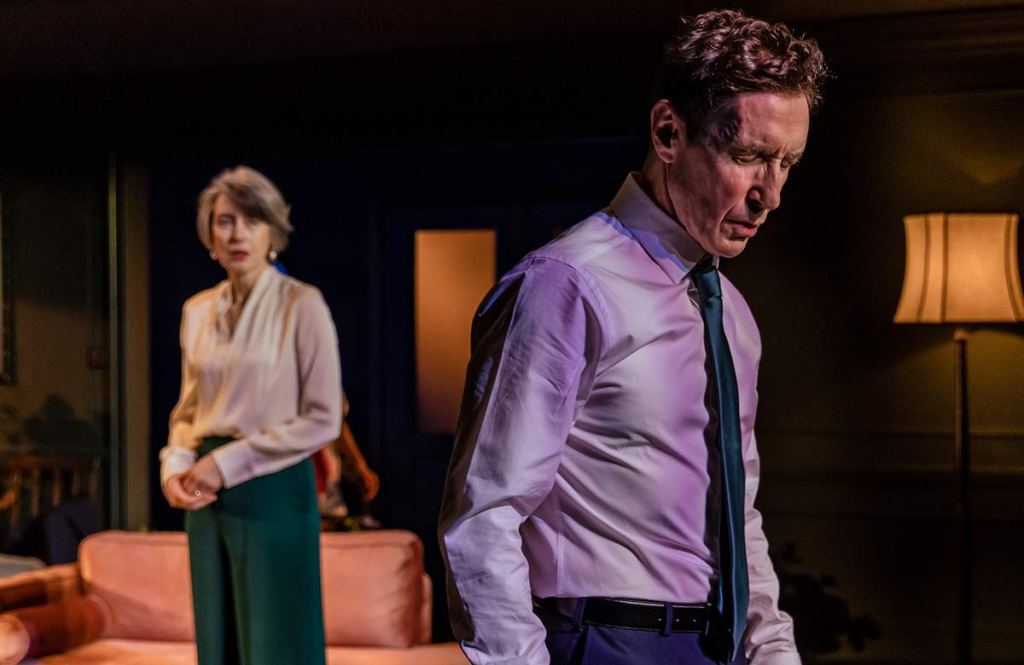

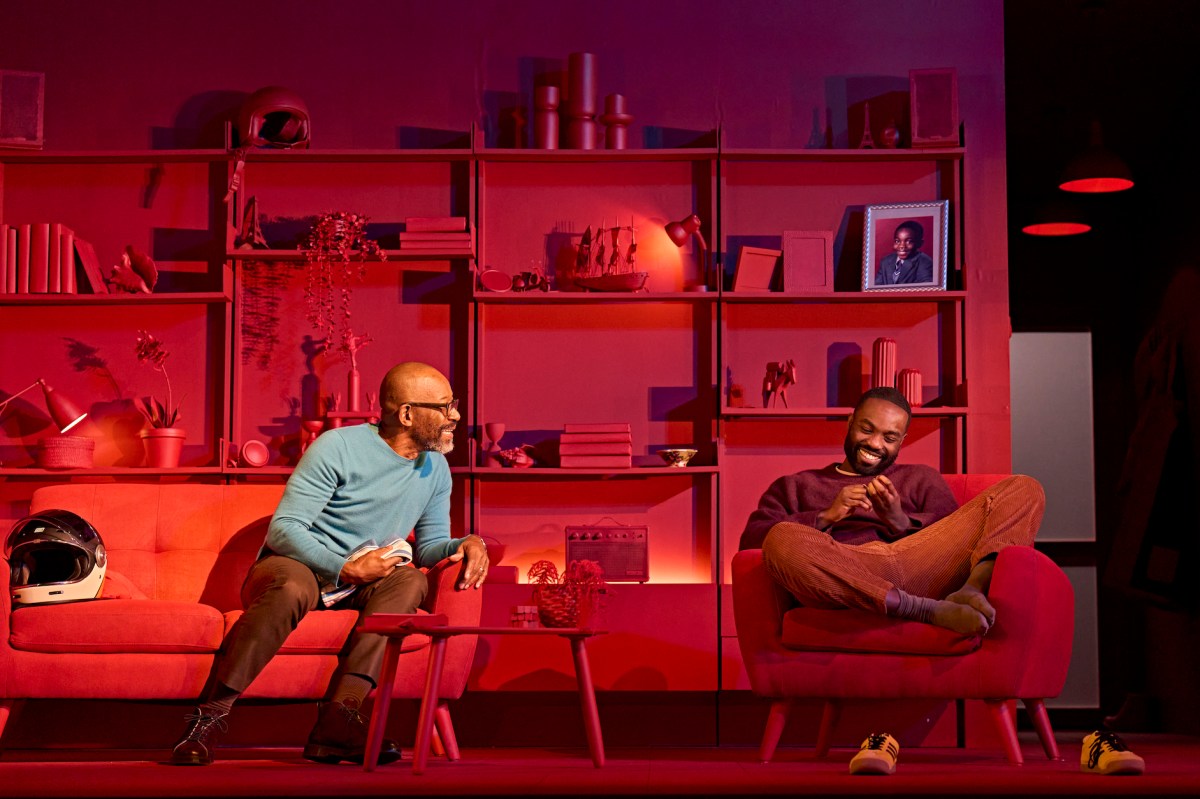

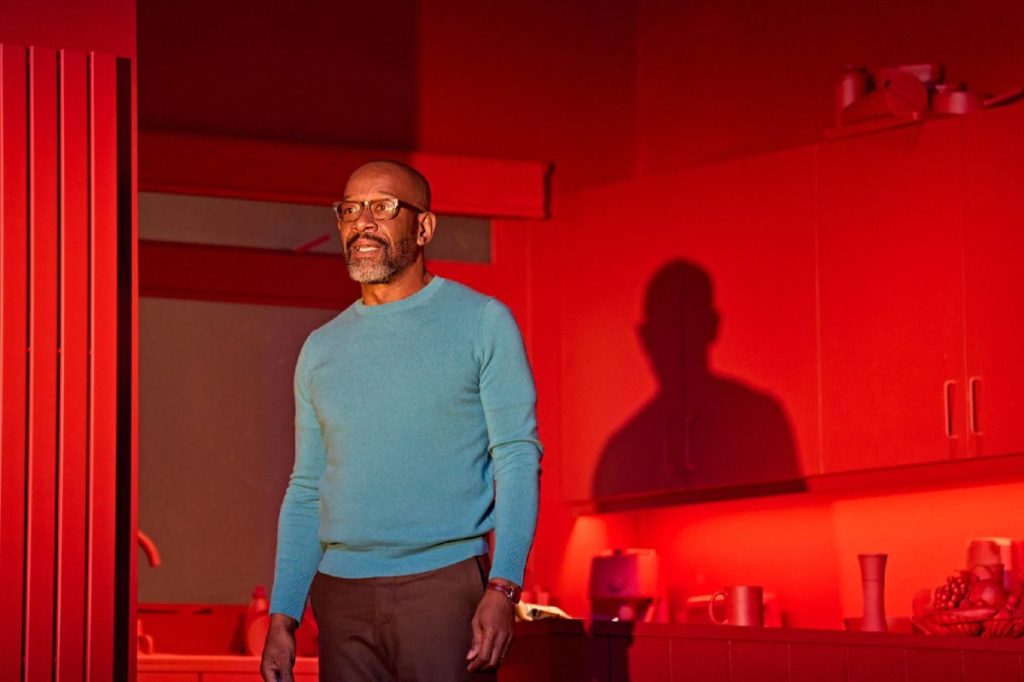
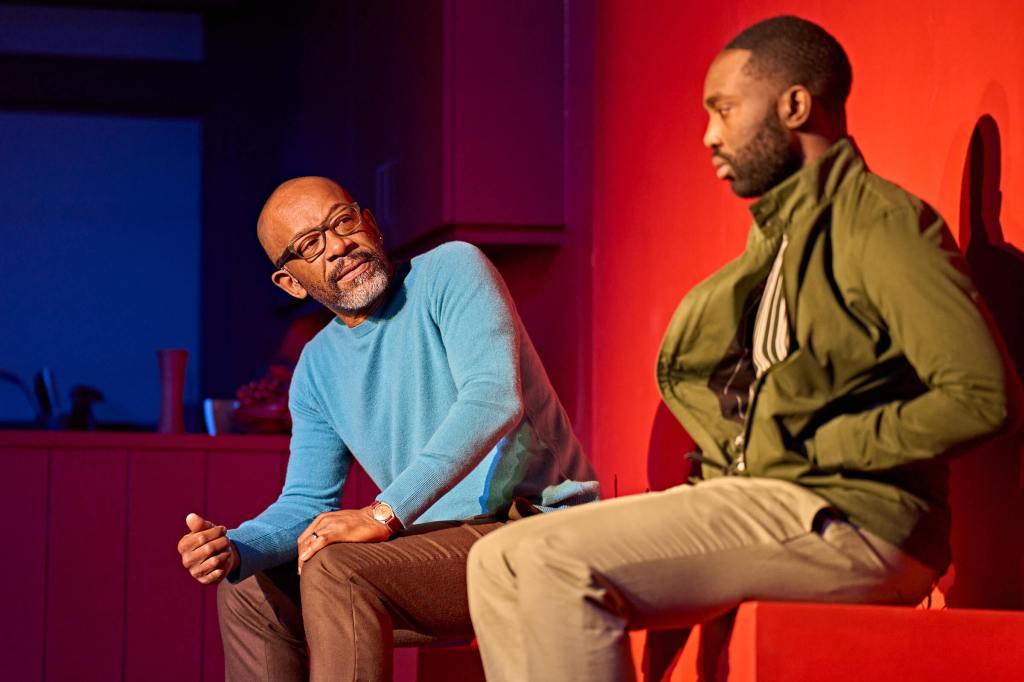
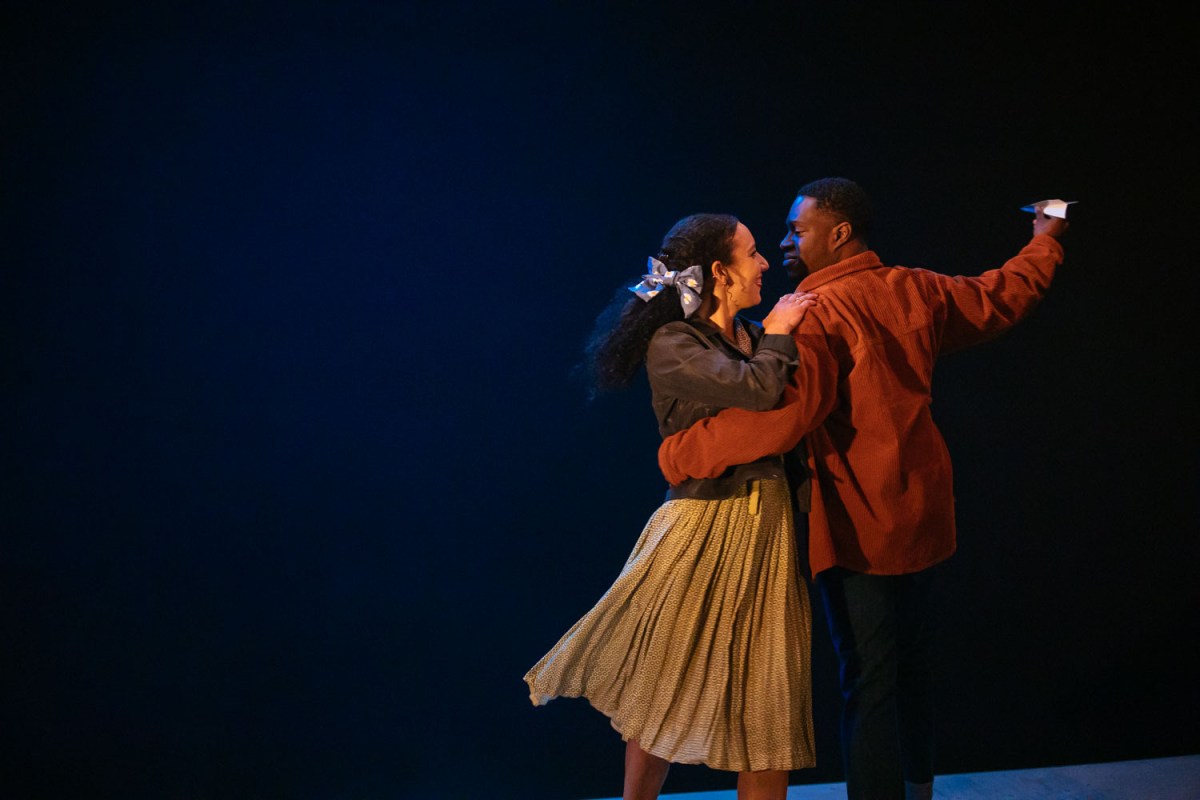


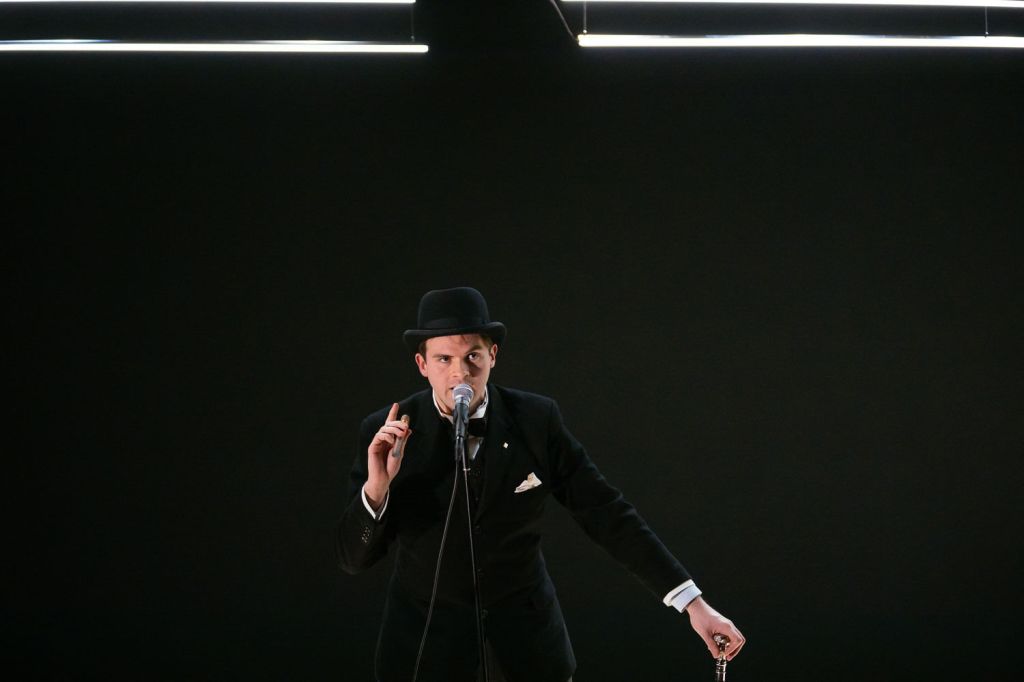
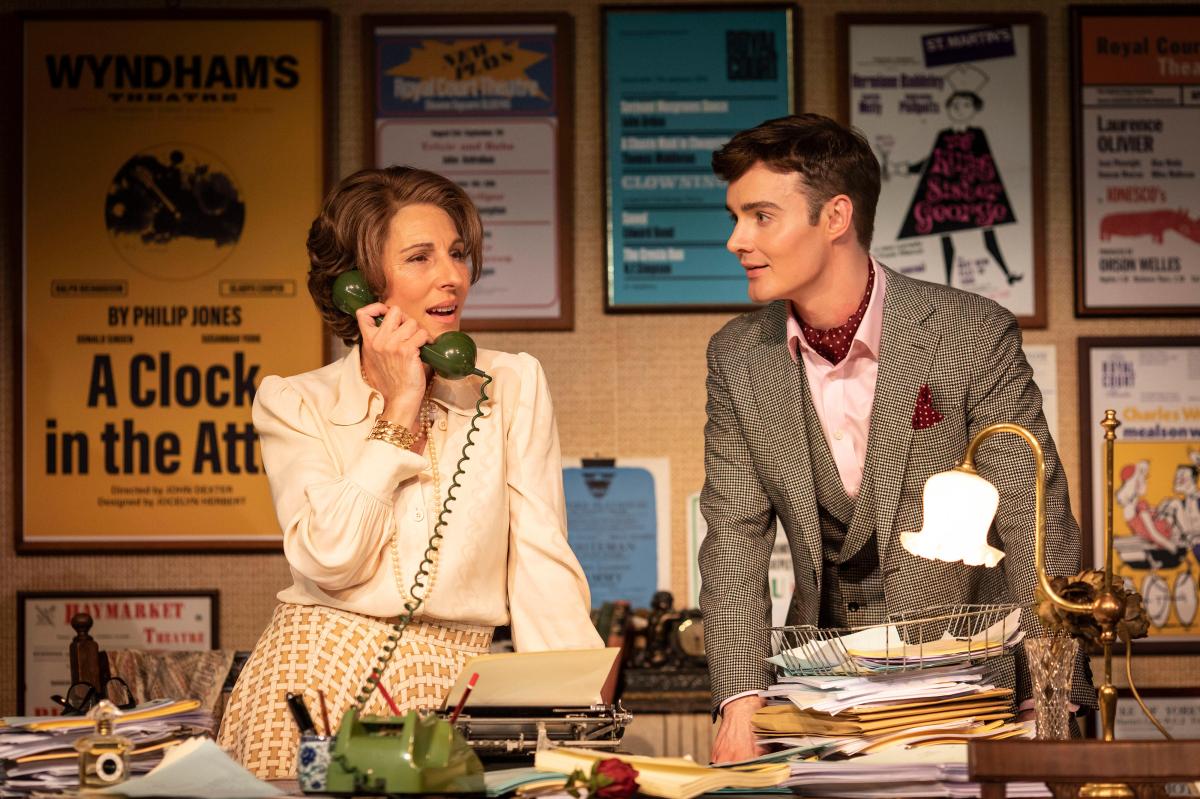


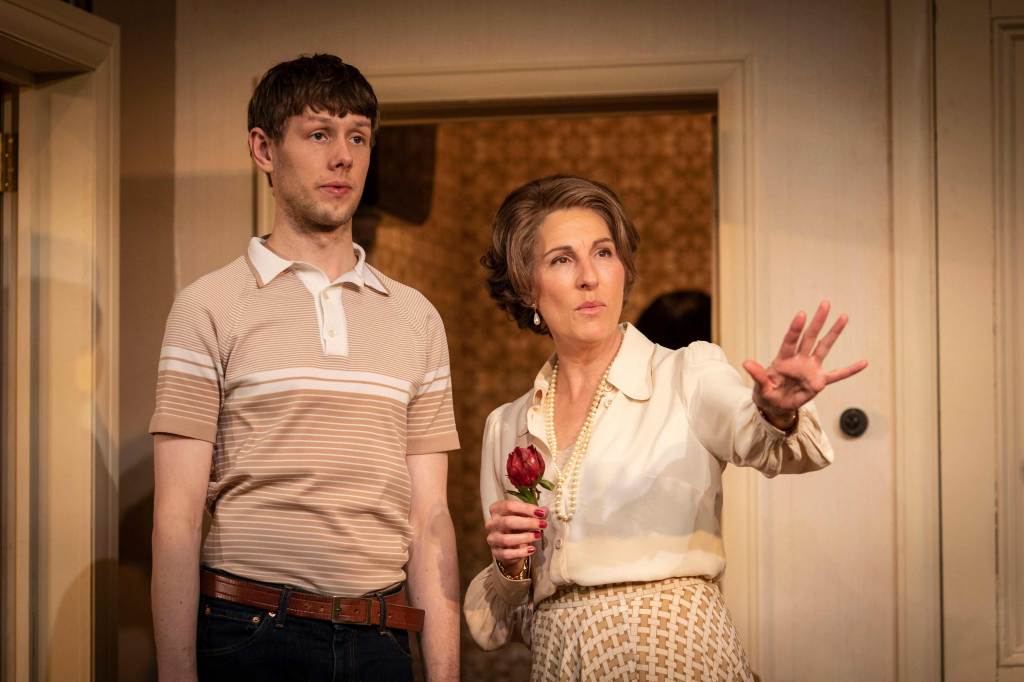
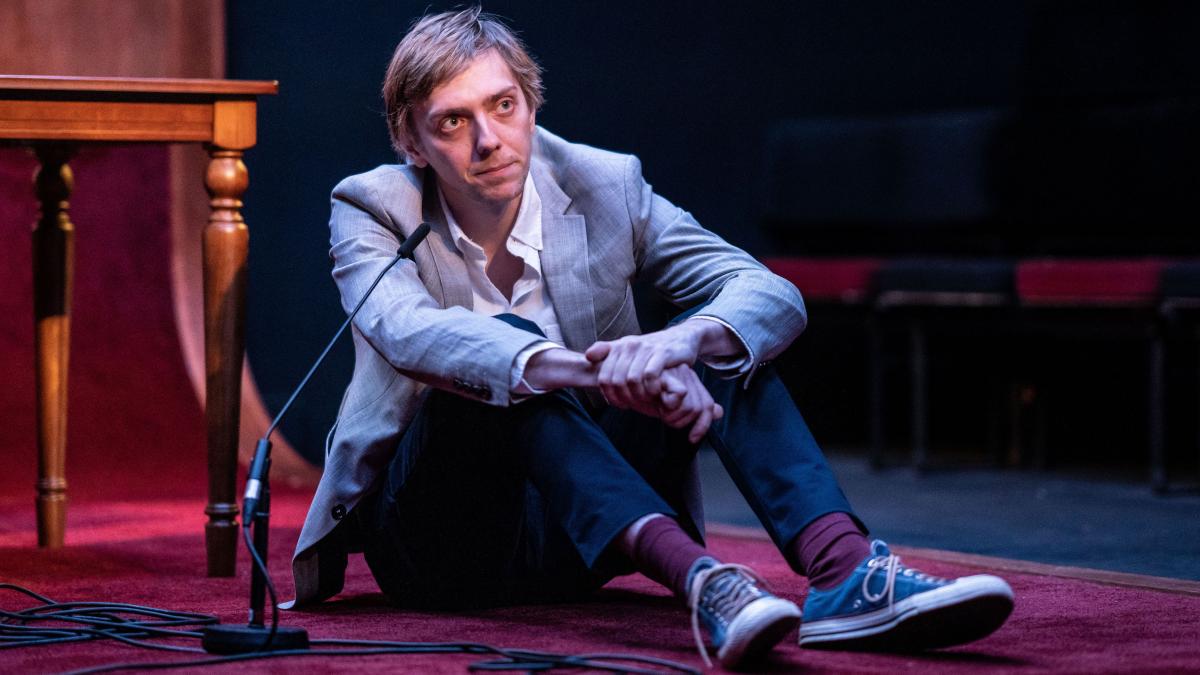
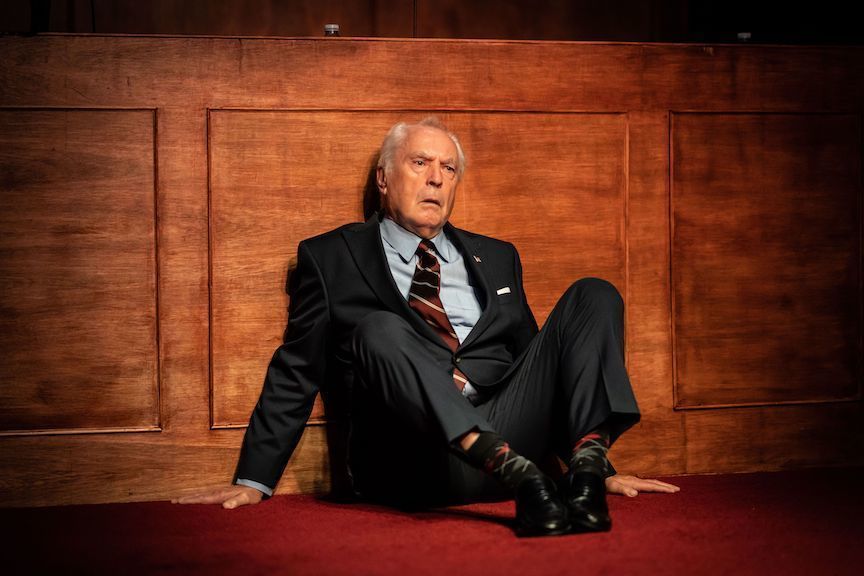


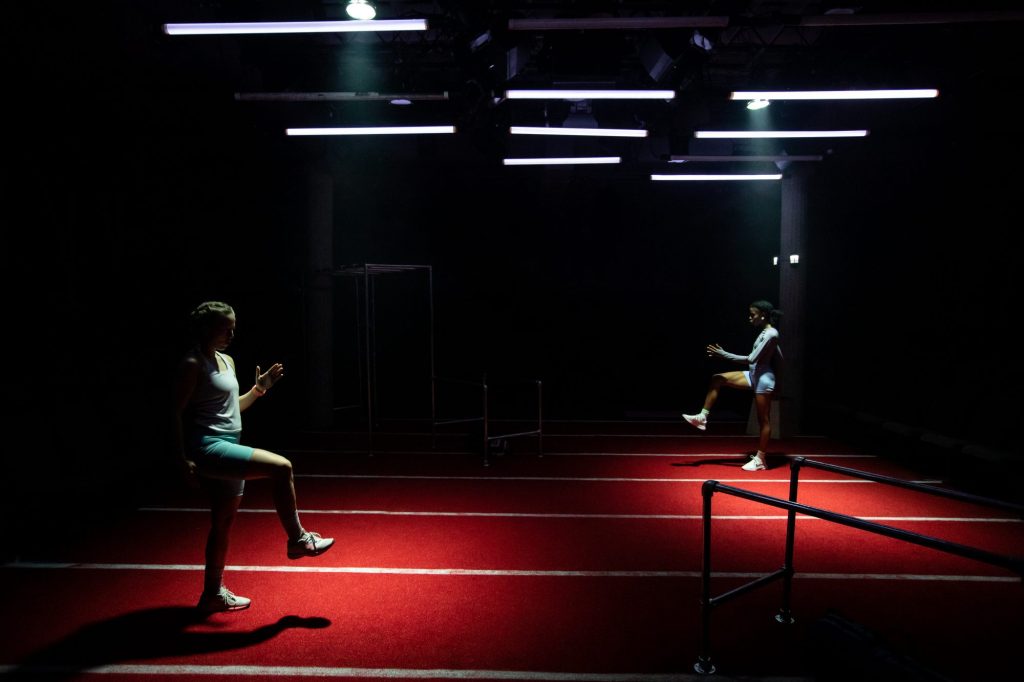


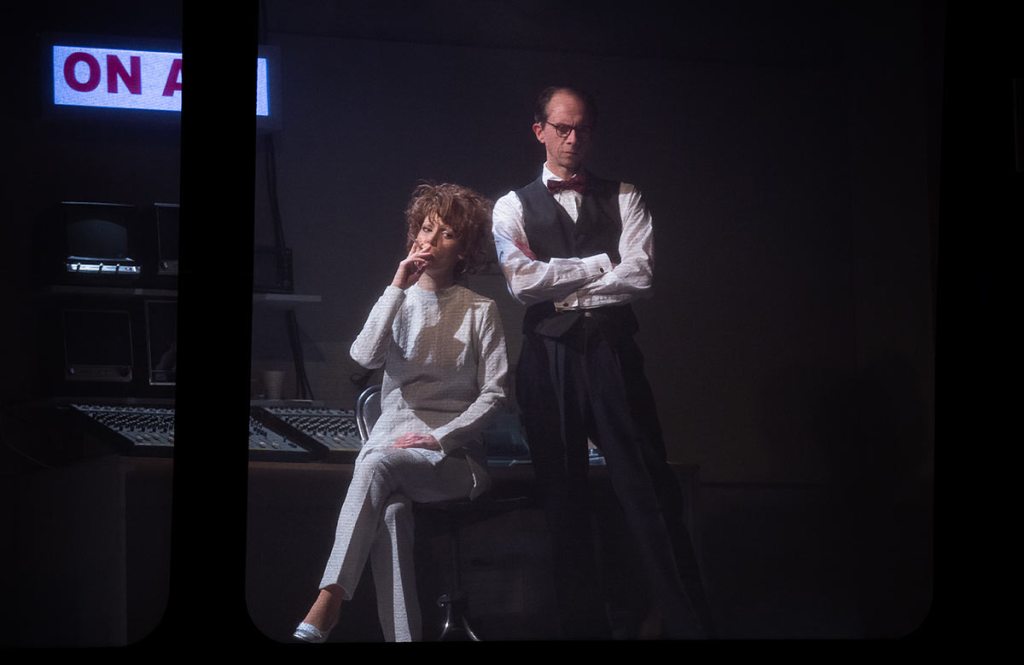


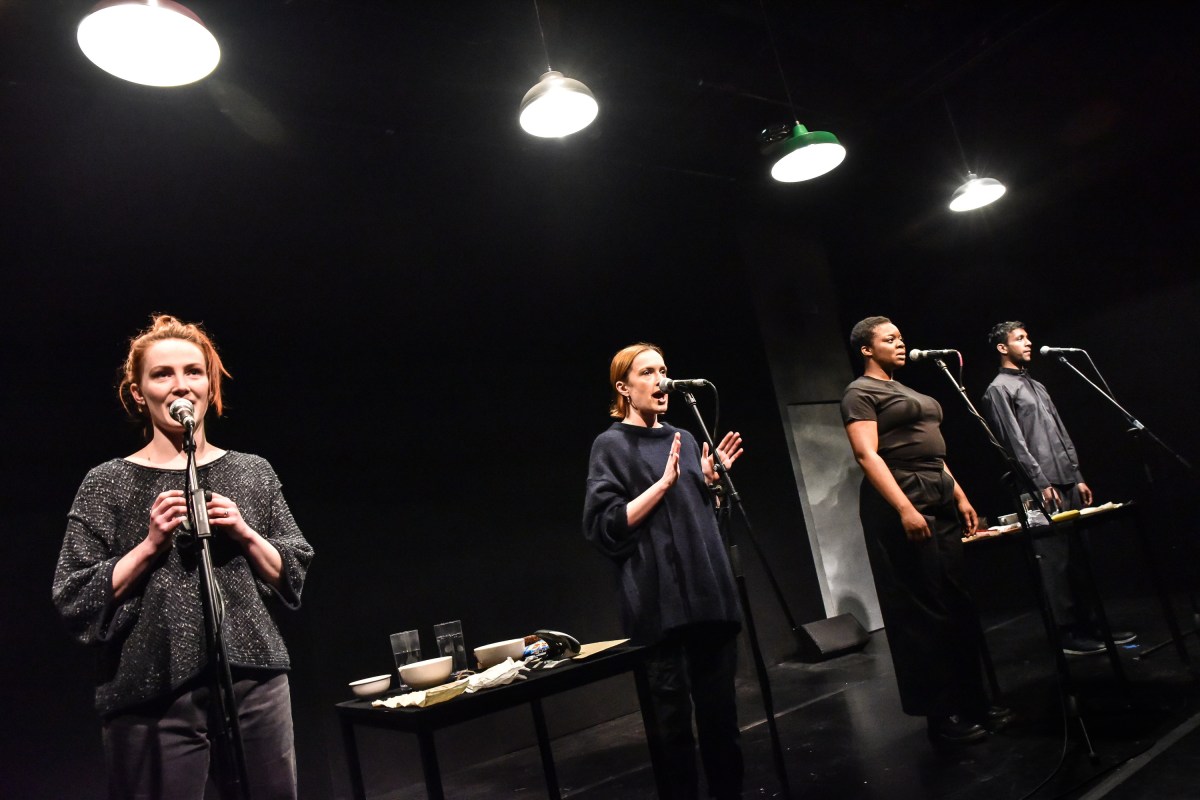
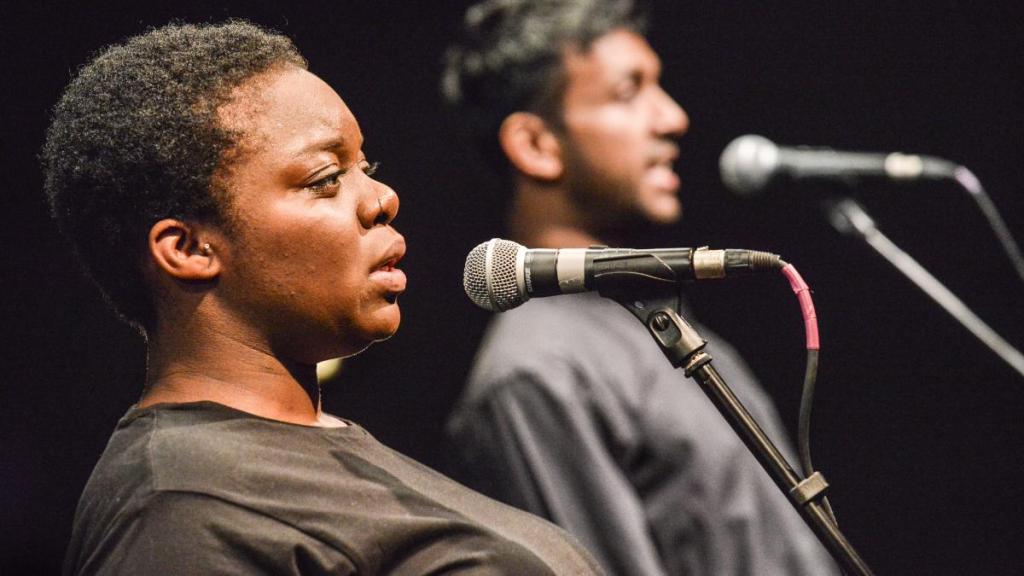
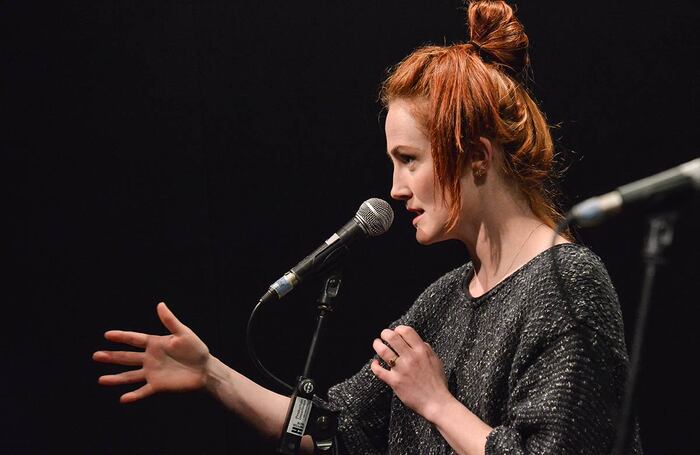

 Joshua Robey