Categories
theatre

Girl on an Altar – Kiln

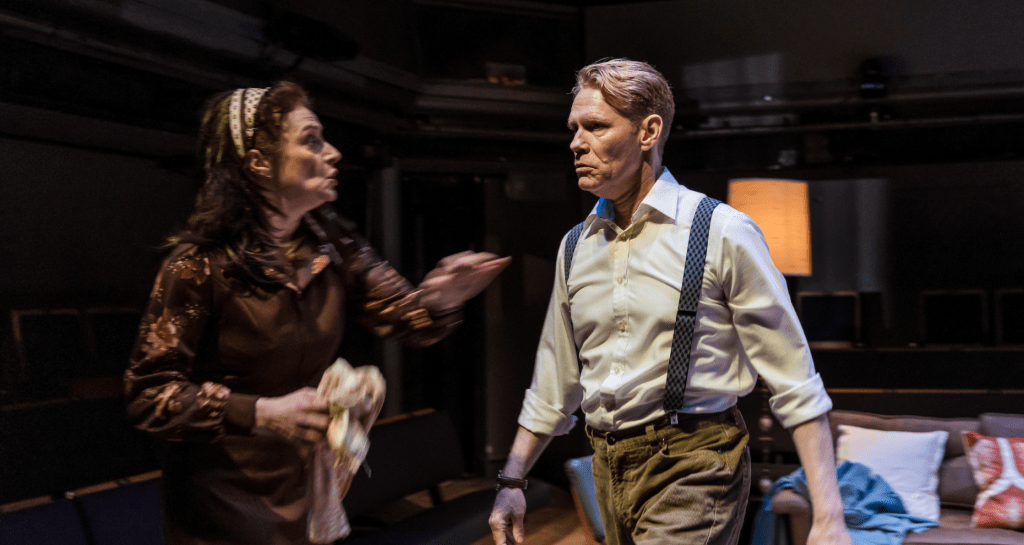
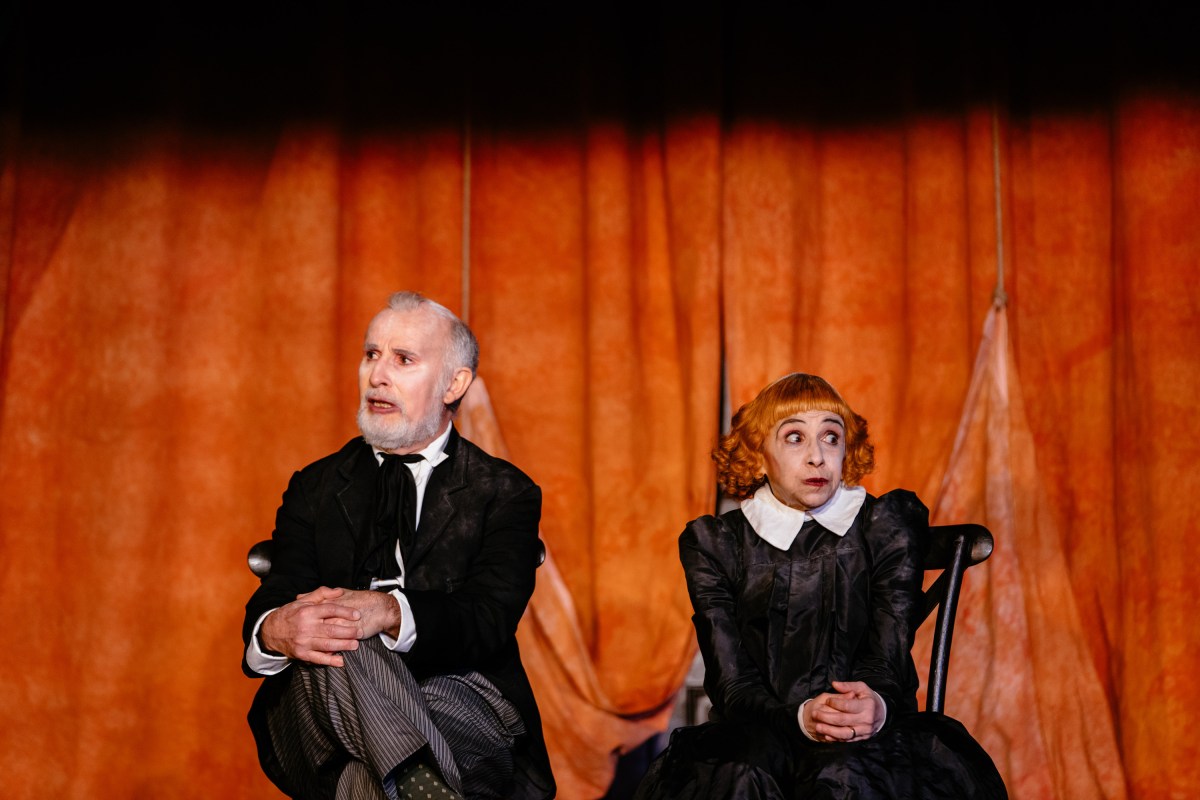
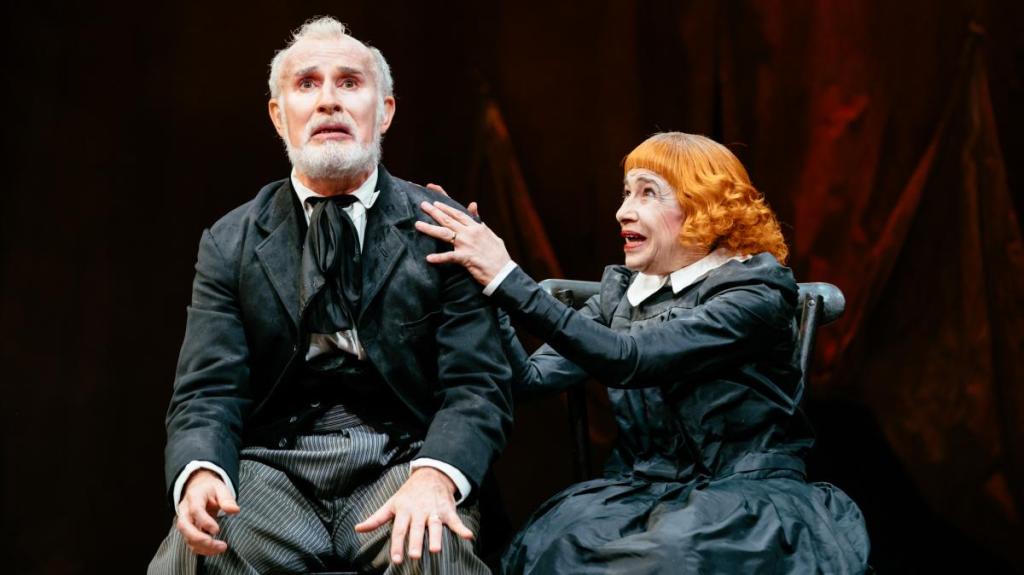
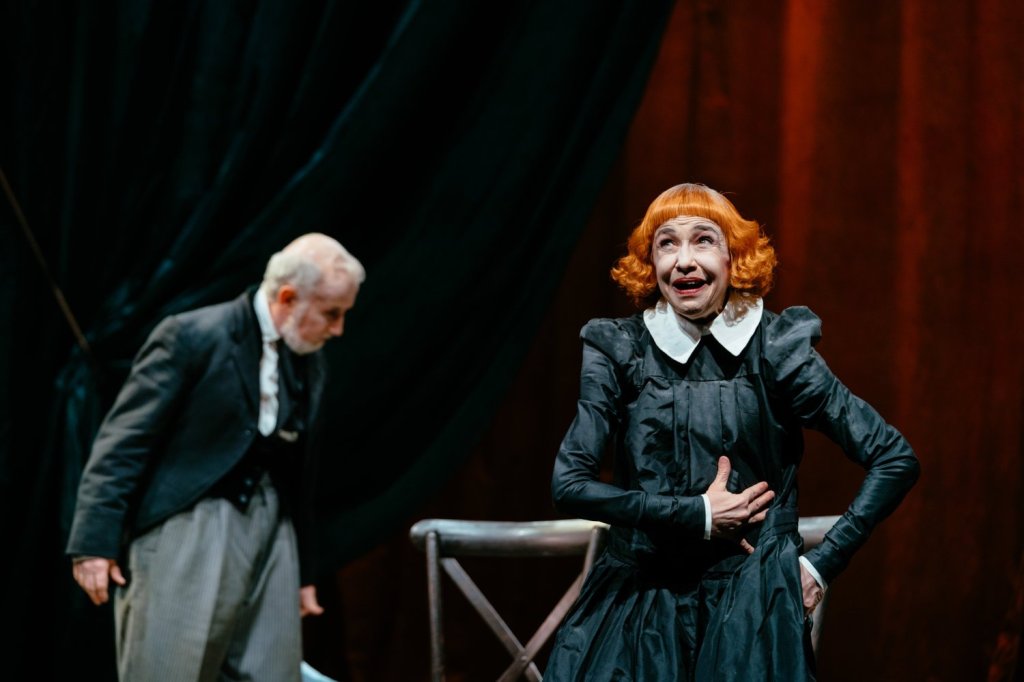
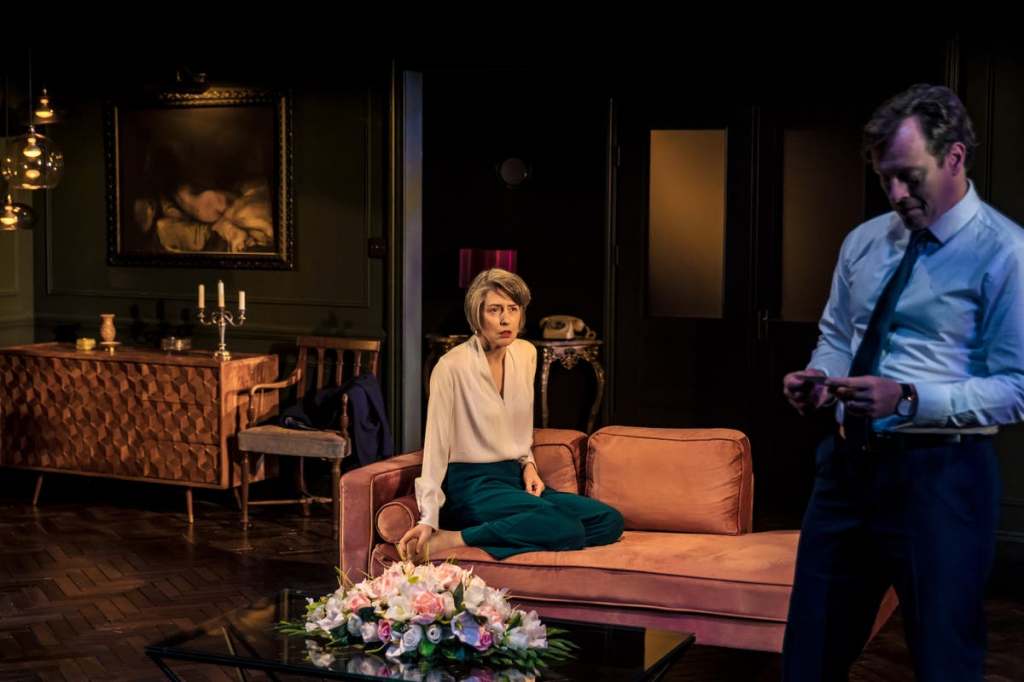
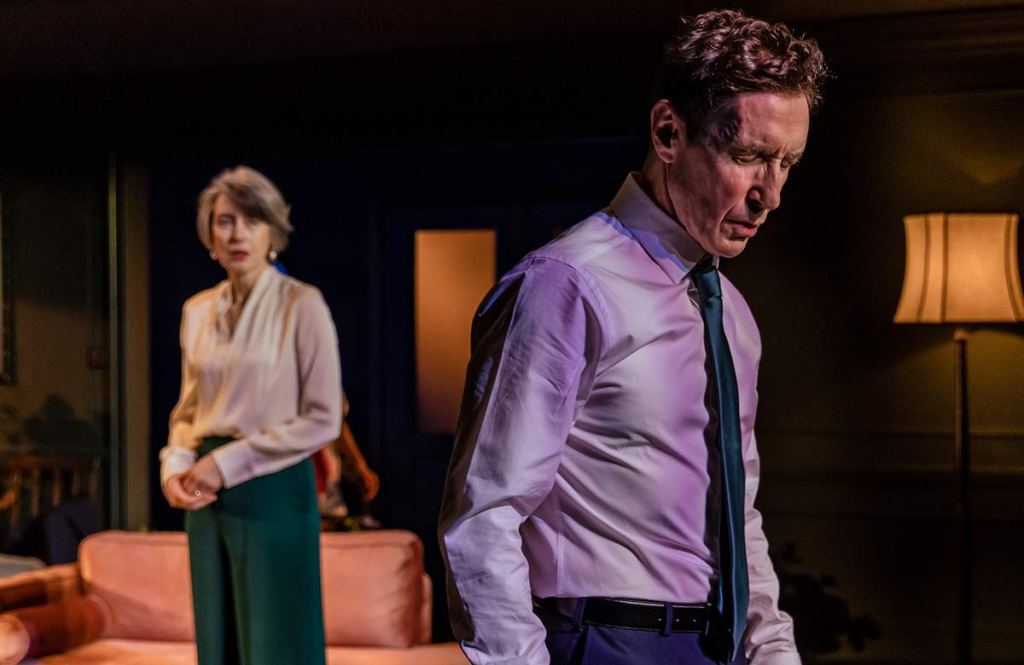
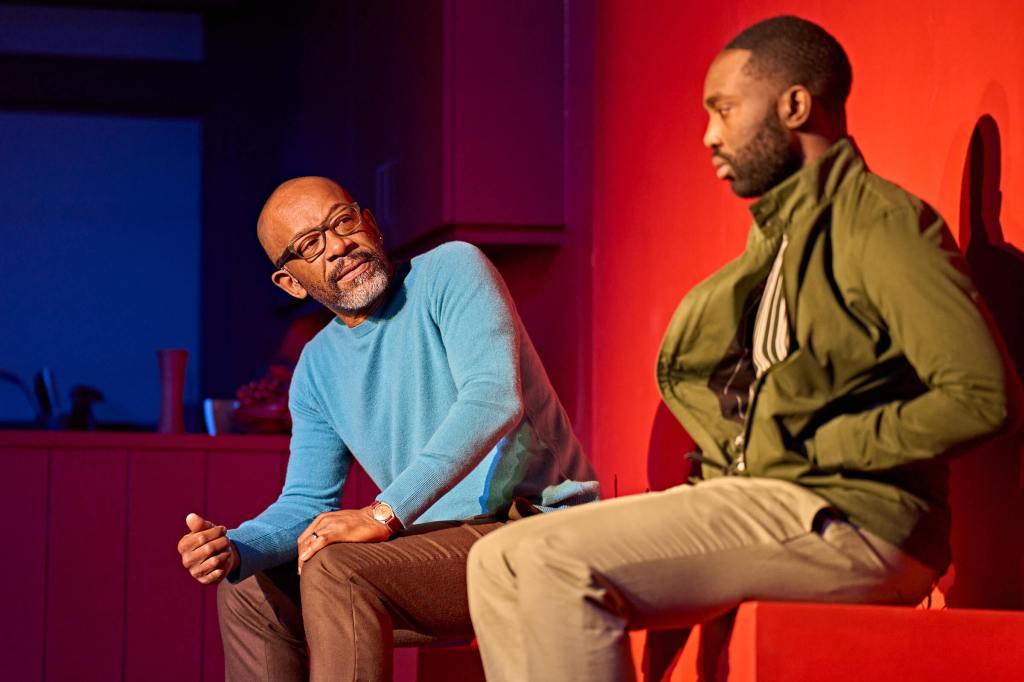
Eileen Walsh and David Walmsley in Girl on an Altar

At a talk she gave, I once heard Marina Carr discuss how she avoids writing chorus parts when adapting Greek tragedy – as they are often quite ‘boring’. It is certainly true that their dislocation from dramatic action is less immediate and engaging for some audiences more used to naturalist realism. Yet what struck me so much about Carr’s superb Girl on an Altar is the way that this free adaptation and extension of Aeschylus’s Agamemnon (the first part of The Oresteia trilogy) replaces the chorus with something other than straightforward dialogue. The painful recollection of Iphigenia’s sacrificial death a decade earlier, which is recalled at the beginning of The Oresteia, is no longer a vividly graphic summary (though it remains vivid and graphic) but an introspective deliberation from Clytemnestra, firing the starting gun for her eventual murder of her husband. The play follows in this pattern; each character becomes a filter through which subjective narratives pass, in long, poetic monologues, interspersed with occasional dialogues.

Annabelle Comyn’s direction – which coaxes passion and precision from a hugely impressive ensemble – relishes the effects of these delightfully unreliable narrators. Often the stage action contrasts the dialogue in subtly destabilising ways. Agamemnon’s infamous fatal bath is relocated to a bed on stage, but not in speech. It happens more subtly in narration of emotion; a character might remember a smile that the corresponding actor does not give, for instance. These moments sow subtle distrust as to whose version of events is accurate.

Carr’s dramatic gesture here is distension – opening up the time between Agamemnon’s return and his murder by days, even weeks. The timing is somewhat ambiguous, yet Aeschylus’s observation of the unity of time is purposefully discarded in favour of a passionate slow burn of love and hatred. As in many Greek tragedies, Aeschylus sets the action of Agamemnon just outside the family home, and the fateful cries of pain and anguish are typically heard from within – offstage. Carr instead takes us inside, the marital bed sitting prominently in the centre of the space. As Cilissa remarks, Clytemnestra and Agamemnon need time to ‘grieve and seethe’ in private – rather than the relatively more public scenes of the original Agamemnon. This (ultimately failed) attempt at healing and restitution is exactly what Girl on an Altar stages.

With its intergenerational struggle and murdered kings, The Oresteia certainly has affinities with Hamlet – with Clytemnestra as a far more active parallel to Gertrude, doing the deed herself and remarrying the cousin rather than the brother to maintain power. In this mould, Clytemnestras are often presented as either scheming and cruel, or madly emotional. What Carr does here is essentially to cast her as Hamlet himself – deliberating for two and a half hours over the right course of action as she battles with the complexities of love, anger and loathing she feels towards her husband and his actions. This grieving, seething mix is encapsulated in the blazing performance of Eileen Walsh, whose compelling stage presence communicates effortless authority and searching vulnerability at once. This is an all-time great Clytemnestra that refuses to mute her humanity in any way by dismissing her actions as mad, over-emotional, or self-interested and scheming. This Clytemnestra endures the agony of living with dignity and power, though letting go of her grief is impossible. Meanwhile, David Walmsley refines his take on Agamemnon as the play progresses, brilliantly conveying a mellowing from initial brutishness into a subtler, more sensitive figure choked up with pressure and regret, before he descends once more into irrepressible barbarity.
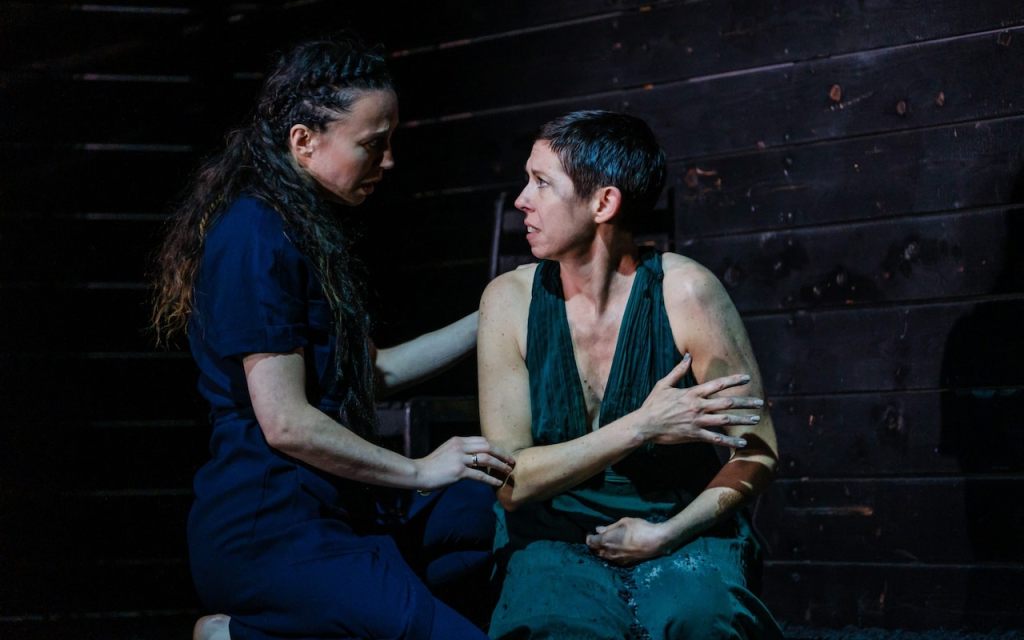
Kate Stanley Brennan and Eileen Walsh in Girl on an Altar

The title’s indefinite article hints at Girl on an Altar’sunderlying contention – that the horror of Iphigenia’s murder is not only the act of filicide, but the fact it presages a paradigm shift, after which sacrifices of daughters are normalised, even expected. The girl on an altar is in the process of becoming a savagely iconic image. Carr seems deeply concerned by the power of the image on the imagination. Clytemnestra learns that a similar sacrifice was made by Agamemnon in Troy, of Hecuba’s daughter Polyxena – in order that the winds would blow them back home. Drawing on both The Trojan Women and Hecuba by Euripides, Carr has Clytemnestra remark that ‘They sacrificed another girl before they left. […] One of Hecuba’s daughters. They say Hecuba was there.’ The events rhyme but are not identical; Clytemnestra’s spare dialogue rings with her still raw anguish and guilt that she arrived too late to see her daughter’s murder. (In this version, when Clytemnestra arrived there was already sacrificial ‘[b]lood on the stones’.)

The image of the sacrificial girl is potent and contagious, Clytemnestra desperate to stop the spread. She recalls that in the past ‘if a sacrifice was wanted it was a calf or a deer. Now it’s girls. The blood of spotless girls these new gods want.’ Carr situates the play in a world not entirely bereft of women’s rights – albeit within rigid class hierarchies – but where the limited rights women already have are under significant threat. An overtone of contemporariness wafts through the drama, but Carr feels no need to make the parallels explicit. Rather than reproductive rights or healthcare, it is the sacrifice of female children that is the new frontier here, and these killings are emblematic of a regressive renegotiation of the place of women in society. Even the king’s daughter is not safe. Clytemnestra dryly remarks that (for Agamemnon, and Greece as a whole) these sacrifices are ‘becoming a habit’, following the parallel sacrifice of Polyxena. What has been read previously as a concluding tragic echo of the sacrifice that began the war is convincingly situated instead as a continuation of an alarming, misogynistic trend. The play never entirely punctures the divine authority of the gods – though there is perhaps a subtle agnosticism towards the sacrifice’s causation of the winds. Yet Carr absolutely connects the pernicious effects of religious and superstition to violence against women. The gods themselves seem pliable to received wisdom and social prejudices. After all, Clytemnestra emphasises that they are ‘new’.

The danger of images is also apparent in the construction of heroic masculinity. When Agamemnon slays his daughter and dances on the altar, he retrospectively admits that it was as if Hercules was in his blood. We are left to judge whether this gauche celebration stemmed most from peer pressure, the expectations created by idealised heroes such as Hercules, or simple self-aggrandisement and ego – that he, like Hercules, might himself ascend to Mount Olympus and become god-like, if not a god himself. The violent mythical hero Hercules sets an alarming precedent. Hercules too killed family members – murdering his wife and sons in a fit of madness. (This usually is said to have presaged his twelve labours, as atonement, yet in Euripides he kills them on his return.) Carr’s drama is laced with a suspicion of such archetypes – not least the titular doomed girl on the altar, but also the masculine hero, and the mad wife. There is always greater complexity beneath the surface, whether one is a hero or a villain.

A final striking image echoes The Oresteia’s language quite directly. Where Ivo van Hove recently interrogated the social effects of war, violence and anger in Age of Rage, Carr seems far more concerned about the effects of war in private – and most of all, the way gender structures the world. This manifests, upon Agamemnon’s return from Troy, in his narrated decision to reassert control over Clytemnestra through patience, rather than simply dominating her. ‘All flowers bend towards the sun’, he says, foreshadowing his later claim of god-like status. He goes on: ‘She needs the yoke again but I won’t force it yet.’ Agamemnon thinks he is being reasonable, when in fact her is merely advocating a slightly less oppressive form of misogyny than physical violence.

Yet the image of the ‘yoke’ – a crosspiece which was fixed around the necks of two oxen in order to draw a plough – is hugely important in The Oresteia. Agamemnon and Menelaus are called ‘Atreus’ sturdy yoke of sons’, between them driving Greece to military victory. Aeschylus, in Robert Fagles’s translation, makes this image an extended metaphor; Agamemnon ‘slipped his neck in the strap of fate’, in his determination to sacrifice his daughter for military advantage. Yet the image is also replete with submission and control. When placed on the altar – desperate to avoid her screaming – Iphigenia is gagged, bridled. Fagles renders Agamemnon’s instruction as a conscious echo from the chorus: ‘slip this strap in her gentle curving lips’. Here, the horrifying outrage of her death is not only the substitution of a young girl in the place of a ‘yearling’, but the fact that, until moments earlier, it had been Agamemnon in the metaphorical straps. Now, Iphigenia is literally restrained. (This Aeschylean substitution is alive in Carr’s script too, notably in Agamemnon’s metaphorical defence that ‘My hands were tied’ by the army’s pressure on him, met by Clytemnestra’s literal retort, ‘Iphigenia’s hands were tied.’) Carr has Agamemnon claim that Clytemnestra should belong in the yoke – that ambiguous place of both child murdering warrior and female victim. His repressive misogyny is made all the harsher by the echo of Iphigenia’s stifled scream; female voices are crushed into silence.
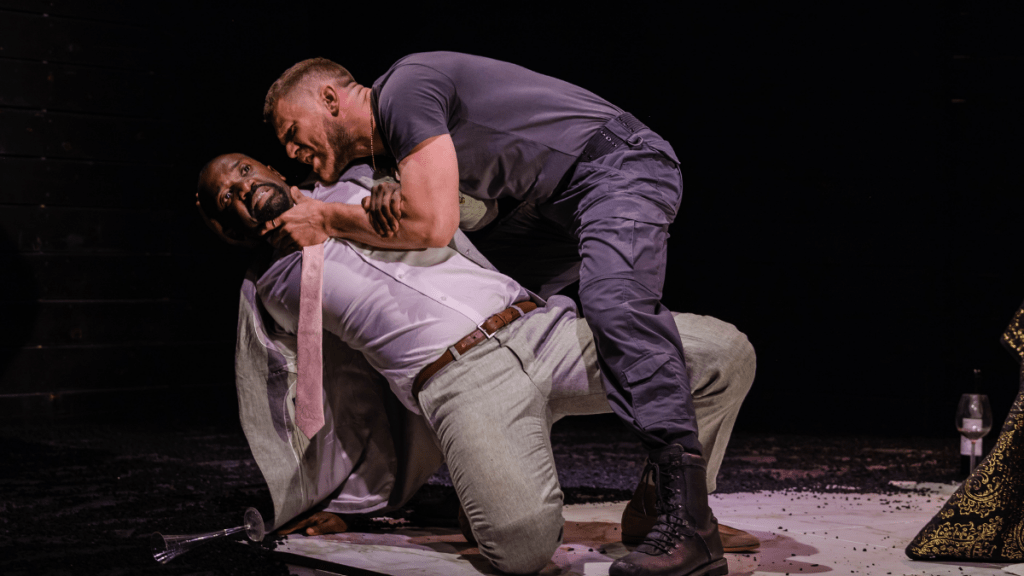
Daon Broni and David Walmsley in Girl on an Altar

The play’s structure is perhaps akin to a psychological thriller – a whydunit that simmers with not only hatred and vengeance, but the agony of love. Unlike the original Agamemnon’s dramaturgy of relatively straightforward retribution and descent, Carr’s drama thrums with life in the oscillations. Agamemnon’s decision is now the result of immense pressure, rather than simply the ‘frenzy’ of war-lust; he may have danced upon the altar, but his inner thoughts and feelings are ambiguous even to him. Furthermore, The Oresteia is usually grounded in clear patrilineal trauma (from Tantalus, to Pelops, to Atreus, to Agamemnon – and then to Orestes, in parts two and three, The Libation Bearers and The Eumenides). Yet for Carr, it is not only the house of Atreus which is haunted by spectres of violence and madness. Clytemnestra mentions that ‘My mother went mad’ – another intergenerational trauma, amid the traditionally male terrain of inheritance. She even names her child, with Aegisthus, Leda – the same name as her mother.

Clytemnestra’s love for Agamemnon is startlingly complex too. It is sexually passionate, yet warmly loving beneath that – evincing far more than a simple dichotomy of enemies and lovers. Yet they cannot be together without opening old wounds. In a long scene, actually set in their bedchamber, Clytemnestra confronts Agamemnon, eventually coaxing an admission from him: ‘Okay. I killed her.’ This is greeted with a sudden passionate kiss – culpability as aphrodisiac, yet in that admission their relationship might still have a future. Carr’s text, like Aeschylus’s, is largely free from stage directions; the lustful passion between them is brilliantly interpreted by Comyn as intensely physical. Yet it is the fact that Agamemnon cannot bear to remain in this position as an apologetic supplicant that speeds the play towards its bloody climax. Instead, he reasserts his authority and orders Clytemnestra and Leda are sent out to the harem of captive women, where Leda will soon die.
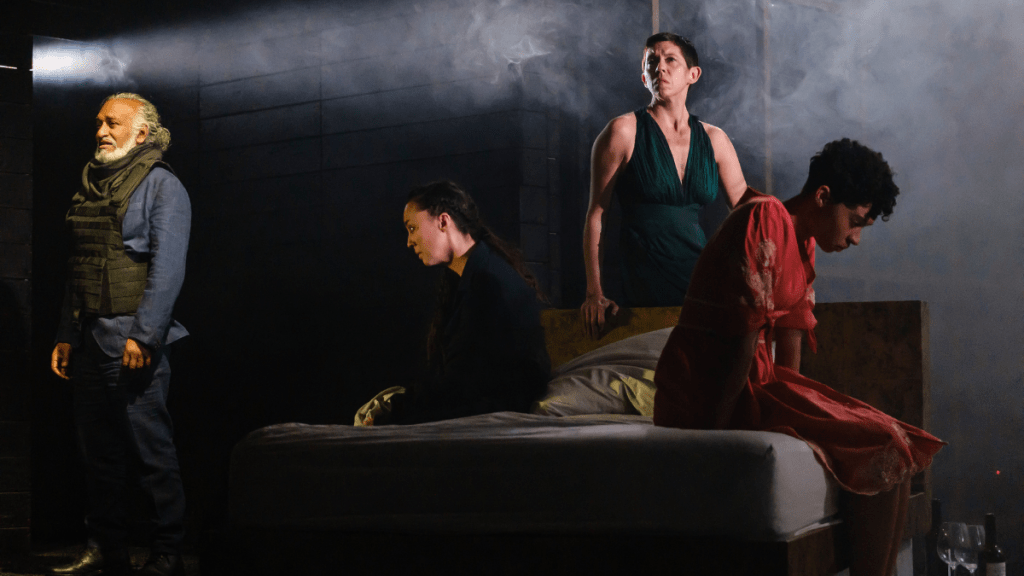
Jim Findley, Kate Stanley Brennan, Eileen Walsh and Nina Bowers in Girl on an Altar

The play, rather surprisingly given the more domestic scope of Aeschylus’ Agamemnon, transforms in the second half into a full-blown war play – at least for the male characters. In one particularly exquisite moment of gendered scenography, the women sit around the bed in a tableau of silent, peaceful contemplation, while the men stand tall and bellow military commands. With the captured Clytemnestra offstage, Carr elicits many spinetingling moments from the excavation of the minor female characters. The nurse, Cilissa, originally only from The Libation Bearers, is now a significant figure, as a ‘servingwoman’ to Clytemnestra whose agency and power is frequently examined. In a startling moment, when Cassandra desperately complains that Agamemnon has kept her from her children, Cilissa replies ‘Your children? What about my children? Don’t talk to me about children.’ Kate Stanley Brennan, so often on stage here, unleashes the line as a sudden, flooring grenade, tearing through the drama of the royal household with a reminder of how their violence harms more than just themselves.

Also impressive is Nina Bowers’s astonishing Cassandra. Robert Icke, who staged The Oresteia in a 2015 production at the Almeida, has argued that while the traditional reading that Cassandra is a ‘sex slave’ who Clytemnestra is jealous of is understandable, the play could also be read more sympathetically that Agamemnon is ‘try[ing] to rehabilitate a version of Iphigenia’ – ‘someone who could have been put to the knife and wasn’t’. (She is Hecuba’s daughter – who, unlike Polyxena, survives the fall of Troy.) Icke ensured that the relationship between them was still fraught with a power imbalance and potential abuse yet interposed an additional ambiguity. Carr also complicates the character, refusing often-typical mumbled prophecies and anguished screams, and giving Cassandra the role of narrator; her prophecies are now authoritative. Bowers delivers the play’s haunting final line: ‘And then, as foretold, she comes for me.’ The lights plunge into sudden darkness, with that breath-taking rush of emotion the best plays manage in their closing moments. In this conclusion, the original trilogy’s tragic cycle of murders is leant a new shape. Cassandra is no longer ancillary to the revenge killing of Agamemnon. She is the substitute Iphigenia who Clytemnestra has now killed, and Clytemnestra, in part, becomes what she despises.

Girl on an Altar

Written by Marina Carr, Directed by Annabelle Comyn, Design by Tom Piper, Lighting Design by Amy Mae, Composition and Sound Design by Philip Stewart, Projection Design by Will Duke, Casting Direction by Julia Horan CDG, Movement and Intimacy Direction by Ingrid Mackinnon, Voice and Dialect Coaching by Daniele Lydon, Costume Supervision by Isobel Pellow, Assistant Direction by Jessica Mensah, Starring Nina Bowers, Daon Broni, Jim Findley, Kate Stanley Brennan, David Walmsley, Eileen Walsh
Production Photographs by Peter Searle
Reviewed 31st May 2022
Categories
Film

Boiling Point

Vinette Robinson and Stephen Graham in Boiling Point

Andy Jones is clearly under pressure.

Philip Barantini’s film, which follows the unfolding disasters of one evening in a high-end London restaurant, is both a study of the head chef’s tragic downfall and a dynamic ensemble piece, following the interweaving tales of his staff and punters through this pressure-cooker work environment. The film begins with Andy’s shuffling (a bit faster than is comfortable) towards the restaurant, later than he should be – as usual. He is leaving an apologetic voicemail, to the wife he is currently divorcing, seemingly apologising for letting down his son. Stephen Graham’s tremendous gift for communicating a character’s quietly exhausted determination shines through every minute, this brief opening scene creating an effective contrast between the father losing authority within his family and the chef struggling to maintain the respect of his team. By the end of the film, we assume the ambiguous let-down has something to do with his drug addiction. The camera comes to rest after 90 minutes, as an overdose leaves Andy spasming on the floor, alone a back room, his muffled gasps drowned out by laughing patrons.

Drugs are Andy’s coping mechanism for the stress that occupies his every working (and waking) moment. Stress is probably Boiling Point’s main theme. Perhaps the most obvious recent comparison would be to the inexorable escalation of the plot of Uncut Gems, though Graham excels even further in portraying the wounded humanity beneath the bravado. Both are playing men just trying to do what they have to do, and in both cases, money is at the heart of the anxiety. Though his restaurant is successful – indeed, overbooked on the night in question – Andy lives in the shadow of a £200,000 debt to a rival restauranteur, former (and potentially future) collaborator Alastair Skye (a deliciously waspish Jason Flemying).

Unlike Sam Mendes’ entertaining (if a little exhausting) one-shot World War One drama 1917, which hid its cuts through (mostly convincing) camera tricks, Boiling Point is the real deal. There are a few moments where cuts could have been hidden (perhaps deliberately included as fail-safes), but Barantini uses none of them. The film is one take from start to finish. Watching Boiling Point, you probably already know this – though the film’s character-led drama helps you to forget quickly. Boiling Point truly is a rare film whose one-shot structure is wholly justified by content, but it is an undeniably powerful gimmick nonetheless – probably the film’s second-biggest individual selling point, from a marketing perspective, after the presence of the mighty Stephen Graham.

1917’s cinematography, which, though impressive at times, felt a little hampered during some action sequences by the laborious repositioning required of the camera. By contrast, Boiling Point’s fluid camerawork is a triumph of artful choreography. We peel off entirely naturally to follow various restaurant staff in the kitchen, serving tables, washing up, and working front of house, smoothly glimpsing impeccably scripted mini-narratives as we go. One waiter is vivaciously camp with a table of drunk women, but the performance evaporates the second he turns away; instead, he seems tired, crushed and demeaned. Elsewhere, we are shown the difference in courtesy afforded to different waitresses, due to ethnicity; when the maltreated Black waitress is sent back to the kitchen with an apparently unsatisfactory plate of lamb, she is then further slighted, this time by the kitchen staff who assume she has failed to explain the dish sufficiently. How could the aggressions of a racist patron be explained in an environment anathema to empathy? The pressure kills – rather than creates – camaraderie. Instead, downright hostility is fostered between the different teams of staff – each perpetually (and irrationally) suspicious of sabotage.

Naturally, the film is structured as a series of nearly worst-possible events. A health and safety inspection bumps their hygiene rating down from the full 5 to a mere 3 – largely due to Andy’s poor record-keeping and a culture of insufficient handwashing. They do not have enough ingredients, and the restaurant is overbooked. Then Alastair Skye turns up with a new business proposal and a food critic in tow. Bar a major fire, it is hard to imagine a more perfect storm of gastronomic incompetence, more and more mistakes creeping in as the team is stretched to its limits.

Jason Flemying and Lourdes Faberes in Boiling Point

Boiling Point can be read as an apt comment on the pressures of filmmaking – the restaurant acting as a canny parallel for a film set. Both environments find artistic vision hitting against the practical limitations of time and money – while attempting to cater to a financially viable audience. They are potentially collegiate and creative but often turn hostile. Andy seems to epitomise the responsibility a director wields (and too frequently lack), simultaneously authoritative – kitchens, like film sets, have rigorously established chains of command – but with a duty to provide pay, resources and foster a positive work environment. Andy fails on almost every count; the team is stretched to breaking point, crushed by the emotional and physical labour of their jobs. Meanwhile, Andy seems to have cash flow issues, asked about late wages and challenged over his failure to ‘do the orders’. For a restaurant, not having enough food – and being forced to scrimp on portion sizes – is far from ideal. When everything spirals out of control, Alastair encourages Andy to blame second-in-command chef Carly (a steely Vinette Robinson, in an understated star turn). Thus, Boiling Point catalogues and cautions against the dangers of exploitation in pressurised workplaces. Split-second failures have morale-crushing consequences for both staff and patrons.

It is highly apt, then, that a film focused on the stress of a restaurant kitchen, where nothing can go wrong and timing is essential, has been shot in such a highly pressured single way. Production circumstances compound the meta-stress of the enterprise. The film was almost never made, shot the week before national lockdown was imposed in 2020. With its modest budget, only eight takes were scheduled over four days. Either they pulled it off or they didn’t. (In the end, only the third take was used.)

The film climaxes with two medical emergencies, first of a customer and then of Andy himself. When the kitchen mixes up the allergy requirements of a diner (whose partner was planning to propose to her that evening), it feels grimly inevitable. If you watch closely, you can see it happen before your eyes. The allergy is not recorded on the system, and Andy’s lack of ordering means that they run out of salad dressing. In a split-second decision, he tells a junior chef just to use another – which, it later transpires, contains the nuts to which she is dangerously allergic.

The film keeps many plates spinning in the air, deftly weaving subplot after subplot into a rich tapestry. Early in the film, Andy tells off a pastry chef for not rolling up his sleeves, before moving on to the main kitchen; the camera lingers to reveal that he is concealing evidence of self-harm. He is consoled by a fellow chef, but these moments of empathy are few and far between in such an intense workplace. Barantini and James Cummings script these details lightly, but they would be enough to sustain stories of their own. Boiling Point succeeds as a potent brew of tension, stress and the crushing weight of failure – a horror story of creative disappointment and anxiety, whose technical mastery should be admired, though it never distracts from the film’s gripping, compulsive effect.

Boiling Point

Directed by Philip Barantini, Written by Philip Barantini and James Cummings, Cinematography by Matthew Lewis, Edited by Alex Fountain, Music by Aaron May and David Ridley, Starring Stephen Graham, Vinette Robinson, Alice Feetham, Hannah Walters, Malachi Kirby, Taz Skylar, Lauryn Ajufo, Daniel Larkai, Lourdes Faberes, Jason Flemying, Ray Panthaki
Categories
Books

Our Wives Under the Sea by Julia Armfield

Depth structures so much of our thoughts and everyday language. We look for insight by going in depth, hunting for a deeper understanding, going below the surface or getting to the bottom of something. A superficial person is shallow. One can sink low in failure – until reaching rock bottom. Trauma is buried or submerged. Something can be beneath one’s dignity or leave one out of their depth. Go too far and you could even be said to have gone off the deep end or be in over your head. Or maybe it’s not that deep?

Yet outside of literary criticism, depth is seldom given the kind of extended, psychological and thematic focus found in Julia Armfield’s assured debut novel, Our Wives Under the Sea – which treats depth as a site of horror, scientific enquiry, and semi-Freudian self-discovery. Following an ill-fated submarine expedition into deep, uncharted waters, the novel is structured according to zones of ocean depth, in five sections: Sunlight Zone, Twilight Zone, Midnight Zone, Abyssal Zone, and Hadal Zone. Each is deeper than the one before, posing greater and greater mysteries to scientists – culminating in the virtually unknown terrain of the Hadal Zone, named after the ancient underworld, Hades. While depth is often figuratively associated with clarity, truth, and getting the root of something, Armfield’s deep-sea setting reveals an alternative way of seeing (and not seeing) things: the deeper you go, the darker things get. Things get lost in the gloom – of the deep ocean, and the unconscious mind.

Our Wives Under the Sea charts the effects of catastrophe, the pain of not knowing, and the cost of discovery, within the marriage of Leah – a deep sea explorer and scientist – and her wife, Miri. On the fateful mission at the heart of the novel, a submarine malfunction leaves Leah and her two crewmates stranded at the bottom of the ocean, in near darkness for months on end. Without digital clocks, they lose all sense of time. Meanwhile, Miri waits on the surface in anguished uncertainty, hearing little to no news about Leah’s situation. She eventually assumes Leah has died and tries to come to terms with it. Yet also told in parallel are the facts of Leah’s remarkable return, Miri’s delight at their reunion turning to complicated confusion when Leah barely communicates, spends hour after hour sat in salty bath water, and appears to transform into some sort of sea creature – who, at the novel’s conclusion, Miri dutifully transports to the shoreline to release out into the ocean.

Armfield keeps many of the novel’s details if not opaque, but translucent. By the end of the novel, I was left with the distinct impression that the evasive, elusive ‘Centre for Marine Enquiry’, who Leah works for, may have deliberately sabotaged their vessel. Perhaps the mission was less about studying the ocean than about studying its effects on stranded people. Leah’s bodily changes, for the majority of the novel, remain just within the realms of medical possibility, yet squaring these questions literally is, of course, far less interesting than the haunting effects of our ignorance. Armfield deftly balances a bubbling sense of bureaucratic betrayal with the mystical and mythic; the entire novel is like us peering through the gloom, as Leah desperately does at the end of the novel. At the expense of their potential survival, she insists on them remaining submerged, despite the miraculous return of the submarine’s power. Peering through the portholes, she tries to learn the deepest secrets of the ocean.

Within its five sections, Our Wives Under the Sea is constructed from short chapters which nimbly alternate between the perspectives of Miri and Leah. However, the novel actually tells three stories of grief in parallel, rather than two: Miri thinking Leah has perished, Leah coming to terms with near-certain, imminent death, and Miri’s second bout of mourning for the person Leah once was – when she comes back profoundly changed. Miri’s chapters flit from present to past tense, contrasting the current baffling immediacy of Leah’s return with the confusion and Kafkaesque bureaucracy of her absence, as she struggles to extract updates from the Centre.

The novel’s plot is relatively spare, largely free from incident bar the premise I have already outlined, and while this would be to the detriment of many novels, Armfield’s choice to write with a downward motion, into depths literal and metaphorical, rather than in the usual linear forward movement seems inspired. Armfield’s eddying, swirling patterns and juxtapositions draw us into the characters she studies and inhabits. Excessive meandering is avoided by Armfield masterfully controlling the flow of information to the reader, ensuring there is always just enough narrative momentum. This magic trick is helped by the novel’s cross-cutting structure, which keeping a story about stasis in constant motion.

Our Wives Under the Sea is a profoundly moving dual character study, and the character of Miri especially is rendered with a brittle realism that makes her experience all the more heart-breaking. Armfield’s writing here evinces the same knack for scalpel-like sentences that made her short story collection, Salt Slow, crawl inside one’s head. Miri’s narration deploys searing emotional insight in a way that seems effortless and casual, yet also the hard-work lessons of heartache. Armfield toys with language in an intensely satisfying manner, viewing clichés askance and breathing fresh, vital life into them. The ‘error in my reasoning was to assume that alone was somewhere you could go, rather than somewhere you had to be left’, Miri narrates, at the start of the novel. Later, we read that ‘loving is something we all do alone’ – a lonely revelation surely learned by Miri after having been left.

Leah’s chapters are retrospectively revealed to be entries in log, written to pass the time in the stranded submarine – an insight into a mind under pressure and about to undergo a substantial change. As such, they contain fear and frankness. Miri, by contrast, is more loquacious – ambiguously addressing us and almost seeming to perform for us. Armfield peppers Miri’s chapters with delightful similes. At one point, Miri reflects that ‘I have allowed blame to settle over me like a weather system’, while later a bad kiss is hilariously figured ‘as though he were using me to floss with’. (Armfield’s narrative voice remains preoccupied with teeth throughout; Leah’s gums bleed, the ocean is repeatedly described as having teeth, and at one point, a house is ‘gutted […] of its useful attributes’, and Miri describes how she ‘stole its furniture, pulled its teeth’. In her story ‘Smack’ too, the ‘waves [are] drawing back like lips revealing teeth’.) At times, Armfield’s gifts of comic observation are used in tandem with devastating emotional revelation. The exhaustion of caring for Leah, compounded by not knowing whether she is helping or not, is compared to ‘the way that anyone who sneezes more than four times abruptly loses the sympathy of an audience’. The novel’s jokes ache with human life and limitations.

Armfield’s narrators regularly defamiliarize everyday objects, and the novel has a recurring gesture of re-evaluation. The horror begins uncanny, found in minor recalibrations that signal seismic changes on the horizon. We share Miri’s horrified unease when Leah starts to mix salt into her drinking water. Yet over time, Miri comes to prepare salt water for Leah to drink, in an uncertain act of love. The novel builds towards a stunning metamorphosis – another recurring concern for Armfield in Salt Slow. Most akin to this is the opening story ‘Mantis’, whose title foreshadows a girl’s transformation into an insect-creature which is named only in the title. In that story, a teenage girl tells us conversationally about her ‘problem skin’, which has a hereditary mixture of acne, psoriasis, eczema and vitiligo – but also not quite any of them. Over the course of twenty pages, her skin slowly flakes off more and more, until she transforms into something with wings and malevolent intentions. Somewhat similar is the more minor transformation of protagonist Nicola in ‘Smack’, who finds that her finger has ‘mottled up around her wedding ring’, so she cannot get it off – no matter how hard she tries.

Leah, after days submerged in saltwater, undergoes a strange metamorphosis, which is described only indirectly, in shards of bodily detail. We learn she is ‘translucent, then eventually clear’. It is as if she ‘melts’; ‘the body I [Miri] am holding is becoming less a body’. There is no shift from innocence to violence though, only the slow fade of devoted, marital love into something unintelligible and beyond human understanding.

In ‘Mantis’, it seems as if we are invited to view the transformation as a metaphor for the changes, pressures and terrors of adolescence – a pungent metaphor, and fertile ground for horror. The irremovable ring in ‘Smack’ points to Nicola’s inability to look after herself when alone, as her husband tries to divorce her. By contrast, Our Wives Under the Sea seems to resist reduction to a singular primary theme, instead inviting more exploratory metaphorical interpretation – hunting out deeper meanings that elude simple detection. The novel speaks to grief quite directly, as well as the difficulties of the responsibilities of caring that love quietly confers. Miri’s perspective arguably represents someone coming to terms with an inexorable change in a partner. Early in the novel, Miri and Leah’s friend Sam claims that love is not actually ‘complicated’ at all; ‘if you’re with the wrong person it’s hard.’ Yet Our Wives Under the Sea examines a terrifying question: what if the right person then changes? The novel reads as a sublime metaphorical journey into acceptance of someone growing out of a relationship. Here, through a profound, inexplicable metamorphic shift, Leah and Miri’s continued relationship becomes untenable. Their needs are too different. In this case, it is literally that Leah now needs to be submerged in salt water. Yet any attempt to construct too direct an allegory seems doomed to fail, feeling quaint compared to the rich, unresolvable strangeness of Armfield’s writing.

The novel’s imagery is redolent of sea monsters, swashbuckling myth combined with the real deep-sea surprises of David Attenborough’s The Blue Planet and other similar documentaries. Yet the novel is also suffused with a latent spirituality, particularly fascinated by Catholicism. According to Leah, Miri is a ‘Catholic hobbyist’, while faith burns at the ‘white hot core’ of Jelka, the ‘brisk and rational and often cold-blooded’ fellow sub-aquatic research scientist. We learn that she likes the sea not for any pantheistic wonder at the omnipresence of God, but due to its absence of and distance from churches. Despite Jelka’s adolescent hopes, her gender still forbids her from training to become a priest. Every now and again, Armfield circles back to religion, which contributes further to the recurring gesture of peering into the unknown and hints at another metaphorical reading of the novel’s ending. Perhaps we are to see Leah’s release into the ocean as a symbolic escape from earthly pain (such as during a terminal illness), where death acts as an ambiguous liberation – potentially into another life, in a new form.

These concerns could be considered predictably uncertain; the novel is concerned with known unknowns. Thus, Our Wives Under the Sea is about the horror of the unexplained and inexplicable, yet, for Armfield, horror is also a highly predictable genre. In an intelligent touch towards the end, Leah recalls how Miri describes the obviousness of horror films; ‘Every horror movie ends the way you know it will.’ This implicitly identifies the genre they are in, Leah realising that she knows what will happen, more or less. There is no resolution within the bounds of medical science; horror is so often a genre of predictable descent. Much like tragedy though, of which horror could be considered a debatable sub-genre, inevitability does not blunt its emotive, cathartic force. Genre is almost like a scab to be picked at over and over again – and many of Armfield’s characters cannot resist picking at them.

The ongoing popularity of horror could be attributed, psychologically, to its inbuilt rehearsal of traumas – the reopening of old wounds. In trauma theory, such a decision to revisit early trauma is called repetition compulsion. Part of this is to reckon with previous events, yet there is likely a preparatory function too, so that next time we might be ready. Horror films confront us with the apocalyptic and terrifyingly inescapable perhaps in order to salve our knowledge of our inevitable demise and the uncontrollable forces which govern our lives. Horror is, of course, a deeply psychological genre – perhaps in part due to its predictability. After all, psychoanalysis claims to unearth things that you already knew – deep down. (At one point in the novel, a couples therapist operates a ‘deep listening’ style, arguing that ‘childhood experience could often be a root of dysfunction in adult relationships’.)

The genre is also conceived of here as an engine of metamorphosis: ‘if you’re watching a movie about werewolves, you can be almost certain your hero will become one by the end. If you’re watching a movie about vampires, same thing. Ghosts too’. As Leah is released into the sea, Miri sees it as an ‘alchemist […], changing something into something else’. I was struck by the similarly to a tangential aside from David Graeber (in his 2018 book Bullshit Jobs), where he notes that ‘the most frightening monsters […] do not simply threaten to rend or torture or kill you but to turn you into a monster yourself’. Body horror often has a subtler spiritual component – the crushing of the human soul and spirit into something baser, animalistic, or without imagination. Armfield’s stunning subversion though comes in Miri’s tender acceptance of Leah’s change. If the sea is an alchemist, and the process of change like alchemy, then it could even be an improvement or transcendence. Though Miri grieves for the Leah she previously knew, and the future together they will not have, the lonely love that Miri is left with demands that she does what is best for Leah. The sadness is matched with hope and determination; ‘I know what I am doing now’, Miri realises, as she carries Leah to the water’s edge.

The novel returns to Leah’s perspective for its final paragraph, as she and Matteo are ‘rocket[ing] upwards’ towards the surface of the sea. Armfield implies that this rapid ascent may have caused decompression sickness – also known as the bends – though, of course, Leah’s symptoms are far more varied and unknowable than such a simple diagnosis. As the submarine rises, with the previously irreligious Matteo clinging to Jelka’s rosary, Leah’s ‘sunken thoughts reced[e]’. Instead, she thinks of ‘Miri Miri Miri’. The strongest feelings are not necessarily the deepest, but the ones that are clear and at the surface. So, the novel concludes with the couple apart, yet separately declaring a total, all-consuming love.

Despite the descent into horror in genre, structure and imagery, Our Wives Under the Sea is also a deeply moving love story. Pondering the inevitability of endings, death and ‘the number of times you will defrost the fridge’, Miri rejects the mathematical certainty of the finite span of life and love – instead noting that we ‘simply imagine that whatever time we have is limitless’. Thus, the novel’s end freezes this moment of absolute marital love as Leah ‘wait[s] for the ocean to end’. Love is a lonely emotion, experienced together and apart – its value in the moment unaffected by life’s change and ending, burning bright in the moments that count.

Our Wives Under the Sea

Written by Julia Armfield, Cover Design by Ami Smithson, Image by Nick Fancher
Published by Picador
Categories
theatre

Tom Fool – Orange Tree Theatre

Jonah Rzeskiewicz and Anna Francolini in Tom Fool

Beneath the surface of the social realist genre churns an implicit discussion about whether radical art is (or should be) informative, confrontational or transcendent. Is the main aim that the audience walks away and urgently demands socio-political reform, and is that possible? Similarly, is representing poverty on stage going to foster vital empathy, or perversely lull predominantly middle-class audiences into thinking they have done their bit purely by thinking about social problems. These questions seem renewed in an era of social media, where raising awareness and recognising injustice is often mistaken for activism itself – rather than, at best, a first step.

Franz Xaver Kroetz’s Tom Fool, written in German in 1978 and translated sensitively by Estella Schmid and Anthony Vivis, portrays the devastating force that money exerts upon a family, playing on the fault lines of intergenerational resentment and patriarchy. Its undeniable anti-capitalist message is never quite didactic, emerging instead through a pervasive tone of discontent – the aching sense that things do not have to be as they are. It uncompromisingly depicts life under capitalism for those it does little to benefit and implicitly spurs its audience into action – though the drama’s disconsolate, desolate air is partly down to the difficulty of resisting such an all-pervading system.

Previously revived at the Bush Theatre in 2007, Tom Fool seems perhaps more apt now as a tale of a squeezed cost of living, and a family it splinters apart. It focuses on the low-key tribulation of a family of three – with a working father, the mother at home, and the late-teen son Ludwig caught between childhood and adulthood, in a lacuna of jobless inertia. Michael Shaeffer’s patriarch, Otto, dominates the stage, his performance commanding and riven with buried shame. It is a turn which anchors the play too, allowing Anna Francolini to give a quieter, yet utterly compelling performance as his put-upon wife, Martha, victimised by him one time too many. She is the play’s devastating emotional heart. Jonah Rzeskiewicz meanwhile plays Ludwig with a youthful uncertainty about his place in the world, and the actions read by his father as idly disrespectful (lying in bed and skulking around the house) seem more like attempts at hiding from the withering paternal glare of disapproval.

Otto encapsulates Kroetz’s main thesis – that capitalism is ultimately dehumanising – while Martha and Ludwig advance supporting hypotheses about the maltreatment of women and the young respectively (both unable to access jobs in a system where work defines worth). Kroetz’s most searing critique is of the dehumanising effects of automation. While left-wing, anti-capitalist writing about automation has always been somewhat conflicted (between the positives of eliminating the need for dangerous, exploitative and inefficient labour, and the negatives of increasing profits for owners while eradicating working class jobs), Kroetz homes in on the human cost above the economics. Automation is not a debate about efficiency or wealth redistribution, but a battle for the soul of the worker. Here, it is not the car industry which has been automated. Instead, the human workers themselves have been reduced to machines, in an Adam Smith-like vision of streamlined ultra-efficiency. Otto, a semi-skilled worker, is in charge of the screws that go into a car door and window. Yet this is not a triumph of specialisation, but a psychologically destructive separation of worker from output.

Though Otto’s job here is specific to German industry – and particularly to the late-20th century too – for Kroetz, I doubt this matters too much. Otto’s work conditions function as a metaphor for capitalist employment as a whole, which he contends is inherently unfulfilling. Kroetz mirrors Otto’s profession in his hobby – building intricate model gliders. They are made according to his vision, and he is responsible for every part. Perhaps this is less efficient, but the connection between effort and output is enriching, even joyous. Interspersed in the play are scenes where Otto works on his glider or embarks on test flights. He narrates his actions, even pretending to be an interviewee on a German radio station – greeting his own aggrandising introduction with a gentle faux-modesty, conceding that everything he knows about glider-making is something he has taught himself. In some versions, especially given his cruel streak, these scenes could be directed to mock Otto – charging him with a narcissistic, delusional streak perhaps. Yet Zora locates in them a private spark of joy. These are the key to sympathising with the play’s difficult lead.

Anna Francolini and Michael Shaeffer in Tom Fool

Otto is both a tragic protagonist and a comically absurd creation – penny-pinching to the max and regaling his wife with long-winded anecdotes about the price of a restaurant meal, or the whereabouts of a fountain pen, borrowed by a higher-up at work. On stage, his mania is strangely compelling. To live with, it would be exhausting. Kroetz heavily implies that his obsessions with money come as much from a desire to assert power and authority, as much as from a fear of poverty. Capitalism has infected life absolutely, every moment of generosity fiercely bounded with financial caveats. Out with the family at a pub, the father offers his son another drink. ‘A pint?’ he asks. He is allowed a half and reprimanded for being cheeky – even though a scene later the father is opining about a half’s relatively poor value for money.

Though Otto feels dehumanised by his job, the alternative – not working – carries a profound sense of shame, which manifests in his borderline abusive treatment of his son. Ludwig is caught in a depressive eddy of unemployment, lacking the qualifications and social opportunities to pursue a career which would satisfy his parents. His attempts to become a bricklayer are shouted down by his father, yet Otto is also quick to ridicule his son’s apparent indolence and tells him to ‘go out and earn some money first’, before doing anything enjoyable. Otto is motivated by a powerful resentment, that his son might not have to suffer the way he does, yet this attitude ascribes a moral value to labour itself and reinforces the capitalist system.

The first half, in brief staccato scenes, slowly escalates Otto’s resentment and powerlessness to breaking point. When 50 Marks go missing – stolen by Ludwig to buy a ticket for a rock festival – Otto explodes in rage, strip-searching his son and expelling him from the house when the money is not found. The rage continues to bubble up, now directed at Martha, and, in a heart-stopping scene just before the end of the first half, Otto loses control completely. He deliberately spills some of his beer on the floor, a move rendered shocking for its sheer wastefulness – that Otto would normally condemn. Then he quietly smashes the bottle on the floor. Then he unleashes a burst of pure rage; he upturns the dinner table and a dresser, puts his foot through the television and empties out the pot plants’ soil. Martha watches on, the actions a deliberate attempt to intimidate her, infringing on a space that is implicitly hers. When Otto first pours out his beer, she immediately goes to clear it up; the gendered division of their domestic labour has been clearly established long ago.

The most striking part of Kroetz’s text is the scene that follows. Together, in near-silence, Martha and Otto clean up the mess. It takes at least five minutes, and Diyan Zora brilliantly insists on verisimilitude. The fact that the scene leads into the interval would allow the cleaning to be approximated or cut short – left as a task for stagehands, while the audience pops to the loo. But Zora plays the scene with a powerful realism that wordlessly communicates guilt, blame, apology, fear and even acts as a form of catharsis. For Otto, perhaps it is even that – joining his wife in cleaning up – he is truly able to release the pent-up emotion that caused his violent outburst. Yet it is now too late to save their marriage.

Realism and naturalism are usually about simulation. By evoking what Lyn Gardner describes (in her review of the 2007 production) as the ‘tedious minutiae’ of daily life in a ‘hyper-realistic style’, we gain a different an insight and understanding that we would from the more contrived mechanics of standard plot-drama. Sometimes, ‘real’ plays cut to the heart of the matter by announcing the limits of their reality from the start. Alecky Blythe’s beautiful verbatim play Our Generation (which recently played on the National Theatre’s Dorfman stage) begins with a projected acknowledgement of the play’s real dialogue, though character details and names have been changed. There is always a limit of some kind; theatre is not life. Actions happening onstage are not the same as those offstage.

However, there is something about the act of cleaning specifically that pushes against the limits of realist simulation in theatre. Annie Baker’s 2014 play The Flick centred on three cinema employees, whose jobs included the ‘walkthrough’ required after every screening. It is something that happens in theatre too; the auditorium is checked for rubbish (or lost property) and cleaned up. Baker places scenes of cleaning on stage, yet – making no concessions to theatrical brevity – she sets many of these scenes in near-total silence. Baker is faithful to the duration of actual cleaning work and has the actors sweep prop popcorn off the cinema carpet. Yet Baker honours the social awkwardness of her characters too; they may not know what to say to each other, but the work needs to be done. Thus, it plays in silence. At one point, one of the two cleaners does not show up for work, so the other has to do the walkthrough on their own. Realistic as ever, Baker plays the scene entirely without dialogue, while the cleaning ends up taking twice as long.

Cheating this onstage also becomes difficult. An audience might play along if a character pronounced a messy set as pristine, but the play would lose any implicit claims that it was presenting life exactly as things are. Therefore, writing mess into a play – especially mess that needs to be cleaned up – introduces a sudden loss of control. The Orange Tree seats its audience on the same level as the stage, fairly close and in the round. As a result, there are inevitable concessions to safety (and economy). The dresser is presumably fitted with shatterproof Perspex, so its ‘glass’ does not break when overturned. If you squint, you can also see that some of the bone china ornaments are surprisingly robust. While the beer bottle is (presumably) made from safety glass, it shatters into small pieces across the stage and will take far longer to clear up than it does to make the mess.

Ultimately, this compellingly understated scene seems pivotal in Kroetz’s contemplation of the mechanised industrial worker. Technically precise social realist acting is arguably fraught with potential for a similar mechanical reproduction – though embodying a character is obviously far more varied and holistic an act that than bolting the same set of sixteen screws into a Volkswagen’s door. Yet, hewing to an exact, hyper-realistic mode could threaten to reduce the actor to an instrument. Here though, they clean up an unpredictable mess, in a way that cannot be mechanically reproduced – requiring a heightened responsiveness and adaptability. The actor is not a mechanical part of an industrialised process, their physical actions not preordained or choreographed with quite the same exactness. There is a higher form of realism in its randomness.

Anna Francolini, Jonah Rzeskiewicz and Michael Shaeffer in Tom Fool

It is also a scene which defiantly, though silently, asserts the value of Martha’s work – puncturing Otto’s self-constructed mythos of himself as the family’s sole provider. In his view, he is the worker of the family, but seeing the effort expended at such length in clearing up his mess powerfully demonstrates that housework is a form of labour. When the room is finally returned to a semblance of normal tidiness, Martha flatly remarks that ‘that needed doing.’ Kroetz lends her a subtle power and decency in this grimly comic punchline, yet it also speaks to an internalised set of domestic and marital obligations. It is a terrible indictment of this family, and society, that her default reaction is simply to start cleaning up her husband’s mess.

Otto’s character is a synthesis of many archetypal tragic flaws. He is proud and hubristic – even ceremoniously placing a paper crown atop his head – cruel and dominating to his family, and quick to anger. Yet, unlike traditional tragic tyrants, he lacks the social standing to make his outbursts more than implosive, harming his closest loved ones – but above all himself. This seems epitomised by his final act when he trashes the flat; he snaps the wing off his beloved glider. A lot of his anger is really aimed inwards. The mother and son bond, finding ways to support each other in the second half, yet Otto never really recovers.

At stake in Otto is the humanity that he seems to lack – which Kroetz squarely blames on oppressive social forces, though without neutralising the much-deserved scorn accorded him by Martha when she walks out. This humanity has been utterly crushed out of him by his work. Kroetz even ironically titles a short scene in which Otto tries and fails to masturbate ‘Being Human’. Even sex has been tainted by its association with money. Otto solicits a prostitute but finds he is physically unable to go through with it, so he asks for his money back. His request is refused. Kroetz’s main critique appears to be that something natural and human has been perverted, rather than engaging in any more detail about the social causes and labour of sex work. Instead, it registers as a sin committed – in weakness – against the family, for which capitalism is ultimately to blame.

The play ends – like many dramas of its genre – without any particular resolution for action, though with the slightest glimpse of hope. ‘He’s got to do the same as us. Learn’, Martha says, in the play’s final line. It lands both as a fitting inward reflection on the family’s situation and a profound diagnosis of a society in stagnation. It also defers the issue of solving social problems from the artificial world of the play to the real world outside of it; we too have to learn, fashioning a happier ending through improved conditions and social reform. Thus, Tom Fool inclines towards the grimmer, bleaker end of social realism, which attempts to weaponize audience discomfort as a tool of social change. Its effectiveness as a genre is up for debate, but this staging is undeniably a profoundly affecting drama, its characters aching with life.

Tom Fool

Written by Franz Xaver Kroetz, Translated by Estella Schmid and Anthony Vivis, Directed by Diyan Zora, Design by Zoë Hurwitz, Dramaturg Jennifer Bakst, Lighting Design by Christopher Nairne, Sound Design by Joe Dines, Movement Direction by Chris Evans, Intimacy Coordination by David Thackeray, Casting Direction by Christopher Worrall, Voice Coaching by Emma Woodvine, Costume Supervision by Rebecca Carpenter, Deputy Stage Manager Anna Hunscott, Assistant Stage Manager Eavan Gribbin, Starring Anna Francolini, Jonah Rzeskiewicz, Michael Shaeffer
Production Photographs by Richard Davenport
Reviewed 6th April 2022
Categories
theatre

The Human Voice – Harold Pinter Theatre

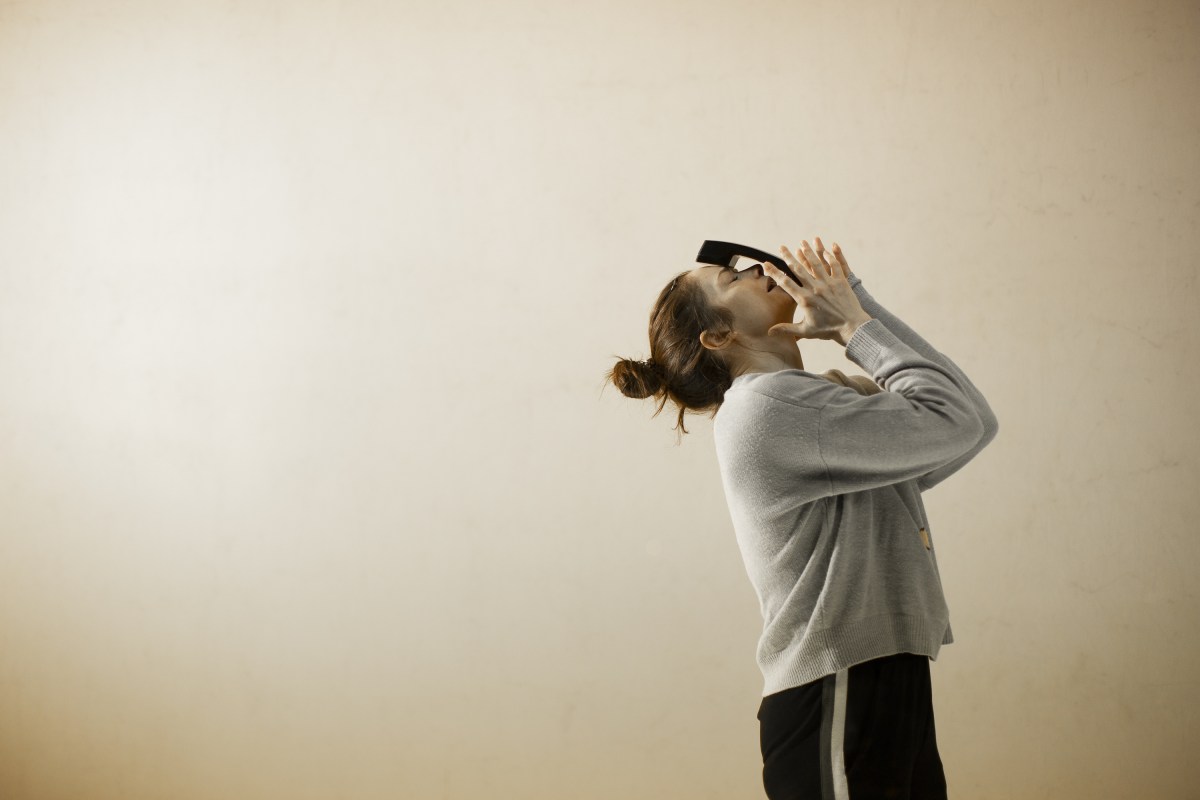
Ruth Wilson in The Human Voice

Ivo van Hove’s production of Hedda Gabler played on National’s Lyttelton stage to considerable acclaim in 2016, so the news of another collaboration between the garlanded director and lead Ruth Wilson sets high expectations. Unfortunately, this production of Jean Cocteau’s often-adapted 1930 monodrama struggles to fulfil them.

Like their Hedda, also designed by Jan Versweyveld, The Human Voice plays in a near-empty void of white space. Hedda Gabler’s set had the sparsest furnishings of a modern home, punctuated only with a few objects of either essential function or immense significance (a gun, flowers, an upright piano). The Human Voice pares things back even further. Wilson is placed into a vacant white box, which she sometimes brings props into, yet unlike before the effect is not of a gaping emptiness, but a claustrophobic, restrictive container. We see Wilson only through a window, so she is letterboxed in widescreen, hemmed in, her suppressed emotions soon filling the space. She seems trapped behind the glass – like it is a petri dish, a display case, or even as if she is under the slide of a microscope. Yet despite Wilson’s best efforts, this suffuses an air of cold, scientific sterility into the play’s atmosphere.

Peering through the glass, there is an inescapable and palpable sense of voyeurism, and surely van Hove knows this. However, he does little to challenge us or problematise our presence. The show casts us as curtain-twitching onlookers across the street – or from another nearby tower block. (We realise that here she is high up once she jumps to her death.) Yet we hear her only down the telephone, almost as if we are her lover – hearing her often ASMR-like amorous overtures down the phone, flickering in an instant between dismissive and desperate. Thus, we are both sought out and blamed.

Perhaps the ethical complications van Hove seeks to entertain are stymied by the unfortunate fact that the show offers fairly few theatrical pleasures. Though fans of Wilson will relish the chance to see her on stage again, the production is languorous and lacks energy. Were we really gazing in through her window, I doubt we would carry on watching. Though running at only 70 minutes, the sheer aesthetic austerity of the play – a deliberate reflection of her mental state though it is – tests one’s endurance a little. The greatest variation comes from the terrific sound design, the lighting swelling from cool white to a pungent yellow, or the occasional opening of the window. Any attempt to goad us into guilt about what we are watching would rely on us being problematically riveted, rather than somewhat indifferent.

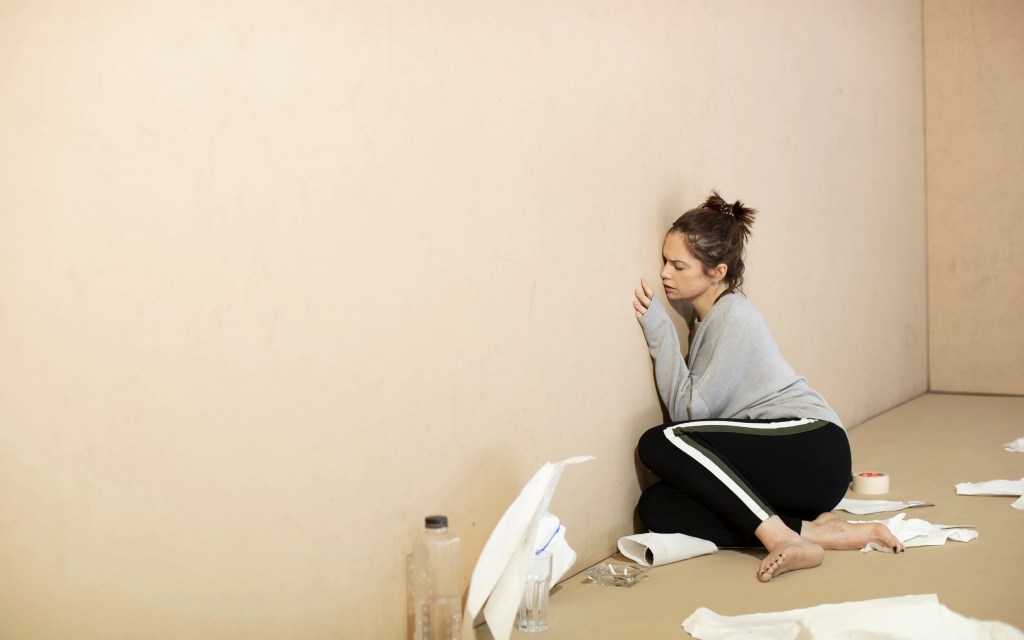
Ruth Wilson in The Human Voice

The main source of life in the play is music – some diegetic, some as additional soundtrack. At the start of the play, she listens to Arlo Parks’ ‘Hope’, with its recurring refrain ‘You’re not alone, like you think you are’. As a statement on how technology connects, it seems logical, while it also creepily suggests our presence as the voyeuristic audience. It also foreshadows, with tragic irony, the woman’s eventual lonely fate. Later, her melancholy is telegraphed by the onset of Radiohead’s ‘How to Disappear Completely’ – a gently meandering ode to dissociation, which is actually one of my favourite songs. Yet even so, here it felt like an underearned attempt to overlay emotions that we were not quite feeling – largely due to the alienation built into the design, rather than Wilson’s acting.

The track recurs through the play, its first use the most creative – though the third and final (near-complete) playthrough is the most artistically daring. Wilson plays music on her phone, dancing to Beyonce’s ‘Single Ladies’ – another song laden with an ironically literal relationship to the drama. Yet Radiohead fades in and eventually drowns it out. The music is implicitly internal – reflecting her true state of lifeless, out-of-bodily sadness. However, the effect seems too deliberately composed and imposed, a shortcut to emotion that does not fully satisfy. The third time ‘How to Disappear Completely’ plays, Wilson sits inertly against the back wall. She does not move a muscle for a full four minutes, in a daring gambit. Yet, by this point, even a track as liltingly beautiful as this one has started to feel cheapened and overused.

At the play’s conclusion, when Wilson’s character dons an electric blue evening gown and pulls open her apartment’s sliding window to jump to her death, van Hove and Versweyveld’s sudden plunge into darkness is almost immediately interrupted by a blast of Miley Cyrus’ song ‘Wrecking Ball’. The choice is downright bizarre and feels crassly misjudged, disconcertingly dissonant with the play’s previous aesthetic of beige severity. It feels like a glib reaction to a woman’s suicide, especially when she acts not out of an excess of passion and spurned rage (as in Cyrus’ lines ‘I never hit so hard in love’ and ‘All you ever did was wreck me’) but out of a slump into deep depression.

Ruth Wilson in The Human Voice

In the scenes leading to her suicide, van Hove transposes some of Cocteau’s phone-bound dialogue into a direct audience address – which reaps some of the most effective moments of the evening. ‘I am suffering’, she tells us, and it is as if she is pleading for empathy – rather than being the subject of scrutinised, distant sympathy. She even says she knows it is difficult to keep listening. Afterwards, I wondered if many of the effects of the production are deliberately designed not for in-person thrills. Perhaps instead this version of The Human Voice should creep up on you later on. A couple of weeks on from seeing it, I find there is some truth in this, but there is so little stage action to hold on to that the specifics of the production do slide from your memory. Arguably the small creative team of van Hove, Versweyveld and Wilson are trying to show the difficulty of catching someone before they fall into depression – that such experiences (both for the sufferer and the attempted provider of support) are tiring, exhausting and sometimes even dull. In this production, as much sympathy as Wilson makes us feel, you can understand why answering the phone to her character becomes difficult – despite her pleas to be heard.

It does not help that we are so remote from her that the action fails to recruit much more than general sympathy. She is pitied rather than mourned because we rarely get the chance to ache with her. Suffering is the spectacle here; she has been placed here for our amusement, but it is not quite compelling enough for us to feel guilty about watching. In light of this, her death almost seems like she is opting out of the drama itself – realising there is no way to transcend the stage-box she has been trapped in, but that perhaps that she could deprive her observers of the ability to study her pain.

Though The Human Voice seems perfectly positioned for a free adaptation that grapples with the human cost of lockdowns, this version feels too generic, and too disinterested in the theme of isolation itself. Though the play has been advertised with the tag line ‘We’ve never been more connected. We’ve never been more alone’, we are not invited to share the woman’s plight, just to watch it – in a way that would be problematic, if it was more compelling.

The Human Voice

Written by Jean Cocteau, Adapted and Directed by Ivo van Hove, Design by Jan Versweyveld, Starring Ruth Wilson
Production Photographs by Jan Versweyveld
Reviewed 25th March 2022
Categories
Film

The Lost Daughter

Olivia Colman in The Lost Daughter

Reading Elena Ferrante’s 2006 novel The Lost Daughter shortly after watching Maggie Gyllenhaal’s film adaptation is to discover something relatively unsurprising: that the adaptation takes few liberties with Ferrante’s text. Instead, the film communicates the delicate intricacies of the novel on screen, in an astonishing work of cross-medium translation. Gyllenhaal’s screenplay follows a direction already laid out, yet it never puts a foot wrong in its subtle, respectful deviations. Parenthetical first-person observations have been deftly moved into dialogue – such as the phrase ‘children are a crushing responsibility’, which feels like something of a mission statement for the film (or is at least the thesis The Lost Daughter is testing). At other moments though, Gyllenhaal’s writing simply trusts the precision and subtlety of her performers. Her faith is particularly rewarded by the ever-brilliant Olivia Colman, as protagonist Leda, and the even more astonishing Jessie Buckley, Leda’s younger self, who both wring out textual nuances that could only work, in words, on the page.

The Lost Daughter is a stunning, short shiver of a novel. The film is comparatively more languorous (though of course it takes about half as long to watch as it does to read the book). Where Gyllenhaal breathes most air into Ferrante’s taut writing is in the flashbacks – extending them and grading them with a richer, brighter colour palette, than the paradoxically chillier, washed-out Greek beach scenes. Gyllenhaal privileges the past a little more than the book does, and so the film becomes more about memory – as well as the pain, joy and regret that can come with motherhood.

Gyllenhaal’s careful close reading of the text leads her to elevate some of Ferrante’s sublime throwaways to pride of place. A brief line about the nearby lighthouse becomes a recurring image, as its brilliant light streams into the flat, disrupting her sleep and creating the impression of consistent scrutiny and observation. Later, a sequence where her husband picks up hitchhikers is relocated from their car to a house – perhaps to make the filming technically simpler – but the effect is well-judged. As the young Leda drinks and sings with her (previously unwanted) visitors, there is a particularly static oasis of calm created; it is a rest stop on the rambler’s journey, but also a moment for Leda to pause herself, and take stock of whether she really wants to stay with her husband. After their departure, Leda stares at the slept-in guest bed, with an intricate mixture of longing, desire and grief.

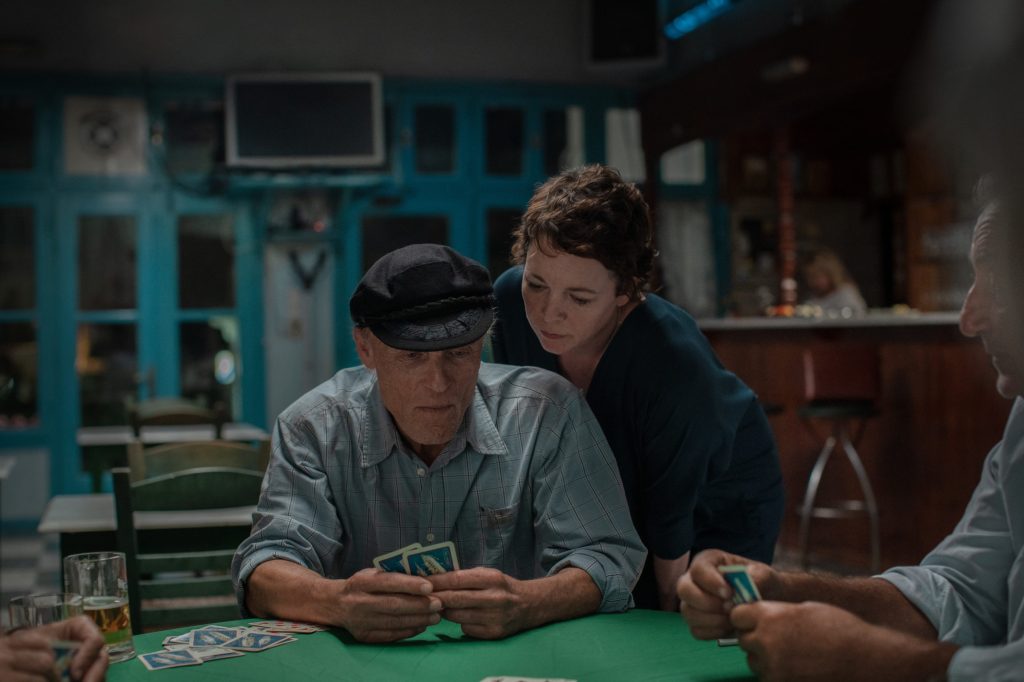
Ed Harris and Olivia Colman in The Lost Daughter

In his review in The New Yorker – which calls the film ‘a major achievement’, but also ‘sluggish’ and ‘spotty’ – Richard Brody argues that the film’s failure lies in its ‘reduction of a literary source to the framework of a plot.’ While I dispute this thoroughly, he also argues that the film should have been more literal in places – suggesting that the theft of the doll (a scene of ‘crucial physicality’) should have been shown on screen. ‘The artifice of that object’s prominence, and that theft’s centrality to the character of Leda and to the plot, cries out for reality at both ends—physically, with a straightforward and detailed view, as in a crime drama, and psychologically, with reference to the layers of Leda’s experience, memory, and emotion’, Brody writes. Though his underlying contention that film is a far more physical medium that prose is entirely reasonable and true, reading the novel confirms what perhaps remains a little uncertain in the film: there is no explanation that has been cut.

Here, Gyllenhaal mirrors the novel exactly, especially in the unsettling impossibility of answering the question of why Leda took the doll. It is as if Leda has momentarily forgotten herself, realising what she has done only when the action had already been completed. The reveal of the stolen doll, secreted among Leda’s books, is as cryptically elusive on the page: ‘I had taken the doll, she was in my bag.’ Leda herself does not know why she has done it, but reckoning with this impulse, and attempting to give the doll back, will drive the film onwards. The Lost Daughter is not about a woman who steals a doll, but instead about someone who finds herself having done so, before being trapped by the peculiar gravity it exerts upon her.

What taking the doll is supposed to achieve for Leda is deliberately unclear, and we spend most of the duration peering with unsettled curiosity – trying to figure out what it is supposed to be a substitute for. By drawing a veil over the theft itself, it simultaneously seems like a potential act of cruelty, desperation, petty revenge, or even love. Perhaps she is jealous of Nina’s superficially happier experience of motherhood – though by the end, Nina declares ‘I can’t take it anymore’ – or it could be an attempt to assert power in small way. A quietly devastating scene sees Leda attend a film screening, only for a group of raucous youths to traipse in, noisily talking over the film. When she tells them to be quiet, they mock her, and she leaves in shame. Though a poised intellectual, seemingly secure in her academic abilities, Leda almost has an underlying vulnerability, powerlessness, or insecurity about her place in the world.

Fiction frequently treats dolls as uncanny substitutes. A cursory Freudian reading of an obsession with a doll might suggest that it is the recipient of rerouted desires – some kind of maternal instinct forcefully visited upon it. Where the novel is rather vague about the psychological substitution at work, Gyllenhaal’s potent imagery implies that the doll may be a surrogate for Leda’s own childhood doll, which, when vandalised by her daughter, she flung out of the top-storey window. The most striking shot of the film is a brief close-up of the doll shattering on the street below. Yet Ferrante and Gyllenhaal keenly suggest themes of replacement and iteration, in subtle, almost game-like ways. Characters repeatedly mishear names, which Ferrante positions to be deliberately tricksy. Nina’s daughter is nicknamed Ledù, but called Elena – itself a significant name for being shared with Ferrante, though the author is famously pseudonymous. Elena’s doll is called Nani (an anagram of Nina, her mother) – making the doll not a substitute child but instead a strange maternal surrogate, a pacifier that stops her from crying. Leda and Elena chime, Rosaria mishears Leda as ‘Neda’, and the characters Gino and Gianni are Rosaria and Leda’s husband and ex- respectively. (Gyllenhaal anglicises the names of now-American and British characters, other than Leda, however.)

Into this tangled mesh, Leda christens the stolen doll Mina – another variation on Nina, but quite different to Elena’s ‘Nani’. (Perhaps ‘Mina’ carries a ring of ‘mine’, or ‘mine now’?) In his ‘Philosophy of Toys’, Charles Baudelaire wrote that he ‘believe[d] that generally children dominate their toys’, yet he also says ‘I would not assert that the contrary does not sometimes happen – I mean that toys do not sometimes dominate children.’ Though he couches himself in a thicket of negatives, Baudelaire formulates the relationship of children to toys as one of – rather shocking – power, domination, and perhaps even violence, potentially in both directions. The Lost Daughter makes a compelling case for extending this formulation to adulthood, with Leda alternating between hiding, locking away, and slamming the doll into the bin, and being compelled to tenderly nursing it back to health. She washes the sand out of it and buys new clothes in a colour she finds more tasteful. (She must quickly devise an alibi when into the toy shop comes Nina.) Leda’s actual motive is inscrutable, but this seems to be the point. This richly symbolic object has become the subject of multiple cruelties and dominations, while also exerting a powerful aura – almost as if it made Leda take it. When she finally returns it, Nina responds with violent shock, driving a hatpin into Leda’s side – who sits down on the sofa in pained silence, utterly baffled by what has occurred.

Jessie Buckley in The Lost Daughter

Undoubtedly the most powerful scenes are those set in the past, with Jessie Buckley’s gripping turn as the younger Leda – crushed and ‘suffocating’ with her two infant toddlers. The young child’s ultimatum ‘I’ll give you three seconds to come back’ presents almost as much of a gut-wrench in the trailer as in the film, while Buckley’s suffocation is evoked in claustrophobic close-ups and the palpable summer heat. The film is somewhat psychoanalytic in its return to the past, searching for answers as to how Leda has arrived at the present. Yet Buckley elevates what could be a cryptic turn, into something desperate – grieving for a joy that she cannot find, prompting her significant exit in which she leaves her husband and children. The film swells with elation when, attending a literary conference, a softly spoken, avuncular English professor (Gyllenhaal’s husband, Peter Sarsgaard) picks out her work by name as worthy of regard. The ensuing affair between them is a moment of transgressive relief and seems inevitable from the moment Gyllenhaal trains the camera on Buckley’s smile, as his public praise washes warmly over her.

The novel and film both reckon with these ethically fraught moments of abandon; in them, Leda transcends her exhausting circumstances and feels herself. At the heart of The Lost Daughter – the open wound probed at almost twenty years later – is Leda’s parental regret, and her decision to leave her husband and children, not seeing them for two years. To be dissatisfied with one’s children remains something of a cultural taboo; the scales generally tip towards children – and how their forms of unhappiness can be traced back to overbearing parenting, or neglect. There is also, without doubt, a strong social pressure to have children – which is felt far more by women than men. Yet this is partially offset by what is now a defined counterculture of antinatalism – driven by philosophical, ethical, feminist, or often simply financial considerations – though this far from neutralises the damage to those who choose not to have children – or find they cannot. Ferrante and Gyllenhaal try to negotiate a third category: those who have children but regret the decision. The film is an extended attempt to articulate this potentially unspeakable, usually unspoken sentiment.

Children are undoubtedly a significant source of regret – either in the having or the not having of them – and parents must generally grieve, in some large or small way, the passage from infancy to adulthood, and the inevitable deviation from the path expected or most desired for them. Leda’s description of motherhood as a ‘crushing responsibility’ – especially when delivered in dialogue to a pregnant Rosaria – perhaps threatens to overwhelm the film’s conception of children. Colman’s sincerity is so compelling that it would be easy to mistake this gently delivered, yet weighty judgement as the film’s view. Yet though Gyllenhaal is best at depicting the suffocation and claustrophobia of motherhood – made worse by the apathy of Leda’s husband, during the flashbacks – there are some powerful moments which counterbalance this.

Olivia Colman in The Lost Daughter

The film’s final shot sees the Leda sat on the beach, peeling an orange. This is used as a recurring motif by Gyllenhaal, encapsulating a subtle joy from childhood: peeling the fruit in a single motion, so that the peel remains in one piece – like a snake. Yet it epitomises the devastating high-wire act of parenthood – the licence to share childish joys again, mixed with the impending worries that something might give way. ‘Don’t let it break. Peel it like a snake’, they chant, in the final shot of the film, which flashes back to a bright, warm beach of a past holiday. Though there is delight in this moment, breakage and rupture are not far away.

Sitting on a Greek beach in the present day, Leda answers her phone. ‘I saw Marta’s name, I felt a great contentment, I answered’, Ferrante writes, her normally poised sentences here running into one, the narrative voice perhaps dizzy from Leda’s stab wound. The words tell of a joy, alien for much of the novel, as Leda delights in her children with a relatively straightforward affection. It feels like the curtains being pulled back, the sun allowed in. I found Gyllenhaal’s ending to be a little more ambivalent, however – certainly regarding Leda’s motherhood. Instead of a sudden rush of relief, pleasure and satisfaction, Colman maintains the patina of uncertainty. Yet in cutting between this ambivalent present and a pocket on joy in the past, Gyllenhaal reveals the hope that was there from the beginning but was not enough to sustain Leda. As she says on phone, ‘I’m dead, but I’m fine.

The Lost Daughter

Directed and Adapted by Maggie Gyllenhaal, The Lost Daughter by Elena Ferrante, Starring Olivia Colman, Jessie Buckley, Dakota Johnson, Ed Harris, Peter Sarsgaard, Paul Mescal, Dagmara Domińczyk, Jack Farthing, Oliver Jackson-Cohen
Categories
theatre

Henry V – Donmar Warehouse

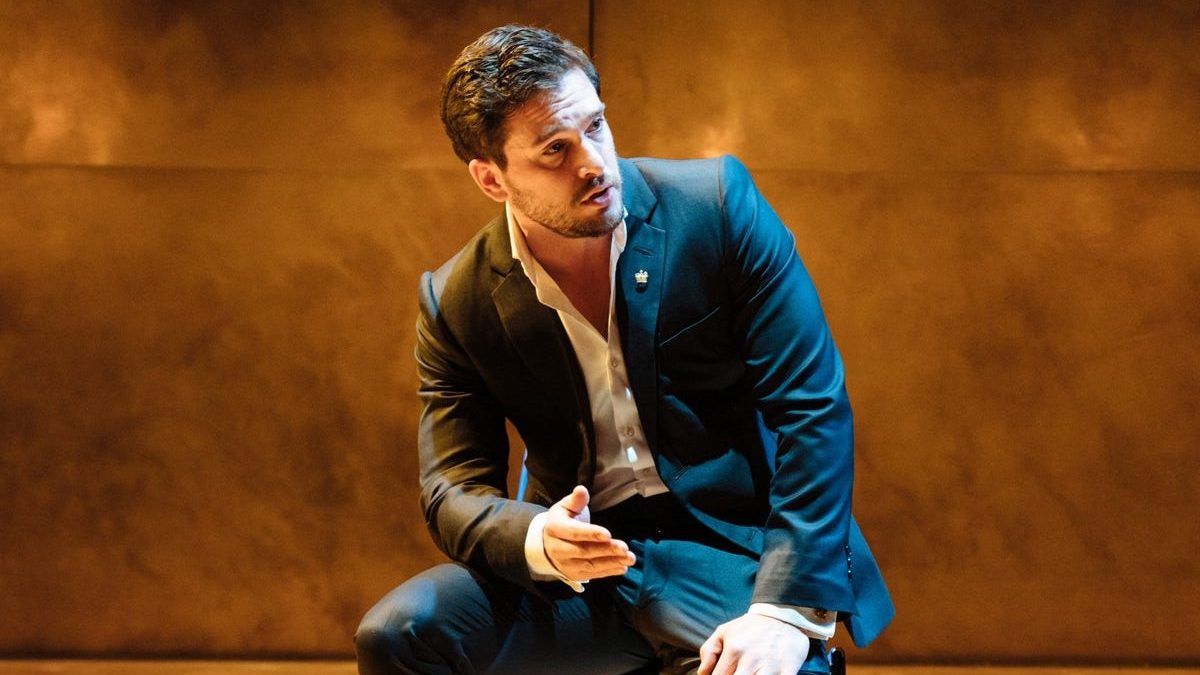
Kit Harington in Henry V

Shakespeare’s war drama Henry V has on various occasions been programmed, staged and filmed with a calculated and deliberate geopolitical message. In 1944, late in the Second World War, Laurence Olivier’s patriotism-drenched film version cast Henry as a brilliant military leader enjoying a deserved triumph over the French. That the French had become allies did not stop the sentiment, and the film was even dedicated to British soldiers ‘whose ancestors it has been humbly attempted to recapture’. More recently, the National Theatre’s 2003 production was received largely as a strong, satirical critique of the UK’s involvement in the Iraq War, treating Henry’s invasion as largely unjustifiable, paralleling British and American military action. Yet in this new, just as timely production, the resonances are shockingly coincidental, yet startling to watch.

Max Webster’s stirring staging echoes the combat fatigues and gritty violence of Nicholas Hytner’s Iraq War critique, yet Webster leans far more into the play’s notorious ambiguity, rather than espousing the clearly ‘pacifist leanings’ Michael Billington identified in 2003. This is not to say that Webster presents war as anything less than a nightmarish horror, which is intensified by Fly Davis, Carolyn Downing and Lee Curran’s terrific design (of set, sound and lighting respectively). Yet Webster’s nuance is slightly, and unavoidably, blunted by the shadow of world events which hangs across the play – obvious long before Kit Harington’s curtain call address, in which he notes that Henry V is a play about invasion, before asking the audience to spare some change for the humanitarian relief effort in Ukraine.

Shakespeare’s depiction of the cost and violence of conquest grimly mirrors Russia’s ongoing attempt to invade Ukraine. This run was announced in mid-2021 and the invasion began a fortnight into its run – though the growing prospect of conflict surely hung over the rehearsal period – so its staging is only a tragically apt coincidence. Thus, there are not direct references made in the play itself. Instead, this already electric staging flickers with a palpable unease, that while the stage is filled with impressive military choreography (from fight director Kate Waters, movement director Benoit Swan Pouffer, and with additional guidance from former Royal Marine Commando Tom Leigh), this is happening for real elsewhere. This is merely a ‘wooden O’, in which war is simulated.

Millicent Wong is terrific as the Chorus, implicitly justifying the role’s presence in the play. (Such a persistent narrator is unusual for Shakespeare.) Yet the infamous apology for the limitations of the stage that opens Henry V seems less necessary than usual. The production inclines to bombast (incredibly effectively), with guns, military manoeuvres and the ever-present sound of circling helicopters. There is no need of ‘imaginary forces’ – Shakespeare’s pun describing mental faculties and pretend armies – when the production depicts semi-realistic modern warfare before our eyes. And yet, scenes of war are now so present on the news, it also seems obvious to suggest that theatre is inadequate in depicting it.

Norman Rabkin famously compared Henry V to drawing of an animal, variously seen as either a rabbit or a duck. Most people can see both at will, mentally switching between the right-facing rabbit and the left-facing duck. However, no matter how hard you try, you cannot see both at once. In Rabkin’s reading, the character of Henry and the moral justifications for the war are like the rabbit-duck. Henry is either a heroic leader of one of England’s crowning military triumphs, or he is barbarous example of the brutality and folly of war. (As the Chorus reminds us at the play’s conclusion, Agincourt’s gains will be lost under Henry VI.) For Rabkin, this ambiguity is to be relished rather than resolved. ‘Mystery is their mode’, he writes, of Shakespeare’s ‘great plays’; ‘the questions aroused by them seem unanswerable’. Thus, to direct Henry V is to either decide on a reading or attempt to embody this tension – leaving the play functioning as a moral challenge for its audience to decode.

Webster strikingly leans into the latter, though it is even more difficult to harbour sympathy for a violent invader now than usual. In this production, the play seems deliberately structured as a series of moral tests. Is Henry admirably ruthless in his determination or a perpetrator of undue, merciless cruelty? In an attempt to bolster the presentation of Henry as a person in his own right, rather than the politician or war leader he appears as in most versions of the play, Webster lifts from Henry IV Part 2 to craft a new opening sequence, in which he is decadent and wayward figure. The Chorus’s Prologue ends with the onset of pounding music, Henry staggering onstage in a stained office shirt, enjoying Bullingdon Club-esque hedonism, and vomiting in the middle of the stage. It is swiftly cleared up, but the smeary remnants glisten under the lights for the next eighty minutes until the interval. Soon he is thrust into power by the death of his father (Henry IV). Yet though he suits up into a suddenly more respectable, disciplined leader, the loutish behaviour lingers in the mind.

Kit Harington in Henry V

The first true test comes in Act 1 Scene 2 of the original Henry V, beginning a trend in Webster’s drama to retain and spruce up the more intractable monologues, rather than simply cutting them. This does make for a long show (over three hours in all), especially given the addition of the opening, yet Webster’s directorial innovations and interventions are compelling and hugely effective. Here, in one such flourish, the Archbishop of Canterbury’s rather turgid explanation of Henry’s claim to the French throne is delivered via PowerPoint presentation. In a neat inversion of the usual audience slump, the characters on stage are visibly bored – yawning, sighing and even swearing when he adds reason after tenuous reason for Henry to stake his claim. Instead, we laugh at the tortuous logic and spider web of a spider web of a family tree, shown in Andrzej Goulding’s superb video projections. That Henry can be convinced by this seems surprising though, and it even grimly evokes Putin’s thin justifications for supposedly ‘liberating’ Ukraine. Henry’s actions are, of course, predicated on an argument about monarchical legitimacy that ignores how the French would self-determine their own nationality.

Henry sits quietly in this scene, epitomising that much-coveted, but nebulous quality of statesmanlike-ness. He has gained authority from his sudden promotion, though perhaps his rigid, silent demeanour is also that of a man still trying to sober up. For all the production’s tendency to overwhelm, Webster plays these subtler moments well; Henry’s power is demonstrated by the simple fact that he is the only one with a chair. After surviving the archbishop’s presentation, Henry is persuaded – calling on ‘God’s help’ to speed their victory, though really it is the vast pledge of church money in support of military action that has tipped the scales for the King. At the end of Act One, Henry is presented with a provocative gift of tennis balls from the Dauphin, an insult to Henry’s ‘youth and vanity.’ Yet you feel the ethical cogs whirring in Webster’s drama; they are derogatory, yes, but are they really an acceptable justification for violent incursion? Yet, Harington explodes with rage, and you feel that ‘chid[ing] this Dauphin at his father’s door’ is hugely understating his aims.

The first half proceeds with a measured pace, next testing Henry with the revelation of the Earl of Cambridge’s plot to assassinate him. The dramatic irony hangs thickly in the air as he tricks them into signing their own death warrants. He tells them of a man who, in drunken excess, ‘railed against our person’. Yet he proposes merciful treatment and allows the plotters to argue against leniency. Accomplice Scroop insists ‘Let him be punished, sovereign, lest example / Breed by his sufferance more of such a kind.’ All three betrayers are in agreement; a King must be feared as well as loved, cruel and kind. Thus, Henry presents them with papers, detailing their own treasonous crimes. When they make their inevitable pleas for mercy, Henry simply gestures to their own hypocrisy. Harington plays Henry here as a clever schemer, his lines half-test, half-trick – playing on the public loyalty everyone must show to him in making them argue against clemency. Shakespeare implicitly questions Henry’s actions; are they start of a slippery slope towards the cruel and dictatorial, or the actions of a just King, only hanging them with their own rope?

This question is, horrifyingly posed again before the interval, when Bardolph is hanged for alleged stealing from a church. While Henry is theoretically upholding a moral standard, in staking a dubiously rightful claim without unnecessary violence or larceny, Webster plays the moment as a grimly mechanised public spectacle – displaying Henry’s swollen power for all to see. Henry watches remorselessly as her body twitches above Donmar’s stage, even though Webster’s additions from Henry IV Part 2 show his youthful friendship with Bardolph, suggesting perhaps that they might have been lovers. There is a potent sense, by this point, that Henry might have gone too far – the killing sapping the morale of Henry’s old Eastcheap friends, Pistol and Nym, and even threatening the customary comic subplot’s mirth.

Kit Harington in Henry V

John Sutherland and Cedric Watts famously place Shakespeare’s Henry on trial in Henry V, War Criminal?, ascribing him that anachronistic moniker, though it has an important partial echo in the original text. After Henry has decided to execute the French prisoners of war, Welsh soldier Llewellyn objects as it is ‘expressly against the law of arms’. Webster slightly updates the phrase to the ‘rules of battle’ – a deliberate shift away from codes of chivalry, respect and fairness, towards modern concepts of human rights and conventions of war. This decision to contravene these rules is the clinching piece of evidence for Sutherland and Watts – as it was in a 2010 mock trial Washington, D.C., which included Supreme Courts justices Samuel Alito and Ruth Bader Ginsburg, where they unanimously found against Henry in the matter of executing prisoners. It is the darkest moment of moral testing in the play, and Webster makes it look for a brief moment like Henry has caught himself in the midst of his tyrannical violence and might retreat from it. Yet instead, defiant of his soldiers’ reluctance, the king graphically slits the throat of one of the prisoners before restating his order. Webster places blood firmly on Henry’s hands.

Yet even amid this horror, there is the rabbit-duck of admirability in amongst the violence. As much as the throat-slitting is a horrifying signifier of just how far Henry has gone, it also, rather perversely, shows him to be a man who leads from the front. He never expects his soldiers to do something he would not be willing to do himself. Henry even skulks covertly around the camp the night before battle, attempting to boost morale. By contrast, the Dauphin avoids the actual fighting, but is still rewarded. Despite the scepticism towards many of Henry’s actions in Shakespeare’s text, Henry’s victory comes through effort, while the French are far from sympathetic victims.

A crucial point after Henry’s victory is his confrontation with Michael Williams (here, one of many gender-swapped roles, like Bardolph). During his night incognito, Henry ends up embroiled in a rather contrived dispute, which leads to the promise of a delayed ‘box on the ear’, if he were ever to come up to her and say, ‘This is my glove’. Of course, Henry eventually does so, prompting immediate terror from Williams as she realises her jest of a threat is now treasonous. Yet Henry pardons the soldier, despite an ominous sense that he might turn against his own army into a completely tyrannical autocrat, more in the vein of Richard III. Instead, Harington’s features crease with warmth and he good-humouredly demands that her glove be filled with money. The stage devolves into a wild party, with drinking, dancing and the blasting underscore of Darude’s ‘Sandstorm’.

Millicent Wong in Henry V

In Shakespeare’s text, this could be read as a pivotal moment of transformation in Henry – the point at which he looks over the precipice, but without falling (as many others have done in the rise-and-fall de causibus tragic form, found variously in history plays such as Richard II and Richard III). A structural reading would align Henry V’s conclusion with the genre of comedy – ending as it does with the wooing of the King of France’s daughter, Katherine, and the promise of their marriage. Yet, typically, Shakespeare infuses a rich ambiguity in these final scenes, a gift to directors (like Webster) who wish to take a more sinister interpretation.

This production treats the awkwardness of the play’s comic resolution as the last of the play’s moral tests, one which – for me – Henry completely fails. Though attempting to be amorous across the language divide, Harington soon turns off Henry’s charm. He is brokering a military deal, as the victor, and as a result his requests are actually demands suffused with a threat of violence and destruction. There is no way that he could straightforwardly court Katherine’s affection. Anoushka Lucas is a standout as Katherine, playing her with a steely determination and wringing as much pathos as possible from her character’s hopeless situation – despite the limitations of the relatively small role. In this staging, the fairly early play Henry V seems to foreshadow the dark undertones of The Winter’s Tale’s resolution (and those of the other late plays), in which the (seemingly) resurrected Hermione does not directly forgive or even address her husband Leontes, whose groundless accusations of adultery led to her apparent death. Leontes hurries everyone offstage before the potential powder keg of unspoken feelings can detonate – and perhaps lead to further tyrannical violence. As with Henry V, Shakespeare’s language denies us the happiness we might expect from the marriage plot’s structural comedy.

Henry V is the third biggest role in Shakespeare – both by raw line count and percentage of the play’s dialogue (32%) – yet I was struck by how small the role felt here, especially in the first half. Kit Harington is cannily cast; of course, his presence will sell tickets, yet he also exudes a quiet celebrity, which fits this interpretation of Henry as a slick-suited, potentially populist monarch. Though Andzrej Łukowski contends in his Time Out review that this production ‘approach[es the play] as a great character study’, I was left with the quite contrasting sense that the play was asking us to judge – as the public, perhaps even as voters – whether we found the King and his actions justifiable, ethical and moral. The frequent projections of Harington’s face on the back wall serve a powerful sense that he is a national leader whose inner thoughts remain largely inaccessible to us. Henry here almost seems like a new take on the Chorus’ invocation ‘Into a thousand parts divide one man’ – not only an entreaty to imagine the stage much wider in scope, but a comment on Henry’s fractured self. He is many things to many people – more of an idea than a psychological presence, and more of a motivational speaker than a soliloquist. We judge him from a distance, rather than suffer with him – as we might with Lear, Macbeth and Lady Macbeth, or Prospero.

Kit Harington in Henry V

Much of the production plays like a glossy modern miniseries, combining stylised stage imagery with realistic verisimilitude. The funeral of Henry’s father (Henry IV) is an operatic, epic scene of stately slow-motion, the Donmar’s medium-sized stage filled with black coats and wet umbrellas. Later, Webster chooses to translate the French scenes back into their original language (with surtitles), a cleverly disruptive choice which elevates the French characters from comic ciphers by giving them their own voice. It forces the audience to engage with the words and lean in, rather than let the drama simply wash over them. Yet it also signifies the French characters’ own defined, different culture – equally real on stage, avoiding the sense that the play is being performed as a history told by the English victors. Even the ostensibly comic scenes crackle with a violent danger. The rather unwieldly comedy of the only originally French scene, in which Katherine learns the English words for body parts (‘de fingres’, ‘de hand’, ‘de bilbow’ and so on) is energised by being set to boxing session. Katherine sharpens her defences, physical and linguistic, knowing that she will likely be part of the peace settlement with Henry.

It is a marvel how well the production’s chaotic clash of imagery works. War is rendered as a baroque spectacle, underscored with live choral music from a quartet of actor-musicians, yet it is also hi tech, with sonar pings, helicopter blades and automatic weaponry. As the army goes ‘Once more unto the breach’, the gold back wall of Fly Davis’ set splits apart into four parts, with red lights blazing through the gaps – a vast St George’s Cross, underlining the pungency of nationalism in this Henry V. England are loutish victors, the flag in the set design literally setting alight as the stage fills with a debauched carnival of celebration, giving a new meaning the Chorus’ earlier statement that ‘all the youth of England are on fire’. Now they are on fire with antisocial raving.

Before the play begins, a quotation is projected on the back wall of the stage: ‘There is no document of civilisation that is not also a document of barbarism.’ Walter Benjamin’s statement chimes with Rabkin’s polysemy, inviting the audience to judge – weighing the evidence, as well as potentially condemning Henry. It is a testament to the intentional ambiguity of Webster’s production, though this neutrality is crushed by the weight of real-world events. Strangely, the actions of Putin make this production seem like a far more definite critique of English nationalism than was perhaps originally intended. For all the play acts as a literary optical illusion, flattering Henry with good qualities of bravery, leadership and determination as well as bad, in Webster’s ambitious take, rhetoric can only distract from Henry’s moral outrages – in no way excusing them.

Henry V

Written by William Shakespeare, Directed by Max Webster, Design by Fly Davis, Lighting Design by Lee Curran, Sound Design by Carolyn Downing, Video Design by Andrzej Goulding, Movement Direction by Benoit Swan Pouffer, Fight Direction by Kate Waters, Casting by Anna Cooper, Composition by Andrew T Mackay, Starring Kit Harington, Jude Akuwudike, Gethin Alderman, Seumas Begg, Claire-Louise Cordwell, Kate Duchêne, Olivier Huband, David Judge, Melissa Johns, Danny Kirrane, Anoushka Lucas, Adam Maxey, Steven Meo, Joanna Songi, Marienella Phillips, Millicent Wong
Production Photographs by Helen Murray
Reviewed 12th March 2022
Categories
theatre

The Chairs – Almeida

Marcello Magni and Kathryn Hunter in The Chairs

In a playful and intimate new version from translator-director Omar Elerian, The Chairs at the Almeida Theatre is a fantastically disruptive, rambunctious and chaotic meta-drama. It is unlike much else on contemporary British stages (certainly in the larger venues), driven by an offbeat comic intensity, powerhouse performances and searing insight into both Ionesco’s text and the 21st century world his drama is now performed in.

In updating Eugène Ionesco’s classic script, Elerian substitutes the blasted heath no-place, fairly typical of the Theatre of the Absurd, for a dilapidated theatre – which literally falls apart as the show goes on. Presiding over this space are the Old Man and Old Woman, nonagenarians who proceed to welcome invisible guests to watch an upcoming speech, setting out an ever-increasing array of chairs from which the apparent message of salvation they have been promised may be witnessed.

The performances here are utterly virtuosic, with real-life married couple Kathryn Hunter and Marcello Magni playing the affectionate, tatty hosts with true precision. The mutual warmth is palpable, despite their constant low-level rowing, and the Old Woman calls her husband ‘Crumpet’ with a loving twinkle. Kathryn Hunter’s performance particularly transcends age; the Old Woman’s seniority manifests not through slowness, but in a spritely, child-like impishness, hunched and small though moving with striking agility, while her voice is gruff but squeaks with youth. Elerian makes excellent use of their masterful physicality, and the characters are tremendous assets in the play’s slowly building first hour. Where a director might usually be forced to tighten up and trim down, here the sheer joy exuded by Hunter and Magni allows Elerian to extend the play with delightful stage business – including some hilarious prop work involving an invisible table, and the repetitive, though idiosyncratically evocative language. They constantly mutter phrases like ‘titters and tatters’, enjoying the words for their alliterative quality while alluding to the ruined apocalyptic world outside, which they avoid acknowledging. The play’s pace increases as the show goes on, swirling into a frenzy when the stage revolves – filling with the titular chairs in a breath-taking display of technical, artful choreography.

Marcello Magni and Kathryn Hunter in The Chairs

Yet the comedy of Hunter and Magni is not an elaborate way to delay the play’s conclusion. Instead seems fundamental to the production’s dramaturgy. I found myself acutely aware of my laughter in a way that I had rarely, if ever, felt before. Here, metatheatre is a powerful engine of both comedy and ethics – far more than the nod and a wink fourth wall breaking that audiences are generally more familiar with. After all, the central image of The Chairs is of a stage filled with empty seats – an audience who are not present, perhaps unrepresented on stage or simply the couple’s shared delusion. The audience are always part of the theatrical event (the prerequisite, as in Peter Brook’s famous definition in The Empty Space), yet we have a particularly unstable relationship to The Chairs. The play parallels us as spectators to a message. Yet, as two unwitting front-row dwellers discover, when enlisted in a sudden bout of audience participation, we are as real to the characters as the unreal, onstage audience. The fourth wall is porous and leaky, and it is as if we too are the delusions of the characters.

Very often, the serious British theatre experience for audiences is defined by a pretence of not existing – trying to dissociate from potential bodily discomfort, bound by unwritten codes of etiquette that dictate that the merest rustle of a sweet packet is a transgression against the theatrical illusion. Such dissociation is all but impossible here. From the start, in an extremely funny, several-minute section added to the play’s beginning, we are made aware of our presence. Sat under the house lights, the audience overhears the actors through an intercom they purportedly do not realise is broadcasting. We are denied the customary plunge of the space into darkness – at which point we often would, for all intents and purposes, cease to exist. Instead, we sit – waiting for the show to begin (but of course it already has) – oddly aware of ourselves as the actors peek through the curtains and note that we’re all sitting there waiting.

The play seems in some ways timeless, or of the very end of time, but is shot through with a knowing contemporary edge. The actor playing the Old Man ensconces himself backstage, insisting that he does not wish to perform, saying ‘tell them I’ve got Covid’ – grimly apt given the premature end to the Almeida’s Spring Awakening in January due to positive cases in the company. Later, the Old Woman’s age is wryly quantified in the twenty-one booster vaccines she has been eligible for – a good joke, but one which places the events of the play within touching distance of now, in the most frightening form of apocalyptic dystopia: the near future, within our own expected lifetimes.

Marcello Magni and Kathryn Hunter in The Chairs

Elerian and the company retool Ionesco’s drama for the present day far more significantly than just in these (well-judged) asides though – most strikingly in the complete overhaul of the play’s distinctive, bathetic ending. The Chairs’ (more frequently performed in Britain) counterpart in absurdist drama is Samuel Beckett’s Waiting for Godot, whose infamous ending in which Godot does not show up is known by the vast majority of audience members in advance. Tragic, however, is not merely his absence, but the absurd, doomed hope that Vladimir and Estragon entertain that Godot could be a source of transformation. That Waiting for Godot’s (lack of) plot is widely known is hardly a problem for the play though. It is not a twist ending, but a dawning realisation – obvious to anyone who has read the programme notes. Yet, if you peruse a programme for a performance of The Chairs, you will ordinarily see a short cast list of three: the Old Man, the Old Woman, and the Orator – who does appear.

Beckett’s play was first staged a year after Ionesco’s, and it could be argued that Beckett is extending, and making more absurd, the misidentification of hope as found in The Chairs. Unlike Godot, the Orator turns up. But just like him, the Orator fails to provide salvation, deliverance, or even coherent words. It is arguably bleaker to see hope which actively fails, rather than a hope postponed indefinitely. Yet though Waiting for Godot is a ‘tragicomedy in two acts’ – suffused with a base humour of impotence – Ionesco denotes his play a ‘tragic farce’. The Chairs is a tragedy because the chairs are really empty and the Orator fails to speak, but it is also a farce because it is witnessed by a real audience, an interplay of genre of which Elerian seems keenly aware. Interviewed by Natasha Tripney in The Stage, he quotes Charlie Chaplin, saying: ‘Life is tragedy up close and comedy in long shot.’ A theatre audience is in the perhaps unique position of having close proximity and abstracted distance all at once.

Marcello Magni, Kathryn Hunter and Toby Sedgwick in The Chairs

Ionesco’s original play expressed not only a general existentialist futility, but the fear that grips writers and potentially audiences too: that theatre (and art) which claims to have a message of salvation is actually voiceless and futile. Partly it dramatises a fear of writer’s block, which mirrors a wider political anxiety that we cannot dream up a better future. Yet it also challenges the grand, implicit promise of many works of art, that they can elevate and transcend material circumstances, wielding the power to change minds with empathy and ideas. The Chairs is a core part of a theatrical tradition that wonders if we have got a bit carried away.

Yet, rather brilliantly, Elerian’s version wonders if the infamous silences, absences and privations of existentialist tragedy have become too much of a spectacle in of themselves. The Orator’s inability to form words constitutes a powerful message in itself – an articulately ineloquent expression of artistic and political failures of imagination. Elerian instead subverts everything which makes the original entrance of the Orator grand and symbolic. Toby Sedgwick plays him amid collapsing scenery and without the relevant costume, with a powerful disaffection – half in character, half the reluctant stagehand who has been roped in to play a character with two other actors who wilfully deviate from the script. Hunter and Magni have a brainwave, when a curtain collapses on top of Sedgwick, using the fabric as the imperial robes of the (usually invisible) Emperor – gleefully trampling over the original dramaturgy while Sedgwick visibly seethes. When the time comes for the Orator to attempt to speak, Sedgwick apologetically addresses us, taking a galumphing, conversational tack in striking contrast to Hunter and Magni’s precision. He punctures the magic of theatre with a shrug – telling us that he was not able to change his costume and pulling away fake, stuck-on mutton chops and whiskers from his face with a baffled expression. None of it is real. This is theatre in collapse.

The most substantial deviation Elerian makes from Ionesco is the replacement of the deaf-mute Orator’s ‘Jou, gou, hou, hou’ noises with a fourth-wall breaking address – yet one riddled with the same powerful bathos. Instead of literal nonsense, we hear relatively empty words. His profound truth is still inaccessible, but now lost in what Elerian describes as the ‘so many conflicting truths’ we are subject to in our daily lives.

Marcello Magni and Kathryn Hunter in The Chairs

The Orator references Guy Debord’s Society of the Spectacle, with pronounced indifference – neatly encapsulating the intellectual apathy which Debord diagnosed as a consequence of capitalism on culture. Yet Debord is a potent addition to the production, introducing his notably theatrical terminology of spectacle – and, implicitly criticised, the passivity, transfixion and vulnerability of spectatorship. Many theorists and theatre makers have sought to mitigate the assumed inactivity and nonparticipation of theatre audiences in drama – which Peter Brook diagnosed as the ‘slump’ caused by theatrical ‘deadliness’. The dramaturgies of Bertolt Brecht and Augusto Boal are designed to deliberately include, exclude and probe their audiences. The latter proposed the term ‘spect-actors’, insisting that to watch drama is not passive, but active, a proposition later argued by Jacques Rancière in The Emancipated Spectator (2009). ‘Emancipation begins when we challenge the opposition between viewing and acting’, he writes, arguing that the spectator ‘observes, selects, compares, [and] interprets’ – all active engagements with the drama. As in Debord, one of the great dangers of the spectacle though is the general sense of helplessness it can engender – as if the drama would be happening anyway, regardless of the presence of the audience.

While some critics – such as Matt Wolf in the New York Times – lamented the production’s ‘fussy’-ness and questioned the need of the final scene’s elongation, for me, Sedgwick’s closing monologue seems essential. The tragedy of this The Chairs contrasts the original, a riposte to the dramatically bathetic anti-climax of the original, absurdist theatre finding an oxymoronic grandeur in the renunciation of hope or resolution. This puts the whimper back into the way the world ends. It is not as simple as a failure of vision from political leaders or artists, but an unwillingness on the part of the audience to sift the wisdom from the noise – leaving meaning in ‘titters and tatters.’

The Chairs

Written by Eugène Ionesco, Directed and Translated by Omar Elerian, Design by Cécile Trémolières and Naomi Kuyck-Cohen, Lighting Design by Jackie Shemesh, Sound Design by Elena Peña and Pete Malkin, Wigs, Hair and Makeup Co-Designed by Suzanne Scotcher, Voice Coaching by Michaela Kennen, Assistant Direction by Nastazja Domaradzka, Magic Consultant Patrick Ashe, Starring Kathryn Hunter, Marcello Magni, Toby Sedgwick
Production Photographs by Helen Murray
Reviewed 11th February 2022
Categories
theatre

The Forest – Hampstead Theatre

Angel Coulby and Paul McGann in The Forest

Following his recent critically acclaimed, devastating family drama The Son and Oscar-winning film adaptation The Father, the return of French playwright Florian Zeller to the British stage is a welcome one. Translated again by Christopher Hampton, Zeller’s new play The Forest arrives at Hampstead Theatre as a world premiere. Though it shares some of the previous plays’ experimental touches, this production lacks the emotional pull of previous works – suffused instead with a coolly detached, almost surgical sheen; though there are moments of bloody violence, the overall effect remains pristine – perhaps like an operating theatre.

Even more so here than in previous plays, Zeller employs narrative pyrotechnics to explore his theme formally. In The Forest, the nameless main character is an eminent surgeon – but written on the page as two people, Man 1 and Man 2. The role is doubled (by the excellent Toby Stephens and Paul McGann) – contrasting the amiable father and husband with the conniving cheat, the slick, successful healer of others with his desperate urge for self-preservation. The strength of Stephens and McGann’s performances resists such a simple dichotomy though. All of the selves are encapsulated in both; the dual role simply makes these differences more immediately intelligible.

Gina McKee and Toby Stephens in The Forest

Zeller’s thesis – that men contain many selves, and thus the capacity for cruelty and violence – becomes apparent quickly, and the play’s structural twists and turns largely serve to generate intrigue in the relatively simple plot, rather than build on this theme. It is undeniably a powerful dramaturgical device, and Stephens and McGann thoughtfully generate a continuity between the two parts, but I found that the unfortunate by-product was the implicit suggestion of male complexity – as opposed to female simplicity. Why is it that all of the male roles alternate between the male actors – not only with Man 1 and Man 2, but with the other men interchanging as various friends and colleagues too? The intention seems to be critical of men and male behaviour, but the effect is almost contradictory; the men exist in exquisite complication while the women are singular and simple – even one-note in places.

At its heart, The Forest seems to be a play about gender – but it rarely digs into the social factors that might cause this male multifariousness – or prohibit it for women. The idea that men exist in multiple selves while women – in general – do not could potentially be examined in light of social and historical norms. Perhaps women are not permitted to be complicated in these ways? Yet Zeller’s drama largely steers away from a concept of gender that is socialised, historical or constructed. The structure – baked into the drama from the very start – gestures towards a crude biological determinism, which goes without interrogation. By definition here, maleness involves a tendency to lie and manipulate. Womanhood, in contrast, is presented as a form of victimhood – every main female character wronged by a man’s (usually sexual, sometimes violent) behaviour. The Forest seems to assert this as a precondition, not a product, of society – interested mainly in the effects of this inescapable psychological prison than on potential solutions to the problem. The harm is to everyone – though the male experience of internal struggle is vividly staged, while women’s pain is expressed either in silence – or is rendered completely inaccessible, when the women are pushed offstage or killed.

Jonathan Kent’s direction is extremely slick, and the cast wring as much from the material as they can. Gina McKee and Angel Coulby should be especially commended – locating emotion in their sometimes cipher-like characters. McKee particularly remains etched in my mind for the way her suspicions, disappointments and ultimate exhaustion seem to play across her face – especially given the relative lack of expression the Wife is given in dialogue. She exists on stage largely through the play’s repeated actions – clearing up wine glasses and fetching water, frowning at the greetings card on some unexpected flowers. Never is McKee’s understated presence more palpable than near the play’s ending, where her crushing disappointment with her husband is expressed in a vast silence. ‘What is it?’, the Man asks, but she says nothing. As Zeller writes in his stage directions: ‘She indicates “nothing” with her head. But her serious expression seems to suggest the opposite. An interminable pause, loaded with subtext.’ This moment could have ended the play – a reminder of the cost of male vices on women. Instead, Zeller goes on, choosing to conclude with the Man’s weeping, under a spotlight – rather expressing the play’s gendered priorities in miniature.

Gina McKee and Paul McGann in The Forest

Similarly unexamined (or left only to subtext) are other social dynamics in the play – particularly the class and cultural specificities which allow the Man to live the life he does. The Forest is another play in which upper middle-class people have wine and affairs, leading to internal catastrophe – but which has very little effect on the material circumstances of the protagonist. The play’s intentions tend heavily towards the psychological. Yet when the female perspective is so underexplored, heterosexual infidelity (where the man cheats) lacks the same emotional heft of Zeller’s previous subjects (such as dementia and depression). Formally, it seems to be a story about fundamental gender differences, yet the presence of pharmaceutical corruption, bribery and organised murder steer the story into something more generic, yet less universal.

The Forest’s title comes from a recurring metaphor in the play – a nightmare expressing a potent fear of being lost in a forest, every tree different but looking so similar. The experience of watching play is a bit like being lost in a forest at night, with its sinister, uncanny sense that we have been this way before – but that things have changed. (This is often a good thing, and the play is certainly entertaining – its narrative repetitions and variations reeling you in rather than pushing you away.) The space of the forest has long held contrasting symbolism of wildness and wilderness, but also human (male) power; there is danger in the natural world, but which can also be tamed by hunters. Zeller evokes this heady mix of images, replete as it is with traditional ideas of male conquest – the hunt sometimes analogous to romantic endeavour. Yet it is hard not to feel these ideas could have cohered into something more than (admittedly impressive) stage imagery.

Toby Stephens and Gina McKee in The Forest

Zeller and Kent craft a show filled with strange, sometimes fabulous images – designed impeccably by Anna Fleischle. The downstairs portion of the stage slowly fills with more and more flowers, which appear almost magically. A large painting imperceptibly changes, its style becoming more photorealistic while also changing to display the image of the Girlfriend by the end. In the bedroom of her small flat – which looms above the stage, like the sword of Damocles – we see the Girlfriend’s bloody body laid across the bed, over and over. It is a queasy image though, rather aestheticized – as female corpses too often are. At the end of the play, the lights come up on the bedroom set to reveal a huge deer – shot dead – spreadeagled across the bed, reaffirming the earlier metaphor of forests and conquest. The Girlfriend has become the victim of cruel, male endeavour.

The reason for her murder is simply that – growing tired and jealous of the Man’s marriage to the Wife – she threatens to reveal the affair, unless he commits to be exclusive with her. Coulby mostly sells the characterisation, though play struggles to conceive of any relationship desired by a woman that does not amount to heterosexual monogamy. Yet for all of the Man’s obvious flaws, I also found his willingness to commit murder (by proxy, though one scene presents Man 2 firing and wiping the barrel clean of fingerprints) unconvincing – a stretch too far for a man whose morality seemed merely deficient, rather than a complete void.

If The Forest is meant to imply that these are horrifying depths to which men may sink, given the opportunity, in shallow self-preservation, then its logic is not developed quite enough. Murder here felt too easy – its reveal a relatively cheap twist, a feat of rapid costume changing and sly set design, rather than a source of psychological horror. In its presentation of wronged women, the weight of the betrayal is relatively weak, when the female characters are so thinly sketched. Zeller’s writing merely invites us to pity them, rather than sympathise with their suffering.

The Forest

Written by Florian Zeller, Translated by Christopher Hampton, Directed by Jonathan Kent, Set Design by Anna Fleischle, Lighting Design by Hugh Vanstone, Sound Design by Isobel Waller-Bridge, Starring Toby Stephens, Gina McKee, Millie Brady, Paul McGann, Angel Coulby, Eddie Toll, Silas Carson, Sakuntala Ramanee, Finbar Lynch
Reviewed 17th February 2022
Categories
theatre

A Number – Old Vic

Lennie James and Paapa Essiedu in A Number

You first realise that this staging of A Number is beginning as rich string chords fade in across the auditorium. As the light’s come down, the music becomes recognisable as the work of Estonian minimalist composer Arvo Pärt. His piece ‘Fratres’ will recur throughout the production, scoring the interstices between the five scenes, and I found it to be a hugely powerful choice which was not only thematically apt, but revelatory even in Lyndsey Turner’s heart-breaking take on Caryl Churchill’s short play.

First performed in 2002, A Number tells a deceptively simple tale of a father (Salter) and his son (Bernard), who has seen ‘a number’ of clones of himself wandering around in the world. At first, Salter denies all knowledge, but the facades he has built soon crumble away and we learn that this Bernard is also a clone – having duplicated the first Bernard after putting him into care. Instead of having another child, Salter insists though that he wanted ‘the same’; as becomes clear, he wanted to have another go at getting fatherhood right. Though debuting amid moral panics over cloning, The essential durability of Churchill’s is epitomised by A Number – whose most searching questions concern the tyrannies of parenthood, abuse, and the socialised nature of identity. Yet in the Old Vic’s new version, Arvo Pärt’s music reveals an additional layer of spirituality – which foreshadows the interests of her recent works, such as Imp and What If If Only.

Originally composed in 1977, ‘Fratres’ has become a phenomenon of 20th century classical music. It is something of a staple in film soundtracks (notably There Will Be Blood) and I believe it is commonly used as placeholder temporary music in the making of other film and television (meaning that many scores end up sounding a bit like it). Its sublime power is undiminished though, and ‘Fratres’ exudes a potent religiosity that moves even secular listeners (including this one).

In many ways, it is the perfect piece to juxtapose with A Number. It is structured in many variations, all different, yet stemming from the same underlying patterns – as the drama’s clones differ while sharing DNA. ‘Fratres’ means ‘brothers’ in Latin, the word balancing familial and holy fellowship, while seeming to comment on the brotherly relationship of each of the piece’s sections. Its energy matches Churchill’s writing too – mercurially shifting from serene stillness and bell-like chords to dazzling, choppy motion. Churchill’s dialogue is similarly coiled like a spring – taut, often quiet and calm, yet with an angular, staccato edge.

It even seems ironically apt that ‘Fratres’ exists not in a single version – but many; the original 1977 version was written ‘without fixed instrumentation’. Thus, there is no definitive or original ‘Fratres’ – fitting given Bernard 2’s questions over the contrasting order and primacy of Salter’s clone sons. Since its composition, it has been performed (perhaps most commonly) by violin and cello soloists with a piano, by orchestras, ensembles of cellists, bands of percussionists, and even a quartet of saxophones. Yet each one shares the same framework – the same musical DNA.

Paapa Essiedu and Lennie James in A Number

Yet this production’s use of Pärt is more than a canny thematic concordance, unearthing, for me, a rich spiritual yearning at the heart of A Number. Past productions, like the Polly Findlay’s terrific 2020 version (with Colin Morgan and Roger Allam at the Bridge Theatre), have left this side of the play relatively unexplored – more than justifying Turner’s decision to remount the play so soon after its last major outing.

This spirituality is found in the structure of Pärt’s composition. In the early 1970s, Pärt converted from Lutheranism to Orthodox Christianity, and after several years, in 1976, began composing again – adopting a new method with a decidedly religious motivation. ‘Fratres’ was an early work in Pärt’s now-defining ‘tintinnabuli’ style. From ‘tintinnabulum’ (Latin for ‘bell’), this mathematical – even algorithmic – form of composition combines two main voices: the notes of the chord of the key signature, and line generally moving in step. These form a ringing harmony, plaintively beautiful – sacred yet modern.

In 1997, Björk commented that Pärt ‘has got the whole battle of this century inside him’. He considers music to have not only spiritual significance, but purpose. Describing the combination of melody with tintinnabuli chords – as in ‘Fratres’, often played on violin or cello and piano respectively – Pärt says that ‘the melodic line is our reality, our sins. But the other line [of tintinnabuli chords] is forgiving the sins’. The music ministers to human errors, an agent of forgiveness. Tom Service even argues that the dissonances that Pärt’s systematic approach creates generate simultaneous ‘sorrow’ and ‘consolation’. His music is a beautiful, though painful, form of purification.

Though some critics have questioned the Old Vic’s decision to stage A Number, less than two (pandemic-stricken) years since the Bridge’s major revival, this is arguably the first production to put forward, as the play’s main theme, forgiveness. Specifically, A Number depicts a failure to seek forgiveness – the play’s father-figure, Salter, clinging onto a tragic desperation to do and be right entirely through his own actions. This is encapsulated in the decision to use the mellower cello arrangement of ‘Fratres’, with its lower, paternal melody line – evoking the sins of the father.

What the presence of ‘Fratres’ seems to articulate, almost imperceptibly, is the alternative path Salter could have taken. The irony at the heart of the play is that the biggest mistake he should correct if he could was his decision to clone his son – a choice driven by an urge to fix past errors. This production seems to argue that Salter should have sought affirmation and forgiveness – perhaps even of a spiritual kind – rather than turn to science. There is no gesture towardness naturalness or criticism of man playing God though; the reason why turning to such a drastic scientific option is flawed is because it is fundamentally incapable of giving Salter the absolution he craves. A second child does not give him a blank slate, but a rickety house of cards – which his lies have sustained for years – which now comes tumbling down.

In Pärt’s music, mathematics and physics are transformative – allowing closeness to the divine. His musical system represents (and for some even does) the forgiveness of sins. For Salter though, science is a means to a very different end. Though the process successfully produces a clone for him to parent, he fails to acknowledge the insurmountable scientific fact of time having passed – and his past actions having had effects. Forgiveness cannot be a unilateral act of self-exoneration, nor can it be attained through further lies and fantasy. A Number is thus a powerfully moving portrait of a father who yearns for forgiveness he cannot bring himself to ask for.

Lennie James in A Number

What elevates this already philosophically and psychologically rich staging even more is the urgent force of its actors, who transform the cryptic turns of the plot into aching human relevations – the pain palpable. Paapa Essiedu is extraordinary, conveying three different but genetically identical characters with immaculate precision. In the opening scene, Salter’s clone son Bernard is rendered with humane perplexity – struggling to piece together the literal facts of his own life and the paternal betrayal simultaneously. Bernard 1, meanwhile, is tenser – coiled with an agitation and simmering menace that culminate in the revelation of his murder of Bernard 2, and then his suicide. In the final scene, Essiedu plays Michael Black – one of the twenty or so unauthorised clones of Bernard 1 – and finds another, strikingly different, register. Hugely (somewhat comically) unbothered by being a clone, the character’s presence almost raises questions as to why he is in the play at all – living a life of quiet, ordinary happiness, in contrast to the searching desperation of Salter, his parent only in biology. Yet this contrast epitomises the play’s dramatization of the alternative path; Michael does not feel the crushing need to be defined by his origins.

Lennie James, meanwhile, matches Essiedu – anchoring the play with an unshowy, subtle turn as Salter. His good-natured demeanour and stage action lull us into a security that is offset by the truth of his actions. Salter is often in motion – a proactive father – quietly undertaking housework tasks, and gently wringing tea towels with discomfort. When he talks about the difficulties of parenting, saying ‘I did cook meals now and then’, it seems less apologetic than self-effacing; he does seem – in some ways – an attentive, well-meaning dad, though with a secret eating him up inside. James opts to play him as a man who barely knows that he is lying, the effect brilliantly realised. Lies seem so customary to Salter that he cannot help it. ‘I’m not attempting to deny’, he says to Bernard 1, mere seconds after an attempted denial. James’ warmth makes Salter seem wretched rather than evil, not dissimilar to Allam’s take in 2020. It is probably the better choice, mining the role’s understated pathos rather than presenting him as a sinister, calculating manipulator. Salter does not consider himself a villain but becomes something like one through his efforts not to be.

When – almost on reflex – Salter suggests that Bernard could sue the cloning company, for infringement on his personhood, it sounds like the result of a learned cultural instinct, from the capitalist waters we swim in, rather than the result of a scheming personal greed. Systems of justice and restitution have been usurped by a purely financial logic. This implicit satire of compensation culture is perhaps one of the play’s more specific links to the early noughties – much more so than the moral panics over cloning and identity.

Though identity and the age-old nature versus nurture debate rumble below A Number’s surface, Turner presents the play mainly as an account of paternal failure and inherited consequences. Here, Churchill’s drama seems fairly certain that genetics are far lower down the deterministic pecking order than the effects of parenting and socialisation – which the final scene, quietly, devastatingly demonstrates. The early taut, domestic tension dissipates with a change to Es Devlin’s set, which replaces the sleek, minimalist, modular home with an art gallery – each canvas strikingly empty. A security guard wanders in the background, the play’s intense two-character dramaturgy substituted for something looser, more leisurely and laid-back.

There is none of the blame-filled struggle between father and son. The clone Michael provides a vision of an alternative path – the same DNA, raised differently. Yet the key difference was not that he was raised in a different style per se, but that he was not brought up by Salter. The purpose of the meeting seems to be for Salter to extract information – about Michael’s emotions and inner life. Michael, though, cannot provide all of the answers Salter is looking for, struggling to understand why the existence of other clones – and the fact he is one – would be a form of ‘losing [his] life’. ‘I’ve still got my life’, he calmly responds. Salter probes, hoping to find Michael’s essence – ‘tell me something about yourself that’s really specific to you, something really important’ – but Michael insists again and again on defining himself in relation to others. His wife, family and baby all constitute a large part of his identity; meanwhile, as Michael blithely notes, we have ‘thirty percent the same [DNA] as a lettuce’. Advocates for genetically determined difference not only overlook the vast similarities – evoked here as ‘the unifuckingversal [joy of] turning over in bed’ – but also that what particularises us as individuals is very often the unique combination of relationships we have formed with others. The reason Michael is so unaffected by the revelation of his birth is that he looks to meaningful relationships for his identity, rather than inside himself or towards a point of origin.

Lennie James and Paapa Essiedu in A Number

Salter’s fundamental mistake – his flaw, even – is that for him everything is coloured by deterministic logic, coloured quite literally in Es Devlin’s beautifully pristine set. The home setting for scenes one to four evokes the pungent vitality yet unreality of Salter’s world. Almost every single prop and feature on stage is painted the same shade of deep red. It has the sheen of a modern science lab and the intense lighting of a nuclear power station in meltdown. The effect is uncanny and unsettling; something in this home is not quite right. The hue unavoidably evokes blood. For Salter, that is where the bond between father and son is located – a biological fact, rather than a shared, social relationship. What makes Salter’s flaw so toxifying is his inability to reckon with his sons’ differences from him; though connected through blood, one’s children will always have their own lives distinct from yours – a painful fact every parent has to accept. Yet for Salter, divergence equates to a form of personal failure. Devlin’s masterfully heightened realism is matched in the dialogue’s delivery too. Churchill’s staccato rhythms are deliberately challenging, potentially open to an ultra-realist, digressive interpretation, though here the actors lend them a perfectly off-kilter, stylised edge.

As you watch Turner’s production, you peer closer – trying to see how things fit together, as Bernard 2 does at the baffling course of events in the first scene. At some point (perhaps early on, or only at the curtain call) you figure out that the Pärt-underscored inter-scenes feature not Essiedu but an understudy (Phillip Olagoke) to facilitate what seem like dazzlingly quick, magical costume changes. It is a neat touch to mirror the play’s themes in this stage magic – more Bernards wandering about than you expect.

While I certainly agree with Dan Rebellato’s claim that Caryl Churchill ‘never repeats herself’, A Number’s concerns seem so defining and important that it is not surprising to see them appearing again new forms. Churchill’s latest short play, the brilliant What If If Only – which James Macdonald staged at the Royal Court in late 2021 – spirals back to these themes, this time with a partner who the protagonist seems to will into manifestation. That’s what Bernard 2 is here – a ‘what if if only’ made flesh. Yet this production shows that it would not be fair to assert A Number is the harder sci-fi play compared to What If If Only’s ghostly spirituality. A searching, almost-but-not-quite religious quality flickers in A Number too, animated here in the transfixing and moving use of ‘Fratres’ – evoking Salter’s sins, and the failed attempts at forgiveness which he made without making an apology.

The play ends with Salter asking ‘[do] you like your life’, to which Michael replies ‘I do yes, sorry.’ Of course, ironically, Michael is the one with nothing to apologise for.

A Number

Written by Caryl Churchill, Directed by Lyndsey Turner, Set Design by Es Devlin, Costume Design by Natalie Pryce, Lighting Design by Tim Lutkin, Sound Design by Donato Wharton, Starring Paapa Essiedu, Lennie James, David Carr, Phillip Olagoke
Reviewed 14th February 2022