Categories
theatre

Patriots – Almeida

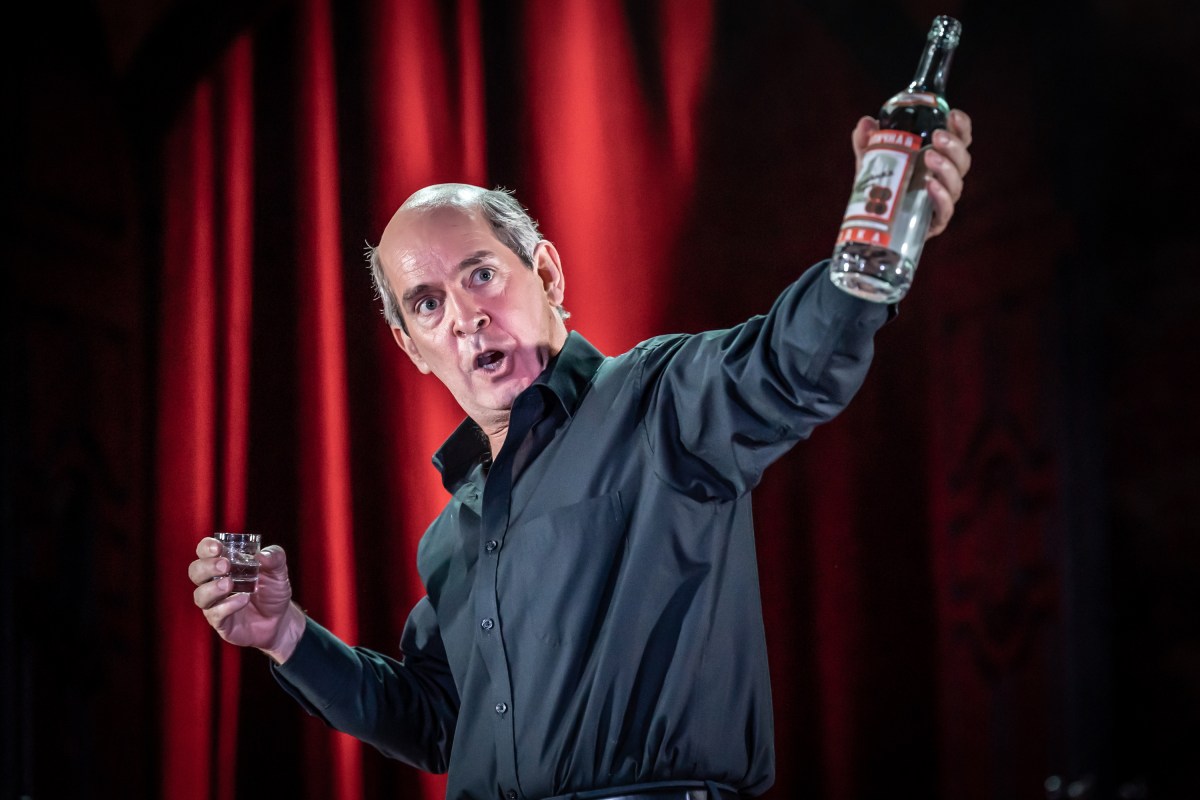
Tom Hollander in Patriots

A gifted scientist, led by infinite ambition and limitless imagination, creates a monster which grows beyond his control. Frankenstein, Mary Shelley’s 1818 novel of ambition, inquiry and overreach, has given us tropes that are now familiar. It provides a cautioning message to anyone who believes they can transcend human limitations – part-Prometheus, part-Icarus in its mythic warning. It also takes the fatal flaw which usually undoes a tragic protagonist and externalises it – an unwitting self-destruction.

This narrative shape is put to excellent use in Peter Morgan’s new historical drama, which dramatises the life of Boris Berezovsky (in this case, a gifted mathematician rather than experimental scientist) as the genius who is blind to the dangers of his own creation – until it is too late. Patriots largely operates as a biography of Berezovsky, from his early childhood (he was born in 1946) to death by suicide (in 2013). Yet by the second half, it becomes less the story of Berezovsky as the origin story of an even more significant figure: Vladimir Putin.

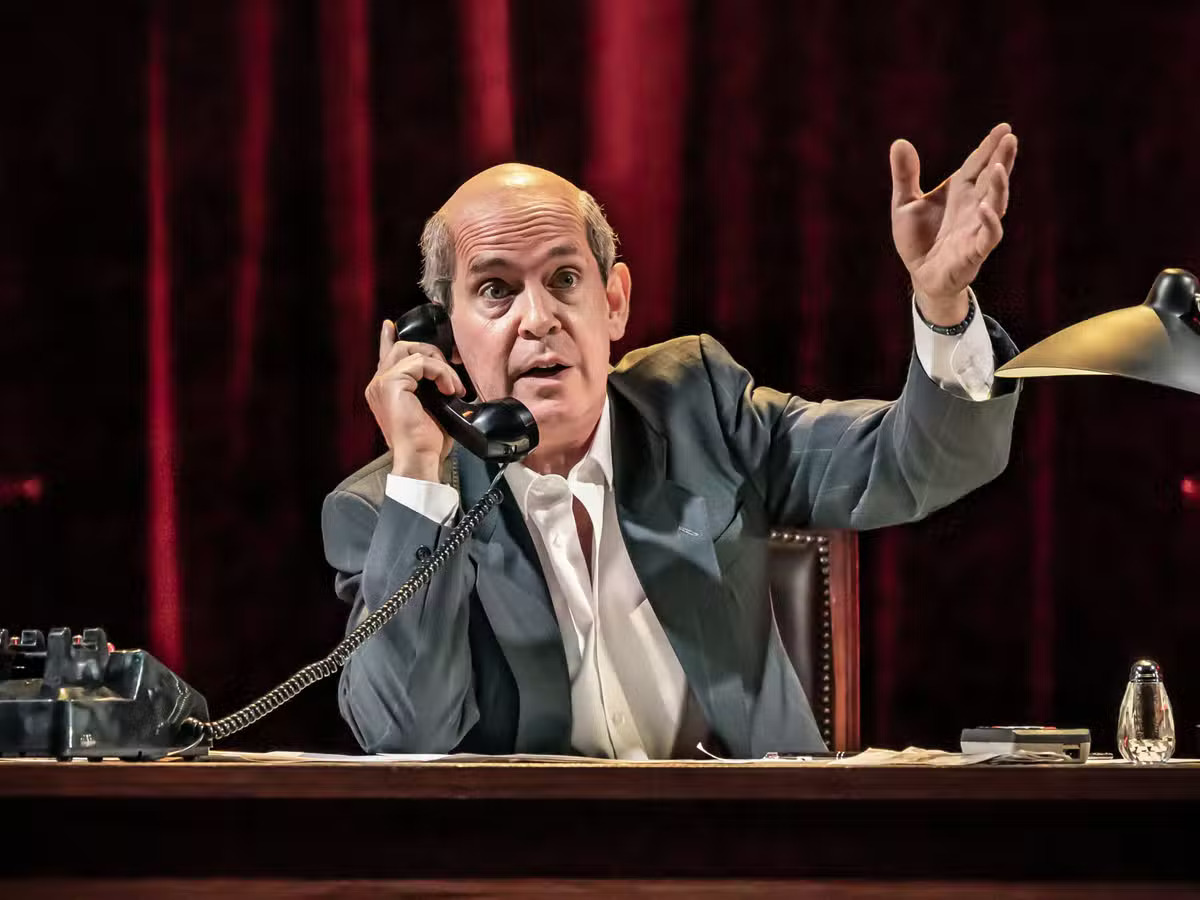
Tom Hollander, who seems subtly but significantly to improve everything he appears in, plays Berezovsky marvellously. He is frequently light and fun, leavening the play with delightful swings between razor-sharp focus and confidence, and bathetic notes of self-pity. His darkly vindictive side emerges on a hair trigger. Yet beneath this all, a pungent melancholy pervades his homesick Russian soul, when exiled from Russia by the very man he promoted. In flashback sequences, Hollander embodies the impishly arrogant child Boris, showing him gradually turning away from his childhood passion of mathematics and his determination to win a Nobel Prize: ‘They pay a million dollars’. (Asked what he would do with the money, he simply replies, ‘Gloat.’) Instead, Berezovsky becomes a titan of Russian commerce – one of the first big businessmen to operate there after the collapse of the Soviet Union, raring to go from the moment Gorbachev ‘permitted small-scale private enterprise.’ Berezovsky saw an opportunity and seized it, his luminous imagination envisioning the chain of events that would lead to Russia’s increasingly capitalistic economy and allowing him to prepare. He is obsessed by the infinite and limitless; ‘Ambition’, he says, as a child, ‘is the belief that the infinite is possible.’ Whether that works in practice, rather than just on paper, is another matter.

Jamael Westman and Yolanda Kettle in Patriots

Berezovsky repeatedly cites his degree in decision making mathematics – especially as leverage in business deals. He can tell them, with scientific confidence, that they are making a good or bad choice. Yet Morgan seeks to expose how complex calculations can go awry when mapped onto real, unknowable people. Morgan and director Rupert Goold withhold just enough from us that a chance encounter in Act One Scene Six crackles into life with sudden realisation and humorous surprise. Attentive viewers will already realise that the Deputy Mayor who Boris is unable to bribe is Vladimir Putin, but it is easy to miss his identity – particularly as Will Keen plays him with a powerful anti-charisma, at first, softly spoken, austere and seemingly banal. Held back as a sudden shock is the revelation that the ‘kid’ – in Boris’ words – who he is reluctantly meeting is Roman Abramovic, known for his regular press coverage as the former owner of Chelsea FC. Morgan stages their meeting as a deliberate jolt; ‘Roman Abramovich. Vladimir Putin,’ says Berezovsky in a mutual introduction which hammers home just how timely this drama will be. The bit players are soon to become protagonists in their own stories. Meanwhile, Berezovsky is unaware of the potent dramatic irony as we see his inevitable downfall in the mere presence of the apparent inferiors who will outgrow him.

Abramovic is played as magnificently bashful by the brilliant Luke Thallon, who shone recently in Camp Siegfried and After Life, as well as the Almeida’s original 2017 production of Albion (also directed by Goold). Like Putin, Abramovic is another Russian of immense geopolitical significance who Berezovsky appears to create. He acts as a ‘Krysha’ to Abramovic, an almost familial relationship, a form of business protection, support and sponsorship. The word literally means ‘roof’. In return, Berezovsky receives informal, undocumented payments – which amount to at least fifty percent of Abramovic’s profits. Morgan’s script states ‘thirty million dollars’ as the floor figure for his payment, but Goold cannily changes this to a percentage, demonstrating that this arrangement is ongoing and cannot easily be escaped.

At times, Boris carries his vast wealth and power lightly, yet he also dictates the rhythm of every conversation he is in with stunning authority. That is, until he doesn’t anymore. In a meeting with then-incipient oligarch Abramovic, Berezovsky insists on keeping jazz piano live in the background. ‘It soothes me’, he says, though it quietly irks his associate. Yet when Abramovic demands greater clarity in their financial relationship, Boris slams the piano lid shut – intimidatingly yelling at the pianist ‘SILENCE!! WHAT IS THIS IMBELIC TINKERING?! IT TORMENTS ME!!’ The message is clear: like the piano music itself, Boris can be a soothing presence, opening doors, providing a roof and making you rich, but he can also be a formidable tormentor. He will allow you to be rich, but your money is made only by his grace.

Yet this arrangement will be mirrored in Putin’s Russia, where oligarchs’ activities and interests are permitted at the leader’s behest. Will Keen completing the leading trio well, playing Russia’s future ruler as a bureaucratic presence, stiff and drained of life – albeit with an undeniably vigorous work ethic, whose power, once attained, cannot be contested. He stands in the shame-riddled shadow of his military service in East Germany (where, Boris claims, ‘they generally sent the desk jockeys, the altar boys, the softies’). Berezovsky’s claim that not being selected as a real ‘KGB man of action’ attests to him ‘as a human being’, but the remark is barbed; Morgan notes that, here, Putin looks ‘eviscerated’. Berezovsky becomes too accustomed to this power play, seeing Putin as intrinsically weak and relatively low-status – even has he elevates him higher and higher, forgetting the potential risks. When Berezovsky helps Putin to get installed as Prime Minister of Russia, he assumes that he has attained political office himself. Yet Putin is no puppet. When Boris Yeltsin – perhaps the only man in Russia Boris cannot control, but only influence – names Putin as his successor as President (on the final day of the 20th century), Putin’s power comes close to absolute.

Berezovsky watches on in horror as his power runs dry. Hollander perfectly captures Boris’ initial denial, falteringly trying to tell Putin what he must do, but there is now no need for Putin to listen. His terrorising shouts only worked when backed up with real financial and political power. The man who, in Morgan’s telling, Boris near-singlehandedly groomed for puppet governance inevitably turns on his creator – a modern Frankenstein’s monster, who forces Berezovsky into exile in London. Berezovsky’s obsession with the infinite, the mathematical concept that so fascinated him as a child and which now functions as his prevailing ideology, has led him to overlook his finite, dwindling authority. One miscalculation is all it takes to undo him and those around him – such as personal bodyguard Alexander Litvinenko, known to his friends as Sasha, who was notoriously assassinated in London in 2006.
Tom Hollander in Patriots

The play succeeds in exposing us to a story we might not otherwise know, or at least only know in part. The Almeida generally programmes shows late, allowing it to be more responsive than most theatres (both to world events and its high-calibre stars’ availability). Patriots was announced in May this year, and the play has inevitably existed long before Russia’s invasion of Ukraine. Yet, while the Donmar Warehouse’s meditation of the ethics of war in Max Webster’s Henry V seemed grimly serendipitous in its coincidental programming, Patriots feels far more deliberately placed. Thus, it works as something of a documentary play, a form of almost-journalism that seeks to inform us on a subject we should know more about.

Yet, Morgan’s drama never feels too urgent in its focus, particularly compared to the last major play to tackle Putin on a London stage. Lucy Prebble’s 2019 play A Very Expensive Poison, based on Luke Harding’s book of the same name and staged at the Old Vic, examined a similar subject by focusing on the murder of Berezovsky’s bodyguard, Alexander Litvinenko, who tried to raise the issue of FSB corruption with its then-leader, Putin. Prebble tackles Russia as a sprawling and rich culture, rather than Morgan’s simpler dichotomy of eastern, Siberian wastes and the cities of Moscow and St Petersburg, where political power is concentrated. While Morgan translates history to the stage with poise and wit, Patriots does not share Prebble’s ambition and flair. A Very Expensive Poison not only documents the story of Alexander Litvinenko, but it also searches for theatrical and real-world justice – honouring both his memory and the ongoing fight for the legal inquiry which his widow Marina Litvinenko lobbied for long after his death.

Marina appears in Patriots too as a character on the fringes. At first, she accorded a sense of power by Morgan – with Boris wooing her, rather than her husband, to leave the FSB and become his personal bodyguard. Yet she is treated more like a prop in the second half – telling Boris to settle down and find a wife, synthesising her (all too real) grief into a somewhat artificial call to action for the protagonist. In a fictional drama, we might not bat an eyelid, but it rings a little hollow considering the determined, passionate advocacy and activism of Marina, campaigning for the British government to take Sasha’s murder seriously. Here, she seems to have almost given up on life, telling Boris to save himself while he can, even if it is too late for her.

In A Very Expensive Poison, Prebble mounts a sustained assault on the fourth wall, its Vaudevillian stylings capturing the sheer theatre of Putin’s regime – with Reece Shearsmith’s Putin goading the audience, heckling from the private boxes, and even giving a talk about theatre itself. He casts himself as the master storyteller (and liar). Yet the play culminates in a powerfully emotional final puncture to the fourth wall, where MyAnna Buring’s Marina asked audience members ‘How do you do’ until all the artifice fell away. ‘I am obviously not Marina Litvinenko’, she says, before Sasha’s actual words are read out for us. Prebble indicts those who she considers culpable: not just the Kremlin and their Russian agents, but the British government response. Theresa May, Home Secretary before she was Prime Minister, is quoted – denying an inquiry into the murder due to ‘the cost to the public’ – a justification that three high court judges later found insufficient. Ignorance, Prebble argues, is too great a cost. Morgan is driven by a similar impulse, but it takes him a little less far, preferring character study to direct political statements.
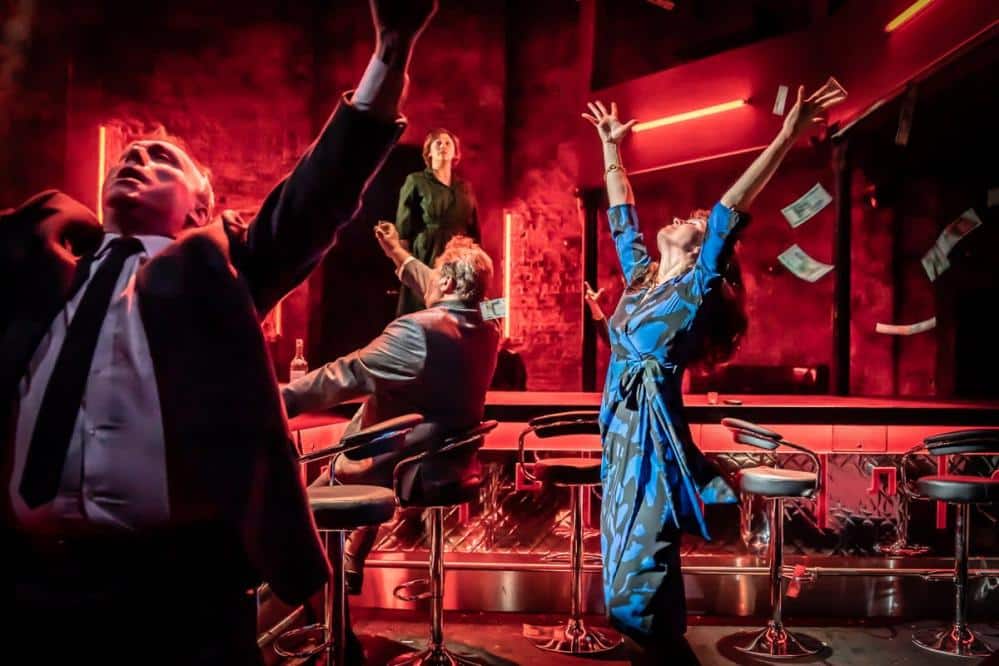
Morgan’s drama mostly addresses the question of how we got here, rather than where we can go next, but it still stands as a strong and compelling take on an underexplored subject, powered by a tremendous central performance. Rupert Goold’s pacy production delivers political thrills and at times some visceral chills, playing out on a fabulous set from Miriam Buether, drenched in Jack Knowles’ moodily red-tinged lighting.

Whether Morgan successfully captures Russia could be debated. A repeated monologue bookends the drama, in which Boris tells us that westerners ‘have no idea’ what Russia is like, listing items of clothing and food as symbolic of Russian life and culture. Yet Morgan’s gestures toward authenticity seem a little hollow. The mocking of London for being too ‘metropolitan’, for example, speaks in a cynical language familiar to contemporary British politics. The word is pejorative in current British media rather than Noughties Russia, replete with connotations of wealthy liberal hypocrisy and functioning as sweeping shorthand in the same way ‘North London’ and (the Almeida’s own borough) ‘Islington’ have done. Boris tells us that we consider Russia to be ‘a cold, bleak place, full of hardship and cruelty’, yet Patriots hardly disproves this, leaning into it at times. It is only despite (or perhaps because of) these difficulties that Russia is so loved and treasured as a home by people like Boris Berezovsky.

In fact, the effect of the opening monologue’s repetition – fashioned into a sort of fourth-wall breaking suicide note – seems unintentionally to affirm the play’s limitations. After two and a half hours, we are charged with the same ignorance we had at the start; it has apparently taught us nothing. Perhaps the implication is that our incomprehension is a condition of western-ness, not a lack of knowledge per se. Yet on the page, Morgan’s intentions for the scene seem clearer. He asks that the sound of Vladimir Vysotsky’s ‘unmistakable’ singing voice be heard, while street vendors sell pelmenyi dumplings, a visible mirage of Boris’ nostalgia – nostalgia in its most literal, etymological sense: homesickness. This speech is summoning into being the Russia that he loves, so that – in his mind at least – he can die there, rather than in a perpetual exile. Goold, however, opts to play the scene straight, without manifesting Russia before us so literally. It is a very understandable impulse of restraint here; the mental image Morgan generates likely outshines the stage action that would be possible. It feels like not much has replaced these stage directions though, giving us the sense that little has changed over the course of the play.

Ultimately, as the title suggests, the major theme of Morgan’s drama is patriotism. It is a theme that quietly underpins most of his work, given his recurring interest in the British Royal Family, most notably. His last play, The Audience (staged in the West End in 2013), examines this through the contrastingly patriotic roles of monarch and Prime Minister. Here, Morgan names his focus explicitly. As a western play looking in, you might expect it to have a greater focus on how patriotism (and nationalism) operates in British politics, though this never quite manifests beyond the occasional winking satire. (Lines about the follies of elected government generate even more knowing laughter than they usually might.) The battle for Russia’s power and its soul is not fought between patriotic true Russians and western interlopers, hellbent on bringing deregulated free-market capitalism to Russia, Morgan contends. Instead, the play depicts two opposing forms of sincere patriotism. Putin and Berezovsky’s respective motives are partly self-aggrandising, power- and money-driven, yet both consider themselves to be acting for the good of Russia. They consider themselves to be the bridge between the present and an illustrious future. Yet, tellingly, it is always the nation itself that is identified as the beneficiary of patriotic altruism, rather than its citizens themselves.

Morgan takes them mostly at face value, as earnest – if conniving – lovers of Russia. Boris pines for his home from his life of luxurious exile, and Putin refuses his entreaties to return to life a quiet (and probably not even affluent) life as a mathematics professor – motivated, it seems, by a conviction that he must protect Russia from his westernised economic and political pressure.
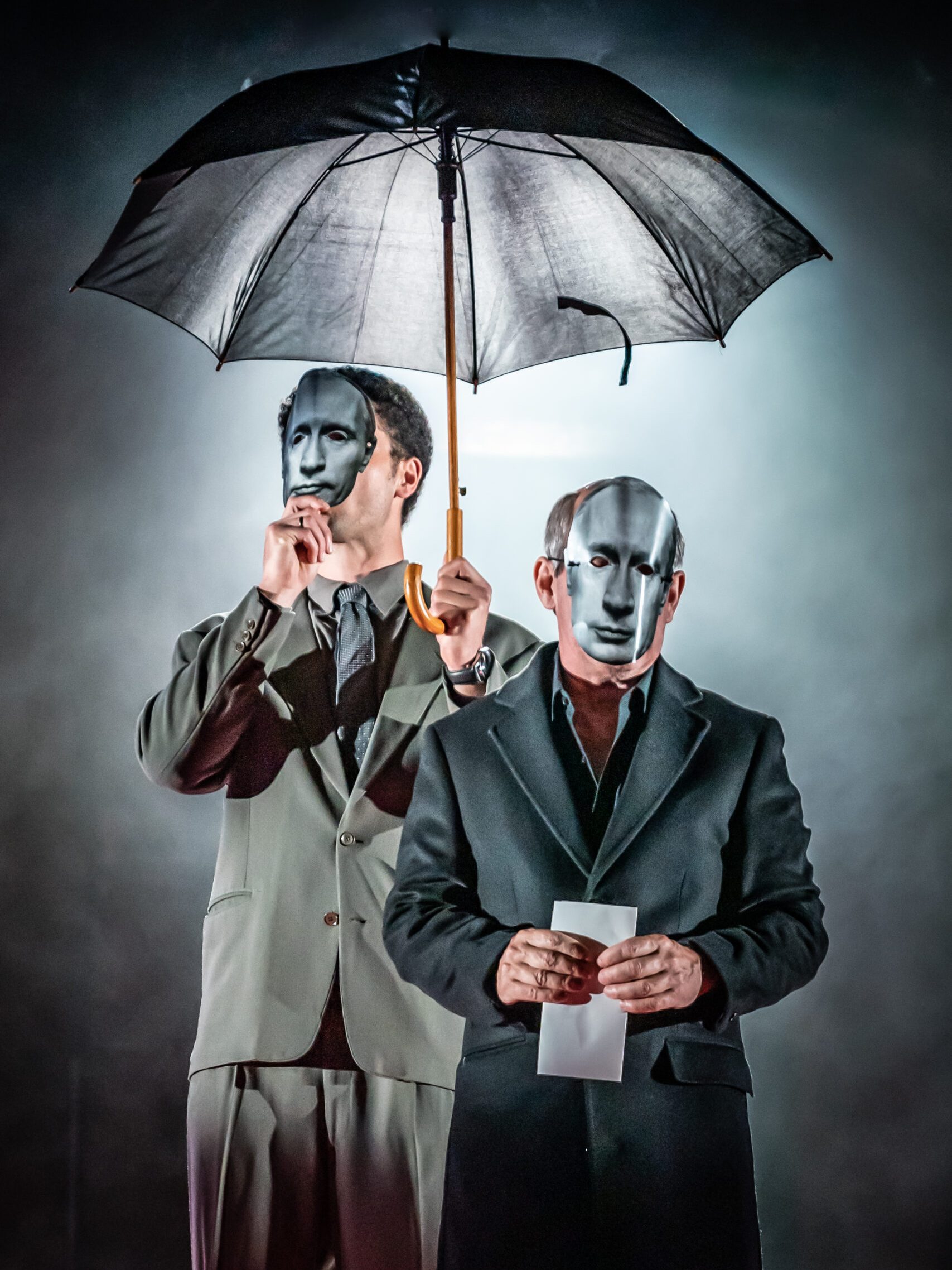
Jamael Westman and Tom Hollander in Patriots

In the second half of the play, Putin instates Abramovic as the governor of (what The Guardian calls) ‘the frozen far-eastern province’ Chukotka, six thousand kilometres from Moscow. In a March 2022 feature for The New Yorker, Patrick Radden Keefe called the province ‘comically inhospitable’ – noting that its ‘winds are fierce enough to blow a grown dog off its feet.’ Abramovic ‘pumped plenty of his own money into the region’, Keefe writes, and Morgan dramatises as fact something that is widely believed to be true: that Abramovic was very much steered into this apparently thankless role by Putin’s guiding hand. (Catherine Belton particularly advances this view in her 2020 book Putin’s People.) Though Boris may have been Abramovic’s Krysha once, in contemporary Russia, Putin acts as Krysha to all of the oligarchs. They keep their wealth only because Putin permits. Yet the scene where Putin visits Chukotka seems redolent of Morgan’s main theme; the billionaire is not only being groomed for his loyalty, but Putin appears to be testing Abramovic’s patriotism. The poverty of Chukotka is still far preferable to a life in exile elsewhere.

This is the vision of patriotism that crystallises in the drama: the pain of separation as greater than any hardships that life may contain. Berezovsky would surrender his wealth to keep his home, and Putin leverages that power against him, as Berezovsky leveraged power against others and him. Yet it is almost a moment where a vital fault line of the play is exposed; how much of what we are witnessing is true? It is another perennial concern in Morgan’s writing, and he treads a line between dramatizing facts of historical record and inventing within plausible parameters. The play bears no caveats about its level of fictionality, nor any acknowledged sources; its content does not signal (as Prebble’s gloriously absurd touches did) where gaps have been creatively filled.

In the bid to dramatise these lacunae, some moments strike false notes. The opening scene is one such example. We hear that the nine-year-old Boris has solved the Kaliningrad Bridge Problem – a traditional problem (previously called the Seven Bridges of Königsberg) in which a city’s seven bridges, connecting its various islands, must all be crossed on a single route, crossing no bridge more than once. The play as performed (but not the script) describes the fact that Euler solved the puzzle in the negative – meaning that he proved it has no solution. Euler effectively devised a new branch of mathematics in the process, and now – for mathematicians familiar with such methods – it is not too difficult a problem to solve. Unless Euler were catastrophically wrong (which he was not), solving it in the positive would be impossible.

This could just be stage shorthand for mathematical genius that contains a fairly fundamental flaw, or perhaps this is a deliberate tell, a sign that the drama is an imperfect, inherently unreal rendering of a life. The gist is true; Boris was an ambitious, intelligent man, and so too would his childhood have been. Either way, Patriots demands our attention in sifting hard fact from elegant fiction. Are we to take the characters’ claims of patriotism on trust, or should our suspicions be raised throughout? It would benefit from a little more direct admission of its inventions, but maybe fiction is what we are supposed to expect.  

Patriots

Written by Peter Morgan, Directed by Rupert Goold, Set Design by Miriam Buether, Costume Design by Deborah Andrews and Miriam Buether, Lighting Design by Jack Knowles, Sound Design and Composition by Adam Cork, Movement Direction by Polly Bennett, Casting Direction by Robert Sterne CDG, Voice Coaching by Joel Trill, Assistant Direction by Sophie Drake, Russia Consultant Yuri Goligorsky, Starring Matt Concannon, Stephen Fewell, Ronald Guttman, Aoife Hinds, Tom Hollander, Will Keen, Yolanda Kettle, Sean Kingsley, Paul Kynman, Jessica Temple, Luke Thallon, Jamael Westman
Production Photographs by Marc Brenner
Reviewed 8th July 2022
Categories
theatre

Sun & Sea – The Albany

Having watched Sun and Sea a couple of weeks ago, I have found my mind returning to it more and more due to news coverage of this record-breaking heatwave. Despite being a major weather event – pointing to severe and rapid global heating – the media response, at least in the run up and early stages was, for the most part, shockingly glib. This was matched by Deputy Prime Minister Dominic Raab encouraging everyone simply to ‘enjoy the sunshine’. Yet in other quarters, there have been pockets of utter doomerism – widespread suffering considered a taste of our medicine, just desserts, laced with the masochistic pleasure of having been proved right. Frequently, however, even following a ‘red warning’ for ‘exceptional heat’ – never before issued by the Met Office in the UK – and the risk of huge excess mortality, outlets have returned to the imagery of the beach – a stock film staple of the sunny weather VT. The climate crisis is no beach holiday.

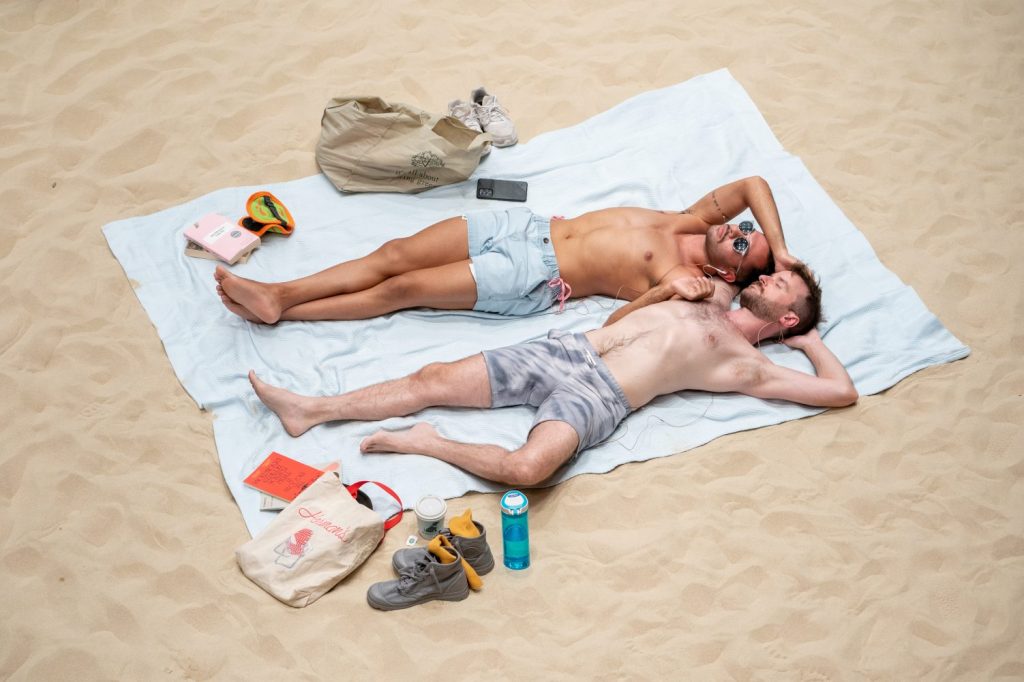
Sun & Sea, a durational opera by Lina Lapelytė, Vaiva Grainytė and Rugilė Barzdžiukaitė, aptly examines the beach – specifically the sandy beach favoured by many holidaymakers – as a nexus of our relationship to the planet, as well as a representation of contemporary life in microcosm. As part of the LIFT Festival, The Albany’s auditorium has been transformed into a two-tier arena to play host to the opera, which has previously played across Europe (most notably the Venice Biennale, where it won the top prize, the Golden Lion). From above, the audience watch over the beach scene below, where deck chairs and towels are populated by various beach dwellers – most of whom are characters in the opera, taking solos, duets, and occasionally choral roles in the few group numbers. Billed as an opera, it seems more redolent of song cycles – with loosely juxtaposed pieces circling around central themes. You watch for an hour, and it repeats over and over (sometimes up to eight hours in total). Its looping format negates the possibility of any overarching linear plot. Yet any narrative would seem antithetical to its attempt to represent a beach scene. Instead, we hear sometimes-surreal snapshots of various lives.

The opera is implicitly about the ethical weight of our decisions. Flying to go on a beach holiday, as the ‘Wealthy Mommy’ character has (collecting the different seas her eight-year-old son has swum in on a bucket list) cannot be considered a neutral act. The beach is a space where people’s relationship to the planet and to each other meet in theoretical harmony – but are fraught with danger. The heat is an ambiguous climate of joyous relaxation and simultaneous alarm. Like the news in recent days, Sun & Sea places implicit pressure on the semantics of weather; we are so used to associating heat with ‘good weather’, yet it has clear dangers – far beyond mere sunburn. Meanwhile, the shore is under threat from rising sea levels and falling biodiversity.

The libretto conceives of this beach as an explicit escape from the demands of capitalism, though it remains impossible to escape its effects – psychological and ecological. The ‘Song of Exhaustion’, delivered by the ‘Workaholic’ (characters are anonymous, identified by vague types they fit into), is the most direct expression of a soul under threat from the grind of office labour. His ‘suppressed emotions’ have become ‘knotted up in [his] psyche’, and even on the beach, he is unable to switch off; he cannot ‘let [himself] slow down, because my colleagues will look down on me’. Everything he does is soaked in shame, his pent up anguish building to a moment that never arrives here but inevitably will – where he ‘lose[s his] cool in public’ and mortifyingly embarrasses himself – or worse. He worries that his ‘suppressed negativity’ will burst out of him ‘like lava’. His maleness is unspecified in the text, though the role implicitly seems to imagine some toxic masculine behaviour as an uncontrolled, volcanic outpouring stemming from exhaustion – like the earthquakes caused by tectonic plates under immense pressure. We are invited to sympathise but not necessarily excuse such an explosion.

One of the show’s great triumphs is its understanding and presentation of sheer pettiness. The recurring iterations of the ‘Chanson of Admiration’ – short stanzas of praise for beauty of the sky, seabirds and jellyfish – juxtapose the longer incarnations of the ‘Song of Complaint’. ‘What’s wrong with people’, the first bout of complaining begins. People with dogs are accused of ‘leav[ing] shit on the beach, fleas in the sand’, while beer drinkers mean ‘it smells like a slum-hole’. The song is woven with casual contempt for the poor and homeless – who the singer has seemingly holidayed to escape from contact with – and one description of finding the fishy remains of someone’s lunch under their blanket describes the object (with a seemingly deliberate loaded quality) as ‘a foreign body’. The closest thing to a narrative payoff in the opera comes in the second part of the song, in which the singer reminisces about the ‘unpleasant associations’ of fish that came from being force fed it by her (now-deceased) grandmother. The gesture deepens her character. Like the Workaholic, her attitudes are not legitimised but explained with a surprising tenderness, while opening up the fissures of entitlement and exclusivity that pervade some holidays.

Relatively simple moments can be hugely effective. The rhythms of visiting a beach are put under the microscope in catchy songs such as ‘Sunscreen Bossa Nova’, while a hugely moving conversation between a couple sees them repeatedly counting the hours they have left together before one goes away. They take solace in plans to make an omelette and refuel the car, unable to full express their anticipated emotions beyond simply the fact of them ‘getting sad’. Also brilliantly incorporated are the volunteer participants dotted around the edge of the beach, soaking up the simulated sun, reading, playing games, and seemingly befriending each other before our eyes. Though I am unable to see a dog on stage without being reminded of Ella Hickson’s The Writer (in which a character claims that ‘There should not be a dog’ on stage, ‘unless you’re going to cut its […] tongue out’), Sun & Sea is a rare piece of theatre where a dog’s unpredictability adds to the scene’s verisimilitude, rather than highlighting its fakery and breaking the theatrical illusion. The extent of the opera’s artifice is abundantly clear (given that we are literally inside), yet that does not preclude ostensibly real (certainly new, unrehearsed and unreproducible) events occurring in the space.

The music itself plays second fiddle to the superb design concept, with the vocal lines beautifully sung over relatively sparse backing. The lyrics are at their best when taking more surreal turns, such as in a song entitled ‘Dream’, in which one sunbather tell us about dreaming of meeting someone with an egg-sized tumour in his brain. Another thread describes vast flight disruption from an unexpected volcano eruption, leaving a couple stranded together in an uneasily idyllic extended holiday. The brilliant ‘3D Sisters’ Song’ is a downright bizarre highlight. It features duetting identical twins contemplating the mortality of the human body, before fantasising about 3D-printing coral reefs back into existence; ‘Yet with the press of a single button, I will remake this world again. 3D corals fade away! […] 3D me lives forever.’ Are we to implicitly wonder if the sisters have themselves been 3D-printed from the same design? Strange and wonderful possibilities abound, and Sun & Sea is uninterested in simple answers. This beach has room for dreams of transhumanist immortality alongside increasingly ambitious rallies of badminton.

The final song in the libretto – though the nature of the piece means that the audience constantly ebb and flow in and out, and we experience no defined end or beginning – describes the ‘sea as green as a forest’, imagining the human body ‘covered with a slippery green fleece’, their swimming costumes ‘filling up with algae’. The climate crisis hangs over events, largely unspoken. The ‘Philosopher’ considers our normalisation of vast-scale importing – ‘to give us a feeling of bliss’ for only ‘one bite’ – while the 3D Sisters envision an ‘empty planet without birds, animals and corals’. The final image of eutrophication is another gesture towards climate breakdown, though suffused with a greater ambiguity. This is an algal bloom that seems delightful in its life, but is destabilising to the ecosystem – leaving ‘empty snail homes, swollen seaweed, [and] fish remains’.

Ice Watch by Olafur Eliasson, 2018

Durational installations perhaps prime us for the gradual nature of life and ecosystems – transcending the present moment and placing as a part of something longer term. They provide a way of comprehending that which is far greater than us. Perhaps the most notable recent example is Olafur Eliasson’s Ice Watch. In December 2018, the Icelandic-Danish artist brought 30 blocks of Greenlandic ice to London, as he had done previously in Copenhagen and Paris. Most were placed on the Southbank, by the Thames, just outside the Tate Modern, where visitors and passers-by alike could observe and engage with the blocks – as they slowly melted away. The aim was part-pedagogical, part-chiding, giving people – in Eliasson’s words – ‘a very tangible encounter with the consequences of their actions’.

Yet works like this (as with Sun and Sea) can encounter accusations of hypocrisy that threaten to blunt their actions. After all, Eliasson has literally contributed to melting Arctic ice through removing 30 chunks of it. Attempting to head off such criticism, three times the carbon offset cost was donated to the Woodland Trust, and while some would spin this as making the project carbon-neutral or even net-positive, this overlooks the fact that such emissions were fundamentally avoidable. Yet just because emissions occurred does not delegitimise the project outright. Instead, it is a core part of the ethical tangle that artists face; almost all art is made from resources with some carbon cost.

The Venice production of Sun & Sea featured over 25 tonnes of imported sand – imported at an inevitable price. Yet this is also the logic used to undermine the efforts of climate change campaigners in many sectors. Climate crisis art can never really escape the bind that – even if carbon neutral, with reused or upcycled design – there is a debatable opportunity cost – even then. When time is running out and urgent practical, political intervention is required, then all art could be considered a self-indulgent (and even harmful) luxury. Writing on Sun & Sea (as well as other recent climate-themed exhibitions and shows), Eloise Hendy notes that ‘the performers’ dilemma is the same one we all face, namely how to spend our days at the end of the world; how to fiddle while the world burns’. Does anything that is not purely activist itself have value?

For all the claims made about the power of art, it is highly unlikely that art will ever save us in and of itself. Sun & Sea seems to know this. Art plays a role in protest, yet protest likely cannot be artistic alone. Perhaps the true value of art in a time of emergency is its provision of a space of ethical reflection. Art’s merits are not in activism as an end in itself, but instead in how it equips audiences with knowledge and tools that make activism more effective – as well as making life worth living. Theatre, particularly, is a shared space, in which the cold facts of the climate crisis meet the complex human reality of life. Art, then, is perhaps akin to a beach holiday; it can be something of a luxury, but also brings you together with strangers, offering relaxation and rejuvenation, before returning to action elsewhere revitalised. In Sun & Sea, we look down on the beachgoers, perhaps in judgement, but it is ourselves we are judging too. This judgement is no mere condemnation, but – hopefully – a resolution for action.

Sun & Sea

Composed by Lina Lapelytė, Libretto by Vaiva Grainytė, Translated from Lithuanian by Rimas Užgiris, Direction and Scenography by Rugilė Barzdžiukaitė, Concept and Development by Lina Lapelytė, Vaiva Grainytė and Rugilė Barzdžiukaitė
Reviewed 7th July 2022
Categories
Art

Cornelia Parker – Tate Britain

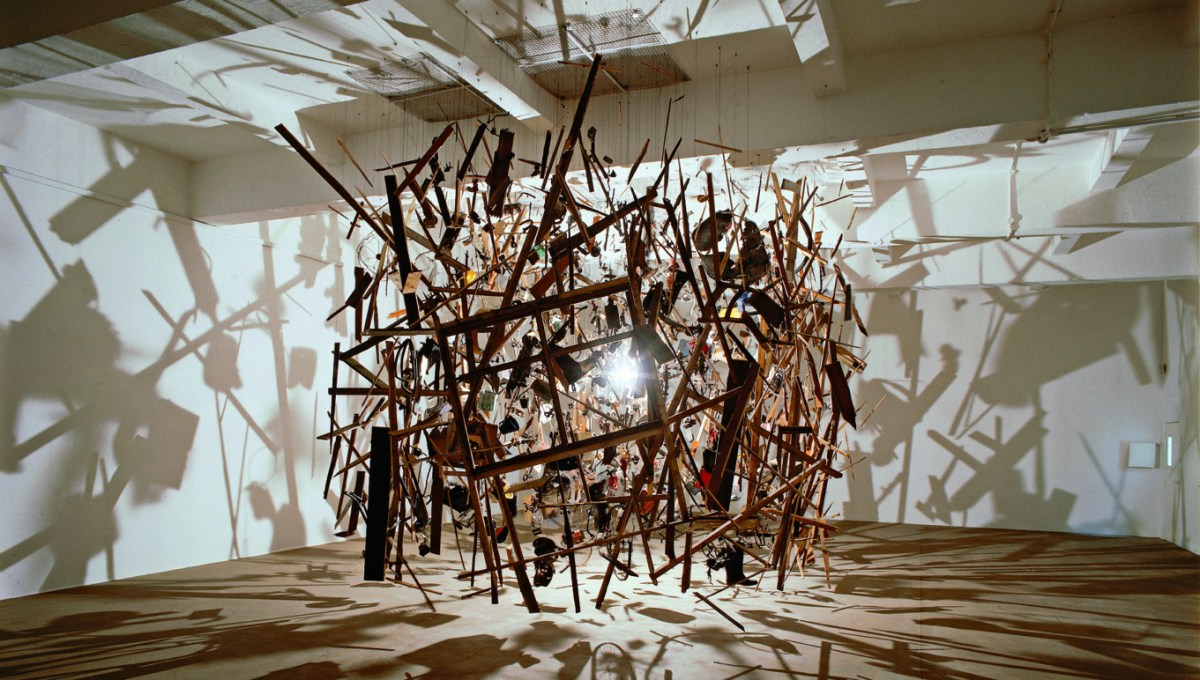
Cold Dark Matter: An Exploded View, 1991

It is a sentiment (perhaps too-) often expressed about modern art that if you need to read about an artwork to understand it, then it is not working as it should. It is bad art, even. Yet Tate Britain’s slickly curated exhibition of Cornelia Parker’s sculptures, films and installations mounts a fascinating rejoinder to this view. Though I have long pondered the necessity of reading the frequently long and essayistic prose lacquered upon gallery walls, and how to privilege it against the sensory experience of simply viewing the work, Parker’s authored descriptions seem vital here. Each one is a testament to the art’s process, meaning, and sometimes its hidden agenda; one giant ball of string, we are informed, contains a literal hidden weapon. Other than Parker herself, no one knows what it is – or whether it could go off at any moment.

There is a thrilling mystique that comes from Parker’s tantalising reveals and evasions. Especially in its early rooms, this exhibition offers a form of delight more familiar to the audience of a magician or a comedian than a visual artist; many of her pieces work as tricks, or jokes. She lets us in on a secret, before letting us know that she is keeping another.

Reading her descriptions, you soon find that most pieces follow the same pattern: Parker undertakes to befriend some arm of the state (be it the police, HM Customs and Excise, the British Army) and, having been convinced that collaborating with Parker will be a good idea, they supply her with contraband resources which are either destroyed (ie. cocaine, a shotgun) or used to destroy something else (most notably the British Army helping her rig up a garden shed with Semtex).

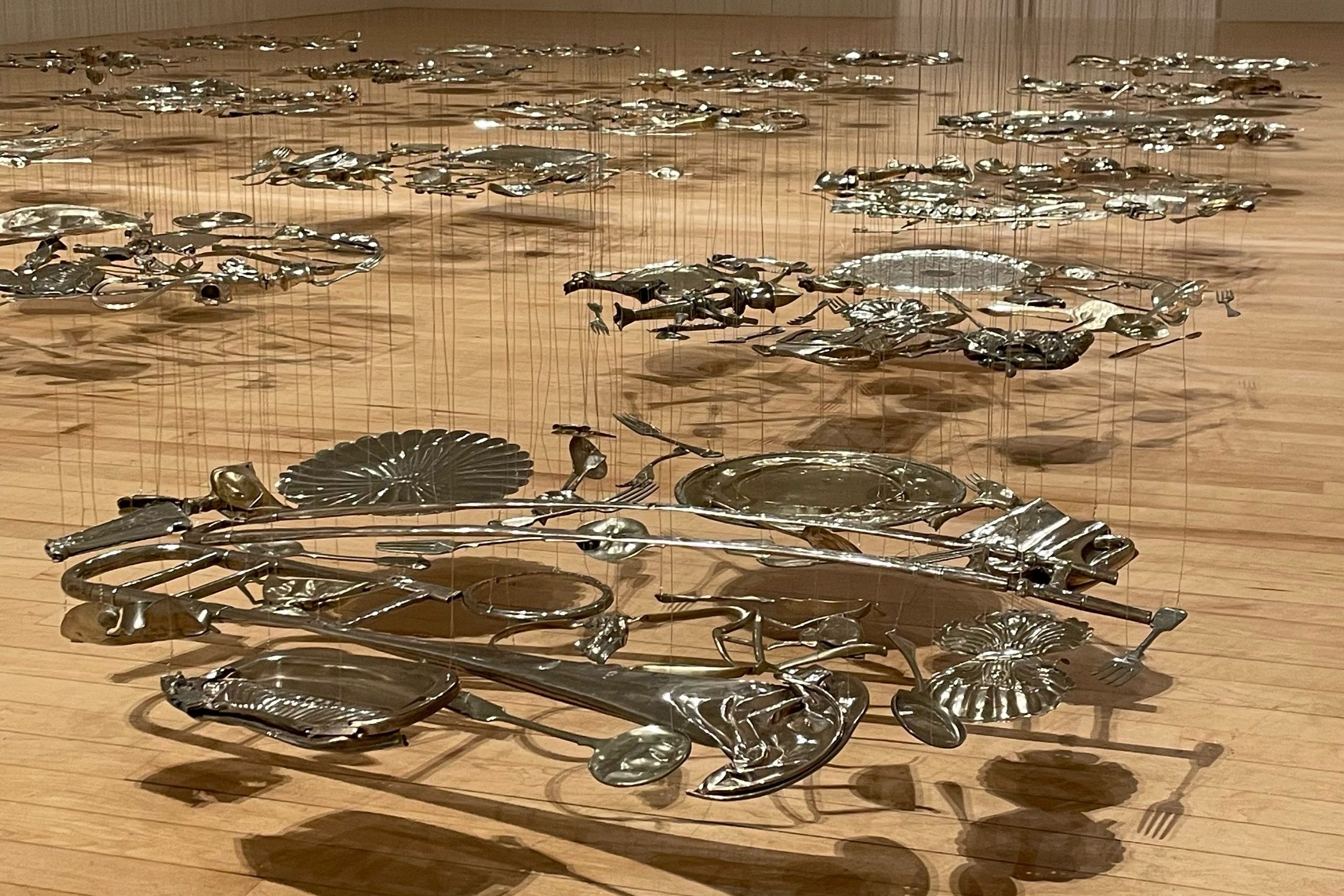
Thirty Pieces of Silver, 1988-1989

The works – a loosely themed array from the last three decades of Parker’s career – are displayed with poise, their captions alive with simmering deadpan wit, a little aloof, yet the techniques are also hugely sentimental. As a child, Parker experimented with placing coins onto railway tracks, fascinated by how they warped and changed under the hulking tonnage of a freight train. This impulse – a literally childish one – animates much of her professional work. The first room, containing a suspended installation titled Thirty Pieces of Silver, features thirty iterations of thirty silver objects (cutlery, plates, antiques, glimmering under the gallery lights), all crushed flat with a steamroller. Elsewhere, Parker tells us how she cleaned other antique objects – significant for having belonged to Charles Dickens, Charles Darwin, Horatio Nelson, Henry VIII, even the lantern used by Guy Fawkes, and the personal soup spoon of the inventor of the soup spoon, James Bowie. She then has displayed the rags, caked in their residue – what Parker calls their ‘Stolen Thunder Tarnish’. Parker’s art frequently acknowledges the metaphorical imprints we leave on objects, artefacts, and the world – chronicling human sentiment, though guided by an impulse which is itself sentimental. Much of her work seems intent on pinning down and displaying the transference of sentimental value from one object to another.

The gallery’s centrepiece is her 1991 work Cold Dark Matter: An Exploded View, which displays the splintered remains of a garden shed and its contents in mid-air, simulating the moment of their explosion. The fragments are illuminated solely by a bright bulb at the centre. Parker has described the centrality of the explosion in mass culture – from ‘the violence of the comic strip’ to ‘Super Novas and the Big Bang’ and ‘never ending reports of war’ on television. Her claim seems all the more convincing thirty years on, after the continuation (and expansion) of televised war reporting (in Afghanistan, Iraq, Syria and Ukraine), the horror and spectacle of 9/11, and the Marvel Cinematic Universe. In Parker’s view, the shed is a highly sentimental space; ‘Like the attic,’ she says, ‘it’s a place where toys, tools, outgrown clothes and records tend to congregate.’ We see bicycle tires, shovels, a book (mostly intact) titled Winning Through: Stories for Girls, a shredded badminton racquet, a tattered windbreaker, a bucket without its spade, a desk fan, a solitary Wellington boot, lawnmower remnants, a Jerry can, the wooden frame that once held the windows, another book entitled An Artist’s Dilemma, a tricycle – all slowly, subtly moving in the room’s light breeze, their shadows playing across the walls (as much a part of the sculpture as the material itself).

Yet what makes Cold Dark Matter so fascinating is the curious collaboration that made it happen. While the British army were deploying more troops in one go than it had since World War Two (in the Gulf War from 1990 to 1991), Parker was enlisting soldiers that remained on UK soil to assist in her artistic controlled explosion. The piece works simultaneously as a reflection on the detritus of the past we cannot quite give up – the shed being a storage purgatory while we summon up to courage to show no-longer-treasured possessions the bin – and a reflection on geopolitical conflict and violence’s grasp on our cultural iconography. Perhaps Cold Dark Matter mounts an implicit critique, if not of the British Army directly as an institution, then of their part in global military violence and the way it makes us think. Yet, undeniably, the work would not exist without their literal assistance.

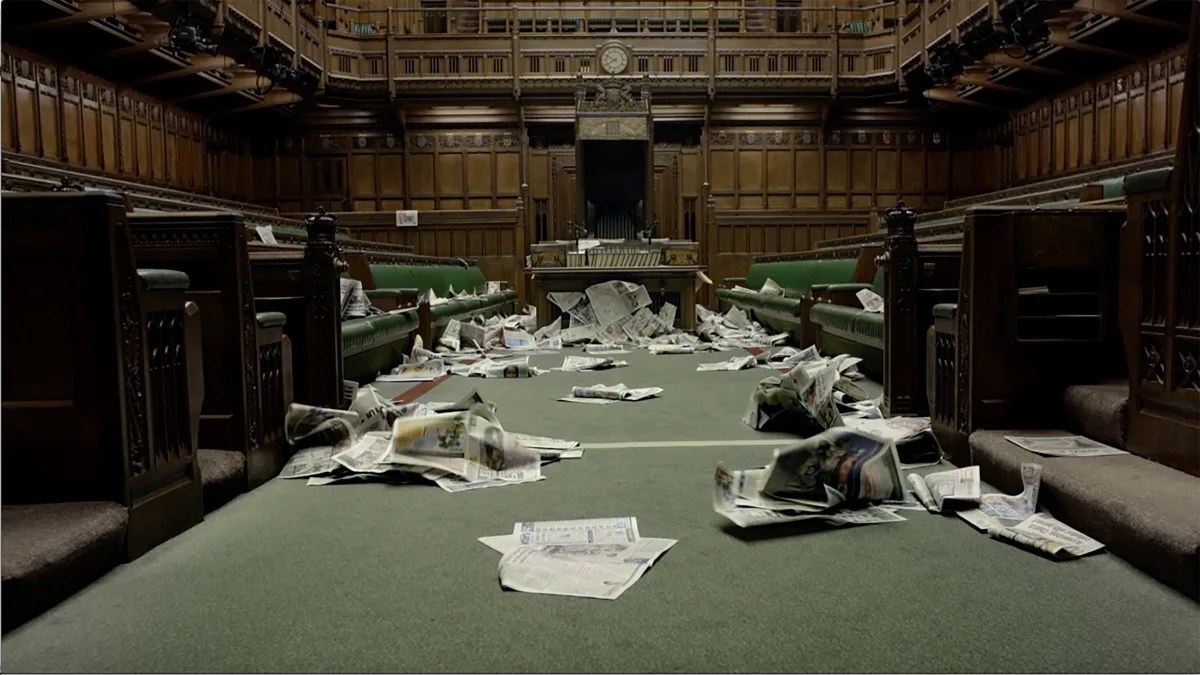
Still from the short film Left, Right and Centre, 2017

By contrast, later rooms – especially the one entitled ‘Politics’ – felt relatively jarring, precisely because of the curiously askance relationship to politics and morality elsewhere. Articulating viewpoints which hew to broad left-wing consensus positions contrasts the plunge towards ‘Abstraction’ – as one room in the middle is titled. An earlier work, a doll of Oliver Twist sliced in two by the same guillotine which beheaded Marie Antoinette, seems more effective for its polysemic metaphors than it would had Parker explained her message. For me, it makes a comment on the way revolutions often turn on the poor and vulnerable – such as in the French revolution, where many deaths during the 1793-4 Reign of Terror were from the non-aristocratic third estate. However, Parker seems to leave the work of interpretation (and the extent to which interpretation is required) squarely to us. The artefact before us is immediately disquieting, even upsetting. Our task is to negotiate the significances of the objects – our emotions, be they mirth, wonder or curiosity, proof of the power of sentiment on the human mind.

Later works preclude the need for this leaning in and questioning. This begins with a looping series of films – including one depicting the making of a Union Flag, and Left, Right and Centre, in which (predominantly right-wing) newspapers are blown around in the House of Commons, making an all-too-literal mess. The pacing of the six films seems odd, especially given how slackly they have been edited. To watch them all would require nearly three quarters of an hour – vastly extending your visit’s duration. (I suspect most visitors will give these only a cursory look as a result.) These lead into another single video installation – capturing Halloween 2016, just before the US election. On the one hand, Parker’s characterisation of Trump supporters in political merchandise as unwittingly and uncannily dressed in Halloween costumes seems relatively lazy. Yet on the other, it does prefigure a curious turn in the liberal reception of Trump – which precisely did cartoon- and Halloween-ise a broader hard-right movement as the sole wrongdoing of an individual monstrous bogeyman. (A similar Halloween costume trend can be seen in the resurgence of iconography from Margaret Atwood’s The Handmaid’s Tale – particularly the handmaid’s uniforms, which have been seen in protests as well as for satirical, seasonal fancy dress purposes.)

For me, the low-point of the exhibition comes in the ‘Politics’ room – a melee of loosely grouped pieces that survey the political make-up of the UK and US during the 2010s and early 2020s. A photograph of a map held together with yellowed tape (entitled World Coming Apart at the Seams) is a groaningly obvious metaphorical response to 2017’s political anxieties, and possibly the threat of the climate crisis. (Parker’s art, especially in its concern with waste, often seems on the fringes of commenting on environmental anxieties and disaster, yet I found it hard to establish any direct references.) The concept is somewhat transcended somewhat by the execution – and, in some ways, the lack thereof. Rather than a calculated and deliberately manipulated image, Parker has clearly discovered this map in its current state – sticky tape plastered across its reverse side, over the United States of America. Even so, what the piece does seem to have too much of is directness. It is difficult to quantify directness in art, yet most people would agree that some symbols can feel too obvious, too easy, and are thus less effective than metaphors that occur seemingly accidentally and more subtly. One of the problems of directness is that it closes down the artwork, as a finished piece rather than an ongoing conversation.

Island, 2022

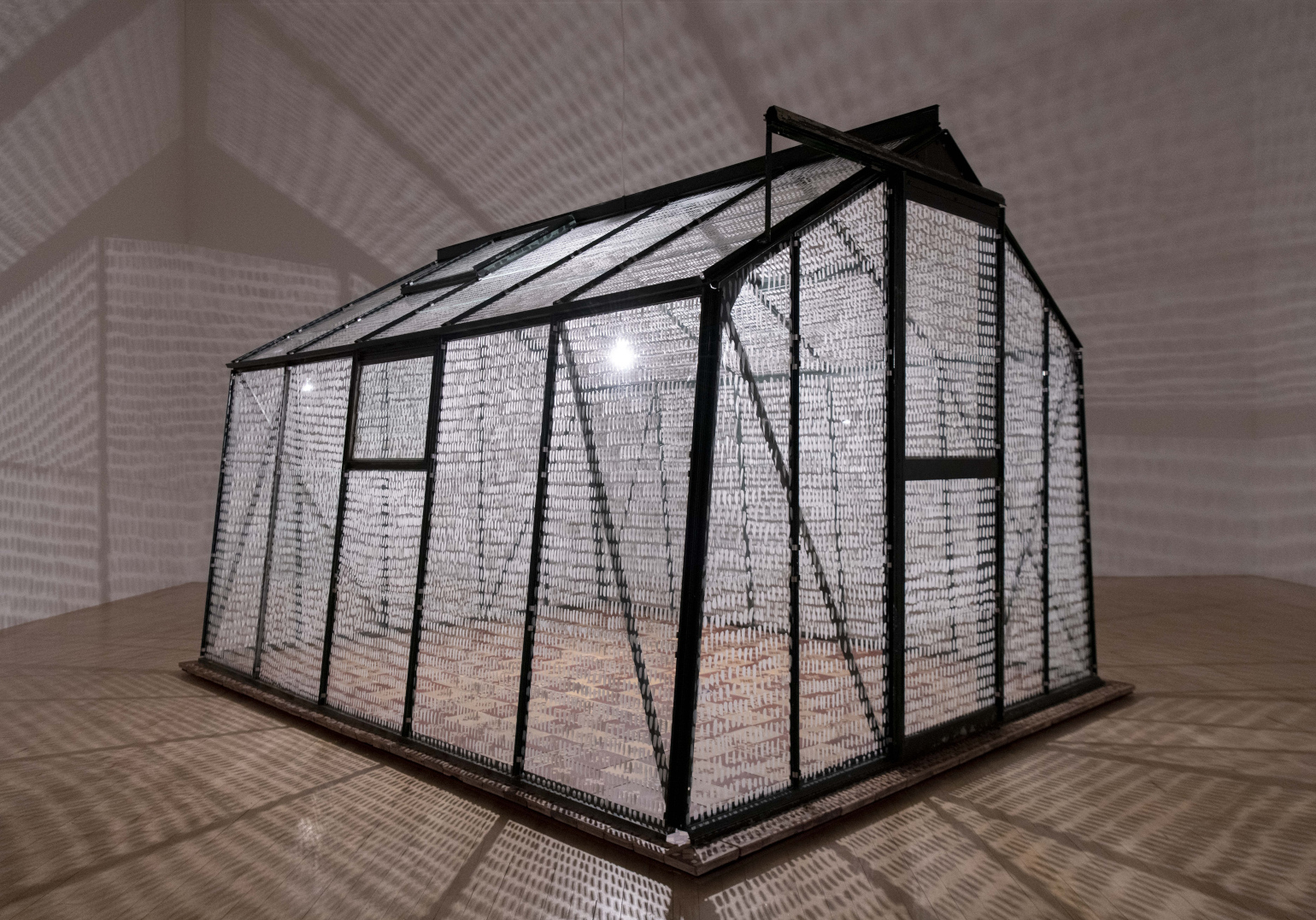
This issue particularly afflicts Island, a new work constructed from a greenhouse, lit from the inside by a dimming and brightening single bulb – which seems like an echo of Cold Dark Matter. The accompanying wall text reveals a charming anecdote about Parker’s memories of growing tomatoes in her childhood. Yet then comes the revelation that the white daubing on the inside of the glass is pigmented with the famous white rock of the cliffs of Dover. The partially whitewashed walls evoke a nation shutting itself off. It perhaps suggests Shakespeare’s Richard II too, under which thrums an ongoing debate about whether England is better conceived of as a garden (albeit full of weeds under Richard’s wanting stewardship) or as a defended, military castle (a position advanced by the ultimately triumphant Henry Bolingbroke). Island presents a relatively unspecific sense of English myth – of which, especially since the 2016 EU membership referendum, the White Cliffs of Dover have become offhandedly symbolic.

Not only is this somewhat repetitive in theme for Parker, but more underwhelming is her return to the same material once again. The cliffs have long been sources of fascination for her; she has thrown things off them, Inhaled Cliffs (displayed alongside Exhaled Cocaine’s drug residue) uses their chalk to starch bedsheets, and the diptych White Abstract and Red Abstract use the cliff’s chalk and ‘Brick dust from the house that fell off the White Cliffs of Dover’ respectively. Thus, Island’s gesture seems a little hollow – and not just in its rather obvious critique of British (though possibly English) isolationism. Though it would be glib to charge many artists with being repetitive (what might be considered self-plagiarism in writing is, in visual art, often just an artist developing a style), the opening rooms of the Cornelia Parker exhibition prime us with a logic more familiar to comedy than art. Many of the works are at first a little baffling, visually odd, until their secrets are delightfully revealed in Parker’s punchline-esque descriptions of the material used and her coolly bathetic recollection of how they were made, sourced and obliterated. Looking at the greenhouse and its cliff dust metaphor, I felt not only the whiff of over-explanation, but also the sense that I’d heard this one before – and told a bit better. In comedy, and perhaps conceptual art, even if you enjoyed it once, you cannot just have more of the same.

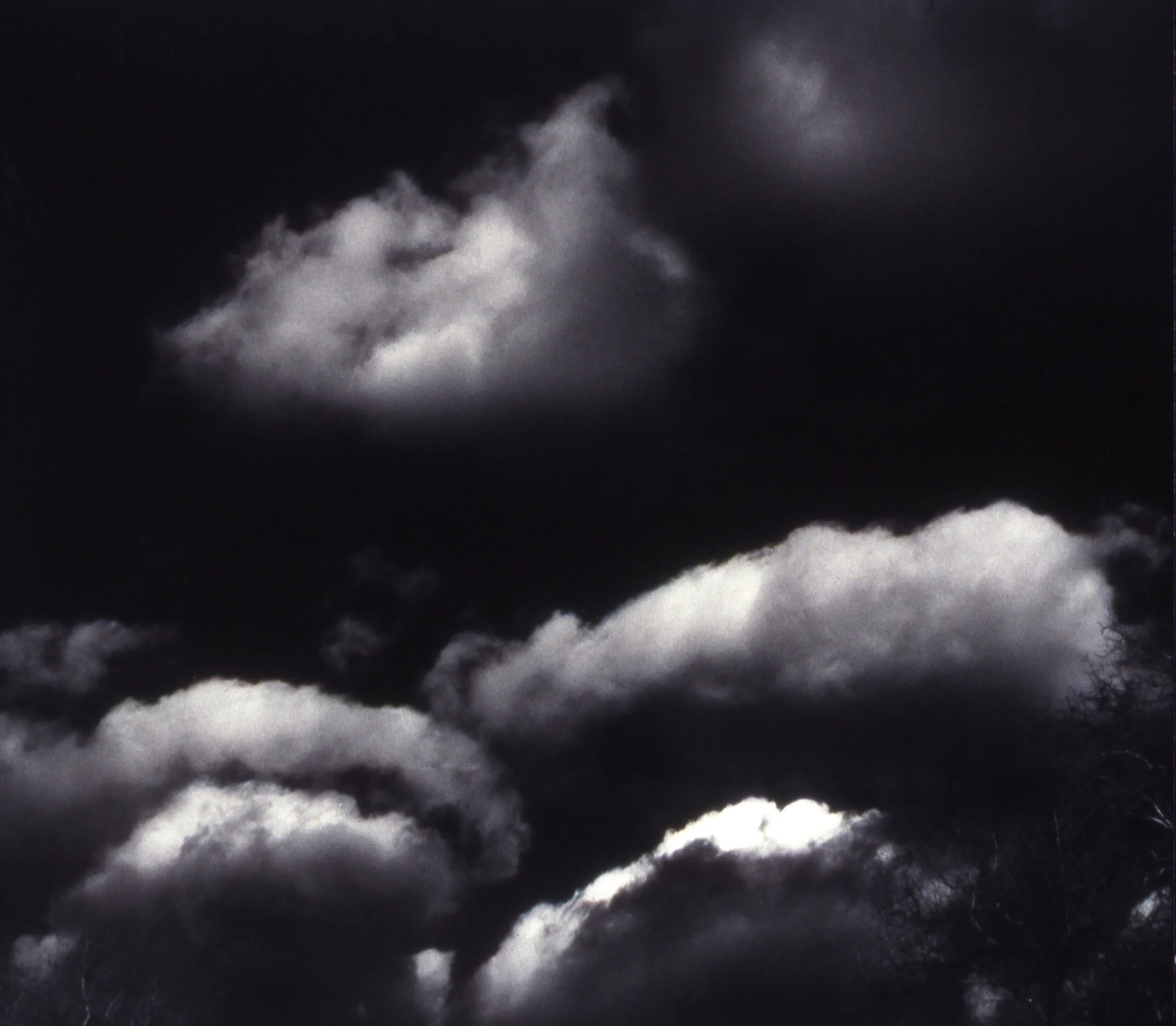
One of four images from Avoided Object, 1999

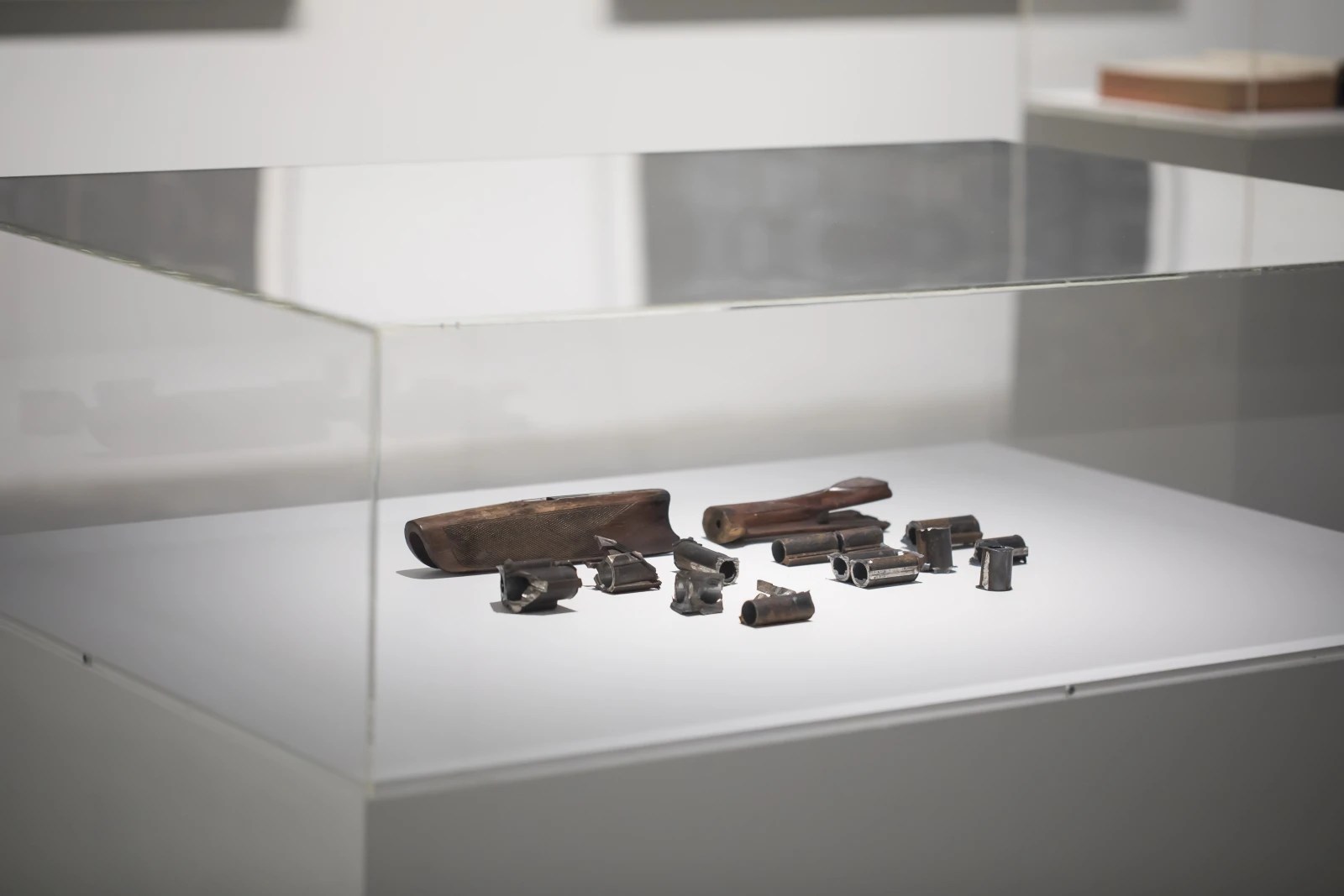
Though several pieces seem frustratingly direct, only one seems fundamentally ill-conceived. In the ‘Politics’ room, somewhat strangely, are four photos of the sky, placed across one wall. The images are the most seemingly innocuous of the exhibition, with gentle wisps of cloud against a neutral space – shot using infrared film, generating a deep black and white image. Their inoffensive subjects – banality even – are precisely the point. It is their material which is loaded with dark context; these photographs have been taken with the camera of Auschwitz commandant Rudolf Hoess – the man who introduced Zyklon B to gas chambers. Parker tells us that she was given permission to take the camera just outside its current home in the Imperial War Museum, where she pointed it upwards – a gesture she thought ‘somehow seemed appropriate’. Yet this juxtaposition of natural beauty and sheer horror seems far too blunt – little different from taking pictures of wild flowers springing up at the sites of former concentration camps. It is too straightforward a contrast between the aesthetically mild and the barbaric. It even seems to fetishize the object’s assumed memory – its proximity to historic evil – in a way that could be considered disrespectful. It seems to be a darker variation on the impulse that drove Parker’s work Sawn Up Sawn-Off Shotgun, which we are gleefully informed had been used in a ‘violent crime’. Yet the combination of the weapon’s relative anonymity (we do not know who it attacked, or killed) and the fact the shotgun has been neutralised makes it seem less lurid. The camera, though, is connectable to a specific known evil.

By this point, the exhibition’s audience has become accustomed to seeing objects, artefacts and images which appear relatively unassuming and finding, on reading about them, that they are replete with backstory. Avoided Object gives us a sudden jolt of seriousness, the punchline quality of its reveal being rather queasy. Furthermore, its title clashes with the reality; Parker has sought this object out, using it not despite its connotations – in the way some might engage with potentially problematic art – but precisely because of them. The attempted refusal is merely performed, not really meant. Instead, a crass fascination has drawn Parker in.

Sawn Up Sawn Off Shotgun, 2015 – ‘Shotgun sawn off by criminals, sawn up by police’

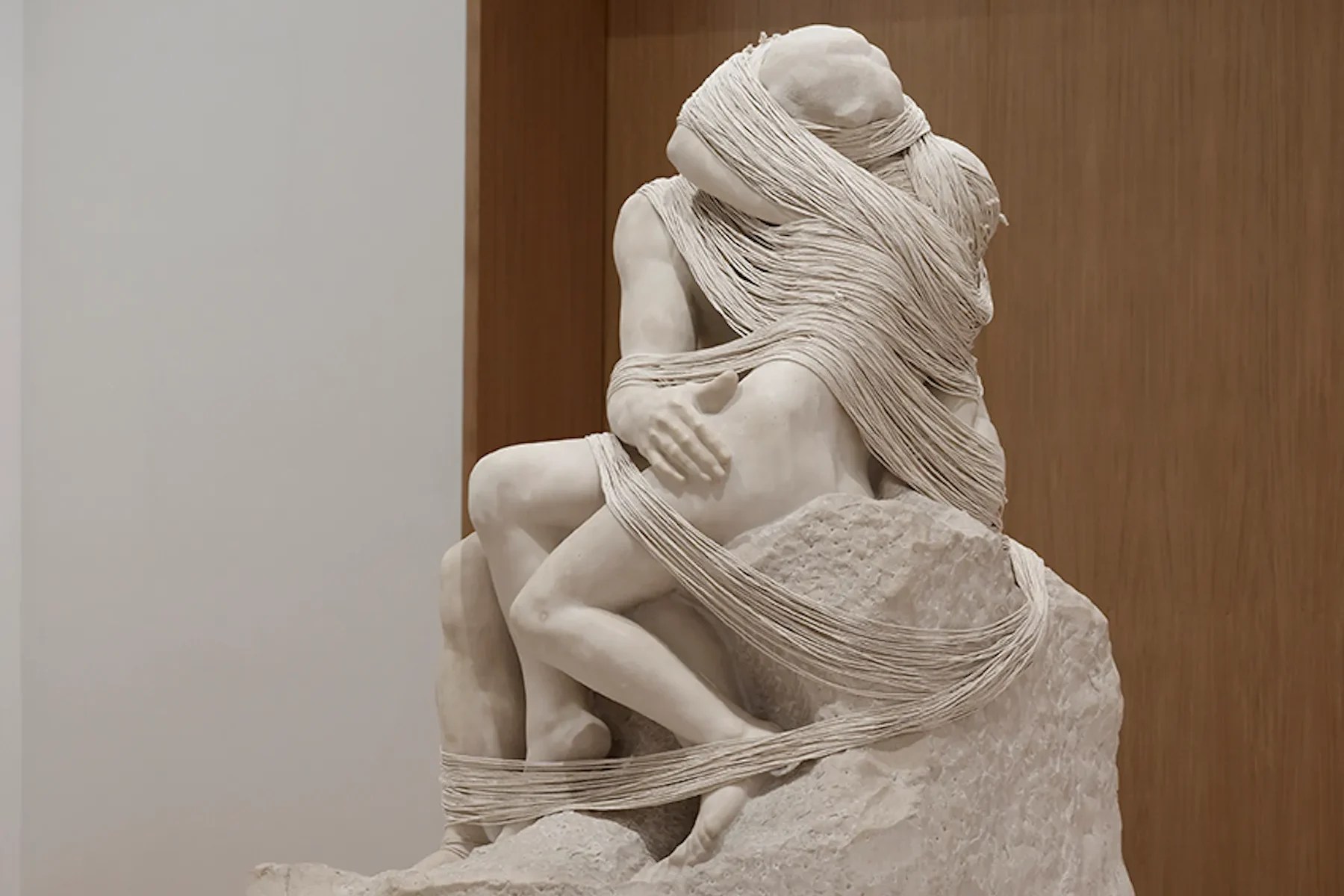
This semi-Freudian game of avoidance and attraction is presumably deliberate. Parker describes political art as a ‘digestive system’ – a process of understanding and working through ideas and events, articulating a view that would not be out of place in contemporary trauma theory. We are in a constant state of processing the past – personal, social and historical. That art is an ongoing conversation for Parker is evident in the loose diptych of the string-wrapped Rodin in Tate Britain’s foyer, and the string-wrapped weapon in the exhibition itself. Parker provoked strong reactions upon the initial display of The Distance (A Kiss With Strings Attached), with many decrying her apparent disrespect for Rodin. Opponents of conceptual art, the Stuckists, targeted her work and snipped the string. Yet Parker’s response was artistic, reknotting the string and making another work in conversation with it: The Distance (With Concealed Weapon). Snip away at this, it seems to say, and who knows what you’ll unleash – a fabulous, booby-trapped Pandora’s Box of a response. (The artwork is here housed in a thick glass box.)

Parker’s work can ably convey this knockabout quality, flirting with semi-artistic semi-vandalism and gentle threat. It has humour in spades, powered by a care for sentimental significances but also a healthy dose of irreverence. Yet the atrocities of Auschwitz seem ill-suited for Parker’s distinctive gaze. There seems little for her to reveal through the images that make up Avoided Object. By this point, her thesis that objects carry trace memories of events seems well-proved. Any further motivation remains elusive. Everything for Parker seems justified primarily by the logic that it would simply be interesting – and possibly amusing. As an experiment in more serious subjects, it is hard to call Avoided Object an inherent mistake, but it does seem like a misstep in the curation of this exhibition. There seems little to be digested here; all it does is interpose a note of ugliness at the very end – oddly placed under the ill-fitting banner of ‘Politics’.

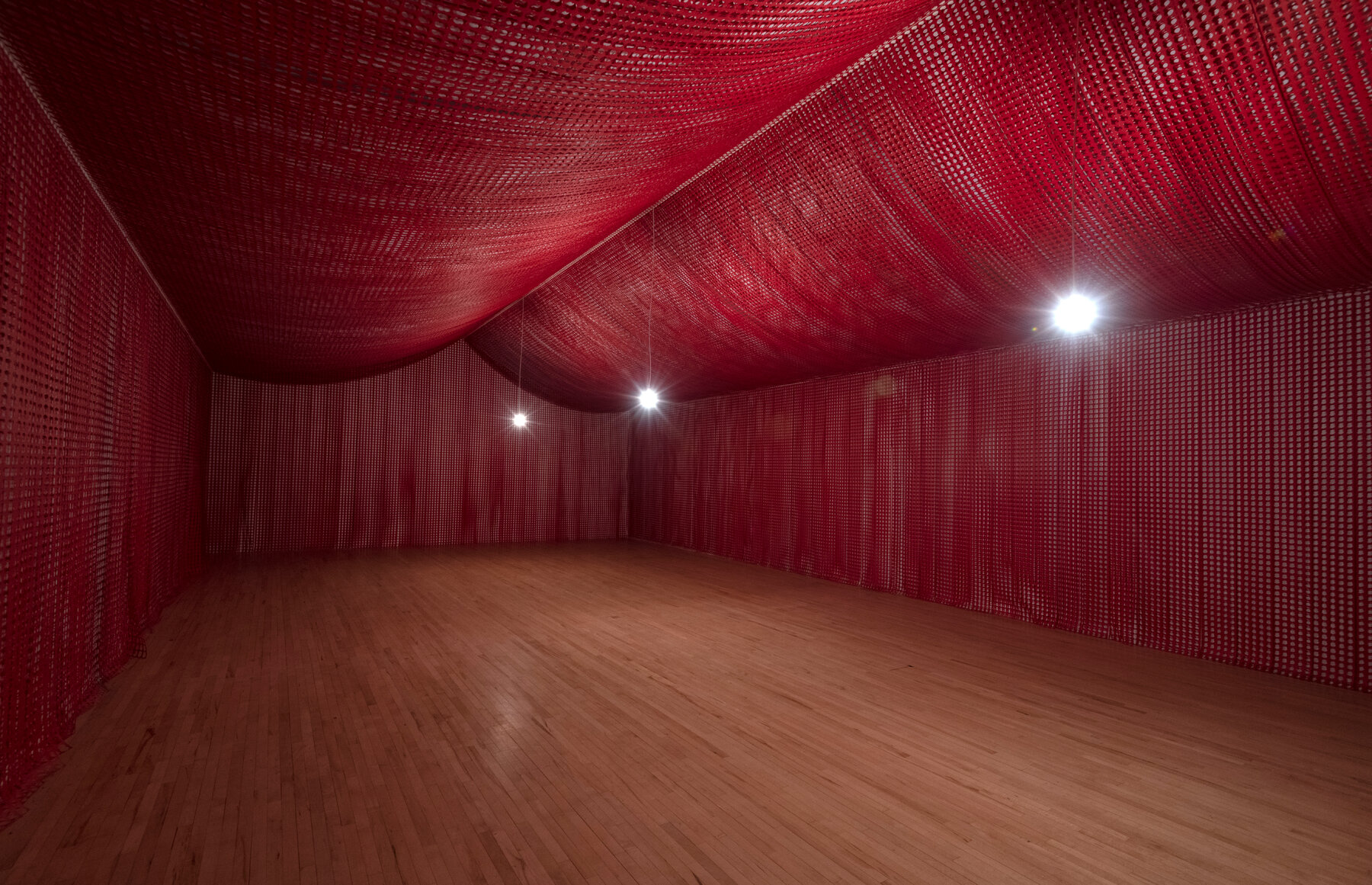
War Room, 2015/2022

With the right material, Parker’s art can search deeper – though by remaining in a more abstract realm. War Room, first created in 2015, and recreated here, utilises one of the most striking offcuts in Parker’s repertoire: the paper shells of Remembrance Day poppies. She has affixed the long, machined sheets to the walls and towards the ceiling in the sloping shape of a large tent. Poppies occupy a fascinating space in contemporary political discussion. Their ubiquity in late October and early November is perhaps beginning to enter a decline, though they still remain one of the most widely recognised symbols in Britain. Frequent furores break out over whether television presenters are sporting poppies early enough, or whether the wearing is correct, while an annual debate unfolds over their ethics – and whether a white commemorative poppy, which celebrates and aspires towards peace, is more appropriate. Last year, campaigners called for the plastic in the poppies to be removed, making them recyclable and thus more sustainable. Yet, generally less widely known, is that some poppies are made by inmates of UK prisons, for which they are paid on average £10 per week. (Minimum wage in prison is a shockingly meagre £4 per week.)

War Room demonstrates Parker at her most effectively political – cracking open existing fissures with a genuinely startling and moving visual meditation. Its meaning is thornier from being hard to pin down, though this piece is unlikely to teach you anything you did not already know. Parker contemplates the sheer waste of war by showing the waste of poppies’ manufacture. Yet the tent structure draws upon the imagery of the Field of Cloth of Gold too – Henry VIII’s grand meeting in 1520 with the King of France, which was theoretically intended to cement peace and stability, but became a show of decadent wealth and implicit strength. The elaborate structure is an impressive spectacle, though could even be considered a space to grieve – a deliberate refusal of a common and popular symbol of remembrance for its literal negative, finding something ambiguously personal in it.

The Distance (A Kiss With Strings Attached), 2003 (Auguste Rodin’s The Kiss, 1901-4, wrapped in string by Parker)

Parker’s art exists in a peculiar intersection of collaboration (with its connotations both positive and highly loaded), elaborate timewasting (a form of activism-adjacent resistance even), and a kind of art-wash. Cold Dark Matter best exemplifies this ethical tangle. Helping an artist blow up a shed – especially when it goes on to become a semi-iconic piece of contemporary British art – perhaps function as evidence that the British Army are a bunch of avuncular, necessary experts in dangerous equipment, primarily technical specialists rather than (inherently political) soldiers. With Parker, they are able to be health and safety officers with a much greater sense of fun. Parker’s description of each work draws attention to the process of acquisition, and the same tone of friendly enquiry is present consistently, regardless of whether her cheeky, though sincere, request was to the Home Office, the Tate, or a rural rattlesnake farm.

One of the main delights of Parker’s wrapped Rodin is how she makes you share the giddy logistical challenge of convincing ostensibly serious people (soldiers, senior police officials, and in this case gallery curators) of the merit of doing something very silly. Perhaps it is mild satire at the institutions’ expense – occupying their time with apparent triviality, though gestures which have the potential to unleash utter delight for Parker’s spectators.

This ethical play seems to be a deliberately fraught part of Parker’s design. It would surprise me if an artist who is (at times) so political considers these collaborations – especially with UK Border Force, the police, and Parliament – to be neutral. Yet Parker’s laconic phrasing deliberately obfuscates the process of actually obtaining her unusual, highly political materials. Is her status in the art world enough to open doors, or does she pay for resources and access? Are these unlikely friendships forged through bureaucratic email exchanges, eccentric handwritten requests, or steadily fostered personal relationships – toasted over chummy glasses of champagne? The collaboration seems one of the exhibition’s central subjects. After creative destruction, it is probably Parker’s second-most significant artistic gesture. So much of Parker’s work concerns negative space – the sheets of red card from which remembrance poppies are cut, the grooves cut out of vinyl records – yet the intriguing stories of how Parker acquired her resources are curiously unknown, though they seem immensely significant. The magician shows us her hand – but hides many more secrets.

The descriptive text accompanying Island bears the closing line ‘With thanks to UK Parliament’ – the final words you read in the exhibition. The work deliberately evokes Brexit in its use of the White Cliffs of Dover as pigment – and in its title. (Parker has spoken about disliking ‘feeling not part of Europe’ and not wanting to be a ‘little Englander’.) Therefore, it seems hard not to attribute a wry irony, a trace of sarcasm to the thanks. Yet the statement is at least equally in earnest too. The tiles that cover the greenhouse’s floor were sourced from the Palace of Westminster – to which Parker has been afforded somewhat unprecedented access. She was the official Election Artist in 2017 – which came with the backing of the establishment, and an implicit duty to document journalistically, responding perhaps as a courtroom artist does – observing rather than commenting. Without access and assistance, Parker’s art would largely not exist. The results of these collaborations are frequently fascinating, though the spectre of compromise (inevitably) hovers over them.

Categories
theatre

The 47th – Old Vic

Bertie Carvel in The 47th

‘Art needs time and space and reflection we can all agree on that.’

From Shipwreck, by Anne Washburn (2019)

It is a lexical quirk of the American political system that Presidents become known by their number. Trump was, and is, the 45th, Obama 44th. Joe Biden is the 46th, and – should he not run again in 2024 – we are only a couple of years away from the 47th. However, only one US President (so far) is known by two numerals. Grover Cleveland, by dint of winning Presidential office twice, separated by the Presidency of Benjamin Harrison, thus counts as the 22nd and 24th President of the USA. It is a pub quiz trivia staple and remains unique in US political history. Perhaps, that is, until 2024, should Donald Trump run successfully again.

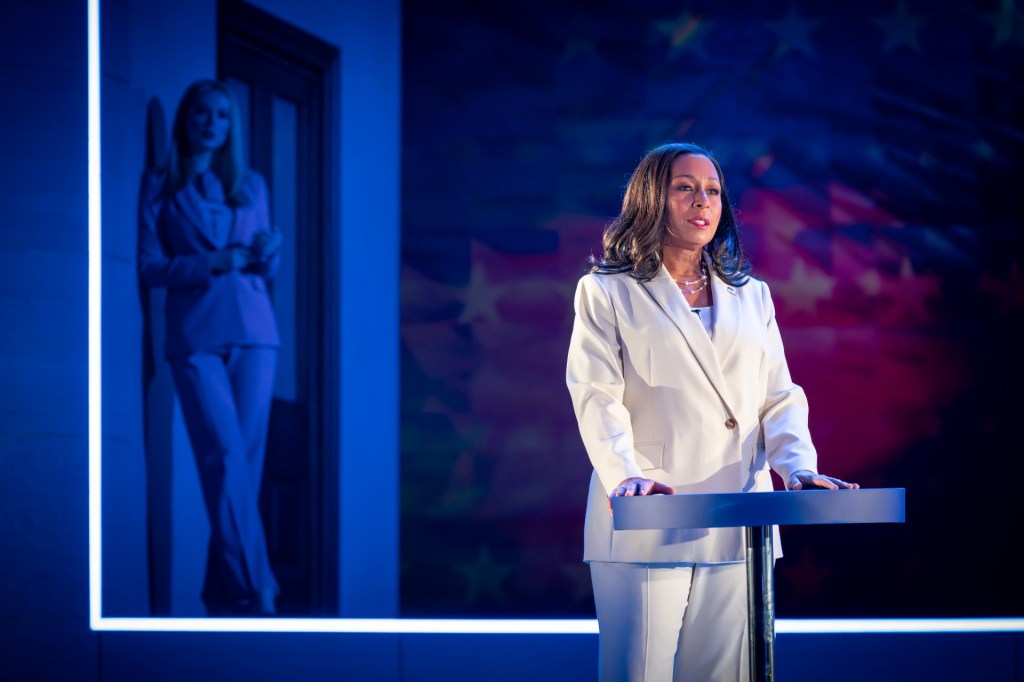
This creeping liberal dread that Trump might emerge victorious again underpins Mike Bartlett’s The 47th. The title seems – at least before you see the play – as if it cannot bear to speak Trump’s name, referring to him by an undeserved moniker he has rendered mock-heroic. In the play itself though, it is a wry, satisfying touch from Bartlett that the title does not refer to Trump after all, but Kamala Harris. She is instated by Biden in his place as his health deteriorates, in an act that seems to reverse-mirror Trump’s own refusal to share power when ill with Coronavirus. It is a canny substitution, though in no meaningful way does the character of Donald Trump have second billing here – either on the page, or in Bertie Carvel’s scene-chewing and -stealing, magisterial turn. This is, to use language of many reviewers during his Presidency (as they did about Brexit), a ‘Trump play’.

Lydia Wilson and Tamara Tunie in The 47th

The 47th seems most obviously reminiscent of Bartlett’s 2014 play King Charles III, which shares a future-history premise and a director in Rupert Goold. While King Charles III opened at the Almeida, of which Goold is Artistic Director, The 47th arrives in the much vaster space of the Old Vic – aware that a play with as zeitgeisty a subject and Carvel in such a headline-grabbing lead would attract a larger potential audience. In King Charles III, Bartlett sought out the human weaknesses and follies beneath the grandeur, tradition, and clipped rhetoric of the monarchy – unearthing the seething political opinions and ambitions that lie beneath the long-cultivated veneer of neutrality. The problem with applying the same logic to Trump is that he appears to have no filter. The thrill of seeing a protagonist soliloquising in private – one of the great attractions of Shakespeare’s history plays – is far less edifying when his every thought has been blasted across rolling news coverage. There is relatively little at stake dramatically when he so sorely lacks self-doubt – little interiority to be found. He appears to be a man whose every thought is bluntly, digressively articulated, and, though riven with contradiction, there is little actual conflict within him.

Bartlett does not seem interested in subverting this popular view of Trump here – actively tailoring his Trump to goad us. He remains the cartoon villain we expect, entering on a golf buggy and bragging to us about his achievements from the off. The main difference from the real Trump is the infusion of a greater awareness of liberal sensibilities and things he is mocked for. Trump repeatedly both-sides-ed racial violence and propagated the ‘birther’ conspiracy theory about Obama’s citizenship, yet chiding liberals for discriminating against him for the (orange) ‘colour my skin’ speaks in a liberal vernacular that seems unlikely. He claims to be an entertainer and ‘Your devil’, swearing revenge on those who have ‘exile[d]’ him from the White House and taking us along for the ride. The spirit of pantomime is deliberately alive in his words; he is villain who loves to be a villain.

I was also reminded of Anne Washburn’s wordily brilliant Shipwreck, one of the first plays (perhaps even the first) to put Trump on the London stage. Directed by Goold again, at the Almeida, this mostly portrayed a group of liberals gathering in a remote farmhouse, during a worsening storm, before revealing Trump himself – during a terrifying recreation of his ‘loyalty dinner’ with James Comey. Shipwreck’s rich poetry seemed like a space of solace – of intellectual defiance against the Trump administration, and refusing to fight his brash, name-calling rhetoric on its own terms.

Bartlett’s play too seems to hope that an ostensibly anti-intellectual problem can have an intellectual solution too – that empathy, intelligence and culture will ultimately win out – though it is perhaps less convincing. Its formal gesture seems something of a comfort blanket – not least because it is a return to a specific form, for which Bartlett was previously garlanded. Trump’s angular rhythms are strangely transposed into iambic pentameter, and there seems to be an implicit aesthetic critique that comes from the uncanny juxtaposition. Yet the problem of Trump is not merely the way he talks. Though his manner of speech is an undeniable part of his troubling, dangerous speech acts, it is far from the whole. One of the arguments implicit in Shipwreck seems to be that a liberal critique of Trump that dwells only on formal matters, rather than content is doomed to failure. As Michael Billington wrote in his review in The Guardian, it ‘does something you rarely see in the theatre: it takes Donald Trump seriously rather than as a subject for easy satire.’ The 47th attempts to rationalise the way Trump seems to be an obvious baddie – yet remains a political danger. Yet the impulse it springs from does seem too cheaply comic. What if Trump was King Lear? Wouldn’t that be funny?

Bertie Carvel’s Trump is far more accurate – in mannerism, appearance and voice – than Shipwreck’s version, played by Elliot Cowan in the original Almeida production. Yet for all his realism, The 47th gives Trump only crude malignancy, rather than active malice. Carvel’s performance is a strong recreation, but Cowan’s unhinged tyrant, bare-chested and painted gold, is a more interesting interpretation of his self-aggrandised horror.

In much of the play, Bartlett seems intent to serve up a (somewhat hollow) form of narrative justice for Trump’s actions. Trump is arrested and placed in jail, the imagery of him orange boiler-suited seems like liberal wish fulfilment, after his real-life double impeachment was exposed as functionally meaningless without Senate backing and investigations into his tax affairs have yielded little legal consequence. Perhaps inevitably given its genre of Shakespearean (future) history meets tragedy, Trump dies at the end, in a sequence fashioned presumably as an oblique comeuppance for Trump’s gutting of Obamacare. Slightly implausibly, Trump’s financial folly has led to him not even being covered by health insurance. He is given a private room in the hospital, as in jail, only for security reasons.

The second half falls into a slightly repetitive pattern, hinging on two fairly similar tête-à-têtes between Harris and Trump that buttress the drama. With such fixed positions, based on life, there is little either can gain from each other, apart from the most begrudging form of mutual respect. Elsewhere, the characters simply do not have enough depth to sustain major scenes. Ivanka (an icily composed Lydia Wilson) runs rings around her siblings too easily to create the Succession-like thrills that seem to be intended, as the Trump children jockey for position. This is compounded by Ivanka clearly being her father’s favourite. In Succession, the only daughter Shiv’s relative competence is offset by her father’s lingering preference for his sons – this dynamic functioning as the central thread of the second series. The best scenes with Trump offstage follow siblings Charlie and Rosie Takahashi, one a (Democrat-supporting) journalist, the other a Republican working for Ivanka’s Presidential campaign. The personal stakes of politics emerge in their confrontations, sibling loyalty tussling with political allegiance.

Like Washburn, Bartlett approaches Trump with a curious formal abstraction. Shipwreck is dubbed a ‘history play about 2017’ (which was first staged in early 2019), while The 47th (like King Charles III) is a future history, documenting the hypothetical events of the 2024 election. Perhaps it is because Trump seems so literal and unsubtle; speaking truth to power by simply representing a simulation of the truth won’t cut it. Instead, stepping back (or forward) allows us to observe him within a broader cultural moment.

Yet Shakespeare too, even more than in King Charles III, operates as a genre in of itself – as well as being another form of abstraction. The plot is shaped partly by real-world conjecture about a coming electoral race, combined with recognisable pastiche of Shakespearean moments. Most clearly, the play begins with Trump as King Lear – and the overall shape of Trump’s arc in the play could be (very) loosely mapped onto that character. He begins by musing on his coming demise; instead of a kingdom, he has an inheritance to divide up. Bartlett commits to a conception of Trump which is virtually indistinguishable in public and private, exacting calculated cruelty on his family and stroppily demanding each child flatters him into making them his sole heir. Don Jr. and Eric make their fawning, self-abasing arguments, before Ivanka follows the Shakespearean pattern of Cordelia and refuses to partake in his spiteful game. Instead of banishing her though, Trump remarks ‘And just like that the mic is roundly dropped. […] She had no competition.’ Inevitably – and Bartlett’s script spells out this many times – Trump is presented a monstrously inverted Freudian embodiment of the Oedipus complex – the father who wants to have sex with his daughter. She was always going to be his heir.

Shakespeare plays are often performed in large theatres. (The National’s Olivier hosts one most years, as does their Lyttleton stage.) Yet this is as much to do with the reliability of Shakespeare selling tickets (and perhaps the decline in the fashion for doubling supporting roles, and thus the need of large casts) than the quality of the plays themselves. Though the Globe Theatre has become a cultural touchstone for Shakespearean performance, his plays were often presented in smaller venues – more akin to Shakespeare’s Globe’s winter venue, the Sam Wanamaker Playhouse. There is an intimacy to Shakespearean drama that is often lost – though a great production can create this in a large space. The 47th does lack this intimacy. Partly, this could be the venue. (You wonder what the experience would have been like if Goold had programmed it in the 325 seat Almeida.) Yet there is also something remote about the characters themselves. They appear largely as they do on the news – self-possessed, even as they lose control of events. The rich, archaeological characterisation that you might expect from a Shakespearean drama is mostly missing.

Lydia Wilson in The 47th

Goold’s choice of plays to direct evinces a desire to grasp the nettle of many contemporary political issues. Albion, another Almeida collaboration with Bartlett (in 2017, and revived again in February 2020), was held up as ‘The play that Britain needs right now’ by Dominic Cavendish’s five-star review in The Daily Telegraph. Though Cavendish avoided saying ‘Brexit’ in his review, his subtext was fairly evident, and other reviewers made the connection explicit in other, largely glowing write-ups. Yet even this allegorical drama about restoring an English garden to its (apparent) former glory was designed with a structural abstraction – utilising an overtly Chekhovian structure, with four acts (one for each season), and an ending redolent of The Cherry Orchard.

Sometimes this impulse towards political (or at least politicised) drama has been misjudged. Ava Wong Davies’s brilliant review of The Hunt for Exeunt perfectly captures the tension between admiration for Goold’s typically compelling direction and deep unease at its implications, by scripting a conversation between a defending voice and a detracting one. Dramatizing the descent of a teacher, who is falsely accused of sexually abusing a child, I think that play (an adaptation of Thomas Vinterberg’s 2012 film) likely stemmed from an impulse of exploration, rather than apology or excuse for abusive male behaviour, keen to examine how public opinion is formed and how it shifts. Yet the underlying unlikeliness of the plotting and the political context of high-profile allegations as part of #MeToo made it seem a deeply reactionary piece of theatre, unfortunately placing sympathy squarely with the accused rather than the abused.

The 47th seems to emerge from a similar nettle-grasping political drive, yet the results seem fairly modest. Though most of my detractions are with the script, the production too lacks Goold’s usual fast-pace and flair. The costuming and prosthetics that produce Trump before us are hugely impressive, yet the rest of the design underwhelms a little. Miriam Buether, who designed such a gorgeous garden set which changed with each season in Albion, here channels the marble of the White House and the shape of the Oval Office, in a two-tier set. Unfortunately, it gets caught between naturalistic and stylised aesthetics though, and ends up feeling slightly visually bland. (Her latest collaboration with Goold, Patriots at the Almeida, is a triumph.) Enlivening the space, however, is Neil Austin’s use of light, which generates a palpable menace in scenes with QAnon – Buether evoking the horrifying aesthetic of the January 6th Capitol rioters.

Bartlett’s drama operates as both future prediction and post-mortem, willing into being the end of the Trump story. By contrast, Shipwreck is less about the political events of 2017 itself as liberal hypocrisy (‘There’s a little bit [of money] offshore’, one character admits) and handwringing as American culture adjusts to its new President. Washburn even refers to the trend of dressing up Shakespeare for different political occasions, as a way of coping with the uncertain moment. One character describes ‘that Shakespeare in the Park thing’ where ‘the man who plays Julius Caesar has a weird orange blond wig, […] and in the end he’s assassinated by a lot of brown people’. The production did happen – directed by Oskar Eustis – and was repeatedly interrupted by right-wing activists calling for an end to ‘political violence’ against the right. Yet despite their claims, reinterpreted Shakespeare can hardly be called violence, and there are clear limits to its effectiveness as resistance too. Shipwreck captures the ineffectualness of most art in its attempts to hold power to account. Instead, such productions are more a form of political therapy – giving the illusion of engagement as a substitute for meaningful (and potentially dangerous) political action. Another of Washburn’s characters responds ‘how are we finding a way to process all of this thoughtfully [and] is Shakespeare any kind of answer? Is Shakespeare really relevant to the current day?’

Washburn’s questions seem fascinatingly apt to The 47th. Shakespeare, her characters debate, is both a second choice and the only option; ‘I think they’d use a contemporary play only there isn’t one’. There is no drama ‘about this exact moment’, so old stories must be re-dressed for the occasion. Bartlett attempts to square the circle – drawing on Shakespearean heft with a drama about the coming moment, as the present one is arguably too ephemeral to bottle. Another voice chimes in: ‘Why don’t we just give up already, why don’t we give up and agree that plays are never going to be about the current moment and they shouldn’t be about the current moment. Plays are about the Eternal moment, yes?’ The claim that plays are expressions of universal truth is not entirely convincing, and I don’t believe Washburn expects us to agree with such a sweeping statement, but the eventual point at which this discussion comes to rest seems fair: ‘Art needs time and space and reflection we can all agree on that.’ Yet The 47th seems oddly airless, without this space. Bartlett has not (yet) described how the play came into being – whether it was part-designed to coincide with the 2020 election, before Covid cancellations hit, perhaps. Yet though the gesture of reflection – in this case looking into the future – is present, there is a sense that time and space are not.

Ultimately, while The 47th sees Bartlett returning to the writerly instinct that generated King Charles III, for Goold it seems more of a return to Shipwreck’s idea space. Washburn’s play is thornier – its problems less reducible to one man or one set of circumstances. Its problems are elemental – evoking her earlier play Mr Burns in its gesture of gathering characters around a campfire to tell stories in the dark. In its mythologising and Shakespeare-ising of Trump, The 47th attributes far more to one man than perhaps it should. Trump is a symptom of a political moment, perhaps an opportunist who rode its wave, rather than the sole author of many of the regressive steps America is taking. Even three months on, some aspects of the play feel outdated. As horrifying as the January 6th Capitol attack was, the decline of liberalism is happening in courtrooms rather than on the streets. The January 6th investigation is still ongoing.

Bartlett’s play entertains in spades, and Carvel is impressively accurate while not hamstrung by the demands of the impression, yet Bartlett does not quite succeed in having the last word on Trump. It might be an attempt at a literary exorcism, but the real Trump – rather than just a realistic-looking one – remains elusive.

The 47th

Written by Mike Bartlett, Directed by Rupert Goold, Set Design by Miriam Buether, Costume Design by Evie Gurney, Lighting Design by Neil Austin, Sound Design by Tony Gayle, Original Music and Sound Score by Adam Cork, Video Design by Ash J Woodward, Movement Direction by Lynne Page, Starring Berte Carvel, Tamara Tunie, Lydia Wilson, David Carr, Joss Carter, Kaja Chan, James Cooney, Charles Craddock, Flora Dawson, Eva Fontaine, James Garnon, Richard Hansell, Oscar Lloyd, Jenni Maitland, Freddie Meredith, Ben Onwukwe, Cherrelle Skeete, David Tarkenter, Ami Tredrea, Simon Williams
Production Photographs by Marc Brenner
Reviewed 9th April 2022
Categories
theatre

The Glass Menagerie – Duke of York’s Theatre

Amy Adams in The Glass Menagerie

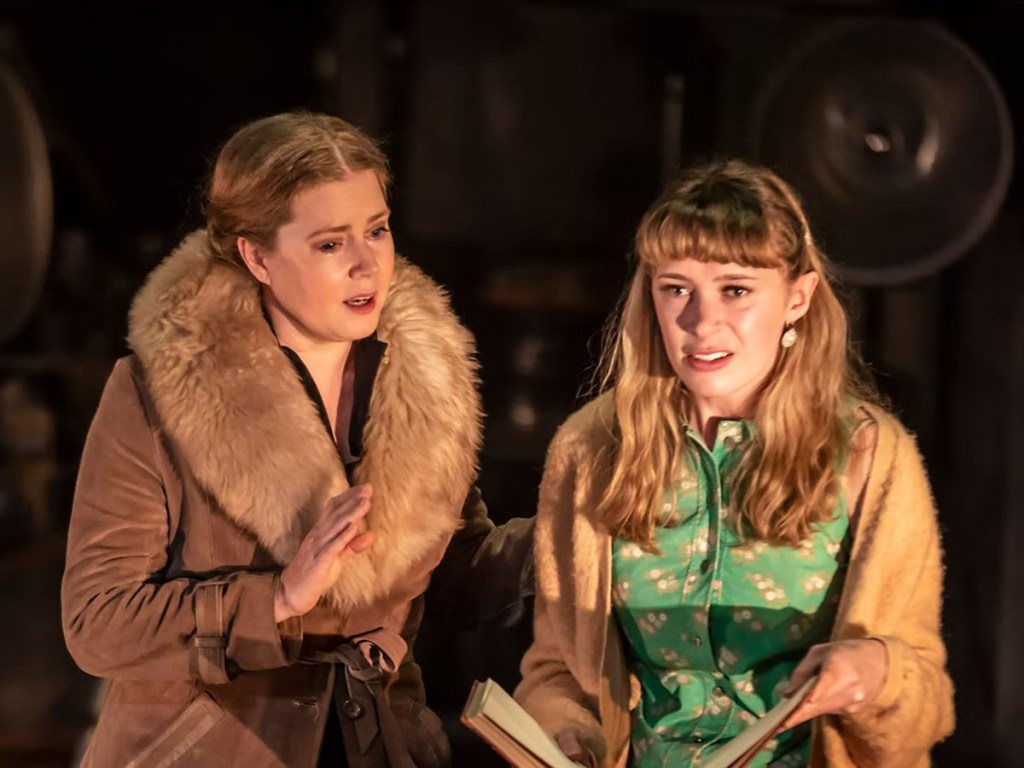
Amy Adams’ choice of West End debut role is a curious one. Playing the disappointed lower-middle class matriarch Amanda Wingfield, Adams gives a strong performance – if not an especially detailed or unusual take on The Glass Menagerie’s ostensible lead. Yet the question of who is at the heart of Tennessee Williams’ 1944 play is somewhat fraught. Amanda may have the highest line count, but – for all Adams’ winning star-quality – she does not quite feel like the protagonist of the drama.

Perhaps the most pivotal role is Amanda’s son, the mercurial narrator, Tom – a man with ‘tricks in my pocket’ and ‘things up my sleeve’, conjuring the play into being before our very eyes like a magician (or a playwright). Yet Herrin saws Tom’s role in half, with Tom Glynn-Carney delivering the spiteful, evasive, discontented younger version while Paul Hilton floats around the stage as a wistful and deliciously impish older narrator, reflecting on a life of mistakes with humour and anguished regret. Though the two halves are unified in a tender moment – where the Toms look searchingly at each other – the overall effect is for Tom to be reduced in importance by his bifurcation, rather than accentuated. In Herrin’s interpretation, Amanda’s daughter Laura is actually the play’s emotional centre, and though the role is usually played by Lizzie Annis, I saw Brydie Service understudy the role in a spectacular performance which was the finest out of a strong cast. Service should be remembered as a serious talent to watch. Adams complements the others well, but you wonder why she did not choose a West End debut in which she was more definitely the lead.

Adams plays Amanda as an incurable optimist – or at least someone who cannot bear to dwell on her life’s pains and sufferings. She manifests distant memories – of receiving seventeen gentlemen callers in one evening – as if they are the present, irrepressibly nostalgic within scenes that are themselves memories (of Tom). The result is that Amanda’s crueller streak is mostly minimised – though her cloying attempts at niceness can be oppressive – and the sense of a toxic family bringing out the worst in each other is muted. She sharply upbraids Laura for dropping out of business school – and wasting fifty dollars in the process – yet this soon turns to a warmer maternal sympathy, leaving the play to languish in general malaise rather than creating richer character drama from Amanda’s sometimes-mean unreasonableness.

Amy Adams and Lizzie Annis in The Glass Menagerie

Paul Hilton’s narrator is one of the highlights of the production, prowling the stage and watching over proceedings with a yearning regret. Every now and again, he sketches out a melody on an upright piano which then loops over and over – like the melancholy memories circling through his mind. Hilton feels slightly underutilised, doing his best with the relatively scant material that comes from slicing his role in two. Yet Hilton superbly embodies retrospective regrets about his past. As Williams writes in his notes on the characters, Tom is ‘not remorseless, but to escape from a trap he has to act without pity.’ At a remove of time, he is now all remorse and pity.

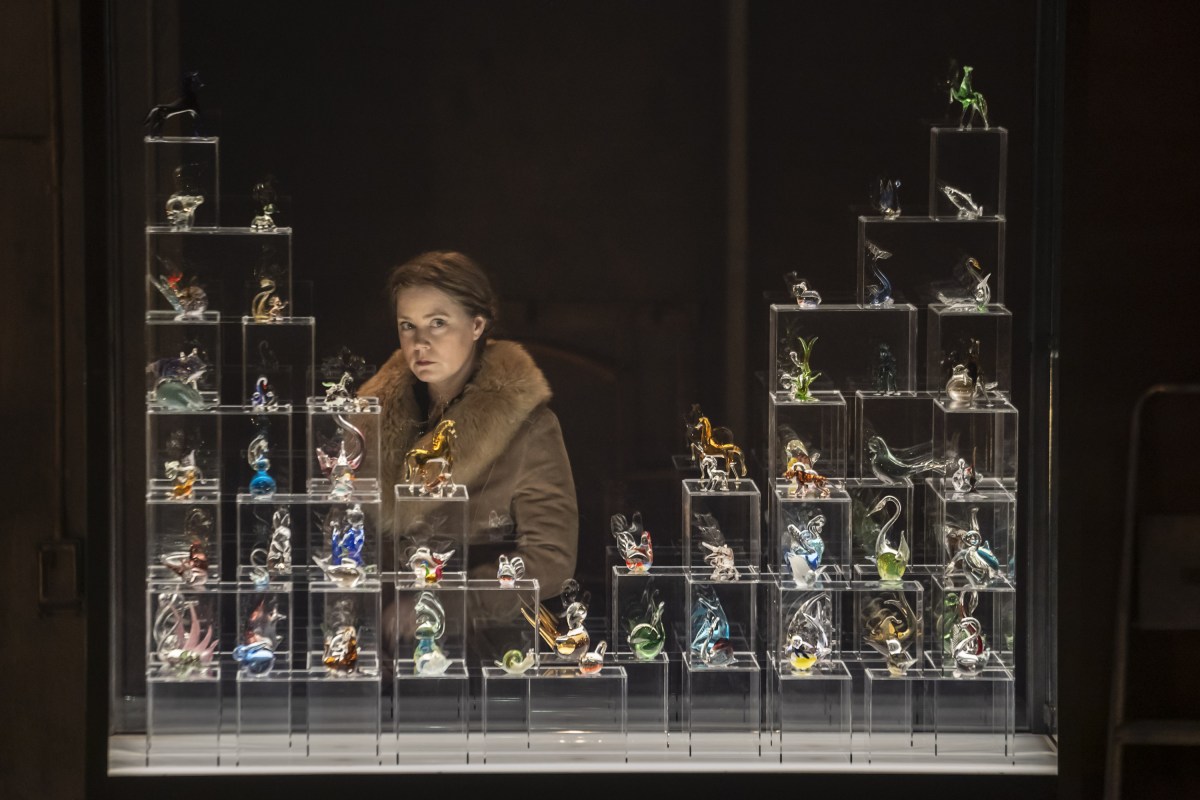
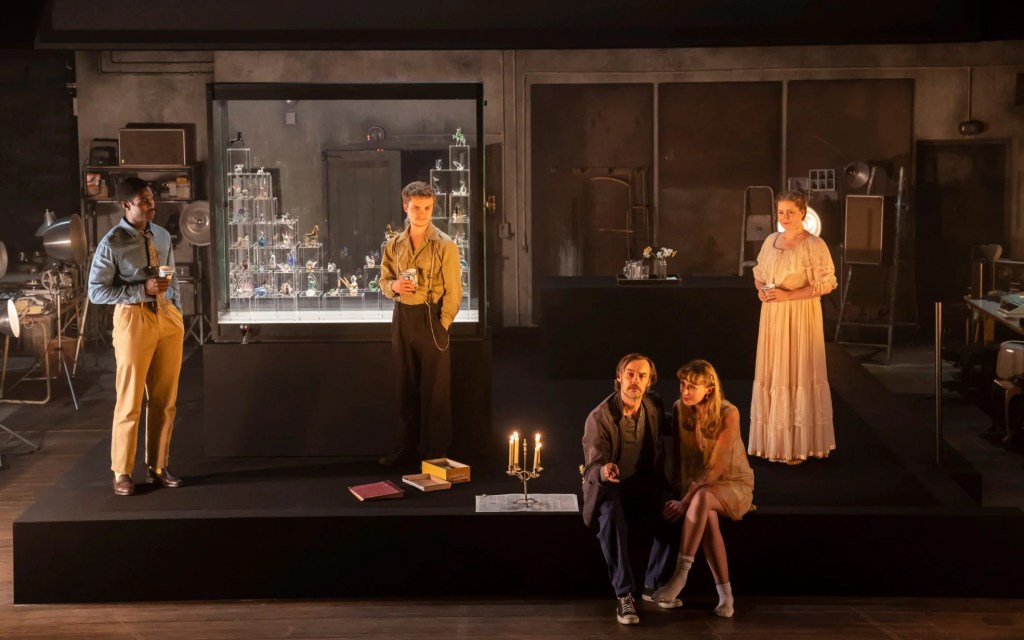
The set is a strange mixture of bareness and overcrowded detail. The titular ornament collection is strangely grand, perhaps one hundred pieces housed in a glass display case, almost like butterfly specimens. It seems implausibly grand and expensive. Most of the play takes place on a raised platform in the middle of the stage, which (from my position at the front of the stalls) renders the back half of the stage (including much of the fascinating, lurking performance of Paul Hilton) near-invisible. Meanwhile, the sides of the stage are comparatively cluttered with semi-realistic detritus, generating a strange dissonance with the almost-empty centre.

Ash J Woodward’s video projections loom over the stage, yet these rarely move beyond the illustrative. A minute photograph of the family’s absent father is vastly projected overhead, the patriarch bearing down on them in a way which invites fairly straightforward psychoanalysis. Despite this, the production rarely makes his absent presence felt; the emphasis here seems to lie with the financial pressures of 1930s America, the deleterious effects of age on a woman’s social status and opportunities, and culture being escapist rather than emancipatory. These are excellent points of focus, each with revealing comments to make on Williams’ frequently performed text, but not all of the production decisions line up with what we see on stage.

Victor Alli, Tom Glynn-Carney, Paul Hilton, Lizzie Annis, and Amy Adams in The Glass Menagerie

Herrin’s production is relatively procedural at first, and a snap judgement at the interval might write this interpretation off as lacking in dramatic verve. However, the play bursts into splendid, scintillating life in the second half – ironically when the apartment is plunged into darkness. Tom has neglected to pay the electricity bill, leaving Amanda to cheerily (but with aching sadness) remark ‘We’ll just have to spend the remainder of the evening in the nineteenth century’. After this, everything attains a prickly intimacy, especially when Jim, the gentleman caller whose visit has been arranged by Tom and Amanda, speaks to Laura alone.

This scene stands out from all the others – as it would in many productions – but the emotional depth that Service and Victor Alli find in their tenderly encouraging conversation is beautiful to watch. Service communicates a powerful sense that such an encounter – even just a conversation – was previously unthinkable for Laura, and we share the delight Jim takes in coaxing her out of her shell. The moment seems genuinely transformative and hopeful, yet the soon-to-come crushing revelation that Jim is already engaged to be married may make Laura close herself off again permanently – unwilling to risk being burned again. Alli plays Jim with a commanding confidence, though he is frank about the fact that this has been learned and practised. When Laura tells him she watched him sing baritone lead in a school production of The Pirates of Penzance, he is touched by her attention and signs her programme with a considered realisation of how much it does mean to Laura. A gesture that could be cheaply self-aggrandising has little arrogance behind it here. Jim is fully conscious of the weight of his words and actions, and he seems well-intentioned – aware of the good he could do in leading Laura towards a more assured and happier life, as well as the harm of promising too much and dashing her hopes. He wills her to aspire to more than her current life, and he seems quietly heartbroken by Laura’s enthusiastic response to questions about her hobbies, interests and talents that she has her glass collection. In his eyes, she is capable of so much more.

Where Jim oversteps is kissing Laura, a moment played not as Jim fulfilling a sordid impulse but as a complex negotiation of desires for himself and for Laura. He truly believes that ‘Somebody – ought to – kiss you, Laura’. The moment is not set to ‘tumultuous’ music, as in Williams’ stage directions, but is quietly intimate. Laura’s expression seems happier than the scripted ‘bright, dazed look’, though it turns to confusion as Jim mutters ‘Stumblejohn! I shouldn’t have done that – that was way off the beam’ – before confessing his forthcoming nuptials.

The production is a rather frustrating almost-there – not quite bottling lightning for most of its runtime, but never that far off. A more unified design, a thornier take on Amanda, and generally less literal approach to video projections would take it closer to a production for the ages. Yet, for around twenty minutes in the second half, during the searchingly tender and sophisticated interpretation of Laura and Jim’s growing mutual affection, the production would be near-impossible to improve. It shines with a delicate fragility, a glassy quality absent elsewhere but magnificent when it appears. Herrin’s The Glass Menagerie is worth seeing, if just for this scene alone.

The Glass Menagerie

Written by Tennessee Williams, Directed by Jeremy Herrin, Set Design by Vicki Mortimer, Costume Design by Edward K. Gibbon, Lighting Design by Paule Constable, Composition and Sound Design by Nick Powell, Video Design by Ash J Woodward, Casting by Jessica Ronane CDG, Associate Director Anna Girvan, Starring Amy Adams, Victor Alli, Lizzie Annis, Tom Glynn-Carney, Paul Hilton, Understudies Mercedes Bahleda, Phillip Olagoke, Mark Rose, Brydie Service
Production Photographs by Johan Persson
Reviewed 1st July 2022
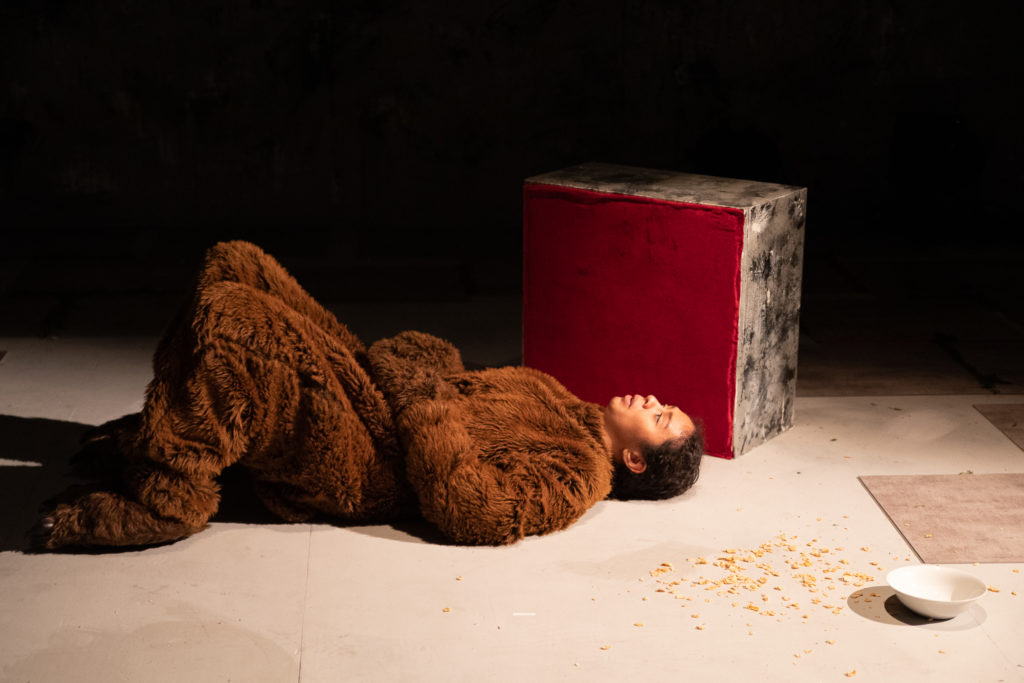
Categories
Books

Reward System by Jem Calder

In fictions of the future, automation generally leads to one of two places. Sometimes it is to emancipation from labour and material struggles, in more utopian accounts. The more dystopian (or, some would argue, realistic) suggest it would presage a return to a semi-feudal poverty for the non-owning classes. Yet Jem Calder’s Reward System explores the arguable reality that the processes of automation, data and algorithms have been refracted in upon the self; we optimise and self-evaluate, increasingly treating ourselves as machines. Even exhaustion and burnout are sometimes framed as needing to recharge our batteries.

Calder’s subtly off-kilter structure embodies a sense of being caught between things and compartmentalised. Billed as a ‘set of […] fictions’ rather than either a short story collection or novel, Reward System mostly satisfies as both – even its fringe narratives epitomising the book’s recurring concerns: the infiltration of all corners of life by technology, the difficulty of human communication, and the contemporary workplace. The stories revolve loosely around Julia and Nick, formerly a couple during university, who navigate the modern metropolis and occasionally re-enter each other’s orbits. The first story focuses squarely on Julia’s work and romantic life, while the second follows Nick’s unhappy travail through social awkwardness at a party. Beyond these, the rules of engagement become slightly unclear. The surprisingly touching third story seems to be about neither character – only ‘the male user’ and ‘the female user’ of a dating app during a short-lived fling, while the fifth involves Nick only incidentally, telling us little more about him than his surname. Perhaps it is a deliberate effect of Calder’s writing that I spent much of the duration searching for connection – to learn more about these characters, who at times burn with life, though seem somewhat remote.

Reward System is set in an ambiguous present day, a time firmly in the shadow of an apocalyptic future rather than the past. Its often detachedly omniscient narrator (mostly in the third person, though Nick narrates stories two and six) sets the scene as ‘a December fifty-seven harvests prior to the Food and Agriculture Organization of the United Nations’ projected start date for the era of total global soil infertility’. A pervasive eco-fatalism recurs throughout the book, but it is also a theme Calder interrogates – mapping the threat of global environmental collapse onto interpersonal relationships. A chance encounter between Nick and Julia is sustained not by years of shared experience or mutual interests, but by a reversion to old habits: discussing articles they had read – either on wealth and inequality, unsustainable use of land and fossil fuels, or often the links between both. The end of the world as we know it is a defence against social anxiety.

So too are various other staple malaises expressed and explored – less as comments on the social ills themselves than as part of character neuroses. The narrator notes that Julia ‘had liked saying the impromptu, pornography-appropriated things she’d said’ while sleeping with her boss-turned-boyfriend, Ellery – articulating a thorny mixture of ethical questions over pleasure and the production of desire. Yet though Reward System is suffused with a hyperawareness of problems and the problematic, knowledge is powerless. The characters consume regular updates on every social problem, yet they are largely unable to do anything about it or find ways of translating their feelings into meaningful action. Wry lines such as ‘the overcast midday sky was the colour of the Financial Times’ speak to their informed cultural references, yet they float through a reality in which everything is tragic – and tragically unavoidable.

Julia and Ellery visit ‘a Sackler-funded contemporary arts space’, while Nick surveys an affluent suburb which has been ‘enriched by electric-car charging ports and anti-homeless architecture’. The acerbic tone contains a critique, yet this is largely aimed at the general state of things. The effect is slightly wearying, especially compared to recent works such as Yara Rodrigues Fowler’s realistic yet optimistic There Are More Things, which presents social problems (especially relating to issues of housing, gentrification and identity) to be the fuel of activism rather than the fodder for despair. Arguably Calder’s framing does the opposite. Instead of calling out and petitioning organisations to divest from Sackler investment, for example, their presence is treated as a regrettably immovable part of how things are.

Naturally, as a book about contemporary life, the terrain of the contemporary workplace comes under scrutiny – first the realm of service labour, in a restaurant, and then the digitised labour of semi-creative industries – whose ‘bureaucratic business model […] is to strategically over-allocate professional resources’. Calder explains that, rather than maximising efficiency, ‘the more billable time you can expend on a project, the more money the company can justifiably charge to its client.’ Thus, ‘The best work ethic you can have around here is a bad one.’ So much of what they do is ‘just busywork’ – the kind of pointless non-work labour described by David Graeber as ‘bullshit’. Yet this too is a despairing diagnosis, rather than a call for galvanising action. This is a financialised world in which politics defines everything, yet everything is rendered apolitical.

Reward System comes emblazoned with the endorsement of Sally Rooney, yet for much of the book I wondered if the narrator’s laconic detachment (laced with barbs of emotional reflection and acid wit) was somehow a deliberate, spiky parody of her distinctive style. The coolly impersonal phrasing seems like an observational comic at their most itemising – Julia watches ‘prestige television streaming on her laptop’, while ‘Ellery entered the kitchen texting, artificial keystroke sounds issuing from his touchscreen device.’ Later, a ‘celebrity’ is defined not by their occupation, talents or name, but simply the fact of their fame. Sometimes smart, contemporary observations – such as the exposing quality of one’s recommended watchlist – are cloaked in similar distance; Julia surveys a ‘sidebar of algorithmically recommended YouTube content’ on Ellery’s laptop. Everything is data now, even the building blocks of stories.

The book’s first section, ‘A Restaurant Somewhere Else’, is by some margin the most compelling – powered by a steadily progressing romance and simmering with a low-key sense of danger. The lack of Julia as a focal point can be felt. Only when she is out of focus does the little free-indirect colour she has previously added to the narrative voice emerge. For instance, in a thirty-year-old wine she tastes ‘multiple wars; economic recessions; iconic acts of terror, [and] the rise of consumer electronics’, among much else. Nick, meanwhile, seems frustrated by his own blandness, a curious subject for a character study, but not one which is necessarily riveting. He imagines writing as a form of escape from his life’s disappointments, but we never learn much about the imaginary worlds he creates – whether they are richly different from his real life, or in a similar key to Reward System itself. Perhaps we are to wonder if Nick and Julia will, after colliding on a few random occasions, end up together again, yet Calder denies us such a neat happy ending. One of its least novelistic gestures might be its refusal of closure; the book ends in rupture – with Julia deciding to leave for Toronto to live with her sister and reboot her life, though both stuck in lockdown for now and Nick developing Coronavirus symptoms. Narrated from Nick’s perspective, the sense of grim abandonment – though she has no obligations to him – feels rather bleak.

Late in Reward System, the usually sterile narrator lapses into the second person, and you sense Calder in a more confrontational register. ‘Take yourself, for example’, he writes – about ‘your first smartphone’. He contends ‘you only checked it once every, what, like couple of hours?’ The sudden personal, conversational quality of both the address and the tone is startling. ‘Cut to now. When was the last time you read a full short story without, at some point, taking an intermission to check your device; refresh your feeds?’ Yet this probing interrogates the failure of the optimised individual to maintain an attention span while also monitoring many things at once. It plays as a slightly shallow gotcha, if wryly written.

Perhaps one of the novel’s most interesting contentions is that most forms of resistance have been assimilated by the mainstream. Calder writes, of one of his office workers in ‘Search Engine Optimisation’, that ‘the more she talks, the harder it becomes for her to actually tell if she even really cares about the issue, or if she’s just reciting a series of prefabricated talking points that’ve been fed to her via a giant cross-media broadcasting apparatus.’ Perhaps this is why Nick values writing so highly as it, in theory, is something original, personal, not reconstituted. So much has been swallowed by a technologized mindset which supposes that humans should learn to become more like AIs rather than just AIs becoming more human. The third story, which Calder writes almost from the perspective of a dating app algorithm, describes how ‘the female user paid close attention to each of her embarrassing human surfaces’. ‘She was working on herself, upgrading by increments.’ Humans ourselves have been made not only into machines but sites of labour, where we reify the impulses of capitalism in our own physical and conscious identity. Yet, for a hopeful answer of where we go from here, you will have to look elsewhere.

Reward System

Written by Jem Calder, Cover Design by Luke Bird, Cover Image adapted from an original by Yulia Ryabokon/Alamy
Published by Faber & Faber
Categories
Film

Happening

Anamaria Vartolomei in Happening

Early on in Happening, Audrey Diwan’s Golden Lion-winning adaptation of Annie Ernaux’s 2000 memoir, a professor of literature asks author-alike Anne what the literary name for a figure of repetition is, in front of a lecture theatre of fellow students. ‘Anaphora,’ she confidently replies. This moment seems like Diwan partially revealing her hand, tipping a wink to the rhythmical structure which underpins the film’s shape – a pattern of dramatic repetition.

Everything changes for Anne on discovery of her unwanted pregnancy. It is the event (the happening, l’événement, as in the French title) which can barely be named – partly for the veil of enforced secrecy that renders any attempt at termination illegal, partly for its sheer incomprehensible horror. Happening follows Anne’s repeated and arduous attempts at getting an abortion in 1960s France – and the failure of each in turn. This anaphoric pattern of relief quickly thwarted creates a recurring rocking motion between hope and despair throughout the film, more potent than mere constant dread.

Perhaps the most significant difference between Ernaux’s memoir and the film is this shift from the interior terror of unwanted pregnancy, albeit abstracted a little by time, to the more external film narrative. We are told and shown that Anne has a brilliant mind and would be a terrible loss from academia and contemporary literature, unlike the book – which communicates this through the subtler implication that, had the pregnancy gone ahead, there would be no memoir at all. Thus, the film is slightly more interpretable as a questionable cautionary tale about the effects of restrictive policies on the exceptional and deserving. Yet Diwan’s choices mitigate such effects, with Anamaria Vartolomei’s subtle central performance foregrounding the sheer human pain over Anne’s relative exceptionality. It is everyone else who is obsessed by her academic potential, which ends up as yet another cruel bureaucracy, heaping pressure upon Anne as she attempts to escape the prisons of motherhood and the state, and survive.

Anamaria Vartolomei in Happening

Anaphora maps onto Anne’s tragic descent. Anne is a star student, knowing all the answers while another female student is upbraided for poor focus. Yet late in the film she receives similar criticism from the same professor, her written work and in-class concentration badly affected by her situation. (Indeed, one effect of the call-back is to make us question the circumstances of the earlier student; perhaps there was more to her ignorance than inattentiveness.) Anaphora also powerfully drives the film’s queasy oscillating motion between seemingly successful escape from pregnancy to each abortion attempt being revealed as a failure. The first doctor does not entertain her request for an abortion, asking her to leave. Yet a second one prescribes Anne something, appearing to be receptive to Anne’s pleading entreaties. The medication does not work. In fact, we later learn that this prescription was designed to strengthen the foetus and make it more difficult to abort. The same process of imagined relief and disappointment occurs again and again – failing to end the pregnancy with a knitting needle, and even by a trip to a Parisian abortionist. Only on a second visit is the pregnancy finally ended, but almost at the cost of Anne’s life.

The film has the visual stylings of a conventional biopic, its close-up focus on Anne compounded by the claustrophobically square aspect ratio. Unshowy on-screen intertitles, starting ‘7 semaines’ and counting the weeks as they tick by from there, rachet up the tension with the simple dread of a ticking clock. The film commits to several startling visual moments – such as unbroken shots of attempted medical procedures – yet the sound-world Diwan has curated also lends the film an eerie tension. Evgueni and Sacha Galperine score Happening like a horror film, punctuated by strange, muted piano and string notes which crackle with building menace. Diwan scores many moments with only silence, shifting sound levels to evoke Anne’s world tilting off its axis. After Anne’s diagnosis, everything sounds very loud, except other people – who are muffled into obscurity. She is alone in a dissonant, hostile world.

The film commits to a pervasive realism, especially true of its frank medical scenes. Two abortion attempts are presented in real time, the second in a long single shot that captures Anne’s agony and the focused precision of abortionist Mme Rivière. It plays out with the grim logic of a horror drama as Rivière tells Anne that if she screams then she will have to stop. If the neighbours overhear the abortion, they could both end up in prison. Anne must endure agony silently, almost akin to the wincing pain of 2018 horror film A Quiet Place. Yet this horror is distinctly realistic and real. As Mme Rivière is almost finished, Anne lets out a sudden cry. The abortionist gives her a look, then quickly finishes up – the scream yet another anaphoric moment of potential failure. Diwan’s realism extends to the offhand glimpses we are given of other similar though untold horror stories, with tragic outcomes. Mme Rivière washes her instruments in boiled water to sterilise them, rather than disinfectant, remarking: ‘bleach in a uterus. And you wonder why they die.’

Anamaria Vartolomei in Happening

Happening is rendered political by its received context more than its literal content. Diwan stages no debates over ethics, methods, efficacy or regulation. French abortion policy is condemned by implication only; its effects are clearly inhumane, cruel and unlikely even to prevent abortions as intended. Happening is instead about the visceral body horror of something growing inside you that you do not want there – and the shockingly obliterative effects of forced birth on women’s lives. Anne describes herself as having ‘[t]he illness that strikes only women and turns them into housewives’. The terms are apocalyptic; pregnancy is literally ‘the end of the world’ for Anne. The toxic patriarchal combination of abortion bans and a society in which mothers are siloed from economic and creative participation in society makes birth a life-altering, even life-ending, event.

As Anthony Lane writes in The New Yorker, ‘Nobody is moved to ruminate on the rights and wrongs of the situation.’ There is a far greater sense of urgency from Anne, to save herself from a terrible fate, while the barrier to action is legal, not personal or moral. Lane writes that the film’s ‘pragmatic’ morality is entirely ‘grounded in a universal terror of breaking the law’. Anne’s friend Brigitte is so terrified of going to prison that her sympathies for one of her closest friends are neutralised, and she keeps her distance in an act of self-preservation. Yet when Anne’s roommate Olivia is forced into complicity, by cutting the umbilical cord, we see the anguished calculations momentarily playing out on her face – balancing shock, horror, and fear of prison – before empathy nullifies legal or moral concerns in favour of the pressing need to assist and provide care in that moment.

Happening shares the same focus on the dehumanising nature of abortion restriction that 2020 US abortion drama Never Rarely Sometimes Always charts. The latter film is set in a country where, at the time of making, abortion was theoretically protected by law. Yet access is rendered expensive and often out of reach, the title evoking the bureaucratic maze of invasive questionnaires that the system demands are answered. In Happening though, the French state is not so much casually cruel in its abortion restriction as outright ignoring the very idea that abortion could be a debate. The result is maddening and alienating – forcing Anne to keep secrets from anyone she cannot entirely trust.

The film works hugely effectively as a contemporary parable about the necessity of reproductive healthcare, as well as a chronicle of a unique period in history. The 1963 setting makes the events feel all the more acute, a time of increasing social sexual pressure not yet matched by availability of birth control or abortion. In many ways, 1963 is a darkly apt mirror of the present day; social pressures remain, just as reproductive healthcare comes under attack from the religious right – especially in America. The grim consequences of such an inchoate sexual revolution – yet to take significant mainstream notice of female pleasure – are depicted in the warped logic of Anne’s male acquaintances. One friend, Jean, tells her that ‘There’s no risk if you’re pregnant’, during his bid to seduce her. Yet, Diwan purposefully hard cuts from his claim to one of Anne’s friends inspecting a mark on her body, suggesting it could be syphilis. By the end of Happening, Diwan arrives at a more nuanced and optimistic view of sexual pleasure, though there remains huge risk when health problems are met with stigma and hostility by the medical establishment.

Perhaps Diwan’s primary theme in Happening is freedom – implicitly asking what it is and how it can be achieved. She documents a society in transition where entrenched beliefs and norms are in flux. Such a shift in intergenerational perspective is evident in one scene where Anne speaks to her mother, who reprimands her by saying: ‘Can we afford to do what we feel like?’ In the mother’s remarks rings the sound of a life unfulfilled. The film clearly prompts us to ask: why not? It is an appeal to the utopian and liberatory which still seems apt now.

Anamaria Vartolomei and Sandrine Bonnaire in Happening

Happening continues to mull the words of Anne’s mother and Jean. While Diwan’s initial juxtaposition makes clear the fallacious logic of there being ‘no risk if you’re pregnant’, it seems to lodge in Anne’s mind, culminating in a stunning sequence in which Anne leverages her pregnancy’s unique silver lining – the protection from conception at least – to have passionate, pleasurable sex without inhibition. From the way she stares, quietly wide-eyed, at her roommate’s demonstration of masturbation on a pillow, Diwan seems to encourage us to deduce that the (off-screen) sex which began Anne’s pregnancy was far from satisfying or pleasurable. Thus, Diwan builds on Ernaux’s coolly retrospective yet tense narrative to add an oasis of joy into its grim, panicked crescendo. It lends a fantastic texture to the film – a catching of breath before the ordeal of the two abortion attempts, which will almost cost Anne’s life.

One of Happening’s defining themes is that of arbitrariness. So much hinges on the kindness of individual doctors within the system. The film shows us three. One is deliberately duplicitous, in prescribing drugs to undermine Anne’s efforts. Another is merely kindly, rather than actually kind. He makes no show of pretending the pregnancy is good news and the line ‘Accept it. You have no choice’ is read with the somewhat good-natured empathy of a man who feels his hands are entirely tied, despite the crushing effect of those words for Anne’s autonomy and future. A third doctor appears, blurrily out of focus and almost entirely unseen, at the film’s ending. Anne lies bleeding on a hospital trolley, and he is asked to make a snap-verdict on her condition which will define the rest of her life. One word from will save her from years in prison. ‘Miscarriage,’ he says.

The palette of the film seems to subtly darken as the film progresses, yet after this it flashes to white as the image swims and fades out. Upon her recovery, everything seems brighter.

In the memoir Happening, Ernaux describes her experience of abortion as defined by ‘clandestinity’, arguing that her story is still worth telling, even though such clandestine experiences are ‘a thing of the past’ due to the legalisation of abortion (in France, and in many western nations). However, the repeal of Roe vs. Wade in America epitomises the many regressive steps that can and have been taken. Ernaux characterises the memoir as a reckoning with a major life experience, and she is convincing in her argument that her story should not be shrouded by a ‘veil of secrecy’ – nor should she ‘remain silent on the grounds that “now it’s all over.”’ Yet two decades on from publication, Happening is a shocking personal tale with sweeping contemporary relevance. It is not only testimony of the past’s cruel bureaucracies but a warning that abortion is unpreventable; all that can, and should, be stopped are the harms caused to those forced to carry foetuses to term against their will. The film’s structural anaphora maps onto a far broader trend. This is one personal iteration of a story that happens again, and again, and again.

Happening

Directed by Audrey Diwan, Screenplay by Audrey Diwan, Marcia Romano and Anne Berest, Based on L’événement by Annie Ernaux, Cinematography by Laurent Tangy, Edited by Géraldine Mangenot, Music by Evgueni Galperine and Sacha Galperine, Starring Anamaria Vartolomei, Kacey Mottet Klein, Sandrine Bonnaire, Louise Orry-Diquero, Louise Chevillotte, Pio Marmaï, Anna Mouglalis, Fabrizio Rongione, Luàna Bajrami, Leonor Oberson
Categories
theatre

The Father and the Assassin – National Theatre Olivier

Nadeem Islam and Shubham Saraf in The Father and the Assassin

Generally speaking, for a theatre equipped with such a muscular infrastructure (physical, in the stage revolves and fly floors, and creative, as Britain’s national theatre), the Olivier has a lower hit rate than one might expect for new plays. The sheer size of the auditorium is a potential struggle; most stories, through little fault of their own, would simply not be big enough to fill the space. Yet here Anupama Chandrasekhar has found the alchemical mixture required, delivering a sharp script which is matched by Indhu Rubasingham’s brilliant production and Shubham Saraf’s bravura lead performance, to create the best new play I have seen in this space.

Chandrasekhar utilises the arena-like quality of the Olivier from the off, with Saraf’s opening monologue jokingly engaging the audience (to the point of exchanging brief, gig-like chat with some stalls-dwellers) and recruiting our complicity. He accosts us: ‘What are you staring at? Have you never seen a murderer up close before?’ Saraf plays Nathuram Godse, a man about whom ‘not much is known’ (by Chandrasekhar’s account in her ‘Note on the Play’), his nervy demeanour offset by a sometimes swaggeringly narcissistic confidence. His claim to notoriety is that, in 1948, he killed Mahatma Gandhi. The Father and the Assassin follows these two characters – Gandhi, popularly known as the father of the nation, and Godse, his killer – weaving their lives together into a complex exploration of radicalisation, colonial occupation, and the ethics of violence.

Saraf carries these weighty themes with a compelling lightness, and the show is so delightful largely because it leans so heavily into comedy, as well as containing moments of sheer weirdness. From the start, Godse mocks ‘that fawning Attenborough film’ with Ben Kingsley – promising to show a stranger and dubiously more accurate version of Gandhi’s life and death, alongside his own. Godse appears to be narrating from some sort of afterlife, where – at the end – he bumps into Gandhi again. He will never be free of the man that once enthralled him, then disappointed him. Meanwhile, Gandhi was barely aware of Godse’s existence.

Ayesha Dharker in The Father and the Assassin

The play is very interested in the way in which history is inscribed. Godse’s implicit justification for holding our attention and being the subject of a play at all is that he is ‘etched in India’s history’. Yet Godse speaks to his discomfort with the moniker ‘assassin’ – ‘a word that gives the killer a high status because of the one he killed’. Godse prefers ‘murderer’, imagining himself to have gained such a status on merit. The obvious rejoinder is that, of course, his historical importance is bound up in this singular act of murder. The imprint left upon history is, for the most part, not quite so indelible though as the imagery of etching suggests. Indeed, the play stages an attempt – ostensibly by Godse himself – to rehabilitate his actions and reputation, rewriting a history that sees him only as the evil killer of Gandhi, rather than a coherent political thinker. Chandrasekhar cleverly leads us up this fraught garden path, before giving us a firm reminder of who has taken us by the hand.

Her theme is beautifully mapped out in Rajha Shakiry’s set design, the backdrop containing a vast loom in mid-weave which bears down on stage events. The right-hand part is tightly wound, the rest yet to take shape – ambiguously in the middle of being made or possibly being undone. It is a literal reference to Godse’s profession (a tailor), yet it balances the play’s presentation of the production of narrative and history as an ongoing process with the image of nation potentially about to unravel – as partition (in 1947) separates one into two. History is certainly more porous and malleable than Godse’s images of ‘etch[ing]’; the thread may be the same, but it can be stitched into many shapes and patterns by a skilled weaver.

The most interesting gesture of the play is the bait and switch that it pulls close to the interval. Chandrasekhar has written a captivating Godse, interpreted with such tremendous lightness and force by Saraf, and we follow the breadcrumbs of his inchoate political philosophy. The moral bind at the crux of the play is the danger that virtuous non-violence (or ahimsa, as Gandhi called it) will allow any authorities willing to use violence to crush you almost by default. In many ways, it is a debate between Kantian morality and consequentialism, the former sitting uncomfortably with the practicalities of revolutionary social change. Gandhi’s insistence on keeping his hands clean could lead only to more suffering; Godse argues he is giving up without the necessary fight. For most of the first half, this perspective is thoroughly and rigorously considered. The audience seems intended to share Godse’s aching frustration at Gandhi’s ineffectual moments, and though the murder we know is coming never really seems justified, we at least understand Godse’s viewpoint.

Yet his budding political zeal leads him to befriend Vinayak Savarkar, who visits the tailors where Godse works. Eventually, Savarkar begrudgingly agrees to take Godse and his friend Narayan Apte under his wing, preaching revolutionary ideas to them in a way that initially rings with a logic that, if not convinces, at least coheres – dovetailing neatly with Godse’s frustrations over Gandhi’s methods. Yet his ideas start to sound alarm bells with the suggestion that ‘we are too bloody welcoming of other cultures’. Soon after, there is a sudden jolt as we realise the true political ends of Savarkar’s thinking. ‘The Germans have it right. The key to nation building is homogeneity’, Savarkar claims. ‘One culture, one nation. The minority culture must embrace the practices of the majority culture.’ The invocation of Nazi fascism looms as a clear warning about the dangers of pursuing a Hindu nation, without pluralism. The aim is not peace or liberation, but authoritarian policing of identity.

Paul Bazely in The Father and the Assassin

The play is politically searing. It stages issues still discussed in contemporary Indian politics. In 2019, Narender Modi distanced himself from some of his party’s candidates who called Godse ‘a patriot’. Yet it also carries a more UK-specific message about how support for an imposed homogenised monoculture can lead to fascism far quicker than you might expect. The contemporariness is signalled in overt, comic references to the political presence, such as Brexit – with Godse narrating from a distinctly transtemporal and transcendental place – as well as being folded into themes which chime with undeniable relevance. This breadth of scope lends the play a real epic quality, utilising a complex history (underrepresented on the British stage) to tell a sharply contemporary story, while Saraf’s personable style ensures it remains intimate – even as Godse loses our sympathy somewhat in the second half, unable to recruit our support for his more radical, or radicalised ideas. Instead, Godse is sharply upbraided – by his family, friends and Gandhi himself, played with a commanding air of calm by Paul Bazely, on the verge of his murder – for lacking personal responsibility and failing to amount to anything. Fascistic ideas, Chandrasekhar implies, lash out at others in order to excuse the moral and personal weaknesses of the individuals who hide behind them.

A great play is rarely the last word in a conversation but a substantial step forward in a discussion with the baton passed to us by the end. Such is the case here. We are left with a challenge from Godse: ‘A Gandhi is no use to you when tomorrow’s battles are fought with deadlier weapons. No, you’ll need a Godse.’ Godse is never treated wholly as a recurring villain we must repeatedly endeavour to prevent or a necessary instrument of violence, but remains a complex mixture of zeal, anger and narcissism. Yet we should clearly be wary of believing too completely the narrative he weaves.

The Father and the Assassin

Written by Anupama Chandrasekhar, Directed by Indhu Rubasingham, Set and Costume Design by Rajha Shakiry, Lighting Design by Oliver Fenwick, Movement Direction by Lucy Cullingford, Composition by Siddhartha Khosla, Musical Direction by David Shrubsole, Sound Design by Alexander Caplen, Fight Direction by Rachel Bown-Williams and Ruth Cooper-Brown, Dialect Coaching by Shereen Ibrahim, Company Voice Work by Jeannette Nelson, Staff Direction by Gitika Buttoo, Dramaturg Emily McLaughlin, Starring Sagar Arya, Ankur Bahl, Paul Bazely, Ayesha Dharker, Marc Elliott, Ravin J Ganatra, Dinita Gohil, Irvine Iqbal, Nadeem Islam, Tony Jayawardena, Sid Sagar, Shubham Saraf, Peter Singh, Maanuv Thiara, Ralph Birtwell, Halema Hussain, Sakuntala Ramanee, Anish Roy, Akshay Shah
Reviewed 11th June 2022
Categories
theatre

Before I Was A Bear – Soho Theatre Upstairs

Jacoba Williams in Before I Was A Bear – images from the 2019 production at The Bunker Theatre

The infamous bear in Shakespeare’s The Winter’s Tale has been interpreted as emblematic of the play’s tragicomedy – murdering one of the play’s most uncomplicatedly good characters (Antigonus) and imperilling the life of a baby, despite being a stage effect with inevitable bathos. Even with a real bear (though there is no evidence one was ever used on the Elizabethan stage, despite the popularity of bearbaiting elsewhere), the sheer unpredictability of placing real animals on stage would be as destabilising as the awkward comedy of person donning a bear costume and shambling after Antigonus in pursuit. Perhaps the stage is not best suited to such visceral, immediate horror.

Yet Eleanor Tindall’s brilliant contemporary monologue Before I Was A Bear does place a bear on stage, drawing on a similar tangle of tones in a hilarious, melancholy story delivered entirely by one woman in a bear costume. Jacoba Williams bursts onto the stage, clad head to toe in bear attire, dancing energetically. The performance’s physicality is suffused not only with dance influences but clowning too. Interludes show her interacting with the world as a bear, adjusting to its difference, challenging physicality. Yet the initial comedy – from Grace Venning’s pantomime-like – steadily turns to frustration and unhappiness as the limits of bear-hood are exposed. Williams marvellously powers the play’s rich physicality, offering a wonderfully dynamic performance which consistently grips and moves us.

Williams plays Cally – named as a deliberate echo of the mythical Callisto, whose story Before I Was A Bear freely adapts. In the myth, Zeus disguises himself as the goddess Artemis in order to seduce the nymph Callisto. The affair is discovery when Callisto falls pregnant, and Zeus’s wife Hera transforms her into a bear in revenge. Tindall utilises the overall shape, updating the myth into a contemporary story of desire and (in)justice.

Zeus here is replaced with Jonathan Bolt, an actor whose meteoric rise takes him from TV detective to film star during the sweep of the play’s narrative, who Cally meets in pub one evening – about a decade on from the height of an all-consuming crush on him. Their conversation soon transforms into a night of passion under a railway bridge, which progresses into an ongoing affair – Cally collecting the miniature toiletries from each hotel they stay in. The affair breaks Cally’s relationship with her best friend and former casual lover Carla, who asks how she could do it knowing that Bolt is married with children. Eventually the story breaks in the press: ‘Love Rat Actor JONATHAN BOLT Linked To At Least Ten WOMEN’. Bolt’s wife, Jasmine, then calmly arrives on Cally’s doorstep and – exactly as in the myth – transforms her into a literal bear. As Tindall writes in the play’s acknowledgments, ‘Thank you to Ovid for the story; sorry that I pulled it apart but that’s what stories are for.’

The play navigates the ethical challenges of a modern-day Callisto from her unique perspective, considering the implications of power. Yet unlike Callisto’s story, which can easily be read as a simple case of double-victimhood, Cally herself feels deeply compromised by her own choices, at least subconsciously. She spends much of the monologue seeking and soliciting our complicity. Cally is constantly appealing to us to share her perspective, winning us over with relatable comedy or direct entreaties to the inevitability of her actions. It’s what any of us would have done, or so we are told. Yet this is also an gesture towards normativity, a logic of rationalisation that is so fundamental to Cally that it even mirrors her understanding of her sexuality. On losing her virginity, Cally says that ‘It’s my first time unless you count a month earlier’. Sex with Carla does not quite count in her mind; the cultural and personal standard is that only heterosexual sex matters.

The show is peppered with bravura comic interludes whose comedy does not so much mask but actually expresses an underlying melancholy. Early in the show, Cally lists all of the London tube lines she has cried on (‘basically every line apart from the Waterloo and City line because who actually uses that’). Foremost among the confessional comedy is the excruciating tale of losing her (heterosexual) virginity to her first boyfriend, Lewis, on his Spiderman bedsheets, which Tindall then spins out into a broader survey of Cally’s sex-life. Aneesha Srinivasan brilliantly choreographs this sequence, using the small, red-trimmed blocks from Grace Venning’s set design to build three small steps. Sex with incompetent men becomes a Sisyphean ascent, in which Cally steps up onto a block and then back down again, over and over.

Cally’s subjectivity is what makes Before I Was A Bear so compelling, yet this conscious one-sidedness has deliberate moral limits. Cally admits to us that she has thought about Jonathan Bolt’s wife – despite lying about that fact to Carla – but she has never considered the potential effect of the affair on his children.

Jacoba Williams in Before I Was A Bear

Before I Was a Bear is a rich and multifaceted drama – overtly a story of friendship, obsession, desire and moral uncertainty, while subtly and profoundly exploring sources of injustice in contemporary society. It presents a world (essentially our own, with the Rio Olympics, Channel 4 drama Sugar Rush, and James Bond as touchstones) in which the apparatus of punishment and law enforcement are strong, while justice itself is wanting. Jonathan Bolt’s stardom is redolent of our cop-drenched culture – the ‘maverick’ investigative anti-hero rendered iconic, and subsequently an ideal fantasy. He appears in a darkly addictive Channel 4 drama, which Tindall parodies to eviscerate derivative crime shows with sublime force. It was ‘the kind of show that starts with a dead woman being found in a skip, or bound and gagged in a car boot, or submerged in a lake, or buried under the floorboards by her husband […]’. It is a genre sustained by violence against women – and the fantasy of justice achieved through a male detective’s apparent brilliance in solving the case and catching the perpetrator. In Cally’s world, Bolt is heavily tipped as the next James Bond – another hero whose narratives are powered by litanies of disposable women.

Yet Tindall’s drama searches deeper than the common critique that culture lionises problematic characters and characteristics; these figures have not only been conferred status, but an erotic power too – an ambiguous mix of primal urge and socialised proclivities. To teenage Cally’s delight, the cop show contains vast amounts of sex – often not ‘relevant’ or ‘necessary’ to the plot. Where the gratuity stretches into troubling is when it takes advantage and misuses power, such as in ‘We-shouldn’t-do-this-because-you’re-the-victim’s-sister-but-we-will-anyway sex’. Tindall’s shards of wit draw blood with their perceptive commentary.

Cally ends up on trial in many different ways. She is branded ‘The Worst Kind of Woman’ – a home-wrecking seducer allegedly hell-bent on snuffing out Bolt’s illustrious profile. ‘Oh look’, one internet commenter writes, ‘another whore ruining a talented man’s career. Classic’.

Many shows have rightly identified the misogynistic bind that demands women are simultaneously sexually available and chaste (a modern variation on Freud’s Madonna-whore complex), but few have expressed it as deftly, succinctly, yet complexly as this. The sudden burst of disdain towards Cally is unsurprising – especially in 2022, as MeToo entreaties towards female sympathy (encapsulated in slogans such as ‘Believe Women’) lose traction. Though Tindall updates Callisto’s rape into consensual and enjoyable sex, the play’s implicit consideration of power (and abuse of) is partly built from this hinterland. However, Cally’s sheer humanity in the play creates a sharp sense of whiplash; as we pity her treatment by the sensational press, a feeding frenzy has begun online that feels unspeakably cruel and unwarranted.

The play presents trial by media and then trial by social media in quick succession. Tindall treats the online and ‘real’ worlds with a very porous relationship. The internet is not a space that can be simply switched off – especially not when Cally is named, shamed and doxed by old school acquaintances and hounded by strangers online and off. Spaces of discussion and debate seem more like torture devices, methods of punishment, blame and shame – with no room for justice.

Yet the show is structured around a final revelation of punishment and injustice which finally explains Cally’s bear-hood – which has gone unremarked upon in the monologue, manifesting in the costume and cleverly directed interludes in which Cally tries to eat a bag of crisps and stares longingly at a tupperware of pasta. There is more we do not know about Jasmine Bolt’s ambiguous decision to unleash a very literal and physical punishment of metamorphosis upon Cally than we actually do. Cally wonders if the other women received the same treatment – or just her. Jasmine’s powers are just accepted; they are simply inexplicable. Yet Cally’s transformation is clearly a misdirected and lopsided punishment; she loses her human form while Bolt himself goes pretty much unscathed, announced as the new James Bond with a sense of inevitability. The update exposes the glaring double standard of the myth but also comments on the present reality; male reputations remain unsullied while women suffer.

The implicit question then is about what Cally should have done differently. By her account, she only did what was natural. By Carla’s, she should never have texted him back. Yet the play charts a fascinatingly nuanced course through various ethical imperatives: that of the individualist pursuit female pleasure, a notional duty to society, a duty to protect children. Jonathan Bolt had long been her fantasy, and probably the best sex she has ever had. Some feminists argue that female desire and pleasure are good ends in themselves – that a woman having a personally satisfying sex life, however she chooses, is innately feminist. Before I Was A Bear seems to feel the pull of this point of view, without fully subscribing to it. Sex with Bolt is joyous. Cally even throws confetti in the air to announce: ‘That night I fucked Jonathan Bolt’. It garners a round of applause. Yet in Cally driving away Carla, the play contrasts the excitement with a reasoned meditation on the cost of her choices.

At the very end, Carla returns, bringing ‘industrial-sized bottles of soap and thick cuts of meat’ to tend to the flea-ridden, hungry bear that Cally has become. It offers the closest glimpse of tenderness and care in a play filled with cruelty, something restorative and humanising after Cally’s strange and extraordinary punishment.

Perhaps the play’s central theme is the reduction of female identity to the solely or primarily bodily. Cally has experienced a distorted, complicated relationship with her body; Tindall’s poetic gifts are in evidence as Cally recalls how puberty hits ‘like a big fucking cricket bat covered in spikes and doused in oestrogen’. Yet with it she is perceived differently by men, most alarmingly on a visit to Lewis’s house, during which her boyfriend’s father deliberately exposes himself to her as he leaves the bathroom. Cally feels as if the cause is located within herself, rather than the grossly entitled and exploitative action of a much older man. Yet the play’s ending evokes this bodily discomfort quite literally. Cally is now perceived as a physically threat, and the police are called in as she roams London – leaping in the Thames to escape.

However, the metamorphosis into a bear cannot be reduced into a simple metaphor. It variously evokes Cally’s depression, alienation from her body, cruel and disproportionate punishments visited upon women (though it is far from limited to these things). Before I Was A Bear is a story that cannot be pinned down; it invites us to keep pulling it apart. After all, that’s what stories are for.

Before I Was A Bear

Written by Eleanor Tindall, Directed by Aneesha Srinivasan, Set and Costume Design by Grace Venning, Lighting Design by Martha Godfrey, Starring Jacoba Williams
Production Photographs by Tara Rooney (of the 2019 production at The Bunker Theatre)
Reviewed 7th June 2022
Categories
theatre

Daddy – Almeida

Sharlene Whyte, Terique Jarrett and Ioanna Kimbook in Daddy

A swimming pool dominates the set of Daddy. It acts as a glittering mirror, a cool space of relief and relaxation, yet it also it fills with bodies, sweat, spit, fluids, and mess. Immaculately designed by Matt Saunders, it is a grand, melodramatic metaphor which befits the play absolutely – representing the opulent, palatial open-plan home in which the action occurs, and the complicated warmth and malice of the play’s dangerous central relationship.

Daddy follows the rise of young artist Franklin, as he meets Andre, a wealthy art collector, potential patron, and (as the frequent and hilariously literal renditions of George Michael attest) substitute ‘Father Figure’. The play opens with Franklin – ‘high on molly’ – dripping wet from the pool, lost in his thoughts and surroundings. Having met Andre at a gallery opening, they have come back to Andre’s place – their simmering, sometimes-troubling, sometimes-affectionate sexual-romantic relationship taking uncertain shape before our eyes. Andre christens Franklin ‘Naomi’, due to having ‘legs like Naomi [Campbell]’, and Franklin will continue to be fetishized, as well as infantilised, as the play goes on.

Daddy is an earlier work than Jeremy O. Harris’s Broadway hit Slave Play (which is yet to appear on a London stage). The plays demonstrate impressive range, with substantially different formal and thematic interests, though there are some fascinating shared preoccupations: the relationship of sex to games, the complication of romantic and sexual relationships by power, history and society, as well as grand gestures in design. (Slave Play’s original setholds up a literal mirror to its audience.) Where Slave Play scrutinises historical trauma in the power dynamics of interracial couples, Daddy adds to this divisions of age and importantly wealth too. Harris seems to view drama as an ideal space to analyse and attempt to draw the line between power’s eroticism, and its tendency towards the problematic or abusive.

Portrait of an Artist (Pool with Two Figures) by David Hockney (1972)

Harris has described David Hockney as an aesthetic influence on the play – particularly his 1972 work Portrait of an Artist (Pool with Two Figures). It was one of many pictures on a mood board in the Almeida’s foyer (along with Hockney’s equally famous 1967 painting A Bigger Splash), and the script’s ‘Note on Style’ instructs the reader to ‘Google’ it. The image of the standing figure (the artist Peter Schlesinger) peering down at swimmer beneath the water seems apt to this play of gaze, longing and looking. There is a yearning in the standing figure, perhaps even a note of melancholy. Daddy dramatises (and inverts) a version of this scene. Now the artist, Franklin, is more often swimming, while being observed longingly by Andre. Yet the painting seems relevant to Daddy not just as art, but as an artefact, tying into a thesis the play repeatedly tests: that art (and possibly everything) loses its value if it can be owned. At Christie’s, in 2018, Hockney’s large canvas set a record for the most expensive painting ever sold at auction by a living artist. An unknown buyer purchased the piece for $90.3 million. Thus, Portrait of an Artist is not only a mirror of the play’s dynamics, or an aesthetic touchstone for its design, but a model of the fraught ownership Daddy interrogates.

Hockney himself is perhaps something of a muse for the play – caught as he is in the eddies and ripples of commercial art. An air of effortlessness pervades his work, from the lightly stylised rendering of the figures and landscape in Portrait of an Artist to his recent work, such as his rather disappointing digital paintings collectively titled ‘The Arrival of Spring, Normandy, 2020’. For some, money has clearly harmed his artistry; Tom Whyman has called this trend in Hockney’s work his ‘Art of Doing the Bare Minimum’, citing ‘rubbish late-period’ pieces including his particularly half-hearted commercial commissions like his low-effort redesign of the logo for Piccadilly Circus station. Whyman contemplates the gesture, suggesting and then rejecting the idea that it mounts a ‘rebellion of the idle’ in reminding commuters that they need not try too hard. Instead, he concludes, it is an ‘arrogant gesture of aristocratic contempt’.

Ioanna Kimbook and John McCrea in Daddy

At stake is the position of the artist in society, the play charting both a regression into childhood – in child-like sexual role play and thumb sucking – and a coming-of-age into an adult and artist. Artistic success is arguably compromising though. Late in the play, Franklin clarifies the claim he made early on, arguing that making art on commission, for a gallery or show, feels tainted – compared to making art for art’s sake. Daddy itself was not commissioned; Harris wrote it on spec, and it is the play that got him into the Yale School of Drama – after which it was rewritten and reworked to become today’s version. Thus, it is a play that questions his own idealism – at the start of a career that so far has been extremely illustrious. Patronage is presented as both elevation and destruction – a valid and important historical model (à la the Medicis), or a relic of a bygone age. Franklin is supported financially and given opportunity, yet he is at risk of selling his soul. Harris, however, considers the artist to be inherently powerful. Though Andre has clear material and social advantages, he comes to realise that Franklin’s comments about ownership were not so much social commentary, or even a prediction of his coming infantilisation by Andre, but a ‘warning’ – ‘that if you [Franklin] could get me [Andre], have me, if I would have you, that I would become worthless in your arms’. It was never simply the exercise of Andre’s dominance over Franklin, but a complex mutual interplay of power.

These rich, interpersonal dynamics are handled with aplomb by the play’s leads. Terique Jarrett stunningly captures Franklin’s fluctuations in confidence and uncertainty – self-assuredly opining about Cy Twombly but still clearly an artist in the making. The best scenes in the play are those between him and Claes Bang’s Andre, which crackle with chemistry, mutual infatuation and menace. Bang is probably most familiar to British audiences as Dracula in the 2020 BBC series of the same name (as well as the lead of Palme d’Or winner The Square, also set in the art world), and he conveys a similarly winning mixture of charm and threat here as the suave, ambiguously vampiric art collector. We begin to wonder if Andre collects not just artworks, but also artists. Despite his ostensible power, he feels somewhat incapable when it comes to expressing his deepest feelings. Yet he is also hilariously expressive, such as in Danya Taymor and choreographer Anjali Mehra’s fantastically staged dance sequence, which closes the first act.

Meanwhile, Harris’s supporting characters, especially young wannabe influencer Bellamy, undergo one of my favourite dramatic transformations: a shift from comically superficial and affected to subtly profound. Their affectations are retrospectively exposed as signs of the characters’ richly drawn neuroses. Delivering a speech for the wedding of Franklin and Andre, Bellamy struggles to find the words she needs, alighting on the phrase ‘When it’s summer every day, when even is it?’ Ioanna Kimbook gives the line a devastatingly discontented reading, puncturing the glossily filtered world that she has helped curate, through her posts and their embedded worldview. At the beginning of the text, Harris notes that ‘She has 9.3K Instagram followers’ and ‘She’s quite happy with her own directionlessness.’ By the end, she seems adrift, and we are left not quite so sure. Strong support also comes from John McCrea, as well as Sharlene Whyte as Franklin’s mother – who becomes a commanding presence in the second half, engaged in an unacknowledged power struggle with Andre, as mother and father figures respectively.

Terique Jarrett in Daddy

Harris’s gleeful determination to deconstruct the theatrical form is in evidence here, though Slave Play’s extended examination of the ethics of play, plays and playing develops this further. Daddy’s disruptions are slightly less assured, yet they reveal a playwright thinking about – and outside of – his chosen medium. Harris has clearly noted the peculiar tension that arises in a theatre when a phone goes off. I recently witnessed the engrossing offstage drama of a man’s palpable relief when a ringtone turned out to be from the phone of his seat neighbour and not his own faux pas. Yet some dramatists are increasingly realising that this miniature ritual of anxiety, shame and judgement will occur both when the phone belongs to an audience member or is part of the play. The jolt of tension created is an arguably unavoidable distancing effect, alienating and reasserting the drama’s fictionality, as the viewer momentarily scrambles to check or remember if they had turned theirs off.

Here, Franklin’s phone repeatedly rings – which is distancing for Franklin himself, pulling him out of his world. Lee Kinney’s sound design melds the distinctive chimes (the iPhone ringtone ‘Opening’) into longer pads, slowing them down and creating alarming soundscapes. Coupled with Isabella Byrd’s lighting, the mood is one filled with potent horror. At the end of the play, we learn that the call Franklin has been silencing is from his father. The anxiety, fear and guilt caused by phones ringing in theatres aptly parallels the feelings evoked by Franklin’s father. It is a neat touch, bringing the play full circle and identifying the major source of trauma in the play. Perhaps Daddy slightly over-resolves itself, and the ending becomes slightly protracted, yet the play remains a hugely engrossing examination of the ethics of art and love.

Daddy

Written by Jeremy O. Harris, Directed by Danya Taymor, Set Design by Matt Saunders, Costume Design by Montana Levi Blanco and Peter Todd, Lighting Design by Isabella Byrd, Sound Design and Original Music by Lee Kinney, Music Supervision by Tim Sutton, Original Vocal Score by Darius Smith and Brett Macias, Hair and Makeup Design by Cynthia De La Rosa, Choreography and Movement Direction by Anjali Mehra, Intimacy and Fight Direction by Yarit Dor, Casting Direction by Amy Ball, Doll Design by Tschabalala Self, Dialect Coaching by Brett Tyne, Costume Supervision by Olivia Ward, Assistant Direction by Mumba Dodwell, Playwright’s Assistant Raffi Donatich, Assistant Sound Design by Ali Taie, Starring Rebecca Bernice Amissah, Keisha Atwell, Claes Bang, Terique Jarrett, Ioanna Kimbook, John McCrea, Jenny Rainsford, Sharlene Whyte, T’Shan Williams
Production Photographs by Marc Brenner
Reviewed 1st April 2022