
Florence Pugh in Don’t Worry Darling
Don’t Worry Darling, as the publicity primes us to expect, is a twist film. Something is not right, and it is part of the fun to work out what. Yet it is surprising just how late this twist actually arrives. Though storytelling should hardly be flattened to essential structures or beats, the reveal feels like it should happen at the start of its second act, rather than the beginning of the third. The result is a pervasive sense of treading water, awaiting a deferred explanation, while its panoply of strange, (often fantastic) imagery swirls before our eyes. A lot of the film is simply consummate, especially in its performances, design and music, though it is hampered by a script which rushes its ending in favour of serving a slow and slightly predictable cocktail of a dubious, haunted idyll, drenched in a 1950s aesthetic.
Florence Pugh’s Alice lives a life of sterile domesticity, her time split between hosting receptions and parties, cooking and cleaning, and enjoying a cool drink by the pool. Meanwhile, Harry Styles’ Jack is employed by the ambiguous Victory Project, where he and Victory’s other men go in a vintage car convoy every morning. Wilde depicts the gendered dynamics in detail, though seems comparatively uninterested in interrogating the racism of either the 1950s or the present day, casting the roles effectively race-blind. We are at first misled to believe that Victory is a strange sort of weapons development programme, a vast conurbation provided seemingly in return for shady, top-secret work in the heart of the desert. The non-domestic jobs in the town itself seem to be being completed by an underclass of men, whose place is never fully explained.
The film’s biggest issues are in the screenplay – an inventive, flawed script from Katie Silberman (reworked from one by Carey and Shane Van Dyke, which made the 2019 Black List). The story is unfortunately marred by plotting contrivances and occasionally sheer incomprehensibility. Its ostensible twist, that protagonist Alice has been unknowingly placed in the simulation by her boyfriend Jack, is slightly unsatisfying when it eventually arrives, perhaps due to the twist simply not being that surprising. The fact that something is wrong and Alice is being controlled is obvious. That this is a computerised rather than medical prison is signposted only very lightly. Furthermore, things that seem like clues (a crashing aeroplane, the walls closing in, reflections behaving strangely in mirrors) go unexplained and unacknowledged; they are presumably just glitches in the matrix (a film Wilde cites as an influence, along with Inception and The Truman Show), pointing to the world’s fictionality.
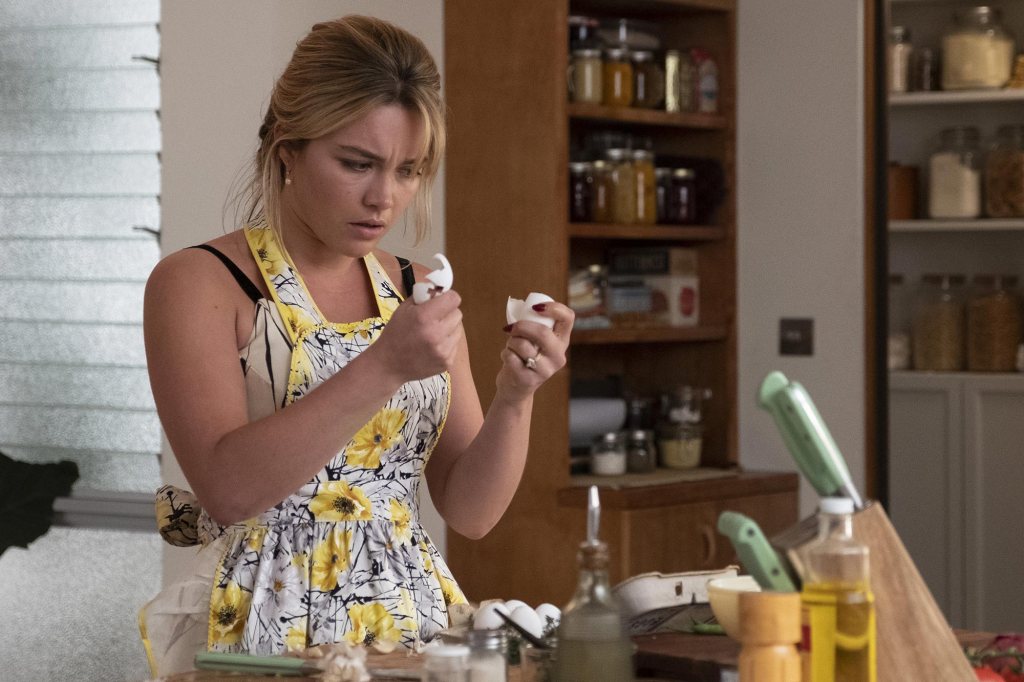
Styles’ performance is not the disaster that some have claimed, though he is comprehensively outshone at every stage by the range of Florence Pugh, wringing pathos from inconsistent material. Pugh is a compelling lead, highly engaging as she attempts to figure out the mystery of the Victory Project. Were her character more naturally curious from the very beginning though, both Alice and the film itself would be more captivating. She crackles in scenes opposite Chris Pine’s Frank, Victory’s founder, who is revealed to be a men’s rights activist thought-leader (modelled consciously on figures such as Jordan Peterson) who pushes her to test the limits of his simulated world more and more. To him, she is a proof of the extent of his power, a virus testing the strength of his computer’s security.
Though much of his performance is merely functional, Styles is surprisingly good in the short flashback sequence, playing the embittered partner to Pugh’s exhausted but purposeful maternity doctor. Playing against type, living in a dingy flat with a patchy beard, his veneer of ineffectuality hides a growing malevolence. When his character complains of being ‘starving’ upon her return from a thirty-hour shift, Styles lends the line just the right amount of implied blame – that she should have been cooking for him, rather than working – to pitch his character as an insidious closet misogynist, in the midst of radicalisation down an internet rabbit hole of male supremacism. (The protagonist’s name, Alice Warren, curiously evokes Alice in Wonderland, falling down the rabbit hole only because her partner pushes her in.) In these scenes, you can see the bones of a much more interesting film lurking within this one. Though its distinctive aesthetic palette, delivered through immaculate costuming by Arianne Phillips and soaring cinematography from Matthew Libatique, is a clear plus point for Don’t Worry Darling, there is an arguably more worthwhile story to be told in the everyday squalor of normal disappointing life.
This blast of social realism seems much more interesting and much thornier compared to the ambiguous stakes of the simulated world. Alice’s long shifts point to a health sector in crisis, running off the passion and care of its doctors, while the psychology of Jack’s search for validation is much more complex than the well-made illusion he presents in Victory. I kept waiting for a clash in the real world between Jack and Alice; once introduced, the real versions seem like the heart of the film. The original script did end with such a scene, and it feels like an important omission. (The available summary of this script seems convoluted in a different but also problematic way, so Wilde and Silberman’s edits are understandable though.) However, the twist immediately hollows out the already thinly sketched Victory-world. Before, with Frank’s claims of hating chaos, far-right adjacent rhetoric of the world being ‘ours’, and the jingoistic ring of the name ‘Victory’, the film seemed like an apt metaphor for the world of incels, men’s rights activists and radicalisation. The reveal that the Victory Project is simply a futuristic version of such ideas is not quite the bracing twist it could be. Instead, it makes the film seem like a straightforward rehearsal of these themes.
After waking up from the simulation, and undergoing part-digital, part-medical reprogramming, Alice is readmitted into the Victory world, seemingly brainwashed. From here on, the strictures of the simulation are defined hastily, and we begin a scramble to the finish. The rules remain slippery though, concretised in dialogue just too late for the emotions to hit home. An argument leads to Alice braining Jack with a heavy-bottomed glass, leaving him dead. I wondered if she would now be tragically trapped in the simulation forever, a mind in a slowly dying body no one knows how to find, hooked up to a computer. Yet we soon learn (rather conveniently) that there are physical locations which let you exit the world – foreshadowed vaguely in Victory’s one rule, which forbids the women to visit Victory Headquarters. Yet this just doesn’t feel like the way such a simulation would be designed, with such an escape route, given its purpose is to imprison and control. Furthermore, the film is hampered by our likely knowledge of existing genre conventions. The logic that dying in the simulation equals death in reality comes without any foreshadowing and is not what we would typically expect. Again, would simulation architects really build it that way, that an in-world accident automatically kills the real body? The science of the simulation is largely irrelevant, but one of the film’s strongest points is understanding the psychology of misogynists, and here the logic of Victory is fumbled.

The film’s mismanagement of audience expectations is felt in the marketing too. Don’t Worry Darling is pretty much exactly the film you might expect it is, its plot mechanics largely revealed in its trailers. Given its reliance on images – creating a patina of a misremembered, nostalgic 1950s aesthetic before cracking it apart – it seems remiss for quite so many of its most striking visuals to have been spoiled in advance; the sight of Alice being crushed by a wall against a window, suffocating herself with clingfilm, and even key parts of the car chase which closes the film are present in the trailers. Nor has the film’s frequently baffling media tour helped. The events on set of Don’t Worry Darling exist somewhere between the excesses of an out-of-hand marketing campaign and a genuine failure of stewardship from the film’s core creatives and producers. The details are vague though potentially alarming, with Pugh largely absent from the film’s promotion. Wilde has called out double standards, suggesting that male filmmakers get much more a pass for poor on-set behaviour, but (though likely true) this hardly works as an excuse. Yet Don’t Worry Darling does not seem like a troubled production on screen though. In fact, its solid premise and production are most in want of subtler script editing, with a more cogent thesis allowed to emerge than what Adrian Horton (writing in The Guardian) calls its ‘empty feminism’.
There has been a strange emphasis on female pleasure as an inherently feminist act in Wilde’s promotion too. The view that female pleasure can be political and liberatory is shared by many feminists and convincingly connects sex to ethics, gender and social behaviour. However, as a theme it seems vastly ill-suited to the film’s actual contents, given how exploitative (and by definition non-consensual) Jack’s sex acts are, however much his and Alice’s sex life foregrounds cunnilingus over the male orgasm. In a sexual context, the simulation seems almost like a metaphor for date-rape drugs, distorting Alice’s sense of reality and crucially undermining her ability to give informed consent. Yet in interviews, such as one in Variety in August, Wilde sets out her vision for feminist sex scenes; ‘Men don’t come in this film […] Only women here!’ While deprioritising the male orgasm has long been a sex-positive feminist goal, the discrepancy between such promotion and the film’s content is jarring, called out by Horton as ‘borderline offensive’.
Wilde laments that ‘the focus on men as the recipients of pleasure is almost ubiquitous’ in depictions of heterosexual sex, yet the extent to which Wilde is deliberately distracting from her twist or missing that the film depicts no real, consensual female pleasure at all is unclear. Wilde is keen to show sex as pleasurable for women in a heterosexual context, as has become more common in LGBTQ cinema. Yet Don’t Worry Darling is a startling metaphor for the imprisoning effects of heterosexuality on women; there is not one relationship in the film not influenced by vast manipulation and male control. ‘My early conversations with the cast were all about how the audience has to buy into the fantasy’ of the world, Wilde says, including the ‘extreme passion’ Jack and Alice seem to have for each other. It is exclusively Jack’s fantasy though. When Frank leads chants of ‘Whose world is it?’ the first-person plural reply of ‘Ours!’ seems strictly limited to the men.
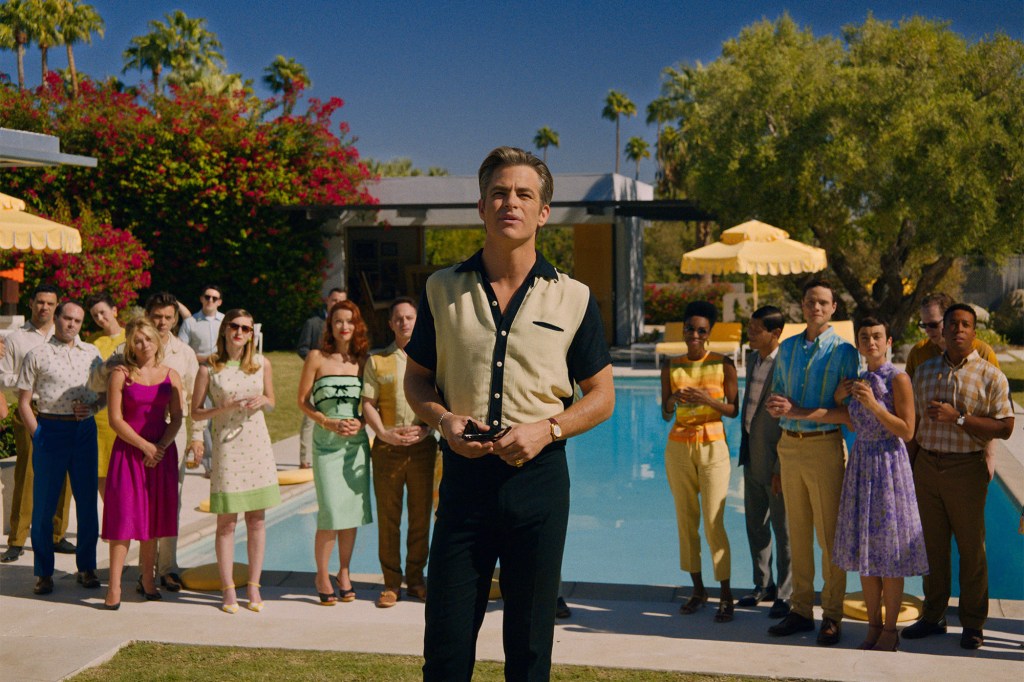
Thematically, Don’t Worry Darling is a film about the importance of female choice and the insidious ways men control and limit those choices – first, in the gendered semiotics of a husband going out to work and the wife expected to stay at home, then in more violent manipulation. At moments, it wants to be a searching film about the nuances of female choice and pleasure, evident in the reveal that Alice’s best friend Bunny has always known the truth. She has, she tells Alice, voluntarily entered the world, though the ethical nuances of such a choice are skated over. If participation in the Victory Project could be consented to (itself debatable), what about voluntarily deciding to leave? Presumably, the men in red would try to stop Bunny if she made a break from the headquarters too. Bunny implies though that she would never want to leave, mainly as her children are there – seemingly replicas of children who died in the real world. Ideas like this, the attraction for some of controlling ideologies as an escape from difficult pain, are fascinating but disappointingly underexplored. Delaying of its reveal so late into the runtime leaves a breathless dash to a very literal exit portal finish line, generating propulsive energy at the cost of depth.
Some themes feel richer, and the presentation of notional hysteria and female madness within the form of a psychological thriller is compelling, served particularly well by the presence of Timothy Simons as the project’s doctor. Also interesting is its presentation of Jack’s underlying misery in Victory, in part the self-loathing that hides beneath a growing bravado but also resentment that he must leave every day to go to work – to ‘pay for this place’ in real job he hates. One aspect of the incel fantasy is that men gain near-total power over women and their families, in return for being providers. Yet the results are misconceived at every level, fuelled by a horrifying saviour complex; Jack thinks he is rescuing Alice from being a doctor, misunderstanding the draw of rewarding difficulty over soulless ease. Yet Wilde and the screenplay neatly combine the techno-misogyny with the capitalist grift that underlies so much incel-oriented media. Men are spurred to work, not merely to provide, but to fund the gurus who inspire them. The wealth seems to trickle upwards, in this case to Frank, who runs and charges for participation in the simulation – a grand metaphor for the publishing and media industries which enrich promoters of pseudo-scientific essentialism and lifestyle advice.

Ultimately, Don’t Worry Darling is a far stronger film about the psychology of men and the causes of patriarchy and abuse than it is about women and feminist responses. The women of Victory are spurred into a hurried revolt again male authority, through little action of Alice. (Why is Alice believed, while Margaret is widely dismissed as hysterical?) Gemma Chan’s highly composed Shelley stabs Frank suddenly, twisting the knife in revenge, but her motivations are kept offscreen. The makings of a revolution are here, but it seems convenient, a film’s happy ending. What happens when these women wake up (potentially tied up, as we see in Alice’s case) next to their abusive partners? The film understands the lengths to which could go in order to assert control, strikingly mirroring real-world behaviour, but its feminist solutions are inapplicable outside of the grammar of cinema.
Wilde’s direction offers some arresting images to complement its timely and interesting, if inconsistent, array of themes. A recurring birds-eye view of a ring of dancers fluttering in and out like the dilations of an iris is later revealed as a form of loading screen, as you enter and exit the system. The production design fills Victory with subtle V-shapes (including Frank’s tie-free suit style, which some of the other men hastily try to adopt in a sharply satirical beat), and the colour palette is perfect for subversion – as the primly immaculate pastels turns to blood-drenched horror. The desert car chase inevitably evokes the aesthetics of Mad Max, but also reminded me of the grit of Coralie Fargeat’s 2017 feminist interrogation of violence and feminist justice Revenge. Victory is rendered through a clever mixture of location shooting and seamless CGI, plausible and disquietingly unreal in the same moment. Underneath, John Powell’s score dissolves from lilting string swoons of apparently perfect love into dissonant tones and breathily sampled vocals, reminiscent of the (albeit more adventurous) work of composer Cristobal Tapia de Veer. The final sequence is particularly striking for its thunderous bass twinned with the sounds of female exhaustion.
All of this should add up to a bit more, and it is a shame that the good work turned in by most departments and actors is not matched by enough deftness in the writing. Don’t Worry Darling is surely destined to be remembered for its alleged production turbulence, rather than its more intriguing (though occasionally alarming) substance. As a comment on incel activities, it works as a functional satire, though the script is largely content to demonstrate gendered violence rather than offer a detail feminist critique or diagnose a solution.
Don’t Worry Darling
Directed by Olivia Wilde, Screenplay by Katie Silberman, Story by Carey Van Dyke, Shane Van Dyke, and Katie Silberman, Produced by Olivia Wilde, Katie Silberman, Miri Yoon, and Roy Lee, Cinematography by Matthew Libatique, Edited by Affonso Gonçalves, Music by John Powell, Starring Florence Pugh, Harry Styles, Olivia Wilde, Gemma Chan, KiKi Layne, Nick Kroll, Chris Pine
 Joshua Robey